MTP readers know that I’ve got no time for the scumbags at TikTok and never have. But it’s getting ridiculous and now the company has collided with Universal.
It was only a matter of time. The artist-centric approach to royalty payments endorsed by Lucian Grainge requires more of the platforms than just rearranging the deck chairs on the Titanic. It requires that the services say goodbye to a flat royalty pool calculated using impenetrable algorithms, formulas, and Malthusian algebra.
It requires that the services open their checkbooks. For you pie fans, it requires that the services grow the pie. And not just for sound recordings, but songwriters, too.
Here’s the other insulting part: TikTok apparently wants to be able to create AI works (from whatever source derived) and repopulate their offering with these allegedly royalty free works. Of course, AI tracks should not be royalty free at all since the AI will inevitably be ripped off from somebody.
As I understand it, TikTok wants to salt the royalty pool with AI to increase the denominator and lower the per-stream royalty. This, of course is insane. Whatever you think about AI, before you even get there it should be obvious that only royalty bearing tracks should be in the calculation for paying royalties. Otherwise, the payments will be understated. Which is of course what TikTok wants. Which was inevitable as soon as monkeys took photos.
But perhaps even more troubling is TikTok’s apparent refusal to be transparent about what it is doing to stop recruiting for illegal cartel activities, child trafficking and promoting hate speech—especially real porn with fake artists. They could do it but they won’t fix what Lucian calls “the tidal wave of hate speech, bigotry, bullying and harassment on the platform.”
Whatever bright and shiny object TikTok and their legion of lobbyists waive in front of artists, who is willing to have their music used as a honeypot for harmful acts?
It’s time for big changes at TikTok and if they are unwilling to modernize and reimagine their business, those who want to shut them down will be unleashed.
Speculative ticketing is the practice of selling an option to maybe buy a popular ticket (often at an insane price) before the ticket goes on sale. You may not realize you are not buying a real ticket, although these tickets often come with fine print, and as Tom Waits tells us, the large print giveth and the small print taketh away.
There is an effort going on to specifically ban speculative ticketing at the state level which I applaud as I think speculative ticketing should be a crime. One reason I think this is because I think it already is a crime in most if not all states and possibly under federal law as well.
Think about it–do you think that if you before Blackstone and said to Sir William, My Lord, the defendant sold me a famous cow he didn’t own at a price he invented and promised to deliver the cow on law day. He took my money but delivered no cow (or delivered a different and unfamous cow). And the defendant said, perfectly legal My Lord.
What do you think My Lord Blackstone would say?
What would Billy do?
I don’t think the English common law would have just let the defendant walk out without at least compensating the buyer. Therefore, there’s probably a case that can be made out of existing law for selling stolen or counterfeit goods, or a host of other common law derivatives that would violate the charter of the land.
So as we try to get specific legal action to deal with speculative tickets, let’s not allow the lobbyists for Stubhub to negotiate the punishment that they want rather than the punishment that already applies under existing state civil or criminal law.
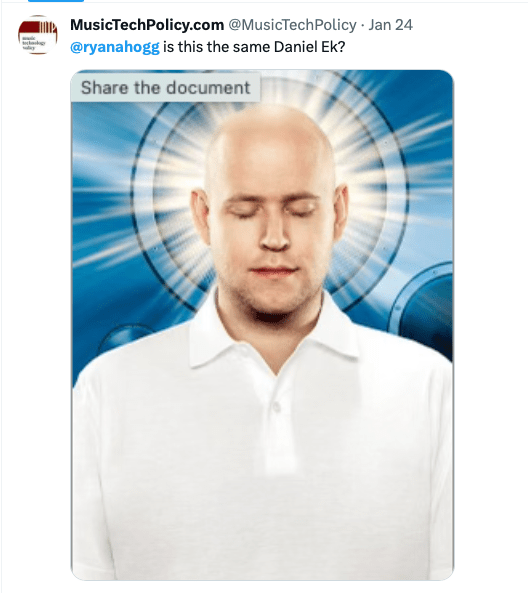
Ek’s New Iconography: Will the real Daniel Ek please stand up?
MTP readers will no doubt remember when Daniel Ek refused to be deposed in the latest Nashville case against Spotify for copyright infringement (Eight Mile Style). He eventually was deposed where he tried to say that he had no first hand knowledge of the facts or publishing practices at Spotify. Others did that for him after they got finished peeling his pears.
Ryan Hogg, writing in Fortune, published what I can only think is a puff piece on Ek trying to pass him off as a man of the people with a management style of just one of the team. Worth over a billion dollars and controlling voting stock.
And then there’s this:
What is Spotify’s contractual basis for their modernized free goods program?
There’s been a lot of discussion about Spotify’s new “modernized” free goods program aka Track Monetization Eligibility. It does raise the question of how they are getting away with this. Free goods, after all, were based on contract terms that the artist got to negotiate (and which, by the way, was passed along to songwriters through the artist’s controlled compositions clause for anyone not on a pure statutory rate and still is.
Who agreed to this? And why aren’t they stepping forward to claim their genius?
The MLC announced it was auditing 49 users of the blanket mechanical license, a massive undertaking. This announcement sent me back to the audit provisions of Title I of the Music Modernization Act to review what the role of the auditor actually is for audits of music users by the MLC as opposed to audits of the MLC by copyright owners. As often happens when reviewing little-used code sections that abruptly become important, I was reminded of a couple nuances that were obviously flawed when drafted. The key nuance is how can a royalty examiner be looking for overpayments against the interest of the party that hired her but still be independent?
How qualified is qualified?
The first issue is with the definition of a “qualified auditor”, a glitch that I’ve harped on a few times. The term “qualified auditor” comes up in two different contexts in the MMA–first, a qualified auditor who prepares the MLC’s audited financial statements. The definition of qualified auditor is in 17 USC § 115(e)(25) as “an independent, certified public accountant with experience performing music royalty audits.” The reason why this term is a drafting error is two fold–first, you don’t need a CPA to conduct music royalty audits and there is nothing on the CPA licensure exams that requires any knowledge of “music royalty audits.” Second, you do need a CPA to prepare audited financial statements if the books are maintained according to generally accepted accounting principles particularly if a financial audit requires an opinion as an attest service, but that role does not require knowledge of royalty audits. So the defined term has an internal contradiction.
The Gaap, ruler of 25 legions of spirits from the Munich Manual of Demonic Magic grimoire
Not only is the definition hinky but it’s common knowledge (outside of the Imperial City, I guess) that many if not most royalty auditors are not CPAs. (There’s also a long-standing assumption among artist lawyers when this concept comes up in record or publishing deals that a CPA requirement for audits is intentionally punitive. The assumption is that CPAs charge more making the cost of auditing more burdensome (therefore less likely to happen), which remains to be proven but is pretty widely accepted.) So the definition should be limited to requiring a CPA for the MLC’s audited financial statements and the common alternate definition of “experienced royalty auditor” for the audit clauses. But let’s put that to one side.
Overpayments and Independence
The MMA rule for auditing digital music providers states:
The qualified auditor shall determine the accuracy of royalty payments, including whether an underpayment or overpayment of royalties was made by the digital music provider to the mechanical licensing collective, except that, before providing a final audit report to the mechanical licensing collective, the qualified auditor shall provide a tentative draft of the report to the digital music provider and allow the digital music provider a reasonable opportunity to respond to the findings, including by clarifying issues and correcting factual errors.
Realize that the MLC and the services monitor payments and make frequent adjustments to royalties (which may be reflected on your royalty statement if you can find them). That’s different than an auditor who works for a client going and seeking out an overpayment as part of their audit report. Relieving the auditor of this conflict does not preclude the service from claiming an overpayment which is an ongoing part of invoicing (see, e.g., 37 CFR §210.27(d)(2)(ii)). You would not be creating a windfall for the party receiving the overpayment.
I would interpret the statute as not requiring the auditor to seek an additional overpayment not previously invoiced, but rather confirming the accuracy of any adjustments made for overpayments or underpayments already reflected on the statements that are the subject of the audit. That’s quite a different thing.
What makes an auditor independent is that they do not have a conflict of interest as to their client, in this case the MLC. The royalty auditor is intended to be an advocate for their client (who pays them) and they are hired to look for ways that the other side has failed to account to their client properly to their client’s disadvantage. Improper payments are most commonly underpayments, i.e., the music user has failed to pay all that the client is entitled to receive. Royalty statements are regularly recalculated for a host of reasons in the normal course of business without regard to the presence or absence of any audit. This is not to say that somehow the MLC (and eventually the copyright owners) get some kind of windfall because the services missed something if any auditor is not seeking out an overpayment. That’s particularly true since there will likely be multiple sets of eyes on the field work and draft audit report. And trust me, they will all be trying to find somebody else’s mistake.
Or said another way, copyright owners don’t receive a windfall that was somehow missed by the largest corporations in commercial history who can determine what floor of which building you are on at what time of day at what address, e.g., sporting goods or children’s toys, so they can serve ads to your phone. Are we really worried about these little lambs getting lost in the woods?
@Helienne Explains the EU’s Cultural Protections Against Streaming Monopolists
We were lucky to get an interview with ESCA President Helienne Lindvall about the European Parliament’s report on cultural protections against streaming monopolies. This is a very important development and something we could use in the United States where this focus is sadly lacking.
@MikeHuppe Made an Important Comment on AI Justice for Creators
SoundExchange CEO Mike Huppe’s comment on AI justice is welcome from a rights platform.
Spotify has announced they are “Modernizing Our Royalty System.” Beware of geeks bearing “modernization”–that almost always means they get what they want to your disadvantage. Also sounds like yet another safe harbor. At a minimum, they are demonstrating the usual lack of understanding of the delicate balance of the music business they now control. But if they can convince you not to object, then they get away with it.
Don’t let them.
An Attack on Property Rights
There’s some serious questions about whether Spotify has the right to unilaterally change the way it counts royalty-bearing streams and to encroach on the private property rights of artists.
Here’s their plan: Evidently the plan is to only pay on streams over 1,000 per song accruing during the previous 12 months. I seriously doubt that they can engage in this terribly modern “stream discrimination” in a way that doesn’t breach any negotiated direct license with a minimum guarantee (if not others).
That doubt also leads me to think that Spotify’s unilateral change in “royalty policy” (whatever that is) is unlikely to affect everyone the same. Taking a page from 1984newspeakers, Spotify calls this discrimination policy “Track Monetization Eligibility”. It’s not discrimination, you see, it’s “eligibility”, a whole new thing. Kind of like war is peace, right? Or bouillabaisse.
According to Spotify’s own announcement this proposed change is not an increase in the total royalty pool that Spotify pays out (God forbid the famous “pie” should actually grow): ”There is no change to the size of the music royalty pool being paid out to rights holders from Spotify; we will simply use the tens of millions of dollars annually [of your money] to increase the payments to all eligible tracks, rather than spreading it out into $0.03 payments [that we currently owe you].”
Yep, you won’t even miss it, and you should sacrifice for all those deserving artists who are more eligible than you. They are not growing the pie, they are shifting money around–rearranging the deck chairs.
Spotify’s Need for Living Space
So why is Spotify doing this to you? The simple answer is the same reason monopolists always use: they need living space for Greater Spotify. Or more simply, because they can, or they can try. They’ll tell you it’s to address “streaming fraud” but there are a lot more direct ways to address streaming fraud such as establishing a simple “know your vendor” policy, or a simple pruning policy similar to that established by record companies to cut out low-sellers (excluding classical and instrumental jazz). But that would require Spotify to get real about their growth rates and be honest with their shareholders and partners. Based on the way Spotify treated the country of Uruguay, they are more interested in espoliating a country’s cultural resources than they are in fairly compensating musicians.
Of course, they won’t tell you that side of the story. They won’t even tell you if certain genres or languages will be more impacted than others (like the way labels protected classical and instrumental jazz from getting cut out measured by pop standards). Here’s their explanation:
It’s more impactful [says who?] for these tens of millions of dollars per year to increase payments to those most dependent on streaming revenue — rather than being spread out in tiny payments that typically don’t even reach an artist (as they do not surpass distributors’ minimum payout thresholds). 99.5% of all streams are of tracks that have at least 1,000 annual streams, and each of those tracks will earn more under this policy.
This reference to “minimum payout thresholds” is a very Spotifyesque twisting of a generalization wrapped in cross reference inside of spin. Because of the tiny sums Spotify pays artists due to the insane “big pool” or “market centric” royalty model that made Spotify rich, extremely low royalties make payment a challenge.
Plus, if they want to make allegations about third party distributors, they should say which distributors they are speaking of and cite directly to specific terms and conditions of those services. We can’t ask these anonymous distributors about their policies if we don’t know who they are.
What’s more likely is that tech platforms like PayPal stack up transaction fees to make the payment cost more than the royalty paid. Of course, you could probably say that about all streaming if you calculate the cost of accounting on a per stream basis, but that’s a different conversation.
So Spotify wants you to ignore the fact that they impose this “market centric” royalty rate that pays you bupkis in the first place. Since your distributor holds the tiny slivers of money anyway, Spotify just won’t pay you at all. It’s all the same to you, right? You weren’t getting paid anyway, so Spotify will just give your money to these other artists who didn’t ask for it and probably wouldn’t want it if you asked them.
There is a narrative going around that somehow the major labels are behind this. I seriously doubt it–if they ever got caught with their fingers in the cookie jar on this scam, would it be worth the pittance that they will end up getting in pocket after all mouths are fed? The scam is also 180 out from Lucian Grange’s call for artist centric royalty rates, so as a matter of policy it’s inconsistent with at least Universal’s stated goals. So I’d be careful about buying into that theory without some proof.
What About Mechanical Royalties?
What’s interesting about this scam is that switching to Spotify’s obligations on the song side, the accounting rules for mechanical royalties say (37 CFR § 210.6(g)(6) for those reading along at home) seem to contradict the very suckers deal that Spotify is cramming down on the recording side:
Royalties under 17 U.S.C. 115 shall not be considered payable, and no Monthly Statement of Account shall be required, until the compulsory licensee’s [i.e., Spotify’s] cumulative unpaid royalties for the copyright owner equal at least one cent. Moreover, in any case in which the cumulative unpaid royalties under 17 U.S.C. 115 that would otherwise be payable by the compulsory licensee to the copyright owner are less than $5, and the copyright owner has not notified the compulsory licensee in writing that it wishes to receive Monthly Statements of Account reflecting payments of less than $5, the compulsory licensee may choose to defer the payment date for such royalties and provide no Monthly Statements of Account until the earlier of the time for rendering the Monthly Statement of Account for the month in which the compulsory licensee’s cumulative unpaid royalties under section 17 U.S.C. 115 for the copyright owner exceed $5 or the time for rendering the Annual Statement of Account, at which time the compulsory licensee may provide one statement and payment covering the entire period for which royalty payments were deferred.
Much has been made of the fact that Spotify may think it can unilaterally change its obligations to pay sound recording royalties, but they still have to pay mechanicals because of the statute. And when they pay mechanicals, the accounting rules have some pretty low thresholds that require them to pay small amounts. This seems to be the very issue they are criticizing with their proposed change in “royalty policy.”
But remember that the only reason that Spotify has to pay mechanical royalties on the stream discrimination is because they haven’t managed to get that free ride inserted into the mechanical royalty rates alongside all the other safe harbors and goodies they seem to have bought for their payment of historical black box.
So I would expect that Spotify will show up at the Copyright Royalty Board for Phonorecords V and insist on a safe harbor to enshrine stream discrimination into the Rube Goldberg streaming mechanical royalty rates. After all, controlled compositions are only paid on royalty bearing sales, right? And since it seems like they get everything else they want, everyone will roll over and give this to them, too. Then the statutory mechanical will give them protection.
To Each According to Their Needs
Personally, I have an issue with any exception that results in any artist being forced to accept a royalty free deal. Plus, it seems like what should be happening here is that underperforming tracks get dropped, but that doesn’t support the narrative that all the world’s music is on offer. Just not paid for.
Is it a lot of money to any one person? Not really, but it’s obviously enough money to make the exercise worthwhile to Spotify. And notice that they haven’t really told you how much money is involved. It may be that Spotify isn’t holding back any small payments from distributors if all payments are aggregated. But either way it does seem like this new new thing should start with a clean slate–and all accrued royalties should be paid.
This idea that you should be forced to give up any income at all for the greater good of someone else is kind of an odd way of thinking. Or as they say back in the home country, from each according to their ability and to each according to their needs. And you don’t really need the money, do you?
By the way, can you break a $20?
The NO AI Fraud Act
Thanks to U.S. Representatives Salazar and Dean, there’s an effort underway to limit Big Tech’s AI rampage just in time for Davos. (Remember, the AI bubble got started at last year’s World Economic Forum Winter Games in Davos, Switzerland).
Chairman Issa Questions MLC’s Secretive Investment Policyfor Hundreds of Millions in Black Box
As we’ve noted a few times, the MLC has a nontransparent–some might say “secretive”–investment policy that has the effect of a government rule. This has caught the attention of Chairman Darrell Issa and Rep. Ben Cline at a recent House oversight hearing. Chairman Issa asked for more information about the investment policy in follow-up “questions for the record” directed to MLC CEO Kris Ahrend. It’s worth getting smart about what the MLC is up to in advance of the upcoming “redesignation” proceeding at the Copyright Office. We all know the decision is cooked and scammed already as part of the Harry Fox Preservation Act (AKA Title I of the MMA), but it will be interesting to see if anyone actually cares and the investment policy is a perfect example. It will also be interesting to see which Copyright Office examiner goes to work for one of the DiMA companies after the redesignation as is their tradition.


 Music Tech Solutions