As we head back into the next Phonorecords proceeding, there is an issue hiding in plain sight inside the existing and ancient streaming mechanical royalty rate structure that we fondly call “the 39 steps” in honor of John Buchan, Alfred Hitchcock and Richard Hannay. Despite the blood lust for complexity from the ancien régime that clings to its one sided royalty pool, there is one part of this unfair business practice that the Copyright Royalty Board (CRB) can and should address this time around.
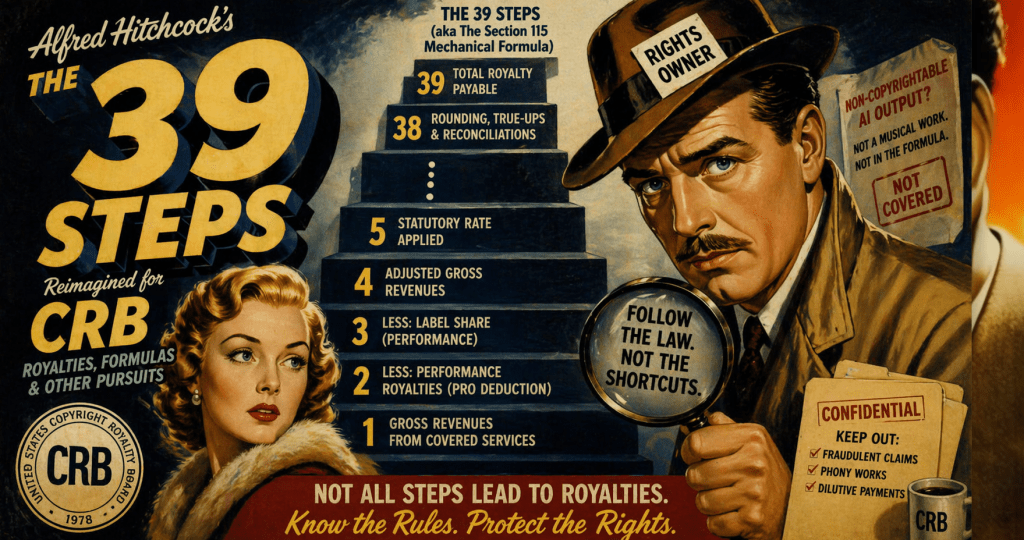
Start with the basics. The part 385 streaming mechanical formula—the so-called “39 steps”—is built on a simple premise: we are calculating royalties for the use of musical works protected by the Copyright Act. The inputs and deductions in that formula are not abstract accounting categories. They are supposed to reflect real payments for real statutory rights.
That premise is now under pressure.
The rise of generative AI has introduced a new category of output that does not fit neatly within the Copyright Act. The U.S. Copyright Office has made clear that works generated entirely by AI are not copyrightable, and that protection exists only to the extent of meaningful human authorship in a proportion yet to be determined. Courts have moved in the same direction, and the Supreme Court’s denial of cert in Thaler v. Perlmutter leaves that framework intact.
Yet the part 385 formula has no explicit mechanism to deal with this category of material. That creates a risk on two fronts.
We have to consider the royalty pool itself. Section 115 applies when the exclusive rights of a copyright owner in a musical work are implicated. If a so-called “AI track” is not a protected musical work, then there is a serious question whether it belongs in the section 115 system at all. Treating non-copyrightable output as if it were a statutory musical work risks diluting the pool for actual rightsholders.
And then, of course, we have the Step 2 deduction for performance royalties. The regulation allows services to subtract payments for the public performance of musical works before calculating the payable pool. But what happens if a service characterizes payments to a platform like AIMPRO as “performance royalties”? If those payments are not, in fact, for the public performance of a protected musical work, they should not reduce the pool. Otherwise, the formula becomes a vector for leakage.
Moreover, if the U.S. Copyright Office ultimately articulates a workable “human authorship” framework for AI-assisted works during the Phonorecords V rate period, the downstream impact on the section 115 system could be profound: for the first time, the part 385 “39 steps” calculation may have to accommodate fractional copyrightability within a single work. Instead of treating a musical work as a binary input (in or out), services and the MLC could be forced to parse which portions of a track are attributable to human authorship and therefore eligible for royalties, and which are not. That would introduce a new layer of allocation on top of an already complex formula—effectively embedding micro-level authorship determinations into macro-level royalty calculations—and raising the administrative, evidentiary, and dispute-resolution burdens across the entire system.
The key point is that the CRB does not need to resolve all questions of AI copyrightability to act here for purposes of the 39 Steps. It can simply clarify what is already in the statute and the regulation: The part 385 formula applies only to payments that correspond to rights in nondramatic musical works, and deductions are limited to payments that genuinely compensate the public performance of such works. That is not a policy innovation. It is a classification rule.
If there is doubt about whether a category of material such as purely generative AI output qualifies as a “musical work” for these purposes, that is a question the CRB can refer to the Register of Copyrights in a pinch. But the CRB should not leave the door open for the mechanical royalty pool to be diluted by payments for things that fall outside the Copyright Act altogether.
This may also be the moment to ask a more fundamental question: whether the industry should abandon the “39 steps” construct altogether. Whatever its historical justification—particularly in Phonorecords I, where publishers were trying to shield early services like MusicNet from crushing retroactive exposure—the current formula has outlived its usefulness. Today, it functions less as a fair pricing mechanism and more as a constraint, allowing services to use their complementary oligopoly power to effectively cap mechanical royalties by anchoring them to total content costs. The result is a structurally odd feedback loop in which sound recording deals influence the value of adjacent musical works. A cleaner alternative would be a flat, escalating penny-rate framework, akin to what the Judges adopted for both Subpart B mechanical royalties (physical and downloads) as well as section 114 royalties—simpler, more transparent, and far less susceptible to strategic manipulation.
We have been here before. The history of section 115 is, in many ways, the history of closing gaps between statutory language and market behavior.
Phonorecords V presents another such moment.
The CRB should take it.

