The AI Capex Party May Be Nearing Last Call

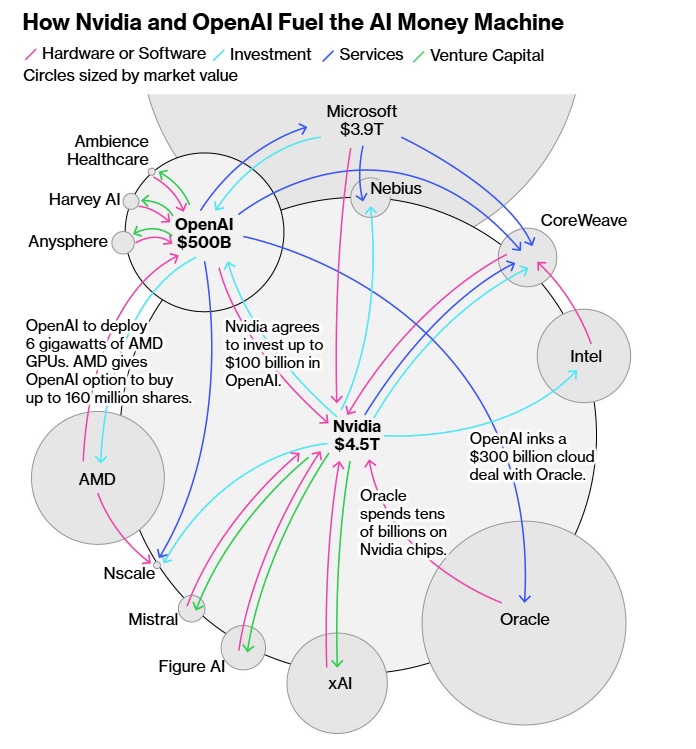
For the past two years, Wall Street has treated artificial intelligence as a one-way trade. Hyperscalers, semiconductor companies, utilities, private-credit funds, and data-center developers have committed hundreds of billions of dollars to what may ultimately become nearly $1 trillion in AI-related infrastructure investment over roughly two years.

The underlying assumption has been remarkably consistent: demand for increasingly powerful AI models will continue growing fast enough to justify unprecedented spending on chips, data centers, transmission lines, substations, and electric generation.

But investment booms rarely end because one assumption proves wrong. They end when several assumptions begin to weaken at the same time.

That appears to be happening.

Ed Dowd’s recent Substack analysis argues that the economics supporting today’s AI buildout are becoming increasingly fragile. Financing is tightening. Enterprise customers are demanding clearer returns on investment. Open-weight models continue improving while driving prices lower. And perhaps most importantly, the physical infrastructure required to support AI is becoming a political issue.

Gary Marcus recently challenged David Sacks’ argument that regulation is the principal threat to American AI leadership (Sacks really needs some new sheet music). Marcus instead argued that the industry faces a far more fundamental economic problem:

“The real issue is that LLMs are commodities; lots of people know how to make them, and everybody is doing more or less the same thing, training on more or less the same data. That means nobody has a technical moat. Which means you get price wars and low margins and more and more competitors over time.”

If Marcus is right, Wall Street may eventually discover that AI resembles cloud computing more than pharmaceuticals. There may be tremendous demand—but not necessarily extraordinary profits. That observation dovetails with Goldman Sachs’ increasingly cautious assessment of the AI investment cycle. Goldman has repeatedly warned investors that the buildout depends on continued access to capital, sustained enterprise demand, adequate electric power, and enough economically valuable use cases to justify unprecedented capital expenditures.

AI does not exist in ‘the cloud.’ It exists on electric grids. Every new model depends on substations, transmission lines, transformers, cooling systems, water supplies, and local political consent.

For months, we’ve tracked what has become a genuine data center backlash. Communities across Texas, Georgia, Louisiana, Virginia, Oklahoma, Utah, Alabama, and elsewhere are increasingly questioning the costs of hosting massive AI infrastructure.

Politicians, meanwhile, are discovering that AI infrastructure is much easier to announce than it is to build. Many governors and local officials have promoted data centers by assuring taxpayers that the projects will ‘pay their own way.’ But that message begins to unravel the moment the infrastructure breaks ground or annexes farmland.

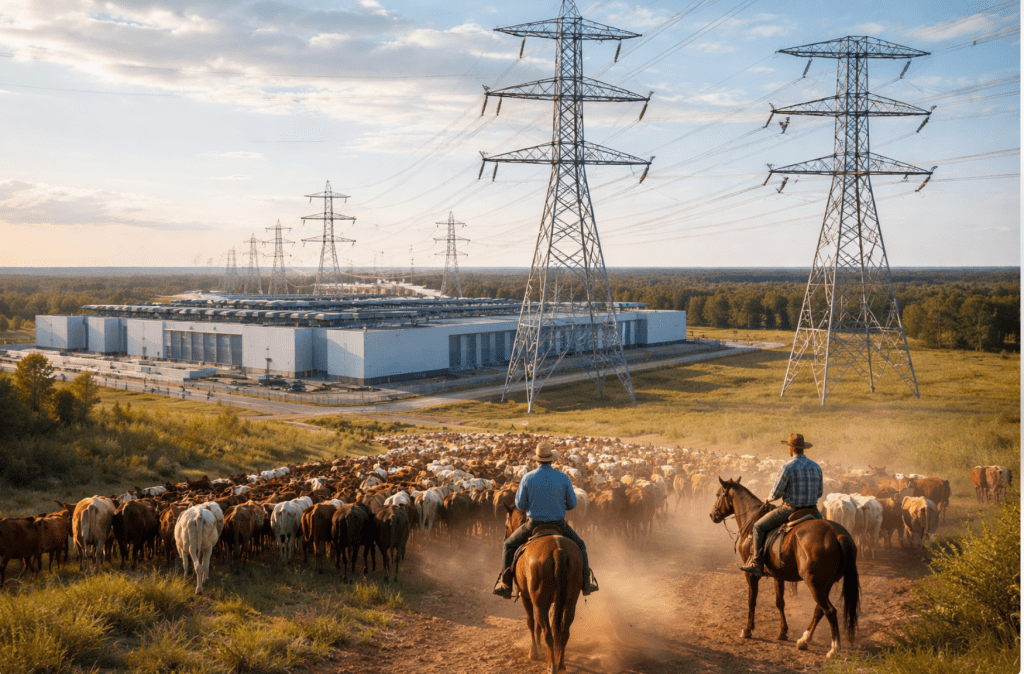
A homeowner facing a 765-kV transmission line across family property is unlikely to be persuaded that the project is privately financed. Likewise, a rancher confronting eminent domain does not care whether the transmission costs appear on a utility bill, a corporate balance sheet, or a tax-abatement agreement. The injury is the same: the family home, ranch, or farm is permanently altered to support infrastructure serving distant customers—who are often anonymous.

In the Texas Hill Country, landowners have mobilized against new transmission corridors intended to serve future electric demand, including AI-related growth. In Coweta County, Georgia, residents organized after learning that transmission infrastructure associated with large-scale data-center development could cut through long-held family properties. The debate quickly ceased being about economics and became about land, community, and the limits of eminent domain.

This is where many elected officials have found themselves trying to have it both ways. They assure taxpayers that private investment will shoulder the costs while simultaneously offering substantial tax abatements, infrastructure incentives, expedited permitting, and other forms of public support. Then, when opposition emerges, they discover that the political issue is no longer who pays for the infrastructure—it’s who lives with it.

For families whose property lies in the path of a transmission corridor, ‘the data centers will pay for themselves’ is not an answer. Their concern is not the financing model. Their concern is keeping the home that has been in the family for generations.

None of this means AI is a passing fad. Transformative technologies often survive speculative bubbles. The internet certainly did. But many companies that financed the dot-com boom did not survive intact, and many investors paid dearly for assuming that technological transformation automatically translated into sustainable profits.

Today’s AI investment cycle rests on multiple pillars: inexpensive capital, robust enterprise demand, premium pricing, abundant electricity, and political support for rapid infrastructure expansion. Gary Marcus questions the durability of the competitive moat. Goldman Sachs questions whether the economics can support the investment. Communities across America are questioning whether they should bear the physical burdens.

Those three conversations are converging. The story is no longer simply about faster models or larger training runs. It is about economics, infrastructure, and public acceptance. The market has spent the last two years pricing AI as though all three will remain aligned indefinitely. History suggests that is a very demanding assumption.

The AI Industry Wants Congress to Create the Next 100-Year Radio Loophole

“Formal property’s contribution to mankind is not the protection of ownership… Property’s real breakthrough is that it radically improved the flow of communications about assets and their potential.”

Hernando de Soto, The Mystery of Capital.

Musicians and other creators are unfortunately familiar with many efforts by big business to extract the economic value of their authorship through expansive free-riding copyright loopholes that pretend property rights don’t exist. The current AI crisis did not originate with Big Tech—they learned it from Big Radio.  I distinctly recall having lunch with a Big Tech Washington lobbyist for XM radio (pre-merger) who had just found out that broadcast radio didn’t pay sound recording performances and wanted that same deal for satellite radio.  I had to put the quietus on that pronto.  And they didn’t even know how close they came to disaster. Sheesh.

In case you were wondering, Congress modernized copyright law in 1995 through the Digital Performance Right in Sound Recordings Act.  The 1995 law created the statutory framework that launched licensed webcasting while preserving the archaic terrestrial radio performance loophole—preserved due to lobbying by Big Radio.

For decades, terrestrial AM/FM broadcasters have relied on a statutory copyright exception that allows them to broadcast sound recordings without compensating the featured artists, session musicians, and backup singers whose performances attract listeners, or the record companies who bear the substantial costs of discovering, recording, marketing, and promoting those works. Despite years of bipartisan efforts to end that free ride through legislation like the American Music Fairness Act (AMFA) and its predecessor bills, broadcasters have vigorously defended the exemption with overwhelming money and utilization of the very broadcast license they abuse to feather their nests.  We have put excellent witnesses in front of Congress only to be outspent by smarmy swamp creatures from the National Association of Broadcasters.

AI disputes echo that familiar pattern. In the end, it all comes down to vast wealth accumulated through safe harbors of one kind or another.  Instead of relying on a terrestrial performance exemption, AI companies advance absurd interpretations of fair use and text-and-data-mining doctrines to justify the uncompensated use of stolen works for commercial model training “because China.” They use influence peddlers like White House AI Viceroy David Sacks to try to sneak retroactive safe harbors into the law through Congress in the form of groundless federal preemption of state and local regulation or executive orders that are clearly bought and paid for under the guise of “data center factories” which are not factories at all.   Although the legal theories differ between AI and broadcasting, the economic consequence is remarkably similar: sweeping commercial enterprises seek to build profitable businesses by lobbying or litigating (two sides of the same King’s shilling) to expand exceptions to the exclusive rights Congress granted creators, while forcing artists, musicians, writers, journalists, film makers and photographers to absorb the resulting loss in value.

That concern is no longer theoretical. In a recent Bloomberg podcast, SoundExchange President and CEO Michael Huppe—whose organization distributes more than $1 billion annually in digital performance royalties derived from rights created by that market-making 1995 legislation—described AI as “something that has a lot of danger, but also a lot of potential.” But he cautioned that “we need to make sure that human creators are protected” and that “there need to be guardrails so that [AI] doesn’t steamroll over the whole creative industry.” I couldn’t agree more. Rather than treating property rights as obstacles to AI, Congress should remember Hernando de Soto’s lesson that clearly defined ownership creates wealth—a principle it proved when licensing sound recordings gave birth to the webcasting industry largely thanks to SoundExchange and the infrastructure it brings to the table.

Huppe’s concerns are rooted in measurable economics rather than speculation. Streaming now accounts for approximately 85% of U.S. recorded music revenue, and streaming services distribute a finite, shared royalty pool among eligible recordings. Huppe noted that some services report receiving roughly 75,000 new recordings every day, with reports suggesting that more than 80% are AI-generated.

Whether those estimates ultimately prove higher or lower, the underlying economic principle is unavoidable: every AI-generated recording entering the marketplace competes for listener attention and, if streamed, competes for a share of the same finite, shared royalty pool. Huppe also warned that AI facilitates streaming fraud, allowing bad actors to generate AI recordings, deploy bots to inflate plays, and “siphon away payment from the pipeline that would otherwise go to real artists and real record labels.” His conclusion was unequivocal: “It’s fraud, basically. Straight-up fraud.”

Moreover, generative AI takes legitimate recorded performances to create competing works substituting for the originals themselves. This economic effect echoes Judge Vince Chhabria’s observations in the Kadrey v. Meta books litigation, where he suggested that flooding markets with AI-generated works competing against originals could constitute the type of market harm that would block a fair use defense to copyright infringement.

The explosion of AI-generated music that Mike Huppe cites therefore provides strong evidence of repeatable and measurable market harm identified by Judge Chhabria. Every AI-generated stream competes for listener attention while simultaneously reducing each human artist’s share of a finite, shared royalty pool. Unlike speculative claims of future injury, this dilution can be observed, quantified, and modeled using actual streaming and royalty distributions.

The economics become even more troubling when combined with large-scale scraping. As we have seen litigated in the cases against Udio, Anthropic and Meta (and I think will continue to see proven through all of the AI models including Suno),  AI has trained on enormous quantities of illegally acquired works without obtaining licenses or compensating the creators whose recordings, performances, writings, images, and other expressive works supplied the raw material that makes those models commercially valuable.  Sound familiar?

The same creative ecosystem that furnished the training corpus is then required to compete against a cascading and endless supply of AI-generated outputs while receiving no payment for either the training use or the resulting competition. Worse yet, because nothing says freedom like getting away with it, AI platforms connected to Google, Facebook and Amazon are so used to ignoring copyrights in their day jobs that they clearly planned to ignore our rights.

In music, the effect is especially stark: the recordings that taught music-generation systems how to produce theoretically commercially appealing songs also become the works displaced by those outputs in the marketplace. Creators are effectively asked to finance their own displacement. They suffer a double economic injury—first, uncompensated exploitation of their works to build commercial AI systems, and second, measurable erosion of their share of a finite, shared royalty pool as AI-generated recordings compete for the same listeners and revenues that streamers like Spotify seem unable to stop from invading the ecosystem.

Because of the insane pool allocation formula used for streaming mechanical royalties on interactive services like Spotify, Amazon, Apple and Deezer, songwriters are also subject to the same kind of dilution as artists.  Hopefully the Copyright Royalty Judges will address this new humiliation in the current statutory rate proceeding and clearly state that AI works are not eligible for the statutory license under Section 115.

This measurable dilution also helps illustrate the broader market-flooding concern identified by Judge Chhabria. If AI-generated outputs systematically occupy the same commercial markets as human-created works, reducing revenues through sheer volume rather than direct substitution alone, then streaming provides one of the first empirical laboratories for proving market harm for “the effect of the use upon the potential market for or value of the copyrighted work.”  Because streaming royalties are transparent, pooled, and data-driven, music offers unusually strong evidence that AI-generated competition can inflict repeatable, measurable, and scalable economic injury. If courts follow Judge Chhabria in recognizing this analysis, the same analytical framework could extend beyond music to books, journalism, visual art, film, software, and other creative industries in which AI-generated outputs compete for the same audiences, revenues, and licensing opportunities as human creators.

Against that backdrop, the American Music Fairness Act is no longer simply a current solution to a decades-old copyright reform proposal. If AI companies are correct that generative AI will place unprecedented pressure on the economics of human creativity, then Congress should strengthen—not further weaken—all of the economic foundations supporting human creators. AMFA would finally require terrestrial broadcasters to compensate featured artists, session musicians, and vocalists for the use of their sound recordings, just as streaming and satellite radio already do. It would also unlock reciprocal foreign performance royalties that American performers currently forfeit because the United States remains an international outlier. 

At a moment when AI is intensifying the struggle for creative labor to survive even while platforms seek broad legal exceptions for uncompensated training through lobbying and executive orders, eliminating one of copyright law’s oldest uncompensated uses would send an important signal: the future of artificial intelligence should not be financed by the continued erosion of the livelihoods of human creators.

The AI industry’s habit of predicting existential harm while aggressively commercializing the same technology presents a profound ethical contradiction that Professor Cal Newport calls “doom trolling” in a recent New York Times post.  This leads to a conclusion that AI companies cannot credibly claim their technology poses existential risks while continuing to accelerate its commercialization without meaningful restraint.

Newport gives this example reminiscent of my personal favorite, the exploding gas tank in Ford Pintos (not to pick on Ford):

Imagine if the Ford Motor Company put out a report saying that it feared its popular F-150 trucks might soon start bursting into flames, but that there was nothing the company could do about it because automotive technology was too inevitable and important to slow down. You’re probably struggling to picture this scenario because no reasonable consumer product company would ever act like this. 

The A.I. companies could start behaving the same way. To do so would require that they stop treating A.I. like some inevitable force that they’re struggling to steward. It’s not. It’s a collection of specific tools that these companies are choosing to design and sell according to specific business plans. Accordingly, they need to talk about their offerings like any other consumer product. This means explaining clearly whom these products are for, justifying their benefits and, critically, taking full responsibility for any harm they might cause. Just because A.I. currently enjoys a high-tech sheen doesn’t make it exceptional with respect to common-sense safety standards.

If these A.I. companies insist on continuing to pretend that they’re merely stoic observers of an unavoidable dystopian future, then perhaps it’s time to force the issue. As consumers, we can refuse to play the doom-trolling game. Next time Anthropic releases a dire report, or Sam Altman’s voice cracks as he imagines the disruption that OpenAI is unleashing, we can pivot back to the pragmatic: “OK, but what benefits am I getting by spending $1,000 a month on tokens?” If they continue to ratchet up the doom, then perhaps it’s time to transform dread into ridicule: The earnest pseudoscience of Anthropic’s white papers already borders on satire. The current zeitgeist surrounding A.I. encourages a fretful submission to these tech leaders, but this could rapidly change.

The AI industry cannot have it both ways. It cannot warn that generative AI will fundamentally transform—or even eliminate—millions of creative jobs while simultaneously insisting that the law should expand uncompensated access to the very works that make those systems possible. If AI companies genuinely believe their own predictions, then the appropriate public policy response is not to weaken copyright, broaden fair use, or create new exceptions for commercial training. It is to reinforce every remaining economic support for human creativity. 

The evidence emerging from music streaming already demonstrates why. AI-generated works are not merely theoretical substitutes; they compete for attention, streams, and revenue, measurably reducing each creator’s share of a finite, shared royalty pool. That provides some of the clearest real-world evidence yet of repeatable market harm from generative AI at commercial scale. Congress should take note. The question is no longer whether creators deserve compensation for their work. It is whether the United States will choose to finance the AI economy by systematically eroding the economic incentives that have sustained human creativity for generations—or whether it will insist that technological progress, like every other successful industry before it, pays its own way.

Perhaps the greatest lesson of the American Music Fairness Act is not about radio at all. It is about refusing to repeat yesterday’s policy mistakes in tomorrow’s technology. As Mike Huppe observed on Bloomberg, Congress should not be creating new copyright exceptions while it is still trying to fix old ones. That warning applies with even greater force to artificial intelligence. If policymakers know that generative AI is likely to place extraordinary pressure on the economics of human creativity—as many AI companies themselves readily acknowledge—then the answer cannot be to expand uncompensated uses of creative works in the name of innovation and unintended consequences be damned.

The webcasting revolution showed what Hernando de Soto long argued: respecting property rights doesn’t kill innovation—it gives innovators the legal foundation to build sustainable markets. AMFA is a cautionary tale: a narrow copyright exception adopted decades ago has deprived generations of American performers of compensation and remains difficult to unwind. Congress should learn from that history, not repeat it. The AI economy should be built by paying for the creative works that make it possible and respecting the rights of all creators—not by creating another exception that future generations will spend decades trying to reverse and an entrenched bureaucracy of the richest corporations in commercial history will oppose with all the resources they can muster.

AI, Soft Power, and the New Thucydides Trap

The White House’s latest AI framework reads like a familiar story dressed in new clothes: we must move fast, avoid “overregulation,” and ensure that the United States “wins” the AI race—because China.

That framing is not new. It is, in fact, a modern version of the Thucydides Trap: the idea that when a rising power threatens to displace an established one, conflict—economic, political, or otherwise—becomes more likely. But what is striking here is not the invocation of competition. It’s how narrowly that competition is defined.

The framework implicitly treats AI dominance as a function of compute, capital, and model scale. Build bigger models faster, feed them more data, and ensure that domestic firms face as few constraints as possible. In that telling, creators, rights, and consent become secondary considerations—at best friction, at worst obstacles.

But that is a profound misread of where U.S. advantage actually lies.

American leadership has never been just about scale. It has been about legitimacy—the ability to build systems that other countries, companies, and individuals trust enough to adopt. That is the essence of soft power. And soft power is not generated by extraction; it is generated by rules that are perceived as fair.

When U.S. policy signals that training on creative works without meaningful consent is acceptable—or even necessary to “win”—it risks trading long-term legitimacy for short-term acceleration. That is a dangerous bargain. It tells the world that American AI leadership is built not on innovation alone, but on the uncompensated appropriation of global cultural and informational resources.

Other jurisdictions are already responding. The EU is experimenting with transparency mandates. Rights holders globally are pushing for enforceable consent regimes. Even countries that want to encourage AI development are increasingly wary of frameworks that look like data extraction at scale without accountability.

This is where the Thucydides analogy breaks down—or at least becomes more complicated. The real risk is not simply that China catches up technologically. It is that the United States, in trying to outrun that possibility, undermines the normative foundations of its own leadership.

Soft power erosion is not dramatic. It doesn’t announce itself with a headline. It accumulates quietly: in trade negotiations, in regulatory divergence, in the willingness of other countries to align—or not align—with U.S. standards. Over time, that erosion can matter more than any benchmark score or model release.

There is another path. The United States could lead by insisting that AI development is compatible with consent, compensation, and provenance. It could treat creators not as inputs to be harvested, but as stakeholders in a system that depends on their work. It could build infrastructure—technical and legal—that makes those principles operational, not aspirational.

That approach may look slower in the short term. It may impose costs that competitors are willing to ignore. But it is also how durable leadership is built.

Because in the long run, the question is not just who builds the most powerful models. It is who builds systems that the rest of the world is willing to trust.

And that is a competition the United States cannot afford to lose.

The Constitutional Shadow of the White House AI Framework: Law Without Law

One of the most important things about the White House AI framework released last week is what it is not.

It is not an executive order.

That may sound like a technical distinction, but it is doing an enormous amount of work here. Because by avoiding the form of an executive order, the framework avoids something even more important: Judicial review.

An executive order that attempted to declare AI training on copyrighted works lawful—or to constrain Congress from acting—would immediately invite challenge in the very judicial branch the framework also seeks to influence. Oh, that would be fun.

It would raise Administrative Procedure Act questions. It would trigger separation-of-powers scrutiny. It would likely be litigated within days.

This framework does none of that and is not susceptible to judicial challenge.

Instead, it achieves much of the same practical effect—shaping legal outcomes, constraining policy space, and signaling preferred doctrine—without creating a justiciable action. It is, in effect, law without law, and outcomes by positioning. Silicon Valley’s favorite.

Takings by Policy, Not Statute

Start with the most obvious constitutional issue: the Takings Clause of Fifth Amendment of the U.S. Constitution which states that “private property [cannot] be taken for public use, without just compensation.”

Copyright is a form of property. That is not controversial. It is a statutory property right grounded in the Constitution’s Intellectual Property Clause, and it carries exclusive rights that have long been understood as economically valuable.

Now consider what the White House framework does.

It declares that AI training—mass, indiscriminate ingestion of copyrighted works—as lawful. It does so without requiring compensation. And it does so in a context where the resulting systems can substitute for, or diminish the market for, the original works.

If that official policy position of the Executive Branch were enacted into law, it would raise a straightforward question:

Has the government authorized the use of private property for public and commercial purposes without compensation? Or more directly, has the Executive Branch just announced that will not prosecute that indiscriminate ingestion for any reason? Can we expect to see amicus briefs from the Solicitor General opposing copyright owners pursuing their rights in court?

That is sounding a lot like a taking.

But because the framework is not law, it avoids the moment where that question must be answered. It does not extinguish rights formally. It renders them economically hollow in practice, while leaving the formal structure intact.

That is the key move: functional elimination without formal abolition.

Ex Post Facto in Everything but Name

The framework also raises a second, less discussed issue: the logic of ex post facto lawmaking.

The Ex Post Facto Clause technically applies to criminal law. But the underlying principle is broader: the government should not change the legal consequences of past conduct to benefit favored actors or disadvantage others. Of course, copyright owners raising this argument will have the Spotify retroactive safe harbor in Title I of the Music Modernization Act thrown in their face as rank hypocrisy, which they would richly deserve, although as any 10 year old can tell you, two wrongs don’t make a right, at least in theory.

Here, the timeline matters.

  • Massive datasets have already been scraped.
  • Models have already been trained.
  • The conduct that enabled this may, in many instances, have been legally questionable—and in cases of willful infringement, potentially criminal under federal copyright law. Or if you listen to me, the largest case of criminal copyright infringement in history.

Now comes the policy years after the fact in the face of over 150 AI lawsuits all based on copyright infringement to one degree or another:

Training is lawful.

That looks less like interpretation and more like retroactive validation.

Even if framed as civil doctrine, the effect is similar to retroactive decriminalization of conduct tied to vested rights. It sends a clear message: conduct that may have been unlawful when undertaken will be treated as lawful because it is now economically indispensable to the broligarchs.

That is not how the rule of law is supposed to work.

Separation of Powers by Suggestion

The framework’s treatment of Congress is equally striking. It does not say Congress lacks authority to legislate. The President cannot say that. Well…he can, but there’s no foundation for the statement. The Constitution is clear: Congress defines copyright.

Instead, the framework says Congress should not act in ways that would affect judicial resolution of the training question.

That is an unusual formulation. Congress legislates in areas under litigation all the time. Indeed, it is often expected to clarify statutory ambiguity.

What the framework is doing is more subtle: It is attempting to shape the legislative field without formally constraining it.

And it pairs that with an implicit second message:

  • Legislation that restricts training or mandates licensing is inconsistent with executive policy.
  • Such legislation is therefore unlikely to be signed by the President. So why bring it?

That is a veto signal—delivered without the political cost of an actual veto.

Judicial Signaling Without Command

The same dynamic applies to the courts.

The framework claims to “defer” to the judiciary. But it simultaneously declares a preferred outcome: training is lawful.

That is not deference. That is signaling.

Judges are, of course, independent. But they do not operate in a vacuum. They are aware of executive priorities, legislative inaction, and market realities. When all three align around a single policy direction, it creates an interpretive gravitational force that is difficult to ignore.

And the signal travels further.

To lawyers.
To regulators.
To anyone whose career may intersect with executive appointment.

It normalizes what counts as a “reasonable” position within the current policy environment.

Prosecutorial Silence as Policy

There is also a more immediate, practical consequence.

While the framework does not have the force of law, it functions as an indirect directive to the Department of Justice. By declaring training lawful as a matter of policy, it signals that federal enforcement resources should not be used to pursue cases premised on the opposite view.

In effect, it tells prosecutors:

Do not spend time considering criminal enforcement for large-scale copyright violations tied to AI training. Do not spend time considering antitrust enforcement against the broligarchs. In fact, don’t spend any time prosecuting anyone regarding AI.

That matters because, for example, willful copyright infringement at scale can, in certain circumstances, give rise to criminal liability. I mean if that doesn’t, what does? Yet under this framework, even the possibility of such enforcement is quietly set aside.

This is not formal immunity. But in practice, it can look very similar.

Why “Not an Executive Order” Matters

If this were an executive order, all of these issues would be front and center:

  • Is this a taking?
  • Does it exceed executive authority?
  • Does it interfere with Congress?
  • Does it interfere with the Judiciary?

Because it is not and EO, these important issues remain in the background—present but untested.

That is the genius, and the danger, of the approach.

It allows the executive branch to:

  • Shape doctrine
  • Influence courts
  • Constrain Congress
  • Guide enforcement priorities
  • Normalize contested conduct

—all without triggering the mechanisms designed to check it.

The Constitutional Shadow

The AI framework does not violate the Constitution in any formal sense.

It does something more complicated.

It operates in the constitutional shadow—where policy can reshape rights, incentives, and expectations without ever crossing the line that would allow a court to say no.

But shadows matter.

Because by the time the law catches up—if it ever does—the world the Constitution was meant to govern and protect may already have changed.

Grassroots Revolt Against Data Centers Goes National: Water Use Now the Flashpoint

Over the last two weeks, grassroots opposition to data centers has moved from sporadic local skirmishes to a recognizable national pattern. While earlier fights centered on land use, noise, and tax incentives, the current phase is more focused and more dangerous for developers: water.

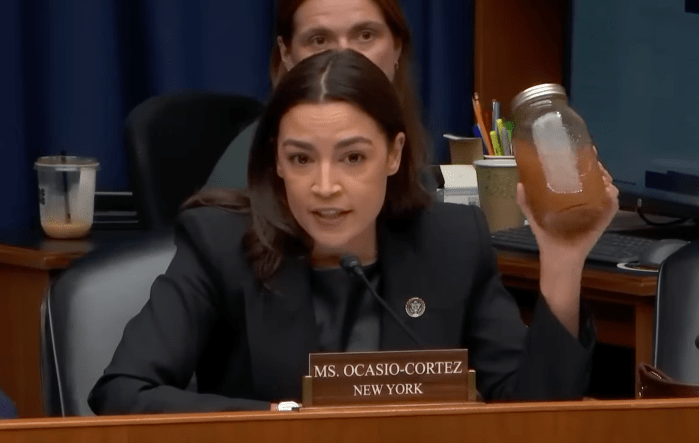
Across multiple states, residents are demanding to see the “water math” behind proposed data centers—how much water will be consumed (not just withdrawn), where it will come from, whether utilities can actually supply it during drought conditions, and what enforceable reporting and mitigation requirements will apply. In arid regions, water scarcity is an obvious constraint. But what’s new is that even in traditionally water-secure states, opponents are now framing data centers as industrial-scale consumptive users whose needs collide directly with residential growth, agriculture, and climate volatility.

The result: moratoria, rezoning denials, delayed hearings, task forces, and early-stage organizing efforts aimed at blocking projects before entitlements are locked in.

Below is a snapshot of how that opposition has played out state by state over the last two weeks.

State-by-State Breakdown

Virginia  

Virginia remains ground zero for organized pushback.

Botetourt County: Residents confronted the Western Virginia Water Authority over a proposed Google data center, pressing officials about long-term water supply impacts and groundwater sustainability.  

Hanover County (Richmond region): The Planning Commission voted against recommending rezoning for a large multi-building data center project.  

State Legislature: Lawmakers are advancing reform proposals that would require water-use modeling and disclosure.

Georgia  

Metro Atlanta / Middle Georgia: Local governments’ recruitment of hyperscale facilities is colliding with resident concerns.  

DeKalb County: An extended moratorium reflects a pause-and-rewrite-the-rules strategy.  

Monroe County / Forsyth area: Data centers have become a local political issue.

Arizona  

The state has moved to curb groundwater use in rural basins via new regulatory designations requiring tracking and reporting.  

Local organizing frames AI data centers as unsuitable for arid regions.

Maryland  

Prince George’s County (Landover Mall site): Organized opposition centered on environmental justice and utility burdens.  

Authorities have responded with a pause/moratorium and a task force.

Indiana  

Indianapolis (Martindale-Brightwood): Packed rezoning hearings forced extended timelines.  

Greensburg: Overflow crowds framed the fight around water-user rankings.

Oklahoma  

Luther (OKC metro): Organized opposition before formal filings.

Michigan  

Broad local opposition with water and utility impacts cited.  

State-level skirmishes over incentives intersect with water-capacity debates.

North Carolina  

Apex (Wake County area): Residents object to strain on electricity and water.

Wisconsin & Pennsylvania 

Corporate messaging shifts in response to opposition; Microsoft acknowledged infrastructure and water burdens.

The Through-Line: “Show Us the Water Math”

Lawrence of Arabia: The Well Scene

Across these states, the grassroots playbook has converged:

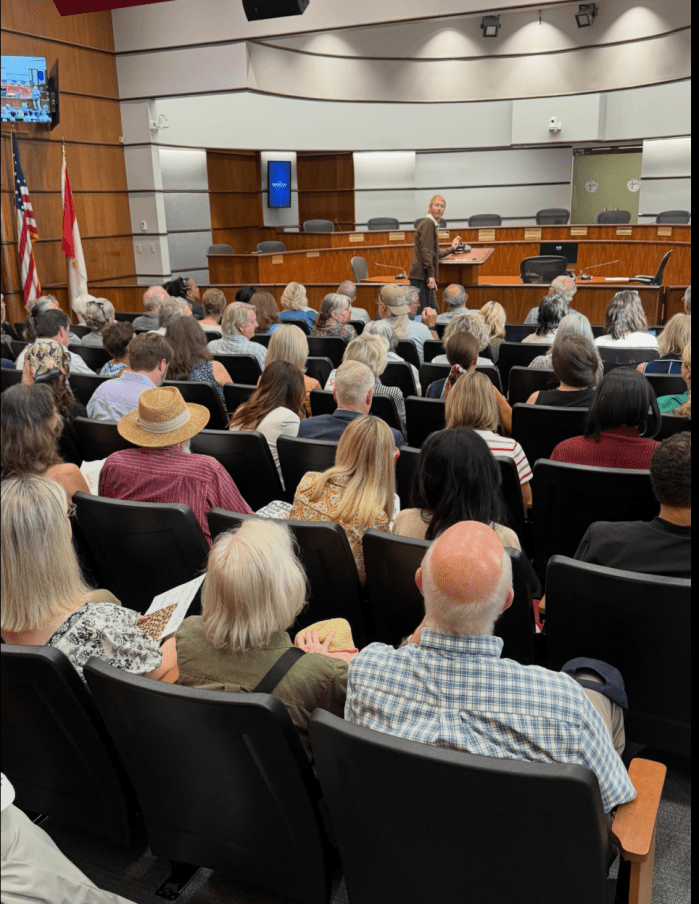
Pack the hearing.  

Demand water-use modeling and disclosure.  

Attack rezoning and tax incentives.  

Force moratoria until enforceable rules exist.

Residents are demanding hard numbers: consumptive losses, aquifer drawdown rates, utility-system capacity, drought contingencies, and legally binding mitigation.

Why This Matters for AI Policy

This revolt exposes the physical contradiction at the heart of the AI infrastructure build-out: compute is abstract in policy rhetoric but experienced locally as land, water, power, and noise.

Communities are rejecting a development model that externalizes its physical costs onto local water systems and ratepayers.

Water is now the primary political weapon communities are using to block, delay, and reshape AI infrastructure projects.

Read the local news:

America’s AI Boom Is Running Into An Unplanned Water Problem (Ken Silverstein/Forbes)

Residents raise water concerns over proposed Google data center (Allyssa Beatty/WDBJ7 News)

How data centers are rattling a Georgia Senate special election (Greg Bluesetein/Atlanta Journal Constitution)

A perfect, wild storm’: widely loathed datacenters see little US political opposition (Tom Perkins/The Guardian) 

Hanover Planning Commission votes to deny rezoning request for data center development (Joi Fultz/WTVR)

Microsoft rolls out initiative to limit data-center power costs, water use impact (Reuters)

South Korea’s AI Action Plan and the Global Drift Toward “Use First, Pay Later”

South Korea has become the latest flashpoint in a rapidly globalizing conflict over artificial intelligence, creator rights and copyright. A broad coalition of Korean creator and copyright organizations—spanning literature, journalism, broadcasting, screenwriting, music, choreography, performance, and visual arts—has issued a joint statement rejecting the government’s proposed Korea AI Action Plan, warning that it risks allowing AI companies to use copyrighted works without meaningful permission or payment.

The groups argue that the plan signals a fundamental shift away from a permission-based copyright framework toward a regime that prioritizes AI deployment speed and “legal certainty” for developers, even if that certainty comes at the expense of creators’ control and compensation. Their statement is unusually blunt: they describe the policy direction as a threat to the sustainability of Korea’s cultural industries and pledge continued opposition unless the government reverses course.

The controversy centers on Action Plan No. 32, which promotes “activating the ecosystem for the use and distribution of copyrighted works for AI training and evaluation.” The plan directs relevant ministries to prepare amendments—either to Korea’s Copyright Act, the AI Basic Act, or through a new “AI Special Act”—that would enable AI training uses of copyrighted works without legal ambiguity.

Creators argue that “eliminating legal ambiguity” reallocates legal risk rather than resolves it. Instead of clarifying consent requirements or building licensing systems, the plan appears to reduce the legal exposure of AI developers while shifting enforcement burdens onto creators through opt-out or technical self-help mechanisms.

Similar policy patterns have emerged in the United Kingdom and India, where governments have emphasized legal certainty and innovation speed while creative sectors warn of erosion to prior-permission and fair-compensation norms. South Korea’s debate stands out for the breadth of its opposition and the clarity of the warning from cultural stakeholders.

The South Korean government avoids using the term “safe harbor,” but its plan to remove “legal ambiguity” reads like an effort to build one. The asymmetry is telling: rather than eliminating ambiguity by strengthening consent and payment mechanisms, the plan seeks to eliminate ambiguity by making AI training easier to defend as lawful—without meaningful consent or compensation frameworks. That is, in substance, a safe harbor, and a species of blanket license. The resulting “certainty” would function as a pass for AI companies, while creators are left to police unauthorized use after the fact, often through impractical opt-out mechanisms—to the extent such rights remain enforceable at all.

Grass‑Roots Rebellion Against Data Centers and Grid Expansion

A grass‑roots “data center and electric grid rebellion” is emerging across the United States as communities push back against the local consequences of AI‑driven infrastructure expansion. Residents are increasingly challenging large‑scale data centers and the transmission lines needed to power them, citing concerns about enormous electricity demand, water consumption, noise pollution, land use, declining property values, and opaque approval processes. What were once routine zoning or utility hearings are now crowded, contentious events, with citizens organizing quickly and sharing strategies across counties and states.


This opposition is no longer ad hoc. In Northern Virginia—often described as the global epicenter of data centers—organized campaigns such as the Coalition to Protect Prince William County have mobilized voters, fundraised for local elections, demanded zoning changes, and challenged approvals in court. In Maryland’s Prince George’s County, resistance has taken on a strong environmental‑justice framing, with groups like the South County Environmental Justice Coalition arguing that data centers concentrate environmental and energy burdens in historically marginalized communities and calling for moratoria and stronger safeguards.


Nationally, consumer and civic groups are increasingly coordinated, using shared data, mapping tools, and media pressure to argue that unchecked data‑center growth threatens grid reliability and shifts costs onto ratepayers. Together, these campaigns signal a broader political reckoning over who bears the costs of the AI economy.

Global Data Centers

Here’s a snapshot of grass roots opposition in Texas, Louisiana and Nevada:

Texas

Texas has some of the most active and durable local opposition, driven by land use, water, and transmission corridors.

  • Hill Country & Central Texas (Burnet, Llano, Gillespie, Blanco Counties)
    Grass-roots groups formed initially around high-voltage transmission lines (765 kV) tied to load growth, now explicitly linking those lines to data center demand. Campaigns emphasize:
    • rural land fragmentation
    • wildfire risk
    • eminent domain abuse
    • lack of local benefit
      These groups are often informal coalitions of landowners rather than NGOs, but they coordinate testimony, public-records requests, and local elections.
  • DFW & North Texas
    Neighborhood associations opposing rezoning for hyperscale facilities focus on noise (backup generators), property values, and school-district tax distortions created by data-center abatements.
  • ERCOT framing
    Texas groups uniquely argue that data centers are socializing grid instability risk onto residential ratepayers while privatizing upside—an argument that resonates with conservative voters.

Louisiana

Opposition is newer but coalescing rapidly, often tied to petrochemical and LNG resistance networks.

  • North Louisiana & Mississippi River Corridor
    Community groups opposing new data centers frame them as:
    • “energy parasites” tied to gas plants
    • extensions of an already overburdened industrial corridor
    • threats to water tables and wetlands
      Organizers often overlap with environmental-justice and faith-based coalitions that previously fought refineries and export terminals.
  • Key tactic: reframing data centers as industrial facilities, not “tech,” triggering stricter land-use scrutiny.

Nevada

Nevada opposition centers on water scarcity and public-land use.

  • Clark County & Northern Nevada
    Residents and conservation groups question:
    • water allocations for evaporative cooling
    • siting near public or BLM-managed land
    • grid upgrades subsidized by ratepayers for private AI firms
  • Distinct Nevada argument: data centers compete directly with housing and tribal water needs, not just environmental values.

The Data Center Rebellion is Here and It’s Reshaping the Political Landscape (Washington Post)

Residents protest high-voltage power lines that could skirt Dinosaur Valley State Park (ALEJANDRA MARTINEZ AND PAUL COBLER/Texas Tribune)

US Communities Halt $64B Data Center Expansions Amid Backlash (Lucas Greene/WebProNews)

Big Tech’s fast-expanding plans for data centers are running into stiff community opposition (Marc Levy/Associated Press)

Data center ‘gold rush’ pits local officials’ hunt for new revenue against residents’ concerns (Alander Rocha/Georgia Record)

The Paradox of Huang’s Rope

If the tech industry has a signature fallacy for the 2020s aside from David Sacks, it belongs to Jensen Huang. The CEO of Nvidia has perfected a circular, self-consuming logic so brazen that it deserves a name: The Paradox of Huang’s Rope. It is the argument that China is too dangerous an AI adversary for the United States to regulate artificial intelligence at home or control export of his Nvidia chips abroad—while insisting in the very next breath that the U.S. must allow him to keep selling China the advanced Nvidia chips that make China’s advanced AI capabilities possible. The justification destroys its own premise, like handing an adversary the rope to hang you and then pointing to the length of that rope as evidence that you must keep selling more, perhaps to ensure a more “humane” hanging. I didn’t think it was possible to beat “sharing is caring” for utter fallacious bollocks.

The Paradox of Huang’s Rope works like this: First, hype China as an existential AI competitor. Second, declare that any regulatory guardrails—whether they concern training data, safety, export controls, or energy consumption—will cause America to “fall behind.” Third, invoke national security to insist that the U.S. government must not interfere with the breakneck deployment of AI systems across the economy. And finally, quietly lobby for carveouts that allow Nvidia to continue selling ever more powerful chips to the same Chinese entities supposedly creating the danger that justifies deregulation.

It is a master class in circularity: “China is dangerous because of AI → therefore we can’t regulate AI → therefore we must sell China more AI chips → therefore China is even more dangerous → therefore we must regulate even less and export even more to China.” At no point does the loop allow for the possibility that reducing the United States’ role as China’s primary AI hardware supplier might actually reduce the underlying threat. Instead, the logic insists that the only unacceptable risk is the prospect of Nvidia making slightly less money.

This is not hypothetical. While Washington debates export controls, Huang has publicly argued that restrictions on chip sales to China could “damage American technology leadership”—a claim that conflates Nvidia’s quarterly earnings with the national interest. Meanwhile, U.S. intelligence assessments warn that China is building fully autonomous weapons systems, and European analysts caution that Western-supplied chips are appearing in PLA research laboratories. Yet the policy prescription from Nvidia’s corner remains the same: no constraints on the technology, no accountability for the supply chain, and no acknowledgment that the market incentives involved have nothing to do with keeping Americans safe. And anyone who criticizes the authoritarian state run by the Chinese Communist Party is a “China Hawk” which Huang says is a “badge of shame” and “unpatriotic” because protecting America from China by cutting off chip exports “destroys the American Dream.” Say what?

The Paradox of Huang’s Rope mirrors other Cold War–style fallacies, in which companies invoke a foreign threat to justify deregulation while quietly accelerating that threat through their own commercial activity. But in the AI context, the stakes are higher. AI is not just another consumer technology; its deployment shapes military posture, labor markets, information ecosystems, and national infrastructure. A strategic environment in which U.S. corporations both enable and monetize an adversary’s technological capabilities is one that demands more regulation, not less.

Naming the fallacy matters because it exposes the intellectual sleight of hand. Once the circularity is visible, the argument collapses. The United States does not strengthen its position by feeding the very capabilities it claims to fear. And it certainly does not safeguard national security by allowing one company’s commercial ambitions to dictate the boundaries of public policy. The Paradox of Huang’s Rope should not guide American AI strategy. It should serve as a warning of how quickly national priorities can be twisted into a justification for private profit.

You Can’t Prosecute Smuggling NVIDIA chips to CCP and Authorize Sales to CCP at the Same Time

The Trump administration is attempting an impossible contradiction: selling advanced NVIDIA AI chips to China while the Department of Justice prosecutes criminal cases for smuggling the exact same chips into China.

According to the DOJ:

“Operation Gatekeeper has exposed a sophisticated smuggling network that threatens our Nation’s security by funneling cutting-edge AI technology to those who would use it against American interests,” said Ganjei. “These chips are the building blocks of AI superiority and are integral to modern military applications. The country that controls these chips will control AI technology; the country that controls AI technology will control the future. The Southern District of Texas will aggressively prosecute anyone who attempts to compromise America’s technological edge.”

That divergence from the prosecutors is not industrial policy. That is incoherence. But mostly it’s just bad advice, likely coming from White House AI Czar David Sacks, Mr. Trump’s South African AI policy advisor who may have a hard time getting a security clearance in the first place..

On one hand, DOJ is rightly bringing cases over the illegal diversion of restricted AI chips—recognizing that these processors are strategic technologies with direct national-security implications. On the other hand, the White House is signaling that access to those same chips is negotiable, subject to licensing workarounds, regulatory carve-outs, or political discretion.

You cannot treat a technology as contraband in federal court and as a commercial export in the West Wing.

Pick one.

AI Chips Are Not Consumer Electronics

The United States does not sell China F-35 fighter jets. We do not sell Patriot missile systems. We do not sell advanced avionics platforms and then act surprised when they show up embedded in military infrastructure. High-end AI accelerators are in the same category.

NVIDIA’s most advanced chips are not merely commercial products. They are general-purpose intelligence infrastructure or what China calls military-civil fusion. They train surveillance systems, military logistics platforms, cyber-offensive tools, and models capable of operating autonomous weapons and battlefield decision-making pipelines with no human in the loop.

If DOJ treats the smuggling of these chips into China as a serious federal crime—and it should—there is no coherent justification for authorizing their sale through executive discretion. Except, of course, money, or in Mr. Sacks case, more money.

Fully Autonomous Weapons—and Selling the Rope

China does not need U.S. chips to build consumer AI. It wants them for military acceleration.Advanced NVIDIA AI chips are not just about chatbots or recommendation engines. They are the backbone of fully autonomous weapons systems—autonomous targeting, swarm coordination, battlefield logistics, and decision-support models that compress the kill chain beyond meaningful human control.

There is an old warning attributed to Vladimir Lenin—that capitalists would sell the rope by which they would later be hanged. Apocryphal or not, it captures this moment with uncomfortable precision.

If NVIDIA chips are powerful enough to underpin autonomous weapons systems for allied militaries, they are powerful enough to underpin autonomous weapons systems for adversaries like China. Trump’s own National Security Strategy statement clearly says previous U.S. elites made “mistaken” assumptions about China such as the famous one that letting China into the WTO would integrate Beijing into the famous rules-based international order. Trump tells us that instead China “got rich and powerful” and used this against us, and goes on to describe the CCP’s well known predatory subsidies, unfair trade, IP theft, industrial espionage, supply-chain leverage, and fentanyl precursor exports as threats the U.S. must “end.” By selling them the most advanced AI chips?

Western governments and investors simultaneously back domestic autonomous-weapons firms—such as Europe-based Helsing, supported by Spotify CEO Daniel Ek—explicitly building AI-enabled munitions for allied defense. That makes exporting equivalent enabling infrastructure to a strategic competitor indefensible.

The AI Moratorium Makes This Worse, Not Better

This contradiction unfolds alongside a proposed federal AI moratorium executive order originating with Mr. Sacks and Adam Thierer of Google’s R Street Institute that would preempt state-level AI protections.
States are told AI is too consequential for local regulation, yet the federal government is prepared to license exports of AI’s core infrastructure abroad.

If AI is too dangerous for states to regulate, it is too dangerous to export. Preemption at home combined with permissiveness abroad is not leadership. It is capture.

This Is What Policy Capture Looks Like

The common thread is not national security. It is Silicon Valley access. David Sacks and others in the AI–VC orbit argue that AI regulation threatens U.S. competitiveness while remaining silent on where the chips go and how they are used.

When DOJ prosecutes smugglers while the White House authorizes exports, the public is entitled to ask whose interests are actually being served. Advisory roles that blur public power and private investment cannot coexist with credible national-security policymaking particularly when the advisor may not even be able to get a US national security clearance unless the President blesses it.

A Line Has to Be Drawn

If a technology is so sensitive that its unauthorized transfer justifies prosecution, its authorized transfer should be prohibited absent extraordinary national interest. AI accelerators meet that test.

Until the administration can articulate a coherent justification for exporting these capabilities to China, the answer should be no. Not licensed. Not delayed. Not cosmetically restricted.

And if that position conflicts with Silicon Valley advisers who view this as a growth opportunity, they should return to where they belong. The fact that the US is getting 25% of the deal (which i bet never finds its way into America’s general account), means nothing except confirming Lenin’s joke about selling the rope to hang ourselves, you know, kind of like TikTok.

David Sacks should go back to Silicon Valley.

This is not venture capital. This is our national security and he’s selling it like rope.

Marc Andreessen’s Dormant Commerce Clause Fantasy

There’s a special kind of hubris in Silicon Valley, but Marc Andreessen may have finally discovered its purest form: imagining that the Dormant Commerce Clause (DCC) — a Constitutional doctrine his own philosophical allies loathe — will be his golden chariot into the Supreme Court to eliminate state AI regulation.

If you know the history, it borders on comedic, if you think that Ayn Rand is a great comedienne.

The DCC is a judge‑created doctrine inferred from the Commerce Clause (Article I, Section 8, Clause 3), preventing states from discriminating against or unduly burdening interstate commerce. Conservatives have long attacked it as a textless judicial invention. Justice Scalia called it a “judicial fraud”; Justice Thomas wants it abolished outright. Yet Andreessen’s Commerce Clause playbook is built on expanding a doctrine the conservative legal movement has spent 40 years dismantling.

Worse for him, the current Supreme Court is the least sympathetic audience possible.

Justice Gorsuch has repeatedly questioned DCC’s legitimacy and rejects free‑floating “extraterritoriality” theories. Justice Barrett, a Scalia textualist, shows no appetite for expanding the doctrine beyond anti‑protectionism. Justice Kavanaugh is business‑friendly but wary of judicial policymaking. None of these justices would give Silicon Valley a nationwide deregulatory veto disguised as constitutional doctrine. Add Alito and Thomas, and Andreessen couldn’t scrape a majority.

And then there’s Ted Cruz — Scalia’s former clerk — loudly cheerleading a doctrine his mentor spent decades attacking.

National Pork Producers Council v. Ross (2023): The Warning Shot

Andreessen’s theory also crashes directly into the Supreme Court’s fractured decision in the most recent DCC case before SCOTUS, National Pork Producers Council v. Ross (2023), where industry groups tried to use the DCC to strike down California’s animal‑welfare law due to its national economic effects.

The result? A deeply splintered Court produced several opinions.  Justice Gorsuch  announced the judgment of the Court, and delivered the opinion of the Court with respect to Parts I, II, III, IV–A, and V, in which Justices Thomas, Sotomayor, Kagan and Barrett joined, an opinion with respect to Parts IV–B and IV–D, in which Justice Thomas and Barrett joined, and an opinion with respect to Part IV–C, in which Justices Thomas, Sotomayor, and Kagan joined.  Justice Sotomayor filed an opinion concurring in part, in which Justice Kagan joined.  Justice Barrett filed an opinion concurring in part. Chief Justice Roberts filed an opinion concurring in part and dissenting in part, in which Justices Alito, Kavanaugh and Jackson joined. Justice Kavanaugh filed an opinion concurring in part and dissenting in part.

Got it?  

The upshot:
– No majority for expanding DCC “extraterritoriality.”
– No appetite for using DCC to invalidate state laws simply because they influence out‑of‑state markets.
– Multiple justices signaling that courts should not second‑guess state policy judgments through DCC balancing.
– Gorsuch’s lead opinion rejected the very arguments Silicon Valley now repackages for AI.

If Big Tech thinks this Court that decided National Pork—no pun intendedwill hand them a nationwide kill‑switch on state AI laws, they profoundly misunderstand the doctrine and the Court.

Andreessen didn’t just pick the wrong legal strategy. He picked the one doctrine the current Court is least willing to expand. The Dormant Commerce Clause isn’t a pathway to victory — it’s a constitutional dead end masquerading as innovation policy.

But…maybe he’s crazy like a fox.  

The Delay’s the Thing: The Dormant Commerce Clause as Delay Warfare

To paraphrase Saul Alinksy, the issue is never the issue, the issue is always delay.  Of course, if delay is the true objective, you couldn’t pick a better stalling tactic than hanging an entire federal moratorium on one of the Supreme Court’s most obscure and internally conflicted doctrines. The Dormant Commerce Clause isn’t a real path to victory—not with a Court where Scalia’s intellectual heirs openly question its legitimacy. But it is the perfect fig leaf for an executive order.

The point isn’t to win the case. The point is to give Trump just enough constitutional garnish to issue the EO, freeze state enforcement, and force every challenge into multi‑year litigation. That buys the AI industry exactly what it needs:  time. Time to scale. Time to consolidate. Time to embed itself into public infrastructure and defense procurement. Time  to become “too essential to regulate” or as Senator Hawley asked, too big to prosecute?

Big Tech doesn’t need a Supreme Court victory. It needs a judicial cloud, a preemption smokescreen, and a procedural maze that chills state action long enough for the industry to entrench itself permanently.  And no one knows that better than the moratorium’s biggest cheerleader, Senator Ted Cruz the Scalia clerk.

The Dormant Commerce Clause, in this context, isn’t a doctrine. It’s delay‑ware—legal molasses poured over every attempt by states to protect their citizens. And that delay may just be the real prize.