Speculative ticketing is the practice of selling an option to maybe buy a popular ticket (often at an insane price) before the ticket goes on sale. You may not realize you are not buying a real ticket, although these tickets often come with fine print, and as Tom Waits tells us, the large print giveth and the small print taketh away.
There is an effort going on to specifically ban speculative ticketing at the state level which I applaud as I think speculative ticketing should be a crime. One reason I think this is because I think it already is a crime in most if not all states and possibly under federal law as well.
Think about it–do you think that if you before Blackstone and said to Sir William, My Lord, the defendant sold me a famous cow he didn’t own at a price he invented and promised to deliver the cow on law day. He took my money but delivered no cow (or delivered a different and unfamous cow). And the defendant said, perfectly legal My Lord.
What do you think My Lord Blackstone would say?

I don’t think the English common law would have just let the defendant walk out without at least compensating the buyer. Therefore, there’s probably a case that can be made out of existing law for selling stolen or counterfeit goods, or a host of other common law derivatives that would violate the charter of the land.
So as we try to get specific legal action to deal with speculative tickets, let’s not allow the lobbyists for Stubhub to negotiate the punishment that they want rather than the punishment that already applies under existing state civil or criminal law.
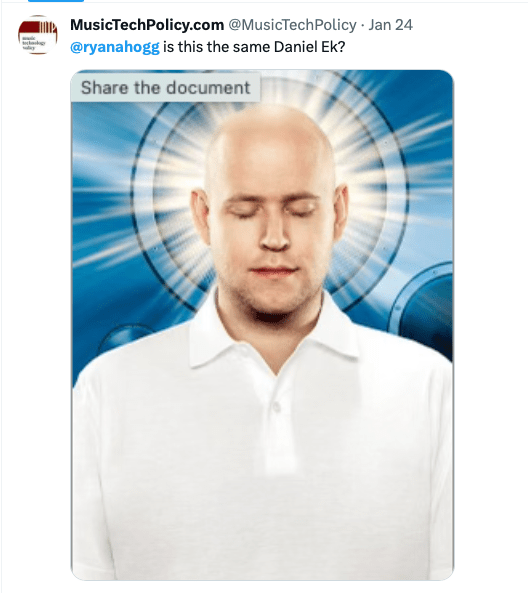
Ek’s New Iconography: Will the real Daniel Ek please stand up?
MTP readers will no doubt remember when Daniel Ek refused to be deposed in the latest Nashville case against Spotify for copyright infringement (Eight Mile Style). He eventually was deposed where he tried to say that he had no first hand knowledge of the facts or publishing practices at Spotify. Others did that for him after they got finished peeling his pears.
Ryan Hogg, writing in Fortune, published what I can only think is a puff piece on Ek trying to pass him off as a man of the people with a management style of just one of the team. Worth over a billion dollars and controlling voting stock.
And then there’s this:
What is Spotify’s contractual basis for their modernized free goods program?
There’s been a lot of discussion about Spotify’s new “modernized” free goods program aka Track Monetization Eligibility. It does raise the question of how they are getting away with this. Free goods, after all, were based on contract terms that the artist got to negotiate (and which, by the way, was passed along to songwriters through the artist’s controlled compositions clause for anyone not on a pure statutory rate and still is.
Who agreed to this? And why aren’t they stepping forward to claim their genius?
 Music Tech Solutions