The Elusive Obelus: Streaming’s Problem With Denominators

“How did you go bankrupt?” Bill asked.
“Two ways,” Mike said. “Gradually and then suddenly.”

Ernest Hemingway, The Sun Also Rises.

No matter how much people would like to deflect it, the unvarnished per stream rate is an ever diminishing income stream.  Given the number of calculations involved for both sound recording and song, it is likely that the total end-to-end cost of rendering the accountings for the streams costs more than the royalty earned on that stream by any one royalty participant.  Solving this problem is the difference between a short-term stock-fueled sugar high and a long-term return of shareholder value for all concerned.  So now what?

If you’re someone who receives or calculates streaming royalties, you’re already familiar with the  problem of the ever-decreasing per-stream rate.  The Trichordist’s definitive “Streaming Price Bible” for 2018 confirms this trend yet again, but simple math explains the problem of the revenue share allocation.

Remember that the way streaming royalties are calculated in voluntary agreements (aka “direct deals”) revolves around a simple formula (Formula A):

(Payable Revenue ÷ Total Service Streams) x Your Streams = Per Stream Rate

Which may also be expressed as Formula B:

Payable Revenue x (Your Streams ÷ Total Service Streams) = Your share of revenue

(Formula A and B are also known as “the big pool” in the user-centric or Ethical Pool models.)

Here’s the trick–it’s in the correlation of the rate of increase over time of the numerator and the denominator.  If you focus on any single calculation you won’t see the problem.  You have to calculate the rate of change over time.  Simply put, if the numerator in either Formula A or Formula B increases at a lower rate than the denominator, then the quotient, or the result of the division, will always decline as long as those conditions are met.  That’s why the Streaming Price Bible shows a declining per-stream rate–a contrarian fact among the hoorah from streaming boosters that sticks in the craw.

Services make these accounting calculations monthly for the most part, and they are calculated a bit differently depending on the service.  This is why the Streaming Price Bible has different rates for different services, rates that vary depending on the terms of the contract and also the amount of “Payable Revenue” that the service attributes to the particular sound recordings.

The quotient will also vary depending on the copyright owner’s deal.  If you add downside protection elements such as contractual per stream or per subscriber minimums, then you can cushion the decline.

This is also true of non-recoupable payments (such as direct payments that are deemed to be recoupable but not returnable, or “breakage”).  Nonrecoupable payments are just another form of nominal royalty payable to the copyright owner, and increase the overall payout.  And of course, the biggest nonrecoupable payment is stock which sometimes pays off as we saw with Spotify.  These payments may or may not be shared with the artist.  (See the WIN Fair Digital Deals Pledge.)

So each of the elements of both Formula A and Formula B are a function of other calculations. We’re not going to dive into those other elements too deeply in this post–but we will note that there are some different elements to the formulas depending on the bargaining power of the rights owner, in this case the owner of sound recordings.

So how is it that the per-stream rate declines over time in the Streaming Price Bible?

Putting the Demon in the Denominator

Back to Formula B, you’ll note that the function “Your Streams ÷ Total Service Streams” looks a lot like a market share allocation.  In fact, if the relevant market is limited to the service calculating the revenue share allocation, it is a market share allocation of service revenue by another name.  When you consider that the customary method of calculating streaming royalties across all services is a similar version of Formula B, it may as well be an allocation of the total market on a market share basis.

Note that this is very different from setting a wholesale price for your goods that implies a retail price.  A wholesale price is a function of what you think a consumer would or should pay.  When a service agrees to a minimum per stream or per subscriber rate, they are essentially accepting a price term that behaves like a wholesale price.

For most artists and indie labels, the price is set by your market share of the subscription fees or ad rates that the service thinks the market will bear based on the service’s business goalsnot based on your pricing decision.

Why is this important?  A cynic might say it’s because Internet companies are in the free lunch crowd–they would give everything away for free since their inflated salaries and sky-high rents are paid by venture capitalists who don’t understand a thing about breaking artists and investing in talent.  You know, the kind of people who would give Daniel Ek a million dollar bonus when he hadn’t met his performance targets, stiffed songwriters for years and gotten the company embroiled in multimillion dollar lawsuits.  But had met the only performance target that mattered which was to put some cosmetics on that porker and push it out the door into a public stock offering.  (SPOT F-1 at p. 133: “In February 2018, our board of directors determined to pay Mr. Ek the full $1,000,000 bonus based on the Company’s 2017 performance though certain performance goals were not achieved…”)

But long-term, it’s important because one way that royalties will rise is if the service can only acquire its only product at a higher price.  Or not.  The other way that royalties will rise is if services are required to pay a per-stream rate that is higher than the revenue share rate.  How that increase is passed to the consumer is up to them.  Maybe a move from World Trade Center to Poughkeepsie would help.

The Streaming Price Bible is based on revenue for an indie label that did not have the massive hits we see on Spotify.  In this sense, it is the unvarnished reality of streaming without the negotiated downside protection goodies, unrecoupable or nonreturnable payments, and of course shares of stock.  While some may say the Bible lacks hits, that’s kind of the point–hits mask a thousand sins.  Ask any label accountant.

Will Consumption Eat Your Free Lunch?

Let’s say again: The simple explanation for the longitudinal decline of streaming royalties measured by the Streaming Price Bible is that the rate of change across accounting periods in the “Payable Revenue” must be greater than the rate of change in the total number of streams in order for the per-stream rate to increase–otherwise the per-stream rate will always decrease.  Another way to think of it is that revenue has to increase faster than consumption, or consumption will eat your lunch.

What if you left the formula the same and just increased the revenue being allocated?  Services will probably resist that move.  After all, when artists complain about their per-stream rate, the services often answer that the problem is not with them, it is with the artist’s labels because the services pay hundreds of millions to the labels.

We don’t really have much meaningful control over what goes in the monthly payable revenue number (i.e., the mathematical “dividend” or numerator).  What kinds of revenue should be included?  Here are a few:

–all advertising revenue from all sources
–e-commerce transactions
–bounties or referral fees, including  recoupable or non-refundable guarantees
–sponsorships
–subscription income
–traffic or tariff charges paid by telcos
–revenue from the sale of data

Services will typically deduct “small off the tops” which would include
–VAT or sales tax
–ad commissions paid to unaffiliated third parties (usually subject to a cap)

Indie labels and independent artists may not have the leverage to negotiate some of these revenue elements such as revenue from the sale of data for starters.  Other elements of the revenue calculation for indie labels and artists will also likely not include the downside protections, subscriber target top up fees and the like.

And of course the biggest difference is that indie labels (at least not in the Merlin group who may) typically do not get nonreturnable advances,  nonrecoupable payments, or stock.

Is That All There Is?

Why should we care about all this?  There is a story that is told of negotiations to settle a lawsuit against a well-known pirate site.  One of the venture capitalists backing the pirates told one of the label negotiators that he could make them all richer through an IPO than any settlement they’d ever be able to negotiate.

The label executive asked, lets’ say we did that, but then what happens?  You say we should adapt, but you’re still destroying the industry ecosystem so that there’s nothing left to adapt to.  The most we could make from an IPO would cover our turnover for a year at best.  And we would be dependent on your success, not our artists’ success.

Then what?


Postdicting the Future: Five Things Congress Could Do for Music Creators That Wouldn’t Cost the Taxpayer a Dime from The Hill

[This is a July 30, 2013 summary from The Hill of my series that first appeared in the Huffington Post on July 26, 2013–let’s see how I did after the Music Modernization Act.]

1.  Create an Audit Right for Songwriters for Compulsory Licenses:  One of the oldest compulsory licenses in the Copyright Act is the “mechanical license”, the statutory mandate forcing songwriters to license songs that dates from 1909.  The government mandates the license and also mandates the rate that songwriters are paid—from 1909 until 1977 that rate was set at 2¢ per recording.  Although that rate was eventually indexed to inflation leading to the current 9.1¢ minimum, songwriters had to dig out of a deep hole.

Getting paid is another story.  This statutory license requires songwriters be sent “statements of account” for royalties—but songwriters are not allowed to conduct a “royalty compliance” examination (called an “audit”).  The law requires a company officer and a CPA to certify the company’s statements—a practice rarely complied with.  As recently demonstrated by Aimee Mann’s lawsuit against Medianet, if songwriters don’t get paid there’s not much they can do except sue—a costly process.

The government tells the songwriter “trust—but don’t verify.”  This is an easy fix.  Congress could give songwriters an audit right as they did for stakeholders in the contemporary digital performance compulsory license for satellite radio and Internet radio.

2.  Allow Artists and Songwriters to Opt Out of the Compulsory License:  The recent blow-up regarding the so-called “Internet Radio Fairness Act” and the related ASCAP and BMI rate court proceedings should let the Congress know that there are many artists and songwriters who want to be able to decide who gets to license their songs.  Again, the digital performance compulsory license allows copyright owners to control “interactive” uses of their works—why not at least do the same for the mechanical license as well?

3. Require Digital Royalties for pre-72 Sound Recordings:  Sound recordings did not receive federal copyright protection until 1972.  When the Congress established the digital performance royalty, it seemed to clearly apply to all recordings and did not arbitrarily exclude recordings prior to 1972.  However, this “gotcha” is used by SiriusXM and others to avoid paying great American artists whose records were released before 1972—jazz, R&B and rock legends get nothing.  Congress could fix this “gotcha” and secure a fair share of digital performance royalties to these authors of our musical heritage.

4.  Require All Unpaid Statutory Mechanical Royalties Be Paid to the State Unclaimed Property Offices:  As Aimee Mann’s alleged in her lawsuit against the white label provider Medianet, witnesses stated that 23 percent of the songs used by Medianet are unlicensed—which could easily be millions of songs if true.  And there are likely a number of digital music services that are arbitrarily holding unpaid royalties in an unauthorized “escrow.”

It seems that there could be substantial royalties controlled by the very retailers who must pay songwriters under the law, a potentially significant moral hazard.  Congress could require that any “escrowed” royalties be paid over under State unclaimed property laws—a lawful “escrow.”

5.  Require that Online and Offline Videos Follow the Same Rules:  As online video platforms become available through Internet enabled home televisions, attention should be paid to a frequently overlooked category of songwriter—the film and television music composers.  Current reporting by online video platforms makes it difficult for score composers to be paid for their work.  The Congress may well ask whether those who seek to replace television should be held to the same licensing standards as television.

These are but a few ideas the Congress could be addressing that might make a difference in the lives of artists and songwriters and would cost the taxpayer very little.  All leverage existing structures and bureaucracies, eliminate “gotchas,” and help to reduce the unintended consequences of government mandated compulsory licensing.

Postdicting the Future: Five Things Congress Could Do for Music Creators That Wouldn’t Cost the Taxpayer a Dime Part 4: Fixing Unmatched Songwriter Royalties

[In 2013, I wrote 5 articles on Huffington Post titled “5 Things Congress Could Do That Wouldn’t Cost Taxpayers a Dime”. After the MMA, how did I do on predictions?  These posts were written from a 2013 perspective.]

The US is alone in the world in maintaining a compulsory license for songs. The government forces songwriters to license their songs at a rate approved by the government and then has rather flimsy rules about how songwriters actually get paid. These flimsy rules, I suggest, have resulted in unknown amounts of royalties not finding their way to songwriters, particularly under compulsory licenses used by on-demand digital music services.

There’s an easy fix for this — the same rule that was applied against record companies and music publishers for unclaimed royalties in the past: Pay the money to state unclaimed property offices. If songwriters are getting ripped off by brand sponsored piracy on the unlicensed sites, then let’s at least make sure they get paid on the licensed services.

The Compulsory License for Songs

When the Congress established the compulsory license in 1909, the legislative body was concerned that granting exclusive rights in “mechanical royalties” for songs in piano rolls might create a monopoly if a single publisher could buy up the market in songs. However real that concern might have been at the time, the most common complaint from digital music services about songs is that the music publishing market is too fragmented, so it seems that argument is no longer relevant.

One of the big users of compulsory licenses is, of course, Google Play. Concern about the antitrust lusting of songwriters is particularly difficult to comprehend in a world in which the same government allows Google to buy and subsidize YouTube with monopoly rents, buy Double Click to achieve a dominant position in online advertising, and is given a pass by the FTC for antitrust violations. But those songwriters…boy, we have to keep a close eye on them.

Unsupervised Digital Music Services

So what appears to be happening is this: Digital music services use the compulsory license and its labyrinthine regulations — often with notices that are too late, accountings that are noncompliant and data that is just incorrect. To give you a sense of scope, digital music services often offer 20 million or so recordings, all of which contain the co-equal copyright in the song being recorded. Songs and recordings of songs have to be separately licensed for on-demand streaming services (especially the popular “cover recordings”). Songs are frequently co-owned — so the service using the compulsory license must notify a minimum of 20 million songwriters of their use of the song and often two or more writers per song. So let’s just call it tens of millions of licenses.

The digital music services must then track the use of these songs and recordings and match the usage to licenses obtained. There inevitably will be songs for which the writers cannot be found. So even if you assume that these companies can get to the matching stage without making any mistakes at all, what happens when there is usage — and therefore payable royalties — for songs that the service is unable to match — even for the most honest of reasons.

How Digital Music Services Pay Themselves Free Money

Add to this problem another problem — digital music services frequently try to dupe songwriters — the ones they have found — into agreeing that the service need only account to them if the songwriter has over a certain amount in payable royalties — somewhere between $50 and $250 depending on the service. (Google Play, for example, has a $100 minimum threshold — unilaterally imposed — on all international and “friction free” electronic payments.)

To put some math on this, realize that there are about 20 million songs typically available in a broad based retail offering such as Google Play or Spotify. Assume that on average 50 percent achieve $25 in earnings in a given calendar quarter accounting period. (This is consistent with both the “long tail” power law type sales distribution and the miniscule royalties paid to songwriters by these services.)

If a service holds royalty payments from songwriters until payable royalties exceed $25 (such as Google Play’s $100 default threshold as stated in their “Publisher Statement of Account Preference”), this means that the service could then be sitting on up to $250,000,000 in interest-free money. Free money that they theoretically may never have to pay out and only have to pay out when the service determines that the songwriter’s account is payable. Free money that is not permitted under the compulsory license rules for songs.

And that’s one service.

This policy of withholding royalties is fraught with moral hazard and practical problems: The heirs of one songwriter recently tried to sort out these payments and were told they needed to hire a lawyer to deal with the highly litigious digital music service. They couldn’t afford a lawyer so guess what happens to the unclaimed monies? And then there’s the statute of limitations.

Unmatched and Unclaimed Royalties

But there’s another problem with the digital music services — if they service cannot match usage (and earnings) to a royalty recipient in their systems, what happens then? Particularly with monies based on a share of advertising revenue that is distributed proportionately based on usage?

In this example, if in one month all songs were played 100 times and your song was played 10 times, then you would get 10/100 (or 10 percentt) of the advertising pie for that period. But — if there were actually 120 songs played during that period but only 100 could be matched, what happens to the other 20 that were unmatched? There is a growing belief that what happens is that the services don’t count the 20 unmatched songs, and divide the pie up based on the 100 they are able to match.

That means — there are 20 songs that were exploited but that are never paid and are not on the books. Even though there should be no songs on the service that were unlicensed because the compulsory license applies. If this seems high, remember that MediaNet’s lawyers acknowledged in a declaration cited in the current case by Aimee Mann against MediaNet that 23 percent of the millions of songs on the service are unlicensed.

By not counting the unmatched (and probably also unlicensed) songs, a service could argue — albeit fallaciously — that it had no “unallocated” royalties as it allocated all payable royalties to songs it could match and did not accrue any unpaid royalties. If I’m right about this, services are overpaying the matched songs with a share of revenue from the unmatched songs (in our example, 10/120 or 8-1/3 percent instead of the overpayment of 10/100 or 10 percent).

Because the Congress does not allow songwriters to audit the digital music services, there is no real way to know whether this is happening or the degree to which it is happening. If 23 percent of the MediaNet songs are unlicensed, royalties payable on any activity on these songs seems like it should at least be accrued until the songwriters can be found.

This is, of course, why states have unclaimed property statutes. In 2004, then Attorney General Eliot Spitzer chased record companies and music publishers for unpaid royalties for artists who could not be found for a variety of reasons, some plausible, some not so plausible. Spitzer forced the royalties to be paid—like utility deposits, dividends, abandoned bank accounts, the works—to the state unclaimed property office where the monies are held forever and where somebody eventually tries to track down the rightful owner.

Of course — there is a chance that if the digital music services did this voluntarily they might be admitting that they were using unlicensed songs and they want to keep a good eye on those kinds of admissions. So they will come up with many excuses for why they should not be subject to the same laws as everyone else. It is, after all, the Internet, and you know how that can be.

An Easy Fix for Congress: Pay unclaimed money to people who deal with unclaimed money

Even if the Congress does not establish an audit right for songwriters for mechanical royalties as they have for rights holders under the more contemporary webcasting compulsory license and the Audio Home Recording Act, it would be quite simple for the Congress to clarify once and for all that unpaid royalties — whether for the unmet minimum thresholds unilaterally imposed by digital music services, unknown addresses for songwriters, or any other reason — should be paid to the state unclaimed property offices in the state of the songwriter’s last known address or at least the state where the company does business.

Companies that want to take advantage of the compulsory license rules for songs shouldn’t also get to make their own rules to take advantage of songwriters.

Postdicting the Present: Five Things Congress Could Do for Music Creators That Wouldn’t Cost the Taxpayer a Dime Part 3: Create an Audit Right for Songwriters

[In 2013, I wrote 5 articles on Huffington Post titled “5 Things Congress Could Do That Wouldn’t Cost Taxpayers a Dime”. After the MMA, how did I do?  These posts were written from a 2013 perspective.]

Once a song is distributed to the public with the permission of the owner of the copyright in the song, the U.S. Copyright Act requires songwriters to license songs for reproduction and distribution under a “compulsory license.” This license is typically called a “mechanical license” because it only covers the “mechanical reproduction” of the song and does not, for example, include the right to use the song in a YouTube video or a motion picture, create a mashup or reprint the lyrics of the song.

When the Congress first developed the compulsory mechanical license in 1909, the concern was that “the right to make mechanical reproductions of musical works might become a monopoly controlled by a single company.” This monopoly never came to pass, and given the fragmentation in music licensing in the current environment, is unlikely to ever come about.

The user of the compulsory license (or “licensee”) has to comply with the rules for these licenses — including an obligation to account and pay royalties. If the licensee fails to comply, then the songwriter can in theory terminate the license, although making that termination stick usually requires an expensive copyright infringement lawsuit.

The bare compulsory license was not widely used before the advent of Internet music services — and then became something of a weapon of its own — music services bought into the “long tail” theory and tried to clear millions of songs overnight by massive mailings of notices of their intention to use the work. Given that songs are frequently co-written, this required sending huge numbers of notices. Behind each notice — supposedly — is a royalty account and statement of usage as required by law.

So if you’re following, songwriters suddenly were required to license to services they did not ask to be included in (unlike artists recording “cuts” the songwriter solicited), and only a limited paper trail to confirm the accuracy of royalty payments.

Trust, But Don’t Verify

Intuitively, you are probably thinking that songwriters would have the right to make the licensee provide evidence to demonstrate if this morass actually resulted in correct payments, right? Checking the evidence is called a “royalty compliance examination” or an “audit”. Since there is no “auditor general” of compulsory licenses appointed by the Congress, it would seem strange to believe that the intent of Congress was to codify the moral hazard of allowing the person doing the paying to examine their own books.

And yet, in the current practice, the fox is squarely among the chickens. This is because the government requires that the licensee merely “certifies” their own statements (i.e., promises the statements are true). This certification is done on a monthly basis by an officer of the licensee and annually by the licensee’s CPA. And songwriters are told “trust me.”

The Industry Standard

It’s safe to say that this certification process is drastically different than any industry-standard mechanical license. There is a long history of audits in the music business — the State of California even passed legislation in 2004 protecting the artist’s right to audit record companies. But when it comes to songwriters, the federal government forces songwriters to take the compulsory license, tells them the royalty rate they are to be paid, but does not permit songwriters to audit the licensee.

Instead, the government permits the licensee to “certify” their own statements (i.e., promises the statements are true). This certification is done on a monthly basis by an officer of the licensee and annually by the licensee’s CPA. And songwriters are told “trust me.”

The Blanche Dubois Approach to Royalty Accounting

As Blanche Dubois said in A Streetcar Named Desire, “I have always depended on the kindness of strangers” and until the Congress updates this certification business model, that’s exactly what songwriters are expected to do, too.

The compulsory license requires certification by the licensee on a monthly basis and by a CPA on an annual basis.

An officer of the licensee is to include this certification oath with the songwriter’s monthly statement:

“I certify that I have examined this Monthly Statement of Account and that all statements of fact contained herein are true, complete, and correct to the best of my knowledge, information, and belief, and are made in good faith.”

The Annual Statement of Account requires this certification by a Certified Public Accountant for the licensee:

“We have examined the attached “Annual Statement of Account Under Compulsory License For Making and Distributing Phonorecords” for the fiscal year ended (date) of (name of the compulsory licensee) applicable to phonorecords embodying (title or titles of nondramatic musical works embodied in phonorecords made under the compulsory license) made under the provisions of section 115 of title 17 of the United States Code, as amended by Pub. L. 94-553, and applicable regulations of the United States Copyright Office. Our examination was made in accordance with generally accepted auditing standards and accordingly, included tests of the accounting records and such other auditing procedures as we considered necessary in the circumstances.”

Do you think that the CPA has in fact examined millions of annual statements? Does the CPA’s risk manager or insurance carrier know that the CPA is certifying to a multitude of songwriters that the CPA has actually “examined the attached “Annual Statement of Account…” when it is highly unlikely that the CPA has done any such thing?

Congress crafted this language in a much simpler time. Remember — there are now millions of these statements every month. Do you think that the certification oath could possibly be true every time? Some of the time? How would you find out?

Certification is a One-Way Street

This certification runs only one way — the government only offers licensees and CPAs the opportunity to certify that the books are correct, not that they are incorrect. Under current practice, if a company or CPA is squishy about how accurate their books and records are, songwriters typically get no certifications at all and just an uncertified royalty statement if they are lucky.

What conclusion should be drawn from a failure to certify? Why not provide an alternative certification — that the licensee’s books and records cannot be certified. While it may be unrealistic to think that companies would ever disqualify their own books, it is not unrealistic to think that a CPA might choose this option on the annual statement of account given the CPA’s licensing responsibilities.

And it is definitely not unrealistic to think that the company’s books would be more likely to be accurate if the company knew that this disqualification option were available to the CPA. But the simplest thing Congress could do is to create an audit right for the compulsory license.

Let’s Keep it Simple

Chairman Goodlatte has said he intends to update the Copyright Act to bring it into line with the digital age. The Congress already allowed audits for the compulsory license for sound recordings and the webcasting royalty established under Section 114. This mechanism that Congress created in the recent past is working quite well.

Chairman Goodlatte could borrow heavily from the audit rights for the Section 114 compulsory license for sound recordings, and allow songwriters to conduct group audits under Section 115 to avoid a multiplicity of audits.

These changes would bring help bring song licensing into the 21st century and allow songwriters to enjoy greater confidence that they are being paid properly. Creating an audit right under Section 115 compulsory licenses would allow market forces to work to align the incentives toward better payments for songwriters.

In 2013, I wrote 5 articles on Huffington Post titled “5 Things Congress Could Do That Wouldn’t Cost Taxpayers a Dime”. After the MMA, how did I do?

via Postdicting the Present: Five Things Congress Could Do for Music Creators That Wouldn’t Cost the Taxpayer a Dime Part 2: Update the Compulsory License for Songwriters — Artist Rights Watch

Postdicting the Present: Five Things Congress Could Do For Music Creators That Wouldn’t Cost the Taxpayer a Dime Part 1: Pre-72 Sound Recordings

In 2013, I wrote 5 articles on Huffington Post titled “5 Things Congress Could Do That Wouldn’t Cost Taxpayers a Dime”. After the MMA, how did I do?

Chris Castle's avatarArtist Rights Watch--News for the Artist Rights Advocacy Community

[This series first appeared in the Huffington Post on July 26, 2013–lets see how I did now that music is all modern and chrome.]

In this and future posts, I will be addressing five things the Congress could do for music creators that are easy to do and that would help develop an online market for music. First up is a slightly esoteric, but important area: royalties paid by companies like SiriusXM for sound recordings made before 1972.

Many of us in the music business know that songwriters and recording artists are financially worse off under the “new boss” than they were under the “old boss.” We have watched older artists “die on the bandstand” because the royalty or residual income they had counted on to support them in their retirement began evaporating with the arrival of the Internet in their lives. We have watched younger artists and songwriters essentially…

View original post 1,055 more words

Ethical Props–How Streamers Can Empower Fans on the Path to Sustainability 

[This post first appeared in the MusicTechPolicy Monthly Newsletter, if you’d like future issues, subscribe to email updates for MusicTech.Solutions]

After the one-time pop of Spotify’s public stock offering cash-out, the new reality is going to be increasingly obvious–we’re stuck for at least a generation with trading high margin physical for low-to-no margin streaming royalties.  That stock-fueled sugar high created a near-total dependence on big minimum guarantees and non recoupable payments from streamers–if you could get those payments.  But the bad thing about non-recurring income is that it’s non-recurring. Spotify’s stock price is already testing lower lows near the $110 level, $7 above it’s 52 week low, but $80 below its 52 week high.

Now what?  I’ve heard a lot of discussion about my “Ethical Pool” approach to streaming royalties, but any “user-centric” model isn’t going to fix the low-to-no margin streaming royalty problem by itself.  The streaming hole is dug too deep.   
Strange as it may seem, streamer Tencent from the People’s Republic of China may have started a helpful social trend, and Apple is translating that trend into a business practice. Both companies present a teachable moment and an opportunity for the Ethical Pool’s mutual opt-in by fans and the artists they love in the form of micropayments I will call “Ethical Props”.

There’s three obvious things we know about streaming if we know nothing else:  Everyone who works for Spotify got even richer in their stock market cashout while the overwhelming majority of artists and songwriters on the service languish;  per-stream royalties are pitiful which matters if you don’t get minimum guarantees;  plus streamers lose money because they spend too much on overhead, especially salaries and rent.

There’s a less obvious problem we know but that doesn’t come up very often–streamers don’t empower fans to reward the artists they love, much less the songwriters who write the music it all starts with.  Imagine if fans could actually give money directly to their artists (and sign up for direct communications outside of the service).

But–thanks to inspiration from Tencent’s “virtual gift” feature, artists may have renewed negotiation leverage in actually getting streamers to empower fans to make direct contributions to the artists they love in the form of small “Ethical Prop” payments.  Of course, in order to be entitled to be “ethical” handle, the streaming services–including Tencent–will have to make some changes in their current business practice.

Which should be welcomed by all concerned.  As Sony Music as well as Taylor Swift and Universal Music Group recently demonstrated, ethical business is good business.  Both labels have agreed to pass through to artists a share of each label’s Spotify stock windfall on a non-recoupment basis–we’ll come back to that nonrecoupment part.

Simply put, Tencent allows users (all users, subscription or ad-supported service) to make virtual gifts in the form of micropayments directly to artists they love.  (The feature is actually broader than cash and applies to all content creators, but let’s stay with these socially-driven micropayments to artists or songwriters.)

Tencent, of course, makes serious bank on these system-wide micropayments.  As Jim Cramer noted in “Mad Money” last week:
“Tencent Music is a major part of the micropayment ecosystem because they let you give virtual gifts,” Cramer said. “If you want to tip your favorite blogger with a song, you do it through Tencent Music. In the latest quarter we have numbers for, 9.5 million users spent money on virtual gifts, and these purchases accounted for more than 70 percent of Tencent Music’s revenue.”
And that’s real money.  Tencent actually made this into a selling point in their IPO prospectus:
We are pioneering the way people enjoy online music and music-centric social entertainment services. We have demonstrated that users will pay for personalized, engaging and interactive music experiences. Just as we value our users, we also respect those who create music. This is why we champion copyright protection-because unless content creators are rewarded for their creative work, there won’t be a sustainable music entertainment industry in the long run. Our scale, technology and commitment to copyright protection make us a partner of choice for artists and content owners.
That sounds like these guys read the blog!

But–how to make “music-centric social entertainment services” into the Ethical Props? First, the streamer needs to take a smaller cut and they need to do some “Artist Services” work for their share.  If you want to get paid for artist services, then serve the artist for your payment (to get all antimetabole about it).

Spotify and Apple need to create the infrastructure that invests fans with the power to directly support the artists they love.  This empowerment will become increasingly important as more and more fans get woke with the main driver of the Ethical Pool–fans discovering that the very large lion’s share of the subscription fee they pay goes to music they don’t listen to performed by artists they’d never listen to. This ought to apply to both ad-supported and subscription services.

In addition to the Ethical Prop button, services need to empower fans to connect directly with the artists they love through an email list if the artist has one.  
In the background, the service may facilitate transactions like a “Fulfilled by Amazon” service that generates a 1099K (like Kickstarter) or an Apple in-app purchase.  In fact, the Chinese micropayments reportedly influenced Apple to change its in-app purchase policies, which make a good guideline for putting the “ethical” into an Ethical Prop:
Apps may enable individual users to give a monetary gift to another individual without using in-app purchase, provided that (a) the gift is a completely optional choice by the giver, and (b) 100% of the funds go to the receiver of the gift. However, a gift that is connected to or associated at any point in time with receiving digital content or services must use in-app purchase.

(That’s section 3.2.1(vii) in Apple’s App Store Review Guidelines for those reading along at home.)

Following Apple’s lead, Ethical Props should be given at the option of the fan and 100% of the funds should go to the artist directly (but not in lieu of a royalty).  Because the payment is optional for the fan, micropayments ought not to be taken into account in any rate setting hearing or negotiation.

And here’s where the “nonecoupable” issue returns–these monies should be paid directly each artist who opts-in to the feature.  Sony and Universal learned to leave some on the table–we’ll see how far that goes.  But certainly independent creators should get the benefit of 100% of any Ethical Prop.

On the songwriter side–now that lyrics are so prevalent and even Spotify is adding songwriter credits, it should be pretty simple for the discerning fan to give an Ethical Prop to a credited songwriter if the songwriter opts in to the Ethical Props.

So like the Ethical Pool, the Ethical Prop is bilateral–both fan and artist have to opt into the transaction.  If the streamer wants to provide a service to handle any required income or sales tax reporting (although it’s likely that none of these transactions will be significant enough to trigger a 1099), then that might justify a cut.  Maybe.


Ethical Props present a win-win opportunity for services and all artists that want to break the headlock of hyper-efficient market share distributions on streaming services.  As we all know and Tencent acknowledges, sustainability requires more than a per-stream royalty that starts 2, 3 or even 4 decimal places to the right.

As the Spotify sugar high starts to crash, Ethical Props may provide an important counterpart to the Ethical Pool.

Why Will Spotify’s Stock Price Tank?

Stocks go up, stocks go down, can’t pick a top and can’t pick a bottom.

However–Spotify is a particularly interesting stock for a number of reasons, mostly having to do with the nature of the initial offering.  Remember, Spotify did not offer shares in an “initial public offering,” they used an untried method called a “direct public offering.”

The difference is crucial.  In an IPO, or as it’s more precisely known, a “full commitment underwriting,” the company (or “issuer”) actually raises money through selling new shares of stock to a group of investors, usually banks.  These investors are often called “underwriters”.  In the case of a full commitment underwriting IPO, the company sells shares to an underwriting group (or “syndicate“) and the syndicate then sells those shares to the public after the syndicate decides the valuation of the company and the price of the shares of stock.

This is completely different from the direct public offering.  There are no new shares, there is no syndicate, and the price is set (or was for Spotify) by reference to the price of shares selling in the private market immediately before the public is able to buy–and my bet is that the DPO price was a lot higher than an IPO price would have been.  (Dropbox, for example, priced at $21 and closed at $28.48 on its first day of trading.  Facebook priced at $38, Google at $85, Alibaba $68, Amazon was $18.   All had different valuations, of course.  Spotify priced at $132 using a loophole from the SEC.  And what goes up, must come down.)

So, you may ask, if the issuer doesn’t sell shares to an underwriting syndicate, where do the shares come from?

The shares come from insiders at the company and any other shareholder, employee, record company, other investors already holding shares who want to get out.  All of these insiders have an incentive to keep the share price as high as they can before they get their shares sold to the bigger fool…sorry, I mean to other investors.

According to a puff piece that Spotify’s lawyers conveniently wrote and published at a Harvard Law School meeting (wonder who paid for that), Spotify identified three goals in their DPO:

  • Offer greater liquidity for its existing shareholders [translation: existing shareholders can cash out], without raising capital itself and without the restrictions imposed by standard lock-up agreements

  • Provide unfettered access to all buyers and sellers of its shares, allowing Spotify’s existing shareholders the ability to sell their shares immediately after listing at market prices [this essentially repeats benefit #1]

  • Conduct its listing process with maximum transparency and enable market-driven price discovery

That last one is utter gibberish as the SEC takes care of the transparency through Form S-1 (or F-1 in Spotify’s case as a foreign filer) and Regulation S-K. The first point is really two related but different goals:  lockup agreements bar employees and key holders from dumping their stock for a typical 180 day period.  This is to avoid high employee turnover after a public offering the way we’ve seen at companies like…you know…Spotify.  It’s generally thought that losing key employees is bad for shareholders, so that’s why every mother’s daughter has lock up agreements. It’s also hard to recruit replacements when the insiders are selling, especially if the stock is tanking.

And one can’t help noticing that building a sustainable business model for long-term shareholder value and artist longevity is not on the list.

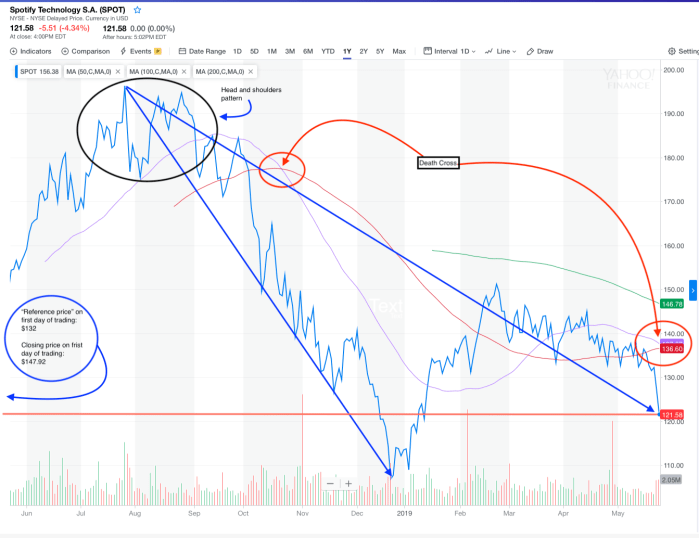
Anyway…if you look at the following chart, you’ll see some interesting patterns developing over the short history of Spotify’s stock.  I don’t put a lot of trust in chart analysis, but some people do and it is one of the few things we have to rely on in this case because there is so much insider activity.

You’ll notice that there’s something of a “head and shoulders” pattern emerging when the stock reached its high on July 26, 2018 of $196.28.  This pattern is often associated with a move to the downside, sometimes a sharp move to the downside.

Spot 12-17-18

Sure enough, the stock went into a sputtering dive the next day and the dive has continued ever since.  Note that at the high, volume was rising.  The low volume of Spotify stock is another one of the untold stories and is another suggestion of price management in the background.

Once the downside move became apparent, which was about October 10, downward pressure accelerated on rising volume (relatively speaking since volume is low).  A couple weeks later, more sell signals confirmed the downside move.

Spot Projection 12-17-18

One signal that I found significant was the 50 and 100 day moving averages of the stock price crossed to the downside on October 22, which also happened to be the date that the stock traded and closed at $148.54–below $149.01, the closing price on the first day of trading.

Starting with the high at the head and shoulders formation, the stock has more or less collapsed on about a 45 degree downward angle ever since.  Why is that?  Possibly because the stock was priced too high to begin with.  Some people think that SPOT is just reacting to the overall market sell-off.  I don’t think that is true as SPOT has not moved in relation to the market since inception.  SPOT was higher on the market highs and lower on the market lows, so I don’t see the coupling argument at all.

Plus, Spotify announced a $1 billion stock buy back, so the price is rapidly declining in spite of the buyback.  Perhaps if Spotify had made a tender offer for shares at a fixed price, they could have supported the stock more successfully.

Based on the stock’s recent history, it would not be surprising to see SPOT retrace some of its collapse and rise to something in the $120-$130 range by the end of the year.  Then I suspect that it will decline to approximately $95 around the end of January.

After that, we shall see.  Obviously, this is not investment advice, just speculation based on some guesses derived from the chart.  But the chart is relevant because there’s unlikely to be any real change in the company’s financial position in the next six weeks.

Analyst Mark Hake has developed three different scenarios for where Spotify’s stock price will be in 2021:  $125.68, $61.42 and $38.39, but assigns a $114.89 price based on a probability analysis.  About where it is now, in other words.  His post in Seeking Alpha (“Spotify Has A Valuation Problem”) is a must read if you’re interested in financial analysis.

Spotify closed today at $116.50, down $2.17 in after hours trading.

What Does the New MLC Candidate Mean for the Copyright Office?

Nate Rau reports in The Tennessean that there is a new group competing to be the “Mechanical Licensing Collective” under the Music Modernization Act.  I would expect there will be at least one more group come forward in the coming weeks.  This competition was easy to expect, but it does call to account the short time frames for setting up the MLC in the Music Modernization Act.  Those time frames fail to take into account the potential delaying effects of competition.

Multiple competitors also suggests that whoever wins the designation of the Copyright Office should be looking over their shoulder before the 5 year review of the MLC’s performance by the Copyright Office.  It’s likely that whoever is the runner-up in that designation pageant will still be around and may be critical of the winner when that 5 year review comes around.

It’s also worth noting that no one seems to be very interested in the music services’ counterpart to the MLC, being the “Digital Licensee Coordinator” or the “DLC”.  Whoever ends up getting to be the DLC is also going to be subject to a 5 year review, likely to be side by side with the MLC’s review.

As it now seems like there may be hard feelings on the part of the runner up for the MLC, this would be a good time for the Copyright Office to come up with objective criteria for both the selection of a winner and the definition of success when the 5 year review comes up.  It appears from the statutory language that Congress intends for the Copyright Office to come up with these criteria, and the clearer and more transparent the criteria, the less likely it will be for hard feelings to result in a meltdown.

The review of both the MLC and the DLC are governed by the same language in the Music Modernization Act:

Following the initial designation of the [mechanical licensing collective/digital licensee coordinator], the Register shall, every 5 years, beginning with the fifth full calendar year to commence after the initial designation, publish notice in the Federal Register in the month of January soliciting information concerning whether the existing designation should be continued, or a different entity meeting the criteria described in clauses (i) through (iii) of subparagraph (A) shall be designated. Following publication of such notice, the Register shall—

“(I) after reviewing the information submitted and conducting additional proceedings as appropriate, publish notice in the Federal Register of a continuing designation or new designation of the [mechanical licensing collective/digital licensee coordinator], as the case may be, and the reasons for such a designation, with any new designation to be effective as of the first day of a month that is not less than 6 months and not longer than 9 months after the date on which the Register publishes the notice, as specified by the Register; and

“(II) if a new entity is designated as the [mechanical licensing collective/digital licensee coordinator], adopt regulations to govern the transfer of licenses, funds, records, data, and administrative responsibilities from the existing mechanical licensing collective to the new entity.

The Congressional mandate to the Copyright Office is very broad–“soliciting information” could mean just about anything even remotely germane.  Given that the Copyright Office is to designate each of these crucially important offices empowered by Congress and to then measure their competency five years from now, it does seem that the Copyright Office would do well to give both the MLC and the DLC notice of what’s expected of each of them, and to do so before the designation is made.

For example, record keeping regarding customer service responsiveness, accuracy of the ownership database, overbudget or underbudget spending, complaints by songwriters, matching rates, number of audits of services undertaken, audit recoveries and distributions and executive compensation might all be relevant in the case of the MLC.

Some of these same criteria might be relevant for the DLC, although the DLC would have its own issues not common to the MLC.  These might include responsiveness of the DLC to potential blanket licensees, confidential treatment of competitive information, fair allocation of the assessment and communication with all licensees, especially the significant nonblanket licensees.

The Copyright Office would do well to recall the “seven anonymous amici” from the Microsoft antitrust litigation who were so dependent on Microsoft and so afraid of retaliation that they could not even use their own names to file an amicus brief in the case.  If the Copyright Office intends to have a candid assessment of either the MLC or the DLC, it might be a good idea to make an anonymous comment process available to competitors who fear retaliation.

If the Copyright Office makes a nonexhaustive list of qualities that constitute a successful completion of the five year trial period at the beginning of that period rather than the end, it might make succesful completion more likely.

Facebook Outage Reveals People Still Read the News Other Ways, Would YouTube Outage Reveal People Still Listen to Music?

I have often said that if I was able to persuade the entire entertainment industry to devote say 10% of their marketing spend to aardvark.com, then aardvark.com could be as big as YouTube.  This, of course, is an aspirational statement that doesn’t take into account how Google would react or how Google games search result, but you get the idea.

Somehow YouTube has managed to convince our marketing folk that they just can’t get along without the views and likes.  But is that really true?  Will people listen to music somewhere besides YouTube if YouTube wasn’t there?

Josh Schwartz writing at Nielman Lab gives us some insight into a somewhat analogous situation with Facebook and news sites:

At Chartbeat, we got a glimpse into that on August 3, 2018, when Facebook went down for 45 minutes and traffic patterns across the web changed in an instant. What did people do? According to our data, they went directly to publishers’ mobile apps and sites (as well as to search engines) to get their information fix. This window into consumer behavior reflects broader changes we see taking hold this year around content discovery, particularly on mobile.

So when YouTube tries to tell us that we can’t get along without them, which is definitely the implication of Google’s most recent charm offensive in the European Parliament, it may not even be a close call.  Particularly when you consider the downside from low royalties, unchecked stream ripping and YouTube’s corrosive safe harbor practices.

Fans found music they loved before YouTube and they will after YouTube, just like they did after Tower Records–and Tower Records didn’t spy on them.  And that’s what the Chartbeat research showed about news sites after the Facebook outage:

Key data points show that when Facebook went down, referrals to news sites fell, as expected — but other activity more than made up for it.

  • Direct traffic to publishers’ websites increased 11 percent, while traffic to publishers’ mobile apps soared 22 percent.

  • Search referral traffic to publishers was also up 8 percent.

  • Surprisingly, there was a net total traffic increase of 2.3 percent — meaning that the number of pages consumed across the web spiked upward in this timeframe.

What if it turned out that YouTube needed us more than we need YouTube?