
Europe Leads With A Solution to the “Safe Harbor”Problem

Recital 38 of proposed European Commission Digital Single Market reforms:

In order to ensure the functioning of any licensing agreement, information society service providers storing and providing access to the public to large amounts of copyright protected works or other subject matter uploaded by their users should take appropriate and proportionate measures to ensure protection of works or other subject matter, such as implementing effective technologies. This obligation should also apply when the information society service providers are eligible for the liability exemption provided in Article 14 of Directive 2000/31/EC.

The legacy safe harbors in the U.S. legislation commonly called the Digital Millennium Copyright Act (DMCA) and its European counterpart are a dichotomy:  The law provides a little latitude to reasonable people acting reasonably, but it also provides a smokescreen for those who are trying to fake their way to one of the great income transfers of all time.

Which players are on which side of that dichotomy?  One easy yardstick is the ISPs who participate in the Copyright Alert System and those who don’t.  CAS members have a real commitment to infrastructure, are not in a line of business that is based on commoditizing other peoples value, and seem to have a genuine commitment to staying within the boundaries of the DMCA safe harbors.

And then there’s Google and its wholly owned subsidiary YouTube.  It’s been 10 years since Google acquired YouTube and it’s an even bigger mess today than it was when it was operated as a blatant infringement machine.  But the real risk about YouTube is that Google has shown other powerful multinational corporations that you don’t want to infringe a little–you want to infringe a lot.

Now we can add Facebook and Vimeo to the list of billionaires who profit themselves by hiding behind the DMCA safe harbors.  These others, especially Facebook, are likely to simply point to YouTube and say if you’re going to shut us down, you have to shut them down, too.

And they have a point.

That’s why it’s so refreshing to see the European Commission taking a selective approach to tackling safe harbor abuse.  While I’m sympathetic to the urge to try to abolish safe harbors altogether, I don’t think that’s fair to the good actors in the ISP space.  Wouldn’t you rather have other ISPs point to the good corporate citizens like AT&T, Cablevision, Comcast, Time Warner and Verizon as a model rather than Google and Facebook?  (After BMG Rights’ multimillion dollar victory over MIC Coalition member Cox Communications we have to assume that the industry understands where the boundary is, but time will tell.)

A better starting place for reforming safe harbor abuse might be to identify the bad actors and deny them the chance to misuse the law to commoditize the property rights of artists, among others.  Given the lobbying clout that Google and Facebook can bring to bear in the U.S., we’re probably going to have to wait for the European Commission to lead the way forward as they have with antitrust prosecutions of Google.

It should come as no surprise that nations that value their creators are willing to take on rapacious multinationals even as the Googles and Facebooks desperately try to increase the size of their lobbying footprint on the faces of Europeans.

Google Fiber Goes Wireless–Where Does That Leave Nashville?

There is no motion, because that which is moved must arrive at the middle before it arrives at the end, and so on ad infinitum.

Zeno’s Paradox of Motion

Nashville is one of the cities who was in early on Google Fiber–Google’s much vaunted gigabit fiber to the premises Internet service.  (Fiber is now reportedly called “Access” and is being downsized after Google’s reorganization under the “Alphabet” company name.)

The Nashville page for Google Fiber describes it as “Fiber is coming”.  Which must mean Fiber is not there yet.

According to recent reporting in Watchdog.org:

The Nashville Metro Council is considering a new ordinance to allow Google to quickly access utility poles and move existing equipment largely owned by rivals Comcast and AT&T. The measure will likely be voted on Sept. 6….Representatives from AT&T, Comcast and Google Fiber met with Nashville City Council members earlier this month to hash out the issue.Google Fiber claimed it might bypass the city if the ordinance isn’t passed.

That’s an interesting threat given other recent news regarding Fiber from The Wall Street Journal:

Google parent Alphabet Inc. is rethinking its high-speed internet business after initial rollouts proved more expensive and time consuming than anticipated, a stark contrast to the fanfare that greeted its launch six years ago.

Alphabet’s internet provider, Google Fiber, has spent hundreds of millions dollars digging up streets and laying fiber-optic cables in a handful of cities to offer web connections roughly 30 times faster than the U.S. average.

Now the company is hoping to use wireless technology to connect homes, rather than cables, in about a dozen new metro areas, including Los Angeles, Chicago and Dallas, according to people familiar with the company’s plans. As a result Alphabet has suspended projects in San Jose, Calif., and Portland, Ore.

Meanwhile, the company is trying to cut costs and accelerate its expansion elsewhere by leasing existing fiber or asking cities or power companies to build the networks instead of building its own.

It is well to remember that when Google nixed the Google Glass project, the decision came out of the blue when it encountered a consumer reaction ranging from yawn to outright hostility.  Also, Recode is reporting that “Google’s moonshot factory is having trouble getting products out the door.”

The Information reports that Fiber/Access is also struggling:

When Google was planning to launch its Fiber broadband and TV service, Fiber executives had ambitious hopes of signing up around 5 million subscribers in five years, said a person close to Google’s parent, Alphabet. But by the end of 2014, more than two years after service began, Google had only signed up around 200,000 broadband subscribers, said a former employee. The current number isn’t known, but it’s still well short of initial expectations, said another person close to Alphabet….But that’s only part of the story. Last month, Alphabet CEO Larry Page ordered Google Fiber’s chief, Craig Barratt, to halve the size of the Google Fiber team to 500 people, said the second person close to Alphabet.

The Watchdog.org report also discusses a recent poll about Fiber taken in Nashville

As Nashville and internet providers debate pole attachment rules, a recent poll shows most residents of the Music City think rules should be relaxed to expedite Google Fiber’s network growth there.

Local polling company icitizen found that 94 percent of Nashville residents favor “one-touch, make-ready” legislation that would allow a single utility crew to rewire poles for all providers to accommodate a new company. Eighty-five percent of respondents strongly favored the idea, while only 4 percent were opposed to such legislation. Icitizen polled more than 550 Nashville residents Aug. 18-24 for its survey….Watchdog asked [an citizen representative] if she was concerned about possible bias in the poll, given that the question about the legislation notes the current law is leading to a delay in Google Fiber rollout but doesn’t emphasize the argument of rival telecom providers that one-touch, make-ready impedes on their property rights and doesn’t offer sufficient relief or notification in case their equipment is damaged. The question does note the concerns over possible disruption of infrastructure and giving a shortcut to Google.

The poll also omitted the fact that Fiber/Access is downsizing by 50% and is planning on shifting to wireless anyway.  So why should Nashvillians go through the headache of “one-touch make-ready” in the first place?  Google’s championing of the issue almost looks calculated to create a negative public perception of Google’s competitors in the Nashville market.

Austin has recently suffered through the Silicon Valley-style “take my ball and go home” tactics with Google Ventures portfolio company Uber.  (Uber’s ballot proposition was defeated by a 56% majority after Uber and Lyft’s $10 million campaign trying to get Austin to yes backfired.)  While some were aware that Uber is planning on replacing its independent contractor drivers with driver-less cars, most voters in the substantial majority of the Austin community rejected Uber’s threats anyway.

I’m not saying the two are synonymous, but it’s a lot easier for Google to leave Nashville before it installs cables on poles or wireless infrastructure.  It’s hard to believe that a 50% cut in the Fiber workforce will result in anything like the bubbly version of the future of Fiber in Nashville that Nashvillians were thinking of when they took that poll.

If Nashville residents were told that they were going to get half the customer support and none of the pole problems, there’s no telling how that poll would have turned out.

Spotify IPO Watch: Blame ≠ Profit

11949849771043985234traffic_light_red_dan_ge_01-svg-med


By its own calculation, Spotify dominates the global streaming music market.  According to a 2014 speech by Will Page, Spotify’s director of economics, as reported by Billboard:

….Page noted Spotify has launched in 32 of the 37 countries where streaming is the primary digital source of revenue. Page also pointed out that Spotify is half of the $1.5 billion global subscription streaming market. In the U.S. market, Spotify made up approximately 90 percent of last year’s growth in subscription revenue, according to Page.

While competition from Apple is certainly heating up, Spotify still is the dominant company in the space.  According to the Wall Street Journal, Spotify’s revenues nearly doubled to $2 billion last year and is expected to do well again this year.

Like Pandora and every other IPO-focused music service except for perhaps Tidal, Spotify blames its inability to make a profit on royalty payments rather than on its self-inflicted battle with Apple and spending levels based on a growth strategy.

Spotify also took on a billion dollar convertible loan at what will turn out to be credit card interest rates to fund that grown strategy.   Not to fund royalties, but to fund growth and competition with Apple.

Spotify’s main arguments about why no IPO is summed up in a Wall Street Journal article that misses a few key points, but the lead paragraph is revealing:

As Spotify AB gears up for a potential initial public offering next year, the music-streaming service is missing one key component in its pitch to investors: rights to play the music in years to come, according to people familiar with the matter.

First–as predicted, no Spotify IPO this year or for the foreseeable future.  And also as predicted, the blame for no IPO is not due to mismanagement by Spotify’s executive team, it’s due to The Evil Record Companies.  Due to solid reporting by Hanna Karp at WSJ,  Spotify’s “leak when you’re weak” strategy didn’t really give them what they wanted.
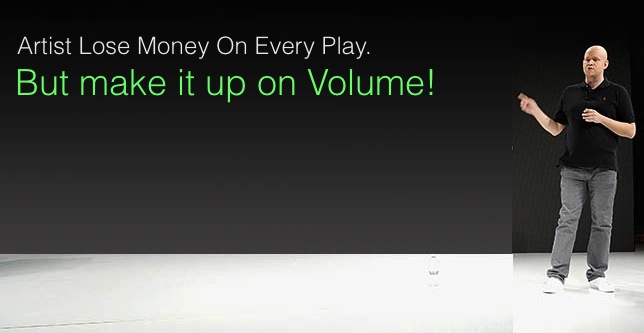
daniel-ek-spotify-ceo-2012billoardspoof-2

Leak When You’re Weak

Spotify has a long history of leaks, and in particular leaks that backfired.  This WSJ story is no exception.  The actual story is not one of “scrappy little startup beset by The Evil Record Companies” which is the narrative that Big Tech has been selling since 1999 and is getting a little dog eared.  This is particularly true of Spotify with a valuation greater than any record company’s.  However misguided that valuation, that is the one they have.

Rather, the story is that inexperienced management has tried to play in the tall weeds with the big dogs on Wall Street and are embarrassing themselves from the financial corner they are painted into by the shortcomings of their own business strategy.

Nobody but Spotify got Spotify into the corner they’re in.  And that’s the story that the WSJ is telling.

How did they get there?  Lavish spending, rapid expansion, high executive salaries and a general failure to capitalize on the many markets in which Spotify operates before entering new and uncertain markets is not a good look for a “start up” with a higher market capitalization than that of any one record company they do business with.

And then there’s the songwriters–not mentioned once by the WSJ.  Spotify is outright stealing from songwriters by using unlicensed songs for which they don’t pay royalties.  So where ever Spotify comes up with this “we pay 70% of revenues in royalties” begs the question–if that’s true, then why are there two class action lawsuits brought against Spotify by songwriters for nonpayment?

Why did Spotify have to make a quick settlement with the National Music Publishers Association (former owner of Spotify’s licensing service provider)?  Why are there rumors that many independent publishers rejected that settlement and are planning their own class action?

That part of the story didn’t get included in the WSJ’s reporting, but you know who notices that kind of story?  Bondholders.

And bondholders have a clause in the typical bond that in extreme cases allows them to take over the company in cases of insolvency and a reasonable expectation that the bonds can’t be paid due to the uncured mismanagement of the debtor–an event which, at best, may result in a call for accelerated repayment of the loan or a reset of the bond’s interest rate–higher, and with even more warrant coverage.

Market Conditions

While the publicly traded tech sector leaders and the broader indices have recovered somewhat from earlier lows driven by downward pressure on oil prices and the Brexit crash, the U.S. IPO market is still in the doldrums and is likely to stay there for the rest of 2016 and probably at least the first quarter or two of 2017.

In order for a high risk investment like Spotify to get a full commitment underwriting syndicate interested in floating the company’s stock on a public exchange at a valuation that smells like victory in the morning, it’s going to need to do better than it’s doing now or has done in the last few years.  This is the point at which underwriters ask why a company with a $2 billion top line cannot seem to make a profit.  Will those underwriters be willing to accept The Evil Record Company story more than The Incompetent Management story?  Or The Incompetent Management Can’t Manage Their Vendors story?

Absent the “greater fool” frothiness in the markets which I don’t see coming back from 1999 any time soon, a lack of “irrational exuberance” may means goodbye IPO for Spotify and hello Chapter 11.

And Then There’s the Debt

Said another way, the earliest that Spotify could IPO in the U.S. is likely to be more than one year from March 29, 2016, the date that Spotify announced its $1 billion convertible note with Texas Pacific Group, hedge fund Dragoneer and Goldman Sachs clients.

If Spotify holds a public offering in the next year [that is, before March 29, 2016], TPG and Dragoneer will be able to convert the debt into equity at a 20% discount to the share price of the public offering, according to two people briefed on the deal. After a year, that discount increases by 2.5 percentage points every six months, the people said.

Spotify also agreed to pay annual interest on the debt that starts at 5% and increases by 1 percentage point every six months until the company goes public, or until it hits 10%, the people said. This interest—also called a “coupon” and in this case paid in the form of additional debt, rather than cash—is commonly used in private-equity deals but rarely seen in venture funding.

So the equity warrants start to decrease 18 months out, i.e., starting around September 2017, but the interest rate will increase from 5% to 6% around the end of September 2016–next month, that is.

Running Spotify will get very much more expensive in about 30 days from today.  That has nothing to do with royalty payments or licenses.

Do you think that Spotify executives will be asked to take salary cuts?  Cancel magazine subscriptions?  Fly coach? Move from Manhattan to Syracuse?  No more Uber black cars?

And will that make the bondholders happy?

When is a Down Round Not Called A Down Round?

When it is convertible debt, apparently.  Companies often use debt to avoid closing a round of financing at a valuation that is lower than the last round of financing.  Why?  Because there are usually antidilution penalties that are triggered to protect the “pre-money” shareholders from being diluted by the subsequent down round that they may or may not invest in, too.

Even so, Spotify’s debt may have already diluted the pre-debt valuation of the company. Again, according to the Wall Street Journal:

While Spotify’s valuation doesn’t technically change with the debt round, one of its mutual-fund investors has marked down its stake. Fidelity Investments held its Spotify shares at [absurdly high stock price of] $1,643 a share in January, down 27% from last August, according to regulatory filings. [That’s a markdown from an implied share price of an even more exuberant share price of $2,250.] Another mutual fund, Vanguard International Growth, paid $2,229 a share for a stake in Spotify and still held it at that price as of December.  [Attention Vanguard shareholders!]

The Deal is Bad and They Are Untrustworthy

If the songwriter experience with Spotify is any guide, you can’t trust these people to run what is essentially a glorified record club unless they are under the watchful eye of a magistrate judge.

On top of that, they routinely seem to leak terms in an effort to get themselves a better deal with the people who actually own the rights they need to license.

If people want to do exclusives with Apple, they’re going to do them even if the dominant multinational in the space–that means Spotify–doesn’t like Apple getting those deals.  Maybe if Spotify got caught up on all their songwriter payments they’d be more worthy of sympathy.  In fact, maybe the songwriters (who are often the artists, too) might even take their side occasionally.

These deals should have been closed long ago, and that’s a reflection on poor management at Spotify that can manage to borrow $1 billion, but can’t close a box when it comes to licensing their one product.

Show Me the Proof

There are two great canards at Spotify (and all subscription services that offer a free tier, to be fair):  Exclusives hurt their business and if consumers get something for free long enough, they’ll want to pay for it instead.

There is no public consumer research that I’m aware of that supports either of these conclusions.

I’d love to hear about that research, I’m all ears.  Maybe its just another excuse for not being able to turn a profit on $2 billion of top line revenue.

Conclusion:  No Spotify IPO, not now, maybe never

As I’ve written before on Spotify IPO Watch, a combination of factors have gotten Spotify where it is now.  Market conditions, bad management, arrogance, stiffing songwriters and getting too big, too fast.

Until all those things change to one degree or another, it’s likely that the Spotify IPO myth will remain just that.

Watch this Space: MTP Podcast on 100% Licensing with David Lowery, Steve Winogradsky, Chris Castle coming soon

The MusicTechPolicy podcast is back! Next week we will kick things off with a discussion of the Department of Justice [sic] ruling on 100% licensing and partial withdrawals. Participants will be David Lowery, Steve Winogradsky of Winogradsky/Sobel and author of Music Publishing: The Complete Guide and me. Watch this space for links to the podcast when […]

via Watch this Space: MTP Podcast on 100% Licensing with David Lowery, Steve Winogradsky, Chris Castle coming soon — MUSIC • TECHNOLOGY • POLICY

The MTP Interview: Alan Graham’s Artist’s Guide to Blockchain, Open Music Initiative, Smart Contracts and Dark Social (Part 1)

Chris Castle interviews innovator Alan Graham about blockchain, the Open Music Initiative, smart contracts and solving the online data problems for artists.

via The MTP Interview: Alan Graham’s Artist’s Guide to Blockchain, Open Music Initiative, Smart Contracts and Dark Social (Part 1) — MUSIC • TECHNOLOGY • POLICY

Cost Recovery and the DOJ’s 100% Licensing Scheme

After a prolonged and expensive process of soliciting public comments on potential betterments in the ASCAP and BMI consent decrees, the Department of Justice has decided to ignore all of the ideas presented and focus on the one thing that is almost guaranteed to destroy the PRO system in the U.S.–adopt the punitive policy of “100% licensing”.

Simply put, 100% licensing refers to the ability of a co-owner of an undivided interest in real property to grant a nonexclusive license to allow a third party to use the whole parcel without the consent (and potentially over the objection) of the co-owners.  A co-owner relying on this rule also assumes the obligation of accounting to the co-owner and to not license at a rate that constitutes economic waste of the property.

The Department of Justice seeks to apply this theory to song copyrights through the consent decrees.  After all the hopeful aspirations that the legacy consent decrees were going to be fixed by the Obama Administration, it now appears that at this late stage of the Administration’s term, the can will just get kicked down the road even further.

The Administration’s relatively new position appears to have been based on extraordinarily bad advice–advice that is so bad it looks punitive.  This in part because in order to get to the punchline, the Administration has to ignore the implications to international trade, replace a voluntary licensing doctrine with a government mandate, ignore written agreements between generations of songwriters, and impose untold transaction costs on songwriters without requiring an increase in royalty rates to permit cost recovery.

The Four Preconditions

It is true that the rule has been applied to copyright in the U.S. from time to time, but it is actually quite rare because of four preconditions.

First, to the extent the rule obtains at all, it is a U.S. creature.   Applying this rule to copyrights originating in countries other than the U.S. when the rule is not recognized in those other nations raises the real possibility that the proposed application by the DOJ is unlawful.  In fact, it may actually be a treaty violation that could cause the United States to be hailed into a WTO arbitration.  (See Fairness in Music Licensing Act where that exact thing happened, the U.S. lost, and U.S. taxpayers are subsidizing foreign songwriters.)

The rule also involves voluntary licensing by the co-owner.  To my knowledge, it has never been applied to a government mandated license in copyright, real property or otherwise.  (If the DOJ is confident in its position, then I for one would like to see this issue briefed.)  I am also not familiar with cases where the license is issued over the objection of the co-owner.

The rights of the co-owner typically will originate with some agreement or purchase agreement that grants to the co-owner the right to the use of the whole of the property even though they only own a partial interest.  In order to be effective, the co-owner license must not violate an agreement to the contrary between or among the co-owners.

At a minimum, songwriters often avail themselves of “song split agreements” to document their percentage ownership.  Since song split agreements typically provide for each writer to administer their respective shares of copyright, it is likely that there are hundreds of thousands, if not millions, of song split agreements covering songs available under ASCAP and BMI blanket licenses.

Not only are there likely to be written agreements covering these songs, the fact that each songwriter has registered their works with their respective PROs of which they are writer members is pretty easily interpreted as an “implied in fact” contract from the mere uncontested registration of song shares with multiple PROs.  As the U.S. Supreme Court noted in Baltimore & Ohio R. Co. v. United States, 261 U.S. 592 (1923):

[A]n agreement “implied in fact” founded upon a meeting of minds, which, although not embodied in an express contract, is inferred, as a fact, from conduct of the parties showing, in the light of the surrounding circumstances, their tacit understanding.

What could be clearer than the uncontested act of PRO registration?

Perhaps most importantly and most relevantly for this post, the co-owner’s license is presumed to be negotiated at a rate that will take into account the cost of the license to the  granting co-owner.  This is another place that the DOJ’s proposed rule disintegrates or even becomes punitive.

Under the DOJ’s proposed 100% licensing rule, the applicable rate payable to PROs under the consent decrees is a rate for the use of the music licensed.  No rate court took into account the “surprise” cost of administering songs in a 100% licensing world now being created by the DOJ from whole cloth.

Cost Recovery

Since the cost of administering these licenses was never included in the rate, any fee charged for 100% licensing by PROs would simply offset the costs for the convenience of the licensee music user and not be a rate for the benefit of songwriters, it seems proper that any music user seeking to trade on this theory should pay the freight.

In other words, ASCAP and BMI songwriters should be able to charge a fee for the convenience of 100% licensing that should be outside of the consent decrees and rate courts altogether.  If not, the new transaction cost of administering 100% licensing when deducted from the already minuscule rate court license fees may well cause the music user to be in a better position than she would be in if the PRO had fully performed under the consent decree’s terms.

This is particularly true regarding the rates that were mandated by the two rate court judges without an opportunity for songwriters to be heard regarding these additional “surprise”regulatory costs now contemplated by the Department of Justice.

If the Obama Administration wants to lame duck their way out of amending (or terminating) these ancient consent decrees, they could at least do songwriters the courtesy of telling them to their faces.


The Great Artist Revolt: Are Apple Music and Spotify a Solution to a Post-YouTube Reality?

As I noted in a recent Huffington Post blog, major labels are in the middle of renegotiations with YouTube, Google’s subsidiary and the world’s dominant video search engine.  These deals are relatively short term and are renegotiated every few years.

What’s different this time is that a growing number of artists and songwriters at the grassroots and established levels are asking a simple question:  How can the labels conclude any negotiation with YouTube that doesn’t address the problems with YouTube’s legacy “DMCA license” business?  Would this not trigger an artist revolt if their demands are not met?

You may say you’ve never heard the term “DMCA license”.  It’s a term that has come to describe a bargaining position that plays a desire to push an extreme interpretation by a music user of the “notice and takedown” rules that twists the statute into an unrecognizable shape–so the users have neither a DMCA compliant service nor a license.  The DMCA license is predicated on  the user having an essentially unlimited litigation budget that allows the user to strong arm an entire industry.  There is only one company in this category at the moment–Google–but others like Vimeo and Facebook are not far behind.

Will Negotiations Fail?

There are at least three key points to be addressed in any new deal with YouTube: updating YouTube’s legacy revenue share based royalty, marketing restrictions (such as on selling artist names as keywords and the use of recordings in UGC not approved by artists), but most importantly Google’s aggressive DMCA practices in both search and on YouTube.

For the first time, artists are crossing Google’s DMCA position in search with YouTube’s desire to have the cover of licenses on YouTube.

As of this writing, Google is rumored to be holding the line in their renegotiations regardless of what the artists want.  When you consider the issues we covered in YouTube’s Messaging Problem, it’s not surprising that the brittle true believers in Google’s policy shop make compromise on Google’s legacy business an impossibility (like long-time true believer Fred Von Lohmann, chief architect of the Electronic Frontier Foundation’s legal strategy to destroy artists livelihood).

This leads me to believe that when confronted with these choices, the negotiations with YouTube will fail.  This is unfortunate, because what really should be happening is that YouTube should agree to take the DMCA safe harbor off the table if they are getting a license.  It seems not only logically inconsistent to have both a real license and a faux DMCA license, trying to combine the two comes up with an unworkable and frustrating structure.

If YouTube wants the benefits of a license with copyright owners, they should not be surprised that artists expect them to abandon the safe harbor for those licensed recordings, adopt a private arbitration process to resolve disputes, and respect the marketing restrictions that artists reasonably expect.

6de1a479-0b7b-441e-a38d-4fa4d16f8b5d

Where Do We Go if Negotiations Fail?

There’s no reason that official videos could no longer be available on Vevo that is partly owned by YouTube–although expect YouTube to violate their fiduciary duties as a stockholder if major label partners withdraw from YouTube.

The most likely outcome of getting out of the YouTube deals will be a renewed emphasis on alternative video sites like Apple and Spotify.  There’s actually no reason not to start working more closely with those two services right away which will address the artist displeasure with Google.

Plus, as I spun out a bit more on the Huffington Post, YouTube has the great benefit of label marketing budgets spent to drive traffic to YouTube (as well as marketing resources from companies in all other copyright categories).  If those budgets are redeployed to drive traffic away from litigious companies that insult artists with aggressive and unreasonable DMCA positions, the industry will be better prepared for the inevitable “step away” from YouTube.

I think that labels need to be coming to grips with a succession plan as it seems increasingly unlikely that Google will stop acting on the advice of the “policy people” who have never sold a record in their lives.

If the labels fail to satisfy their artists, there will no doubt be an artist revolt.


@linamkhan: How to reboot the FTC — Artist Rights Watch

Since the FTC closed its investigation of Google’s business practices, researchers have found that Google ties its content to its search results in ways that harm the public—one of the very practices that FTC had scrutinized and decided posed no problems.

via @linamkhan: How to reboot the FTC — Artist Rights Watch

Bad Medicine, No Spoonful of Sugar: How Useful is Blockchain for Music?

A Guest Post By Alan Graham of OCL.  Let’s get real. There’s a lot of talk about data and transparency and blockchain these days when it comes to the music industry. This will solve everything! However, there are issues no one seems to want to discuss that also need immediate attention. So let’s open up and take a very bitter […]

via Guest Post: Bad Medicine, No Spoonful of Sugar — MUSIC • TECHNOLOGY • POLICY

In this guest post, UK technologist Alan Graham offers some penetrating insights into what the much ballyhooed blockchain will and won’t do, and some technologies that are not so far over the horizon that we should all be thinking about how to bring into a safe and sane environment.

Pandora Sees the Light On Audit Rights

Music industry licenses that require a music service to pay a royalty to a copyright owner have traditionally included what’s come to be called an “audit clause”.  Because so much information required to actually confirm that royalties are paid properly is under the control of the person doing the paying, the control of that information by the party in whose interest  lies the underpayment creates significant moral hazard.

Under Pandora’s new version of the direct publishing license for their on-demand streaming service currently being circulated by MRI, we get some good news.  Here’s why….

In the MRI license Pandora has dropped many of the restrictions on royalty compliance examinations (commonly called “audits”) that it tried to get the Copyright Royalty Judges to impose on artists and record companies through the sound recording statutory license.  SoundExchange conducts these audits under the compulsory license on behalf of featured artists, nonfeatured artists and sound recording owners.

This will, no doubt, come up on one of the appeals of the CRJs, so hopefully the ruling of the Copyright Royalty Judges (called “Web IV”) on this issue will now be moderated by reality in the form of this new Pandora commercial benchmark.  And we all know how important Pandora’s contracting practices are for benchmarking the law the rest of us must live under.

Digital services are new to royalty audits and have perpetuated the charade started with the very record companies these services are quick to criticize–this time that somehow only certified public accountants have the qualifications to conduct royalty audits of the services.

There is a great tradition in record deals of trying to load up as many restrictions as possible on the artist’s auditor to suppress the number of “inbound” audits coming at the record company.  Almost all record companies will drop the CPA requirement, because in reality everyone knows that royalty compliance has nothing to do with GAAP, financial statements or any of the other tools of the CPA’s trade.  More on this below from a Warner Music Group executive.

Royalty compliance examinations are a science of knowing where to look, knowing when you’re being lied to, and having the means to hold feet to the fire.  And due to the complexity of streaming and its billions of lines of royalties, an auditor also needs to have the technical expertise, staff and systems to manage enormous volumes of data.

This is not a knock on CPAs, but that expertise has nothing to do with GAAP or the skill set tested by the CPA licensing examinations.  The reason that a digital service traditionally wants a CPA requirement is that (1) it is usually more expensive (unnecessarily so), and most importantly (2) very few CPAs do royalty compliance examinations of digital services so the service is likely to be audited by someone who doesn’t know where–or how–to look.  (All due respect to CPAs, but royalty compliance–especially the specific skill set required for digital service audits–is simply not part of their training.)

The National Association of Broadcasters went even further in the recent Web IV proceeding with the full-throated support of Pandora’s CFO Michael Herring–under the CRJ’s new rules not only must a compulsory license audit be conducted by a certified public accountant, that CPA must also be licensed in the jurisdiction where the audit is conducted.  This is another one of the real howlers enunciated with a straight face by the Copyright Royalty Judges in their Web IV determination recently published.  (See the final determination paragraph G6.)

Not even the evil record companies ever tried to get away with this licensing requirement under the audit clauses of record deals, probably because they would have been laughed out of the room.  Unfortunately, that’s not possible with the government’s boot on your throat in the form of the Copyright Royalty Judges.

Warner Music Group executive Ron Wilcox gave an excellent summary of this issue in his Web IV testimony (at p. 15):

WMG’s agreements generally do not require that a certified public accountant (“CPA”) perform royalty audits with its digital partners. Auditors who conduct royalty audits of digital services generally do not draw on the set of skills required to pass the CPA exam.

Rather, royalty auditors must be able to understand the technical systems that WMG’s partners use, to interpret data those systems maintain and generate, and the like. For example, a royalty auditor may have to examine a streaming service’s server logs and content databases to determine the accuracy of the service’s statement of performances and royalty payments.

This could require understanding how the service’s systems record digital performances, how those records are retained, and how those records are used to generate royalty statements. In addition, royalty auditors must be familiar with some of the unique conventions and jargon in the music industry as well as the royalty terms applicable to each service provider.

For instance, auditors need to understand how to calculate a pro-rata share from a label pool, how performances are defined in the relevant contracts, and how to account for non-royalty-bearing plays.

Because royalty audits require extensive technical and industry-specific expertise, in WMG’s experience a CPA certification is not generally a requirement for conducting such audits. To my knowledge, some of the most experienced and knowledgeable royalty auditors in the music industry are not CPAs.

For some unknown reason, the Copyright Royalty Judges chose to disregard this testimony from one of the most experienced and knowledgeable executives in the music business.  Who happened to get the issue exactly right, by the way.

So the CRJ’s disconnected ruling on this issue was unfortunate.  Especially so because this ruling affects all SoundExchange audits–conducted on behalf of artists, musicians, vocalists and record companies.  The CRJ’s ruling makes an already difficult practice Jesuitical in the extreme and adds untold expense and inefficiency to an already cumbersome process.

But good news has come to light–actually great news.  Pandora has seen the error of their ways on this issue and has dropped both the CPA requirement and the licensing requirement in its most recent push for direct licensing conducted by MRI.  This is truly great news and indicates a welcome change of heart at Pandora.

Here’s the new language in Pandora’s announced streaming service:

Audit: In order to enable PUBLISHER to be satisfied that it is being accounted to on an accurate and timely basis in connection with the Pandora Services (including by verifying that the calculation of all financial information is correct), PUBLISHER may appoint an independent third-party auditor (“Auditor”) to examine and make copies and extracts of Pandora’s books, records and server logs related to the use of PUBLISHER Compositions and fulfillment of Pandora’s obligations under this Agreement (collectively, the “Accounting Materials”), such audit to occur at Pandora’s offices and at PUBLISHER’s expense.

This is a triumph of reason over the absurdly out of touch positions taken during Web IV by Pandora, NAB and others, and should immediately be brought to the attention of the appeals court to conform the audit regulations in line with the Pandora commercial benchmark.