Creators Rally Behind Cyril Vetter’s Termination Rights Case in the Fifth Circuit

Songwriter and publisher Cyril Vetter is at the center of a high-stakes copyright case over his song “Double Shot of My Baby’s Love” with massive implications for authors’ termination rights under U.S. law. His challenge to Resnik Music Group has reached the Fifth Circuit Court of Appeals, and creators across the country are showing up in force—with a wave of amicus briefs filed in support including Artist Rights Institute.  Let’s consider the case on appeal.

At the heart of Vetter’s case is a crucial question: When a U.S. author signs a U.S. contract governed by U.S. law and then later the author (or the author’s heirs) invokes their 35-year termination right under Sections 203 and 304 of the U.S. Copyright Act, does that termination recover only U.S. rights (the conventional wisdom)—or the entire copyright, including worldwide rights?  Vetter argued for the worldwide rights at trial.  And the trial judge agreed over strenuous objections by the music publisher opposing Cyril.

Judge Shelly Dick of the U.S. District Court for the Middle District of Louisiana agreed. Her ruling made clear that a grant of worldwide rights under a U.S. contract is subject to U.S. termination. To hold otherwise would defeat the statute’s purpose which seems obvious.

I’ve known Vetter’s counsel Tim Kappel since he was a law student and have followed this case closely. Tim built a strong record in the District Court and secured a win against tough odds. MTP readers may recall our interviews with him about the case, which attracted considerable attention. Tim’s work with Cyril has energized a creator community long skeptical of the industry’s ‘U.S. rights only’ narrative—a narrative more tradition than law, an artifact of smoke filled rooms and backroom lawyers.

The Artist Rights Institute (David Lowery, Nikki Rowling, and Chris Castle), along with allies including Abby North (daughter-in-law of the late film composer Alex North), Blake Morgan (#IRespectMusic), and Angela Rose White (daughter of the late television composer and music director David Rose), filed a brief supporting Vetter. The message is simple: Congress did not grant a second bite at half the apple. Termination rights are meant to restore the full copyright—not just fragments.

As we explained in our brief, Vetter’s original grant of rights was typical: worldwide and perpetual, sometimes described as ‘throughout the universe.’ The idea that termination lets an author reclaim only U.S. rights—leaving the rest with the publisher—is both absurd and dangerous.

This case is a wake-up call. Artists shouldn’t belong to the  ‘torturable class’—doomed to accept one-sided deals as normal. Termination was Congress’s way of correcting those imbalances. Terminations are designed by Congress to give a second bite at the whole apple, not the half.

Stay tuned—we’ll spotlight more briefs soon. Until then, here’s ours for your review.

Steve’s Not Here–Why AI Platforms Are Still Acting Like Pirate Bay

In 2006, I wrote “Why Not Sell MP3s?” — a simple question pointing to an industry in denial. The dominant listening format was the MP3 file, yet labels were still trying to sell CDs or hide digital files behind brittle DRM. It seems kind of incredible in retrospect, but believe me it happened. Many cycles were burned on that conversation. Fans had moved on. The business hadn’t.

Then came Steve Jobs.

At the launch of the iTunes Store — and I say this as someone who sat in the third row — Jobs gave one of the most brilliant product presentations I’ve ever seen. He didn’t bulldoze the industry. He waited for permission, but only after crafting an offer so compelling it was as if the labels should be paying him to get in. He brought artists on board first. He made it cool, tactile, intuitive. He made it inevitable.

That’s not what’s happening in AI.

Incantor: DRM for the Input Layer

Incantor is trying to be the clean-data solution for AI — a system that wraps content in enforceable rights metadata, licenses its use for training and inference, and tracks compliance. It’s DRM, yes — but applied to training inputs instead of music downloads.

It may be imperfect, but at least it acknowledges that rights exist.

What’s more troubling is the contrast between Incantor’s attempt to create structure and the behavior of the major AI platforms, which have taken a very different route.

AI Platforms = Pirate Bay in a Suit

Today’s generative AI platforms — the big ones — aren’t behaving like Apple. They’re behaving like The Pirate Bay with a pitch deck.

– They ingest anything they can crawl.
– They claim “public availability” as a legal shield.
– They ignore licensing unless forced by litigation or regulation.
– They posture as infrastructure, while vacuuming up the cultural labor of others.

These aren’t scrappy hackers. They’re trillion-dollar companies acting like scraping is a birthright. Where Jobs sat down with artists and made the economics work, the platforms today are doing everything they can to avoid having that conversation.

This isn’t just indifference — it’s design. The entire business model depends on skipping the licensing step and then retrofitting legal justifications later. They’re not building an ecosystem. They’re strip-mining someone else’s.

What Incantor Is — and Isn’t

Incantor isn’t Steve Jobs. It doesn’t control the hardware, the model, the platform, or the user experience. It can’t walk into the room and command the majors to listen with elegance. But what it is trying to do is reintroduce some form of accountability — to build a path for data that isn’t scraped, stolen, or in legal limbo.

That’s not an iTunes power move. It’s a cleanup job. And it won’t work unless the AI companies stop pretending they’re search engines and start acting like publishers, licensees, and creative partners.

What the MP3 Era Actually Taught Us

The MP3 era didn’t end because DRM won. It ended because someone found a way to make the business model and the user experience better — not just legal, but elegant. Jobs didn’t force the industry to change. He gave them a deal they couldn’t refuse.

Today, there’s no Steve Jobs. No artists on stage at AI conferences. No tactile beauty. Just cold infrastructure, vague promises, and a scramble to monetize other people’s work before the lawsuits catch up. Let’s face it–when it comes to Elon, Sam, or Zuck, would you buy a used Mac from that man?

If artists and AI platforms were in one of those old “I’m a Mac / I’m a PC” commercials, you wouldn’t need to be told which is which. One side is creative, curious, collaborative. The other is corporate, defensive, and vaguely annoyed that you even asked the question.

Until that changes, platforms like Incantor will struggle to matter — and the AI industry will continue to look less like iTunes, and more like Pirate Bay with an enterprise sales team.

The OBBBA’s AI Moratorium Provision Has Existential Constitutional Concerns and Policy Implications

As we watch the drama of the One Big Beautiful Bill Act play out there’s a plot twist waiting in the wings that could create a cliffhanger in the third act: The poorly thought out, unnecessary and frankly offensive AI moratorium safe harbor that serves only the Biggest of Big Tech that we were gifted by Adam Theirer of the R Street Institute.

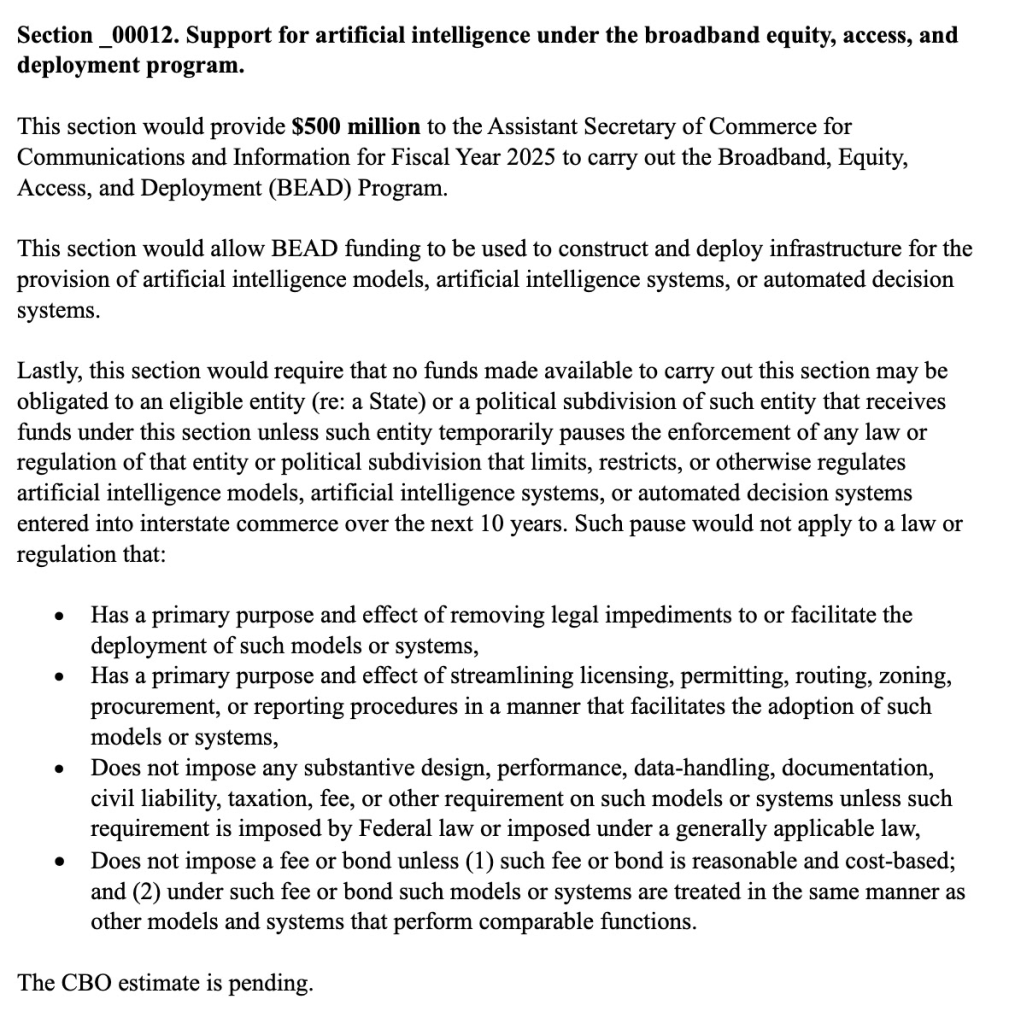
The latest version of the AI moratorium poison pill in the Senate version of OBBBA (aka HR1) reads something like this:

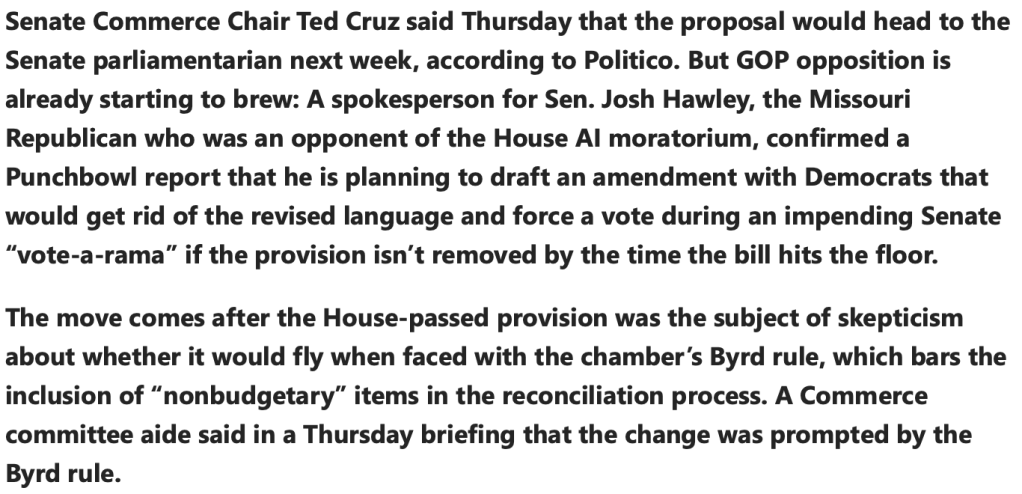
The AI moratorium provision within the One Big Beautiful Bill Act (OBBBA) reads like the fact pattern for a bar exam crossover question. The proposed legislation raises significant Constitutional and policy concerns. Before it even gets to the President’s desk, the legislation likely violates the Senate’s Byrd Rule that allows the OBBBA to avoid the 60 vote threshold (and the filibuster) and get voted on in “reconciliation” on a simple majority. The President’s party has a narrow simple majority in the Senate so if it were not for the moratorium the OBBBA should pass.

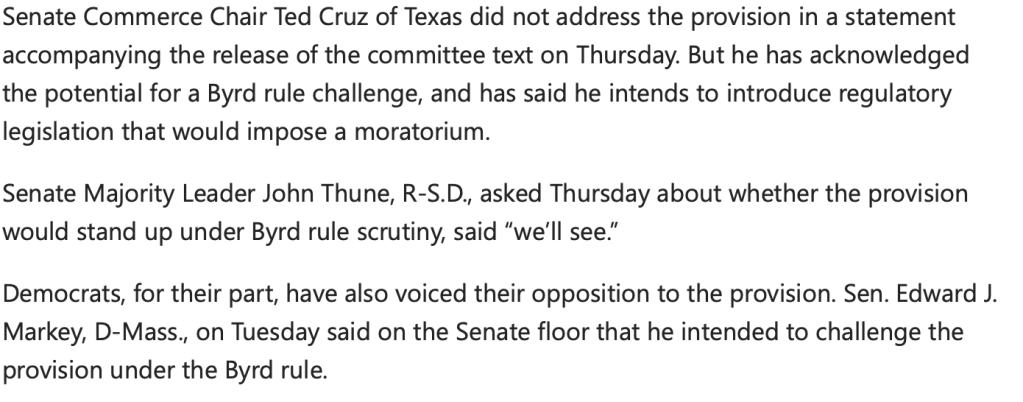
There are lots of people who think that the moratorium should fail the “Byrd Bath” analysis because it is not “germane” to the budget and tax process required to qualify for reconciliation. This is important because if the Senate Parliamentarian does not hold the line on germaine-ness, everyone will get into the act for every bill simply by attaching a chunk of money to your favorite donor, and that will not go over well. According to Roll Call, Senator Cruz is already talking about introducing regulatory legislation with the moratorium, which would likely only happen if the OBBBA poison pill was cut out:

The AI moratorium has already picked up some serious opponents in the Senate who would likely have otherwise voted for the President’s signature legislation with the President’s tax and spending policies in place. The difference between the moratorium and spending cuts is that money is fungible and a moratorium banning states from acting under their police powers really, really, really is not fungible at all. The moratorium is likely going to fail or get close to failing, and if the art of the deal says getting 80% of something is better than 100% of nothing, that moratorium is going to go away in the context of a closing. Maybe.

And don’t forget, the bill has to go back to the House which passed it by a single vote and there are already Members of the House who are getting buyers remorse about the AI moratorium specifically. So when they get a chance to vote again…who knows.

Even if it passes, the 40 state Attorneys General who oppose it may be gearing up to launch a Constitutional challenge to the provision on a number of grounds starting with the Tenth Amendment, its implications for federalism, and other Constitutional issues that just drip out of this thing. And my bet is that Adam Thierer will be eyeball witness #1 in that litigation.

So to recap the vulnerabilities:

Byrd Rule Violation

The Byrd Rule prohibits non-budgetary provisions in reconciliation bills. The AI moratorium’s primary effect is regulatory, not fiscal, as it preempts state laws without directly impacting federal revenues or expenditures. Senators, including Ed Markey (D-MA) as reported by Roll Call, have indicated intentions to challenge the provision under the Byrd Rule. The Hill reports:

Federal Preemption, the Tenth Amendment and Anti-Commandeering Doctrine

The Tenth Amendment famously reserves powers not delegated to the federal government to the states and to the people (remember them?). The constitutional principle of “anticommandeering” is a doctrine under U.S. Constitutional law that prohibits the federal government from compelling states or state officials to enact, enforce, or administer federal regulatory programs.

Anticommandeering is grounded primarily in the Tenth Amendment. Under this principle, while the federal government can regulate individuals directly under its enumerated powers (such as the Commerce Clause), it cannot force state governments to govern according to federal instructions. Which is, of course, exactly what the moratorium does, although the latest version would have you believe that the feds aren’t really commandeering, they are just tying behavior to money which the feds do all the time. I doubt anyone believes it.

The AI moratorium infringes upon the good old Constitution by:

  • Overriding State Authority: It prohibits states from enacting or enforcing AI regulations, infringing upon their traditional police powers to legislate for the health, safety, and welfare of their citizens.
  • Lack of Federal Framework: Unlike permissible federal preemption, which operates within a comprehensive federal regulatory scheme, the AI moratorium lacks such a framework, making it more akin to unconstitutional commandeering.
  • Precedent in Murphy v. NCAA: The Supreme Court held that Congress cannot prohibit states from enacting laws, as that prohibition violates the anti-commandeering principle. The AI moratorium, by preventing states from regulating AI, mirrors the unconstitutional aspects identified in Murphy. So there’s that.

The New Problem: Coercive Federalism

By conditioning federal broadband funds (“BEAD money”) on states’ agreement to pause AI regulations , the provision exerts undue pressure on states, potentially violating principles established in cases like NFIB v. Sebelius. Plus, the Broadband Equity, Access, and Deployment (BEAD) Program is a $42.45 billion federal initiative established under the Infrastructure Investment and Jobs Act of 2021. Administered by the National Telecommunications and Information Administration (NTIA), BEAD aims to expand high-speed internet access across the United States by funding planning, infrastructure deployment, and adoption programs. In other words, BEAD has nothing to do with the AI moratorium. So there’s that.

Supremacy Clause Concerns

The moratorium may conflict with existing state laws, leading to legal ambiguities and challenges regarding federal preemption. That’s one reason why 40 state AGs are going to the mattresses for the fight.

Lawmakers Getting Cold Feet or In Opposition

Several lawmakers have voiced concerns or opposition to the AI moratorium:

  • Rep. Marjorie Taylor Greene (R-GA): Initially voted for the bill but later stated she was unaware of the AI provision and would have opposed it had she known. She has said that she will vote no on the OBBBA when it comes back to the House if the Mr. T’s moratorium poison pill is still in there.
  • Sen. Josh Hawley (R-MO): Opposes the moratorium, emphasizing the need to protect individual rights over corporate interests.
  • Sen. Marsha Blackburn (R-TN): Expressed concerns that the moratorium undermines state protections, particularly referencing Tennessee’s AI-related laws.
  • Sen. Edward Markey (D-MA): Intends to challenge the provision under the Byrd Rule, citing its potential to harm vulnerable communities.

Recommendation: Allow Dissenting Voices

Full disclosure, I don’t think Trump gives a damn about the AI moratorium. I also think this is performative and is tied to giving the impression to people like Masa at Softbank that he tried. It must be said that Masa’s billions are not quite as important after Trump’s Middle East roadshow than they were before, speaking of leverage. While much has been made of the $1 million contributions that Zuckerberg, Tim Apple, & Co. made to attend the inaugural, there’s another way to look at that tableau–remember Titus Andronicus when the general returned to Rome with Goth prisoners in chains following his chariot? That was Tamora, the Queen of the Goths, her three sons Alarbus, Chiron, and Demetrius along with Aaron the Moor. Titus and the Goth’s still hated each other. Just sayin’.

Somehow I wouldn’t be surprised if this entire exercise was connected to the TikTok divestment in ways that aren’t entirely clear. So, given the constitutional concerns and growing opposition, it is advisable for President Trump to permit members of Congress to oppose the AI moratorium provision without facing political repercussions, particularly since Rep. Greene has already said she’s a no vote–on the 214-213 vote the first time around. This approach would:

  • Respect the principles of federalism and states’ rights.
  • Tell Masa he tried, but oh well.
  • Demonstrate responsiveness to legitimate legislative concerns on a bi-partisan basis.
  • Ensure that the broader objectives of the OBBBA are not jeopardized by a contentious provision.

Let’s remember: The tax and spend parts of OBBBA are existential to the Trump agenda; the AI moratorium definitely is not, no matter what Mr. T wants you to believe. While the OBBBA encompasses significant policy initiatives which are highly offensive to a lot of people, the AI moratorium provision presents constitutional and procedural challenges and fundamental attacks on our Constitution that warrant its removal. Cutting it out will strengthen the bill’s likelihood of passing and uphold the foundational principles of American governance, at least for now.

Hopefully Trump looks at it that way, too.

How the AI Moratorium Threatens Local Educational Control

The proposed federal AI moratorium currently in the One Big Beautiful Bill Act states:

[N]o State or political subdivision thereof may enforce, during the 10-year period beginning on the date of the enactment of this Act, any law or regulation of that State or a political subdivision thereof limiting, restricting, or otherwise regulating artificial intelligence models, artificial intelligence systems, or automated decision systems entered into interstate commerce.

What is a “political subdivision”?  According to a pretty standard definition offered by the Social Security Administration:

A political subdivision is a separate legal entity of a State which usually has specific governmental functions.  The term ordinarily includes a county, city, town, village, or school district, and, in many States, a sanitation, utility, reclamation, drainage, flood control, or similar district.

The proposed moratorium would prevent school districts—classified as political subdivisions—from adopting policies that regulate artificial intelligence. This includes rules restricting students’ use of AI tools such as ChatGPT, Gemini, or other platforms in school assignments, exams, and academic work. Districts may be unable to prohibit AI-generated content in essays, discipline AI-related cheating, or require disclosures about AI use unless they write broad rules for ‘unauthorized assistance’ in general or something like that.

Without clear authority to restrict AI in educational contexts, school districts will likely struggle to maintain academic integrity or to update honor codes. The moratorium could even interfere with schools’ ability to assess or certify genuine student performance. 

Parallels with Google’s Track Record in Education

The dangers of preempting local educational control over AI echo prior controversies involving Google’s deployment of tools like Chromebooks, Google Classroom, and Workspace for Education in K–12 environments. Despite being marketed as free and privacy-safe, Google has repeatedly been accused of covertly tracking students, profiling minors, and failing to meet federal privacy standards.  It’s entirely likely that Google has integrated its AI into all of its platforms including those used in school districts, so Google could likely raise the AI moratorium as a safe harbor defense to claims by parents or schools that they violate privacy or other rights with their products.

2015 complaint by the Electronic Frontier Foundation (EFF) alleged that Google tracked student activity even with privacy settings enabled although this was probably an EFF ‘big help, little bad mouth’ situation. New Mexico sued Google in 2020 for collecting student data without parental consent. Most recently, lawsuits in California allege that Google continues to fingerprint students and gather metadata despite educational safeguards.

Although the EFF filed an FTC complaint against Google in 2015, it did not launch a broad campaign or litigation strategy afterward. Critics argue that EFF’s muted follow-up may reflect its financial ties to Google, which has funded the organization in the past. This creates a potential conflict: while EFF publicly supports student privacy, its response to Google’s misconduct has been comparatively restrained.

This has led to the suggestion that EFF operates in a ‘big help, little bad mouth’ mode—providing substantial policy support to Google on issues like net neutrality and platform immunity, while offering limited criticism on privacy violations that directly affect vulnerable groups like students.

AI Use in Schools vs. Google’s Educational Data Practices: A Dangerous Parallel

The proposed AI moratorium would prevent school districts from regulating how artificial intelligence tools are used in classrooms—including tools that generate student work or analyze student behavior. This prohibition becomes even more alarming when we consider the historical abuses tied to Google’s education technologies, which have long raised concerns about student profiling and surveillance.

Over the past decade, Google has aggressively expanded its presence in American classrooms through products like Google Classroom, Chromebooks with Google Workspace for Education, Google Docs and Gmail for student accounts.

Although marketed as free tools, these services have been criticized for tracking children’s browsing behavior and location, storing search histories, even when privacy settings were enabled, creating behavioral profiles for advertising or product development, and sharing metadata with third-party advertisers or internal analytics teams.

Google previously entered into a 2014 agreement with the Electronic Frontier Foundation (EFF) to curb these practices—but watchdog groups and investigative journalists have continued to document covert tracking of minors, even in K–12 settings where children cannot legally consent to data collection.

AI Moratorium: Legalizing a New Generation of Surveillance Tools

The AI moratorium would take these concerns a step further by prohibiting school districts from regulating newer AI systems, even if they profile students using facial recognition, emotion detection, or predictive analytics, auto-grade essays and responses, building proprietary datasets on student writing patterns, offer “personalized learning” in exchange for access to sensitive performance and behavior data, or encourage use of generative tools (like ChatGPT) that may store and analyze student prompts and usage patterns

If school districts cannot ban or regulate these tools, they are effectively stripped of their local authority to protect students from the next wave of educational surveillance.

Contrast in Power Dynamics

IssueGoogle for EducationAI Moratorium Impacts
Privacy ConcernsTracked students via Gmail, Docs, and Classroom without proper disclosures.Prevents districts from banning or regulating AI tools that collect behavioral or academic data.
Policy ResponseLimited voluntary reforms; Google maintains a dominant K–12 market share.Preempts all local regulation, even if communities demand stricter safeguards.
Legal RemediesFew successful lawsuits due to weak enforcement of COPPA and FERPA.Moratorium would block even the potential for future local rules.
Educational ImpactCreated asymmetries in access and data protection between schools.Risks deepening digital divides and eroding academic integrity.

Why It Matters

Allowing companies to introduce AI tools into classrooms—while simultaneously barring school districts from regulating them—opens the door to widespread, unchecked profiling of minors, with no meaningful local oversight. Just as Google was allowed to shape a generation’s education infrastructure behind closed doors, this moratorium would empower new AI actors to do the same, shielded from accountability.

Parents groups should let lawmakers know that the AI moratorium has to come out of the legislation.

Now What? Can the AI Moratorium Survive the Byrd Rule on “Germaneness”?

Yes, the Big Beautiful Bill Act has passed the House of Representatives and is on its way to the Senate–with the AI safe harbor moratorium and its $500,000,000 giveaway appropriation intact. Yes, right next to Medicaid cuts, etc.

So now what? The controversial AI regulation moratorium tucked inside the reconciliation package is still a major point of contention. Critics argue that the provision—which would block state and local governments from enforcing or adopting AI-related laws for a decade—is blatantly non-germane to a budget bill. But what if the AI moratorium, in the context of a broader $500 million appropriation for a federal AI modernization initiative, isn’t so clearly in violation of the Byrd Rule? Just remember–these guys are not babies. They’ve thought about this and they intend to win–that’s why the language survived the House.

Remember, the assumption is that President Trump can’t get the BBB through the Senate in regular order which would require 60 votes and instead is going to jam it through under “budget reconciliation” rules which requires a simple majority vote in the Republican-held Senate. Reconciliation requires that there not be shenanigans (hah) and that the budget reconciliation actually deals with the budget and not some policy change that is getting sneaked under the tent. Well, what if it’s both?

Let’s consider what the Senate’s Byrd Rule actually requires.

To survive reconciliation, a provision must:
1. Affect federal outlays or revenues;
2. Have a budgetary impact that is not “merely incidental” to its policy effects;
3. Fall within the scope of the congressional instructions to the committees of jurisdiction;
4. Not increase the federal deficit outside the budget window;
5. Not make recommendations regarding Social Security;
6. Not violate Senate rules on germaneness or jurisdiction.

Critics rightly point out that a sweeping 10-year regulatory moratorium in Section 43201(c) smells more like federal policy overreach than fiscal fine-tuning, particularly since it’s pretty clearly a 10th Amendment violation of state police powers. But the moratorium exists within a broader federal AI modernization framework in Section 43201(a) that does involve a substantial appropriation: $500 million allocated for updating federal AI infrastructure, developing national standards, and coordinating interagency protocols. That money is real, scoreable, and central to the bill’s stated purpose.

Here’s the crux of the argument: if the appropriation is deemed valid under the Byrd Rule, the guardrails that enable its effective execution may also be valid – especially if they condition the use of federal funds on a coherent national framework. The moratorium can then be interpreted not as an abstract policy preference, but as a necessary precondition for ensuring that the $500 million achieves its budgetary goals without fragmentation.

In other words, the moratorium could be cast as a budget safeguard. Allowing 50 different state AI rules to proliferate while the federal government invests in a national AI backbone could undercut the very purpose of the expenditure. If that fragmentation leads to duplicative spending, legal conflict, or wasted infrastructure, then the moratorium arguably serves a protective fiscal function.

Precedent matters here. Reconciliation has been used in the past to impose conditions on Medicaid, restrict use of federal education funds, and shape how states comply with federal energy and transportation programs. The Supreme Court has rejected some of these on 10th Amendment grounds (NFIB v. Sebelius), but the Byrd Rule test is about budgetary relevance, not constitutional viability.

And that’s where the moratorium finds its most plausible defense: it is incidental only if you believe the spending exists in a vacuum. In truth, the $500 million appropriation depends on consistent, scalable implementation. A federal moratorium ensures that states don’t undermine the utility of that spending. It may be unwise. It may be a budget buster. It may be unpopular. But if it’s tightly tied to the execution of a federal program with scoreable fiscal effects, it just might survive the Byrd test.

So while artists, civil liberties advocates and state officials rightly decry the moratorium on policy grounds, its procedural fate may ultimately rest on a more mundane calculus: Does this provision help protect federal funds from inefficiency? If the answer is yes—and the appropriation stays—then the moratorium may live on, not because it deserves to, but because it was drafted just cleverly enough to thread the eye of the Byrd Rule needle.

Like I said, these guys aren’t babies and they thought about this because they mean to win. Ideally, somebody should have stopped it from ever getting into the bill in the first place. But since they didn’t, our challenge is going to be stopping it from getting through attached to a triple-whip, too big to fail, must pass signature legislation that Trump campaigned on and was elected.

And even if we are successful in stopping the AI moratorium safe harbor in the Senate, do you think it’s just going to go away? Will the Tech Bros just say, you got me, now I’ll happily pay those wrongful death claims?

Winning without Fighting: Strategic Parallels between TikTok and China’s “Assassin’s Mace” Weapons

To fight and conquer in all your battles is not supreme excellence; supreme excellence consists in breaking the enemy’s resistance without fighting.
Sun Tzu, The Art of War (Giles trans.)

In his must-read book The Hundred-Year Marathon, Michael Pillsbury describes China’s “Assassin’s Mace” weapons strategy as strategic systems designed to neutralize superior adversaries, particularly the United States. Assassin’s Mace weapons are asymmetric, cost-effective, and intended to exploit specific vulnerabilities in order to deliver a knockout blow.

Key characteristics include:

  • Asymmetry: Undermines U.S. advantages without matching its power.
  • Concealment: Many programs are secretive and deceptive.
  • Psychological Disruption: Designed to shock and paralyze response.
  • Preemptive Advantage: Intended to disable key systems early in a conflict.

Examples Pillsbury cites include anti-satellite weapons, cyberwarfare tools, EMPs, anti-ship ballistic missiles, and hypersonic glide vehicles.

It must also be said that the PRC has long had a doctrine of “military-civil fusion.” Military-Civil Fusion (MCF) doctrine is a national strategy aimed at integrating civilian industries, research institutions, and private enterprises with military development to enhance the capabilities of the People’s Liberation Army (PLA). The policy seeks to eliminate barriers between China’s civilian and military sectors, ensuring that technological advancements in areas like artificial intelligence (of which Bytedance is one of the top 5 AI developers in China), quantum computing, aerospace, and biotechnology serve both economic and defense purposes.

Key aspects of MCF include:

  • Technology Acquisition – The Chinese government encourages the transfer of cutting-edge civilian technologies to military applications, often through state-backed research programs and corporate partnerships.
  • Institutional Integration – The Central Military-Civil Fusion Development Committee, chaired by Xi Jinping, oversees the strategy to ensure seamless coordination between civilian and military entities.
  • Global Concerns – The U.S. and other nations view MCF as a security risk, citing concerns over intellectual property theft and the potential for civilian technologies to be repurposed for military dominance.

MCF is a cornerstone of China’s long-term military modernization, with the goal of developing a world-class military by 2049. If you’re familiar with China’s National Intelligence Law mandating cooperation by the civilian sector with the Ministry of State Security, this should all sound pretty familiar vis a vis TikTok.

Comparison to TikTok’s Data Mining and AI Algorithms

While not traditional kinetic weapons, TikTok’s AI and data collection tactics mirror many elements of an Assassin’s Mace—particularly in the information and psychological warfare domains.

Comparison:

FeatureAssassin’s Mace (Military)TikTok Data/A.I. (Civil-Info)
AsymmetricTargets U.S. military dependence on techTargets U.S. cultural and cognitive weaknesses
Concealed capabilitiesHidden programs in cyberwarfare or spaceOpaque algorithms and data harvesting
Psychological effectShock and morale disruptionBehavioral influence and identity shaping
Preemptive edgeDeployed early in conflictInfluences before conflict or overt tension
Cost/AttributionCheap and hard to detectSocial media disguise, plausible deniability
Dependency creationReduces U.S. tech autonomyEntrenches digital reliance on foreign platform

Strategic Parallels, MCF and National Security Implications

  • Informational Warfare: TikTok’s algorithmic controls may shape narratives aligned with CCP objectives.
  • Data as Weaponized Intel: TikTok collects biometric and behavioral data potentially usable for state profiling or surveillance.
  • AI as Force Multiplier: Data harvested fuels China’s military-linked AI development.
  • Cultural Erosion: Gradual influence can diminish U.S. civic cohesion and resilience.

Surrender Videos and CCP Use of Video as Psychological Operations (PsyOps)

The Chinese Communist Party (CCP) has increasingly leveraged video platforms—including domestic networks like WeChat and global platforms like TikTok—for strategic psychological operations aimed at foreign populations. These campaigns serve to erode morale, stir political divisions, and promote favorable perceptions of the Chinese regime.

A notable example includes the circulation of staged or coerced “surrender videos” purportedly featuring Taiwanese soldiers or civilians pledging allegiance to Beijing. Such footage is designed to sap resistance and cultivate an image of inevitable Chinese dominance over Taiwan, particularly in the event of an invasion or political crisis.

Another instance occurred on TikTok, where a Chinese user posted a video in fluent English urging Americans to support China and reject then-President Trump’s trade and tariff policies. I’m not a huge fan of the tariffs, but I found this video to be very suspicious.

The video called for solidarity with China and implied that U.S. opposition to Chinese economic expansion was both unjust and self-destructive. Though framed as personal opinion, such content aligns with Chinese state interests and is amplified by algorithms that may favor politically charged engagement. These efforts form part of a broader information warfare strategy wherein short-form video is used not only to manipulate algorithms and audience emotions but to subtly shift public opinion in democracies. By flooding feeds with curated messages, the CCP could exploit free speech protections in adversary nations to inject authoritarian narratives under the guise of popular expression

TikTok Could be a Combination Punch to Win Without Fighting

TikTok’s AI algorithms and extensive data collection constitute a modern parallel to China’s Assassin’s Mace strategy. Instead of missiles or EMPs, Beijing may be relying on AI-powered cognitive and cultural influence to erode Western resilience over time. This information-first strategy aligns with Pillsbury’s warning that America’s adversaries may seek to win without fighting a conventional war by use of strategic weapons like the Assassin’s Mace. As Master Sun said, win without fighting.

What Bell Labs and Xerox PARC Can Teach Us About the Future of Music

When we talk about the great innovation engines of the 20th century, two names stand out: Bell Labs and Xerox PARC. These legendary research institutions didn’t just push the boundaries of science and technology—they found solutions that brought us breakthroughs to challenges. The transistor, the laser, the UNIX operating system, the graphical user interface, and Ethernet networking all trace their origins to these hubs of long-range, cross-disciplinary thinking.

These breakthroughs didn’t happen by accident. They were the product of institutions that were intentionally designed to explore what might be possible outside the pressures of quarterly earnings reports–which means monthly which means weekly. Bell Labs and Xerox PARC proved that bold ideas need space, time, and a mandate to explore—even if commercial applications aren’t immediately apparent. You cannot solve big problems with an eye on weekly revenues–and I know that because I worked at A&M Records.

Now imagine if music had something like Bell Labs and Xerox PARC.

What if there were a Bell Labs for Music—an independent research and development hub where songwriters, engineers, logisticians, rights experts, and economists could collaborate to solve deep-rooted industry challenges? Instead of letting dominant tech platforms dictate the future, the music industry could build its own innovation engine, tailored to the needs of creators. Let’s consider how similar institutions could empower the music industry to reclaim its creative and economic future particularly confronted by AI and its institutional takeover.

Big Tech’s Self-Dealing: A $500 Million Taxpayer-Funded Windfall

While creators are being told to “adapt” to the age of AI, Big Tech has quietly written itself a $500 million check—funded by taxpayers—for AI infrastructure. Buried within the sprawling “innovation and competitiveness” sections of legislation being promoted as part of Trump’s “big beautiful bill,” this provision would hand over half a billion dollars in public funding—more accurately, public debt—to cloud providers, chipmakers, and AI monopolists with little transparency and even fewer obligations to the public.

Don’t bother looking–it will come as no surprise that there are no offsetting provisions for musicians, authors, educators, or even news publishers whose work is routinely scraped to train these AI models. There are no earmarks for building fair licensing infrastructure or consent-based AI training databases. There is no “AI Bell Labs” for the creative economy.

Once again, we see that innovation policy is being written by and for the same old monopolists who already control the platforms and the Internet itself, while the people whose work fills those platforms are left unprotected, uncompensated, and uninformed. If we are willing to borrow hundreds of millions to accelerate private AI growth, we should be at least as willing to invest in creator-centered infrastructure that ensures innovation is equitable—not extractive.

Innovation Needs a Home—and a Conscience

Bell Labs and Xerox PARC were designed not just to build technology, but to think ahead. They solved many future challenges often before the world even knew they existed.

The music industry can—and must—do the same. Instead of waiting for another monopolist to exercise its political clout to grant itself new safe harbors to upend the rules–like AI platforms are doing right now–we can build a space where songwriters, developers, and rights holders collaborate to define a better future. That means metadata that respects rights and tracks payments to creators. That means fair discovery systems. That means artist-first economic models.

It’s time for a Bell Labs for music. And it’s time to fund it not through government dependency—but through creator-led coalitions, industry responsibility, and platform accountability.

Because the future of music shouldn’t be written in Silicon Valley boardrooms. It should be composed, engineered, and protected by the people who make it matter.

Who’s Coming to Lunch? What Do Personnel Changes at Copyright Office Mean for MLC?

If you’ve been following the news lately, you’ll have heard that President Trump has made some personnel changes at the Library of Congress and the head of the U.S. Copyright Office (styled as the “Register of Copyrights”). When the dust settles we’ll see if these changes stick, but my bet is they probably will. This is because the President was probably within his authority to replace the Librarian of Congress (a presidential appointee). Remember that the Librarian is a “principal officer of the United States” who ultimately reports to the President. We’ll come back to that point.

Because the Librarian appoints the head of the Copyright Office for an unspecified term and can terminate that person, there’s probably an argument for the President being able to terminate the “Register” directly if there’s a vacancy in the Librarian’s office especially if there’s urgent business before the Copyright Office. Alternatively, there’s definitely an argument for the replacement Librarian, “Acting” or otherwise, to be able to terminate the non-Senate confirmed Register. (See a similar argument from Professor Volokh.)

So whatever the sequence, the result is likely the same. Was it prudent? No. Was it well-handled? No. Is it enforceable? Quite probably. That doesn’t mean that those who are terminated can’t or shouldn’t pursue claims, but I think it does mean that their respective replacements are going to take over. The topic that is front and center in most discussions of these movements is Big Tech’s lobbying on AI and that is well to be concerned about because today is Wednesday and Big Tech is still trying to screw us. In that regard it is a day like any other.

But there is other pending business before the Copyright Office that will now be supervised by a Department of Justice lawyer with an entirely different background and set of relationships to all prior Registers. My bet is that the culture at the Copyright Office is about to change. I would say change radically, but I’d be skeptical that anything in Washington changes radically. For example, remember that the Library of Congress/Copyright Office public database apparently uses an older Oracle database system and/or COBOL or PL/SQL for data processing.  The user interface is HTML with embedded JavaScript, and uses CGI or early Java-based web tools for query submission. That’s right–1998 technology. Helloooo DoGE.

One item of pending business is the 5-year redesignation oversight review of the MLC’s operations and a review of the MLC’s investment policy on the $1.2 billion black box (or more) that is gradually inching its way toward a market share distribution with little or no explanation.

For reasons known only to the lobbyists who wrote Title I of the Music Modernization Act, the Copyright Office was given oversight of the MLC and its hedge fund.   As anyone could have predicted who’d studied the culture of the Copyright Office for five minutes, that oversight is effectively meaningless.  The MLC has just refused to allow any transparency over their hedge fund—over a billion dollars of other people’s money—and the Copyright Office so far has let that happen.  As Guy Forsyth wrote, Americans are freedom loving people and nothing says freedom like getting away with it.

So there’s a deeper structural issue with the MLC’s oversight: the Copyright Office is required to review the MLC every five years, but it has no real enforcement powers other than refusing to redesignate the quango which would create a huge disconnect between the sunny narrative of aspirations for the “historic” Title I of the MMA that created the MLC and the dark underbelly of the utter failure of that legislation that no one talks about at parties. Unlike executive agencies like the DOJ, FTC or SEC, the Copyright Office can’t subpoena records, issue fines, or force compliance. Its first five-year review—launched in January 2024—is now grinding on in its second year, with no public recommendations or reforms issued to date despite the requirements of the moment.

With an emphasis on regulatory accountability, the Trump administration might push for more rigorous oversight of the MLC’s operations, including its data practices and how it invests the black box OPM funds. Oversight could be enhanced through a combination of Copyright Office audits and a potential executive branch role—such as a streamlined agency focused on government efficiency. The goal: protect creators’ money and ensure the MLC’s compliance without increasing taxpayer burden. Costs for such oversight could, and arguably should, be charged back to the MLC which is funded by the richest corporations in commercial history.

In fact, beefing up the Copyright Office’s oversight role may actually be required. As Professor Volokh observes:

The answer appears to be that the Library of Congress is actually an Executive Branch department for legal purposes [and not in the Legislative Branch], though it also provides some services to Congress. Indeed, I think it has to be such a department in order to have the authority that it has over the implementation of copyright law (via the Register of Copyrights): As Buckley v. Valeo (1976) made clear, in a less famous part of its holding, Congress can’t appoint heads of agencies that exercise executive powers.

Of course the Librarian has to be confirmed by the Senate, although under vacancies rules, an acting Librarian has pretty much the full authority of the office for 210 days without Senate confirmation. The Register is not Senate confirmed, so there’s an odd juxtaposition where Trump’s Acting Librarian could be replaced, but the Register is not subject to the 210 day clock.

This is all down in the weeds in Appointments Clause land. But you get the idea. Paul Perkins, who was serving as an Associate Deputy Attorney General at the U.S. Department of Justice, will soon be looking at the MLC. My understanding is that Mr. Perkins is the deputy of Todd Blanche, who is now taking over as acting Librarian. (Todd Blanche who currently serves as the 40th United States Deputy Attorney General, having been confirmed by the Senate. He was formerly a partner at Cadwalader and former federal prosecutor in the SDNY.)

And just wait til DoGE gets a load of that COBOL programming and a billion dollar hedge fund at a quasi governmental agency. Remember, the Presidential Signing Statement for the Music Modernization Act–signed by Trump 45–specifically designates the MLC board members as inferior officers of the United States. That means on a certain level that they report to the Librarian, a new twist for music business executives. If it comes to a showdown between Trump and the MLC, my money is on Trump. So there’s that.

Time will tell. But one thing is certain: The DOJ lawyer coming in to supervise the entire situation is unlikely to care whether he’ll ever have lunch in that town again.

How Google’s “AI Overviews” Product Exposes a New Frontier in Copyright Infringement and Monopoly Abuse: Lessons from the Chegg Lawsuit

In February 2025, Chegg, Inc.—a Santa Clara education technology company—filed what I think will be a groundbreaking antitrust lawsuit against Google and Alphabet over Google’s use of “retrieval augmented generation” or “RAG.” Chegg alleges that the search monopolist’s new AI-powered search product, AI Overviews, is the latest iteration of its longstanding abuse of monopoly power.

The Chegg case may be the first major legal test of how RAG tools, like those powering Google’s AI search features, can be weaponized to maintain dominance in a core market—while gutting adjacent industries.

What Is at Stake?

Chegg’s case is more than a business dispute over search traffic. It’s a critical turning point in how regulators, courts, and the public understand Google’s dual role as:
– The gatekeeper of the web, and
– The competitor to every content publisher, educator, journalist, or creator whose material feeds its systems.

According to Chegg, Google’s AI Overviews scrapes and repackages publisher content—including Chegg’s proprietary educational explanations—into neatly summarized answers, which are then featured prominently at the top of search results. These AI responses provide zero compensation and little visibility for the original source, effectively diverting traffic and revenue from publishers who are still needed to produce the underlying content. Very Googley.

Chegg alleges it has experienced a 49% drop in non-subscriber traffic from Google searches, directly attributing the collapse to the introduction of AI Overviews. Google, meanwhile, offers its usual “What, Me Worry?” defense and insists its AI summaries enhance the user experience and are simply the next evolution of search—not a monopoly violation. Yeah, right, that’s the ticket.

But the implications go far beyond Chegg’s case.

Monopoly Abuse, Evolved for AI

The Chegg lawsuit revives a familiar pattern from Google’s past:

– In the 2017 Google Shopping case, the EU fined Google €2.42 billion for self-preferencing—boosting its own comparison shopping service in search while demoting rivals.
– In the U.S. DOJ monopoly case (2020–2024), a federal court found that Google illegally maintained its monopoly by locking in default search placement on mobile browsers and devices.

Now with AI Overviews, Google is not just favoring its own product in the search interface—it is repurposing the product of others to power that offering. And unlike traditional links, AI Overviews can satisfy a query without any click-through, undermining both the economic incentive to create content and the infrastructure of the open web.

Critically, publishers who have opted out of AI training via robots.txt or Google’s own tools like Google-Extended find that this does not block RAG-based uses in AI Overviews—highlighting a regulatory gap that Google exploits. This should come as no surprise given Google’s long history of loophole seeking arbitrage.

Implications Under EU Law

The European Union should take note. Article 102 of the Treaty on the Functioning of the European Union (TFEU) prohibits dominant firms from abusing their market position to distort competition. The same principles that justified the €2.42B Google Shopping fine and the 2018 €4.1B Android fine apply here:

– Leveraging dominance in general search to distort competition in education, journalism, and web publishing.
– Self-preferencing and vertical integration via AI systems that cannibalize independent businesses.
– Undermining effective consent mechanisms (like AI training opt-outs) to maintain data advantage.

Chegg’s case may be the canary in the coal mine for what’s to come globally as more AI systems become integrated into dominant platforms. Google’s strategy with AI Overviews represents not just feature innovation, but a structural shift in how monopolies operate: they no longer just exclude rivals—they absorb them.

A Revelatory Regulatory Moment

The Chegg v. Google case matters because it pushes antitrust law into the AI litigation arena. It challenges regulators to treat search-AI hybrids as more than novel tech. They are economic chokepoints that extend monopoly control through invisible algorithms and irresistible user interfaces.

Rights holders, US courts and the European Commission should watch closely: this is not just a copyright fight—it’s a competition law flashpoint.

How RAG Affects Different Media and Web Publishers

Note: RAG systems can use audiovisual content, but typically through textual intermediaries like transcripts, not by directly retrieving and analyzing raw audio/video files. But that could be next.

CategoryExamples of Rights HoldersHow RAG Uses the Content
Film Studios / ScriptwritersParamount, Amazon, DisneySummarizes plots, reviews, and character arcs (e.g., ‘What happens in Oppenheimer?’)
Music Publishers / SongwritersUniversal, Concord, Peer/Taylor Swift/Bob Dylan/Kendrick LamarDisplays lyrics, interpretations, and credits (e.g., ‘Meaning of Anti-Hero by Taylor Swift’)
News OrganizationsCNN, Reuters, BBCGenerates summaries from live news feeds (e.g., ‘What’s happening in Gaza today?’)
Book Publishers / AuthorsHarpersCollins, Hachette, Macmillan Synthesizes themes, summaries, and reviews (e.g., ‘Theme of Beloved by Toni Morrison’)
Gaming Studios / ReviewersGameFAQs, IGN, RedditExplains gameplay strategies using fan walkthroughs (e.g., ‘How to defeat Fire Giant in Elden Ring’)
Visual Artists / PhotojournalistsArtNet, Museum Sites, Personal PortfoliosExplains style and methods from exhibition texts and bios (e.g., ‘How does Banksy create his art?’)
Podcasters / Transcription ServicesPodcast transcripts, show notesPulls quotes and summaries from transcript databases (e.g., ‘What did Ezra Klein say about AI regulation?’)
Educational Publishers / EdTechKhan Academy, Chegg, PearsonDelivers step-by-step solutions and concept explanations (e.g., ‘Explain the Pythagorean Theorem’)
Science and Medical PublishersMayo Clinic, MedlinePlus, PubMedAnswers medical questions with clinical and scientific data (e.g., ‘Symptoms of lupus’)