Missile Gap, Again: Big Tech’s Private Power vs. the Public Grid

If we let a hyped “AI gap” dictate land and energy policy, we’ll privatize essential infrastructure and socialize the fallout.

Every now and then, it’s important to focus on what our alleged partners in music distribution are up to, because the reality is they’re not record people—their real goal is getting their hands on the investment we’ve all made in helping compelling artists find and keep an audience. And when those same CEOs use the profits from our work to pivot to “defense tech” or “dual use” AI (civilian and military), we should hear what that euphemism really means: killing machines.

Daniel Ek is backing battlefield-AI ventures; Eric Schmidt has spent years bankrolling and lobbying for the militarization of AI while shaping the policies that green-light it. This is what happens when we get in business with people who don’t share our values: the capital, data, and social license harvested from culture gets recycled into systems built to find, fix, and finish human beings. As Bob Dylan put it in Masters of War, “You fasten the triggers for the others to fire.” These deals aren’t value-neutral—they launder credibility from art into combat. If that’s the future on offer, our first duty is to say so plainly—and refuse to be complicit.

The same AI outfits that for decades have refused to license or begrudgingly licensed the culture they ingest are now muscling into the hard stuff—power grids, water systems, and aquifers—wherever governments are desperate to win their investment. Think bespoke substations, “islanded” microgrids dedicated to single corporate users, priority interconnects, and high-volume water draws baked into “innovation” deals. It’s happening globally, but nowhere more aggressively than in the U.S., where policy and permitting are being bent toward AI-first infrastructure—thanks in no small part to Silicon Valley’s White House “AI viceroy,” David Sacks. If we don’t demand accountability at the point of data and at the point of energy and water, we’ll wake up to AI that not only steals our work but also commandeers our utilities. Just like Senator Wyden accomplished for Oregon.

These aren’t pop-up server farms; they’re decades-long fixtures. Substations and transmission are built on 30–50-year horizons, generation assets run 20–60, with multi-decade PPAs, water rights, and recorded easements that outlive elections. Once steel’s in the ground, rate designs and priority interconnects get contractually sticky. Unlike the Internet fights of the last 25 years—where you could force a license for what travels through the pipe—this AI footprint binds communities for generations; it’s essentially forever. So we will be stuck for generations with the decisions we make today.

Because China–The New Missle Gap

There’s a familiar ring to the way America is now talking about AI, energy, and federal land use (and likely expropriation). In the 1950s Cold War era, politicians sold the country on a “missile gap” that later proved largely mythical, yet it hardened budgets, doctrine, and concrete in ways that lasted decades.

Today’s version is the “AI gap”—a story that says China is sprinting on AI, so we must pave faster, permit faster, and relax old guardrails to keep up. Of course, this diverts attention from China’s advances in directed-energy weapons and hypersonic missiles which are here right now today and will play havoc in an actual battlefield—which the West has no counter to. But let’s not talk about those (at least not until we lose a carrier in the South China Sea), let’s worry about AI because that will make Silicon Valley even richer.

Watch any interview of executives from the frontier AI labs and within minutes they will hit their “because China” talking point. National security and competitiveness are real concerns, but they don’t justify blank checks and Constitutional-level safe harbors. The missile‑gap analogy is useful because it reminds us how a compelling threat narrative propaganda can swamp due diligence. We can support strategic compute and energy without letting an AI‑gap story permanently bulldoze open space and saddle communities with the bill.

Energy Haves (Them) and Have Nots (Everyone else)

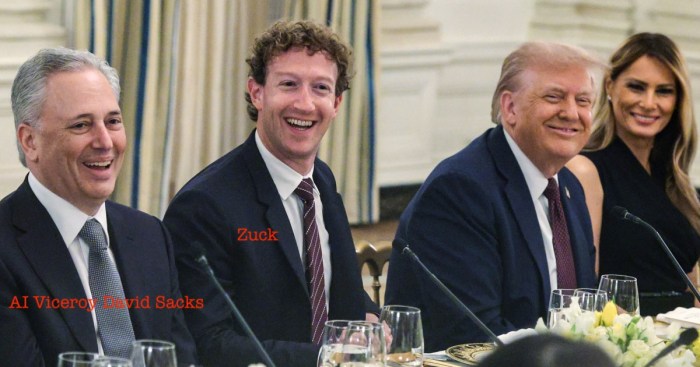
The result is a two‑track energy state AKA hell on earth. On Track A, the frontier AI lab hyperscalers like Google, Meta, Microsoft, OpenAI & Co. build company‑town infrastructure for AI—on‑site electricity generation by microgrids outside of everyone else’s electric grid, dedicated interties and other interconnections between electric operators—often on or near federal land. On Track B, the public grid carries everyone else: homes, hospitals, small manufacturers, water districts. As President Trump said at the White House AI dinner this week, Track A promises to “self‑supply,” but even self‑supplied campuses still lean on the public grid for backup and monetization, and they compete for scarce interconnection headroom.

President Trump is allowing the hyperscalers to get permanent rights to build on massive parcels of government land, including private utilities to power the massive electricity and water cooling needs for AI data centers. Strangely enough, this is continuing a Biden policy under an executive order issued late in Biden Presidency that Trump now takes credit for, and is a 180 out from America First according to people who ought to know like Steve Bannon. And yet it is happening.

White House Dinners are Old News in Silicon Valley

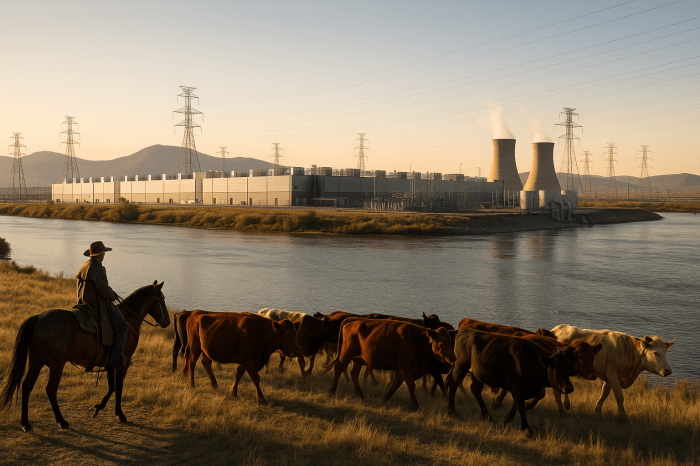
If someone says “AI labs will build their own utilities on federal land,” that land comes in two flavors: Department of Defense (now War Department) or Department of Energy sites and land owned by the Bureau of Land Management (BLM). This are vastly different categories.  DoD/DOE sites such as Idaho National Laboratory Oak Ridge Reservation, Paducah GDP, and the Savannah River Site, imply behind-the-fence, mission-tied microgrids with limited public friction; BLM land implies public-land rights-of-way and multi-use trade-offs (grazing, wildlife, cultural), longer timelines, and grid-export dynamics with potential “curtailment” which means prioritizing electricity for the hyperscalers. For example, Idaho National Laboratory (INL) as one of the four AI/data-center sites. INL’s own environmental reports state that about 60% of the INL site is open to livestock grazing, with monitoring of grazing impacts on habitat.  That’s likely over.

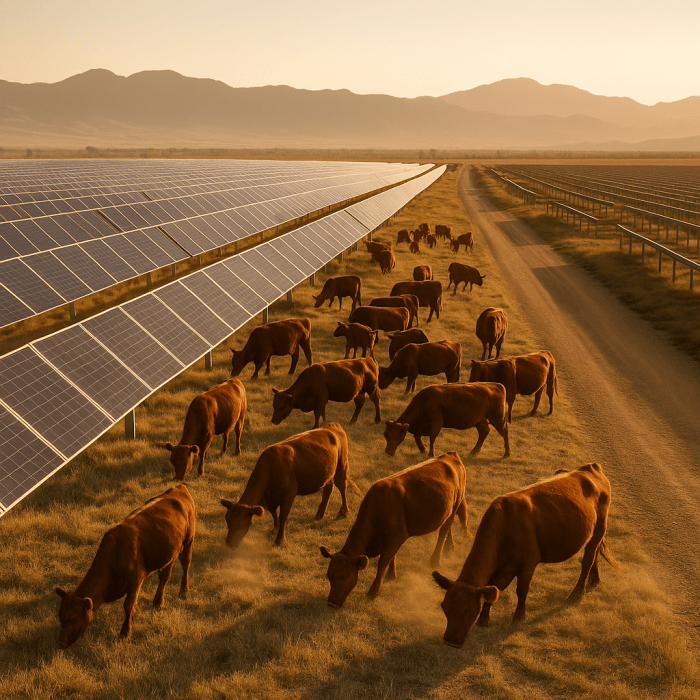
This is about how we power anything not controlled by a handful of firms. And it’s about the land footprint: fenced solar yards, switchyards, substations, massive transport lines, wider roads, laydown areas. On BLM range and other open spaces, those facilities translate into real, local losses—grazable acres inside fences, stock trails detoured, range improvements relocated.

What the two tracks really do

Track A solves a business problem: compute growth outpacing the public grid’s construction cycle. By putting electrons next to servers (literally), operators avoid waiting years for a substation or a 230‑kV line. Microgrids provide islanding during emergencies and participation in wholesale markets when connected. It’s nimble, and it works—for the operator.

Track B inherits the volatility: planners must consider a surge of large loads that may or may not appear, while maintaining reliability for everyone else. Capacity margins tighten; transmission projects get reprioritized; retail rates absorb the externalities. When utilities plan for speculative loads and those projects cancel or slide, the region can be left with stranded costs or deferred maintenance elsewhere.

The land squeeze we’re not counting

Public agencies tout gigawatts permitted. They rarely publish the acreage fenced, AUMs affected, or water commitments. Utility‑scale solar commonly pencils out to on the order of 5–7 acres per megawatt of capacity depending on layout and topography. At that ratio, a single gigawatt occupies thousands of acres—acres that, unlike wind, often can’t be grazed once panels and security fences go in. Even where grazing is technically possible, access roads, laydown yards, and vegetation control impose real costs on neighboring users.

Wind is more compatible with grazing, but it isn’t footprint‑free. Pads, roads, and safety buffers fragment pasture. Transmission to move that energy still needs corridors—and those corridors cross someone’s water lines and gates. Multiple use is a principle; on the ground it’s a schedule, a map, and a cost. Just for reference, a rule‑of‑thumb for acres/electricity produces is approximately 5–7 acres per megawatt of direct current (“MWdc”), but access roads, laydown, and buffers extend beyond the fence line.

We are going through this right now in my part of the world. Central Texas is bracing for a wave of new high-voltage transmission. These are 345-kV corridors cutting (literally) across the Hill Country to serve load growth for chip fabricators and data centers and tie-in distant generation (so big lines are a must once you commit to the usage). Ranchers and small towns are pushing back hard: eminent-domain threats, devalued land, scarred vistas, live-oak and wildlife impacts, and routes that ignore existing roads and utility corridors. Packed hearings and county resolutions demand co-location, undergrounding studies, and real alternatives—not “pick a line on a map” after the deal is done. The fight isn’t against reliability; it’s against a planning process that externalizes costs onto farmers, ranchers, other landowners and working landscapes.

Texas’s latest SB 6 is the case study. After a wave of ultra-large AI/data-center loads, frontier labs and their allies pushed lawmakers to rewrite reliability rules so the grid would accommodate them. SB 6 empowers the Texas grid operator ERCOT to police new mega-loads—through emergency curtailment and/or firm-backup requirements—effectively reshaping interconnection priorities and shifting reliability risk and costs onto everyone else. “Everyone else” means you and me, kind of like the “full faith and credit of the US”. Texas SB 6 was signed into law in June 2025 by Gov. Greg Abbott. It’s now in effect and directs PUCT/ERCOT to set new rules for very large loads (e.g., data centers), including curtailment during emergencies and added interconnection/backup-power requirements. So the devil will be in the details and someone needs to put on the whole armor of God, so to speak.

The phantom problem

Another quiet driver of bad outcomes is phantom demand: developers filing duplicative load or interconnection requests to keep options open. On paper, it looks like a tidal wave; in practice, only a slice gets built. If every inquiry triggers a utility study, a route survey, or a placeholder in a capital plan, neighborhoods can end up paying for capacity that never comes online to serve them.

A better deal for the public and the range

Prioritize already‑disturbed lands—industrial parks, mines, reservoirs, existing corridors—before greenfield BLM range land. Where greenfield is unavoidable, set a no‑net‑loss goal for AUMs and require real compensation and repair SLAs for affected range improvements.

Milestone gating for large loads: require non‑refundable deposits, binding site control, and equipment milestones before a project can hold scarce interconnection capacity or trigger grid upgrades. Count only contracted loads in official forecasts; publish scenario bands so rate cases aren’t built on hype.

Common‑corridor rules: make developers prove they can’t use existing roads or rights‑of‑way before claiming new footprints. Where fencing is required, use wildlife‑friendly designs and commit to seasonal gates that preserve stock movement.

Public equity for public land: if a campus wins accelerated federal siting and long‑term locational advantage, tie that to a public revenue share or capacity rights that directly benefit local ratepayers and counties. Public land should deliver public returns, not just private moats.

Grid‑help obligations: if a private microgrid islands to protect its own uptime, it should also help the grid when connected. Enroll batteries for frequency and reserve services; commit to emergency export; and pay a fair share of fixed transmission costs instead of shifting them onto households.

Or you could do what the Dutch and Irish governments proposed under the guise of climate change regulations—kill all the cattle. I can tell you right now that that ain’t gonna happen in Texas.

Will We Get Fooled Again?

If we let a hyped latter day “missile gap” set the terms, we’ll lock in a two‑track energy state: private power for those who can afford to build it, a more fragile and more expensive public grid for everyone else, and open spaces converted into permanent infrastructure at a discount. The alternative is straightforward: price land and grid externalities honestly, gate speculative demand, require public returns on public siting, and design corridor rules that protect working landscapes. That’s not anti‑AI; it’s pro‑public. Everything not controlled by Big Tech—will be better for it.

Let’s be clear: the data-center onslaught will be financed by the taxpayer one way or another—either as direct public outlays or through sweet-heart “leases” of federal land to build private utilities behind the fence for the richest corporations in commercial history. After all the goodies that Trump is handing to the AI platforms, let’s not have any loose talk of “selling” excess electricity to the public–that price should be zero. Even so, the sales pitch about “excess” electricity they’ll generously sell back to the grid is a fantasy; when margins tighten, they’ll throttle output costs, not volunteer philanthropy. Picture it: do you really think these firms won’t optimize for themselves first and last? We’ll be left with the bills, the land impacts, and a grid redesigned around their needs. Ask yourself—what in the last 25 years of Big Tech behavior says “trustworthy” to you?

From Fictional “Looking Backward” to Nonfiction Silicon Valley: Will Technologists Crown the New Philosopher‑Kings?

More than a century ago, writers like Edward Bellamy and Edward Mandell House asked a question that feels as urgent in 2025 as it did in their era: Should society be shaped by its people, or designed by its elites? Both grappled with this tension in fiction. Bellamy’s Looking Backward (1888) imagined a future society run by rational experts — technocrats and bureaucrats centralizing economic and social life for the greater good. House’s Philip Dru: Administrator (1912) went a step further, envisioning an American civil war where a visionary figure seizes control from corrupt institutions to impose a new era of equity and order.  Sound familiar?

Today, Silicon Valley’s titans are rehearsing their own versions of these stories. In an era dominated by artificial intelligence, climate crisis, and global instability, the tension between democratic legitimacy and technocratic efficiency is more pronounced than ever.

The Bellamy Model: Eric Schmidt and Biden’s AI Order

President Biden’s sweeping Executive Order on AI issued in late 2023 feels like a chapter lifted from Looking Backward. Its core premise is unmistakable: Trust our national champion “trusted” technologists to design and govern the rules for an era shaped by artificial intelligence. At the heart of this approach is Eric Schmidt, former CEO of Google and a key advisor in shaping the AI order at least according to Eric Schmidt

Schmidt has long advocated for centralizing AI policymaking within a circle of vetted, elite technologists — a belief reminiscent of Bellamy’s idealistic vision. According to Schmidt, AI and other disruptive technologies are too pivotal, too dangerous, and too impactful to be left to messy democratic debates. For people in Schmidt’s cabal, this approach is prudent: a bulwark against AI’s darker possibilities. But it doesn’t do much to protect against darker possibilities from AI platforms.  For skeptics like me, it raises a haunting question posed by Bellamy himself: Are we delegating too much authority to a technocratic elite?

The Philip Dru Model: Musk, Sacks, and Trump’s Disruption Politics

Meanwhile, across the aisle, another faction of Silicon Valley is aligning itself with Donald Trump and making a very different bet for the future. Here, the nonfiction playbook is closer to the fictional Philip Dru. In House’s novel, an idealistic and forceful figure emerges from a broken system to impose order and equity. Enter Elon Musk and David Sacks, both positioning themselves as champions of disruption, backed by immense platforms, resources, and their own venture funds. 

Musk openly embraces a worldview wherein technologists have both the tools and the mandate to save society by reshaping transportation, energy, space, and AI itself. Meanwhile, Sacks advocates Silicon Valley as a de facto policymaker, disrupting traditional institutions and aligning with leaders like Trump to advance a new era of innovation-driven governance—with no Senate confirmation or even a security clearance. This competing cabal operates with the implicit belief that traditional democratic institutions, inevitiably bogged down by process, gridlock, and special interests can no longer solve society’s biggest problems. To Special Government Employees like Musk and Sacks, their disruption is not a threat to democracy, but its savior.

A New Gilded Age? Or a New Social Contract?

Both threads — Biden and Schmidt’s technocratic centralization and Musk, Sacks, and Trump’s disruption-driven politics — grapple with the legacy of Bellamy and House. In the Gilded Age that inspired those writers, industrial barons sought to justify their dominance with visions of rational, top-down progress. Today’s Silicon Valley billionaires carry a similar vision for the digital era, suggesting that elite technologists can govern more effectively than traditional democratic institutions like Plato’s “guardians” of The Republic.

But at what cost? Will AI policymaking and its implementation evolve as a public endeavor, shaped by citizen accountability? Or will it be molded by corporate elites making decisions in the background? Will future leaders consolidate their role as philosopher-kings and benevolent administrators — making themselves indispensable to the state?

The Stakes Are Clear

As the lines between Silicon Valley and Washington continue to blur, the questions posed by Bellamy and House have never been more relevant: Will technologist philosopher-kings write the rules for our collective future? Will democratic institutions evolve to balance AI and climate crisis effectively? Will the White House of 2025 (and beyond) cede authority to the titans of Silicon Valley? In this pivotal moment, America must ask itself: What kind of future do we want — one that is chosen by its citizens, or one that is designed for its citizens? The answer will define the character of American democracy for the rest of the 21st century — and likely beyond.

AI’s Manhattan Project Rhetoric, Clearance-Free Reality

Every time a tech CEO compares frontier AI to the Manhattan Project, take a breath—and remember what that actually means.  Master spycatcher James Jesus Angleton is rolling in his grave. (aka Matt Damon in The Good Shepherd.). And like most elevator pitch talking points, that analogy starts to fall apart on inspection.

The Manhattan Project wasn’t just a moonshot scientific collaboration. It was the most tightly controlled, security-obsessed R&D operation in American history. Every physicist, engineer, and janitor involved had a federal security clearance. Facilities were locked down under military command of General Leslie Groves. Communications were monitored. Access was compartmentalized. And still—still—the Soviets penetrated it.  See Klaus Fuchs.  Let’s understand just how secret the Manhattan Project was—General Curtis LeMay had no idea it was happening until he was asked to set up facilities for the Enola Gay on his bomber base on Tinian a few months before the first nuclear bomb.  You want to find out about the details of any frontier lab, just pick up the newspaper.  Not nearly the same thing. There were no chatbots involved and there were no Special Government Employees with no security clearance.

Oppie Sacks

So when today’s AI executives name-drop Oppenheimer and invoke the gravity of dual-use technologies, what exactly are they suggesting? That we’re building world-altering capabilities without any of the safeguards that even the AI Whiz Kids admit are historically necessary by their Manhattan Project talking point in the pitch deck?

These frontier labs aren’t locked down. They’re open-plan. They’re not vetting personnel. They’re recruiting from Discord servers. They’re not subject to classified environments. They’re training military-civilian dual-use models on consumer cloud platforms. And when questioned, they invoke private sector privilege and push back against any suggestion of state or federal regulation.  And here’s a newsflash—requiring a security clearance for scientific work in the vital national interest is not regulation.  (Neither is copyright but that’s another story.)

Meanwhile, they’re angling for access to Department of Energy nuclear real estate, government compute subsidies, and preferred status in export policy—all under the justification of “national security” because, you know, China.  They want the symbolism of the Manhattan Project without the substance. They want to be seen as indispensable without being held accountable.

The truth is that AI is dual-use. It can power logistics and surveillance, language learning and warfare. That’s not theoretical—it’s already happening. China openly treats AI as part of its military-civil fusion strategy. Russia has targeted U.S. systems with information warfare bots. And our labs? They’re scraping from the open internet and assuming the training data hasn’t been poisoned with the massive misinformation campaigns on Wikipedia, Reddit and X that are routine.

If even the Manhattan Project—run under maximum secrecy—was infiltrated by Soviet spies, what are the chances that today’s AI labs, operating in the wide open are immune?  Wouldn’t a good spycatcher like Angleton assume these wunderkinds have already been penetrated?

We have no standard vetting for employees. No security clearances. No model release controls. No audit trail for pretraining data integrity. And no clear protocol for foreign access to model weights, inference APIs, or sensitive safety infrastructure. It’s not a matter of if. It’s a matter of when—or more likely, a matter of already.

Remember–nobody got rich out of working on the Manhattan Project. That’s another big difference. These guys are in it for the money, make no mistake.

So when you hear the Manhattan Project invoked again, ask the follow-up question: Where’s the security clearance?  Where’s the classification?  Where’s the real protection?  Who’s playing the role of Klaus Fuchs?

Because if AI is our new Manhattan Project, then running it without security is more than hypocrisy. It’s incompetence at scale.

AI Frontier Labs and the Singularity as a Modern Prophetic Cult

It gets rid of your gambling debts 
It quits smoking 
It’s a friend, it’s a companion 
It’s the only product you will ever need
From Step Right Up, written by Tom Waits

The AI “frontier labs” — OpenAI, Anthropic, DeepMind, xAI, and their constellation of evangelists — often present themselves as the high priests of a coming digital transcendence. This is sometimes called “the singularity” which refers to a hypothetical future point when artificial intelligence surpasses human intelligence, triggering rapid, unpredictable technological growth. Often associated with self-improving AI, it implies a transformation of society, consciousness, and control, where human decision-making may be outpaced or rendered obsolete by machines operating beyond our comprehension. 

But viewed through the lens of social psychology, the AI evangelists increasingly resembles that of cognitive dissonance cults, as famously documented in Dr. Leon Festinger and team’s important study of a UFO cult (a la Heaven’s Gate), When Prophecy Fails.  (See also The Great Disappointment.)

In that social psychology foundational study, a group of believers centered around a woman named “Marian Keech” predicted the world would end in a cataclysmic flood, only to be rescued by alien beings — but when the prophecy failed, they doubled down. Rather than abandoning their beliefs, the group rationalized the outcome (“We were spared because of our faith”) and became even more committed. They get this self-hypnotized look, kind of like this guy (and remember-this is what the Meta marketing people thought was the flagship spot for Meta’s entire superintelligence hustle):


This same psychosis permeates Singularity narratives and the AI doom/alignment discourse:
– The world is about to end — not by water, but by unaligned superintelligence.
– A chosen few (frontier labs) hold the secret knowledge to prevent this.
– The public must trust them to build, contain, and govern the very thing they fear.
– And if the predicted catastrophe doesn’t come, they’ll say it was their vigilance that saved us.

Like cultic prophecy, the Singularity promises transformation:
– Total liberation or annihilation (including liberation from annihilation by the Red Menace, i.e., the Chinese Communist Party).
– A timeline (“AGI by 2027”, “everything will change in 18 months”).
– An elite in-group with special knowledge and “Don’t be evil” moral responsibility.
– A strict hierarchy of belief and loyalty — criticism is heresy, delay is betrayal.

This serves multiple purposes:
1. Maintains funding and prestige by positioning the labs as indispensable moral actors.
2. Deflects criticism of copyright infringement, resource consumption, or labor abuse with existential urgency (because China, don’t you know).
3. Converts external threats (like regulation) into internal persecution, reinforcing group solidarity.

The rhetoric of “you don’t understand how serious this is” mirrors cult defenses exactly.

Here’s the rub: the timeline keeps slipping. Every six months, we’re told the leap to “godlike AI” is imminent. GPT‑4 was supposed to upend everything. That didn’t happen, so GPT‑5 will do it for real. Gemini flopped, but Claude 3 might still be the one.

When prophecy fails, they don’t admit error — they revise the story:
– “AI keeps accelerating”
– “It’s a slow takeoff, not a fast one.”
– “We stopped the bad outcomes by acting early.”
– “The doom is still coming — just not yet.”

Leon Festinger’s theories seen in When Prophecy Fails, especially cognitive dissonance and social comparison, influence AI by shaping how systems model human behavior, resolve conflicting inputs, and simulate decision-making. His work guides developers of interactive agents, recommender systems, and behavioral algorithms that aim to mimic or respond to human inconsistencies, biases, and belief formation.   So this isn’t a casual connection.

As with Festinger’s study, the failure of predictions intensifies belief rather than weakening it. And the deeper the believer’s personal investment, the harder it is to turn back. For many AI cultists, this includes financial incentives, status, and identity.

Unlike spiritual cults, AI frontier labs have material outcomes tied to their prophecy:
– Federal land allocations, as we’ve seen with DOE site handovers.
– Regulatory exemptions, by presenting themselves as saviors.
– Massive capital investment, driven by the promise of world-changing returns.

In the case of AI, this is not just belief — it’s belief weaponized to secure public assets, shape global policy, and monopolize technological futures. And when the same people build the bomb, sell the bunker, and write the evacuation plan, it’s not spiritual salvation — it’s capture.

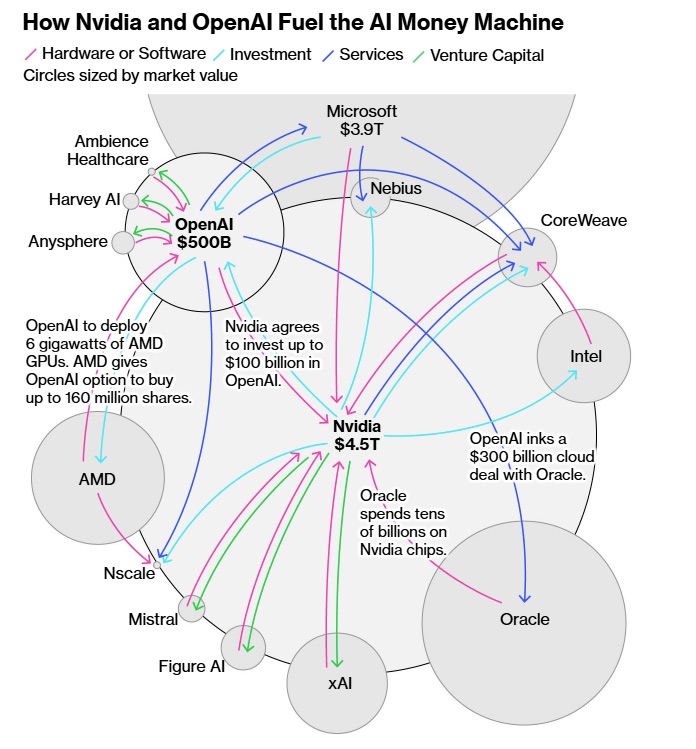
The pressure to sustain the AI prophecy—that artificial intelligence will revolutionize everything—is unprecedented because the financial stakes are enormous. Trillions of dollars in market valuation, venture capital, and government subsidies now hinge on belief in AI’s inevitable dominance. Unlike past tech booms, today’s AI narrative is not just speculative; it is embedded in infrastructure planning, defense strategy, and global trade. This creates systemic incentives to ignore risks, downplay limitations, and dismiss ethical concerns. To question the prophecy is to threaten entire business models and geopolitical agendas. As with any ideology backed by capital, maintaining belief becomes more important than truth.

The Singularity, as sold by the frontier labs, is not just a future hypothesis — it’s a living ideology. And like the apocalyptic cults before them, these institutions demand public faith, offer no accountability, and position themselves as both priesthood and god.

If we want a secular, democratic future for AI, we must stop treating these frontier labs as prophets — and start treating them as power centers subject to scrutiny, not salvation.

Schrödinger’s Training Clause: How Platforms Like WeTransfer Say They’re Not Using Your Files for AI—Until They Are

Tech companies want your content. Not just to host it, but for their training pipeline—to train models, refine algorithms, and “improve services” in ways that just happen to lead to new commercial AI products. But as public awareness catches up, we’ve entered a new phase: deniable ingestion.

Welcome to the world of the Schrödinger’s training clause—a legal paradox where your data is simultaneously not being used to train AI and fully licensed in case they decide to do so.

The Door That’s Always Open

Let’s take the WeTransfer case. For a brief period this month (in July 2025), their Terms of Service included an unmistakable clause: users granted them rights to use uploaded content to “improve the performance of machine learning models.” That language was direct. It caused backlash. And it disappeared.

Many mea culpas later, their TOS has been scrubbed clean of AI references. I appreciate the sentiment, really I do. But—and there’s always a but–the core license hasn’t changed. It’s still:

– Perpetual

– Worldwide

– Royalty-free

– Transferable

– Sub-licensable

They’ve simply returned the problem clause to its quantum box. No machine learning references. But nothing that stops it either.

 A Clause in Superposition

Platforms like WeTransfer—and others—have figured out the magic words: Don’t say you’re using data to train AI. Don’t say you’re not using it either. Instead, claim a sweeping license to do anything necessary to “develop or improve the service.”

That vague phrasing allows future pivots. It’s not a denial. It’s a delay. And to delay is to deny.

That’s what makes it Schrödinger’s training clause: Your content isn’t being used for AI. Unless it is. And you won’t know until someone leaks it, or a lawsuit makes discovery public.

The Scrape-Then-Scrub Scenario

Let’s reconstruct what could have happened–not saying it did happen, just could have–following the timeline in The Register:

1. Early July 2025: WeTransfer silently updates its Terms of Service to include AI training rights.

2. Users continue uploading sensitive or valuable content.

3. [Somebody’s] AI systems quickly ingest that data under the granted license.

4. Public backlash erupts mid-July.

5. WeTransfer removes the clause—but to my knowledge never revokes the license retroactively or promises to delete what was scraped. In fact, here’s their statement which includes this non-denial denial: “We don’t use machine learning or any form of AI to process content shared via WeTransfer.” OK, that’s nice but that wasn’t the question. And if their TOS was so clear, then why the amendment in the first place?

Here’s the Potential Legal Catch

Even if WeTransfer removed the clause later, any ingestion that occurred during the ‘AI clause window’ is arguably still valid under the terms then in force. As far as I know, they haven’t promised:

– To destroy any trained models

– To purge training data caches

– Or to prevent third-party partners from retaining data accessed lawfully at the time

What Would ‘Undoing’ Scraping Require?

– Audit logs to track what content was ingested and when

– Reversion of any models trained on user data

– Retroactive license revocation and sub-license termination

None of this has been offered that I have seen.

What ‘We Don’t Train on Your Data’ Actually Means

When companies say, “we don’t use your data to train AI,” ask:

– Do you have the technical means to prevent that?

– Is it contractually prohibited?

– Do you prohibit future sublicensing?

– Can I audit or opt out at the file level?

If the answer to those is “no,” then the denial is toothless.

How Creators Can Fight Back

1. Use platforms that require active opt-in for AI training.

2. Encrypt files before uploading.

3. Include counter-language in contracts or submission terms:

   “No content provided may be used, directly or indirectly, to train or fine-tune machine learning or artificial intelligence systems, unless separately and explicitly licensed for that purpose in writing” or something along those lines.

4. Call it out. If a platform uses Schrödinger’s language, name it. The only thing tech companies fear more than litigation is transparency.

What is to Be Done?

The most dangerous clauses aren’t the ones that scream “AI training.” They’re the ones that whisper, “We’re just improving the service.”

If you’re a creative, legal advisor, or rights advocate, remember: the future isn’t being stolen with force. It’s being licensed away in advance, one unchecked checkbox at a time.

And if a platform’s only defense is “we’re not doing that right now”—that’s not a commitment. That’s a pause.

That’s Schrödinger’s training clause.

From Plutonium to Prompt Engineering: Big Tech’s Land Grab at America’s Nuclear Sites–and Who’s Paying for It?

In a twist of post–Cold War irony, the same federal sites that once forged the isotopes of nuclear deterrence are now poised to fuel the arms race of artificial intelligence under the leadership of Special Government Employee and Silicon Valley Viceroy David Sacks. Under a new Department of Energy (DOE) initiative, 16 legacy nuclear and lab sites — including Savannah River, Idaho National Lab, and Oak Ridge Tennessee — are being opened to private companies to host massive AI data centers. That’s right–Tennessee where David Sacks is riding roughshod over the ELVIS Act.

But as this techno-industrial alliance gathers steam, one question looms large: Who benefits — and how will the American public be compensated for leasing its nuclear commons to the world’s most powerful corporations? Spoiler alert: We won’t.

A New Model, But Not the Manhattan Project

This program is being billed in headlines as a “new Manhattan Project for AI.” But that comparison falls apart quickly. The original Manhattan Project was:
– Owned by the government
– Staffed by public scientists
– Built for collective defense

Today’s AI infrastructure effort is:
– Privately controlled
– Driven by monopolies and venture capital
– Structured to avoid transparency and public input
– Uses free leases on public land with private nuclear reactors

Call it the Manhattan Project in reverse — not national defense, but national defense capture.

The Art of the Deal: Who gets what?

What Big Tech Is Getting

– Access to federal land already zoned, secured, and wired
– Exemption from state and local permitting
– Bypass of grid congestion via nuclear-ready substations
– DOE’s help fast-tracking nuclear microreactors (SMRs)
– Potential sovereign AI training enclaves, shielded from export controls and oversight

And all of it is being made available to private companies called the “Frontier labs”: Microsoft, Oracle, Amazon, OpenAI, Anthropic, xAI — the very firms at the center of the AI race.

What the Taxpayer Gets (Maybe)

Despite this extraordinary access, almost nothing is disclosed about how the public is compensated. No known revenue-sharing models. No guaranteed public compute access. No equity. No royalties.

Land lease payments? Not disclosed. Probably none.
Local tax revenue? Minimal (federal lands exempt)
Infrastructure benefit sharing? Unclear or limited

It’s all being negotiated quietly, under vague promises of “national competitiveness.”

Why AI Labs Want DOE Sites

Frontier labs like OpenAI and Anthropic — and their cloud sponsors — need:
– Gigawatts of energy
– Secure compute environments
– Freedom from export rules and Freedom of Information Act requests
– Permitting shortcuts and national branding

The DOE sites offer all of that — plus built-in federal credibility. The same labs currently arguing in court that their training practices are “fair use” now claim they are defenders of democracy training AI on taxpayer-built land.

This Isn’t the Manhattan Project — It’s the Extraction Economy in a Lab Coat

The tech industry loves to invoke patriotism when it’s convenient — especially when demanding access to federal land, nuclear infrastructure, or diplomatic cover from the EU’s AI Act. But let’s be clear:

This isn’t the Manhattan Project. Or rather we should hope it isn’t because that one didn’t end well and still hasn’t.
It’s not public service.
It’s Big Tech lying about fair use, wrapped in an American flag — and for all we know, it might be the first time David Sacks ever saw one.

When companies like OpenAI and Microsoft claim they’re defending democracy while building proprietary systems on DOE nuclear land, we’re not just being gaslit — we’re being looted.

If the AI revolution is built on nationalizing risk and privatizing power, it’s time to ask whose country this still is — and who gets to turn off the lights.

When Viceroy David Sacks Writes the Tariffs: How One VC Could Weaponize U.S. Trade Against the EU

David Sacks is a “Special Government Employee”, Silicon Valley insider and a PayPal mafioso who has become one of the most influential “unofficial” architects of AI policy under the Trump administration. No confirmation hearings, no formal role—but direct access to power.

He:
– Hosts influential political podcasts with Musk and Thiel-aligned narratives.
– Coordinates behind closed doors with elite AI companies who are now PRC-style “national champions” (OpenAI, Anthropic, Palantir).
– Has reportedly played a central role in shaping the AI Executive Orders and industrial strategy driving billions in public infrastructure to favored firms.

Under 18 U.S.C. § 202(a), a Special Government Employee is:

  • Temporarily retained to perform limited government functions,
  • For no more than 130 days per year (which for Sacks ends either April 14 or May 30, 2025), unless reappointed in a different role,
  • Typically serves in an advisory or consultative role, or
  • Without holding actual decision-making or operational authority over federal programs or agencies.

SGEs are used to avoid conflict-of-interest entanglements for outside experts while still tapping their expertise for advisory purposes. They are not supposed to wield sweeping executive power or effectively run a government program. Yeah, right.

And like a good little Silicon Valley weasel, Sacks supposedly is alternating between his DC side hustle and his VC office to stay under 130 days. This is a dumbass reading of the statute which says “‘Special Government employee’ means… any officer or employee…retained, designated, appointed, or employed…to perform…temporary duties… for not more than 130 days during any period of 365 consecutive days.” That’s not the same as “worked” 130 days on the time card punch. But oh well.

David Sacks has already exceeded the legal boundaries of his appointment as a Special Government Employee (SGE) both in time served but also by directing the implementation of a sweeping, whole-of-government AI policy, including authoring executive orders, issuing binding directives to federal agencies, and coordinating interagency enforcement strategies—actions that plainly constitute executive authority reserved for duly appointed officers under the Appointments Clause. As an SGE, Sacks is authorized only to provide temporary, nonbinding advice, not to exercise operational control or policy-setting discretion across the federal government. Accordingly, any executive actions taken at his direction or based on his advisement are constitutionally infirm as the unlawful product of an individual acting without valid authority, and must be deemed void as “fruit of the poisonous tree.”

Of course, one of the states that the Trump AI Executive Orders will collide with almost immediately is the European Union and its EU AI Act. Were they 51st? No that’s Canada. 52nd? Ah, right that’s Greenland. Must be 53rd.

How Could David Sacks Weaponize Trade Policy to Help His Constituents in Silicon Valley?

Here’s the playbook:

Engineer Executive Orders

Through his demonstrated access to Trump and senior White House officials, Sacks could promote executive orders under the International Emergency Economic Powers Act (IEEPA) or Section 301 of the Trade Act, aimed at punishing countries (like EU members) for “unfair restrictions” on U.S. AI exports or operations.

Something like this: “The European Union’s AI Act constitutes a discriminatory and protectionist measure targeting American AI innovation, and materially threatens U.S. national security and technological leadership.” I got your moratorium right here.

Leverage the USTR as a Blunt Instrument

The Office of the U.S. Trade Representative (USTR) can initiate investigations under Section 301 without needing new laws. All it takes is political will—and a nudge from someone like Viceroy Sacks—to argue that the EU’s AI Act discriminates against U.S. firms. See Canada’s “Tech Tax”. Gee, I wonder if Viceroy Sacks had anything to do with that one.

Redefine “National Security”

Sacks and his allies can exploit the Trump administration’s loose definition of “national security” claiming that restricting U.S. AI firms in Europe endangers critical defense and intelligence capabilities.

Smear Campaigns and Influence Operations

Sacks could launch more public campaigns against the EU like his attacks on the AI diffusion rule. According to the BBC, “Mr. Sacks cited the alienation of allies as one of his key arguments against the AI diffusion plan”. That’s a nice ally you got there, be a shame if something happened to it.

After all, the EU AI Act does what Sacks despises like protects artists and consumers, restricts deployment of high-risk AI systems (like facial recognition and social scoring), requires documentation of training data (which exposes copyright violations), and applies extraterritorially (meaning U.S. firms must comply even at home).

And don’t forget, Viceroy Sacks actually was given a portfolio that at least indirectly includes the National Security Council, so he can use the NATO connection to put a fine edge on his “industrial patriotism” just as war looms over Europe.

When Policy Becomes Personal

In a healthy democracy, trade retaliation should be guided by evidence, public interest, and formal process.

But under the current setup, someone like David Sacks can short-circuit the system—turning a private grievance into a national trade war. He’s already done it to consumers, wrongful death claims and copyright, why not join war lords like Eric Schmidt and really jack with people? Like give deduplication a whole new meaning.

When one man’s ideology becomes national policy, it’s not just bad governance.

It’s a broligarchy in real time.

Beyond Standard Oil: How the AI Action Plan Made America a Command Economy for Big Tech That You Will Pay For

When the White House requested public comments earlier this year on how the federal government should approach artificial intelligence, thousands of Americans—ranging from scientists to artists, labor leaders to civil liberties advocates—responded with detailed recommendations. Yet when America’s AI Action Plan was released today, it became immediately clear that those voices were largely ignored. The plan reads less like a response to public input and more like a pre-written blueprint drafted in collaboration with the very corporations it benefits. The priorities, language, and deregulatory thrust suggest that the real consultations happened behind closed doors—with Big Tech executives, not the American people.

In other words, business as usual.

By any historical measure—Standard Oil, AT&T, or even the Cold War military-industrial complex—the Trump Administration’s “America’s AI Action Plan” represents a radical leap toward a command economy built for and by Big Tech. Only this time, there are no rate regulations, no antitrust checks, and no public obligations—just streamlined subsidies, deregulation, and federally orchestrated dominance by a handful of private AI firms.

“Frontier Labs” as National Champions

The plan doesn’t pretend to be neutral. It picks winners—loudly. Companies like OpenAI, Anthropic, Meta, Microsoft, and Google are effectively crowned as “national champions,” entrusted with developing the frontier of artificial intelligence on behalf of the American state.

– The National AI Research Resource (NAIRR) and National Science Foundation partnerships funnel taxpayer-funded compute and talent into these firms.
– Federal procurement standards now require models that align with “American values,” but only as interpreted by government-aligned vendors.
– These companies will receive priority access to compute in a national emergency, hard-wiring them into the national security apparatus.
– Meanwhile, so-called “open” models will be encouraged in name only—no requirement for training data transparency, licensing, or reproducibility.

This is not a free market. This is national champion industrial policy—without the regulation or public equity ownership that historically came with it.

Infrastructure for Them, Not Us

The Action Plan reads like a wishlist from Silicon Valley’s executive suites:

– Federal lands are being opened up for AI data centers and energy infrastructure.
– Environmental and permitting laws are gutted to accelerate construction of facilities for private use.
– A national electrical grid expansion is proposed—not to serve homes and public transportation, but to power hyperscaler GPUs for model training.
– There’s no mention of public access, community benefit, or rural deployment. This is infrastructure built with public expense for private use.

Even during the era of Ma Bell, the public got universal service and price caps. Here? The public is asked to subsidize the buildout and then stand aside.

Deregulation for the Few, Discipline for the Rest

The Plan explicitly orders:
– Rescission of Biden-era safety and equity requirements.
– Reviews of FTC investigations to shield AI firms from liability.
– Withholding of federal AI funding from states that attempt to regulate the technology for safety, labor, or civil rights purposes.

Meanwhile, these same companies are expected to supply the military, detect cyberattacks, run cloud services for federal agencies, and set speech norms in government systems.

The result? An unregulated cartel tasked with executing state functions.

More Extreme Than Standard Oil or AT&T

Let’s be clear: Standard Oil was broken up. AT&T had to offer regulated universal service. Lockheed, Raytheon, and the Cold War defense contractors were overseen by procurement auditors and GAO enforcement.

This new AI economy is more privatized than any prior American industrial model—yet more dependent on the federal government than ever before. It’s an inversion of free market principles wrapped in American flags and GPU clusters.

Welcome to the Command Economy—For Tech Oligarchs

There’s a word for this: command economy. But instead of bureaucrats in Soviet ministries, we now have a handful of unelected CEOs directing infrastructure, energy, science, education, national security, and labor policy—all through cozy relationships with federal agencies.

If we’re going to nationalize AI, let’s do it honestly—with public governance, democratic accountability, and shared benefit. But this halfway privatized, fully subsidized, and wholly unaccountable structure isn’t capitalism. It’s capture.