The White House’s latest AI framework reads like a familiar story dressed in new clothes: we must move fast, avoid “overregulation,” and ensure that the United States “wins” the AI race—because China.
That framing is not new. It is, in fact, a modern version of the Thucydides Trap: the idea that when a rising power threatens to displace an established one, conflict—economic, political, or otherwise—becomes more likely. But what is striking here is not the invocation of competition. It’s how narrowly that competition is defined.
The framework implicitly treats AI dominance as a function of compute, capital, and model scale. Build bigger models faster, feed them more data, and ensure that domestic firms face as few constraints as possible. In that telling, creators, rights, and consent become secondary considerations—at best friction, at worst obstacles.
But that is a profound misread of where U.S. advantage actually lies.
American leadership has never been just about scale. It has been about legitimacy—the ability to build systems that other countries, companies, and individuals trust enough to adopt. That is the essence of soft power. And soft power is not generated by extraction; it is generated by rules that are perceived as fair.
When U.S. policy signals that training on creative works without meaningful consent is acceptable—or even necessary to “win”—it risks trading long-term legitimacy for short-term acceleration. That is a dangerous bargain. It tells the world that American AI leadership is built not on innovation alone, but on the uncompensated appropriation of global cultural and informational resources.
Other jurisdictions are already responding. The EU is experimenting with transparency mandates. Rights holders globally are pushing for enforceable consent regimes. Even countries that want to encourage AI development are increasingly wary of frameworks that look like data extraction at scale without accountability.
This is where the Thucydides analogy breaks down—or at least becomes more complicated. The real risk is not simply that China catches up technologically. It is that the United States, in trying to outrun that possibility, undermines the normative foundations of its own leadership.
Soft power erosion is not dramatic. It doesn’t announce itself with a headline. It accumulates quietly: in trade negotiations, in regulatory divergence, in the willingness of other countries to align—or not align—with U.S. standards. Over time, that erosion can matter more than any benchmark score or model release.
There is another path. The United States could lead by insisting that AI development is compatible with consent, compensation, and provenance. It could treat creators not as inputs to be harvested, but as stakeholders in a system that depends on their work. It could build infrastructure—technical and legal—that makes those principles operational, not aspirational.
That approach may look slower in the short term. It may impose costs that competitors are willing to ignore. But it is also how durable leadership is built.
Because in the long run, the question is not just who builds the most powerful models. It is who builds systems that the rest of the world is willing to trust.
And that is a competition the United States cannot afford to lose.
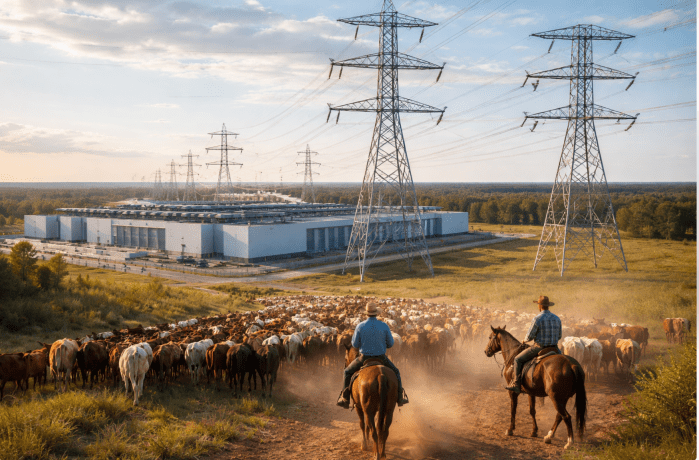
For the better part of a year, local opposition to AI hyperscaler data centers has been dismissed as NIMBYism—yet it is a movement that has gained real traction. Rural counties worried about water draw. Suburban communities objecting to diesel backup generators. Landowners frustrated over transmission corridors cutting through farmland and massive data centers removing large swaths of productive land in essentially irreversible dedication to AI.
Local politics around data-center construction often turn on land use, water, and power. Officials welcome tax base and jobs, but residents worry about noise, transmission lines, diesel backup generators, and groundwater consumption. Zoning boards and county commissioners become battlegrounds where developers promise infrastructure upgrades and community benefits while opponents push for setbacks, environmental review, and limits on incentives. Utilities and grid operators weigh reliability and cost shifting, especially where hyperscale demand requires new substations or high-voltage lines. Rural areas face pressure from land aggregation and fast-track permitting, while cities debate transparency, property-tax abatements, and whether long-term public costs outweigh near-term economic gains.
But the politics just escalated.
According to multiple reports, President Trump is preparing to highlight “ratepayer protection pledges” from major tech companies during his State of the Union address tonight — urging AI and cloud companies to publicly commit that residential electricity customers will not bear the cost of new data-center load.
That confirms concerns from Trump advisor Peter Navarro over the last couple months and is not a small signal.
For months, grassroots organizers have warned that hyperscale AI buildout could increase local electricity rates, force costly new transmission lines, accelerate natural gas plant approvals, and strain already fragile regional grids. And then there’s the nuclear issues as hyperscalers openly promote new nuclear plants. Until now, much of the policy conversation has centered on growth and competitiveness, you know, because China. The Trump pivot reframes the issue around consumer protection — closely tracking the concerns raised by grassroots opponents.
What the White House Is Signaling
The reported approach stops short of imposing a formal price cap on electricity or shifting costs to taxpayers. Instead, policymakers are signaling that large technology firms — particularly hyperscale operators — should voluntarily shoulder the marginal power costs created by their own demand growth.
In practice, this means encouraging companies such as Microsoft, Alphabet, Amazon, and OpenAI to fund grid upgrades, transmission extensions, standby generation, and other infrastructure required to serve new data-center loads, rather than socializing those costs across ordinary ratepayers. The political logic is straightforward: if hyperscale demand is driving billions in new utility investment, the beneficiaries should internalize the expense. The strategy relies on negotiated commitments, public-utility leverage, and reputational pressure rather than mandates, aiming to avoid rate shocks while still enabling continued digital-infrastructure expansion.
We’ll see.
In parallel, the administration has backed efforts to expand electricity supply in regions experiencing sharp data-center load growth, pairing political support with regulatory acceleration. In practice, this has meant encouraging grid operators to run emergency or supplemental capacity auctions—for example, in markets like PJM or ERCOT—to secure short-lead-time generation such as gas peaker plants, temporary turbines, and large-scale battery storage. Policymakers have also supported fast-track permitting and uprates at existing nuclear and natural-gas facilities, along with expedited approvals for new combined-cycle plants where reliability risks are rising. In some areas, utilities are advancing transmission expansions and demand-response programs to bridge near-term gaps. The goal is to bring firm capacity online quickly enough to keep pace with AI-driven electricity demand without triggering reliability shortfalls or price spikes.
Supposedly, Trump’s message is if data centers drive the demand spike, data centers should fund the solution. That makes sense, but count me as a skeptic as to whether this will actually happen, or whether hyperscalers will come to the taxpayer. You know, because China. But let’s sell China Nvidia chips.
Why This Matters for the Grassroots Fight
Grassroots opposition to large-scale data centers has crystallized around three increasingly defined pillars — each with its own constituency and political leverage.
1. Land Use and Community Character. Residents object to the scale and industrial footprint of hyperscale campuses: multi-building complexes, 24/7 lighting, diesel backup generators, high-security fencing, and new high-voltage transmission corridors. In rural counties, projects can involve the quiet aggregation of farmland followed by rezoning from agricultural to industrial use. In suburban areas, neighbors focus on setbacks, noise from cooling systems, and visual impact. Planning and zoning hearings have become flashpoints where local control collides with state-level economic development priorities.
2. Environmental and Water Stress. Data centers are energy- and water-intensive facilities. In water-constrained regions, evaporative cooling systems raise concerns about aquifer drawdown and drought resilience. Environmental advocates question lifecycle emissions from new gas-fired generation built to serve AI load, as well as the cumulative impact of substations, transmission lines, and backup generators. Even where companies pledge renewable procurement, critics argue that incremental demand can still drive fossil fuel buildout in constrained grids.
3. Electricity Costs and Grid Strain. The most politically volatile pillar is ratepayer impact. Local activists argue that if hyperscale demand requires billions in new generation, transmission, and distribution investment, those costs could be socialized through higher retail rates. Concerns also extend to reliability — whether rapid load growth risks price spikes, capacity shortfalls, or emergency measures during extreme weather.
And then there’s the jobs myth. The “data center jobs” pitch often overstates long-term employment. Construction phases can generate hundreds of temporary union and trade jobs—electricians, concrete crews, steel, and site work—sometimes for 12–24 months. But once operational, hyperscale facilities are highly automated and run by surprisingly small permanent staffs relative to their footprint and power load. A multi-building campus consuming hundreds of megawatts may employ only a few dozen to low hundreds of full-time workers, focused on security, facilities management, and network operations. For rural counties weighing tax abatements and infrastructure upgrades, the gap between short-term construction labor and modest permanent payroll becomes a central economic-development question.
By elevating electricity price protection to a presidential talking point, the administration effectively validates this third pillar. What began as local testimony at zoning meetings is now part of national energy policy framing: the principle that ordinary households should not subsidize AI infrastructure through their power bills. That rhetorical shift transforms a local grievance into a broader political issue with statewide and federal implications.
This is no longer just a zoning fight. It is now a kitchen-table affordability issue. Which may be a good start.
The Uncomfortable Math
AI data centers run 24/7, require enormous continuous baseload power, often demand dedicated substations, and can trigger multi-billion-dollar transmission upgrades. In regulated utility regions, those upgrades may be socialized across ratepayers unless cost allocation rules are enforced.
That is the central fear: even if tech companies pay for direct interconnection, broader grid reinforcement costs may still reach residential customers. If “ratepayer protection” pledges gain traction, this would mark a major federal acknowledgement that the risk is politically real.
Why This Is Bigger Than Trump
Governors in data-center-heavy states have also expressed concern. Utilities want load growth but fear rate shock. Grid operators face pressure to accelerate capacity procurement without triggering bill spikes. Grassroots activists have argued the AI buildout is outpacing responsible grid planning — and that argument has now moved from local meetings to national politics.
Whether any president—including Trump—can truly compel hyperscale tech firms to absorb rising power and infrastructure costs remains uncertain. Without formal regulation, enforcement tools are limited to negotiation, procurement leverage, and public pressure, all of which depend on the companies’ strategic interests.
Voluntary pledges can signal cooperation but lack binding force especially if market conditions shift. The Trump announcement also raises a political question: does the “pledge” represent a balancing act inside the administration between economic populists and China hawks like Peter Navarro, often associated with industrial-policy cost discipline, and pro-AI growth lobbyists such as Silicon Valley’s AI Viceroy David Sacks? If so, the commitment may reflect an internal compromise as much as an external policy toward accelerationist hyperscalers.
Data-center growth is turning electricity affordability into a geopolitical issue, not just a local zoning fight. When hyperscalers drop a 100–500 MW load into a market, they can tighten reserve margins, push up wholesale prices, and force expensive transmission and distribution upgrades—costs that governments then have to allocate between the new entrant and everyone else. That same demand can crowd out electrification priorities (heat pumps, EVs, industrial decarbonization) or trigger emergency procurement of “firm” power—often gas—because reliability deadlines don’t wait for ideal renewable buildouts.
We are way past McDonald’s on the Champs-Élysées
This is where “net zero” starts to look like it’s in the rear-view mirror. Many jurisdictions still talk about decarbonization, but the near-term political imperative is keeping the lights on and bills stable. If the choice is between fast AI load growth and strict emissions trajectories, the operational reality in many grids is that fossil backup and accelerated thermal approvals re-enter the picture—sometimes explicitly, sometimes quietly. Meanwhile, countries with abundant cheap power (hydro, nuclear, subsidized gas) gain leverage as preferred data-center destinations, while constrained grids face moratoria, queue rationing, and public backlash.
Data-center expansion is rapidly turning electricity policy into a global political and economic tradeoff. When hyperscale facilities add hundreds of megawatts of demand, they can tighten capacity margins, raise wholesale prices, and force costly grid upgrades—decisions governments must make about who ultimately pays. In many markets, this new load competes directly with electrification goals such as EV adoption, heat pumps, and industrial decarbonization. Reliability timelines often drive utilities toward fast, firm capacity—frequently gas—because intermittent renewables and storage cannot always be deployed quickly enough.
In that sense, Trump’s choices increasingly resemble a classic “guns and butter” dilemma. Policymakers must balance the strategic push for AI infrastructure and digital competitiveness against long-term climate commitments. While net-zero targets remain official policy in many jurisdictions, near-term choices often prioritize keeping power reliable and affordable, even if that means slowing emissions progress. The tension does not necessarily mean decarbonization disappears, but it underscores the difficulty of advancing both rapid AI build-out and strict net-zero trajectories simultaneously under real-world grid constraints.
Rate Payers Get the Immediate Proof: Utility bills
If the White House advances voluntary ratepayer-protection pledges, several trajectories could unfold. Technology companies may publicly commit to absorbing incremental grid and infrastructure costs, framing the move as responsible corporate citizenship. Personally, I don’t think Trump actually believes it, and I fully expect that the teleprompter will say one thing, and then in a classic Trump aside, he will undercut the speech writers.
Utilities, facing rising capital requirements, could press for clearer cost-allocation rules to ensure large-load customers bear system expansion expenses. State public-utility commissions might reopen tariffs and special-contract pricing for hyperscale users, testing how far voluntary commitments translate into enforceable rate structures.
Meanwhile, grassroots groups are likely to demand transparent accounting to verify that ordinary customers are insulated from price impacts. Yet the full economic value of any pledge will emerge only over years of build-out and rate cases—long after the current administration, and Trump himself, are no longer in office.
For the moment, the debate has shifted. Grassroots opposition is no longer just about land or water. It is about who pays when AI reshapes the grid — and now the president is talking about it.
Let’s say I’m wrong and Trump is serious about reigning in AI. If Trump were able to make such a policy stick, it could mark a broader shift in how governments confront the external costs of rapid AI expansion. Requiring hyperscalers to internalize infrastructure and power burdens could slow the breakneck build-out that fuels large-scale model training and synthetic media proliferation.
For artists and performers, that deceleration could matter. The fight over voice, likeness, and identity—already highlighted by figures such as Brad Pitt and Tom Cruise ripped off by China’s Seedance 2.0 —centers on protecting human personhood from industrial-scale replication. A structural slowdown in AI growth would not end that conflict, but it could rebalance leverage, giving creators, unions, and policymakers more time to establish enforceable guardrails.
Paul Sinclair’s framing of generative music AI as a choice between “open studios” and permissioned systems makes a basic category mistake. Consent is not a creative philosophy or a branding position. It is a systems constraint. You cannot “prefer” consent into existence. A permissioned system either enforces authorization at the level where machine learning actually occurs—or it does not exist at all.
That distinction matters not only for artists, but for the long-term viability of AI companies themselves. Platforms built on unresolved legal exposure may scale quickly, but they do so on borrowed time. Systems built on enforceable consent may grow more slowly at first, but they compound durability, defensibility, and investor confidence over time. Legality is not friction. It is infrastructure. It’s a real “eat your vegetables” moment.
The Great Reset
Before any discussion of opt-in, licensing, or future governance, one prerequisite must be stated plainly: a true permissioned system requires a hard reset of the model itself. A model trained on unlicensed material cannot be transformed into a consent-based system through policy changes, interface controls, or aspirational language. Once unauthorized material is ingested and used for training, it becomes inseparable from the trained model. There is no technical “undo” button.
The debate is often framed as openness versus restriction, innovation versus control. That framing misses the point. The real divide is whether a system is built to respect authorization where machine learning actually happens. A permissioned system cannot be layered on top of models trained without permission, nor can it be achieved by declaring legacy models “deprecated.” Machine learning systems do not forget unless they are reset. The purpose of a trained model is remembering—preserving statistical patterns learned from its data—not forgetting. Models persist, shape downstream outputs, and retain economic value long after they are removed from public view. Administrative terminology is not remediation.
Recent industry language about future “licensed models” implicitly concedes this reality. If a platform intends to operate on a consent basis, the logical consequence is unavoidable: permissioned AI begins with scrapping the contaminated model and rebuilding from zero using authorized data only.
Why “Untraining” Does Not Solve the Problem
Some argue that problematic material can simply be removed from an existing model through “untraining.” In practice, this is not a reliable solution. Modern machine-learning systems do not store discrete copies of works; they encode diffuse statistical relationships across millions or billions of parameters. Once learned, those relationships cannot be surgically excised with confidence. It’s not Harry Potter’s Pensieve.
Even where partial removal techniques exist, they are typically approximate, difficult to verify, and dependent on assumptions about how information is represented internally. A model may appear compliant while still reflecting patterns derived from unauthorized data. For systems claiming to operate on affirmative permission, approximation is not enough. If consent is foundational, the only defensible approach is reconstruction from a clean, authorized corpus.
The Structural Requirements of Consent
Once a genuine reset occurs, the technical requirements of a permissioned system become unavoidable.
Authorized training corpus. Every recording, composition, and performance used for training must be included through affirmative permission. If unauthorized works remain, the model remains non-consensual.
Provenance at the work level. Each training input must be traceable to specific authorized recordings and compositions with auditable metadata identifying the scope of permission.
Enforceable consent, including withdrawal. Authorization must allow meaningful limits and revocation, with systems capable of responding in ways that materially affect training and outputs.
Segregation of licensed and unlicensed data. Permissioned systems require strict internal separation to prevent contamination through shared embeddings or cross-trained models.
Transparency and auditability. Permission claims must be supported by documentation capable of independent verification. Transparency here is engineering documentation, not marketing copy.
These are not policy preferences. They are practical consequences of a consent-based architecture.
The Economic Reality—and Upside—of Reset
Rebuilding models from scratch is expensive. Curating authorized data, retraining systems, implementing provenance, and maintaining compliance infrastructure all require significant investment. Not every actor will be able—or willing—to bear that cost. But that burden is not an argument against permission. It is the price of admission.
Crucially, that cost is also largely non-recurring. A platform that undertakes a true reset creates something scarce in the current AI market: a verifiably permissioned model with reduced litigation risk, clearer regulatory posture, and greater long-term defensibility. Over time, such systems are more likely to attract durable partnerships, survive scrutiny, and justify sustained valuation.
Throughout technological history, companies that rebuilt to comply with emerging legal standards ultimately outperformed those that tried to outrun them. Permissioned AI follows the same pattern. What looks expensive in the short term often proves cheaper than compounding legal uncertainty.
Architecture, Not Branding
This is why distinctions between “walled garden,” “opt-in,” or other permission-based labels tend to collapse under technical scrutiny. Whatever the terminology, a system grounded in authorization must satisfy the same engineering conditions—and must begin with the same reset. Branding may vary; infrastructure does not.
Permissioned AI is possible. But it is reconstructive, not incremental. It requires acknowledging that past models are incompatible with future claims of consent. It requires making the difficult choice to start over.
The irony is that legality is not the enemy of scale—it is the only path to scale that survives. Permission is not aspiration. It is architecture.
Over the last two weeks, grassroots opposition to data centers has moved from sporadic local skirmishes to a recognizable national pattern. While earlier fights centered on land use, noise, and tax incentives, the current phase is more focused and more dangerous for developers: water.
Across multiple states, residents are demanding to see the “water math” behind proposed data centers—how much water will be consumed (not just withdrawn), where it will come from, whether utilities can actually supply it during drought conditions, and what enforceable reporting and mitigation requirements will apply. In arid regions, water scarcity is an obvious constraint. But what’s new is that even in traditionally water-secure states, opponents are now framing data centers as industrial-scale consumptive users whose needs collide directly with residential growth, agriculture, and climate volatility.
The result: moratoria, rezoning denials, delayed hearings, task forces, and early-stage organizing efforts aimed at blocking projects before entitlements are locked in.
Below is a snapshot of how that opposition has played out state by state over the last two weeks.
State-by-State Breakdown
Virginia
Virginia remains ground zero for organized pushback.
Botetourt County: Residents confronted the Western Virginia Water Authority over a proposed Google data center, pressing officials about long-term water supply impacts and groundwater sustainability.
Hanover County (Richmond region): The Planning Commission voted against recommending rezoning for a large multi-building data center project.
State Legislature: Lawmakers are advancing reform proposals that would require water-use modeling and disclosure.
Georgia
Metro Atlanta / Middle Georgia: Local governments’ recruitment of hyperscale facilities is colliding with resident concerns.
DeKalb County: An extended moratorium reflects a pause-and-rewrite-the-rules strategy.
Monroe County / Forsyth area: Data centers have become a local political issue.
Arizona
The state has moved to curb groundwater use in rural basins via new regulatory designations requiring tracking and reporting.
Local organizing frames AI data centers as unsuitable for arid regions.
Maryland
Prince George’s County (Landover Mall site): Organized opposition centered on environmental justice and utility burdens.
Authorities have responded with a pause/moratorium and a task force.
Indiana
Indianapolis (Martindale-Brightwood): Packed rezoning hearings forced extended timelines.
Greensburg: Overflow crowds framed the fight around water-user rankings.
Oklahoma
Luther (OKC metro): Organized opposition before formal filings.
Michigan
Broad local opposition with water and utility impacts cited.
State-level skirmishes over incentives intersect with water-capacity debates.
North Carolina
Apex (Wake County area): Residents object to strain on electricity and water.
Wisconsin & Pennsylvania
Corporate messaging shifts in response to opposition; Microsoft acknowledged infrastructure and water burdens.
The Through-Line: “Show Us the Water Math”
Lawrence of Arabia: The Well Scene
Across these states, the grassroots playbook has converged:
Pack the hearing.
Demand water-use modeling and disclosure.
Attack rezoning and tax incentives.
Force moratoria until enforceable rules exist.
Residents are demanding hard numbers: consumptive losses, aquifer drawdown rates, utility-system capacity, drought contingencies, and legally binding mitigation.
Why This Matters for AI Policy
This revolt exposes the physical contradiction at the heart of the AI infrastructure build-out: compute is abstract in policy rhetoric but experienced locally as land, water, power, and noise.
Communities are rejecting a development model that externalizes its physical costs onto local water systems and ratepayers.
Water is now the primary political weapon communities are using to block, delay, and reshape AI infrastructure projects.




 Music Tech Solutions