From Plutonium to Prompt Engineering: Big Tech’s Land Grab at America’s Nuclear Sites–and Who’s Paying for It?

In a twist of post–Cold War irony, the same federal sites that once forged the isotopes of nuclear deterrence are now poised to fuel the arms race of artificial intelligence under the leadership of Special Government Employee and Silicon Valley Viceroy David Sacks. Under a new Department of Energy (DOE) initiative, 16 legacy nuclear and lab sites — including Savannah River, Idaho National Lab, and Oak Ridge Tennessee — are being opened to private companies to host massive AI data centers. That’s right–Tennessee where David Sacks is riding roughshod over the ELVIS Act.

But as this techno-industrial alliance gathers steam, one question looms large: Who benefits — and how will the American public be compensated for leasing its nuclear commons to the world’s most powerful corporations? Spoiler alert: We won’t.

A New Model, But Not the Manhattan Project

This program is being billed in headlines as a “new Manhattan Project for AI.” But that comparison falls apart quickly. The original Manhattan Project was:
– Owned by the government
– Staffed by public scientists
– Built for collective defense

Today’s AI infrastructure effort is:
– Privately controlled
– Driven by monopolies and venture capital
– Structured to avoid transparency and public input
– Uses free leases on public land with private nuclear reactors

Call it the Manhattan Project in reverse — not national defense, but national defense capture.

The Art of the Deal: Who gets what?

What Big Tech Is Getting

– Access to federal land already zoned, secured, and wired
– Exemption from state and local permitting
– Bypass of grid congestion via nuclear-ready substations
– DOE’s help fast-tracking nuclear microreactors (SMRs)
– Potential sovereign AI training enclaves, shielded from export controls and oversight

And all of it is being made available to private companies called the “Frontier labs”: Microsoft, Oracle, Amazon, OpenAI, Anthropic, xAI — the very firms at the center of the AI race.

What the Taxpayer Gets (Maybe)

Despite this extraordinary access, almost nothing is disclosed about how the public is compensated. No known revenue-sharing models. No guaranteed public compute access. No equity. No royalties.

Land lease payments? Not disclosed. Probably none.
Local tax revenue? Minimal (federal lands exempt)
Infrastructure benefit sharing? Unclear or limited

It’s all being negotiated quietly, under vague promises of “national competitiveness.”

Why AI Labs Want DOE Sites

Frontier labs like OpenAI and Anthropic — and their cloud sponsors — need:
– Gigawatts of energy
– Secure compute environments
– Freedom from export rules and Freedom of Information Act requests
– Permitting shortcuts and national branding

The DOE sites offer all of that — plus built-in federal credibility. The same labs currently arguing in court that their training practices are “fair use” now claim they are defenders of democracy training AI on taxpayer-built land.

This Isn’t the Manhattan Project — It’s the Extraction Economy in a Lab Coat

The tech industry loves to invoke patriotism when it’s convenient — especially when demanding access to federal land, nuclear infrastructure, or diplomatic cover from the EU’s AI Act. But let’s be clear:

This isn’t the Manhattan Project. Or rather we should hope it isn’t because that one didn’t end well and still hasn’t.
It’s not public service.
It’s Big Tech lying about fair use, wrapped in an American flag — and for all we know, it might be the first time David Sacks ever saw one.

When companies like OpenAI and Microsoft claim they’re defending democracy while building proprietary systems on DOE nuclear land, we’re not just being gaslit — we’re being looted.

If the AI revolution is built on nationalizing risk and privatizing power, it’s time to ask whose country this still is — and who gets to turn off the lights.

When Viceroy David Sacks Writes the Tariffs: How One VC Could Weaponize U.S. Trade Against the EU

David Sacks is a “Special Government Employee”, Silicon Valley insider and a PayPal mafioso who has become one of the most influential “unofficial” architects of AI policy under the Trump administration. No confirmation hearings, no formal role—but direct access to power.

He:
– Hosts influential political podcasts with Musk and Thiel-aligned narratives.
– Coordinates behind closed doors with elite AI companies who are now PRC-style “national champions” (OpenAI, Anthropic, Palantir).
– Has reportedly played a central role in shaping the AI Executive Orders and industrial strategy driving billions in public infrastructure to favored firms.

Under 18 U.S.C. § 202(a), a Special Government Employee is:

  • Temporarily retained to perform limited government functions,
  • For no more than 130 days per year (which for Sacks ends either April 14 or May 30, 2025), unless reappointed in a different role,
  • Typically serves in an advisory or consultative role, or
  • Without holding actual decision-making or operational authority over federal programs or agencies.

SGEs are used to avoid conflict-of-interest entanglements for outside experts while still tapping their expertise for advisory purposes. They are not supposed to wield sweeping executive power or effectively run a government program. Yeah, right.

And like a good little Silicon Valley weasel, Sacks supposedly is alternating between his DC side hustle and his VC office to stay under 130 days. This is a dumbass reading of the statute which says “‘Special Government employee’ means… any officer or employee…retained, designated, appointed, or employed…to perform…temporary duties… for not more than 130 days during any period of 365 consecutive days.” That’s not the same as “worked” 130 days on the time card punch. But oh well.

David Sacks has already exceeded the legal boundaries of his appointment as a Special Government Employee (SGE) both in time served but also by directing the implementation of a sweeping, whole-of-government AI policy, including authoring executive orders, issuing binding directives to federal agencies, and coordinating interagency enforcement strategies—actions that plainly constitute executive authority reserved for duly appointed officers under the Appointments Clause. As an SGE, Sacks is authorized only to provide temporary, nonbinding advice, not to exercise operational control or policy-setting discretion across the federal government. Accordingly, any executive actions taken at his direction or based on his advisement are constitutionally infirm as the unlawful product of an individual acting without valid authority, and must be deemed void as “fruit of the poisonous tree.”

Of course, one of the states that the Trump AI Executive Orders will collide with almost immediately is the European Union and its EU AI Act. Were they 51st? No that’s Canada. 52nd? Ah, right that’s Greenland. Must be 53rd.

How Could David Sacks Weaponize Trade Policy to Help His Constituents in Silicon Valley?

Here’s the playbook:

Engineer Executive Orders

Through his demonstrated access to Trump and senior White House officials, Sacks could promote executive orders under the International Emergency Economic Powers Act (IEEPA) or Section 301 of the Trade Act, aimed at punishing countries (like EU members) for “unfair restrictions” on U.S. AI exports or operations.

Something like this: “The European Union’s AI Act constitutes a discriminatory and protectionist measure targeting American AI innovation, and materially threatens U.S. national security and technological leadership.” I got your moratorium right here.

Leverage the USTR as a Blunt Instrument

The Office of the U.S. Trade Representative (USTR) can initiate investigations under Section 301 without needing new laws. All it takes is political will—and a nudge from someone like Viceroy Sacks—to argue that the EU’s AI Act discriminates against U.S. firms. See Canada’s “Tech Tax”. Gee, I wonder if Viceroy Sacks had anything to do with that one.

Redefine “National Security”

Sacks and his allies can exploit the Trump administration’s loose definition of “national security” claiming that restricting U.S. AI firms in Europe endangers critical defense and intelligence capabilities.

Smear Campaigns and Influence Operations

Sacks could launch more public campaigns against the EU like his attacks on the AI diffusion rule. According to the BBC, “Mr. Sacks cited the alienation of allies as one of his key arguments against the AI diffusion plan”. That’s a nice ally you got there, be a shame if something happened to it.

After all, the EU AI Act does what Sacks despises like protects artists and consumers, restricts deployment of high-risk AI systems (like facial recognition and social scoring), requires documentation of training data (which exposes copyright violations), and applies extraterritorially (meaning U.S. firms must comply even at home).

And don’t forget, Viceroy Sacks actually was given a portfolio that at least indirectly includes the National Security Council, so he can use the NATO connection to put a fine edge on his “industrial patriotism” just as war looms over Europe.

When Policy Becomes Personal

In a healthy democracy, trade retaliation should be guided by evidence, public interest, and formal process.

But under the current setup, someone like David Sacks can short-circuit the system—turning a private grievance into a national trade war. He’s already done it to consumers, wrongful death claims and copyright, why not join war lords like Eric Schmidt and really jack with people? Like give deduplication a whole new meaning.

When one man’s ideology becomes national policy, it’s not just bad governance.

It’s a broligarchy in real time.

Beyond Standard Oil: How the AI Action Plan Made America a Command Economy for Big Tech That You Will Pay For

When the White House requested public comments earlier this year on how the federal government should approach artificial intelligence, thousands of Americans—ranging from scientists to artists, labor leaders to civil liberties advocates—responded with detailed recommendations. Yet when America’s AI Action Plan was released today, it became immediately clear that those voices were largely ignored. The plan reads less like a response to public input and more like a pre-written blueprint drafted in collaboration with the very corporations it benefits. The priorities, language, and deregulatory thrust suggest that the real consultations happened behind closed doors—with Big Tech executives, not the American people.

In other words, business as usual.

By any historical measure—Standard Oil, AT&T, or even the Cold War military-industrial complex—the Trump Administration’s “America’s AI Action Plan” represents a radical leap toward a command economy built for and by Big Tech. Only this time, there are no rate regulations, no antitrust checks, and no public obligations—just streamlined subsidies, deregulation, and federally orchestrated dominance by a handful of private AI firms.

“Frontier Labs” as National Champions

The plan doesn’t pretend to be neutral. It picks winners—loudly. Companies like OpenAI, Anthropic, Meta, Microsoft, and Google are effectively crowned as “national champions,” entrusted with developing the frontier of artificial intelligence on behalf of the American state.

– The National AI Research Resource (NAIRR) and National Science Foundation partnerships funnel taxpayer-funded compute and talent into these firms.
– Federal procurement standards now require models that align with “American values,” but only as interpreted by government-aligned vendors.
– These companies will receive priority access to compute in a national emergency, hard-wiring them into the national security apparatus.
– Meanwhile, so-called “open” models will be encouraged in name only—no requirement for training data transparency, licensing, or reproducibility.

This is not a free market. This is national champion industrial policy—without the regulation or public equity ownership that historically came with it.

Infrastructure for Them, Not Us

The Action Plan reads like a wishlist from Silicon Valley’s executive suites:

– Federal lands are being opened up for AI data centers and energy infrastructure.
– Environmental and permitting laws are gutted to accelerate construction of facilities for private use.
– A national electrical grid expansion is proposed—not to serve homes and public transportation, but to power hyperscaler GPUs for model training.
– There’s no mention of public access, community benefit, or rural deployment. This is infrastructure built with public expense for private use.

Even during the era of Ma Bell, the public got universal service and price caps. Here? The public is asked to subsidize the buildout and then stand aside.

Deregulation for the Few, Discipline for the Rest

The Plan explicitly orders:
– Rescission of Biden-era safety and equity requirements.
– Reviews of FTC investigations to shield AI firms from liability.
– Withholding of federal AI funding from states that attempt to regulate the technology for safety, labor, or civil rights purposes.

Meanwhile, these same companies are expected to supply the military, detect cyberattacks, run cloud services for federal agencies, and set speech norms in government systems.

The result? An unregulated cartel tasked with executing state functions.

More Extreme Than Standard Oil or AT&T

Let’s be clear: Standard Oil was broken up. AT&T had to offer regulated universal service. Lockheed, Raytheon, and the Cold War defense contractors were overseen by procurement auditors and GAO enforcement.

This new AI economy is more privatized than any prior American industrial model—yet more dependent on the federal government than ever before. It’s an inversion of free market principles wrapped in American flags and GPU clusters.

Welcome to the Command Economy—For Tech Oligarchs

There’s a word for this: command economy. But instead of bureaucrats in Soviet ministries, we now have a handful of unelected CEOs directing infrastructure, energy, science, education, national security, and labor policy—all through cozy relationships with federal agencies.

If we’re going to nationalize AI, let’s do it honestly—with public governance, democratic accountability, and shared benefit. But this halfway privatized, fully subsidized, and wholly unaccountable structure isn’t capitalism. It’s capture.

AI Needs Ever More Electricity—And Google Wants Us to Pay for It

Uncle Sugar’s “National Emergency” Pitch to Congress

At a recent Congressional hearing, former Google CEO Eric “Uncle Sugar” Schmidt delivered a message that was as jingoistic as it was revealing: if America wants to win the AI arms race, it better start building power plants. Fast. But the subtext was even clearer—he expects the taxpayer to foot the bill because, you know, the Chinese Communist Party. Yes, when it comes to fighting the Red Menace, the all-American boys in Silicon Valley will stand ready to fight to the last Ukrainian, or Taiwanese, or even Texan.

Testifying before the House Energy & Commerce Committee on April 9, Schmidt warned that AI’s natural limit isn’t chips—it’s electricity. He projected that the U.S. would need 92 gigawatts of new generation capacity—the equivalent of nearly 100 nuclear reactors—to keep up with AI demand.

Schmidt didn’t propose that Google, OpenAI, Meta, or Microsoft pay for this themselves, just like they didn’t pay for broadband penetration. No, Uncle Sugar pushed for permitting reform, federal subsidies, and government-driven buildouts of new energy infrastructure. In plain English? He wants the public sector to do the hard and expensive work of generating the electricity that Big Tech will profit from.

Will this Improve the Grid?

And let’s not forget: the U.S. electric grid is already dangerously fragile. It’s aging, fragmented, and increasingly vulnerable to cyberattacks, electromagnetic pulse (EMP) weapons, and even extreme weather events. Pouring public money into ultra-centralized AI data infrastructure—without first securing the grid itself—is like building a mansion on a cracked foundation.

If we are going to incur public debt, we should prioritize resilience, distributed energy, grid security, and community-level reliability—not a gold-plated private infrastructure buildout for companies that already have trillion-dollar valuations.

Big Tech’s Growing Appetite—and Private Hoarding

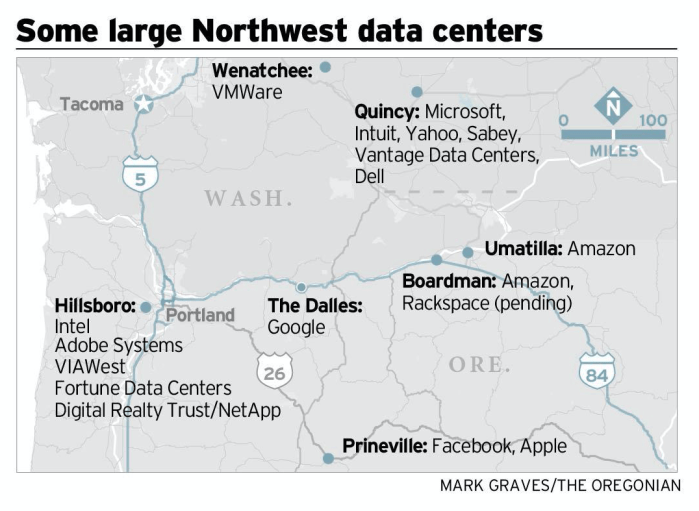
This isn’t just a future problem. The data center buildout is already in full swing and your Uncle Sugar must be getting nervous about where he’s going to get the money from to run his AI and his autonomous drone weapons. In Oregon, where electricity is famously cheap thanks to the Bonneville Power Administration’s hydroelectric dams on the Columbia River, tech companies have quietly snapped up huge portions of the grid’s output. What was once a shared public benefit—affordable, renewable power—is now being monopolized by AI compute farms whose profits leave the region to the bank accounts in Silicon Valley.

Meanwhile, Microsoft is investing in a nuclear-powered data center next to the defunct Three Mile Island reactor—but again, it’s not about public benefit. It’s about keeping Azure’s training workloads running 24/7. And don’t expect them to share any of that power capacity with the public—or even with neighboring hospitals, schools, or communities.

Letting the Public Build Private Fortresses

The real play here isn’t just to use public power—it’s to get the public to build the power infrastructure, and then seal it off for proprietary use. Moats work both ways.

That includes:
– Publicly funded transmission lines across hundreds of miles to deliver power to remote server farms;
– Publicly subsidized generation capacity (nuclear, gas, solar, hydro—you name it);
– And potentially, prioritized access to the grid that lets AI workloads run while the rest of us face rolling blackouts during heatwaves.

All while tech giants don’t share their models, don’t open their training data, and don’t make their outputs public goods. It’s a privatized extractive model, powered by your tax dollars.

Been Burning for Decades

Don’t forget: Google and YouTube have already been burning massive amounts of electricity for 20 years. It didn’t start with ChatGPT or Gemini. Serving billions of search queries, video streams, and cloud storage events every day requires a permanent baseload—yet somehow this sudden “AI emergency” is being treated like a surprise, as if nobody saw it coming.

If they knew this was coming (and they did), why didn’t they build the power? Why didn’t they plan for sustainability? Why is the public now being told it’s our job to fix their bottleneck?

The Cold War Analogy—Flipped on Its Head

Some industry advocates argue that breaking up Big Tech or slowing AI infrastructure would be like disarming during a new Cold War with China. But Gail Slater, the Assistant Attorney General leading the DOJ’s Antitrust Division, pushed back forcefully—not at a hearing, but on the War Room podcast.

In that interview, Slater recalled how AT&T tried to frame its 1980s breakup as a national security threat, arguing it would hurt America’s Cold War posture. But the DOJ did it anyway—and it led to an explosion of innovation in wireless technology.

“AT&T said, ‘You can’t do this. We are a national champion. We are critical to this country’s success. We will lose the Cold War if you break up AT&T,’ in so many words. … Even so, [the DOJ] moved forward … America didn’t lose the Cold War, and … from that breakup came a lot of competition and innovation.”

“I learned that in order to compete against China, we need to be in all these global races the American way. And what I mean by that is we’ll never beat China by becoming more like China. China has national champions, they have a controlled economy, et cetera, et cetera.

We win all these races and history has taught by our free market system, by letting the ball rip, by letting companies compete, by innovating one another. And the reason why antitrust matters to that picture, to the free market system is because we’re the cop on the beat at the end of the day. We step in when competition is not working and we ensure that markets remain competitive.”

Slater’s message was clear: regulation and competition enforcement are not threats to national strength—they’re prerequisites to it. So there’s no way that the richest corporations in commercial history should be subsidized by the American taxpayer.

Bottom Line: It’s Public Risk, Private Reward

Let’s be clear:

– They want the public to bear the cost of new electricity generation.
– They want the public to underwrite transmission lines.
– They want the public to streamline regulatory hurdles.
– And they plan to privatize the upside, lock down the infrastructure, keep their models secret and socialize the investment risk.

This isn’t a public-private partnership. It’s a one-way extraction scheme. America needs a serious conversation about energy—but it shouldn’t begin with asking taxpayers to bail out the richest companies in commercial history.

Deduplication and Discovery: The Smoking Gun in the Machine

WINSTON

“Wipe up all those little pieces of brains and skull”

From Pulp Fiction, screenplay by Quentin Tarantino and Roger Avary

Deduplication—the process of removing identical or near-identical content from AI training data—is a critical yet often overlooked indicator that AI platforms actively monitor and curate their training sets. This is the kind of process that one would expect given the kind of “scrape, ready, aim” business practices that seems precisely the approach of AI platforms that have ready access to large amounts of fairly high quality data from users of other products placed into commerce by business affiliates or confederates of the AI platforms.

For example, Google Gemini could have access to gmail, YouTube, at least “publicly available” Google Docs, Google Translate, or Google for Education, and then of course one of the great scams of all time, Google Books. Microsoft uses Bing searches, MSN browsing, the consumer Copilot experience, and ad interactions. Amazon uses Alexa prompts, Facebook uses “public” posts and so on.

This kind of hoovering up of indiscriminate amounts of “data” in the form of your baby pictures posted on Facebook and your user generated content on YouTube is bound to produce duplicates. After all, how may users have posted their favorite Billie Eilish or Taylor Swift music video. AI doesn’t need 10000 versions of “Shake it Off” they probably just need the official video. Enter deduplication–which by definition means the platform knows what it has scraped and also knows what it wants to get rid of.

“Get rid of” is a relative concept. In many systems—particularly in storage environments like backup servers or object stores—deduplication means keeping only one physical copy of a file. Any other instances of that data don’t get stored again; instead, they’re represented by pointers to the original copy. This approach, known as inline deduplication, happens in real time and minimizes storage waste without actually deleting anything of functional value. It requires knowing what you have, knowing you have more than one version of the same thing, and being able to tell the system where to look to find the “original” copy without disturbing the process and burning compute inefficiently.

In other cases, such as post-process deduplication, the system stores data initially, then later scans for and eliminates redundancies. Again, the AI platform knows there are two or more versions of the same thing, say the book Being and Nothingness, knows where to find the copies and has been trained to keep only one version. Even here, the duplicates may not be permanently erased—they might be archived, versioned, or logged for auditing, compliance, or reconstruction purposes.

In AI training contexts, deduplication usually means removing redundant examples from the training set to avoid copyright risk. The duplicate content may be discarded from the training pipeline but often isn’t destroyed. Instead, AI companies may retain it in a separate filtered corpus or keep hashed fingerprints to ensure future models don’t retrain on the same material unknowingly.

So they know what they have, and likely know where it came from. They just don’t want to tell any plaintiffs.

Ultimately, deduplication is less about destruction and more about optimization. It’s a way to reduce noise, save resources, and improve performance—while still allowing systems to track, reference, or even rehydrate the original data if needed.

Its existence directly undermines claims that companies are unaware of which copyrighted works were ingested. Indeed, it only makes sense that one of the hidden consequences of the indiscriminate scraping that underpins large-scale AI training is the proliferation of duplicated data. Web crawlers ingest everything they can access—news articles republished across syndicates, forum posts echoed in aggregation sites, Wikipedia mirrors, boilerplate license terms, spammy SEO farms repeating the same language over and over. Without any filtering, this avalanche of redundant content floods the training pipeline.

This is where deduplication becomes not just useful, but essential. It’s the cleanup crew after a massive data land grab. The more messy and indiscriminate the scraping, the more aggressively the model must filter for quality, relevance, and uniqueness to avoid training inefficiencies or—worse—model behaviors that are skewed by repetition. If a model sees the same phrase or opinion thousands of times, it might assume it’s authoritative or universally accepted, even if it’s just a meme bouncing around low-quality content farms.

Deduplication is sort of the Winston Wolf of AI. And if the cleaner shows up, somebody had to order the cleanup. It is a direct response to the excesses of indiscriminate scraping. It’s both a technical fix and a quiet admission that the underlying data collection strategy is, by design, uncontrolled. But while the scraping may be uncontrolled to get copies of as much of your data has they can lay hands on, even by cleverly changing their terms of use boilerplate so they can do all this under the effluvia of legality, they send in the cleaner to take care of the crime scene.

So to summarize: To deduplicate, platforms must identify content-level matches (e.g., multiple copies of Being and Nothingness by Jean-Paul Sartre). This process requires tools that compare, fingerprint, or embed full documents—meaning the content is readable and classifiable–and, oh, yes, discoverable.

Platforms may choose the ‘cleanest’ copy to keep, showing knowledge and active decision-making about which version of a copyrighted work is retained. And–big finish–removing duplicates only makes sense if operators know which datasets they scraped and what those datasets contain.

Drilling down on a platform’s deduplication tools and practices may prove up knowledge and intent to a precise degree—contradicting arguments of plausible deniability in litigation. Johnny ate the cookies isn’t going to fly. There’s a market clearing level of record keeping necessary for deduping to work at all, so it’s likely that there are internal deduplication logs or tooling pipelines that are discoverable.

When AI platforms object to discovery about deduplication, plaintiffs can often overcome those objections by narrowing their focus. Rather than requesting broad details about how a model deduplicates its entire training set, plaintiffs should ask a simple, specific question: Were any of these known works—identified by title or author—deduplicated or excluded from training?

This approach avoids objections about overbreadth or burden. It reframes discovery as a factual inquiry, not a technical deep dive. If the platform claims the data was not retained, plaintiffs can ask for existing artifacts—like hash filters, logs, or manifests—or seek a sworn statement explaining the loss and when it occurred. That, in turn, opens the door to potential spoliation arguments.

If trade secrets are cited, plaintiffs can propose a protective order, limiting access to outside counsel or experts like we’ve done 100,000 times before in other cases. And if the defendant claims “duplicate” is too vague, plaintiffs can define it functionally—as content that’s identical or substantially similar, by hash, tokens, or vectors.

Most importantly, deduplication is relevant. If a platform identified a plaintiff’s work and trained on it anyway, that speaks to volitional use, copying, and lack of care—key issues in copyright and fair use analysis. And if they lied about it, particularly to the court—Helloooooo Harper & Row. Discovery requests that are focused, tailored, and anchored in specific works stand a far better chance of surviving objections and yielding meaningful evidence which hopefully will be useful and lead to other positive results.

David Sacks Is Learning That the States Still Matter

For a moment, it looked like the tech world’s powerbrokers had pulled it off. Buried deep in a Republican infrastructure and tax package was a sleeper provision — the so-called AI moratorium — that would have blocked states from passing their own AI laws for up to a decade. It was an audacious move: centralize control over one of the most consequential technologies in history, bypass 50 state legislatures, and hand the reins to a small circle of federal agencies and especially to tech industry insiders.

But then it collapsed.

The Senate voted 99–1 to strike the moratorium. Governors rebelled. Attorneys general sounded the alarm. Artists, parents, workers, and privacy advocates from across the political spectrum said “no.” Even hardline conservatives like Ted Cruz eventually reversed course when it came down to the final vote. The message to Big Tech or the famous “Little Tech” was clear: the states still matter — and America’s tech elite ignore that at their peril.  (“Little Tech” is the latest rhetorical deflection promoted by Big Tech aka propaganda.)

The old Google crowd pushed the moratorium–their fingerprints were obvious. Having gotten fabulously rich off of their two favorites: The DMCA farce and the Section 230 shakedown. But there’s increasing speculation that White House AI Czar and Silicon Valley Viceroy David Sacks, PayPal alum and vocal MAGA-world player, was calling the ball. If true, that makes this defeat even more revealing.

Sacks represents something of a new breed of power-hungry tech-right influencer — part of the emerging “Red Tech” movement that claims to reject woke capitalism and coastal elitism but still wants experts to shape national policy from Silicon Valley, a chapter straight out of Philip Dru: Administrator. Sacks is tied to figures like Peter Thiel, Elon Musk, and a growing network of Trump-aligned venture capitalists. But even that alignment couldn’t save the moratorium.

Why? Because the core problem wasn’t left vs. right. It was top vs. bottom.

In 1964, Ronald Reagan’s classic speech called A Time for Choosing warned about “a little intellectual elite in a far-distant capitol” deciding what’s best for everyone else. That warning still rings true — except now the “capitol” might just be a server farm in Menlo Park or a podcast studio in LA.

The AI moratorium was an attempt to govern by preemption and fiat, not by consent. And the backlash wasn’t partisan. It came from red states and blue ones alike — places where elected leaders still think they have the right to protect their citizens from unregulated surveillance, deepfakes, data scraping, and economic disruption.

So yes, the defeat of the moratorium was a blow to Google’s strategy of soft-power dominance. But it was also a shot across the bow for David Sacks and the would-be masters of tech populism. You can’t have populism without the people.

If Sacks and his cohort want to play a long game in AI policy, they’ll have to do more than drop ideas into the policy laundry of think tank white papers and Beltway briefings. They’ll need to win public trust, respect state sovereignty, and remember that governing by sneaky safe harbors is no substitute for legitimacy.  

The moratorium failed because it presumed America could be governed like a tech startup — from the top, at speed, with no dissent. Turns out the country is still under the impression they have something to say about how they are governed, especially by Big Tech.

The Patchwork They Fear Is Accountability: Why Big AI Wants a Moratorium on State Laws

Why Big Tech’s Push for a Federal AI Moratorium Is Really About Avoiding State Investigations, Liability, and Transparency

As Congress debates the so-called “One Big Beautiful Bill Act,” one of its most explosive provisions has stayed largely below the radar: a 10-year or 5-year or any-year federal moratorium on state and local regulation of artificial intelligence. Supporters frame it as a common sense way to prevent a “patchwork” of conflicting state laws. But the real reason for the moratorium may be more self-serving—and more ominous.

The truth is, the patchwork they fear is not complexity. It’s accountability.

Liability Landmines Beneath the Surface

As has been well-documented by the New York Times and others, generative AI platforms have likely ingested and processed staggering volumes of data that implicate state-level consumer protections. This includes biometric data (like voiceprints and faces), personal communications, educational records, and sensitive metadata—all of which are protected under laws in states like Illinois (BIPA), California (CCPA/CPRA), and Texas.

If these platforms scraped and trained on such data without notice or consent, they are sitting on massive latent liability. Unlike federal laws, which are often narrow or toothless, many state statutes allow private lawsuits and statutory damages. Class action risk is not hypothetical—it is systemic.  It is crucial for policymakers to have a clear understanding of where we are today with respect to the collision between AI and consumer rights, including copyright.  The corrosion of consumer rights by the richest corporations in commercial history is not something that may happen in the future.  Massive violations have  already occurred, are occurring this minute, and will continue to occur into the future at an increasing rate.  

The Quiet Race to Avoid Discovery

State laws don’t just authorize penalties; they open the door to discovery. Once an investigation or civil case proceeds, AI platforms could be forced to disclose exactly what data they trained on, how it was retained, and whether any red flags were ignored.

This mirrors the arc of the social media addiction lawsuits now consolidated in multidistrict litigation. Platforms denied culpability for years—until internal documents showed what they knew and when. The same thing could happen here, but on a far larger scale.

Preemption as Shield and Sword

The proposed AI moratorium isn’t a regulatory timeout. It’s a firewall. By halting enforcement of state AI laws, the moratorium could prevent lawsuits, derail investigations, and shield past conduct from scrutiny.

Even worse, the Senate version conditions broadband infrastructure funding (BEAD) on states agreeing to the moratorium—an unconstitutional act of coercion that trades state police powers for federal dollars. The legal implications are staggering, especially under the anti-commandeering doctrine of Murphy v. NCAA and Printz v. United States.

This Isn’t About Clarity. It’s About Control.

Supporters of the moratorium, including senior federal officials and lobbying arms of Big Tech, claim that a single federal standard is needed to avoid chaos. But the evidence tells a different story.

States are acting precisely because Congress hasn’t. Illinois’ BIPA led to real enforcement. California’s privacy framework has teeth. Dozens of other states are pursuing legislation to respond to harms AI is already causing.

In this light, the moratorium is not a policy solution. It’s a preemptive strike.

Who Gets Hurt?
– Consumers, whose biometric data may have been ingested without consent
– Parents and students, whose educational data may now be part of generative models
– Artists, writers, and journalists, whose copyrighted work has been scraped and reused
– State AGs and legislatures, who lose the ability to investigate and enforce

Google Is an Example of Potential Exposure

Google’s former executive chairman Eric Schmidt has seemed very, very interested in writing the law for AI.  For example, Schmidt worked behind the scenes for the two years at least to establish US artificial intelligence policy under President Biden. Those efforts produced the “Executive Order on the Safe, Secure, and Trustworthy Development and Use of Artificial Intelligence“, the longest executive order in history. That EO was signed into effect by President Biden on October 30.  In his own words during an Axios interview with Mike Allen, the Biden AI EO was signed just in time for Mr. Schmidt to present that EO as what Mr. Schmidt calls “bait” to the UK government–which convened a global AI safety conference at Bletchley Park in the UK convened by His Excellency Rishi Sunak (the UK’s tech bro Prime Minister) that just happened to start on November 1, the day after President Biden signed the EO.  And now look at the disaster that the UK AI proposal would be.  

As Mr. Schmidt told Axios:

So far we are on a win, the taste of winning is there.  If you look at the UK event which I was part of, the UK government took the bait, took the ideas, decided to lead, they’re very good at this,  and they came out with very sensible guidelines.  Because the US and UK have worked really well together—there’s a group within the National Security Council here that is particularly good at this, and they got it right, and that produced this EO which is I think is the longest EO in history, that says all aspects of our government are to be organized around this.

Apparently, Mr. Schmidt hasn’t gotten tired of winning.  Of course, President Trump rescinded the Biden AI EO which may explain why we are now talking about a total moratorium on state enforcement which percolated at a very pro-Google shillery called R Street Institute, apparently by one Adam Thierer .  But why might Google be so interested in this idea?

Google may face exponentially acute liability under state laws if it turns out that biometric or behavioral data from platforms like YouTube Kids or Google for Education were ingested into AI training sets. 

These services, marketed to families and schools, collect sensitive information from minors—potentially implicating both federal protections like COPPA and more expansive state statutes. As far back as 2015, Senator Ben Nelson raised alarms about YouTube Kids, calling it “ridiculously porous” in terms of oversight and lack of safeguards. If any of that youth-targeted data has been harvested by generative AI tools, the resulting exposure is not just a regulatory lapse—it’s a landmine. 

The moratorium could be seen as an attempt to preempt the very investigations that might uncover how far that exposure goes.

What is to be Done?

Instead of smuggling this moratorium into a must-pass bill, Congress should strip it out and hold open hearings. If there’s merit to federal preemption, let it be debated on its own. But do not allow one of the most sweeping power grabs in modern tech policy to go unchallenged.

The public deserves better. Our children deserve better.  And the states have every right to defend their people. Because the patchwork they fear isn’t legal confusion.

It’s accountability.

The OBBBA’s AI Moratorium Provision Has Existential Constitutional Concerns and Policy Implications

As we watch the drama of the One Big Beautiful Bill Act play out there’s a plot twist waiting in the wings that could create a cliffhanger in the third act: The poorly thought out, unnecessary and frankly offensive AI moratorium safe harbor that serves only the Biggest of Big Tech that we were gifted by Adam Theirer of the R Street Institute.

The latest version of the AI moratorium poison pill in the Senate version of OBBBA (aka HR1) reads something like this:

The AI moratorium provision within the One Big Beautiful Bill Act (OBBBA) reads like the fact pattern for a bar exam crossover question. The proposed legislation raises significant Constitutional and policy concerns. Before it even gets to the President’s desk, the legislation likely violates the Senate’s Byrd Rule that allows the OBBBA to avoid the 60 vote threshold (and the filibuster) and get voted on in “reconciliation” on a simple majority. The President’s party has a narrow simple majority in the Senate so if it were not for the moratorium the OBBBA should pass.

There are lots of people who think that the moratorium should fail the “Byrd Bath” analysis because it is not “germane” to the budget and tax process required to qualify for reconciliation. This is important because if the Senate Parliamentarian does not hold the line on germaine-ness, everyone will get into the act for every bill simply by attaching a chunk of money to your favorite donor, and that will not go over well. According to Roll Call, Senator Cruz is already talking about introducing regulatory legislation with the moratorium, which would likely only happen if the OBBBA poison pill was cut out:

The AI moratorium has already picked up some serious opponents in the Senate who would likely have otherwise voted for the President’s signature legislation with the President’s tax and spending policies in place. The difference between the moratorium and spending cuts is that money is fungible and a moratorium banning states from acting under their police powers really, really, really is not fungible at all. The moratorium is likely going to fail or get close to failing, and if the art of the deal says getting 80% of something is better than 100% of nothing, that moratorium is going to go away in the context of a closing. Maybe.

And don’t forget, the bill has to go back to the House which passed it by a single vote and there are already Members of the House who are getting buyers remorse about the AI moratorium specifically. So when they get a chance to vote again…who knows.

Even if it passes, the 40 state Attorneys General who oppose it may be gearing up to launch a Constitutional challenge to the provision on a number of grounds starting with the Tenth Amendment, its implications for federalism, and other Constitutional issues that just drip out of this thing. And my bet is that Adam Thierer will be eyeball witness #1 in that litigation.

So to recap the vulnerabilities:

Byrd Rule Violation

The Byrd Rule prohibits non-budgetary provisions in reconciliation bills. The AI moratorium’s primary effect is regulatory, not fiscal, as it preempts state laws without directly impacting federal revenues or expenditures. Senators, including Ed Markey (D-MA) as reported by Roll Call, have indicated intentions to challenge the provision under the Byrd Rule. The Hill reports:

Federal Preemption, the Tenth Amendment and Anti-Commandeering Doctrine

The Tenth Amendment famously reserves powers not delegated to the federal government to the states and to the people (remember them?). The constitutional principle of “anticommandeering” is a doctrine under U.S. Constitutional law that prohibits the federal government from compelling states or state officials to enact, enforce, or administer federal regulatory programs.

Anticommandeering is grounded primarily in the Tenth Amendment. Under this principle, while the federal government can regulate individuals directly under its enumerated powers (such as the Commerce Clause), it cannot force state governments to govern according to federal instructions. Which is, of course, exactly what the moratorium does, although the latest version would have you believe that the feds aren’t really commandeering, they are just tying behavior to money which the feds do all the time. I doubt anyone believes it.

The AI moratorium infringes upon the good old Constitution by:

  • Overriding State Authority: It prohibits states from enacting or enforcing AI regulations, infringing upon their traditional police powers to legislate for the health, safety, and welfare of their citizens.
  • Lack of Federal Framework: Unlike permissible federal preemption, which operates within a comprehensive federal regulatory scheme, the AI moratorium lacks such a framework, making it more akin to unconstitutional commandeering.
  • Precedent in Murphy v. NCAA: The Supreme Court held that Congress cannot prohibit states from enacting laws, as that prohibition violates the anti-commandeering principle. The AI moratorium, by preventing states from regulating AI, mirrors the unconstitutional aspects identified in Murphy. So there’s that.

The New Problem: Coercive Federalism

By conditioning federal broadband funds (“BEAD money”) on states’ agreement to pause AI regulations , the provision exerts undue pressure on states, potentially violating principles established in cases like NFIB v. Sebelius. Plus, the Broadband Equity, Access, and Deployment (BEAD) Program is a $42.45 billion federal initiative established under the Infrastructure Investment and Jobs Act of 2021. Administered by the National Telecommunications and Information Administration (NTIA), BEAD aims to expand high-speed internet access across the United States by funding planning, infrastructure deployment, and adoption programs. In other words, BEAD has nothing to do with the AI moratorium. So there’s that.

Supremacy Clause Concerns

The moratorium may conflict with existing state laws, leading to legal ambiguities and challenges regarding federal preemption. That’s one reason why 40 state AGs are going to the mattresses for the fight.

Lawmakers Getting Cold Feet or In Opposition

Several lawmakers have voiced concerns or opposition to the AI moratorium:

  • Rep. Marjorie Taylor Greene (R-GA): Initially voted for the bill but later stated she was unaware of the AI provision and would have opposed it had she known. She has said that she will vote no on the OBBBA when it comes back to the House if the Mr. T’s moratorium poison pill is still in there.
  • Sen. Josh Hawley (R-MO): Opposes the moratorium, emphasizing the need to protect individual rights over corporate interests.
  • Sen. Marsha Blackburn (R-TN): Expressed concerns that the moratorium undermines state protections, particularly referencing Tennessee’s AI-related laws.
  • Sen. Edward Markey (D-MA): Intends to challenge the provision under the Byrd Rule, citing its potential to harm vulnerable communities.

Recommendation: Allow Dissenting Voices

Full disclosure, I don’t think Trump gives a damn about the AI moratorium. I also think this is performative and is tied to giving the impression to people like Masa at Softbank that he tried. It must be said that Masa’s billions are not quite as important after Trump’s Middle East roadshow than they were before, speaking of leverage. While much has been made of the $1 million contributions that Zuckerberg, Tim Apple, & Co. made to attend the inaugural, there’s another way to look at that tableau–remember Titus Andronicus when the general returned to Rome with Goth prisoners in chains following his chariot? That was Tamora, the Queen of the Goths, her three sons Alarbus, Chiron, and Demetrius along with Aaron the Moor. Titus and the Goth’s still hated each other. Just sayin’.

Somehow I wouldn’t be surprised if this entire exercise was connected to the TikTok divestment in ways that aren’t entirely clear. So, given the constitutional concerns and growing opposition, it is advisable for President Trump to permit members of Congress to oppose the AI moratorium provision without facing political repercussions, particularly since Rep. Greene has already said she’s a no vote–on the 214-213 vote the first time around. This approach would:

  • Respect the principles of federalism and states’ rights.
  • Tell Masa he tried, but oh well.
  • Demonstrate responsiveness to legitimate legislative concerns on a bi-partisan basis.
  • Ensure that the broader objectives of the OBBBA are not jeopardized by a contentious provision.

Let’s remember: The tax and spend parts of OBBBA are existential to the Trump agenda; the AI moratorium definitely is not, no matter what Mr. T wants you to believe. While the OBBBA encompasses significant policy initiatives which are highly offensive to a lot of people, the AI moratorium provision presents constitutional and procedural challenges and fundamental attacks on our Constitution that warrant its removal. Cutting it out will strengthen the bill’s likelihood of passing and uphold the foundational principles of American governance, at least for now.

Hopefully Trump looks at it that way, too.

How the AI Moratorium Threatens Local Educational Control

The proposed federal AI moratorium currently in the One Big Beautiful Bill Act states:

[N]o State or political subdivision thereof may enforce, during the 10-year period beginning on the date of the enactment of this Act, any law or regulation of that State or a political subdivision thereof limiting, restricting, or otherwise regulating artificial intelligence models, artificial intelligence systems, or automated decision systems entered into interstate commerce.

What is a “political subdivision”?  According to a pretty standard definition offered by the Social Security Administration:

A political subdivision is a separate legal entity of a State which usually has specific governmental functions.  The term ordinarily includes a county, city, town, village, or school district, and, in many States, a sanitation, utility, reclamation, drainage, flood control, or similar district.

The proposed moratorium would prevent school districts—classified as political subdivisions—from adopting policies that regulate artificial intelligence. This includes rules restricting students’ use of AI tools such as ChatGPT, Gemini, or other platforms in school assignments, exams, and academic work. Districts may be unable to prohibit AI-generated content in essays, discipline AI-related cheating, or require disclosures about AI use unless they write broad rules for ‘unauthorized assistance’ in general or something like that.

Without clear authority to restrict AI in educational contexts, school districts will likely struggle to maintain academic integrity or to update honor codes. The moratorium could even interfere with schools’ ability to assess or certify genuine student performance. 

Parallels with Google’s Track Record in Education

The dangers of preempting local educational control over AI echo prior controversies involving Google’s deployment of tools like Chromebooks, Google Classroom, and Workspace for Education in K–12 environments. Despite being marketed as free and privacy-safe, Google has repeatedly been accused of covertly tracking students, profiling minors, and failing to meet federal privacy standards.  It’s entirely likely that Google has integrated its AI into all of its platforms including those used in school districts, so Google could likely raise the AI moratorium as a safe harbor defense to claims by parents or schools that they violate privacy or other rights with their products.

2015 complaint by the Electronic Frontier Foundation (EFF) alleged that Google tracked student activity even with privacy settings enabled although this was probably an EFF ‘big help, little bad mouth’ situation. New Mexico sued Google in 2020 for collecting student data without parental consent. Most recently, lawsuits in California allege that Google continues to fingerprint students and gather metadata despite educational safeguards.

Although the EFF filed an FTC complaint against Google in 2015, it did not launch a broad campaign or litigation strategy afterward. Critics argue that EFF’s muted follow-up may reflect its financial ties to Google, which has funded the organization in the past. This creates a potential conflict: while EFF publicly supports student privacy, its response to Google’s misconduct has been comparatively restrained.

This has led to the suggestion that EFF operates in a ‘big help, little bad mouth’ mode—providing substantial policy support to Google on issues like net neutrality and platform immunity, while offering limited criticism on privacy violations that directly affect vulnerable groups like students.

AI Use in Schools vs. Google’s Educational Data Practices: A Dangerous Parallel

The proposed AI moratorium would prevent school districts from regulating how artificial intelligence tools are used in classrooms—including tools that generate student work or analyze student behavior. This prohibition becomes even more alarming when we consider the historical abuses tied to Google’s education technologies, which have long raised concerns about student profiling and surveillance.

Over the past decade, Google has aggressively expanded its presence in American classrooms through products like Google Classroom, Chromebooks with Google Workspace for Education, Google Docs and Gmail for student accounts.

Although marketed as free tools, these services have been criticized for tracking children’s browsing behavior and location, storing search histories, even when privacy settings were enabled, creating behavioral profiles for advertising or product development, and sharing metadata with third-party advertisers or internal analytics teams.

Google previously entered into a 2014 agreement with the Electronic Frontier Foundation (EFF) to curb these practices—but watchdog groups and investigative journalists have continued to document covert tracking of minors, even in K–12 settings where children cannot legally consent to data collection.

AI Moratorium: Legalizing a New Generation of Surveillance Tools

The AI moratorium would take these concerns a step further by prohibiting school districts from regulating newer AI systems, even if they profile students using facial recognition, emotion detection, or predictive analytics, auto-grade essays and responses, building proprietary datasets on student writing patterns, offer “personalized learning” in exchange for access to sensitive performance and behavior data, or encourage use of generative tools (like ChatGPT) that may store and analyze student prompts and usage patterns

If school districts cannot ban or regulate these tools, they are effectively stripped of their local authority to protect students from the next wave of educational surveillance.

Contrast in Power Dynamics

IssueGoogle for EducationAI Moratorium Impacts
Privacy ConcernsTracked students via Gmail, Docs, and Classroom without proper disclosures.Prevents districts from banning or regulating AI tools that collect behavioral or academic data.
Policy ResponseLimited voluntary reforms; Google maintains a dominant K–12 market share.Preempts all local regulation, even if communities demand stricter safeguards.
Legal RemediesFew successful lawsuits due to weak enforcement of COPPA and FERPA.Moratorium would block even the potential for future local rules.
Educational ImpactCreated asymmetries in access and data protection between schools.Risks deepening digital divides and eroding academic integrity.

Why It Matters

Allowing companies to introduce AI tools into classrooms—while simultaneously barring school districts from regulating them—opens the door to widespread, unchecked profiling of minors, with no meaningful local oversight. Just as Google was allowed to shape a generation’s education infrastructure behind closed doors, this moratorium would empower new AI actors to do the same, shielded from accountability.

Parents groups should let lawmakers know that the AI moratorium has to come out of the legislation.

Now What? Can the AI Moratorium Survive the Byrd Rule on “Germaneness”?

Yes, the Big Beautiful Bill Act has passed the House of Representatives and is on its way to the Senate–with the AI safe harbor moratorium and its $500,000,000 giveaway appropriation intact. Yes, right next to Medicaid cuts, etc.

So now what? The controversial AI regulation moratorium tucked inside the reconciliation package is still a major point of contention. Critics argue that the provision—which would block state and local governments from enforcing or adopting AI-related laws for a decade—is blatantly non-germane to a budget bill. But what if the AI moratorium, in the context of a broader $500 million appropriation for a federal AI modernization initiative, isn’t so clearly in violation of the Byrd Rule? Just remember–these guys are not babies. They’ve thought about this and they intend to win–that’s why the language survived the House.

Remember, the assumption is that President Trump can’t get the BBB through the Senate in regular order which would require 60 votes and instead is going to jam it through under “budget reconciliation” rules which requires a simple majority vote in the Republican-held Senate. Reconciliation requires that there not be shenanigans (hah) and that the budget reconciliation actually deals with the budget and not some policy change that is getting sneaked under the tent. Well, what if it’s both?

Let’s consider what the Senate’s Byrd Rule actually requires.

To survive reconciliation, a provision must:
1. Affect federal outlays or revenues;
2. Have a budgetary impact that is not “merely incidental” to its policy effects;
3. Fall within the scope of the congressional instructions to the committees of jurisdiction;
4. Not increase the federal deficit outside the budget window;
5. Not make recommendations regarding Social Security;
6. Not violate Senate rules on germaneness or jurisdiction.

Critics rightly point out that a sweeping 10-year regulatory moratorium in Section 43201(c) smells more like federal policy overreach than fiscal fine-tuning, particularly since it’s pretty clearly a 10th Amendment violation of state police powers. But the moratorium exists within a broader federal AI modernization framework in Section 43201(a) that does involve a substantial appropriation: $500 million allocated for updating federal AI infrastructure, developing national standards, and coordinating interagency protocols. That money is real, scoreable, and central to the bill’s stated purpose.

Here’s the crux of the argument: if the appropriation is deemed valid under the Byrd Rule, the guardrails that enable its effective execution may also be valid – especially if they condition the use of federal funds on a coherent national framework. The moratorium can then be interpreted not as an abstract policy preference, but as a necessary precondition for ensuring that the $500 million achieves its budgetary goals without fragmentation.

In other words, the moratorium could be cast as a budget safeguard. Allowing 50 different state AI rules to proliferate while the federal government invests in a national AI backbone could undercut the very purpose of the expenditure. If that fragmentation leads to duplicative spending, legal conflict, or wasted infrastructure, then the moratorium arguably serves a protective fiscal function.

Precedent matters here. Reconciliation has been used in the past to impose conditions on Medicaid, restrict use of federal education funds, and shape how states comply with federal energy and transportation programs. The Supreme Court has rejected some of these on 10th Amendment grounds (NFIB v. Sebelius), but the Byrd Rule test is about budgetary relevance, not constitutional viability.

And that’s where the moratorium finds its most plausible defense: it is incidental only if you believe the spending exists in a vacuum. In truth, the $500 million appropriation depends on consistent, scalable implementation. A federal moratorium ensures that states don’t undermine the utility of that spending. It may be unwise. It may be a budget buster. It may be unpopular. But if it’s tightly tied to the execution of a federal program with scoreable fiscal effects, it just might survive the Byrd test.

So while artists, civil liberties advocates and state officials rightly decry the moratorium on policy grounds, its procedural fate may ultimately rest on a more mundane calculus: Does this provision help protect federal funds from inefficiency? If the answer is yes—and the appropriation stays—then the moratorium may live on, not because it deserves to, but because it was drafted just cleverly enough to thread the eye of the Byrd Rule needle.

Like I said, these guys aren’t babies and they thought about this because they mean to win. Ideally, somebody should have stopped it from ever getting into the bill in the first place. But since they didn’t, our challenge is going to be stopping it from getting through attached to a triple-whip, too big to fail, must pass signature legislation that Trump campaigned on and was elected.

And even if we are successful in stopping the AI moratorium safe harbor in the Senate, do you think it’s just going to go away? Will the Tech Bros just say, you got me, now I’ll happily pay those wrongful death claims?