For a moment, it looked like the tech world’s powerbrokers had pulled it off. Buried deep in a Republican infrastructure and tax package was a sleeper provision — the so-called AI moratorium — that would have blocked states from passing their own AI laws for up to a decade. It was an audacious move: centralize control over one of the most consequential technologies in history, bypass 50 state legislatures, and hand the reins to a small circle of federal agencies and especially to tech industry insiders.
But then it collapsed.
The Senate voted 99–1 to strike the moratorium. Governors rebelled. Attorneys general sounded the alarm. Artists, parents, workers, and privacy advocates from across the political spectrum said “no.” Even hardline conservatives like Ted Cruz eventually reversed course when it came down to the final vote. The message to Big Tech or the famous “Little Tech” was clear: the states still matter — and America’s tech elite ignore that at their peril. (“Little Tech” is the latest rhetorical deflection promoted by Big Tech aka propaganda.)
The old Google crowd pushed the moratorium–their fingerprints were obvious. Having gotten fabulously rich off of their two favorites: The DMCA farce and the Section 230 shakedown. But there’s increasing speculation that White House AI Czar and Silicon Valley Viceroy David Sacks, PayPal alum and vocal MAGA-world player, was calling the ball. If true, that makes this defeat even more revealing.
Sacks represents something of a new breed of power-hungry tech-right influencer — part of the emerging “Red Tech” movement that claims to reject woke capitalism and coastal elitism but still wants experts to shape national policy from Silicon Valley, a chapter straight out of Philip Dru: Administrator. Sacks is tied to figures like Peter Thiel, Elon Musk, and a growing network of Trump-aligned venture capitalists. But even that alignment couldn’t save the moratorium.
Why? Because the core problem wasn’t left vs. right. It was top vs. bottom.
In 1964, Ronald Reagan’s classic speech called A Time for Choosing warned about “a little intellectual elite in a far-distant capitol” deciding what’s best for everyone else. That warning still rings true — except now the “capitol” might just be a server farm in Menlo Park or a podcast studio in LA.
The AI moratorium was an attempt to govern by preemption and fiat, not by consent. And the backlash wasn’t partisan. It came from red states and blue ones alike — places where elected leaders still think they have the right to protect their citizens from unregulated surveillance, deepfakes, data scraping, and economic disruption.
So yes, the defeat of the moratorium was a blow to Google’s strategy of soft-power dominance. But it was also a shot across the bow for David Sacks and the would-be masters of tech populism. You can’t have populism without the people.
If Sacks and his cohort want to play a long game in AI policy, they’ll have to do more than drop ideas into the policy laundry of think tank white papers and Beltway briefings. They’ll need to win public trust, respect state sovereignty, and remember that governing by sneaky safe harbors is no substitute for legitimacy.
The moratorium failed because it presumed America could be governed like a tech startup — from the top, at speed, with no dissent. Turns out the country is still under the impression they have something to say about how they are governed, especially by Big Tech.
Category: AI Litigation
The Patchwork They Fear Is Accountability: Why Big AI Wants a Moratorium on State Laws
Why Big Tech’s Push for a Federal AI Moratorium Is Really About Avoiding State Investigations, Liability, and Transparency
As Congress debates the so-called “One Big Beautiful Bill Act,” one of its most explosive provisions has stayed largely below the radar: a 10-year or 5-year or any-year federal moratorium on state and local regulation of artificial intelligence. Supporters frame it as a common sense way to prevent a “patchwork” of conflicting state laws. But the real reason for the moratorium may be more self-serving—and more ominous.
The truth is, the patchwork they fear is not complexity. It’s accountability.
Liability Landmines Beneath the Surface
As has been well-documented by the New York Times and others, generative AI platforms have likely ingested and processed staggering volumes of data that implicate state-level consumer protections. This includes biometric data (like voiceprints and faces), personal communications, educational records, and sensitive metadata—all of which are protected under laws in states like Illinois (BIPA), California (CCPA/CPRA), and Texas.
If these platforms scraped and trained on such data without notice or consent, they are sitting on massive latent liability. Unlike federal laws, which are often narrow or toothless, many state statutes allow private lawsuits and statutory damages. Class action risk is not hypothetical—it is systemic. It is crucial for policymakers to have a clear understanding of where we are today with respect to the collision between AI and consumer rights, including copyright. The corrosion of consumer rights by the richest corporations in commercial history is not something that may happen in the future. Massive violations have already occurred, are occurring this minute, and will continue to occur into the future at an increasing rate.
The Quiet Race to Avoid Discovery
State laws don’t just authorize penalties; they open the door to discovery. Once an investigation or civil case proceeds, AI platforms could be forced to disclose exactly what data they trained on, how it was retained, and whether any red flags were ignored.
This mirrors the arc of the social media addiction lawsuits now consolidated in multidistrict litigation. Platforms denied culpability for years—until internal documents showed what they knew and when. The same thing could happen here, but on a far larger scale.
Preemption as Shield and Sword
The proposed AI moratorium isn’t a regulatory timeout. It’s a firewall. By halting enforcement of state AI laws, the moratorium could prevent lawsuits, derail investigations, and shield past conduct from scrutiny.
Even worse, the Senate version conditions broadband infrastructure funding (BEAD) on states agreeing to the moratorium—an unconstitutional act of coercion that trades state police powers for federal dollars. The legal implications are staggering, especially under the anti-commandeering doctrine of Murphy v. NCAA and Printz v. United States.
This Isn’t About Clarity. It’s About Control.
Supporters of the moratorium, including senior federal officials and lobbying arms of Big Tech, claim that a single federal standard is needed to avoid chaos. But the evidence tells a different story.
States are acting precisely because Congress hasn’t. Illinois’ BIPA led to real enforcement. California’s privacy framework has teeth. Dozens of other states are pursuing legislation to respond to harms AI is already causing.
In this light, the moratorium is not a policy solution. It’s a preemptive strike.
Who Gets Hurt?
– Consumers, whose biometric data may have been ingested without consent
– Parents and students, whose educational data may now be part of generative models
– Artists, writers, and journalists, whose copyrighted work has been scraped and reused
– State AGs and legislatures, who lose the ability to investigate and enforce
Google Is an Example of Potential Exposure
Google’s former executive chairman Eric Schmidt has seemed very, very interested in writing the law for AI. For example, Schmidt worked behind the scenes for the two years at least to establish US artificial intelligence policy under President Biden. Those efforts produced the “Executive Order on the Safe, Secure, and Trustworthy Development and Use of Artificial Intelligence“, the longest executive order in history. That EO was signed into effect by President Biden on October 30. In his own words during an Axios interview with Mike Allen, the Biden AI EO was signed just in time for Mr. Schmidt to present that EO as what Mr. Schmidt calls “bait” to the UK government–which convened a global AI safety conference at Bletchley Park in the UK convened by His Excellency Rishi Sunak (the UK’s tech bro Prime Minister) that just happened to start on November 1, the day after President Biden signed the EO. And now look at the disaster that the UK AI proposal would be.
As Mr. Schmidt told Axios:
So far we are on a win, the taste of winning is there. If you look at the UK event which I was part of, the UK government took the bait, took the ideas, decided to lead, they’re very good at this, and they came out with very sensible guidelines. Because the US and UK have worked really well together—there’s a group within the National Security Council here that is particularly good at this, and they got it right, and that produced this EO which is I think is the longest EO in history, that says all aspects of our government are to be organized around this.
Apparently, Mr. Schmidt hasn’t gotten tired of winning. Of course, President Trump rescinded the Biden AI EO which may explain why we are now talking about a total moratorium on state enforcement which percolated at a very pro-Google shillery called R Street Institute, apparently by one Adam Thierer . But why might Google be so interested in this idea?
Google may face exponentially acute liability under state laws if it turns out that biometric or behavioral data from platforms like YouTube Kids or Google for Education were ingested into AI training sets.
These services, marketed to families and schools, collect sensitive information from minors—potentially implicating both federal protections like COPPA and more expansive state statutes. As far back as 2015, Senator Ben Nelson raised alarms about YouTube Kids, calling it “ridiculously porous” in terms of oversight and lack of safeguards. If any of that youth-targeted data has been harvested by generative AI tools, the resulting exposure is not just a regulatory lapse—it’s a landmine.
The moratorium could be seen as an attempt to preempt the very investigations that might uncover how far that exposure goes.
What is to be Done?
Instead of smuggling this moratorium into a must-pass bill, Congress should strip it out and hold open hearings. If there’s merit to federal preemption, let it be debated on its own. But do not allow one of the most sweeping power grabs in modern tech policy to go unchallenged.
The public deserves better. Our children deserve better. And the states have every right to defend their people. Because the patchwork they fear isn’t legal confusion.
It’s accountability.
The OBBBA’s AI Moratorium Provision Has Existential Constitutional Concerns and Policy Implications
As we watch the drama of the One Big Beautiful Bill Act play out there’s a plot twist waiting in the wings that could create a cliffhanger in the third act: The poorly thought out, unnecessary and frankly offensive AI moratorium safe harbor that serves only the Biggest of Big Tech that we were gifted by Adam Theirer of the R Street Institute.
The latest version of the AI moratorium poison pill in the Senate version of OBBBA (aka HR1) reads something like this:
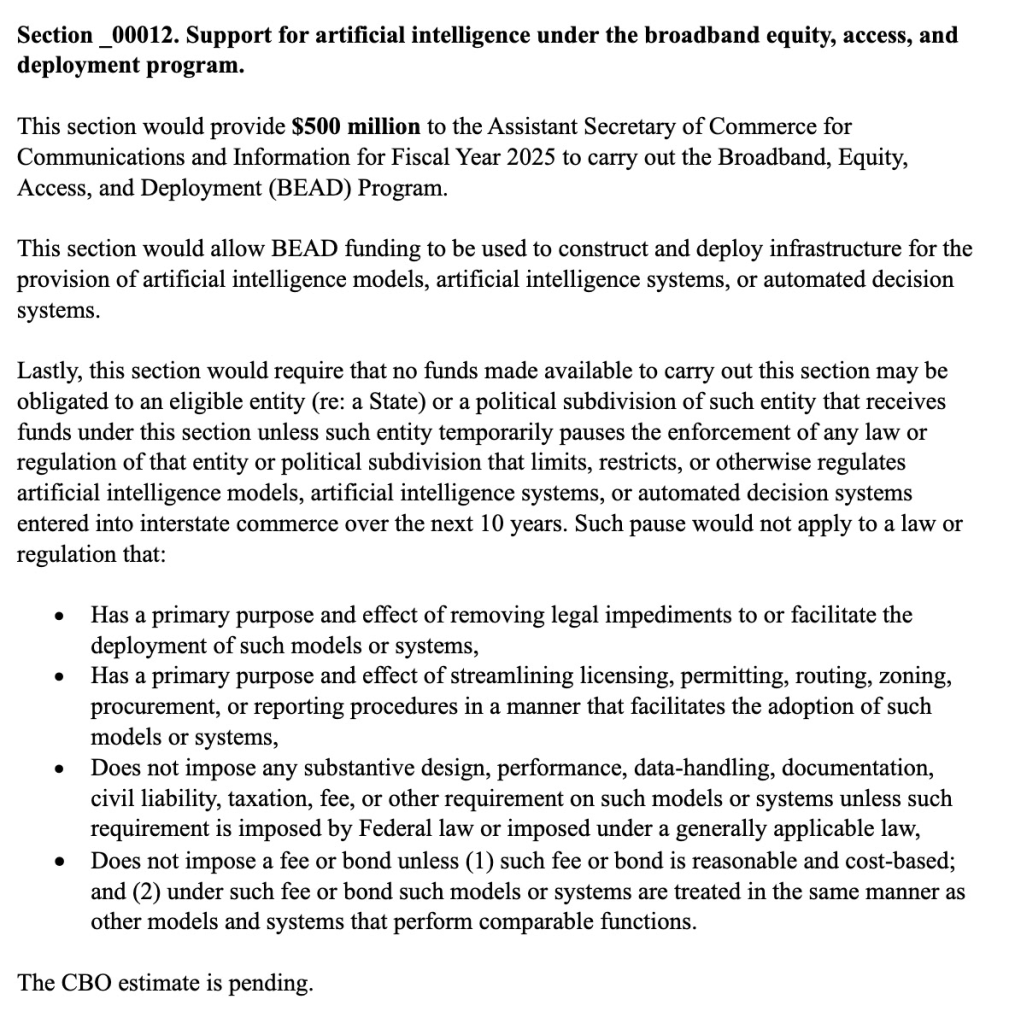
The AI moratorium provision within the One Big Beautiful Bill Act (OBBBA) reads like the fact pattern for a bar exam crossover question. The proposed legislation raises significant Constitutional and policy concerns. Before it even gets to the President’s desk, the legislation likely violates the Senate’s Byrd Rule that allows the OBBBA to avoid the 60 vote threshold (and the filibuster) and get voted on in “reconciliation” on a simple majority. The President’s party has a narrow simple majority in the Senate so if it were not for the moratorium the OBBBA should pass.
There are lots of people who think that the moratorium should fail the “Byrd Bath” analysis because it is not “germane” to the budget and tax process required to qualify for reconciliation. This is important because if the Senate Parliamentarian does not hold the line on germaine-ness, everyone will get into the act for every bill simply by attaching a chunk of money to your favorite donor, and that will not go over well. According to Roll Call, Senator Cruz is already talking about introducing regulatory legislation with the moratorium, which would likely only happen if the OBBBA poison pill was cut out:
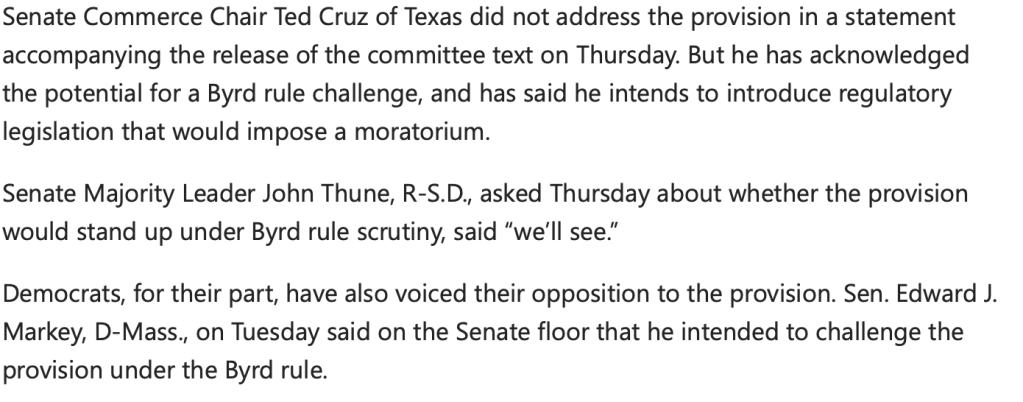
The AI moratorium has already picked up some serious opponents in the Senate who would likely have otherwise voted for the President’s signature legislation with the President’s tax and spending policies in place. The difference between the moratorium and spending cuts is that money is fungible and a moratorium banning states from acting under their police powers really, really, really is not fungible at all. The moratorium is likely going to fail or get close to failing, and if the art of the deal says getting 80% of something is better than 100% of nothing, that moratorium is going to go away in the context of a closing. Maybe.
And don’t forget, the bill has to go back to the House which passed it by a single vote and there are already Members of the House who are getting buyers remorse about the AI moratorium specifically. So when they get a chance to vote again…who knows.
Even if it passes, the 40 state Attorneys General who oppose it may be gearing up to launch a Constitutional challenge to the provision on a number of grounds starting with the Tenth Amendment, its implications for federalism, and other Constitutional issues that just drip out of this thing. And my bet is that Adam Thierer will be eyeball witness #1 in that litigation.
So to recap the vulnerabilities:
Byrd Rule Violation
The Byrd Rule prohibits non-budgetary provisions in reconciliation bills. The AI moratorium’s primary effect is regulatory, not fiscal, as it preempts state laws without directly impacting federal revenues or expenditures. Senators, including Ed Markey (D-MA) as reported by Roll Call, have indicated intentions to challenge the provision under the Byrd Rule. The Hill reports:
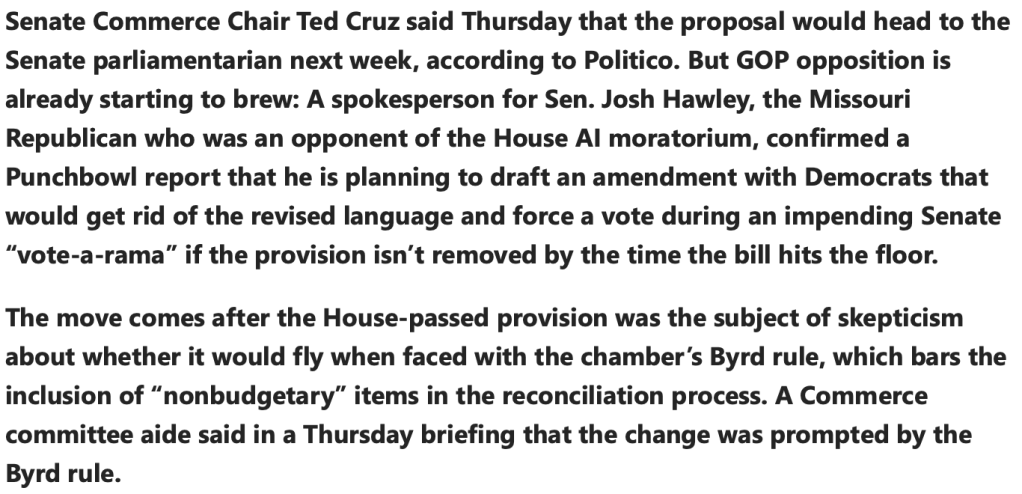
Federal Preemption, the Tenth Amendment and Anti-Commandeering Doctrine
The Tenth Amendment famously reserves powers not delegated to the federal government to the states and to the people (remember them?). The constitutional principle of “anticommandeering” is a doctrine under U.S. Constitutional law that prohibits the federal government from compelling states or state officials to enact, enforce, or administer federal regulatory programs.
Anticommandeering is grounded primarily in the Tenth Amendment. Under this principle, while the federal government can regulate individuals directly under its enumerated powers (such as the Commerce Clause), it cannot force state governments to govern according to federal instructions. Which is, of course, exactly what the moratorium does, although the latest version would have you believe that the feds aren’t really commandeering, they are just tying behavior to money which the feds do all the time. I doubt anyone believes it.
The AI moratorium infringes upon the good old Constitution by:
- Overriding State Authority: It prohibits states from enacting or enforcing AI regulations, infringing upon their traditional police powers to legislate for the health, safety, and welfare of their citizens.
- Lack of Federal Framework: Unlike permissible federal preemption, which operates within a comprehensive federal regulatory scheme, the AI moratorium lacks such a framework, making it more akin to unconstitutional commandeering.
- Precedent in Murphy v. NCAA: The Supreme Court held that Congress cannot prohibit states from enacting laws, as that prohibition violates the anti-commandeering principle. The AI moratorium, by preventing states from regulating AI, mirrors the unconstitutional aspects identified in Murphy. So there’s that.
The New Problem: Coercive Federalism
By conditioning federal broadband funds (“BEAD money”) on states’ agreement to pause AI regulations , the provision exerts undue pressure on states, potentially violating principles established in cases like NFIB v. Sebelius. Plus, the Broadband Equity, Access, and Deployment (BEAD) Program is a $42.45 billion federal initiative established under the Infrastructure Investment and Jobs Act of 2021. Administered by the National Telecommunications and Information Administration (NTIA), BEAD aims to expand high-speed internet access across the United States by funding planning, infrastructure deployment, and adoption programs. In other words, BEAD has nothing to do with the AI moratorium. So there’s that.
Supremacy Clause Concerns
The moratorium may conflict with existing state laws, leading to legal ambiguities and challenges regarding federal preemption. That’s one reason why 40 state AGs are going to the mattresses for the fight.
Lawmakers Getting Cold Feet or In Opposition
Several lawmakers have voiced concerns or opposition to the AI moratorium:
- Rep. Marjorie Taylor Greene (R-GA): Initially voted for the bill but later stated she was unaware of the AI provision and would have opposed it had she known. She has said that she will vote no on the OBBBA when it comes back to the House if the Mr. T’s moratorium poison pill is still in there.
- Sen. Josh Hawley (R-MO): Opposes the moratorium, emphasizing the need to protect individual rights over corporate interests.
- Sen. Marsha Blackburn (R-TN): Expressed concerns that the moratorium undermines state protections, particularly referencing Tennessee’s AI-related laws.
- Sen. Edward Markey (D-MA): Intends to challenge the provision under the Byrd Rule, citing its potential to harm vulnerable communities.
Recommendation: Allow Dissenting Voices
Full disclosure, I don’t think Trump gives a damn about the AI moratorium. I also think this is performative and is tied to giving the impression to people like Masa at Softbank that he tried. It must be said that Masa’s billions are not quite as important after Trump’s Middle East roadshow than they were before, speaking of leverage. While much has been made of the $1 million contributions that Zuckerberg, Tim Apple, & Co. made to attend the inaugural, there’s another way to look at that tableau–remember Titus Andronicus when the general returned to Rome with Goth prisoners in chains following his chariot? That was Tamora, the Queen of the Goths, her three sons Alarbus, Chiron, and Demetrius along with Aaron the Moor. Titus and the Goth’s still hated each other. Just sayin’.
Somehow I wouldn’t be surprised if this entire exercise was connected to the TikTok divestment in ways that aren’t entirely clear. So, given the constitutional concerns and growing opposition, it is advisable for President Trump to permit members of Congress to oppose the AI moratorium provision without facing political repercussions, particularly since Rep. Greene has already said she’s a no vote–on the 214-213 vote the first time around. This approach would:
- Respect the principles of federalism and states’ rights.
- Tell Masa he tried, but oh well.
- Demonstrate responsiveness to legitimate legislative concerns on a bi-partisan basis.
- Ensure that the broader objectives of the OBBBA are not jeopardized by a contentious provision.
Let’s remember: The tax and spend parts of OBBBA are existential to the Trump agenda; the AI moratorium definitely is not, no matter what Mr. T wants you to believe. While the OBBBA encompasses significant policy initiatives which are highly offensive to a lot of people, the AI moratorium provision presents constitutional and procedural challenges and fundamental attacks on our Constitution that warrant its removal. Cutting it out will strengthen the bill’s likelihood of passing and uphold the foundational principles of American governance, at least for now.
Hopefully Trump looks at it that way, too.
How the AI Moratorium Threatens Local Educational Control
The proposed federal AI moratorium currently in the One Big Beautiful Bill Act states:
[N]o State or political subdivision thereof may enforce, during the 10-year period beginning on the date of the enactment of this Act, any law or regulation of that State or a political subdivision thereof limiting, restricting, or otherwise regulating artificial intelligence models, artificial intelligence systems, or automated decision systems entered into interstate commerce.
What is a “political subdivision”? According to a pretty standard definition offered by the Social Security Administration:
A political subdivision is a separate legal entity of a State which usually has specific governmental functions. The term ordinarily includes a county, city, town, village, or school district, and, in many States, a sanitation, utility, reclamation, drainage, flood control, or similar district.
The proposed moratorium would prevent school districts—classified as political subdivisions—from adopting policies that regulate artificial intelligence. This includes rules restricting students’ use of AI tools such as ChatGPT, Gemini, or other platforms in school assignments, exams, and academic work. Districts may be unable to prohibit AI-generated content in essays, discipline AI-related cheating, or require disclosures about AI use unless they write broad rules for ‘unauthorized assistance’ in general or something like that.
Without clear authority to restrict AI in educational contexts, school districts will likely struggle to maintain academic integrity or to update honor codes. The moratorium could even interfere with schools’ ability to assess or certify genuine student performance.
Parallels with Google’s Track Record in Education
The dangers of preempting local educational control over AI echo prior controversies involving Google’s deployment of tools like Chromebooks, Google Classroom, and Workspace for Education in K–12 environments. Despite being marketed as free and privacy-safe, Google has repeatedly been accused of covertly tracking students, profiling minors, and failing to meet federal privacy standards. It’s entirely likely that Google has integrated its AI into all of its platforms including those used in school districts, so Google could likely raise the AI moratorium as a safe harbor defense to claims by parents or schools that they violate privacy or other rights with their products.
A 2015 complaint by the Electronic Frontier Foundation (EFF) alleged that Google tracked student activity even with privacy settings enabled although this was probably an EFF ‘big help, little bad mouth’ situation. New Mexico sued Google in 2020 for collecting student data without parental consent. Most recently, lawsuits in California allege that Google continues to fingerprint students and gather metadata despite educational safeguards.
Although the EFF filed an FTC complaint against Google in 2015, it did not launch a broad campaign or litigation strategy afterward. Critics argue that EFF’s muted follow-up may reflect its financial ties to Google, which has funded the organization in the past. This creates a potential conflict: while EFF publicly supports student privacy, its response to Google’s misconduct has been comparatively restrained.
This has led to the suggestion that EFF operates in a ‘big help, little bad mouth’ mode—providing substantial policy support to Google on issues like net neutrality and platform immunity, while offering limited criticism on privacy violations that directly affect vulnerable groups like students.
AI Use in Schools vs. Google’s Educational Data Practices: A Dangerous Parallel
The proposed AI moratorium would prevent school districts from regulating how artificial intelligence tools are used in classrooms—including tools that generate student work or analyze student behavior. This prohibition becomes even more alarming when we consider the historical abuses tied to Google’s education technologies, which have long raised concerns about student profiling and surveillance.
Over the past decade, Google has aggressively expanded its presence in American classrooms through products like Google Classroom, Chromebooks with Google Workspace for Education, Google Docs and Gmail for student accounts.
Although marketed as free tools, these services have been criticized for tracking children’s browsing behavior and location, storing search histories, even when privacy settings were enabled, creating behavioral profiles for advertising or product development, and sharing metadata with third-party advertisers or internal analytics teams.
Google previously entered into a 2014 agreement with the Electronic Frontier Foundation (EFF) to curb these practices—but watchdog groups and investigative journalists have continued to document covert tracking of minors, even in K–12 settings where children cannot legally consent to data collection.
AI Moratorium: Legalizing a New Generation of Surveillance Tools
The AI moratorium would take these concerns a step further by prohibiting school districts from regulating newer AI systems, even if they profile students using facial recognition, emotion detection, or predictive analytics, auto-grade essays and responses, building proprietary datasets on student writing patterns, offer “personalized learning” in exchange for access to sensitive performance and behavior data, or encourage use of generative tools (like ChatGPT) that may store and analyze student prompts and usage patterns
If school districts cannot ban or regulate these tools, they are effectively stripped of their local authority to protect students from the next wave of educational surveillance.
Contrast in Power Dynamics
| Issue | Google for Education | AI Moratorium Impacts |
| Privacy Concerns | Tracked students via Gmail, Docs, and Classroom without proper disclosures. | Prevents districts from banning or regulating AI tools that collect behavioral or academic data. |
| Policy Response | Limited voluntary reforms; Google maintains a dominant K–12 market share. | Preempts all local regulation, even if communities demand stricter safeguards. |
| Legal Remedies | Few successful lawsuits due to weak enforcement of COPPA and FERPA. | Moratorium would block even the potential for future local rules. |
| Educational Impact | Created asymmetries in access and data protection between schools. | Risks deepening digital divides and eroding academic integrity. |
Why It Matters
Allowing companies to introduce AI tools into classrooms—while simultaneously barring school districts from regulating them—opens the door to widespread, unchecked profiling of minors, with no meaningful local oversight. Just as Google was allowed to shape a generation’s education infrastructure behind closed doors, this moratorium would empower new AI actors to do the same, shielded from accountability.
Parents groups should let lawmakers know that the AI moratorium has to come out of the legislation.
Now What? Can the AI Moratorium Survive the Byrd Rule on “Germaneness”?
Yes, the Big Beautiful Bill Act has passed the House of Representatives and is on its way to the Senate–with the AI safe harbor moratorium and its $500,000,000 giveaway appropriation intact. Yes, right next to Medicaid cuts, etc.
So now what? The controversial AI regulation moratorium tucked inside the reconciliation package is still a major point of contention. Critics argue that the provision—which would block state and local governments from enforcing or adopting AI-related laws for a decade—is blatantly non-germane to a budget bill. But what if the AI moratorium, in the context of a broader $500 million appropriation for a federal AI modernization initiative, isn’t so clearly in violation of the Byrd Rule? Just remember–these guys are not babies. They’ve thought about this and they intend to win–that’s why the language survived the House.
Remember, the assumption is that President Trump can’t get the BBB through the Senate in regular order which would require 60 votes and instead is going to jam it through under “budget reconciliation” rules which requires a simple majority vote in the Republican-held Senate. Reconciliation requires that there not be shenanigans (hah) and that the budget reconciliation actually deals with the budget and not some policy change that is getting sneaked under the tent. Well, what if it’s both?
Let’s consider what the Senate’s Byrd Rule actually requires.
To survive reconciliation, a provision must:
1. Affect federal outlays or revenues;
2. Have a budgetary impact that is not “merely incidental” to its policy effects;
3. Fall within the scope of the congressional instructions to the committees of jurisdiction;
4. Not increase the federal deficit outside the budget window;
5. Not make recommendations regarding Social Security;
6. Not violate Senate rules on germaneness or jurisdiction.
Critics rightly point out that a sweeping 10-year regulatory moratorium in Section 43201(c) smells more like federal policy overreach than fiscal fine-tuning, particularly since it’s pretty clearly a 10th Amendment violation of state police powers. But the moratorium exists within a broader federal AI modernization framework in Section 43201(a) that does involve a substantial appropriation: $500 million allocated for updating federal AI infrastructure, developing national standards, and coordinating interagency protocols. That money is real, scoreable, and central to the bill’s stated purpose.
Here’s the crux of the argument: if the appropriation is deemed valid under the Byrd Rule, the guardrails that enable its effective execution may also be valid – especially if they condition the use of federal funds on a coherent national framework. The moratorium can then be interpreted not as an abstract policy preference, but as a necessary precondition for ensuring that the $500 million achieves its budgetary goals without fragmentation.
In other words, the moratorium could be cast as a budget safeguard. Allowing 50 different state AI rules to proliferate while the federal government invests in a national AI backbone could undercut the very purpose of the expenditure. If that fragmentation leads to duplicative spending, legal conflict, or wasted infrastructure, then the moratorium arguably serves a protective fiscal function.
Precedent matters here. Reconciliation has been used in the past to impose conditions on Medicaid, restrict use of federal education funds, and shape how states comply with federal energy and transportation programs. The Supreme Court has rejected some of these on 10th Amendment grounds (NFIB v. Sebelius), but the Byrd Rule test is about budgetary relevance, not constitutional viability.
And that’s where the moratorium finds its most plausible defense: it is incidental only if you believe the spending exists in a vacuum. In truth, the $500 million appropriation depends on consistent, scalable implementation. A federal moratorium ensures that states don’t undermine the utility of that spending. It may be unwise. It may be a budget buster. It may be unpopular. But if it’s tightly tied to the execution of a federal program with scoreable fiscal effects, it just might survive the Byrd test.
So while artists, civil liberties advocates and state officials rightly decry the moratorium on policy grounds, its procedural fate may ultimately rest on a more mundane calculus: Does this provision help protect federal funds from inefficiency? If the answer is yes—and the appropriation stays—then the moratorium may live on, not because it deserves to, but because it was drafted just cleverly enough to thread the eye of the Byrd Rule needle.
Like I said, these guys aren’t babies and they thought about this because they mean to win. Ideally, somebody should have stopped it from ever getting into the bill in the first place. But since they didn’t, our challenge is going to be stopping it from getting through attached to a triple-whip, too big to fail, must pass signature legislation that Trump campaigned on and was elected.
And even if we are successful in stopping the AI moratorium safe harbor in the Senate, do you think it’s just going to go away? Will the Tech Bros just say, you got me, now I’ll happily pay those wrongful death claims?
Machines Don’t Let Machines Do Opt Outs: Why robots.txt won’t get it done for AI Opt Outs
[Following is based on an except from the Artist Rights Institute’s submission to the UK Intellectual Property Office consultation on a UK AI legislative proposal]
The fundamental element of any rights reservation regime is knowing which work is being blocked by which rights owner. This will require creating a metadata identification regime for all works of authorship, a regime that has never existed and must be created from whole cloth. As the IPO is aware, metadata for songs is quite challenging as was demonstrated in the IPO’s UK Industry Agreement on Music Streaming Metadata Working Groups.
Using machine-readable formats for reservations sounds like would be an easy fix, but it creates an enormous burden on the artist, i.e., the target of the data scraper, and is a major gift to the AI platform delivered by government. We can look to the experience with robots.txt for guidance.
Using a robots.txt file or similar “do not index” file puts far too big a bet on machines getting it right in the silence of the Internet. Big Tech has used this opt-out mantra for years in a somewhat successful attempt to fool lawmakers into believing that blocking is all so easy. If only there was a database, even a machine can do it. And yet there are still massive numbers of webpages copied and those pages that were copied for search (or the Internet Archive) are now being used to train AI.
It also must be said that a “disallow” signal is designed to work with file types or folders, not millions of song titles or sound recordings (see GEMA’s lawsuits against AI platforms). For example, this robots.txt code will recognize and block a “private-directory” folder but would otherwise allow Google to freely index the site while blocking Bing from indexing images:
User-agent: *
Disallow: /private-directory/
User-agent: Googlebot
Allow: /
User-agent: Bingbot
Disallow: /images/
Theoretically, existing robots.txt files could be configured to block AI crawlers entirely by designating known crawlers as user-agents such as ChatGPT. However, there are many known defects when robots.txt can fail to block web crawlers or AI data scrapers including:
Malicious or non-compliant crawlers might ignore the rules in a robots.txt file and continue to scrape a website despite the directives.
Incorrect Syntax of a robots.txt file can lead to unintended results, such as not blocking the intended paths or blocking too many paths.
Issues with server configuration can prevent the robots.txt file from being correctly read or accessed by crawlers.
Content generated dynamically through JavaScript or AJAX requests might not be blocked if robots.txt is not properly configured to account for these resources.
Unlisted crawlers or scrapers not known to the user may not adhere to the intended rules.
Crawlers using cached versions of a site may bypass rules in a robots.txt file, particularly updated rules since the cache was created.
Subdomains and Subdirectories limiting the scope of the rules can lead to not blocking all intended subdomains or subdirectories.
Missing Entire Lists of Songs, Recordings, or Audiovisual works.
While robots.txt and similar techniques theoretically are useful tools for managing crawler access, they are not foolproof. Implementing additional security measures, such as IP blocking, CAPTCHA, rate limiting, and monitoring server logs, can help strengthen a site’s defenses against unwanted scraping. However, like the other tools that were supposed to level the playing field for artists against Big Tech, none of these tools are free, all of them require more programming knowledge than can reasonably be expected, all require maintenance, and at scale, all of them can be gamed or will eventually fail.
It must be said that all of the headaches and expense of keeping Big Tech out is because Big Tech so desperately wants to get in.
The difference between blocking a search engine crawler and an AI data scraper (which could each be operated by the same company in the case of Meta, Bing or Google) is that failing to block a search engine crawler is inconvenient for artists, but failing to block an AI data scraper is catastrophic for artists.
Even if the crawlers worked seamlessly, should any of these folders change names and the site admin forgets to change the robots.txt file, that is asking a lot of every website on the Internet.
It must also be said that pages using machine readable blocking tools may result in pages being downranked, particularly for AI platforms closely associated with search engines. Robots.txt blocking already has problems with crawlers and downranking for several reasons. A robots.txt file itself doesn’t directly cause pages to be downranked in search results. However, it can indirectly affect rankings by limiting search engine crawlers’ access to certain parts of a website. Here’s how:
Restricted Crawling: If you block crawlers from accessing important pages using robots.txt, those pages won’t be indexed. Without indexing, they won’t appear in search results, let alone rank.
Crawl Budget Mismanagement: For large websites, search engines allocate a “crawl budget”—the number of pages they crawl in a given time. If robots.txt doesn’t guide crawlers efficiently, that may randomly leave pages unindexed.
No Content Evaluation: If a page is blocked by robots.txt but still linked elsewhere, search engines might index its URL without evaluating its content. This can result in poor rankings since the page’s relevance and quality can’t be assessed.
The TDM safe harbor is too valuable and potentially too dangerous to leave to machines.
The Delay’s The Thing: Anthropic Leapfrogs Its Own November Valuation Despite Litigation from Authors and Songwriters in the Heart of Darkness
If you’ve read Joseph Conrad’s Heart of Darkness, you’ll be familiar with the Congo Free State, a private colony of Belgian King Leopold II that is today largely the Democratic Republic of the Congo. When I say “private” I mean literally privately owned by his Leopoldness. Why would old King Leo be so interested in owning a private colony in Africa? Why for the money, of course. Leo had to move some pieces around the board and get other countries to allow him to get away with essentially “buying” the place, if “buying” is the right description.
So Leo held an international conference in Berlin to discuss the idea and get international buy-in, kind of like the World Economic Forum with worse food and no skiing. Rather than acknowledging his very for-profit intention to ravage the Congo for ivory (aka slaughtering elephants) and rubber (the grisly extraction of which was accomplished by uncompensated slave labor) with brutal treatment of all concerned, Leo convinced the assembled nations that his intentions were humanitarian and philanthropic. You know, don’t be evil. Just lie.
Of course, however much King Leopold may have foreshadowed our sociopathic overlords from Silicon Valley, it must be said that Leo’s real envy won’t so much be the money as what he could have done with AI himself had he only known. Oh well, he just had to make do with Kurtz.
Which bring us to AI in general and Anthropic in particular. Anthropic’s corporate slogan is equally humanitarian and philanthropic: “Anthropic is an AI research company that focuses on the safety and alignment of AI systems with human values.” Oh yes, all very jolly.
All very innocent and high minded, until you get punched in the face (to coin a phrase). It turns out–quelle horreur–that Anthropic stands accused of massive copyright infringement rather than lauded for its humanitarianism. Even more shocking? The company’s valuation is going through the stratosphere! These innocents surely must be falsely accused! The VC’s are voting with their bucks, so they wouldn’t put their shareholders’ money or limiteds money on the line for a–RACKETEER INFLUENCED CORRUPT ORGANIZATION?!?
Not only have authors brought this class action against Anthropic which is both Google’s stalking horse and cats paw to mix a metaphor, but the songwriters and music publishers have sued them as well. Led by Concord and Universal, the publishers have sued for largely the same reasons as the authors but for their quite distinct copyrights.
So let’s understand the game that’s being played here–as the Artist Rights Institute submitted in a comment to the UK Intellectual Property Office in the IPO’s current consultation on AI and copyright, the delay is the thing. And thanks to Anthropic, we can now put a valuation on the delay since the $4,000,000,000 the company raised in November 2024: $3,500,000,000. This one company is valued at $61.5 billion, roughly half of the entire creative industries in the UK and roughly equal to the entire U.S. music industry. No wonder delay is their business model.
However antithetical, copyright and AI must be discussed together for a very specific reason: Artificial intelligence platforms operated by Google, Microsoft/OpenAI, Meta and the like have scraped and ingested works of authorship from baby pictures to Sir Paul McCartney as fast and as secretly as possible. And the AI platforms know that the longer they can delay accountability, the more of the world’s culture they will have devoured—or as they might say, the more data they will have ingested. And Not to mention the billions in venture capital they will have raised, just like Anthropic. For the good of humanity, of course, just like old King Leo.
As the Hon. Alison Hume, MP recently told Parliament, this theft is massive and has already happened, another example of why any “opt out” scheme (as had been suggested by the UK government) has failed before it starts:
This week, I discovered that the subtitles from one of my episodes of New Tricks have been scraped and are being used to create learning materials for artificial intelligence. Along with thousands of other films and television shows, my original work is being used by generative AI to write scripts which one day may replace versions produced by mere humans like me.
This is theft, and it’s happening on an industrial scale. As the law stands, artificial intelligence companies don’t have to be transparent about what they are stealing.[1]
Any delay[2] in prosecuting AI platforms simply increases their de facto “text and data mining” safe harbor while they scrape ever more of world culture. As Ms. Hume states, this massive “training” has transferred value to these data-hungry mechanical beasts to a degree that confounds human understanding of its industrial scale infringement. This theft dwarfs even the Internet piracy that drove broadband penetration, Internet advertising and search platforms in the 1999-2010 period. It must be said that for Big Tech, commerce and copyright are once again inherently linked for even greater profit.
As the Right Honourable Baroness Kidron said in her successful opposition to the UK Government’s AI legislation in the House of Lords:
The Government are doing this not because the current law does not protect intellectual property rights, nor because they do not understand the devastation it will cause, but because they are hooked on the delusion that the UK’s best interests and economic future align with those of Silicon Valley.[3]
Baroness Kidron identifies a question of central importance that mankind is forced to consider by the sheer political brute force of the AI lobbying steamroller: What if AI is another bubble like the Dot Com bubble? AI is, to a large extent, a black box utterly lacking in transparency much less recordkeeping or performance metrics. As Baroness Kidron suggests, governments and the people who elect them are making a very big bet that AI is not pursuing an ephemeral bubble like the last time.
Indeed, the AI hype has the earmarks of a bubble, just as the Dot Com bubble did. Baroness Kidron also reminds us of these fallacious economic arguments surrounding AI:
The Prime Minister cited an IMF report that claimed that, if fully realised, the gains from AI could be worth up to an average of £47 billion to the UK each year over a decade. He did not say that the very same report suggested that unemployment would increase by 5.5% over the same period. This is a big number—a lot of jobs and a very significant cost to the taxpayer. Nor does that £47 billion account for the transfer of funds from one sector to another. The creative industries contribute £126 billion per year to the economy. I do not understand the excitement about £47 billion when you are giving up £126 billion.[4]
As Hon. Chris Kane, MP said in Parliament, the Government runs the risk of enabling a wealth transfer that itself is not producing new value but would make old King Leo feel right at home:
Copyright protections are not a barrier to AI innovation and competition, but they are a safeguard for the work of an industry worth £125 billion per year, employing over two million people. We can enable a world where much of this value is transferred to a handful of big tech firms or we can enable a win-win situation for the creative industries and AI developers, one where they work together based on licensed relationships with remuneration and transparency at its heart.
[1] Paul Revoir, AI companies are committing ‘theft’ on an ‘industrial scale’, claims Labour MP – who has written for TV series including New Tricks, Daily Mail (Feb. 12, 2025) available at https://www.dailymail.co.uk/news/article-14391519/AI-companies-committing-theft-industrial-scale-claims-Labour-MP-wrote-TV-shows-including-New-Tricks.html
[2] See, e.g., Kerry Muzzey, [YouTube Delay Tactics with DMCA Notices], Twitter (Feb. 13, 2020) available at https://twitter.com/kerrymuzzey/status/1228128311181578240 (Film composer with Content ID account notes “I have a takedown pending against a heavily-monetized YouTube channel w/a music asset that’s been fine & in use for 7 yrs & 6 days. Suddenly today, in making this takedown, YT decides “there’s a problem w/my metadata on this piece.” There’s no problem w/my metadata tho. This is the exact same delay tactic they threw in my way every single time I applied takedowns against broadcast networks w/monetized YT channels….And I attached a copy of my copyright registration as proof that it’s just fine.”); Zoë Keating, [Content ID secret rules], Twitter (Feb. 6. 2020) available at https://twitter.com/zoecello/status/1225497449269284864 (Independent artist with Content ID account states “[YouTube’s Content ID] doesn’t find every video, or maybe it does but then it has selective, secret rules about what it ultimately claims for me.”).
[3] The Rt. Hon. Baroness Kidron, Speech regarding Data (Use and Access) Bill [HL] Amendment 44A, House of Lords (Jan. 28, 2025) available at https://hansard.parliament.uk/Lords%E2%80%8F/2025-01-28/debates/9BEB4E59-CAB1-4AD3-BF66-FE32173F971D/Data(UseAndAccess)Bill(HL)#contribution-9A4614F3-3860-4E8E-BA1E-53E932589CBF
[4] Id.
 Music Tech Solutions