In case you think that infringement of copyrights in AI training happens only to rock stars, photographers, record companies or movie studios, let me give you a personal anecdote that might cause you to reconsider. I asked Bing’s Copilot AI tool to list the deal points in a record producer agreement, and this is what I got back:
Copilot
Certainly! When negotiating a producer agreement, several key points should be considered. Here are some common negotiation points from the artist’s perspective:
Scope of Engagement:
The producer is generally engaged for one album project at a time.
Clarify the scope of work, including the number of songs or recordings to be produced.
Budget and Compensation:
Determine the budget for the project (e.g., $10,000 in your case).
Agree on the producer’s compensation, which may include an upfront fee, points on sales, or a combination.
Ownership and Rights:
Address ownership of the master recordings:
Will the artist own and control the masters?
Does the producer retain any rights?
Credits and Royalties:
Specify how the producer will be credited on releases.
Discuss any royalties or backend points for the producer.
Recording Schedule:
Set a timeline for recording sessions.
Define the two-week period for your project.
Logistics:
Determine where the recordings will take place.
Outline the artist’s approval process.
Define the producer’s deliverables.
Termination Clause:
Include provisions for termination if either party breaches the agreement.
Address payment for work completed up to that point.
Remember that each negotiation is unique, and it’s essential to tailor the agreement to your specific needs and circumstances. Legal advice is recommended to ensure compliance with local laws and industry standards134.
Notice that Copilot lists “Source(s)” and that source #1 is an article from Medium.
My article.
I’ve written a number of articles about negotiating producer agreements and I can categorically say I haven’t given permission or been asked to give permission for any of those articles to be scraped and used to train AI. So how did it come to be in Copilot’s training materials?
My guess is that Medium (and probably a lot of other sites) were crawled by Bing’s spider and that copies of Medium pages were stored in Bing’s (or Microsoft’s) data centers. When Microsoft launched its Copilot AI tool, one could imagine that the temptation would have been strong to use those copies as part of the training tools for Copilot. In fact, the Verge reports that “companies around the web are using your site and its data to build massive sets of training data, in order to build models and products that may not acknowledge your existence at all.”
Are you surprised then that two of the biggest operators in the AI space are the search engine operators Google and Microsoft? This is another example of how Big Tech helps itself to your data and work product without you even knowing it’s happening. So now what? Now I know I’m being ripped off, and I’m wondering if Medium is in on it.
The Verge tells us:
The ability to download, store, organize, and query the modern internet gives any company or developer something like the world’s accumulated knowledge to work with. In the last year or so, the rise of AI products like ChatGPT, and the large language models underlying them, have made high-quality training data one of the internet’s most valuable commodities. That has caused internet providers of all sorts to reconsider the value of the data on their servers, and rethink who gets access to what.
In case you were wondering if the Chinese Communist Party is serious about using TikTok to collect data as they please, Hong Kong publisher Jimmy Lai is a perfect example of what happens when a company refuses to cooperate. The CCP took over Jimmy’s Apple Daily newspaper and arrested him. Jimmy has been in prison for three years and has still not come to “trial” (whatever that means under the CCP).
Blake Morgan sounds off in Hypebot on how TikTok uses music as a honeypot to hook innocent users
The MLC gets a five year review of how they are doing. The Copyright Office conducts that review of both the MLC and the DLC. The public (that’s you) gets a chance to weigh in now because the MLC and the DLC filed their respective written statements about their respective awesomeness.
One of the most interesting exchanges happened between Graham Davies (who essentially is the public face of the DLC and is the head of the Digital Media Association) and the NMPA. Graham offered muted criticism of the MLC which irked the easily irked NMPA who offered a rather scathing response.
The most interesting thing about the exchange was that it was the NMPA–not the MLC–that responded to Graham. Tell you anything?
One of the few things Congress got right in Title I of the Music Modernization Act is the five-year review of the mechanical licensing collective. Or more precisely, whether the private company previously designated by the Copyright Office to conduct the functions of the Mechanical Licensing Collective should have another five years to continue doing whatever it is they do.
Impliedly, and I think a bit unfairly, Congress told the Copyright Office to approve its own decision to appoint the current MLC or admit they made a mistake. This is yet another one of the growing list oversights in the oversight. Wouldn’t it make more sense for someone not involved in the initial decision to be evaluating the performance of the MLC? Particularly when there are at least tens of millions changing hands as well as some highly compensated MLC employees, any one of whom makes more than the Copyright Royalty Judges.
What happens if the Register of Copyright actually fires The MLC, Inc. and designates a new MLC operator? The first question probably should be what happens to the vaunted MLC musical works database and the attendant software and accounting systems which seem to be maintained out of the UK for some reason.
I actually raised this question in a comment to the Copyright Office back in 2020. In short, my question was probably more of a statement: ‘‘The musical works database does not belong to the MLC or The MLC and if there is any confusion about that, it should be cleared up right away.” The Copyright Office had a very clear response:
While the mechanical licensing collective must ‘‘establish and maintain a database containing information relating to musical works,’’ the statute and legislative history emphasize that the database is meant to benefit the music industry overall and is not ‘‘owned’’ by the collective itself….Any use by the Office referring to the public database as ‘‘the MLC’s database’’ or ‘‘its database’’ was meant to refer to the creation and maintenance of the database, not ownership. [85 FR at 58172, text accompanying notes 30 and 31.]
So if the current operator of the MLC is fired, we know from the MMA and the Copyright Office guidance that one thing The MLC, Inc. cannot do is hold the database and its attendant systems hostage, or demand payment, or any other shadiness. These items do not belong to them so they must not assert control over that which they do not own.
Which would include the hundreds of millions of black box money that the MLC, Inc. has failed to distribute in going on four years. I’ve even heard cynics suggest that the market share distribution of black box will occur immediately following The MLC, Inc.’s redesignation and the corresponding renewal of HFA’s back office contract which seems to be worth about $10 million a year all by itself.
What would also have been helpful would be for Congress to have required the Copyright Office to publish evaluation criteria for what they expected the MLC’s operator to actually do as well as performance benchmarks. Like I said, it’s a bit unfair of Congress to put the Copyright Office in the unprecedented position of evaluating such an important role with no guidance whatsoever. Surely Congress did not intend for the Copyright Office to have unfettered autonomy in deciding what standards to apply to their review of a quasi-governmental agency like the MLC, yet seems to have defaulted to the guardrail of the Administrative Procedures Act or some other backstop to sustain checks and balances on the situation.
TikTok users swarmed over the Capitol to protest and impede a Congressional vote that would force the sale of the ubiquitous TikTok. Can Camp Pelosi redux be far behind? Well, no, because this was a digital swarm which is just different, you see. It’s just different when Big Tech tries to protect an IPO.
TikTok’s tactics are very reminiscent of Google’s tactics with SOPA or Napster’s tactics with Camp Chaos.
But not even Napster had the brass to go to full on papal indulgences. Yes, that’s right: NunTok will save the IPO.
Nuns good, TikTok bad!
I wonder which Washington lobbyist thought of NunTok? Perhaps this guy:
Some generative AI platforms are trying to make users believe that the company will actually protect them from copyright infringement claims. When you drill down on what the promise actually is, it’s pretty flimsy and may itself be consumer fraud.
When Universal withdrew from TikTok, the social media company was suddenly thrown back to its pirate-site roots, at least for the Universal catalog of all sound recordings and many, many songs. The eponymous TikTok is now on the clock to take down or mute Universal’s entire catalog. So tick tock baby.
Universal head Lucian Grainge made the case for the company’s approach to terminating its TikTok license because his negotiators were unable to reach a meeting of the minds with the other side. Pretty simple, really. This is not a big deal, it happens every day. Because in a free market capitalist system, “fair” is where we end up. Which means you have to end up somewhere, including nowhere.
Lucian made that case in an open letter to artists and songwriters as a community. There are some great nuggets in that letter, but I like this section to explain the casus belli:
The terms of our relationship with TikTok are set by contract, which expires January 31, 2024. In our contract renewal discussions, we have been pressing them on three critical issues—appropriate compensation for our artists and songwriters, protecting human artists from the harmful effects of AI, and online safety for TikTok’s users.
We have been working to address these and related issues with our other platform partners. For example, our Artist-Centric initiative is designed to update streaming’s remuneration model and better reward artists for the value they deliver to platforms. In the months since its inception, we’re proud that this initiative has been received so positively and taken up by a range of partners, including the largest music platform in the world. We’ve also moved aggressively to embrace the promise of AI while fighting to ensure artists’ rights and interests are protected now and far into the future. In addition, we’ve engaged a number of our platform partners to try to drive positive change for their users and by extension, our artists, by addressing online safety issues, and we are recognized as the industry leader in focusing on music’s broader impact on health and wellness.
With respect to the issue of artist and songwriter compensation, TikTok proposed paying our artists and songwriters at a rate that is a fraction of the rate that similarly situated major social platforms pay. Today, as an indication of how little TikTok compensates artists and songwriters, despite its massive and growing user base, rapidly rising advertising revenue and increasing reliance on music-based content, TikTok accounts for only about 1% of our total revenue.
Let’s not forget that TikTok does not have some statutory or other legal or theoretical right to use Universal’s recordings or songs. Their rights come from one place–their contract with Universal. No Universal contract, no Universal content. (Sorry copyright infringer apologists in the professoriate.).
Contracts have a duration, and when contracts end you negotiate an extension. If you can’t get an extension or a new agreement, remember the clock is ticking and time is running out–fair is where we end up, so one place to end up is nowhere. Stuff happens. Contracts frequently address what happens when the contract is over and the relationship must be unwound, sometimes called post-termination conditions which are just as much of a promise as anything else in the contract even if the duration (or the “term”) of the agreement is over.
The answer to what happened with Universal is simple: TikTok couldn’t close. Mr. TikTok may be a lot of things, but he’s no Blake.
Now that TikTok allowed their Universal deal to spin out of control, the termination clause(s) of their agreement no doubt become effective. If I had to guess, I would guess that TikTok must immediately stop any new uses of Universal content. Then it would not surprise me if TikTok has about 30 days to take it all down so they are on the clock…so to speak. I would also guess (or hope) that Universal has some post term conditions that will protect them from having to take TikTok’s rube deal on DMCA takedowns. The difference between a post term DMCA take down and a bald take down with no pre-existing contract should be that TikTok has a unilateral obligation to police their network for at least a period of time after termination. Failing to do so could leave them open to breach of contract for failing to satisfy post-termination conditions. Or something like that.
Let’s not forget that TikTok started out as a pirate social media site that got retroactive and prospective licenses in settlement of potential copyright infringement lawsuits. If licenses terminate, TikTok is essentially in the same position as it was before the license–at least as to the content that is covered by the terminating license.
But of course TikTok won’t be in exactly the same position as the status quo ante, because the company is dependent on passing itself off as this inevitable legitimate company, i.e., a licensed platform. That was not the case when TikTok began licensing to avoid mammoth copyright infringement lawsuits. And therein lies the rub.
TikTok may have a Napster problem. Once you let unlicensed material into a platform, it’s deuced hard to get it out, even if you have license. And as Judge Patel said in granting an injunction against Napster, “I’m sure that anyone as clever as the people who wrote the software in the case are clever enough, as there are plenty or those minds in Silicon Valley to do it, [to] come up with a program that will help to identify infringing items as well.”
Thank God for the smart people.
So what happens now? Looking to recent history, Spotify was in a similar pre-IPO position when David Lowery and Melissa Ferrick sued the company for massive use of unlicensed songs. This led Spotify to go to Congress to rewrite the copyright laws in order to stop future litigation (called the “Music Modernization Act” with its probably unconstitutional retroactive reach back safe harbor). They were able to do that because of compliant lobbyists and the hunger among the elites for cash money from a Spotify IPO (or more precisely DPO). Plus Congress got to hang out with famous people and generally felt good about it because dissenting views were strangely absent in the mainstream media.
What do you think will happen if TikTok also goes to Congress to change the law to protect their cash cow and undermine artists and songwriters like Spotify did? They may send lobbyists to Capitol Hill with some walking around money, but if you haven’t picked up on it yet, at least half of the Congress despises TikTok. How does TikTok thread that needle?
TikTok’s response reads like it was written by the editorial staff at the People’s Daily:
“It is sad and disappointing that Universal Music Group has put their own greed above the interests of their artists and songwriters.
Despite Universal’s false narrative and rhetoric, the fact is they have chosen to walk away from the powerful support of a platform with well over a billion users that serves as a free promotional and discovery vehicle for their talent.
TikTok has been able to reach ‘artist-first’ agreements with every other label and publisher. Clearly, Universal’s self-serving actions are not in the best interests of artists, songwriters and fans.”
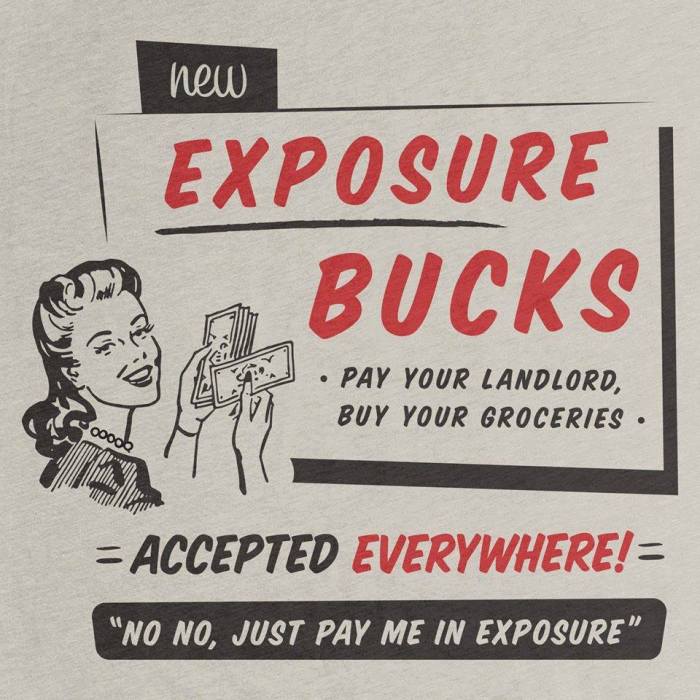
Note to Mr. TikTok and his PR bagmen, that “exposure” angle is not a winner. Not to mention that artists drive their fans to TikTok in huge numbers which is the real “free” promotion as in “uncompensated”. Also, newsflash, there is no free lunch so don’t embarrass yourself by starting the old “free promotion” okie doke. Mr. Tok needs to go home, think about his priorities and try again.
Also, don’t forget that TikTok has to do “blind check” licenses because it lacks the functionality to track and pay royalties, even the broken market centric royalty deal. Blind check licenses are the rough equivalent of an agreement not to sue TikTok rather than an industry standard royalty deal. Over time, it’s likely that the amount of the blind check must increase to compensate for the blindness.
The Universal episode is revealing, however. If TikTok thought they were going to get away with jamming artists because “exposure”, they need to go home and reconsider their life. The situation is completely out of control for one reason–TikTok underestimated Universal’s resolve. And they broke one of the cardinal rules of Business Affairs.
Never let it get to the point that you can’t just write a check.
@helienne’s Panel with Streamers and Label reps about artist centric, streaming fraud and Spotify’s new free goods
I interview Helienne Lindvall about a panel she was on in Europe with reps from Spotify, Deezer and WMG about artist centric implementation, streaming fraud and the new free goods, aka, Track Monetization Eligibility.
How do you say “Bless your heart” in Mandarin?
If you didn’t watch the Big Tech hearing at the U.S. Senate, you should at least watch Senator Marsha Blackburn’s grilling of Mr. TikTok. Must-see TV.
Speculative ticketing is the practice of selling an option to maybe buy a popular ticket (often at an insane price) before the ticket goes on sale. You may not realize you are not buying a real ticket, although these tickets often come with fine print, and as Tom Waits tells us, the large print giveth and the small print taketh away.
There is an effort going on to specifically ban speculative ticketing at the state level which I applaud as I think speculative ticketing should be a crime. One reason I think this is because I think it already is a crime in most if not all states and possibly under federal law as well.
Think about it–do you think that if you before Blackstone and said to Sir William, My Lord, the defendant sold me a famous cow he didn’t own at a price he invented and promised to deliver the cow on law day. He took my money but delivered no cow (or delivered a different and unfamous cow). And the defendant said, perfectly legal My Lord.
What do you think My Lord Blackstone would say?
What would Billy do?
I don’t think the English common law would have just let the defendant walk out without at least compensating the buyer. Therefore, there’s probably a case that can be made out of existing law for selling stolen or counterfeit goods, or a host of other common law derivatives that would violate the charter of the land.
So as we try to get specific legal action to deal with speculative tickets, let’s not allow the lobbyists for Stubhub to negotiate the punishment that they want rather than the punishment that already applies under existing state civil or criminal law.
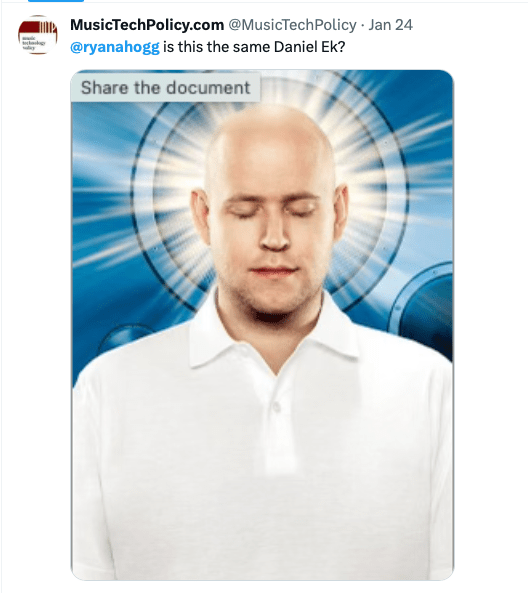
Ek’s New Iconography: Will the real Daniel Ek please stand up?
MTP readers will no doubt remember when Daniel Ek refused to be deposed in the latest Nashville case against Spotify for copyright infringement (Eight Mile Style). He eventually was deposed where he tried to say that he had no first hand knowledge of the facts or publishing practices at Spotify. Others did that for him after they got finished peeling his pears.
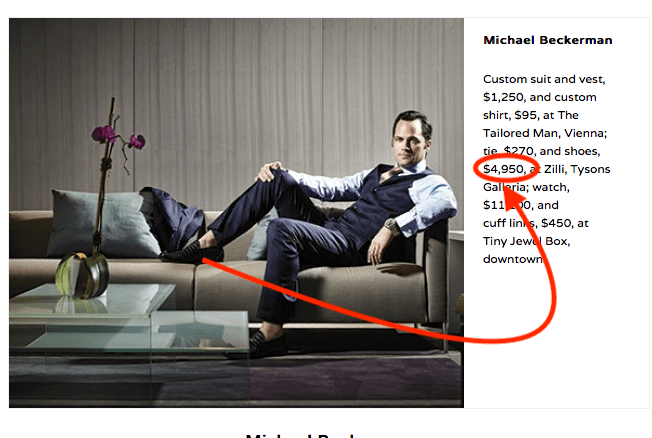
Ryan Hogg, writing in Fortune, published what I can only think is a puff piece on Ek trying to pass him off as a man of the people with a management style of just one of the team. Worth over a billion dollars and controlling voting stock.
And then there’s this:
What is Spotify’s contractual basis for their modernized free goods program?
There’s been a lot of discussion about Spotify’s new “modernized” free goods program aka Track Monetization Eligibility. It does raise the question of how they are getting away with this. Free goods, after all, were based on contract terms that the artist got to negotiate (and which, by the way, was passed along to songwriters through the artist’s controlled compositions clause for anyone not on a pure statutory rate and still is.
Who agreed to this? And why aren’t they stepping forward to claim their genius?
The MLC announced it was auditing 49 users of the blanket mechanical license, a massive undertaking. This announcement sent me back to the audit provisions of Title I of the Music Modernization Act to review what the role of the auditor actually is for audits of music users by the MLC as opposed to audits of the MLC by copyright owners. As often happens when reviewing little-used code sections that abruptly become important, I was reminded of a couple nuances that were obviously flawed when drafted. The key nuance is how can a royalty examiner be looking for overpayments against the interest of the party that hired her but still be independent?
How qualified is qualified?
The first issue is with the definition of a “qualified auditor”, a glitch that I’ve harped on a few times. The term “qualified auditor” comes up in two different contexts in the MMA–first, a qualified auditor who prepares the MLC’s audited financial statements. The definition of qualified auditor is in 17 USC § 115(e)(25) as “an independent, certified public accountant with experience performing music royalty audits.” The reason why this term is a drafting error is two fold–first, you don’t need a CPA to conduct music royalty audits and there is nothing on the CPA licensure exams that requires any knowledge of “music royalty audits.” Second, you do need a CPA to prepare audited financial statements if the books are maintained according to generally accepted accounting principles particularly if a financial audit requires an opinion as an attest service, but that role does not require knowledge of royalty audits. So the defined term has an internal contradiction.
The Gaap, ruler of 25 legions of spirits from the Munich Manual of Demonic Magic grimoire
Not only is the definition hinky but it’s common knowledge (outside of the Imperial City, I guess) that many if not most royalty auditors are not CPAs. (There’s also a long-standing assumption among artist lawyers when this concept comes up in record or publishing deals that a CPA requirement for audits is intentionally punitive. The assumption is that CPAs charge more making the cost of auditing more burdensome (therefore less likely to happen), which remains to be proven but is pretty widely accepted.) So the definition should be limited to requiring a CPA for the MLC’s audited financial statements and the common alternate definition of “experienced royalty auditor” for the audit clauses. But let’s put that to one side.
Overpayments and Independence
The MMA rule for auditing digital music providers states:
The qualified auditor shall determine the accuracy of royalty payments, including whether an underpayment or overpayment of royalties was made by the digital music provider to the mechanical licensing collective, except that, before providing a final audit report to the mechanical licensing collective, the qualified auditor shall provide a tentative draft of the report to the digital music provider and allow the digital music provider a reasonable opportunity to respond to the findings, including by clarifying issues and correcting factual errors.
Realize that the MLC and the services monitor payments and make frequent adjustments to royalties (which may be reflected on your royalty statement if you can find them). That’s different than an auditor who works for a client going and seeking out an overpayment as part of their audit report. Relieving the auditor of this conflict does not preclude the service from claiming an overpayment which is an ongoing part of invoicing (see, e.g., 37 CFR §210.27(d)(2)(ii)). You would not be creating a windfall for the party receiving the overpayment.
I would interpret the statute as not requiring the auditor to seek an additional overpayment not previously invoiced, but rather confirming the accuracy of any adjustments made for overpayments or underpayments already reflected on the statements that are the subject of the audit. That’s quite a different thing.
What makes an auditor independent is that they do not have a conflict of interest as to their client, in this case the MLC. The royalty auditor is intended to be an advocate for their client (who pays them) and they are hired to look for ways that the other side has failed to account to their client properly to their client’s disadvantage. Improper payments are most commonly underpayments, i.e., the music user has failed to pay all that the client is entitled to receive. Royalty statements are regularly recalculated for a host of reasons in the normal course of business without regard to the presence or absence of any audit. This is not to say that somehow the MLC (and eventually the copyright owners) get some kind of windfall because the services missed something if any auditor is not seeking out an overpayment. That’s particularly true since there will likely be multiple sets of eyes on the field work and draft audit report. And trust me, they will all be trying to find somebody else’s mistake.
Or said another way, copyright owners don’t receive a windfall that was somehow missed by the largest corporations in commercial history who can determine what floor of which building you are on at what time of day at what address, e.g., sporting goods or children’s toys, so they can serve ads to your phone. Are we really worried about these little lambs getting lost in the woods?
@Helienne Explains the EU’s Cultural Protections Against Streaming Monopolists
We were lucky to get an interview with ESCA President Helienne Lindvall about the European Parliament’s report on cultural protections against streaming monopolies. This is a very important development and something we could use in the United States where this focus is sadly lacking.
@MikeHuppe Made an Important Comment on AI Justice for Creators
SoundExchange CEO Mike Huppe’s comment on AI justice is welcome from a rights platform.
Spotify has announced they are “Modernizing Our Royalty System.” Beware of geeks bearing “modernization”–that almost always means they get what they want to your disadvantage. Also sounds like yet another safe harbor. At a minimum, they are demonstrating the usual lack of understanding of the delicate balance of the music business they now control. But if they can convince you not to object, then they get away with it.
Don’t let them.
An Attack on Property Rights
There’s some serious questions about whether Spotify has the right to unilaterally change the way it counts royalty-bearing streams and to encroach on the private property rights of artists.
Here’s their plan: Evidently the plan is to only pay on streams over 1,000 per song accruing during the previous 12 months. I seriously doubt that they can engage in this terribly modern “stream discrimination” in a way that doesn’t breach any negotiated direct license with a minimum guarantee (if not others).
That doubt also leads me to think that Spotify’s unilateral change in “royalty policy” (whatever that is) is unlikely to affect everyone the same. Taking a page from 1984newspeakers, Spotify calls this discrimination policy “Track Monetization Eligibility”. It’s not discrimination, you see, it’s “eligibility”, a whole new thing. Kind of like war is peace, right? Or bouillabaisse.
According to Spotify’s own announcement this proposed change is not an increase in the total royalty pool that Spotify pays out (God forbid the famous “pie” should actually grow): ”There is no change to the size of the music royalty pool being paid out to rights holders from Spotify; we will simply use the tens of millions of dollars annually [of your money] to increase the payments to all eligible tracks, rather than spreading it out into $0.03 payments [that we currently owe you].”
Yep, you won’t even miss it, and you should sacrifice for all those deserving artists who are more eligible than you. They are not growing the pie, they are shifting money around–rearranging the deck chairs.
Spotify’s Need for Living Space
So why is Spotify doing this to you? The simple answer is the same reason monopolists always use: they need living space for Greater Spotify. Or more simply, because they can, or they can try. They’ll tell you it’s to address “streaming fraud” but there are a lot more direct ways to address streaming fraud such as establishing a simple “know your vendor” policy, or a simple pruning policy similar to that established by record companies to cut out low-sellers (excluding classical and instrumental jazz). But that would require Spotify to get real about their growth rates and be honest with their shareholders and partners. Based on the way Spotify treated the country of Uruguay, they are more interested in espoliating a country’s cultural resources than they are in fairly compensating musicians.
Of course, they won’t tell you that side of the story. They won’t even tell you if certain genres or languages will be more impacted than others (like the way labels protected classical and instrumental jazz from getting cut out measured by pop standards). Here’s their explanation:
It’s more impactful [says who?] for these tens of millions of dollars per year to increase payments to those most dependent on streaming revenue — rather than being spread out in tiny payments that typically don’t even reach an artist (as they do not surpass distributors’ minimum payout thresholds). 99.5% of all streams are of tracks that have at least 1,000 annual streams, and each of those tracks will earn more under this policy.
This reference to “minimum payout thresholds” is a very Spotifyesque twisting of a generalization wrapped in cross reference inside of spin. Because of the tiny sums Spotify pays artists due to the insane “big pool” or “market centric” royalty model that made Spotify rich, extremely low royalties make payment a challenge.
Plus, if they want to make allegations about third party distributors, they should say which distributors they are speaking of and cite directly to specific terms and conditions of those services. We can’t ask these anonymous distributors about their policies if we don’t know who they are.
What’s more likely is that tech platforms like PayPal stack up transaction fees to make the payment cost more than the royalty paid. Of course, you could probably say that about all streaming if you calculate the cost of accounting on a per stream basis, but that’s a different conversation.
So Spotify wants you to ignore the fact that they impose this “market centric” royalty rate that pays you bupkis in the first place. Since your distributor holds the tiny slivers of money anyway, Spotify just won’t pay you at all. It’s all the same to you, right? You weren’t getting paid anyway, so Spotify will just give your money to these other artists who didn’t ask for it and probably wouldn’t want it if you asked them.
There is a narrative going around that somehow the major labels are behind this. I seriously doubt it–if they ever got caught with their fingers in the cookie jar on this scam, would it be worth the pittance that they will end up getting in pocket after all mouths are fed? The scam is also 180 out from Lucian Grange’s call for artist centric royalty rates, so as a matter of policy it’s inconsistent with at least Universal’s stated goals. So I’d be careful about buying into that theory without some proof.
What About Mechanical Royalties?
What’s interesting about this scam is that switching to Spotify’s obligations on the song side, the accounting rules for mechanical royalties say (37 CFR § 210.6(g)(6) for those reading along at home) seem to contradict the very suckers deal that Spotify is cramming down on the recording side:
Royalties under 17 U.S.C. 115 shall not be considered payable, and no Monthly Statement of Account shall be required, until the compulsory licensee’s [i.e., Spotify’s] cumulative unpaid royalties for the copyright owner equal at least one cent. Moreover, in any case in which the cumulative unpaid royalties under 17 U.S.C. 115 that would otherwise be payable by the compulsory licensee to the copyright owner are less than $5, and the copyright owner has not notified the compulsory licensee in writing that it wishes to receive Monthly Statements of Account reflecting payments of less than $5, the compulsory licensee may choose to defer the payment date for such royalties and provide no Monthly Statements of Account until the earlier of the time for rendering the Monthly Statement of Account for the month in which the compulsory licensee’s cumulative unpaid royalties under section 17 U.S.C. 115 for the copyright owner exceed $5 or the time for rendering the Annual Statement of Account, at which time the compulsory licensee may provide one statement and payment covering the entire period for which royalty payments were deferred.
Much has been made of the fact that Spotify may think it can unilaterally change its obligations to pay sound recording royalties, but they still have to pay mechanicals because of the statute. And when they pay mechanicals, the accounting rules have some pretty low thresholds that require them to pay small amounts. This seems to be the very issue they are criticizing with their proposed change in “royalty policy.”
But remember that the only reason that Spotify has to pay mechanical royalties on the stream discrimination is because they haven’t managed to get that free ride inserted into the mechanical royalty rates alongside all the other safe harbors and goodies they seem to have bought for their payment of historical black box.
So I would expect that Spotify will show up at the Copyright Royalty Board for Phonorecords V and insist on a safe harbor to enshrine stream discrimination into the Rube Goldberg streaming mechanical royalty rates. After all, controlled compositions are only paid on royalty bearing sales, right? And since it seems like they get everything else they want, everyone will roll over and give this to them, too. Then the statutory mechanical will give them protection.
To Each According to Their Needs
Personally, I have an issue with any exception that results in any artist being forced to accept a royalty free deal. Plus, it seems like what should be happening here is that underperforming tracks get dropped, but that doesn’t support the narrative that all the world’s music is on offer. Just not paid for.
Is it a lot of money to any one person? Not really, but it’s obviously enough money to make the exercise worthwhile to Spotify. And notice that they haven’t really told you how much money is involved. It may be that Spotify isn’t holding back any small payments from distributors if all payments are aggregated. But either way it does seem like this new new thing should start with a clean slate–and all accrued royalties should be paid.
This idea that you should be forced to give up any income at all for the greater good of someone else is kind of an odd way of thinking. Or as they say back in the home country, from each according to their ability and to each according to their needs. And you don’t really need the money, do you?
By the way, can you break a $20?
The NO AI Fraud Act
Thanks to U.S. Representatives Salazar and Dean, there’s an effort underway to limit Big Tech’s AI rampage just in time for Davos. (Remember, the AI bubble got started at last year’s World Economic Forum Winter Games in Davos, Switzerland).
Chairman Issa Questions MLC’s Secretive Investment Policyfor Hundreds of Millions in Black Box
As we’ve noted a few times, the MLC has a nontransparent–some might say “secretive”–investment policy that has the effect of a government rule. This has caught the attention of Chairman Darrell Issa and Rep. Ben Cline at a recent House oversight hearing. Chairman Issa asked for more information about the investment policy in follow-up “questions for the record” directed to MLC CEO Kris Ahrend. It’s worth getting smart about what the MLC is up to in advance of the upcoming “redesignation” proceeding at the Copyright Office. We all know the decision is cooked and scammed already as part of the Harry Fox Preservation Act (AKA Title I of the MMA), but it will be interesting to see if anyone actually cares and the investment policy is a perfect example. It will also be interesting to see which Copyright Office examiner goes to work for one of the DiMA companies after the redesignation as is their tradition.
It is commonplace for artists to conduct a royalty examination of their record company, sometimes called an “audit.” Until the Music Modernization Act, the statutory license did not permit songwriters to audit users of the statutory license. The Harry Fox Agency “standard” license for physical records had two principal features that differed from the straight statutory license: quarterly accounting and an audit right. When streaming became popular, the services both refused to comply with the statutory regulations and also refused to allow anyone to audit because the statutory regulations they failed to comply with did not permit an audit. I brought this absurdity to the attention of the Copyright Office in 2011.
After much hoopla, the lobbyists wrote an audit right for copyright owners into the Music Modernization Act. However, rather than permitting copyright owners to audit music users as is long standing common practice on the record side, the lobbyists decided to allow copyright owners to audit theMechanical Licensing Collective. This is consistent with the desire of services to distance themselves from those pesky songwriters by inserting the MLC in between the services and their ultimate vendors, the songwriters and copyright owners. The services can be audited by the MLC (whose salaries are paid by the services), but that hasn’t happened yet to my knowledge.
But the MLC has received what I believe is its first audit notice that was just published by the Copyright Office after receiving it on November 9. First up is Bridgeport Music, Inc. for the period January 1, 2021, through December 31, 2023. January 1, 2021 was the “license availability date” or the date that the MLC began accounting for royalties under the MMA’s blanket license.
Bridgeport’s audit is wise. There are no doubt millions if not billions of streams to be verified. The MLC’s systems are largely untested, compared to other music users such as record companies that have been audited hundreds, if not thousands of times depending on how long they are operating. Competent royalty examiners will look under the hood and find out whether it’s even possible to render reasonably accurate accounting statements given the MLC’s systems. Maybe it’s all fine, but maybe it’s not. The wisdom of Bridgeport’s two year audit window is that two years is long enough to have a chance at a recovery but it’s not so long that you are drowned in data and susceptible to taking shortcuts.
In other words, why wait around?
Auditing the Black Box
A big difference between the audit rules the lobbyists wrote into the MMA and other audits is that the MLC audit is based on payments, not statements. The relevant language in the statute makes this very clear:
A copyright owner entitled to receive payments of royalties for covered activities from the mechanical licensing collective may, individually or with other copyright owners, conduct an audit of the mechanical licensing collective to verify the accuracy of royalty payments by the mechanical licensing collective to such copyright owner…The qualified auditor shall determine the accuracy of royalty payments, including whether an underpayment or overpayment of royalties was made by the mechanical licensing collective to each auditing copyright owner.
Royalty payments would include a share of black box royalties distributed to copyright owners. It seems reasonable that on audit a copyright owner could verify how this share was arrived at and whatever calculations would be necessary to calculate those payments, or maybe the absence of such payments that should have been made. Determining what is not paid that should have been paid is an important part of any royalty verification examination.
Systems Transparency
Information too confidential to be detected cannot be corrected. It is important to remember that copyright owner audits of the MLC will be the first time an independent third party has had a look at the accounting systems and functional technology of The MLC. If those audits reveal functional defects in the MLC’s systems or technology that affects any output of The MLC, i.e., not just the royalties being audited, it seems to me that those defects should be disclosed to the public. Audit settlements should not be used as hush money payments to keep embarrassing revelations from being publicly disclosed.
Unsurprisingly, The MLC lobbied to have broadly confidential treatment of all audits. Realize that there may well be confidential financial information disclosed as part of any audit that both copyright owners and The MLC will want to keep secret. There is no reason to keep secrets about The MLC’s systems. To take an extreme example, if on audit the auditors discovered that The MLC’s systems added 2 plus 2 and got 5, that is a fact that others have a legitimate interest in having disclosed to include the Copyright Office itself that is about to launch a 5 year review of The MLC for redesignation. Indeed, auditors may discover systemic flaws that could arguably require The MLC to recalculate many if not all statements or at least explain why they should not. (Note that a royalty auditor is required to deliver a copy of the auditor’s final report to The MLC for review even before giving it to their client. This puts The MLC on notice of any systemic flaws in The MLC’s systems found by the auditor and gives it the opportunity to correct any factual errors.)
I think that systemic flaws found by an auditor should be disclosed publicly after taking care to redact any confidential financial information. This will allow both the Copyright Office and MLC members to fix any discovered flaws.
The “Qualified Auditor” Typo
It is important to realize that there is no good reason why a C.P.A. must conduct the audit; this is another drafting glitch in the MMA that requires both The MLC’s audited financial statements and royalty compliance examinations be conducted by a C.P.A, defined as a “Qualified Auditor” (17 USC § 115(e)(25)). It’s easy to understand why audited financials prepared according to GAAP should be opined by a C.P.A. but it is ludicrous that a C.P.A. should be required to conduct a royalty exam for royalties that have nothing to do with GAAP and never have.
As Warner Music Group’s Ron Wilcox testified to the CRJs, “Because royalty audits require extensive technical and industry-specific expertise, in WMG’s experience a CPA certification is not generally a requirement for conducting such audits. To my knowledge, some of the. most experienced and knowledgeable royalty auditors in the music industry are not CPAs.”
The “Qualified Auditor” defined term should be limited to the MLC’s financials and removed from the audit clauses.
@VVBrown Articulates the Need for a Complete Reset of Streaming
Finally, I asked singer-songwriter VV Brown about the impact of streaming:
"It's impacted my income massively, we aren't making the money we should, I don't see my music as a way for me to survive – put food on the table. We have to change this; we need a complete reset." (5/5) pic.twitter.com/dbXC59p2IE
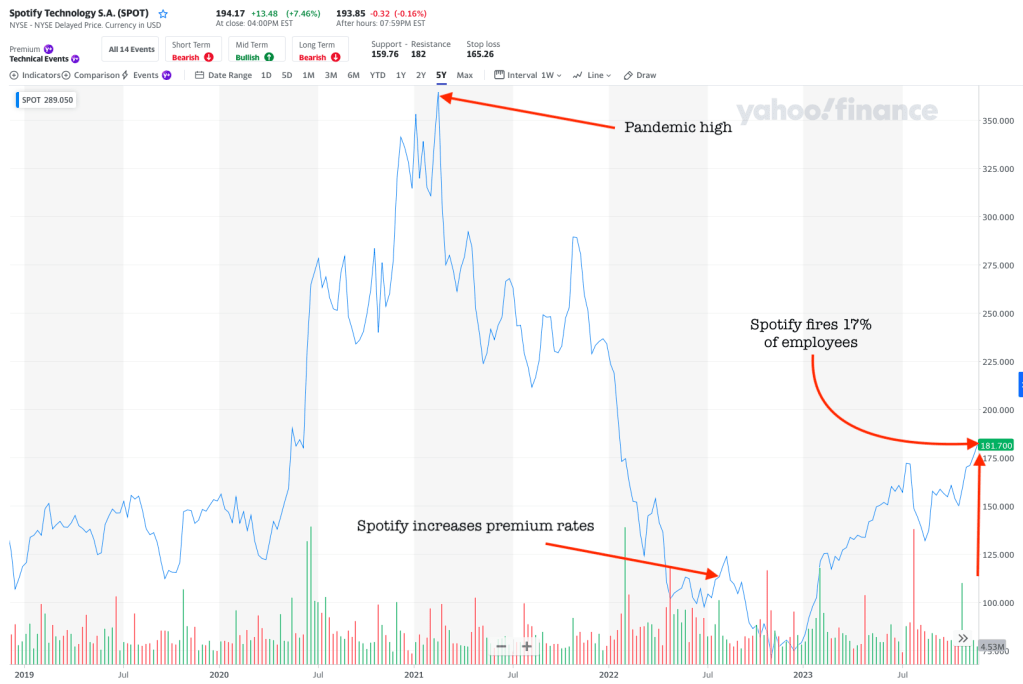
Harsh? Not really, at least not from a share price point of view. Spotify’s all time highest share price was during the COVID pandemic.
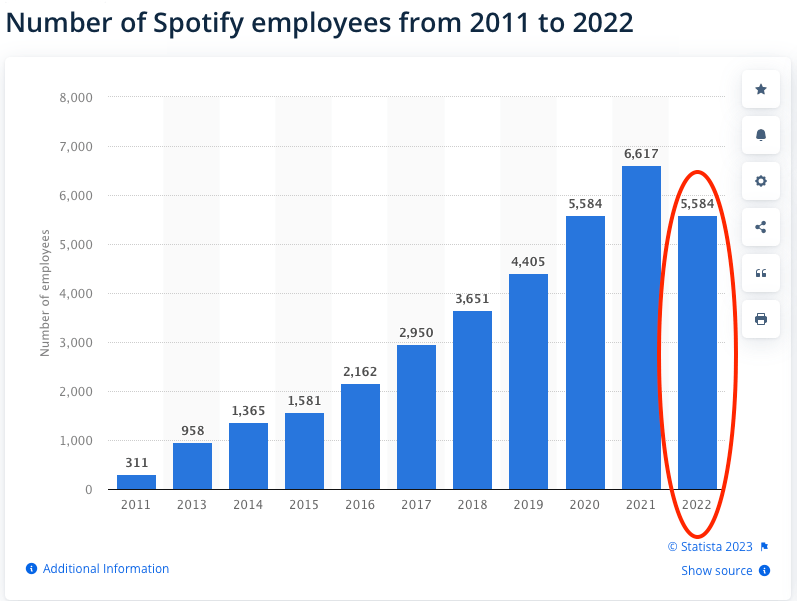
Spotify CEO Daniel Ek and the press tells us that Spotify is cutting 1,500 jobs which works out to about 17% of Spotify employees. Which works out to a pre-layoff workforce of 8,823. So let’s start there—that workforce number seems very high and is completely out of line with some recent data from Statista which is usually reliable.
If Statista is correct, Spotify employed 5,584 as of last year. Yet somehow Spotify’s 2023 workforce grew to 9200 according to the Guardian, fully 2/3 over that 2022 level without a commensurate and offsetting growth in revenue. That’s a governance question in and of itself.
Why the layoffs? The Guardian reports that Spotify CEO Daniel Ek is concerned about costs. He says “Despite our efforts to reduce costs this past year, our cost structure for where we need to be is too big.” Maybe I missed it, but the only time I can recall Daniel Ek being vocally concerned about Spotify’s operating costs was when it came to paying royalties. Then it was full-blown poor mouthing while signing leases for very expensive office space in 4 World Trade Center as well as other pricy real estate, executive compensation and podcasters like Harry & Meghan.
Over the last two years, we’ve put significant emphasis on building Spotify into a truly great and sustainable business – one designed to achieve our goal of being the world’s leading audio company and one that will consistently drive profitability and growth into the future. While we’ve made worthy strides, as I’ve shared many times, we still have work to do. Economic growth has slowed dramatically and capital has become more expensive. Spotify is not an exception to these realities.
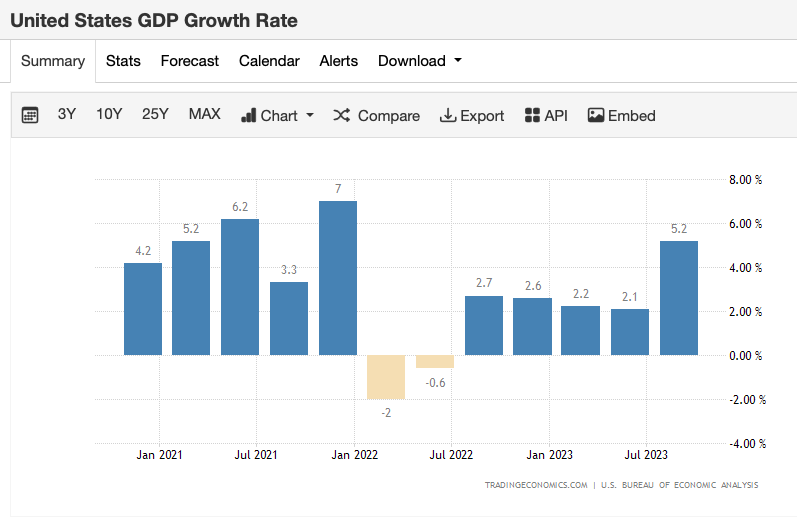
Which “economic growth” is that?
But, he is definitely right about capital costs.
Still, Spotify’s job cuts are not necessarily that surprising considering the macro economy, most specifically rents and interest rates. As recently as 2018, Spotify was the second largest tenant at 4 WTC. Considering the sheer size of Spotify’s New York office space, it’s not surprising that Spotify is now sublettingfive floors of 4 WTC earlier this year. That’s right, the company had a spare five floors. Can that excess just be more people working at home given Mr. Ek’s decision to expand Spotify’s workforce? But why does Spotify need to be a major tenant in World Trade Center in the first place? Renting the big New York office space is the corporate equivalent of playing house. That’s an expensive game of pretend.
Remember that Spotify is one of the many companies that rose to dominance during the era of easy money in response to the financial crisis that was the hallmark of quantitative easing and the Federal Reserve’s Zero Interest Rate Policy beginning around 2008. Spotify’s bankers were able to fuel Daniel Ek’s desire to IPO and cash out in the public markets by enabling Spotify to run at a loss because money was cheap and the stock market had a higher tolerance for risky investments. When you get a negative interest rate for saving money, Spotify stock doesn’t seem like a totally insane investment by comparison. This may have contributed to two stock buy-back programs of $1 billion each, Spotify’s deal with Barcelona FC and other notorious excesses.
As a great man said, don’t confuse leverage for genius. It was only a matter of time until the harsh new world of quantitative tightening and sharply higher inflation came back to bite. For many years, Spotify told Wall Street a growth story which deflected attention away from the company’s loss making operations. A growth story pumps up the stock price until the chickens start coming home to roost. (Growth is also the reason to put off exercising pricing power over subscriptions.) Investors bought into the growth story in the absence of alternatives, not just for Spotify but for the market in general (compare Russell Growth and Value indexes from 2008-2023). Cutting costs and seeking profit is an example of what public company CEOs might do in anticipation of a rotational shift from growth to value investing that could hit their shares.
Never forget that due to Daniel Ek’s super-voting stock (itself an ESG fail), he is in control of Spotify. So there’s nowhere to hide when the iconography turns to blame. It’s not that easy or cheap to fire him, but if the board really wanted to give him the heave, they could do it.
I expect that Ek’s newly found parsimony will be even more front and center in renegotiations of Spotify’s royalty deals since he’s always blamed the labels for why Spotify can’t turn a profit. Not that WTC lease, surely. This would be a lot more tolerable from someone you thought was actually making an effort to cut all costs not just your revenue. Maybe that will happen, but even if Spotify became a lean mean machine, it will take years to recover from the 1999 levels of stupid that preceded it.
Hellooo Apple. One big thinker in music business issues calls it “Spotify drunk” which describes the tendency of record company marketers to focus entirely on Spotify and essentially ignore Apple Music as a distribution partner. If you’re in that group drinking the Spotify Kool Aid, you may want to give Apple another look. One thing that is almost certain is that that Apple will still be around in five years.
Just sayin.
Mechanicals on Physical and Downloads Get COLA Increase; Nothing for Streaming
Recall that the “Phonorecords IV” minimum mechanical royalties paid by record companies on physical and downloads increased from 9.1¢ to 12¢ with an annual cost of living adjustment each year of the PR IV rate period. The first increase was calculated by the Copyright Royalty Judges and was announced this week. That increase was from 12¢ to 12.40¢ and is automatic effective January 1, 2024.
Note that there is no COLA increase for streaming for reasons I personally do not understand. There really is no justification for not applying a COLA to a government mandated rate that blocks renegotiation to cover inflation expectations. After all, it works for Edmund Phelps.
The Federal Trade Commission on Copyright and AI
The FTC’s comment in the Copyright Office AI inquiry shows an interesting insight to the Commission’s thinking on some of the same copyright issues that bother us about AI, especially AI training. Despite Elon Musk’s refreshing candor of the obvious truth about AI training on copyrights, the usual suspects in the Copyleft (Pam Samuelson, Sy Damle, etc.) seem to have a hard time acknowledging the unfair competition aspects of AI and AI training (at p. 5):
Conduct that may violate the copyright laws––such as training an AI tool on protected expression without the creator’s consent or selling output generated from such an AI tool, including by mimicking the creator’s writing style, vocal or instrumental performance, or likeness—may also constitute an unfair method of competition or an unfair or deceptive practice, especially when the copyright violation deceives consumers, exploits a creator’s reputation or diminishes the value of her existing or future works, reveals private information, or otherwise causes substantial injury to consumers. In addition, conduct that may be consistent with the copyright laws nevertheless may violate Section 5.
We’ve seen unfair competition claims pleaded in the AI cases–maybe we should be thinking about trying to engage the FTC in prosecutions.
The UK Government “Took the Bait”: Eric Schmidt Says the Quiet Part Out Loudon Biden AI Executive Order and Global Governance
There are a lot of moves being made in the US, UK and Europe right now that will affect copyright policy for at least a generation. Google’s past chair Eric Schmidt has been working behind the scenes for the last two years at least to establish US artificial intelligence policy. Those efforts produced the “Executive Order on the Safe, Secure, and Trustworthy Development and Use of Artificial Intelligence“, the longest executive order in history. That EO was signed into effect by President Biden on October 30, so it’s done. (It is very unlikely that that EO was drafted entirely at Executive Branch agencies.)
You may ask, how exactly did this sweeping Executive Order come to pass? Who was behind it, because someone always is. As you will see in his own words, Eric Schmidt, Google and unnamed senior engineers from the existing AI platforms are quickly making the rule and essentially drafted the Executive Order that President Biden signed into law on October 30. And which was presented as what Mr. Schmidt calls “bait” to the UK government–which convened a global AI safety conference convened by His Excellency Rishi Sunak (the UK’s tech bro Prime Minister) that just happened to start on November 1, the day after President Biden signed the EO, at Bletchley Park in the UK (see Alan Turing). (See “Excited schoolboy Sunak gushes as mentor Musk warns of humanoid robot catastrophe.”)
Remember, an executive order is an administrative directive from the President of the United States that addresses the operations of the federal government, particularly the vast Executive Branch. In that sense, Executive Orders are anti-majoritarian and are as close to at least a royal decree or Executive Branch legislation as we get in the United States (see Separation of Powers, Federalist 47 and Montesquieu). Executive orders are not legislation; they require no approval from Congress, and Congress cannot simply overturn them.
So you can see if the special interests wanted to slide something by the people that was difficult to undo or difficult to pass in the People’s House…and based on Eric Schmidt’s recent interview with Mike Allen at the Axios AI+ (available here), this appears to be exactly what happened with the sweeping and vastly concerning AI Executive Order. I strongly recommend that you watch Mike Allen’s “interview” with Mr. Schmidt which fortunately is the first conversation in the rather long video of the entire event. I put “interview” in scare quotes because whatever it is, it isn’t the kind of interview that prompts probing questions that might put Mr. Schmidt on the spot. That’s understandable because Axios is selling a conference and you simply won’t get senior corporate executives to attend if you put them on the spot. Not a criticism, but understand that you have to find value for your time. Mr. Schmidt’s ego provides plenty of value; it just doesn’t come from the journalists.
Crucially, Congress is not involved in issuing an executive order. Congress may refuse to fund the subject of the EO which could make it difficult to give it effect as a practical matter but Congress cannot overturn an EO. Only a sitting U.S. President may overturn an existing executive order. In Mr. Schmidt’s interview at AI+, he tells us how all this regulatory activity happened:
The tech peoplealong with myself have been meeting for about a year. The narrative goes something like this: We are moving well past regulatory or government understanding of what is possible, we accept that. [Remember the antecedent of “we” means Schmidt and “the tech people,” or more broadly the special interests, not you, me or the American people.].
Strangely…this is the first time that the senior leaders who are engineers have basically said that they want regulation, but we want it in the following ways…which as you know never works in Washington [unless you can write an Executive Order and get the President to sign it because you are the biggest corporation in commercial history].
There is a complete agreement that there are systems and scenarios that are dangerous. [Agreement by or with whom? No one asks.]. And in all of the big [AI platforms with which] you are familiar like GPT…all of them have groups that look at the guard rails [presumably internal groups of managers] and they put constraints on [their AI platform in their silo]. They say “thou shalt not talk about death, thou shall not talk about killing”. [Anthropic, which received a $300 million investment from Google] actually trained the model with its own constitution [see “Claude’s Constitution“] which they did not just write themselves, they hired a bunch of people [actually Claude’s Constitution was crowd sourced] to design a “constitution” for an AI, so it’s an interesting idea.
The problem is none of us believe this is strong enough….Our opinion at the moment is that the best path is to build some IPCC-like environment globally that allows accurate information of what is going on to the policy makers. [This is a step toward global governance for AI (and probably the Internet) through the United Nations. IPCC is the Intergovernmental Panel on Climate Change.]
So far we are on a win, the taste of winning is there. If you look at the UK event which I was part of, the UK government took the bait, took the ideas, decided to lead, they’re very good at this, and they came out with very sensible guidelines. Because the US and UK have worked really well together—there’s a group within the National Security Council here that is particularly good at this, and they got it right, and that produced this EO which is I think is the longest EO in history, that says all aspects of our government are to be organized around this.
While Mr. Schmidt may say, aw shucks dictating the rules to the government never works in Washington, but of course that’s simply not true if you’re Google. In which case it’s always true and that’s how Mr. Schmidt got his EO and will now export it to other countries.
It’s not Just Google: Microsoft Is Getting into the Act on AI and Copyright
Google and New Mountain Capital Buy BMI: Now what?
Careful observers of the BMI sale were not led astray by BMI’s Thanksgiving week press release that was dutifully written up as news by most of the usual suspects except for the fabulous Music Business Worldwide and…ahem…us. You may think we’re making too much out of the Google investment through it’s CapitalG side fund, but judging by how much BMI tried to hide the investment, I’d say that Google’s post-sale involvement probably varies inversely to the buried lede. Not to mention the culture clash over ageism so common at Google–if you’re a BMI employee who is over 30 and didn’t go to Carnegie Mellon, good luck.
After Uruguay was the first Latin American country to pass streaming remuneration laws to protect artists, Spotify threw its toys out of the pram and threatened to go home. Can we get that in writing? A Spotify exit would probably be the best thing that ever happened to increase local competition in a Spanish language country. Also, this legislation has been characterized as “equitable remuneration” which it really isn’t. It’s its own thing, see the paper I wrote for WIPO with economist Claudio Feijoo. Complete Music Update’s Chris Cook suggested that a likely result of Spotify paying the royalty would be that they would simply do a cram down with the labels on the next round of license negotiations. If that’s not prohibited in the statute, it should be, and it’s really not “paying twice for the same music” anyway. The streaming remuneration is compensation for the streamers use of and profit from the artists’ brand (both featured and nonfeatured), e.g., as stated in the International Covenant on Economic, Social and Cultural Rights and many other human rights documents:
The Covenant recognizes everyone’s right — as a human right–to the protection and the benefits from the protection of the moral and material interests derived from any scientific, literary or artistic production of which he or she is the author. This human right itself derives from the inherent dignity and worth of all persons.



 Music Tech Solutions