Blowing up the Compulsory in Washington DC

There is loose talk these days about something called “blowing up the compulsory” license for songs in the US under Section 115 of the Copyright Act. This is odd. It is particularly odd given that a lot of the same people now trying to find a parade to get in front of were the very people who championed–barely five years ago–the bizarre and counterintuitive Title I of the Music Modernization Act (aka the Harry Fox Preservation Act). Title I was the part of the MMA legislation that created the Mechanical Licensing Collective and invited Big Tech even further into our house. (Don’t forget there were other important parts of what became the MMA that were actually well thought out and helpful.)

The geniuses who came up with Title I are also the same people who refused to include artist pay for radio play in the package of bills that became the sainted MMA back in 2018. So at the very least before anyone takes seriously any plan to “blow up the compulsory”, the proponents who want buy-in on that change in policy can get right with history and atone by declaring their support–vocal support–for artist pay for radio play. This would be supporting the American Music Fairness Act recently introduced in this Congress by our allies Senator Blackburn and Rep. Issa and their colleagues.

It is important to realize that “blowing up the compulsory” cannot be a shoot-from-the-hip reaction to Spotify taking advantage of the gaping bundling loophole left wide open in the highly negotiated streaming mechanical settlement under Phonorecords IV. There are too many factors in that big a shock to the system. Songwriters around the world should not get caught up in throwing toys out of the pram along with 100 years of licensing practice just because they made a bad deal. This is particularly true given that the smart people handed over the industry’s bargaining leverage against Big Tech as part of the MMA debacle in return for what? Allowing Spotify’s public stock offering to go forward on schedule? Another genius move by the smart people. I wonder what they got out of that deal? I mean this stock offering, you know, the one that made Daniel Ek a billionaire:

A good thing we didn’t let another MTV build their business on our backs.

It is also important to recognize the obvious–the compulsory is not really a compulsory, it’s a compulsory in the absence of a negotiated direct agreement such as the one that Universal recently made with Spotify. Copyright owners have always been free to make direct deals with music users. The compulsory is not just a license, it is also a compulsory rate that casts a long commercial shadow over even the big industry negotiations and certainly over rates in the rest of the world.

And for reasons of historical accident those rates are not determined in Nashville, or New York, or Los Angeles, or even Austin, but rather in Washington, DC in front of the Copyright Royalty Board–an agency that itself is on pretty shakey Constitutional grounds after a Supreme Court decision in the 2020 Term. So if we’re going to “blow up the compulsory”, maybe a good place to start is not having lobbyists make these decisions.

Even if the former opponents of artist pay for radio play come to their senses and support fundamental fairness for artists, that’s just a good start. We have to acknowledge that “blowing up the compulsory” is not going to be well received by the streaming services for starters. (Not to mention the labels.) Those would be the same streaming services that the smart people invited into our house by means of underwriting the costs of the Mechanical Licensing Collective.

I don’t know how others feel about it, but I for one am not inclined to go to the mattresses to assuage the multimillion dollar whiplash that the services must feel. We should understand that Big Tech are being asked to abandon their intensely successful lobbying campaign that led songwriters and publishers right down the garden path with the MMA. Not to mention the millions they have spent creating the MLC so the MLC could pass through some of those monies to HFA.

Before Congress goes along with blowing up Title I of the MMA, they’re probably going to want an explanation of why this isn’t just another fine mess in a long string of fine messes. That will probably involve a study by the Copyright Office like the one the Office was asked by a songwriter to conduct as part of the MLC’s five year review (but declined to undertake at that time). Fortunately that five year review is still dragging on over a year after it started so this would be a perfect time to launch that study. Perhaps Congress will instruct them to do so? At this rate, it will be time for a new five year review before the first one gets completed, so as usual, time is not a factor.

Even if the services and Congress would go along with “blowing up the compulsory” what does that mean for the MLC and the sainted musical works database? Remember, the lack of a database was the excuse that services relied on for years for their sloppy licensing practices. The database was the fig leaf they needed to avoid iterative infringement lawsuits for their failure–or the failure of the services outside licensing consultants.

It also must be said that the services were invited by the same smart people to spend millions on setting up the MLC. In fairness they have a right to get the benefit of the bargain they were invited to make by the same people who now want to blow it up. Or get their money back. Plus they have to like the leverage they were handed to go to Congress and complain, and complain quite believably with great credibility.

And perhaps most important of all is what happens to the $1.2 BILLION in publicly traded securities that the MLC announced on their 2023 tax return that they are (or at least were) holding in their name? Does that get blown up, too?

Careful What You Wish For: Consent Decrees, Compulsory Licenses and the Right to Say No

[This post first appeared on Artist Rights Institute’s Artist Rights Watch blog]

I remember you, you’re the one who made my dreams come true…
Written by Johnny Mercer

Careful What You Wish For

Remember the sales pitch for how wonderful the Music Modernization Act was going to be? An even broader compulsory mechanical license for songwriters combined with yet another safe harbor for music users (with new and improved retroactivity) was going to solve all our problems. A solution for unlicensed songs, black box, unpaid royalties, a stop for “inefficient” litigation. The new musical works database would succeed where all other efforts had failed, not to worry and now back to sleep. Good thing it didn’t make the already complex music licensing regime even more convoluted.

There is, of course, a very simple way to clean up at least some complexities in the music licensing system. Digital services don’t use a track if they don’t clear the publishing. Radio stations certainly can block tracks when they blacklist a particular song. That would, of course, require not just accepting responsibility for licensing but also for doing an effective job of licensing so the platform did not get sued. The whole point of the civil law system is to encourage honest behavior and to empower individuals to unleash hell. Don’t mistake “holding up” a license for standing up and fighting back. Those noisy smallfolk may get in the way but that doesn’t mean they’re wrong.

Who Made Them Special?

It doesn’t seem like it’s working out quite as advertised. We were told before the MMA that you just can’t ask the digital services to actually confirm they have the rights to sell their products. Why do we ask it of other commercial actors in complex rights situations but not digital services? We ask grocers, car dealers, doctors, bankers or even lawyers to know who they are dealing with and make sure they are doing so lawfully. As Justice Thomas wrote in a recent Supreme Court case, [i]n the platforms’ world, they are fully responsible for their websites when it results in constitutional protections, but the moment that responsibility could lead to liability, they can disclaim any obligations and enjoy greater protections from suit than nearly any other industry.”

If a car dealer sold a hot Ford or Ferrari, could the dealer tell the prosecutors that compliance was just too hard? If a pharmacy sold counterfeit insulin could they ask for a safe harbor? If a vaccine manufacturer ….no wait.

But no, we were told that digital services were special and that we needed to give them an even broader compulsory license and an even broader safe harbor than Section 230, DMCA and the natural safe harbor from being the richest companies in commercial history. (And there’s a connection between safe harbors and them being rich while we get a royalty that starts 3 or 5 decimal places to the right.).

After the Spotify bundling debacle, all of a sudden a broader and deeper compulsory license doesn’t look so hot. Plus it now appears that Spotify is to be singled out in the coming Phonorecords V proceeding which will be starting in a matter of months. That may not be a dog whistle to the lawyers, but it sure sounds like the meter going down. This may be a test of the antitrust exemption for what sure seems to me to be a concerted refusal to deal, but then I’m just a country lawyer and I’m not as smart as the city fellers. (All the more reason for songwriters and labels to make another separate peace on physical like Phonorecords IV and do it quickly.)

Abandoning The Right to Say No

In other words, it looks like it’s going to be making something extremely complicated with side issues galore when it really comes down to a simple issue: The right to say no. Unfortunately, the compulsory license and the ASCAP and BMI antitrust consent decrees exist for a single reason which is to take away that right to say no. But that was what they wanted and now they’ve got it.

How does the other side perceive their cherished ability to hide behind the government’s boot on our throats? A “friend of the court” brief in the current appeal of the BMI v. NACPA rate court case under the BMI antitrust consent decree gives us some insight. These briefs (also called “amicus briefs”) are sometimes filed in court cases, especially appellate cases, by entities who are not parties to the litigation but who may be affected by the outcome and who are trying to influence the court’s decision. The briefs are often filed by trade associations, giving the members of those associations plausible deniability as to their own intentions.

The “friends” or “amici” often want to point out to the members of the court potential unintended consequences or broader effects of a pending judicial decision resolving the particular controversy. It is common for groups of amici to band together, thus giving the court the benefit of the thinking of companies with (or representing) an interest in how the court rules. These briefs also give some insight into what the other side is thinking.

The joint amicus brief that caught my eye in the BMI v. NACPA BMI rate court case was a brief filed by a number of amici including the National Association of Broadcasters (NAB) and the Digital Media Association (DiMA). That alliance caught my eye. Three guesses why.

The Satanic Cult known as the MIC Coalition

The core logical flaw of the argument by these amici is that they omit the solution of saying no. They want the court to believe that using music is all too complicated. For example:

The [BMI rate court’s] decision here is wrong. It set a rate for BMI using as “benchmarks” rates obtained by two very different performing rights organizations, SESAC and GMR, in very different economic circumstances than pertain to the marketplace governing BMI and ASCAP licensing. 

What’s the principal difference between rates paid to BMI (and ASCAP) and rates paid to SESAC and GMR? The biggest difference identified by the trade association “friends” representing companies that together have market capitalizations in the $3 trillion range is that songwriters represented by SESAC and GMR are free to negotiate. And we can’t have that, now, can we? Here’s the explanation from the “friends”:

BMI and ASCAP, which together control over 90% of all public performance rights in musical works…are subject to consent decrees intended to protect entities like amici from the anticompetitive abuses that come with the aggregation of vast numbers of copyrights in the hands of a single licensing entity….As amici have experienced firsthand [oh, my, first hand? Poor babies!], SESAC and GMR are not subject to the same constraints on anticompetitive conduct as BMI and ASCAP, and amici enjoy none of the consent decrees’ protections when they negotiate—as they must—with SESAC and GMR.

Although SESAC and GMR have smaller repertories than BMI and ASCAP do (partially because they are invitation-only organizations, unlike BMI and ASCAP), each nonetheless controls the rights to multiple thousands of musical compositions, including works of writers as iconic as those who populate the ranks of BMI and ASCAP (such as Adele and Bob Dylan who are licensed by SESAC, and Bruce Springsteen and John Lennon who are licensed by GMR).  

Friends Don’t Let Friends Change One-Way Streets

So what the friends argue is that the BMI rate court should not have taken into account the rates negotiated by SESAC and GMR at arms length when setting the consent decree rate for BMI. In other words, when setting what is effectively a government-mandated rate, the BMI rate court should not have considered a willing buyer/willing seller negotiated rate because that was mixing apples and rotten apples. Which those poor babies know “first hand”–they, too, have been bullied by those “iconic” writers who fancy themselves worth more to music users than the other 90%. Oh, the arrogance!

And here is the fallacious conclusion of the false choice:

Industry reality thus makes it a necessity for amici to obtain blanket licenses from SESAC and GMR as well as BMI and ASCAP. This is particularly the case because music rights are often fragmented, with multiple PROs controlling interests in a single song. Adding to the problem, composition ownership information is opaque and inaccurate. Amici thus face, on the one hand, the threat of crippling copyright infringement liability if they do not obtain SESAC and GMR licenses and, on the other, supra-competitive prices that SESAC and GMR invariably charge when they do. As a result, they find themselves wedged between a rock and a hard place. 

This is the essence of the false choice that keeps coming up in these relationships. The underlying fallacy is that in order to use the music, the richest companies in commercial history must negotiate with SESAC and GMR (especially GMR if you ask me) and those pesky, albeit iconic, songwriters who allow these PROs to represent them. SESAC and GMR are not compelled by the government to bend the knee. If songwriters are allowed to keep going down that road outside the government’s boot, God knows where that might end up. They might get it in their heads that they’re actually worth something. We can’t have that, now can we?

And worse yet, if the government’s rate courts start using these freely negotiated terms to set compulsory rates, the one way street might change direction. And we can’t have that, either. But isn’t the essence of a compulsory license that the government is supposed to approximate what a willing buyer would pay a willing seller for the licensed rights? So aren’t the SESAC and GMR rates for the same use exactly the kind of benchmark the government should use when setting rates for everyone else?

Saying the Quiet Part Out Loud

This drives them wild, of course. They actually say the quiet part out loud:

[T]he impact of [SESAC and GMR’s] supra-competitive [free market] licensing practices on licensees has been cabined before the decision below, in large part because (a) the actual prices, while inflated, are not so high as to be ruinous to licensees given the comparatively smaller repertories involved; and (b) no rate court until now had relied on SESAC or GMR rates in setting rates for the much larger BMI and ASCAP repertories. In relying on SESAC and GMR’s rates, the district court turned a long-standing consent decree designed to protect music users on its head. The BMI consent decree was designed to stop BMI, a music-rights aggregator with monopoly power, from abusing that power. But [BMI Rate Court] Judge Stanton’s decision effectively endorsed those abuses by setting a rate that BMI could never get in a competitive marketplace, even though that is the governing standard for BMI (and ASCAP) rate-setting cases. 

And there’s the false choice again. If you can’t afford Le Bernadin, no one is forcing you to dine there. All these music users can just say no. They don’t want to. What they want is to get the music on the cheap. And, frankly, take a lazy approach to licensing. Yet the amici acknowledge that the court is bound to use a rate from a competitive marketplace as the “governing standard” in setting consent decree rates.

Here’s the rub. Until SESAC and especially GMR came along there effectively had never been a competitive performance royalty rate so the “governing standard” was essentially iterative and therefore meaningless. All these companies represented by amici got the government discount in rate court because of their lobbying power. As Senator John Kennedy told Mark Zuckerberg, tech companies are like countries and they get whatever they want in Washington–the primary reason artists have never been paid for broadcast radio performances of their recordings. And a recession is when Google lays off 25 Members of Congress.

While these music users are supposed to negotiate before going to rate court, those negotiations are just inconveniences so they could get to rate court and start running up legal fees. And shocker–when they have to negotiate with GMR and cannot go to rate court, they end up paying more. Just FYI, there’s also gambling in Rick’s American Bar.

The False Choices

So false choice number 1: The users don’t have to use music they can’t afford. False choice number 2: When songwriters cannot step away from the table and refuse to license, it’s the government that imposes a lower rate particularly when staying in rate court costs a fortune.

The government doesn’t protect the user from anticompetitive behavior, it protects the user from a competitive marketplace. That insulated rate is brought about through lobbying the executive branch and ultimately the Department of Justice. My bet is that this is the only reason–the only reason–that the ASCAP and BMI consent decrees are the longest running consent decrees in US history and probably world history.

Remember when the DOJ was reviewing all antitrust consent decrees in 2018 and terminated over 1000? But not for those dangerous anti-competitive songwriters. Yes, sir, as soon as that writer room door closes they get right down to colluding because that is the essence of songwriting.

For some reason–I wonder why–the DOJ decided that songwriters needed to be right up there with Otis Elevator and Microsoft and continued the bloodsucking consent decree cottage industry that has sent generations of children through prep school, college and law school. So here we are again arguing over the false choices. Hopefully, we may be entering a new era of enlightened thinking where publishers are willing to stand up and be counted to get the government’s boot off their throats.


Justice Department Antitrust Division Starts Terminating Legacy Antitrust Judgments–What Next for ASCAP, BMI and MMA

We’ve noted a few times that there’s a limited benefit to ASCAP and BMI from being involved with the Music Modernization Act (although fans of the bill have been dining out on their support for quite a while).  All of those benefits involve relief from the oppressive government control over songwriters through the ancient consent decrees that now mostly protect the MIC Coalition.

We’ve also pointed out that the new head of the Antitrust Division of the Department of Justice announced his plan to terminate the some 1,500 consent decrees that the DOJ uses to regulate commerce–more properly the role of the Congress, not the Justice Department.  Assistant Attorney General Makan Delrahim, the head of the Antitrust Division, has already said that he would review the ASCAP and BMI consent decrees, so this isn’t idle speculation.

This week, the AAG Delrahim put that plan in motion.  According to a DOJ press release, the Antitrust Division is terminating 19 consent decrees that are like the PRO consent decrees, more regulatory in nature than enforcement oriented.  Here’s the press release:

The Department of Justice’s Antitrust Division today filed a motion and supporting papers, seeking to terminate 19 “legacy” judgments in the District Court for the District of Columbia.  Today’s court filing is part of the Antitrust Division’s effort to terminate decades-old antitrust judgments that no longer serve their original purpose.

“Today we have taken an important next step toward eliminating antitrust judgments that no longer protect competition,” said Assistant Attorney General for Antitrust, Makan Delrahim.  “Today’s filing is the first of many that we will make in courts around the country in our effort to terminate obsolete judgments.”

In its motion filed today, the Antitrust Division explained that perpetual judgments rarely continue to protect competition, and those that are more than ten years old should be terminated absent compelling circumstances.  Other reasons for terminating the judgments include that essential terms of the judgment have been satisfied, most defendants likely no longer exist, the judgment largely prohibits that which the antitrust laws already prohibit, and market conditions likely have changed.  Each of these reasons suggests the judgments no longer serve to protect competition.

The Antitrust Division announced in April its initiative to terminate legacy antitrust judgments, stating that it would review all such judgments to identify those that no longer serve to protect competition.  In its prior announcement, the Antitrust Division set forth the process by which it would seek the termination of outdated judgments.  It also established a new public website (https://www.justice.gov/atr/JudgmentTermination) to serve as the primary source of information for the public regarding the initiative.

At the time that the Antitrust Division announced the initiative, it posted on its public website the legacy judgments in federal district court in Washington, D.C. and in Alexandria, Virginia.  After a 30-day public comment period, the Antitrust Division concluded that termination of these 19 judgments is appropriate.

Since the announcement of its initiative, the Antitrust Division has posted for public comment judgments in 19 additional federal district courts.  It will continue to post judgments periodically as review of those judgments by Antitrust Division attorneys is completed.

Members of the public are encouraged regularly to check the Antitrust Division’s Judgment Termination page on its website, www.justice.gov/atr/JudgmentTermination, for updates.  Members of the public also may subscribe to the mailing list (https://public.govdelivery.com/accounts/USDOJ/subscriber/new(link is external)) to receive notice of new postings to the website, including judgments that the Division has identified as appropriate for termination.

This is important because the latest version of the Music Modernization Act requires the DOJ to notify Congress if they intend to terminate the ASCAP and BMI consent decrees.  Just the ones that relate to songwriters, no others.

So once again, the Congress–which should be regulating songwriters in the first place if anyone is going to engage in that worthless task–isn’t requiring the DOJ to notify them of any of the hundreds and hundreds of other consent decrees that AAG Delrahim proposes to terminate.

The irony of this amendment should not be overlooked–if the DOJ stops improperly regulating songwriters beyond its enforcement powers, oh, no!  Congress must step in to defend the MIC Coalition’s multi trillion dollar market cap from those pesky anticompetitive songwriters.

Why should Congress butt in where it has been afraid to tread since before World War II?  The same body that “forgot” to raise the statutory mechanical royalty for 70 years?

What should happen is the DOJ should terminate the ASCAP and BMI consent decrees and continue in its oversight role for enforcement of the antitrust laws.  Surely this is not controversial.  We don’t need another amendment to the Music Modernization Act to slow down “modernization.”


Will DOJ Consent Decree Review Obviate Any Rationale for the Music Modernization Act?

Let’s be clear–one reason why there are problems with mechanical licensing in the US is the loophole created by the government consent decrees that block ASCAP and BMI from issuing a “unilicense” for both performances and streaming mechanicals.  I have argued for years that PROs should be allowed to administer existing statutory mechanical licenses for services that they already license on the performance side of the song.  Personally, I think it is the main reason for creating the situation (such as the mass address unknown NOIs) that gets abused by the services like other loopholes.

I’m not alone in making this argument for “bundling” rights to be administered by PROs: According to the Copyright Office Music Licensing Study (pp. 103-104):

“NSAI, for example, opined that ‘[t]he most efficient path to digital service providers obtaining necessary licenses would be to allow the PRO’s to license and collect mechanical royalties;’” “NMPA suggested that bundled rights could be sought directly from the music publishers that own and administer the song in question.   But the PROs suggested that their existing structures could be leveraged to facilitate bundled licensing on a blanket basis, if only the consent decrees were amended.”

My view is that bundling should occur at the pubisher level and also at the PRO level for all publishers who do not license directly.

Remember–streaming mechanicals track the exact same song, the exact same use, the exact same copyright owners, the exact same transactions and the exact same services as the PROs already license on the performances.  The PROs already have the most comprehensive ownership databases for songs and those databases are immediately accessible.  This is likely to remain true for a long time.

The ASCAP and BMI consent decrees have been in place for decades.  We accept them as a fact of life, something of an immovable object.  For example, the only part of the Music Modernization Act that affects ASCAP and BMI relates to changes that these PROs evidently would like to make to the consent decrees but cannot get the Justice Department to address.  (“Part” may be overstated–it’s about 1-1/2 pages out of the 151 page bill.)

But–what we were told at the outset of the MMA is that legislation to sunset the consent decrees would never pass due to the lobbying power of the digital media companies, the broadcasters, and the general business establishments.  The MIC Coalition, in other words.  And supposedly we can’t beat them, so we need to give up on that idea and take what we’re given and like it.  (Good thing that guy was not at the Alamo, the Edmund Pettus Bridge, Thermopylae or the Battle of Britain.  Horatius he ain’t.)  This is, of course, entirely the wrong approach–if that thinking is not the ennui of learned helplessness, what is?  As the Reverend Martin Luther King, Jr. said, “Ultimately a genuine leader is not a searcher for consensus, but a molder of consensus.”

No one considered what would happen if the consent decrees actually went away either entirely or substantially because the DOJ wanted them to.  If that happy event came to pass, I would suggest that there would be little to nothing in the Music Modernization Act of any value or relevance to ASCAP and BMI.  If anything, the collective established by the MMA is or could easily become a direct competitor of all the PROs which is likely why the broadcasters are “positively neutral” on the bill.  I seriously doubt that any of them anticipated the consent decrees might go away.

Makan Delrahim, the new head of the Department of Justice Antitrust Division, may have just obviated any reason why the PROs should support the MMA or perhaps whether the MMA is even relevant.

During a speaking engagement on March 27 at Vanderbilt Law School, Mr. Delrahim gave us some insights into his plans for the ASCAP and BMI consent decrees in a discussion with Professor Rebecca Allensworth.  As reported in Broadcasting & Cable he said:

“As public agencies we need to take a look and see if those consent decrees are still relevant in the marketplace,” which he was clearly signaling was up for debate. “If they have solved the competitive problem,” he said, “they could become anticompetitive tools over time[.   I]f they were not necessarily the best ideas at the time, it doesn’t make a whole lot of sense for them to stay.”

Mr. Delrahim has put his finger right on the problem.  In my view, the consent decrees have become weaponized–for example, the last head of the Antitrust Division was closely linked to Google and after an ostensible review of the consent decrees, suddenly launched into the absurd “100% licensing” episode to the great–albeit short lived–satisfaction of the MIC Coalition.

Not only is there serious competition in the PRO marketplace unlike it was in 1941 when the ASCAP consent decree started, the 2015 SESAC acquisition of the Harry Fox Agency actually demonstrates that if left alone, the marketplace will close the mechanical license loophole that the MMA purports to solve.   There is no longer a need for the consent decrees, rate courts, none of it.

This isn’t to say that the PROs should get an exemption from the antitrust laws, far from it.  But it does mean that the broadcasters, the MIC Coalition and the Digital Media Association should not be allowed to play with the “anticompetitive tools” of the entire consent decree apparatus.

hesse

So it appears that Mr. Delrahim thinks there’s actually a chance that the consent decrees could go away.  If that happens, the PROs will have a golden opportunity to close the mechanical licensing loophole without all of the apparatus of the MMA.  In that new world, the major publishers would possibly not have to continue to use pretzel logic to administer the rights in their catalogs and the PROs could provide coverage on everything else.

And unlike the MMA, that world would actually be getting the government further out of the lives of songwriters.  It would avoid songwriters being beholden to the DiMA fox that would at least financially control the collective’s chicken coop.

It would also put to rest the ridiculous premise that the biggest corporations in commercial history need the government to protect them from songwriters–corporations that are themselves subject to antitrust enforcement, at least in Europe.  And that may be the other shoe Mr. Delrahim could be dropping.

alice_par_john_tenniel_04


Holding the Line on Tradeoffs for Statutory Damages

It is very likely that we will hear about a move to make significant amendments to the Copyright Act at some point before the beginning of campaign season in 2018.  There are a significant number of copyright-related bills that have been introduced in the House of Representatives in the current session, so brace yourself for an “omnibus” copyright bill that would try to cobble them all together Frankenstein-style.

A Frankenstein omnibus bill would be a very bad idea in my view and will inevitably lead to horse trading of fake issues against a false deadline.  Omnibus bills are a bad idea for songwriters and artists, particularly independent songwriters and artists, because omnibus bills tend to bring together Corporate America in attack formation.

MIC Coaltion
The MIC Coalition

When you consider that Google and Facebook are part of Corporate America (not to mention Apple), the odds of the independent songwriter and artist, but really any songwriter and artist, just holding onto the few crumbs they currently have crash and burn.  The odds of actually righting wrongs or–God forbid–getting rid of the legacy consent decrees that protect Big Business vanish into the limit.

Of course, what certain elements of Big Tech would really like to do is push all licensing of music into one organization that they could then control through consent decrees or other government regulation and supervision by exercise of the massive lobbying and litigation muscle of the MIC Coalition and DIMA.  While I realize that may actually sound anti-competitive, it is typical of monopolists to use the antitrust law to destroy competition (as Professor Taplin has taught us).   That’s certainly what has happened with the PRO consent decrees–reduced competition and lower royalties.  Not to mention such a licensing organization would collapse under its own complexity.  This is probably why the Copyright Office envisioned a “Music Rights Organization” that would combine the PROs and mechanical rights licensing but provided the relief valve of an new opt-out right so that songwriters could escape the madness.  (“Under the Office’s proposal, except to the extent they chose to opt out of the blanket statutory system, publishers and songwriters would license their public performance and mechanical rights through MROs.”  Copyright Office Music Licensing Study at p. 9)

If you want some ideas about the kinds of property rights that Big Tech wants the government to take away from songwriters and artists, just read Spotify’s most recent filing in the songwriter litigation in Nashville where their lawyer tries to define away mechanical royalties (unsurprisingly, the lawyer is a long-time protege of Lessig).  Why?  Because they are being brought to a trial by their peers on statutory damages for copyright infringement and the potential for having to pay the songwriters’ lawyers due to a statutory right to recover attorneys fees.  (Statutory damages for copyright infringement has long been an attack point of Big Tech and we get a preview of where they want it to go in Pamela Samuelson’s “Copyright Principles Project”–essentially abolished.)

One way or another, the Big Tech cartel (which includes all the companies in the MIC Coalition and MIC Coalition member the Digital Media Association which itself has members like Spotify and, curiously, Apple) is very likely going to go after statutory damages and try to create yet another “safe harbor” for themselves with no burdens–a “friction free” way to infringe pretty much at will because the actual damages for streaming royalties will be pennies.

If the cartel succeeds in eliminating statutory damages and attorneys fees awards, this will truly make copyright infringement litigation toothless and entirely eliminate the one tool that independent songwriters and artists have to protect their rights.  It will neuter massive copyright infringement as alleged in all of the Spotify class actions, not to mention cases like Limewire.

Oh, you say–did you just switch from song copyrights to sound recording copyrights by referencing Limewire?  Yes, I did–because that’s exactly what I predict the DIMA and MIC Coalition have in mind.  Why do I say this?  Because that’s what these companies are backing in the radioactive Transparency in Music Licensing and Ownership bill (HR 3350).  And if you blow up all the current separate bills into one omnibus copyright “reform” bill, the pieces may reconstitute in forms you didn’t expect.

But realize that in almost all the many copyright bills currently before the House of Representatives, the other side is trying to bootstrap unjust harm into a negotiation chip to shakedown creators.  And it’s not just pending legislation–the shakedown is especially observable with the millions of notices of intention to rely on statutory mechanical licenses for songs filed with the Copyright Office.  That’s a nice song you got there, it would be a shame if something happened to it.

Big Tech’s basic negotiation method is to rely on a loophole, bootstrap the loophole to build up the pressure on people who can’t fight back, then run the shakedown to get concessions that should never be made.  This is what Google has done with the DMCA and is the same shakedown tactic on mass NOIs taken by Google, Amazon, Pandora, Spotify, and others–but curiously not Apple.  Somehow Apple has made it work with the most successful digital music platform in history.

Let’s go down the issue list:

Bootstrapped Issue

Fix

Bill

Pandora and Sirius stopped paying artists for digital royalties on pre-72 recordings—because of loophole based on federal copyright protection for sound recordings Start paying artist royalties on classic recordings made before 1972 CLASSICS Act
Terrestrial radio created a loophole so they don’t have to pay performance royalties to artists on sound recordings; stop artists from opting out Start paying artist royalties for broadcast radio (with protection for noncommercial and small broadcasters) Fair Pay Fair Play Act, PROMOTE Act
Big tech suddenly started using a loophole to file millions of “address unknown” NOIs with Copyright Office after indie songwriters filed class actions Require Big Tech to use existing databases to look up copyright owners or don’t use the songs or recordings. None
No “central database” that has all songs (but no requirement to actually look up anything), requires double registration If songwriters and artists don’t register, then no statutory damages Transparency in Music Licensing and Ownership Act

Blown up into parts:

–Avoid raising mechanical royalty rate or paying artist royalties on terrestrial at all

–How to use the lack of the mythical “central database” as a bright and shiny object to avoid paying royalties and shirk liability for not doing copyright research, an absurd position for companies that owe much of their wealth to their unprecedented ability to profile people around the world and “organize the world’s information”

–Avoid paying statutory damages

–How to avoid paying royalties that should have paid anyway (pre-72, terrestrial, mass NOI) through distorted interpretations of the law or even safer harbors

–Avoid an obligation to actually look up anything (new databases)

–Use any work they want if all they have to pay is actual damages and no attorneys fees

–Keep songwriters and artists from opting out

–Create biggest black box possible

It should be apparent which way Big Tech is trying to push the creative community.  It is important for creators to understand that any legislative concession that the MIC Coalition or DIMA win against songwriters or artists they will then turn around and try to extract in the next shakedown–authors, photographers, film makers, all the copyright categories.

It is in everyone’s interest to support a healthy creative community that will continue to engage fans and do enough commerce to create value for the tech monopolies.  But–it is crucial to understand that it doesn’t work the other way around.

The purpose of the creative community is not to create value for tech monopolies.  It is to support compelling artists and help them engage with fans, and sometimes it is art for art’s sake alone.  If those artists throw off some commercial gain that the tech monopolies can turn to profit themselves, fine.  But creating profit for these monopolists is not the goal of artists.

Instead of creating fake problems to try to extract concessions that further undermine creators like offering ice in winter, the tech monopolies like Google, Spotify, Amazon and Pandora should identify real problems and work with us toward real solutions–and not a loophole-driven shakedown.


The Transparency in Music Licensing and Ownership Act: The Domesday Book Meets A Unicorn

Americans are freedom loving people and nothing says freedom like getting away with it.

Long Long Time, written by Guy Forsyth

Longtime PRO opponent Rep. Sensenbrenner introduced a bill entitled “The Transparency in Music Licensing and Ownership Act“, a piece of work that is Dickensian in its cruelty, bringing a whole new meaning to either “newspeak” or “draconian,” take your pick.  It’s rare that the Congress can accomplish the hat trick of an interference with private contracts, an unconstitutional taking and an international trade treaty violation all in one bill.  But I guess practice makes perfect.  And since the MIC Coalition gave the bill a rousing cheer followed by a heaping serving of astroturf, we should not be surprised.  (Read the bill here.)

While this legislation currently applies only to songs and sound recordings, other creators should not feel that they’ve dodged a bullet.  I hear that the House Judiciary Committee staff is planning on closing the loop and making all copyright categories subject to the same “register or lose it” approach favored by Lessig, Samuelson and their fellow travelers.  If you thought that we are in an era of the triumph of property rights, that must be a different Congress you’re thinking of.

The bill perpetuates the myth of the “global rights database” that no one who understands the complexities believes will ever be created.  It sounds logical, right?  We have county recorders for real estate, the DMV for cars, why not a database for music?

That is an 11th century idea being welded onto a 21st century problem, the Domesday Book meets a unicorn.  The problem isn’t knowing who owns a particular work which evidently is either what they believe or want you to believe.

The problem is that the users don’t want to seek permission or beg forgiveness, either.  They want to get away with it.  This bill demonstrates that unassailable fact in colors bold as the Google logo.

Think about it–by the time you finish reading this post, 1000 songs will be written and 500 songs will be recorded somewhere out there in the world.  Or more.  (Not to mention photographs taken,  paintings painted, chapters written and so on.)

Do you think that songwriters around the world are thinking, now I know what lets do, let’s rush to go register that new song in the U.S. Copyright Office–in the database, the registration section, the recordation section?  Otherwise, I’ll never be able to afford the lawyer to sue Spotify if they don’t pay me.  I don’t think they’re thinking that at all and are about to fall into the MIC Association’s trap for the unwary.  Why the MIC Coalition?  We’ll come back to them.

mic-coalition-no-npr
MIC Coalition Members

In a nutshell, the bill requires the extraordinarily heavy burden of requiring all songwriters and recording artists (or their publishers or labels)–all, as in the entire world seeking to sue in the U.S., not just the US writers–to register numerous fields of data in a yet to be created database if they plan on suing for statutory damages:

[I]n an action brought under this title for infringement of the exclusive right to perform publicly, reproduce, or distribute a nondramatic musical work or sound recording, the remedies available to a copyright owner [ANY copyright owner] that has failed to provide or maintain the information [required] shall be limited to…(A) an order requiring the infringer to pay to the copyright owner actual damages for the public performance, reproduction, or distribution of the infringed work; and…(B) injunctive relief to prevent or restrain any infringement alleged in the civil action.

That means if you haven’t undertaken the formality of registering in this new database, then the user has no exposure to statutory damages and will not have to pay the victorious songwriter or artists attorneys’ fees.  And this new safe harbor applies apparently even if that songwriter or artist has filed a copyright registration under existing law.

There is nothing in the bill that actually requires the protected class to actually look up anything in this new database, or actually be in compliance with existing statutory licenses (such as the webcasting or simulcasting licenses).

So who is in the new protected class entitled to the Nanny State’s protection from those collusive and pesky songwriters and artists?  Let’s look at the victimology of the “ENTITLEMENT” paragraph.

Well, actually, there’s no “ENTITLEMENT” paragraph for the entitled, it’s actually called “APPLICABILITY” (see “newspeak”, WAR IS PEACE, etc.).  The connected class includes five different categories of cronies.

First, the defined term “An establishment” gets the new even safer harbor.  “Establishment” is a defined term in the Copyright Act (in Sec. 101 for those reading along at home):

An “establishment” is a store, shop, or any similar place of business open to the general public for the primary purpose of selling goods or services in which the majority of the gross square feet of space that is nonresidential is used for that purpose, and in which nondramatic musical works are performed publicly.

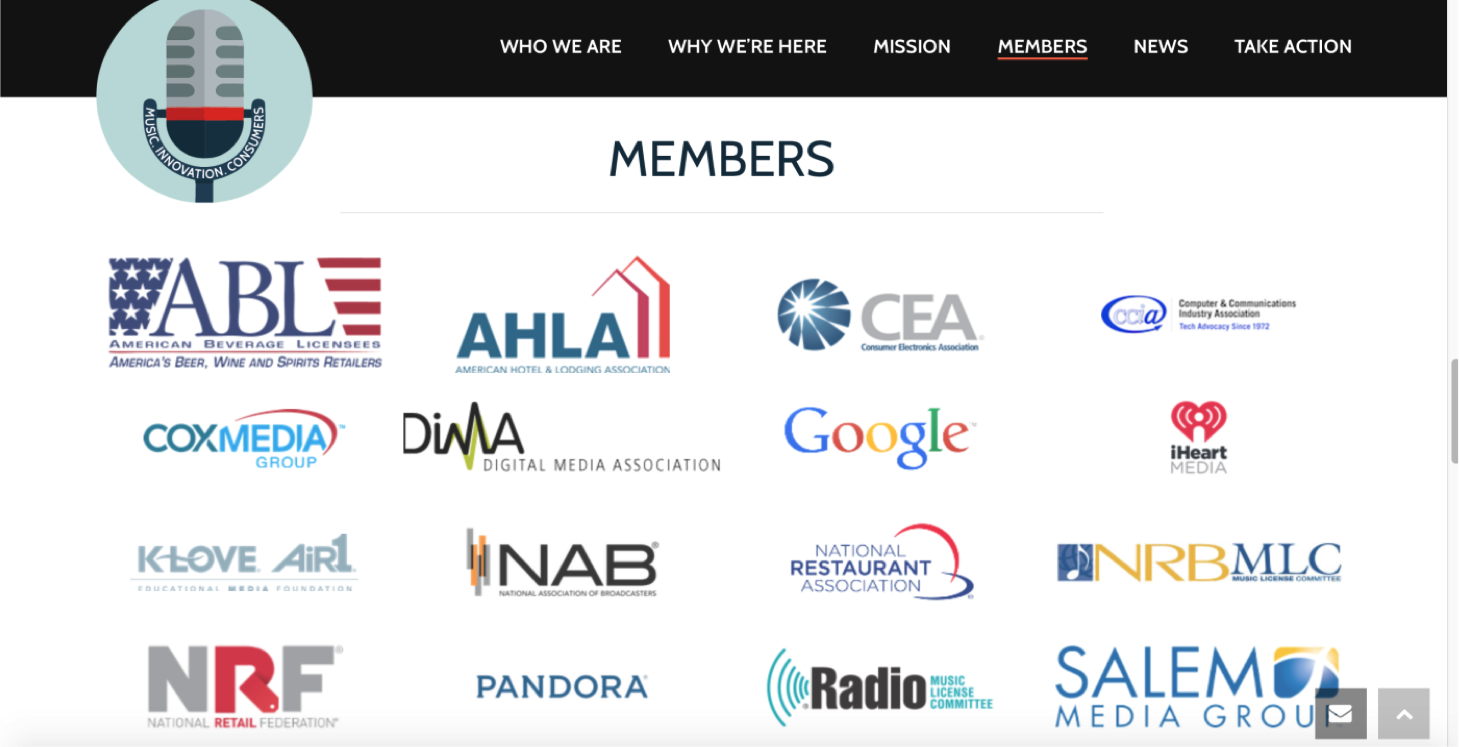
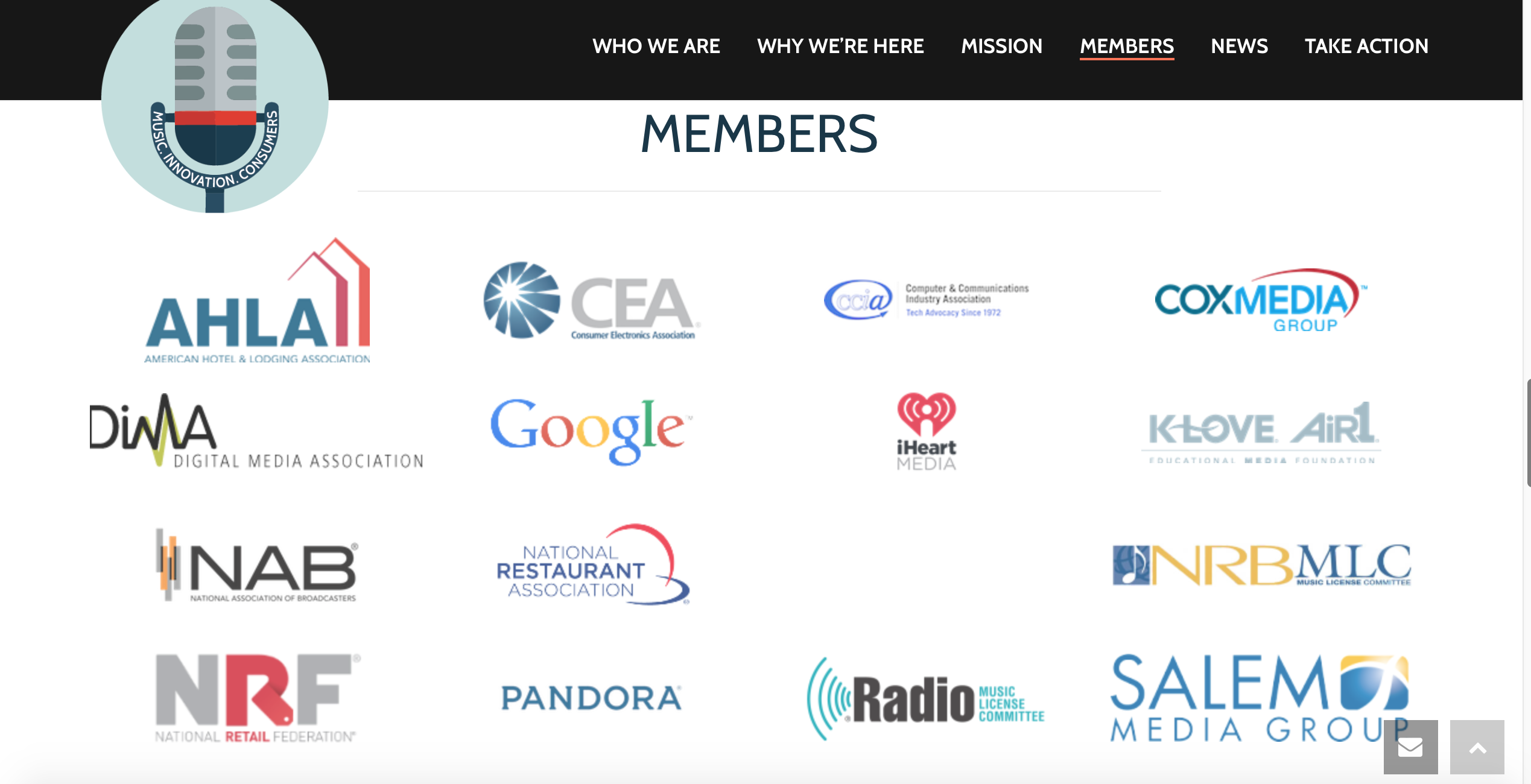
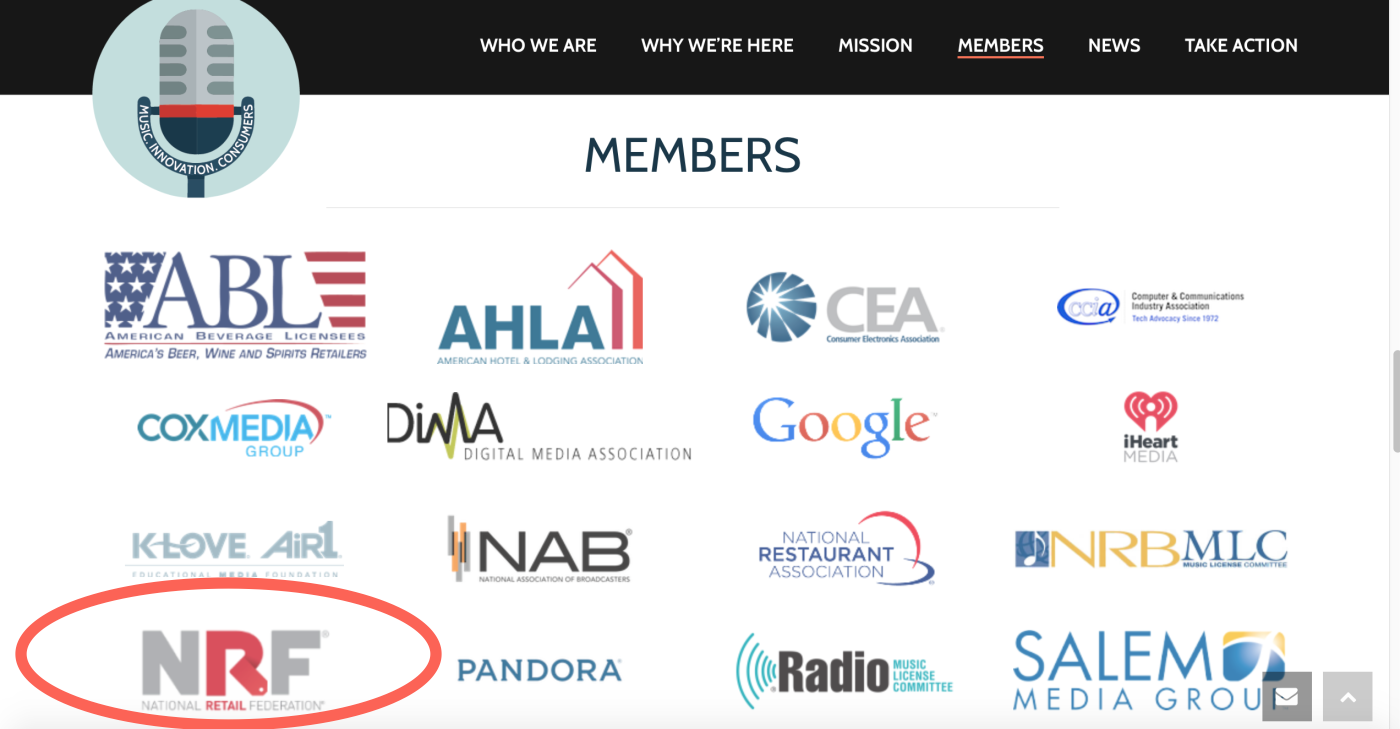
Like the members of this organization, the National Retail Federation:

mic-coaltion-8-15 Retailers

Then another defined term “A food service or drinking establishment”.  Kind of like these people:

mic-coaltion-8-15 Booze

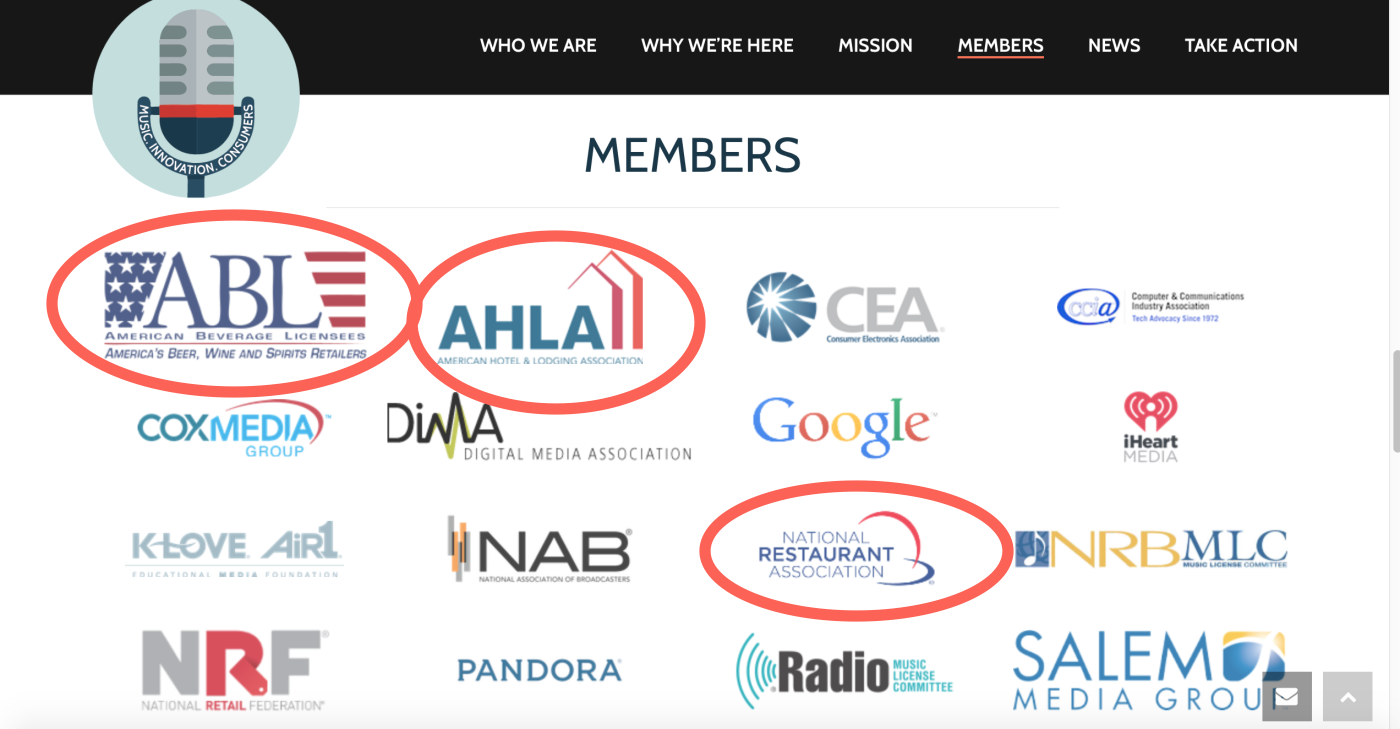
That is, the National Restaurant Association, the American Hotel and Lodging Association  (aka those who put their kids through college thanks to SXSW) and their suppliers, the American Beer, Wine and Spirits Retailers.

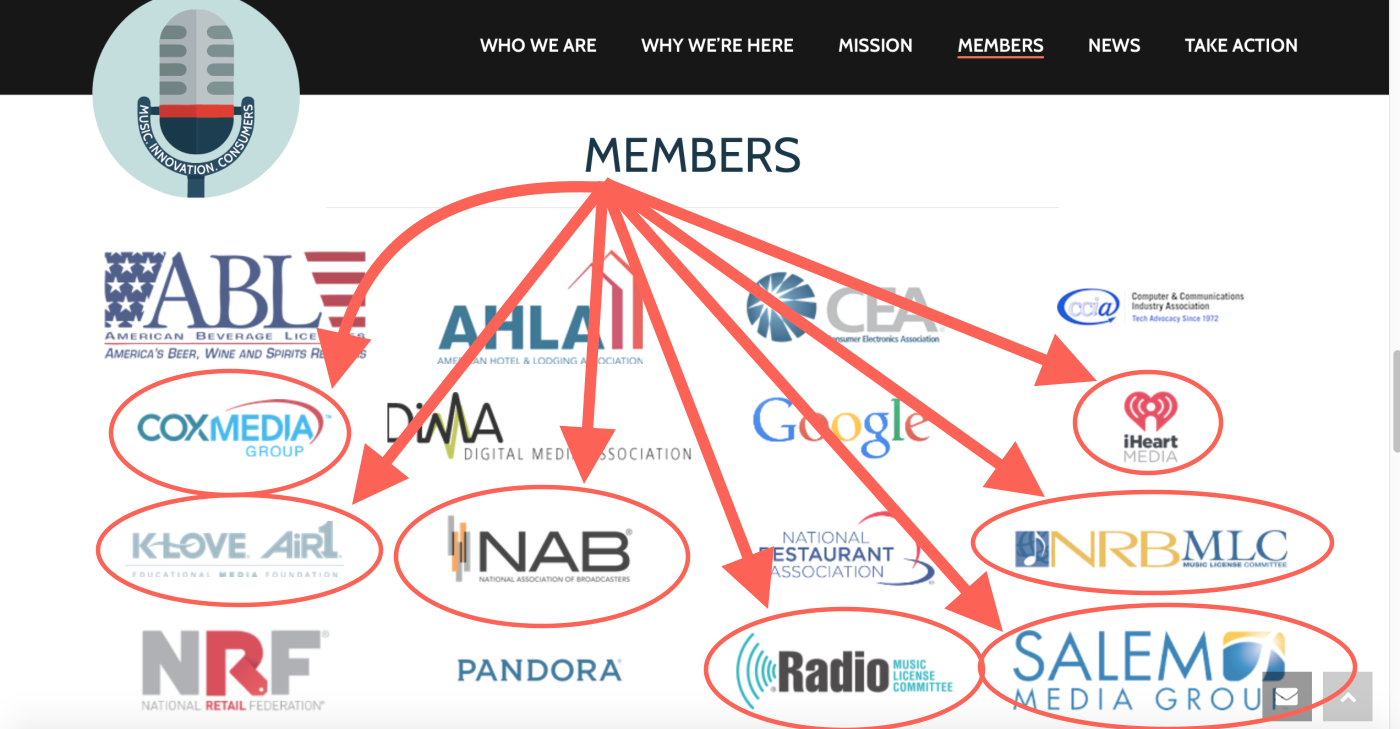
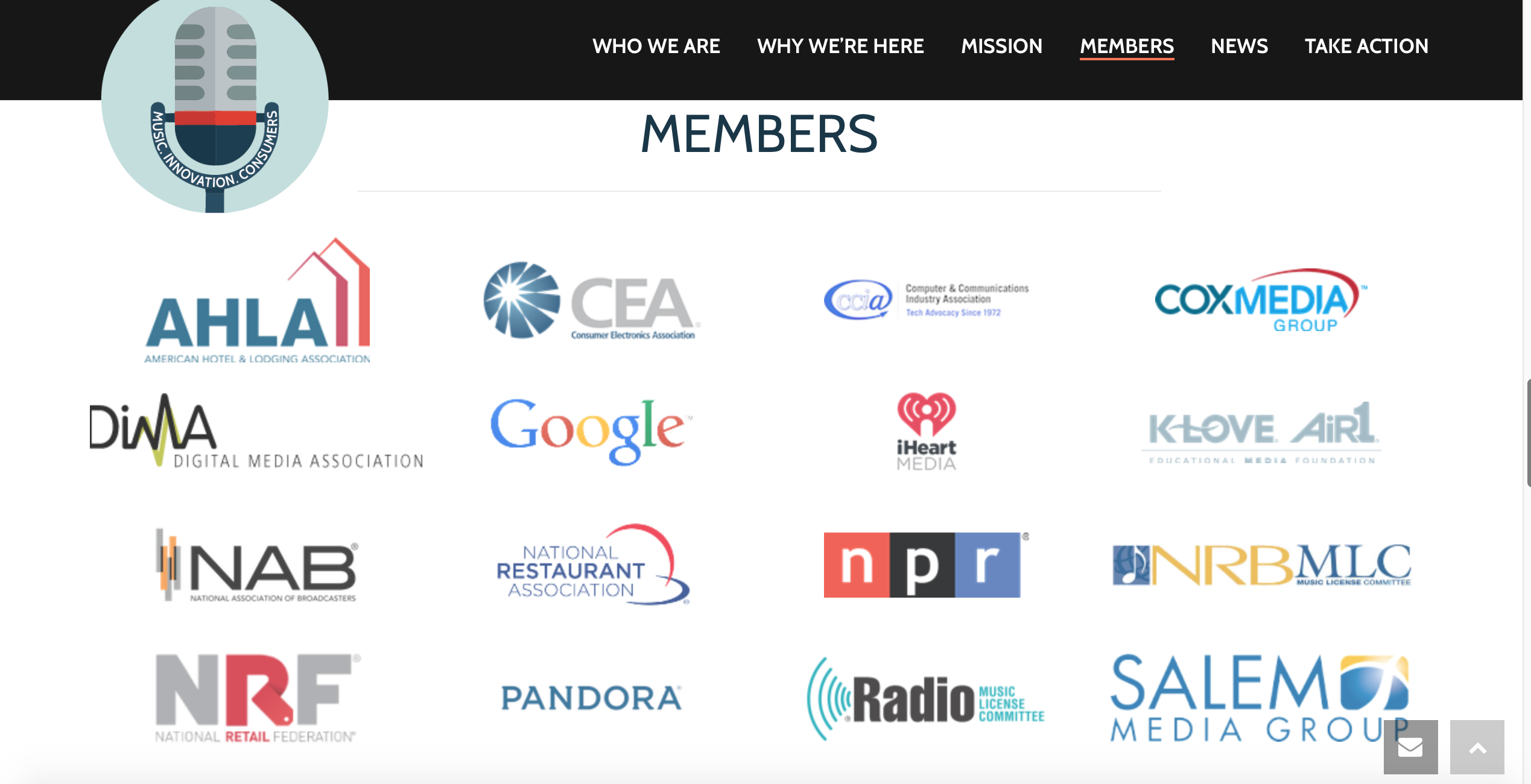
Next, “A terrestrial broadcast station licensed as such by the Federal Communications Commission”.  I guess that would include the National Association of Broadcasters, iHeart, Salem and Cox (which of course raises the question of whether this entitlement also applies to Cox’s Internet group), kind of like these people:

mic-coaltion-8-15 radio

Don’t forget “An entity operating under one of the statutory licenses described in section 112, 114 [webcasting and simulcasting], or 115 [mechanical licenses].”  Note–not that the statutory license applies to the particular song or sound recording in the way it is used that is the subject of the lawsuit, just that the entity is operating some part of its business under one of those licenses regardless of whether the service that is the subject of the lawsuit operates under one of these licenses or not.  (Pandora’s on-demand service compared to webcasting, for example, could be out of compliance with its sound recording licenses but claim the safe harbor because it is “operating under” one or more of the statutory webcasting license in the radio service or the statutory mechanical licenses for songs.)

It appears that would include these people:

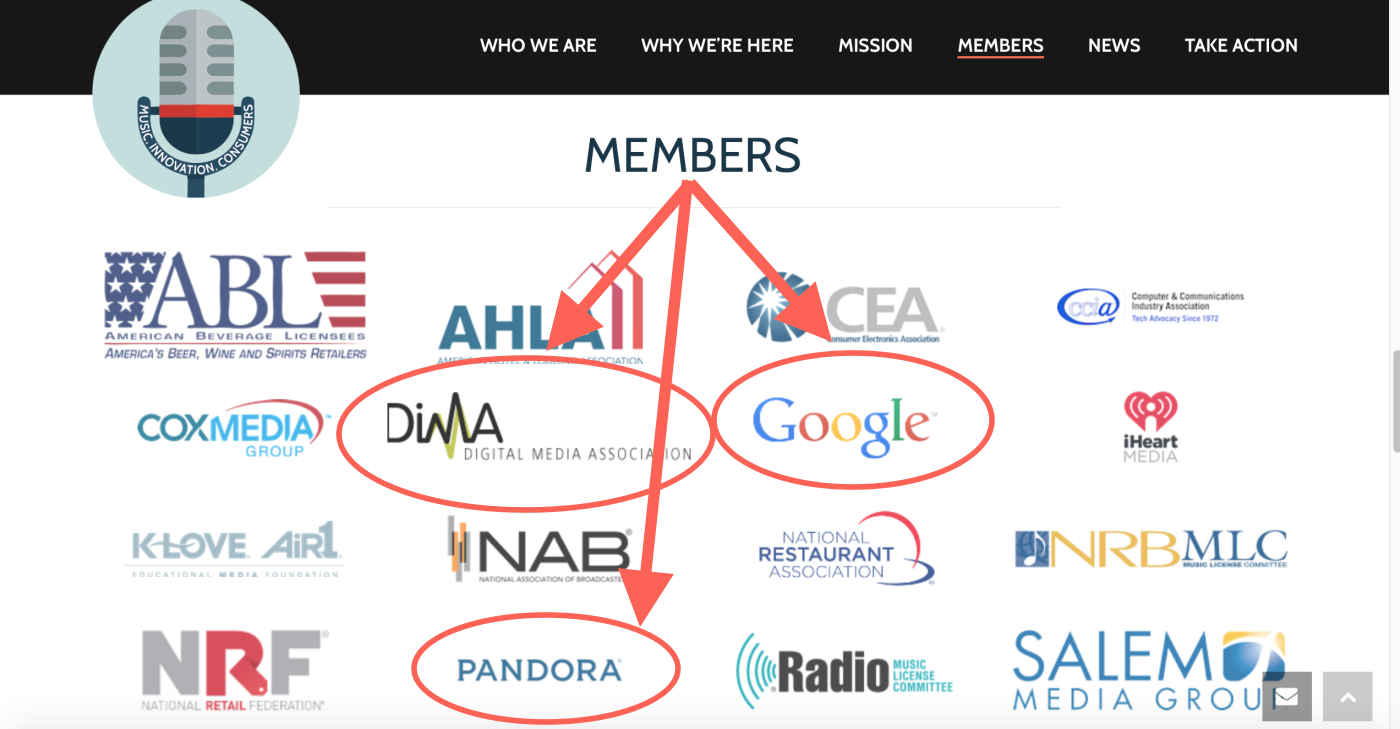
mic-coaltion-DiMA Members

and don’t forget these people who are DiMA members and need the government’s protection from songwriters and artists:

Amazon logo

white apple logo

Microsoft Logo

Spotify_logo

And then I guess you could throw the Consumer Technology Association and CCIA in there, too.

So I think that’s everyone, right?

Last but not least there’s this group as “belt and suspenders”:

An entity performing publicly, reproducing, or distributing musical works or sound  recordings in good faith as demonstrated by evidence such as [i.e., but not limited to] a license agreement in good standing with a performing rights society or other entity authorized to license the use of musical works or sound recordings.

Note:  The license need not be for the musical works or sound recordings for which the “entity” is being sued, just any license for any musical works or sound recordings.

There are loopholes in the bill that you could drive a fleet of Street View cars through, so you have to assume that the loopholes will be hacked given who is involved.  Don’t let anyone tell you “oh that’s just legislative language, we can fix that.”  The whole thing has to be voted down.

Let’s call this bill what it is:  Crony capitalism, the triumph of the connected class.  The Domesday Book writ large.

It’s some of the biggest companies in the world deciding that they don’t want to hear from songwriters or artists anymore.

So shut up and sing.


Jacqueline Charlesworth, Former General Counsel of U.S. Copyright Office, Joins Covington & Burling Law Firm

Showing excellent judgement by the firm, Covington & Burling announced that Jacqueline Charlesworth is joining their New York office.  I’m glad to see Jacqueline join the firm and they are lucky to have her.  What’s not included in the press release is that she was one of the counsel of record along with the Gerard Fox firm representing Songwriters of North America, Michelle Lewis, Thomas Kelley and Pamela Sheyne against the United States Department of Justice for the DOJ’s absurd overreach on 100% licensing.

Here’s the press release:

Jacqueline C. Charlesworth has joined Covington’s Intellectual Property Rights and Media and Communications practices in the New York office. She most recently served as General Counsel and Associate Register of Copyrights of the U.S. Copyright Office.

While at the Copyright Office, Ms. Charlesworth had primary responsibility for interpretation of the U.S. Copyright Act. As General Counsel she oversaw a wide range of litigation, legislative, regulatory, and policy matters, including the Office’s participation in cases before the U.S. Supreme Court, rulemaking proceedings under the Digital Millennium Copyright Act and other provisions, legal review of Copyright Royalty Board decisions, administration of statutory cable, satellite, and music licenses, and copyright registration and termination issues. She also advised Congress on copyright-related legislation and policy concerns.

Prior to joining the Copyright Office, Ms. Charlesworth was in private practice, in litigation and transactional matters. She also previously served as General Counsel of the National Music Publishers’ Association and as General Counsel of The Harry Fox Agency, a music licensing organization.

“Jacqueline’s experience includes a rare combination of litigation, transactional and policy work in both public service and private practice,” said Simon J. Frankel, co-chair of the firm’s Intellectual Property Rights Practice Group. “At a time of significant technological developments and potential revisions to the Copyright Act, we believe Jacqueline’s deep expertise will enhance our ability to serve a wide range of clients dealing with copyright and related intellectual property issues.”

“I am excited to resume my private practice and was particularly drawn to Covington because of its outstanding legal talent and highly collaborative culture,” said Ms. Charlesworth. “I look forward to drawing on my government and private sector experience to assist a diversity of clients with their copyright needs.”

Ms. Charlesworth received a B.A. from Brown University and a J.D. from Yale Law School. She clerked for Judge Betty Fletcher of the U.S. Court of Appeals for the Ninth Circuit and Judge Miriam Goldman Cedarbaum of the U.S. District Court for the Southern District of New York.

Blackstone Acquires SESAC: Is it all about one-stop shopping or is it the data?

“[P]rivate equity funds affiliated with Blackstone” yesterday announced the purchase of SESAC from another private equity group, Rizvi Traverse Management.

We hold our breath to see what the monopolists in the MIC Coalition will do about the sale.  In light of the new administration, it will be an interesting test of both to see if the monopolists in the MIC Coalition run to the nanny state again to try to stop the sale on some grotesquely hypocritical antitrust theory and equally interesting to see if the new administration entertains that idea.  It is almost a certainty that there will be a new head of the antitrust division of the Justice Department, so we’ll see.

But assuming that the sale goes through, it’s worth noting the story that Blackstone is telling in its press release.  We probably think of SESAC as being all about songwriters and publishers.  Songwriters did not get mentioned until the last couple sentences of the third paragraph of Blackstone’s press release.

It seems pretty clear from the press release that what Blackstone is valuing is the licensing infrastructure and data in SESAC followed closely by SESAC’s ability to do one-stop shopping on music licenses after its acquisition of HFA.  (The MIC Coalition has already complained to the DOJ about that.)  Remember–one-stop shopping was one of the improvements in the job killing ASCAP and BMI consent decrees that songwriters were interested in seeing implemented to empower ASCAP and BMI.

It is also worth noting that part of this value is that SESAC is not under the job-crushing regulations from the Department of Justice that have set wage and price controls on songwriters for 75 years.  That means that SESAC can actually engage in free market negotiations–real ones, not the ASCAP and BMI rate court version where judges in a faraway Eastern city pretend to set free market rates in a performance rights market that has effectively never been entirely free.  No wonder MIC Coalition likes other people’s consent decrees.

So while we know that it’s really all about the songwriters and relationships, investors seem at least as interested if not more interested in organizations that can offer licenses that contribute to solutions for the complexities of music licensing–preferably outside of the government mandated compulsory or near compulsory legacy licensing structure that seems to lumber on.

This is good news both for SESAC and for its competitors, and in the end we hope it’s also good for songwriters, too.  DOJ please take note.


How President Trump Can Give Songwriters and Publishers Immediate Relief from DOJ and LOC Overreach

The Obama Department of Justice filed notice on November 11 that it intended to use the peoples money to appeal BMI Rate Court Judge Louis Stanton’s devastating ruling against the DOJ’s bizarre position on “100% licensing”.  Professor Steve Winogradsky and I summarized the results of the ruling in this post.

Aside from the terrible legal optics–the appeal is not unlike a prosecutor losing a capital murder case and then appealing–there is an overtly political aspect to the timing of the appeal as David Lowery has pointed out on The Trichordist.  Filed on a Friday in the “news dump” time slot immediately following a U.S. Presidential election, the filing was likely to be lost in the news hole.

Why appeal Judge Stanton?  First, there is the spite factor.  Given that the head of the Antitrust Division is Renata B. Hesse, a former outside lawyer for Google, it should not be a surprise to learn that division head was the driving force behind the 100% licensing position at the DOJ.  Given also that Judge Stanton, who has been interpreting the BMI consent decree for many, many years, was so decisive in ruling against the DOJ, that message should have been what every songwriter already knows.  The U.S. government’s position was Kafka-esque insanity that has been called out by everyone in the music business as well as Texas Governor Greg Abbott who called on Attorney General Lynch to abandon the DOJ’s position.

Whatever the back story, there is a simple solution to this problem–the incoming administration can simply dismiss the appeal.

How Did This Happen?

Internally at the Antitrust Division, it’s entirely likely that the decision to appeal this ruling was approved by Ms. Hesse.  Ms. Hesse was promoted to  acting associate attorney general, the DOJ’s third-highest ranking official–but will leave office without a confirmation hearing due in part to the timing of her appointment.  A prominent lawyer in the Big Tech legal community, Ms. Hesse is also well-known as someone who nearly exclusively represented Google during a revolving door hiatus in private practice where she protected the interests of the multinational media corporation.

mic-coalition-no-npr

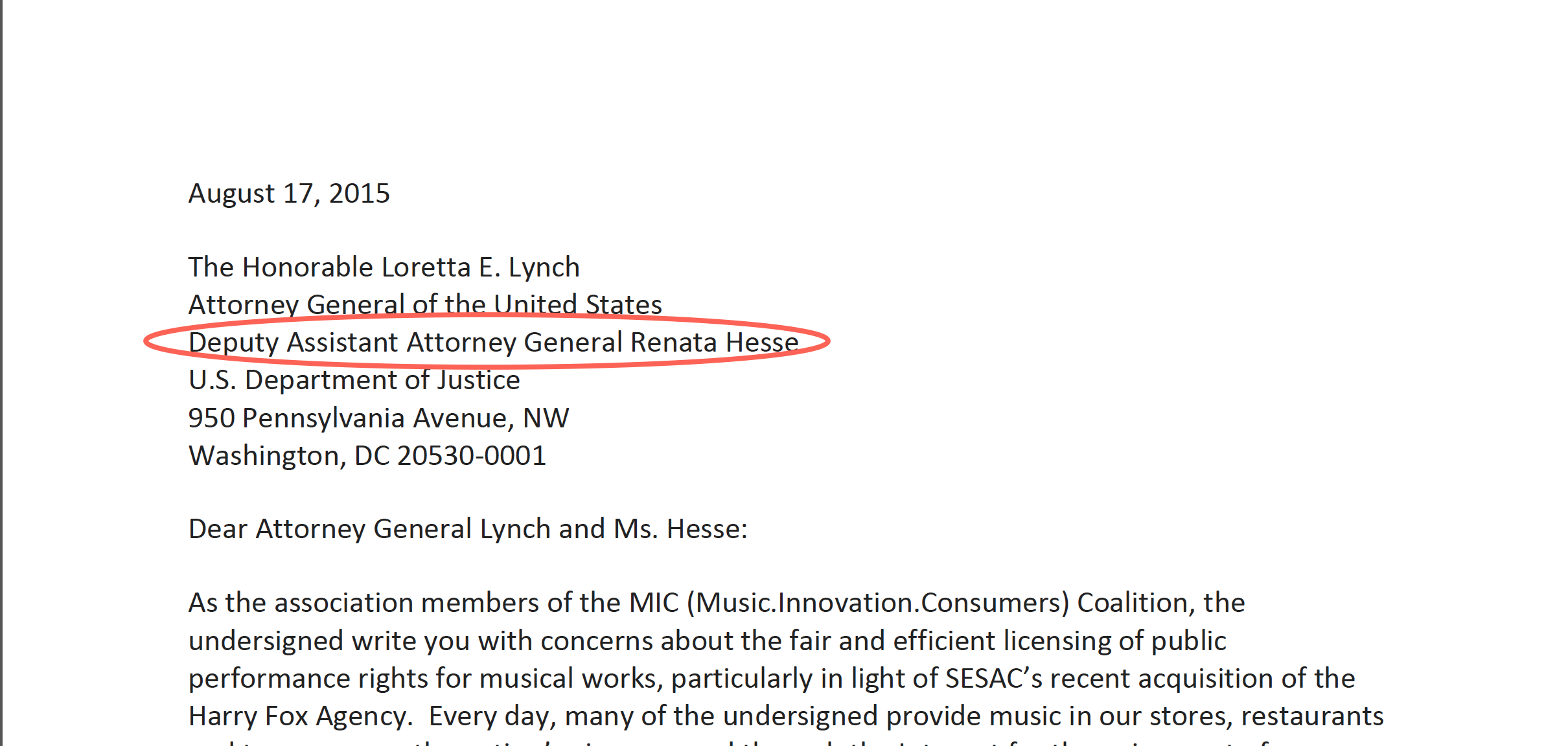
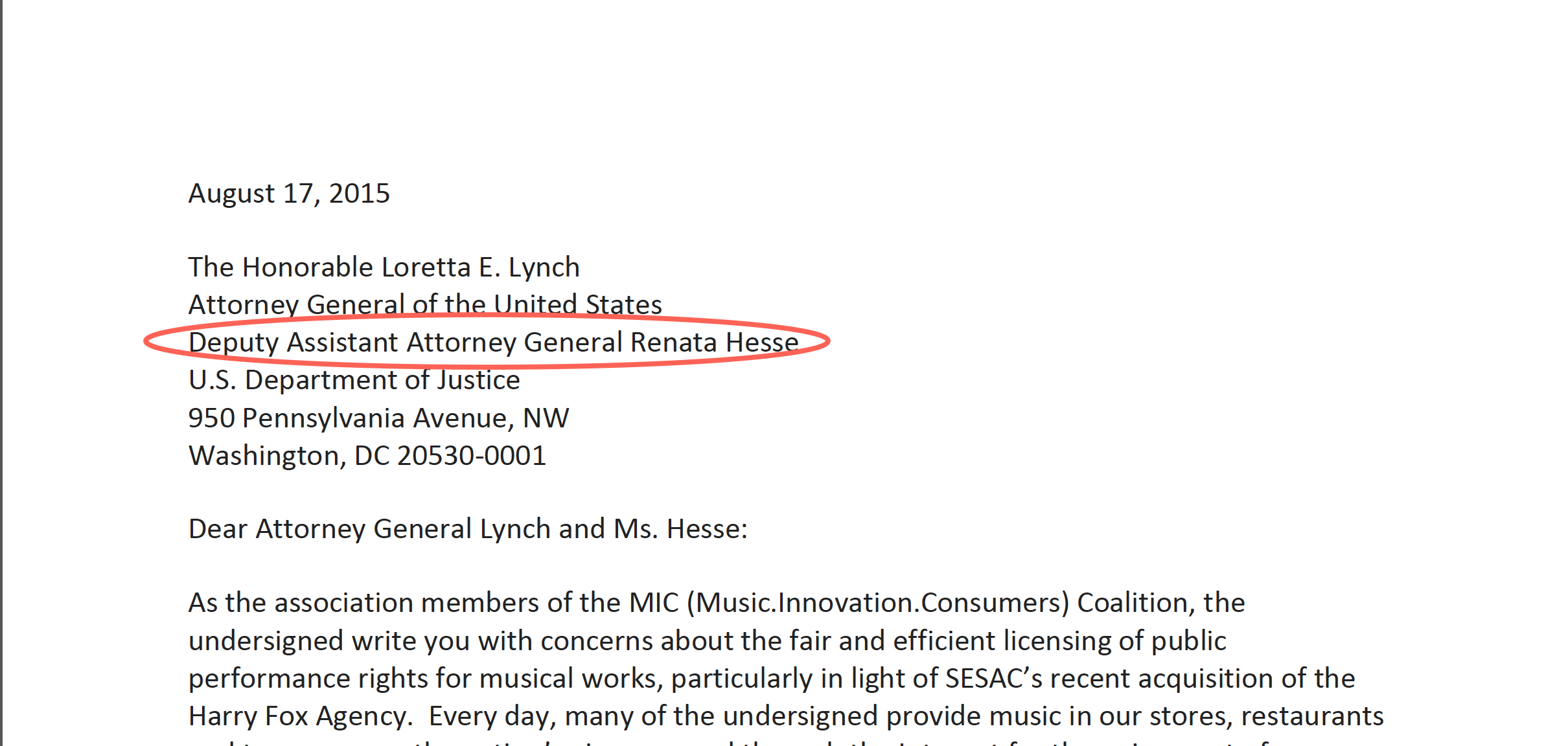
Given her loyalties, it was natural for the Google-backed MIC Coalition to turn to Ms. Hesse when it wanted the government to attack SESAC, one of two U.S. based PROs not currently under consent decree.  (Read their letter here.)

hesse

It is hard to believe that the DOJ’s decision to appeal the 100% licensing case was taken without Ms. Hesse’s chop given the commitment of the people’s money involved in a lengthy appeal.  It is equally hard to believe that Ms. Hesse’s former client had no influence on her decision to grind the songwriters just a little while longer to make her point.

Whatever the motive behind the appeal, it must be said that the BMI ruling also undercuts another event near and dear to Google–the termination of Register of Copyrights Maria Pallante by recent Obama appointee Carla Hayden, the new Librarian of Congress.

As the Wall Street Journal Editorial Board notes:

There is some circumstantial evidence that Google’s lobbying influence was brought to bear in removing Ms. Pallante, though both Google and Ms. Pallante declined to talk to us. Google’s business model is essentially making money off other people’s content, and the company’s strategy has been to infringe on copyrighted material like books and fight it out later in court. The copyright office administers laws that protect owners.

For example, Ms. Pallante’s office opposed a Justice Department interpretation of licensing that would have undercut collaborations. As it happens, that change was reportedly pushed by a former outside counsel for Google who had moved over to Justice. Ms. Pallante’s view won in court.

Given the campaign to discredit Register Pallante, the Googlers now left in the bunker simply could not allow that home run by Register Pallante to stay on the scoreboard without going into extra innings with an appeal.

It should also not be forgotten that Songwriters of North America sued the DOJ over this very 100% licensing ruling, a case that is largely concerning the DOJ’s mishandling–which inevitably will mean Ms. Hesse’s mishandling–of the 100% licensing position and its refusal to provide written versions of the DOJ’s planned statement for public comment.  If the case survives summary judgement, the discovery could include the filing of this appeal as an extension of the mishandling of the process.

Finally, you have to wonder why the Obama Justice Department is trying to back their successors into a corner with this odd appeal so close in time to when the new President will take over.

But therein lies a simple solution to the entire caustic episode, however.  In a few weeks, the Department of Justice will have a new boss.  President Trump and his new Attorney General could easily decide to stand by the analysis of the subject matter expert–the BMI Rate Court Judge–and simply dismiss the case to end the madness.


Original Sin and Obama’s Missed Opportunity: What’s Next for the ASCAP and BMI Consent Decrees?

Original sin–In Christian theology, the condition of sin that marks all humans as a result of Adam’s first act of disobedience to God.

It’s kind of an Old Testament thing.  The ASCAP and BMI consent decrees punish songwriters for a kind of original sin that most of them don’t know about and that happened some time before 1941–before most of them were born.  And yet all of them are held guilty in advance.

Sound familiar?

The Obama Justice Department just had a spectacular loss on its misguided and probably unconstitutional 100% licensing position in front of Judge Louis Stanton, the BMI rate court judge who has primary responsibility for interpreting the BMI consent decrees.  BMI asked for declaratory relief from Judge Stanton which was granted in a decisive opinion rejecting the government’s position.  So now what?

Not only did the Obama Justice Department go down the wrong rabbit hole with the consent decrees, they also managed to get themselves sued–by songwriters.  How in the world could that have happened?  Not just one, but two separate and distinct lawsuits.

The songwriters lawsuit is against the Justice Department, the Attorney General of the United States and the head of the Antitrust Division, Principal Deputy Assistant Attorney General Renata B. Hesse.  (It appears that Principal Deputy Assistant Attorney General Hesse is the prime mover in pushing the DOJ’s position on 100% licensing through the Justice Department, although it is hard to imagine that the Attorney General did not personally approve the position given the magnitude of the change in position.)

The songwriters’ lawsuit is not brought under the consent decrees.  The complaint alleges that the DOJ attorneys, starting with Principal Deputy Assistant Attorney General Hesse, engaged in unconstitutional behavior by denying songwriters their due process rights as well as taking the economic value of private property without compensation (see Professor Richard Epstein).

The lawsuit also alleges that the process that Principal Deputy Assistant Attorney General Hesse engaged in–secret phone calls, no public comment on proposed amendments to the consent decree, deceptive practices designed to encourage songwriters to leave their PROs–violated laws governing the behavior of federal administrative agencies.  The implication is that the DOJ intentionally engaged in deceptive practices lead by Hesse but also the recently departed Litigation III Section Chief David C. Kully.  (Mr. Kully was probably “just following orders”, but we all know where that can lead.)

What are the possible steps forward from here?

No Change for Music Users

Some of the less knowledgeable reporting on fractional licensing suggests that somehow music users are burdened by the decision.  Not true–most music users already have licenses from ASCAP, BMI, SESAC and increasingly from Global Music Rights.  SESAC and GMR are not subject to consent decrees because more PROs means more competition which means good things happen, right?  That was, after all, reason for the consent decrees in the first place–to encourage more competition, not less, in the public interest.

The choices afforded songwriters among competing licensing associations are no more burdensome for music users than having to deal with any other vendors in their business.  On the contrary, if the Justice Department had been successful in their stated goals of encouraging songwriters to leave ASCAP and BMI, the Justice Department would have mandated mind numbing complexity in the market place.

The Missed Opportunity

The real policy failure is that the Department of Justice failed to adopt any of the hundreds of policy proposals made by the public to amend the consent decrees–the longest running consent decrees in the history of the United States–after years of review, negotiation and discussion.

Not one.

Instead, the DOJ fixed on 100% licensing, which is something that nobody had asked for publicly as the Copyright Office noted (at p. 2, text accompanying note 8):

Despite the wide-ranging nature of the study and invitation to raise additional issues, none of the participants identified fractional licensing of musical works by the PROs as a practice that needed to be changed.

The Justice Department missed an historic opportunity to do something good for everyone.

This is tragic.

Possible Futures

DOJ Changes Position on 100% Licensing

The easiest thing would be for Principal Deputy Assistant Attorney General Hesse to issue a statement acknowledging she got it wrong on 100% licensing and that the DOJ is abandoning the position.  I doubt this will happen.

DOJ Appeals Judge Stanton’s Ruling 

Given the general bull-headedness that produced the flawed 100% licensing statement in the first place, I think it is more likely than not that the DOJ appeals Judge Stanton’s ruling.  If you were able to suspend reality to the point that you would come up with the idea in the first place, then you are probably possessed of the kind of denial that would make you believe you will prevail on appeal.

As Judge Stanton is a U.S. District Judge sitting in the Southern District of New York, the appeal in this case would go to the Second Circuit Court of Appeals.  It seems unlikely that the Second Circuit is going to rule against the subject matter expertise of the BMI Rate Court judge–expertise is the point of having rate court judges in the first place.  This is particularly true in a case requiring an interpretation of the consent decree.

Nevertheless, I will not be surprised to see an appeal, particularly one filed before the ASCAP rate court judge (Judge Cote) follows Judge Stanton’s which is likely.  An appeal of the BMI case would allow the DOJ to drag out the uncertainty which seems to be the plan for reasons no one outside the Justice Department can understand.

ASCAP Asks for Declaratory Relief

Given the many rulings against songwriters handed down by Judge Cote, caution may be the watchword for any request for declaratory relief by ASCAP.  However much I appreciate Judge Stanton’s ruling, it must be said that the conclusion is rather obvious.  Even so, I thought that the ASCAP members’  partial withdrawal from collective licensing of the bundle of rights was so obviously the law that it was axiomatic, and Judge Cote ruled against that rather obvious policy.

It may be better for ASCAP to simply wait it out until the issue arises before Judge Cote in a future proceeding.  Since the MIC Coalition seems to have its hand in the Justice Department’s positioning anyway, it would not surprise if the MIC Coalition went to Judge Cote for their own declaratory relief.

MIC Coalition
MIC Coalition Members

SONA Pursues Its Lawsuit

The most interesting part of the puzzle is the lawsuit brought by Songwriters of North America, Michelle Lewis, Thomas Kelly and Pamela Sheyne.  As a threshold matter, it reinforces the idea that ASCAP and BMI are comprised of songwriters bargaining collectively.  While it may be convenient for the broadcasters, Google and their MIC Coalition to heap condemnation on the PROs, when doing so they are actually shaming the individual songwriters who are members of ASCAP and BMI.  Those songwriters don’t feel they’ve done anything wrong.

The SONA lawsuit confirms this for all to see.  While it takes considerable courage to sue a defendant who comes with badges and guns and prints money to pay their legal bills, the DOJ is now faced with a process that reeks to high heaven, looks at least potentially fraught with corruption and which SONA will now put under a microscope–if they survive summary judgement.

Of course, it should not be lost on anyone that the DOJ’s position will be some version of “We lost, so no harm, no foul” as absurd as that may seem.  I’m not sure that “just kidding” is a good look for them.

Until the ASCAP judge rules on the issue and follows Judge Stanton’s reasoning and the DOJ agrees not to file an appeal, there’s no reason for SONA to change course.  If SONA survives summary judgement on one or both of its claims, then things may get interesting.

Governors Take Action

Texas Governor Greg Abbott was the first state governor to call on the Attorney General to back off of the 100% licensing rule, acting in defense of Texas songwriters.  It would not be surprising to see other governors write their own letters to the AG, particularly now that Judge Stanton has ruled.

Terminating the Consent Decrees

What this episode should teach everyone is that the consent decrees have run their course.  They are now being manipulated by crony capitalists for private commercial advantage.  Hesse’s connections to Google and the MIC Coalition are well known and only further undermine the public’s trust in government’s ability to operate fairly.

Abandoning the consent decrees does not mean that songwriters would get a free pass on antitrust prosecution, it just means that the true free market would operate outside of a little intellectual elite in a far away Eastern city that thinks it can plan the lives of songwriters better than songwriters can themselves.  Music users and the government would still be free to bring antitrust actions if the facts warranted it as has already happened to SESAC (which is not subject to a consent decree).

So for the moment, songwriters are in a holding pattern but with the wind at their backs.

I’m still looking forward to an explanation of why Google, Pandora, Clear Channel and a host of other giant multinational corporations with hundreds if not thousands of lobbyists need the awesome power of the U.S. Government to protect them from…songwriters.

Getting closure on this regrettable episode will be better for songwriters and for music users.  It’s hard enough without the Nanny State intervening.  Collective licensing is one of the few areas of the business that is working pretty well in the digital age.

Songwriters deserve the chance to live their commercial lives without paying for long-forgotten sins committed before most of them were born.