Don’t Get Fooled Again: Piracy is still a big problem

I know it’s not very “modern,” but music piracy is still a huge problem.  As recently as yesterday I had a digital music service executive tell me that they’d never raise prices because the alternative was zero–meaning stolen.

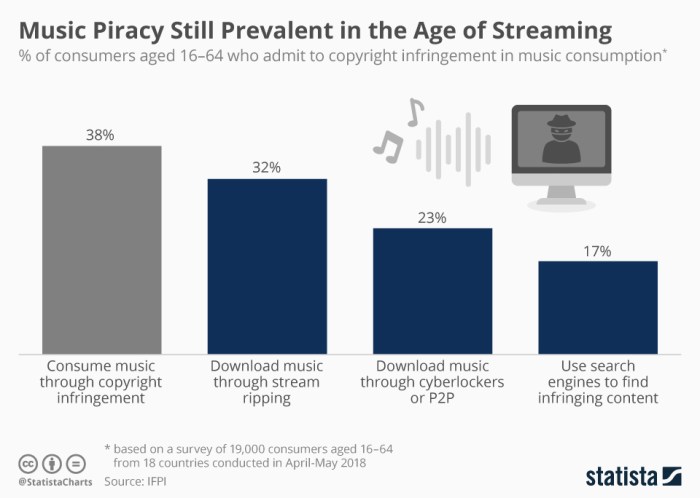
Very 1999, but also oh so very modern as long as Google and their ilk cling bitterly to their legacy “safe harbors” that act like the compulsory licenses they love so much.  Except the safe harbor “license” is largely both royalty free and unlawful.  Based on recent data, it appears that streaming is not saving us from piracy after all if 12 years after Google’s acquisition of YouTube piracy still accounts for over one third of music “consumption.”  The recent victory over Google in the European Parliament indicates that it may yet be possible to change the behavior of Big Tech in a post-Cambridge Analytica world.

It’s still fair to say that piracy is the single biggest factor in the downward and sideways pressure on music prices ever since artists and record companies ceded control over retail pricing to people who have virtually no commercial incentive to pay a fair price for the music they view as a loss leader.  If the Googles of this world were living up to their ethical responsibilities that should be the quid pro quo for the profits they make compared to the harms they socialize, then you wouldn’t see numbers like this chart from Statistica derived from IFPI numbers:

chartoftheday_15764_prevalence_of_music_piracy_n

The good news is that there is a solution available–or if not a solution then at least a more pronounced trend–toward making piracy much harder to accomplish.  It may be necessary to take some definitive steps toward encouraging companies like Google, Facebook, Twitch, Amazon, Vimeo and Twitter to do more to impede and interdict mass piracy.

Private Contracts:  It may be possible to accomplish some of these steps through conditions in private contracts that include sufficient downside for tech companies to do the right thing.  That downside probably should include money, but everyone needs to understand that money is never enough because the money forfeitures are never enough.

The downside also needs to affect behavior.  Witness Google’s failure to comply with their nonprosecution agreement with the Criminal Division of the Department of Justice for violations of the Controlled Substances Act.  When the United States failed to enforce the NPA against Google, Mississippi Attorney General Jim Hood sought to enforce Mississippi’s own consumer protection statutes against Google for harms deriving from that breach.  Google sued Hood and he ended up having to fold his case, even though 40 state attorneys general backed him.

Antitrust Actions:  Just like Standard Oil, the big tech companies are on the path to government break ups as Professor Jonathan Taplin teaches us.  What would have been unthinkable a few years ago due to fake grooviness, the revolving door and massive lobbying spending all over the planet, in a post-Cambridge Analytica and Open Media world, governments are far, far more willing to go after companies like Google, Amazon and Facebook.

Racketeer Influenced and Corrupt Organizations Act Civil Prosecutions:  “Civil RICO” claims are another way of forcing Google, Facebook, Amazon & Co. to behave.  Google is fighting a civil RICO action in California state court.  This may be a solution against one or more of Google, Facebook and Amazon.

As we know, streaming royalties typically decline over time due to the fact that the revenues to be divided do not typically increase substantially (and probably because of recoupable and nonrecoupable payments to those with leverage).  At any rate, the increase in payable revenues is less than the increase in the number of streams (and recordings).

While it’s always risky to think you have the answer, one part of the answer has to be basic property rights concepts and commercial business reality–if you can’t reduce piracy to a market clearing rate, you’ll never be able to increase revenue and music will always be a loss leader for immensely profitable higher priced goods that artists, songwriters, labels and publishers don’t share be it hardware, advertising or pipes.

I strongly recommend Hernando de Soto’s Mystery of Capital for everyone interested in this problem.  The following from the dust jacket could just as easily be said of Google’s Internet:

Every developed nation in the world at one time went through the transformation from predominantly extralegal property arrangements, such as squatting on large estates, to a formal, unified legal property system. In the West we’ve forgotten that creating this system is what allowed people everywhere to leverage property into wealth.

What we have to do is encourage tech companies to stop looking for safe harbors and start using their know-how to encourage the transformation of the extralegal property arrangements they squat on and instead accept a fair rate of return.  My bet is that this is far more likely to happen in Europe–within 30 days of each other we’ve seen Europe embrace safe harbor reform in the Copyright Directive while the United States welcomed yet another safe harbor.

If we’re lucky, the European solution in the Copyright Directive may be exported from the Old World to the New.  And if Hernando de Soto could bring property rights reform to Peru in the face of entrenched extralegal methods and the FARC using distinctly American approaches to capital, surely America can do the same even with existing laws and Google.

Arithmetic on the Internet: The Ethical Pool Solution to Streaming Royalty Allocation

“Sick of my money funding crap.”
A Fan’s Tweet

Subscription services are one of the few secular trends in the current economy that is not yet reactive to trade wars or interest rates.  Subscription services are found in many areas of the economy, but music drives some of the big ones like Spotify, Amazon and especially the razor-and-razorblades plays like Apple.  But per-stream royalties do not come close to making up for the CD and download royalties they cannibalize.   Not only do subscription retail rates need to increase, but it’s also time for a major change in the way artist’s streaming royalties are calculated from what is essentially a market share approach to one that is more fair.   (Listen to the Break the Business podcast discussion about the Ethical Pool that I had with Ryan Kairalla.)

Artists’ dismal streaming royalties on music subscription services are largely based on a simple calculation:  A per-stream payment derived from a share of the service’s revenue prorated by number of streams.  Artists get a portion of a service’s monthly revenue (at least the revenue the service discloses) based on a ratio of your plays to all the plays.  Your plays will always be a lot smaller than the total plays.  (This is essentially what Sharky Laguana referred to as the “Big Pool.”)

Sounds simple, but mixed with the near-payola of Spotify’s playlist culture and Pandora’s “steering” deals, it’s really not.  Negotiating leverage allows big stakeholders to tweak the basic calculation with floors, advances (aka breakage), nonrecoupable payments that help cover accounting costs, and other twists and turns to avoid a pure revenue share.

It also must be said that stock analysts and venture investors always—always—blame “high” royalties for loss-making in music services.  This misapprehension ignores high overhead such as Spotify’s 10 floors of 4 World Trade Center or high bonus payments such as Daniel Ek’s $1,000,000 bonus paid for failing to accomplish half of his incentive goals stated in the Spotify SEC documents (p. 133 “Executive Compensation Program Requirements”).

Of course all these machinations happen behind the scenes.  Fans are not aware that their subscription pays for music they don’t listen to and artists they never heard of or don’t care for.   Plus, it’s virtually impossible for any label or publisher to tell an artist or songwriter what their per-stream rate is or is going to be.

Fans Don’t Like It:  A New Wave of Cord Cutters?

So neither fans nor artists are happy with the current revenue share model. Given that the success of the subscription business model is keeping subscribers subscribing, the last thing the fledgling services need are cord cutters.

Many artists will tell you that the playlist culture and revenue share model are destructive.  Dedicated fans often don’t like it  either (after they understand it) because it gives the lie to supporting your favorite artist by streaming their music.  Artists don’t like it because unless you have a massive pop or hip hop hit, all you can aspire to is a royalty rate that starts in the third decimal place from the right if not the fourth.  This is compounded for songwriters.   (See Universal Music Publishing’s Jody Gerson on streaming royalties for songwriters.)

Simply put, if a fan pays their subscription and listens to 20 artists in a month, that fan likely believes that their subscription is shared by those 20 artists and not by 200,000 artists, 99.99% of whom that fan never listened to and probably never will, similar to Sharky’s “Subscriber Pool.”  (You can take a survey here.)

This is why some artists like Sharky Laguana (and their managers) have begun arguing for replacing the status quo with “user-centric” royalties that more directly correlate fan listening to artist payments.  I have a version of this idea I call the “Ethical Pool.”  

How Did We Get Here?

How in the world did we get to the status quo?  The revenue share concept started in the earliest days of commercial music platforms.  These services didn’t want to pay the customary “penny rate” (as is typical for compilation records, for example), because a fixed penny rate might result in the service owing more than they made–particularly if they wanted to give the music away for free to compete with massive advertising supported pirate sites.

Paying more than you make doesn’t fit very well with a pitch for a Web 2.0, advertising driven model:  All you can eat of all the world’s music for free or very little, or “Own Nothing, Have Everything,” for example.  It also works poorly if you think that artists should be grateful to make any money at all rather than be pirated.

Revenue share deals for big stakeholders have some bells and whistles that leverage can get you, like per-subscriber minimums, conversion goals, top up fees, limits on free trials, cutbacks on “off the top” revenue reductions, and the percentage of revenue in the pool (50%—60%-ish).  Even so,  the basic royalty calculation in a revenue share model is essentially this equation calculated on a monthly basis:

(Net Revenue * [Your Streams/All Streams])

Or ([Net Revenue/All Streams] * Your Streams)

In other words all the money is shared by all the artists.

Sounds fair, right?

Wrong.  First, all artists may be equal, but on streaming services, some are more equal than others.  Regardless of the downside protection like per-subscriber or per-stream minima, the revenue share model has an inherent bias for the most popular getting the most money out of the “Big Pool.”  (This is true without taking into account the unmatched.)

And of course it must be said that the more of those artists are signed to any one label, the bigger that label’s take is of the Big Pool.  So the bigger the label, the more they like streaming.

Conversely, the smaller the label the lower the take.  This is destructive for small labels or independent artists.  That’s why you see some artists complaining bitterly about a royalty rate that doesn’t have a positive integer until you get three or four decimal places to the right.  Why drive fans away from higher margin CDs, vinyl or permanent downloads to a revenue share disaster on streaming?  

Yet it increasingly seems that we are all stuck with the nonsensical streaming revenue share model.

Do Fans Think It’s Wrong?

There’s nothing particularly nefarious about this—them’s the rules and rev share deals have been in place for many years, mostly because the idea got started when the main business of the recorded music business was selling high margin goods like CDs or even downloads.  Low margin streaming didn’t matter much until the last couple years.

It was only a question of time until that high margin business died due to the industry’s willingness to accept fluctuating micropennies as compensation for the low-to-no margin streaming business.  (I say “no margin business” because the costs of accounting for streaming royalties may well exceed the margin—or even the payable royalty—on a per-stream basis when all transaction costs are considered as Professor Coase might observe.) 

So understand—the revenue share model is essentially a market share distribution.  Which is fine, except that in many cases, and I would argue a growing number of cases, when the fans find about about it, the fans don’t like it.  They pay their monthly subscription fee and they think their money goes to the artists they actually listen to during the month.  Which is not untrue, but it is not paid in the ratio that the fan might believe.  Fans could easily get confused about this and the Spotifys of this world are not rushing to correct that confusion.  

Here’s the other fact about that rev share equation: over time, the quotient is almost certain to produce an ever-declining per-stream royalty.  Why? 

Simple.  

If the month-over-month rate of change in revenue (the numerator) is less than the month-over-month rate of change in the total number of streams or sound recordings streamed on the service (the denominator), the per-stream rate will decline over those months.  This is because there will be more recordings in later months sharing a pot of money that hasn’t increased as rapidly as the number of streams.

As the number of recordings released will always increase over time for a service that licenses the total output of all major and indie labels (and independent artists), it is likely that the total number of recordings streamed will increase at a rate that exceeds the rate of change of the net revenue to be allocated.  If there are more recordings, it is also likely that there will be more streams.

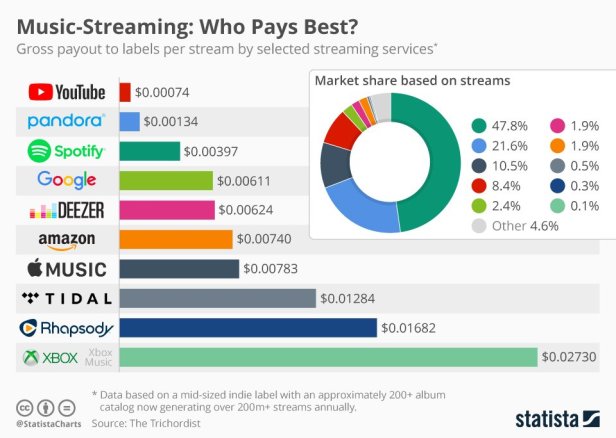
So streaming royalties in the Big Pool model will likely (and some might say necessarily will) decline over time.  That’s demonstrated by declining royalties documented in The Trichordist’s “Streaming Price Bible” among other evidence.
dz34tgix0aacovv-jpg-large

Thus the fan’s dissatisfaction with the use of their money is already rising and is likely to continue to rise further over time.

User-Centric Royalties and the Ethical Pool

How to fix this?  One idea would be to give fans what they want.  A first step would be to let fans tell the platform that they want their subscription fee to go to the artists that the fan listens to and no one else.  This is sometimes called “user-centric” royalties, but I call this the “Ethical Pool”. 

When the fan signs up for a service, let the fan check a box that says “Ethical Pool.”  That would inform the service that the fan wants their subscription fee to go solely to the artists they listen to.  This is a key point—allowing the fan to make the choice addresses how to comply with contracts that require “Big Pool” accountings or count Ethical Pool plays for allocation of the Big Pool.   Remember–the Ethical Pool exists along side the Big Pool, not to the exclusion of the Big Pool.  If the fan did not opt in to the Ethical Pool, the default would be the Big Pool.  Don’t miss this point, lots of people do.

Artists also would be able to opt into this method by checking a corresponding box indicating that they only want their recordings made available to fans electing the Ethical Pool.  The artist gets to make that decision.   Of course, the artist would then have to give up any claim to a share of the “Big Pool.”

Existing subscribers could be informed in track metadata that an artist they wanted to listen to had elected the Ethical Pool.  A fan who is already a subscriber could have to switch to the Ethical Pool method in order to listen to the track.  That election could be postponed for a few free listens which is much less of an issue for artists who are making less than a half cent per stream.

The basic revenue share calculation still gets made in the background, but the only streams that are included in the calculation are those that the fan actually listened to.  If the fan doesn’t check the box, then their subscription payment goes into the market share distribution as is the current practice, but their musical selection is limited to “Other than Ethical Pool” artists.

That’s really all there is to it.  The Ethical Pool lives side by side with the current Big Pool market share model.  If an Ethical Pool artist is signed, the label’s royalty payments would be made in the normal course.  The main difference is that when a subscriber checks the box for the Ethical Pool, that subscriber’s monthly fee would not go into the market share calculation and would only be paid to the artists who had also checked the box on their end.

One other thing—the subscription service could also offer a “pay what you feel” element that would allow a fan to pay more than the service subscription price as, for example, an in-app purchase, or—clasping pearls—allow artists to put a Patreon-type link to their tracks that would allow fans to communicate directly with the artist since the artist drove the fan to the service in the first place.  I’ve suggested this idea to senior executives at Apple and Spotify but got no interest in trying.

The Ethical Pool is real truth in advertising to fans and at least a hope of artists reaping the benefit of the fans they drive to a service.  There are potentially some significant legal hurdles in separating the royalty payouts, but there are ways around them.

I think the Ethical Pool is an idea worth trying.

UPDATE:  I want to emphasize a couple points that seem to keep coming up in discussions about Ethical Pool.

Ethical Pool exists as an option to the Big Pool. If a fan doesn’t select the Ethical Pool, the default is the Big Pool. The Ethical Pool is a different pot of money that the Big Pool and is divided among fewer artists.  Both exist at the same time.

If artists who are not rewarded by the Big Pool can offer their music at a higher margin somewhere other than the big platforms, they may just skip the Ethical Pool altogether and simply drive fans to the higher margin sites in more of a direct to fan relationship.

The two essential points of the Ethical Pool are (1) the Big Pool is a hyperefficient concentration of revenue to a small number of artists that trends toward a market share allocation and will always fail to reward niche and developing artists, and (2) that if the artist wants to be on the big platform, they may have a better shot at getting a higher royalty with the Ethical Pool than the Big Pool.
Rut Roh: Led Zeppelin’s Free Agency Streaming Service

There’s always been a wrangle between record companies and artist managers over who owns recordings the band creates outside of the “recording commitment” masters that the label pays for.  There’s a misconception out there that if an artist is signed to a label, that label “owns” everything the artist records during the term.

Not true.  The label may have a blocking right over exploitation of records made outside of the artist’s deal during the term, but there almost always comes a time when the artist is free to exploit those outside recordings on their own or through a third party.  Not to mention re-records.

In the middle of what I think is a lot of hot air about Spotify becoming a threat to record companies–almost always a story promoted either by stock analysts who don’t know a trap case from a coke spoon or by overpaid Spotify executives–comes a very interesting story.  According to Digital Music News, Led Zeppelin may be about to launch its own streaming service.

If the stock analysts want a story that actually is disruptive, here’s one.  Led Zeppelin is exactly the kind of band that can maximize free agency (not to mention owning their own label for years albeit one closely affiliated with and probably largely funded by a major label).  Led Zeppelin is also exactly the kind of band that a service like Apple would do well to cozy up to which I’m sure was not lost on people at Apple.  (Spotify wouldn’t know what to do with anyone who wasn’t already a pop or hip hop star, frankly.)

This is exactly the kind of thing that many, many bands from the 60s, 70s and maybe 80s could do very well (assuming they still have enough of the kind of rarities that used to be included as bonus material in CD box sets and are still included in some vinyl releases).  This is also the kind of thing that is simply not a fit for Spotify as that service is the wrong demo and you couldn’t really imagine a John Bonham record on a “Sleep” playlist.

We’re coming up on the 20th anniversary of an article I wrote called “Why Free Agency Matters: The Coming Changes in Artist Relations.”  This Led Zeppelin service is exactly the kind of thing we should have more of–a great add-on to a fan club or fan community, completely outside of the big platforms.  One challenge will be overhead, but that’s nothing that a sponsorship couldn’t solve for a band like Led Zep.

Is Tencent a Cautionary Tale for Spotify?

If you’ve ever asked yourself why Spotify has such a large market cap, I’d suggest there are a couple reasons.  (One we can eliminate right away is that the company is actually worth today’s $34,880,000,000 valuation.)

We can discount as a correctable market distortion the fact that Spotify manipulated the SEC into allowing the company to take its private market sale price as an indicator of what its public shares should trade at (discounting that most of the private stock was likely sold by insiders on the private market who had an interest in propping up the valuation).  We can also discount that the “direct public offering” resulted in shares being sold by insiders on the public market who had an interest in propping up the stock price and the implied valuation.

One cannot underestimate the role that Chinese darling Tencent played in the dance that was Spotify’s stock market valuation and resulted in Spotify and Tencent holding 10% of each other, Dot Bomb Style.

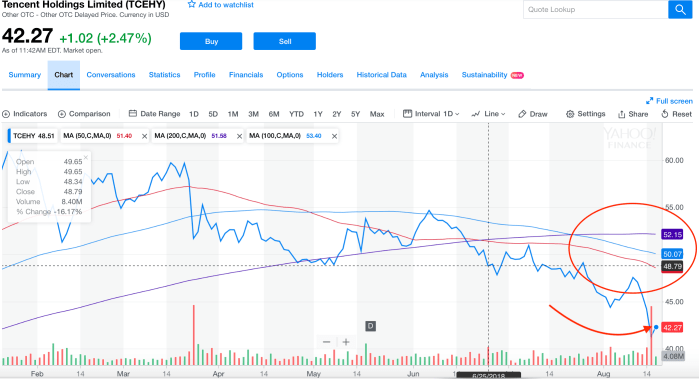
The only problem is that while the Peoples Republic of China can command a lot of stuff in their economy (if you can call it that), one thing Xi Jinping (who is General Secretary for Life of the Communist Party of China,  President for Life of the People’s Republic of China, and Chairman for Life of the Central Military Commission) cannot control is the stock market.  And the stock market is sending a signal about Tencent that Spotify would do well to pay attention to given the chunk of Spotify owned by Tencent.  (Check quickly to see if any recordings of the Tibetan Freedom Concert are available on Spotify.)

Tencent is down 17% on the year and dropped a bunch yesterday from its first profit cut   in 13 years because “it did not know when it would get Chinese approval to make money from its most popular game” according to Reuters.

That’s a good reminder of the facts on the ground for Chinese companies–if President for Life Xi Xinping doesn’t want you to make money, it can ruin your whole day.  Read the Tencent earnings call transcript.  And a squeeze on Tencent can also create some international or regional index fund torque that affects other big Chinese companies.

But the tale of the tape tells us that the problems started for Tencent quite some time ago–in January Tencent had a $575 billion market cap compared to $403 billion today, a lopping of some $170 billion–that’s billion with a “B”–off of its market cap.  Which is indicative of the problems with the Chinese economy as a whole–not to mention that there’s a lot of domestic retail investing on margin in China and short selling.

And when the margin calls come in, that stuff is nasty no matter what geographical economy you live in (see The Big Short.)

Tencent 8-16-18

So at the moment, it looks as if Tencent’s shares of Spotify are doing better for Tencent than Spotify’s shares of Tencent are doing for Spotify.

HFA is Getting Blamed Unfairly


afriendinneed
A Friend In Need

When you’ve been around as long as the Harry Fox Agency, you’re going to make some enemies, screw some things up, over react and over reach.  You’re also going to do a lot of things right, make some friends and do some good.  But most of all, you’re going to be the whipping boy for your client’s enemies, screwups, overreacting and over reaching.

From one whipping boy to another, that’s just not fair and anyone who has ever tried to do anything really hard with data in the music business knows it.  So pish and pshaw on those who gang up on HFA in the debate on the Music Modernization Act.  Let’s look at the facts.

When HFA developed the first digital download mechanical license in the late 1990s, the current crop of critics were nowhere to be seen.  Was it a perfect solution?  Not entirely, no.  But it did work and business got done and songwriters made money.  We were all feeling our way along the digital precipice and making it up as we went along.

I will go out on a limb here and say that if it weren’t for people like HFA’s Ed Murphy, it’s entirely possible that there would be no “streaming mechanical” at all.  That would be the same Ed Murphy who stepped up and licensed Napster’s effort at a p2p subscription service in 2001.  Again, the current crop of critics were nowhere to be seen.

Here’s another fact that you won’t hear about.  When it came time to mete out justice to a massive infringer record company who had been ripping off Texas singer-songwriters for years and years, it was HFA who stood with us.  Not because they made money, not because there was some pot of gold for them–there wasn’t and they didn’t.

They did it because it was the right thing to do.

They may not be choir boys, but they have their moments.  When we really needed them, they showed up for Texas songwriters.  And that’s how we measure friendship in my part of the world.

HFA is often blamed for the Spotify meltdown which in its own way led directly to the controversial safe harbor in the Music Modernization Act.  You can tell that’s true because the MMA’s proponents never talk about the safe harbor except to say that they negotiated away the rights of all the world’s songwriters in some “grand bargain,” the grandness of which elludes me almost as much as the legitimacy of consent.

The fact that Spotify chose to go forward without all the rights necessary to do business is not HFA’s fault.  It is Spotify’s fault.  If Spotify has an issue with HFA, that’s between them.  Ultimately, Spotify knew what it was doing and I seriously, seriously doubt that HFA told them otherwise.  I won’t believe it without both pictures and tapes.

Another fact is that the clearance problems that Spotify and some other HFA clients have were set in motion well before SESAC’s acquisition of HFA in 2015.   If anything, HFA’s been doing it better and cleaner after the acquisition in my opinion.  So if there is blame to go around, then the blame should go all the way around.

You may hear some pretty nasty comments about HFA now that its parent’s parent company is lobbying for a seat at the table on the Music Modernization Act.  Pay them no mind.  If SESAC and HFA had been dealt in at the beginning of the MMA process–which it sounds like they were not along with a lot of other people who should have been there, too–then there’d be some actual evidence that they were reneging on a commitment instead of no evidence that a commitment was ever made.  If you’re going to bet the farm, don’t take silence as consent.

Bashing HFA won’t fix the failure to include them, and I for one think it’s really unfair.  The solution isn’t dealing them out, the solution is embracing SESAC and HFA by respecting their efforts to make MMA a better bill that will have a greater chance of flourishing.

@alibhamed: Pre-Seed Investing is Not About Check Size

[Interesting post by Ali Hamed about the goals of a pre-seed investment round]

Pre-Seed Investing, in my view, should not be defined by check size. I think a lot of people are tempted to describe a pre-seed investment as a “sub $1M investment,” or a ~$500k investment. And while directionally correct, or associated with seed rounds, likely isn’t their definition.

To me, a pre-seed round is a round of capital used for proving whether or not a product can be valuable to a customer.

One thing that has always bothered me is when seed investors, or pre-seed investors ask super cookie-cutter questions, like:

  • What is your monthly revenue?
  • What is your MoM growth?

To many investors, these are almost formulaic questions that define if they will take a meeting or not.

Read the post on Medium

Justice Department Antitrust Division Starts Terminating Legacy Antitrust Judgments–What Next for ASCAP, BMI and MMA

We’ve noted a few times that there’s a limited benefit to ASCAP and BMI from being involved with the Music Modernization Act (although fans of the bill have been dining out on their support for quite a while).  All of those benefits involve relief from the oppressive government control over songwriters through the ancient consent decrees that now mostly protect the MIC Coalition.

We’ve also pointed out that the new head of the Antitrust Division of the Department of Justice announced his plan to terminate the some 1,500 consent decrees that the DOJ uses to regulate commerce–more properly the role of the Congress, not the Justice Department.  Assistant Attorney General Makan Delrahim, the head of the Antitrust Division, has already said that he would review the ASCAP and BMI consent decrees, so this isn’t idle speculation.

This week, the AAG Delrahim put that plan in motion.  According to a DOJ press release, the Antitrust Division is terminating 19 consent decrees that are like the PRO consent decrees, more regulatory in nature than enforcement oriented.  Here’s the press release:

The Department of Justice’s Antitrust Division today filed a motion and supporting papers, seeking to terminate 19 “legacy” judgments in the District Court for the District of Columbia.  Today’s court filing is part of the Antitrust Division’s effort to terminate decades-old antitrust judgments that no longer serve their original purpose.

“Today we have taken an important next step toward eliminating antitrust judgments that no longer protect competition,” said Assistant Attorney General for Antitrust, Makan Delrahim.  “Today’s filing is the first of many that we will make in courts around the country in our effort to terminate obsolete judgments.”

In its motion filed today, the Antitrust Division explained that perpetual judgments rarely continue to protect competition, and those that are more than ten years old should be terminated absent compelling circumstances.  Other reasons for terminating the judgments include that essential terms of the judgment have been satisfied, most defendants likely no longer exist, the judgment largely prohibits that which the antitrust laws already prohibit, and market conditions likely have changed.  Each of these reasons suggests the judgments no longer serve to protect competition.

The Antitrust Division announced in April its initiative to terminate legacy antitrust judgments, stating that it would review all such judgments to identify those that no longer serve to protect competition.  In its prior announcement, the Antitrust Division set forth the process by which it would seek the termination of outdated judgments.  It also established a new public website (https://www.justice.gov/atr/JudgmentTermination) to serve as the primary source of information for the public regarding the initiative.

At the time that the Antitrust Division announced the initiative, it posted on its public website the legacy judgments in federal district court in Washington, D.C. and in Alexandria, Virginia.  After a 30-day public comment period, the Antitrust Division concluded that termination of these 19 judgments is appropriate.

Since the announcement of its initiative, the Antitrust Division has posted for public comment judgments in 19 additional federal district courts.  It will continue to post judgments periodically as review of those judgments by Antitrust Division attorneys is completed.

Members of the public are encouraged regularly to check the Antitrust Division’s Judgment Termination page on its website, www.justice.gov/atr/JudgmentTermination, for updates.  Members of the public also may subscribe to the mailing list (https://public.govdelivery.com/accounts/USDOJ/subscriber/new(link is external)) to receive notice of new postings to the website, including judgments that the Division has identified as appropriate for termination.

This is important because the latest version of the Music Modernization Act requires the DOJ to notify Congress if they intend to terminate the ASCAP and BMI consent decrees.  Just the ones that relate to songwriters, no others.

So once again, the Congress–which should be regulating songwriters in the first place if anyone is going to engage in that worthless task–isn’t requiring the DOJ to notify them of any of the hundreds and hundreds of other consent decrees that AAG Delrahim proposes to terminate.

The irony of this amendment should not be overlooked–if the DOJ stops improperly regulating songwriters beyond its enforcement powers, oh, no!  Congress must step in to defend the MIC Coalition’s multi trillion dollar market cap from those pesky anticompetitive songwriters.

Why should Congress butt in where it has been afraid to tread since before World War II?  The same body that “forgot” to raise the statutory mechanical royalty for 70 years?

What should happen is the DOJ should terminate the ASCAP and BMI consent decrees and continue in its oversight role for enforcement of the antitrust laws.  Surely this is not controversial.  We don’t need another amendment to the Music Modernization Act to slow down “modernization.”


The Music Modernization Act’s New Burdens for Labels Identifying Unmatched Songs

The Music Modernization Act is definitely the gift that keeps on giving.  It seems like every time I read it, a new toad jumps out from under a rock.

The latest one I found is a new burden the MMA places on all sound recording owners, large and small, to help the digital services comply with their obligation to locate song copyright owners in order for the services to keep the new “reachback” safe harbor also referred to as the “Limitation on Liability”.  This is the retroactive safe harbor given effect on January 1, 2018 regardless of when the bill actually is passed by both houses of Congress and signed by the President.

Here’s the relevant clause (at pages 100-101 of the House bill):

REQUIREMENTS FOR LIMITATION ON LIABILITY.—The following requirements shall apply on the enactment date and through the end of the period that expires 90 days after the license availability date to digital music providers seeking to avail themselves of the [reachback safe harbor]:

‘(i) No later than 30 calendar days after first making a particular sound recording of a musical work available through its service via one or more covered activities, or 30 calendar days after the enactment date, whichever occurs later, a digital music provider shall engage in good-faith, commercially reasonable efforts to identify and locate each copyright owner of such musical work (or share thereof). Such required matching efforts shall include the following:

(I) Good-faith, commercially reasonable efforts to obtain from the owner of the corresponding sound recording made available through the digital music provider’s service the following information:

(aa) Sound recording name, featured artist, sound recording copyright owner, producer, international standard recording code, and other information commonly used in the industry to identify sound recordings and match them to the musical works they embody.

(bb) Any available musical work ownership information, including each songwriter and publisher name, percentage ownership share, and international standard musical work code.

And yes, that is a double “good-faith, commercially reasonable” predicate–a drafting bugaboo of mine.  I guess it means really, really, really good faith and absolutely positively commercially reasonable since they said it twice.

So what this means is that labels are required to provide to digital services a lot of song ownership information that they may or may not have.  For example, if the label licenses in a sound recording and puts the publishing payments on the licensor (very common practice) the information might be “available” but it is just not available to them.

Note that despite the fact that “good faith” and “commercially reasonable” are repeated twice for emphasis, those concepts modify the efforts of the digital service and not the efforts of the label to respond.  (Not surprising, if you believe as I do that the MMA was largely written by the lobbyists for the services and not the publishers or songwriters.)

At a minimum, the clause should be revised to extend the “good faith” and “commercially reasonable” modifiers to the label’s efforts to provide song information.  Having said it twice, why not three times?

There’s also no procedure for how this request is to be made or responded to, nor is there reimbursement of the costs incurred by the label in complying.  There’s also no limitation on liability for the label if it provides the service what turns out to be incorrect information.

Of course, what should really happen is that the entire paragraph (bb) should simply be struck.  It has long been the practice of record companies to refuse to provide publisher information to digital services and it has long been the practice of digital services to not ask for it.

In all likelihood, the services will engage a third party to do their song research, which is covered in the very next clause:

(II) Employment of one or more bulk electronic matching processes that are available to the digital music provider through a third-party vendor on commercially reasonable terms, but a digital music provider may rely on its own bulk electronic matching process if it has capabilities comparable to or better than those available from a third-party vendor on commercially reasonable terms.

Taking a long look at the clause, it seems reasonable to simply strike the entire clause (I) and keep the labels out of it as has long been the practice, and require the services to either use their own systems or hire a vendor.  And that’s where there should be some criteria for what constitutes a proper vendor.  If there’s going to be any work done by the labels, then–as advertised–the digital services should pay the label’s cost of compliance as part of the assessment and the label should have no liability if they happen to not have the song information “available”–in a commercially reasonable manner.

We all want the MMA to work, but we also all want to avoid unfunded mandates imposed by the federal government that create unintended consequences.

Five Reasons Why Apple Could Succeed as a Music Publisher

Music Business Worldwide reports in a fairly detailed article that Apple is launching a music publishing division–crucially based in both London and the US run by Elena Segal (recently of my old alma mater, Mitchell Silberberg).  This doesn’t necessarily mean that Apple will be competing with publishers to acquire catalogs or for songwriter talent just yet, but that is something worth thinking about.

Personally, I don’t see a catalog buy in Apple’s future.  They don’t need the money or the headache–Apple is in the Benjamin business not the Lincoln business.  If Apple moves into publishing my bet is that it will be strategic and not tactical.

But I could see a world in which Apple leveraged their creative staff and audio recording toolshed to attract developing writers.  Even a $1 million investment in a stable of developing songwriters could go a long way.

Here’s five reasons why Apple has a strategic advantage over almost everyone in getting into the creative side of the business:

1.  History:  Largely due to Steve Jobs’ genius, Apple has always attracted musicians and artists to the company’s products.  When I attended the “Hell Has Frozen Over” launch of iTunes for Windows, even a blind man could see how much the artists who Facetimed with Steve on stage really enjoyed the guy.  Remember that iTunes for Windows launched with a whole bunch of exclusive tracks from top artists–all of whom were happy to participate.  How much happier would they be to actually include Apple in their creative careers?

2.  Trust:  Apple has never been sued by songwriters or artists.  They give a straight count for iTunes.  Not to say they shouldn’t be audited, trust but verify, etc., but on balance most people trust their Apple statement not to be shady.  That is definitely not true for Spotify, or…ahem…others.  Plus, Apple doesn’t hand out stock to lower royalties for everyone.

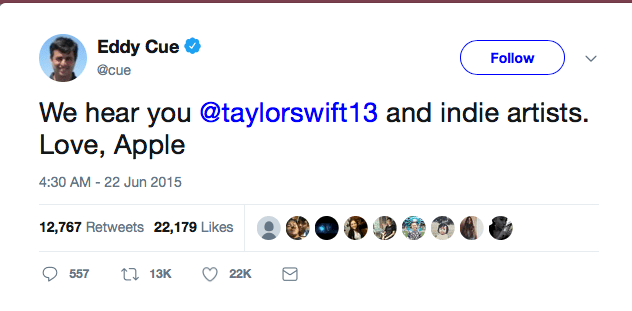
3.  Fairness:  As an old Apple lawyer once said to me, we decide what’s fair and then we jam it down your throat.  Which sounds harsh, but remember that Apple Music’s long-time honcho Eddie Cue made a huge change in Apple Music’s launch strategy because Taylor Swift tweeted that she thought the free period was too long.  One tweet and that was that.

Eddie Cue

Contrast this exchange with billionaire Daniel Ek’s tone deaf mansplaining to the same Taylor Swift over windowing.

4.  Longevity:  In a time of ups and mostly downs in the music industry, Apple isn’t going anywhere.  There’s no fear that key executives are going to pump and dump their Apple stock on a get-rich-quick scheme that benefits everyone except the creators.  So the long term interests are aligned.

5.  Playlists:  You don’t get the impression that Apple is going to use the 21st century algorithmic equivalent of Top 40 to create a version of George Orwell’s versificator that bears about as much resemblance to a Ponzi scheme as it does to a listening experience.  Apple smartly engaged Zane Lowe & Co to keep the human element in a kind of global Radio One.  Artists don’t like to feel that they are simply part of the background music–who can get excited about being on the “Sleep” playlist?  It’s like asking artists if they’d like to sign to Muzak.

I personally find the idea of Apple in the creative side of publishing very attractive because it allows Apple to distinguish itself on values that many creators find compelling:  Transparency, integrity and trustworthiness.

Frankly, we could all do well to promote those values in our business instead of passing laws that try to make the indelible sleaze disappear.

@TXMusicOffice: Music Industry Economic Impact Study Quoted by Sen. @JohnCornyn

The good news is the bad news is wrong.  And someone has the data to prove it.

If you watched Smokey Robinson’s riviting testimony before the U.S. Senate Judiciary Committee this week, you may recall that Senator John Cornyn read some statistics from the Texas Music Office Economic Impact study on the benefits to the State of Texas from the music industry.

This one exchange should give the lie to the usual cant we hear from lobbyists both in and outside the music business that we will never win against the broadcasters on terrestrial royalties because there’s a radio station in every Congressional district.  There’s music industry in every state at least, if not every Congressional district.

The economic impact study concluded:

Combined, music business and music education directly account for over 95,000 permanent jobs, $3.6 billion in annual earnings, and just over $8.5 billion in annual economic activity, up from 92,000 jobs and about $7.5 billion in annual activity during 2015.

  • The ripple effects associated with the direct injection related to music business and music education bring the total impact (including the direct effects) to over 178,000 permanent jobs, $6.5 billion in earnings, and $19.8 billion in annual economic activity. The State of Texas also realizes over $323 million in tax revenue from these impacts.

In addition to the TMO economic impact study, you should also read Titan Music Group’s Austin Music Census that really drills down deep on the local impacts and has become a rally point for Austin musicians.

The Texas Music Office sets the gold standard for providing federal lawmakers with the information they need to defend the music industry as important job creators rather than an afterthought.

Senator Cornyn’s exchange should debunk forever the idea that there’s no support for music industry initiatives outside of New York, Nashville and Los Angeles, so nobody bothers to explain themselves to residents of flyover states.