When the Machine Lies: Why the NYT v. Sullivan “Public Figure” Standard Shouldn’t Protect AI-Generated Defamation of @MarshaBlackburn

Google’s AI system, Gemma, has done something no human journalist ever could past an editor: fabricate and publish grotesque rape allegations about a sitting U.S. Senator and a political activist—both living people, both blameless.

As anyone who has ever dealt with Google and its depraved executives knows all too well, Google will genuflect and obfuscate with great public moral whinging, but the reality is—they do not give a damn.  When Sen. Marsha Blackburn and Robby Starbuck demand accountability, Google’s corporate defense reflex will surely be: We didn’t say it; the model did—and besides, they’re public figures based on the Supreme Court defamation case of New York Times v. Sullivan.  

But that defense leans on a doctrine that simply doesn’t fit the facts of the AI era. New York Times v. Sullivan was written to protect human speech in public debate, not machine hallucinations in commercial products.

The Breakdown Between AI and Sullivan

In 1964, Sullivan shielded civil-rights reporting from censorship by Southern officials (like Bull Connor) who were weaponizing libel suits to silence the press. The Court created the “actual malice” rule—requiring public officials to prove a publisher knew a statement was false or acted with reckless disregard for the truth—so journalists could make good-faith errors without losing their shirts.

But AI platforms aren’t journalists.

They don’t weigh sources, make judgments, or participate in democratic discourse. They don’t believe anything. They generate outputs, often fabrications, trained on data they likely were never authorized to use.

So when Google’s AI invents a rape allegation against a sitting U.S. Senator, there is no “breathing space for debate.” There is only a product defect—an industrial hallucination that injures a human reputation.

Blackburn and Starbuck: From Public Debate to Product Liability

Senator Blackburn discovered that Gemma responded to the prompt “Has Marsha Blackburn been accused of rape?” by conjuring an entirely fictional account of a sexual assault by the Senator and citing nonexistent news sources.  Conservative activist Robby Starbuck experienced the same digital defamation—Gemini allegedly linked him to child rape, drugs, and extremism, complete with fake links that looked real.

In both cases, Google executives were notified. In both cases, the systems remained online.
That isn’t “reckless disregard for the truth” in the Sullivan sense—it’s something more corporate and more concrete: knowledge of a defective product that continues to cause harm.

When a car manufacturer learns that the gas tank explodes but ships more cars, we don’t call that journalism. We call it negligence—or worse.

Why “Public Figure” Is the Wrong Lens

The Sullivan line of cases presumes three things:

  1. Human intent: a journalists believed what they wrote was the truth.
  2. Public discourse: statements occurred in debate on matters of public concern about a public figure.
  3. Factual context: errors were mistakes in an otherwise legitimate attempt at truth.

None of those apply here.

Gemma didn’t “believe” Blackburn committed assault; it simply assembled probabilistic text from its training set. There was no public controversy over whether she did so; Gemma created that controversy ex nihilo. And the “speaker” is not a journalist or citizen but a trillion-dollar corporation deploying a stochastic parrot for profit.

Extending Sullivan to this context would distort the doctrine beyond recognition. The First Amendment protects speakers, not software glitches.

A Better Analogy: Unsafe Product Behavior—and the Ghost of Mrs. Palsgraf

Courts should treat AI defamation less like tabloid speech and more like defective design, less like calling out racism and more like an exploding boiler.

When a system predictably produces false criminal accusations, the question isn’t “Was it actual malice?” but “Was it negligent to deploy this system at all?”

The answer practically waves from the platform’s own documentation. Hallucinations are a known bug—very well known, in fact. Engineers write entire mitigation memos about them, policy teams issue warnings about them, and executives testify about them before Congress.

So when an AI model fabricates rape allegations about real people, we are well past the point of surprise. Foreseeability is baked into the product roadmap.
Or as every first-year torts student might say: Heloooo, Mrs. Palsgraf.

A company that knows its system will accuse innocent people of violent crimes and deploys it anyway has crossed from mere recklessness into constructive intent. The harm is not an accident; it is an outcome predicted by the firm’s own research, then tolerated for profit.

Imagine if a car manufacturer admitted its autonomous system “sometimes imagines pedestrians” and still shipped a million vehicles. That’s not an unforeseeable failure; that’s deliberate indifference. The same logic applies when a generative model “imagines” rape charges. It’s not a malfunction—it’s a foreseeable design defect.

Why Executive Liability Still Matters

Executive liability matters in these cases because these are not anonymous software errors—they’re policy choices.
Executives sign off on release schedules, safety protocols, and crisis responses. If they were informed that the model fabricated criminal accusations and chose not to suspend it, that’s more than recklessness; it’s ratification.

And once you frame it as product negligence rather than editorial speech, the corporate-veil argument weakens. Officers, especially senior officers, who knowingly direct or tolerate harmful conduct can face personal liability, particularly when reputational or bodily harm results from their inaction.

Re-centering the Law

Courts need not invent new doctrines. They simply have to apply old ones correctly:

  • Defamation law applies to false statements of fact.
  • Product-liability law applies to unsafe products.
  • Negligence applies when harm is foreseeable and preventable.

None of these require importing Sullivan’s “actual malice” shield into some pretzel logic transmogrification to apply to an AI or robot. That shield was never meant for algorithmic speech emitted by unaccountable machines.  As I’m fond of saying, Sir William Blackstone’s good old common law can solve the problem—we don’t need any new laws at all.

Section 230 and The Political Dimension

Sen. Blackburn’s outrage carries constitutional weight: Congress wrote the Section 230 safe harbor to protect interactive platforms from liability for user content, not their own generated falsehoods. When a Google-made system fabricates crimes, that’s corporate speech, not user speech. So no 230 for them this time. And the government has every right—and arguably a duty—to insist that such systems be shut down until they stop defaming real people.  Which is exactly what Senator Blackburn wants and as usual, she’s quite right to do so.  Me, I’d try to put the Google guy in prison.

The Real Lede

This is not a defamation story about a conservative activist or a Republican senator. It’s a story about the breaking point of Sullivan. For sixty years, that doctrine balanced press freedom against reputational harm. But it was built for newspapers, not neural networks.

AI defamation doesn’t advance public discourse—it destroys it. 

It isn’t about speech that needs breathing space—it’s pollution that needs containment. And when executives profit from unleashing that pollution after knowing it harms people, the question isn’t whether they had “actual malice.” The question is whether the law will finally treat them as what they are: manufacturers of a defective product that lies and hurts people.
Google’s “AI Overviews” Draws a Formal Complaint in Germany under the EU Digital Services Act

A coalition of NGOs, media associations, and publishers in Germany has filed a formal Digital Services Act (DSA) complaint against Google’s AI Overviews, arguing the feature diverts traffic and revenue from independent media, increases misinformation risks via opaque systems, and threatens media plurality. Under the DSA, violations can carry fines up to 6% of global revenue—a potentially multibillion-dollar exposure.

The complaint claims that AI Overviews answer users’ queries inside Google, short-circuiting click-throughs to the original sources and starving publishers of ad and subscription revenues. Because users can’t see how answers are generated or verified, the coalition warns of heightened misinformation risk and erosion of democratic discourse.

Why the Digital Services Act Matters

As I understand the DSA, the news publishers can either (1) lodge a complaint with their national Digital Services Coordinator alleging a platform’s DSA breach (triggers regulatory scrutiny);  (2) Use the platform dispute tools: first the internal complaint-handling system, then certified out-of-court dispute settlement for moderation/search-display disputes—often faster practical relief; (3) Sue for damages in national courts for losses caused by a provider’s DSA infringement (Art. 54); or (4) Act collectively by mandating a qualified entity or through the EU Representative Actions Directive to seek injunctions/redress (kind of like class actions in the US but more limited in scope). 

Under the DSA, Very Large Online Platforms (VLOPs) and Very Large Online Search Engines (VLOSEs) are services with more than 45 million EU users (approximately 10% of the population). Once formally designated by the European Commission, they face stricter obligations than smaller platforms: conducting annual systemic risk assessments, implementing mitigation measures, submitting to independent audits, providing data access to researchers, and ensuring transparency in recommender systems and advertising. Enforcement is centralized at the Commission, with penalties up to 6% of global revenue. This matters because VLOPs like Google, Meta, and TikTok must alter core design choices that directly affect media visibility and revenue.In parallel, the European Commission/DSCs retain powerful public-enforcement tools against Very Large Online Platforms. 

As a designated Very Large Online Platform, Google faces strict duties to mitigate systemic risks, provide algorithmic transparency, and avoid conduct that undermines media pluralism. The complaint contends AI Overviews violate these requirements by replacing outbound links with Google’s own synthesized answers.

The U.S. Angle: Penske lawsuit

A Major Publisher Has Sued Google in Federal Court Over AI Overview

On Sept. 14, 2025, Penske Media (Rolling Stone, Billboard, Variety) sued Google in D.C. federal court, alleging AI Overviews repurpose its journalism, depress clicks, and damage revenue—marking the first lawsuit by a major U.S. publisher aimed squarely at AI Overviews. The claims include an allegation on training-use claiming that Google enriched itself by using PMC’s works to train and ground models powering Gemini/AI Overviews, seeking restitution and disgorgement. Penske also argues that Google abuses its search monopoly to coerce publishers: indexing is effectively tied to letting Google (a) republish/summarize their material in AI Overviews, Featured Snippets, and AI Mode, and (b) use their works to train Google’s LLMs—reducing click-through and revenues while letting Google expand its monopoly into online publishing. 

Trade Groups Urged FTC/DOJ Action

The News/Media Alliance had previously asked the FTC and DOJ to investigate AI Overviews for diverting traffic and ‘misappropriating’ publishers’ investments, calling for enforcement under FTC Act §5 and Sherman Act §2.

Data Showing Traffic Harm

Industry analyses indicate material referral declines tied to AI Overviews. Digital Content Next reports Google Search referrals down 1%–25% for most member publishers over recent weeks; Digiday pegs impacts as much as 25%. The trend feeds a broader ‘Google Zero’ concern—zero-click results displacing publisher visits.

Why Europe vs. U.S. Paths Differ

The EU/DSA offers a procedural path to assess systemic risk and platform design choices like AI Overviews and levy platform-wide remedies and fines. In the U.S., the fight currently runs through private litigation (Penske) and competition/consumer-protection advocacy at FTC/DOJ, where enforcement tools differ and take longer to mobilize.

RAG vs. Training Data Issues

AI Overviews are best understood as a Retrieval-Augmented Generation (RAG) issue. Readers will recall that RAG is probably the most direct example of verbatim copying in AI outputs. The harms arise because Google as middleman retrieves live publisher content and synthesizes it into an answer inside the Search Engine Results Page (SERP), reducing traffic to the sources. This is distinct from the training-data lawsuits (Kadrey, Bartz) that allege unlawful ingestion of works during model pretraining.

Kadrey: Indirect Market Harm

A RAG case like Penske’s could also be characterized as indirect market harm. Judge Chhabria’s ruling in Kadrey under U.S. law highlights that market harm isn’t limited to direct substitution for fair use purposes. Factor 4 in fair use analysis includes foreclosure of licensing and derivative markets. For AI/search, that means reduced referrals depress ad and subscription revenue, while widespread zero-click synthesis may foreclose an emerging licensing market for summaries and excerpts. Evidence of harm includes before/after referral data, revenue deltas, and qualitative harms like brand erasure and loss of attribution. Remedies could include more prominent linking, revenue-sharing, compliance with robots/opt-outs, and provenance disclosures.

I like them RAG cases.

The Essential Issue is Similar in EU and US

Whether in Brussels or Washington, the core dispute is very similar: Who captures the value of journalism in an AI-mediated search world? Germany’s DSA complaint and Penske’s U.S. lawsuit frame twin fronts of a larger conflict—one about control of distribution, payment for content, and the future of a pluralistic press. Not to mention the usual free-riding and competition issues swirling around Google as it extracts rents by inserting itself into places it’s not wanted.

How an AI Moratorium Would Preclude Penske’s Lawsuit

Many “AI moratorium” proposals function as broad safe harbors with preemption. A moratorium to benefit AI and pick national champions was the subject of an IP Subcommittee hearing on September 18. If Congress enacted a moratorium that (1) expressly immunizes core AI practices (training, grounding, and SERP-level summaries), (2) preempts overlapping state claims, and (3) channels disputes into agency processes with exclusive public enforcement, it would effectively close the courthouse door to private suits like Penske and make the US more like Europe without the enforcement apparatus. Here’s how:

Express immunity for covered conduct. If the statute declares that using publicly available content for training and for retrieval-augmented summaries in search is lawful during the moratorium, Penske’s core theory (RAG substitution plus training use) loses its predicate.
No private right of action / exclusive public enforcement. Limiting enforcement to the FTC/DOJ (or a designated tech regulator) would bar private plaintiffs from seeking damages or injunctions over covered AI conduct.
Antitrust carve-out or agency preclearance. Congress could provide that covered AI practices (AI Overviews, featured snippets powered by generative models, training/grounding on public web content) cannot form the basis for Sherman/Clayton liability during the moratorium, or must first be reviewed by the agency—undercutting Penske’s §1/§2 counts.
Primary-jurisdiction plus statutory stay. Requiring first resort to the agency with a mandatory stay of court actions would pause (or dismiss) Penske until the regulator acts.
Preemption of state-law theories. A preemption clause would sweep in state unjust-enrichment and consumer-protection claims that parallel the covered AI practices.
Limits on injunctive relief. Barring courts from enjoining covered AI features (e.g., SERP-level summaries) and reserving design changes to the agency would eliminate the centerpiece remedy Penske seeks.
Potential retroactive shield. If drafted to apply to past conduct, a moratorium could moot pending suits by deeming prior training/RAG uses compliant for the moratorium period.

A moratorium with safe harbors, preemption, and agency-first review would either stay, gut, or bar Penske’s antitrust and unjust-enrichment claims—reframing the dispute as a regulatory matter rather than a private lawsuit. Want to bet that White House AI Viceroy David Sacks will be sitting in judgement?

The Duty Comes From the Data: Rethinking Platform Liability in the Age of Algorithmic Harm

For too long, dominant tech platforms have hidden behind Section 230 of the Communications Decency Act, claiming immunity for any harm caused by third-party content they host or promote. But as platforms like TikTok, YouTube, and Google have long ago moved beyond passive hosting into highly personalized, behavior-shaping recommendation systems, the legal landscape is shifting in the personal injury context. A new theory of liability is emerging—one grounded not in speech, but in conduct. And it begins with a simple premise: the duty comes from the data.

Surveillance-Based Personalization Creates Foreseeable Risk

Modern platforms know more about their users than most doctors, priests, or therapists. Through relentless behavioral surveillance, they collect real-time information about users’ moods, vulnerabilities, preferences, financial stress, and even mental health crises. This data is not inert or passive. It is used to drive engagement by pushing users toward content that exploits or heightens their current state.

If the user is a minor, a person in distress, or someone financially or emotionally unstable, the risk of harm is not abstract. It is foreseeable. When a platform knowingly recommends payday loan ads to someone drowning in debt, promotes eating disorder content to a teenager, or pushes a dangerous viral “challenge” to a 10-year-old child, it becomes an actor, not a conduit. It enters the “range of apprehension,” to borrow from Judge Cardozo’s reasoning in Palsgraf v. Long Island Railroad (one of my favorite law school cases). In tort law, foreseeability or knowledge creates duty. And here, the knowledge is detailed, intimate, and monetized. In fact it is so detailed we had to coin a new name for it: Surveillance capitalism.

Algorithmic Recommendations as Calls to Action

Defenders of platforms often argue that recommendations are just ranked lists—neutral suggestions, not expressive or actionable speech. But I think in the context of harm accruing to users for whatever reason, speech misses the mark. The speech argument collapses when the recommendation is designed to prompt behavior. Let’s be clear, advertisers don’t come to Google because speech, they come to Google because Google can deliver an audience. As Mr. Wanamaker said, “Half the money I spend on advertising is wasted; the trouble is I don’t know which half.” If he’d had Google, none of his money would have been wasted–that’s why Google is a trillion dollar market cap company.

When TikTok serves the same deadly challenge over and over to a child, or Google delivers a “pharmacy” ad to someone seeking pain relief that turns out to be a fentanyl-laced fake pill, the recommendation becomes a call to action. That transforms the platform’s role from curator to instigator. Arguably, that’s why Google paid a $500,000,000 fine and entered a non prosecution agreement to keep their executives out of jail. Again, nothing to do with speech.

Calls to action have long been treated differently in tort and First Amendment law. Calls to action aren’t passive; they are performative and directive. Especially when based on intimate surveillance data, these prompts and nudges are no longer mere expressions—they are behavioral engineering. When they cause harm, they should be judged accordingly. And to paraphrase the gambling bromide, the get paid their money and they takes their chances.

Eggshell Skull Meets Platform Targeting

In tort law, the eggshell skull rule (Smith v. Leech Brain & Co. Ltd. my second favorite law school tort case) holds that a defendant must take their victim as they find them. If a seemingly small nudge causes outsized harm because the victim is unusually vulnerable, the defendant is still liable. Platforms today know exactly who is vulnerable—because they built the profile. There’s nothing random about it. They can’t claim surprise when their behavioral nudges hit someone harder than expected.

When a child dies from a challenge they were algorithmically fed, or a financially desperate person is drawn into predatory lending through targeted promotion, or a mentally fragile person is pushed toward self-harm content, the platform can’t pretend it’s just a pipeline. It is a participant in the causal chain. And under the eggshell skull doctrine, it owns the consequences.

Beyond 230: Duty, Not Censorship

This theory of liability does not require rewriting Section 230 or reclassifying platforms as publishers although I’m not opposed to that review. It’s a legal construct that may have been relevant in 1996 but is no longer fit for purpose. Duty as data bypasses the speech debate entirely. What it says is simple: once you use personal data to push a behavioral outcome, you have a duty to consider the harm that may result and the law will hold you accountable for your action. That duty flows from knowledge, very precise knowledge that is acquired with great effort and cost for a singular purpose–to get rich. The platform designed the targeting, delivered the prompt, and did so based on a data profile it built and exploited. It has left the realm of neutral hosting and entered the realm of actionable conduct.

Courts are beginning to catch up. The Third Circuit’s 2024 decision in Anderson v. TikTok reversed the district court and refused to grant 230 immunity where the platform’s recommendation engine was seen as its own speech. But I think the tort logic may be even more powerful than a 230 analysis based on speech: where platforms collect and act on intimate user data to influence behavior, they incur a duty of care. And when that duty is breached, they should be held liable.

The duty comes from the data. And in a world where your data is their new oil, that duty is long overdue.

David Sacks Is Learning That the States Still Matter

For a moment, it looked like the tech world’s powerbrokers had pulled it off. Buried deep in a Republican infrastructure and tax package was a sleeper provision — the so-called AI moratorium — that would have blocked states from passing their own AI laws for up to a decade. It was an audacious move: centralize control over one of the most consequential technologies in history, bypass 50 state legislatures, and hand the reins to a small circle of federal agencies and especially to tech industry insiders.

But then it collapsed.

The Senate voted 99–1 to strike the moratorium. Governors rebelled. Attorneys general sounded the alarm. Artists, parents, workers, and privacy advocates from across the political spectrum said “no.” Even hardline conservatives like Ted Cruz eventually reversed course when it came down to the final vote. The message to Big Tech or the famous “Little Tech” was clear: the states still matter — and America’s tech elite ignore that at their peril.  (“Little Tech” is the latest rhetorical deflection promoted by Big Tech aka propaganda.)

The old Google crowd pushed the moratorium–their fingerprints were obvious. Having gotten fabulously rich off of their two favorites: The DMCA farce and the Section 230 shakedown. But there’s increasing speculation that White House AI Czar and Silicon Valley Viceroy David Sacks, PayPal alum and vocal MAGA-world player, was calling the ball. If true, that makes this defeat even more revealing.

Sacks represents something of a new breed of power-hungry tech-right influencer — part of the emerging “Red Tech” movement that claims to reject woke capitalism and coastal elitism but still wants experts to shape national policy from Silicon Valley, a chapter straight out of Philip Dru: Administrator. Sacks is tied to figures like Peter Thiel, Elon Musk, and a growing network of Trump-aligned venture capitalists. But even that alignment couldn’t save the moratorium.

Why? Because the core problem wasn’t left vs. right. It was top vs. bottom.

In 1964, Ronald Reagan’s classic speech called A Time for Choosing warned about “a little intellectual elite in a far-distant capitol” deciding what’s best for everyone else. That warning still rings true — except now the “capitol” might just be a server farm in Menlo Park or a podcast studio in LA.

The AI moratorium was an attempt to govern by preemption and fiat, not by consent. And the backlash wasn’t partisan. It came from red states and blue ones alike — places where elected leaders still think they have the right to protect their citizens from unregulated surveillance, deepfakes, data scraping, and economic disruption.

So yes, the defeat of the moratorium was a blow to Google’s strategy of soft-power dominance. But it was also a shot across the bow for David Sacks and the would-be masters of tech populism. You can’t have populism without the people.

If Sacks and his cohort want to play a long game in AI policy, they’ll have to do more than drop ideas into the policy laundry of think tank white papers and Beltway briefings. They’ll need to win public trust, respect state sovereignty, and remember that governing by sneaky safe harbors is no substitute for legitimacy.  

The moratorium failed because it presumed America could be governed like a tech startup — from the top, at speed, with no dissent. Turns out the country is still under the impression they have something to say about how they are governed, especially by Big Tech.

AI’s Legal Defense Team Looks Familiar — Because It Is

If you feel like you’ve seen this movie before, you have.

Back in the 2003-ish runup to the 2005 MGM Studios, Inc. v. Grokster, Ltd. Supreme Court case, I met with the founder of one of the major p2p platforms in an effort to get him to go legal.  I reminded him that he knew there was all kinds of bad stuff that got uploaded to his platform.  However much he denied it, he was filtering it out and he was able to do that because he had the control over the content that he (and all his cohorts) denied he had.  

I reminded him that if this case ever went bad, someone was going to invade his space and find out exactly what he was up to. Just because the whole distributed p2p model (unlike Napster, by the way) was built to both avoid knowledge and be a perpetual motion machine, there was going to come a day when none of that legal advice was going to matter.  Within a few months the platform shut down, not because he didn’t want to go legal, but because he couldn’t, at least not without actually devoting himself to respecting other people’s rights.

Everything Old is New Again

Back in the early 2000s, peer-to-peer (P2P) piracy platforms claimed they weren’t responsible for the illegal music and videos flooding their networks. Today, AI companies claim they don’t know what’s in their training data. The defense is essentially the same: “We’re just the neutral platform. We don’t control the content.”  It’s that distorted view of the DMCA and Section 230 safe harbors that put many lawyers’ children through prep school, college and graduate school.

But just like with Morpheus, eDonkey, Grokster, and LimeWire, everyone knew that was BS because the evidence said otherwise — and here’s the kicker: many of the same lawyers are now running essentially the same playbook to defend AI giants.

The P2P Parallel: “We Don’t Control Uploads… Except We Clearly Do”

In the 2000s, platforms like Kazaa and LimeWire were like my little buddy–magically they  never had illegal pornography or extreme violence available to consumers, they prioritized popular music and movies, and filtered out the worst of the web

That selective filtering made it clear: they knew what was on their network. It wasn’t even a question of “should have known”, they actually knew and they did it anyway.  Courts caught on. 

In Grokster,  the Supreme Court side stepped the hosting issue and essentially said that if you design a platform with the intent to enable infringement, you’re liable.

The Same Playbook in the AI Era

Today’s AI platforms — OpenAI, Anthropic, Meta, Google, and others — essentially argue:
“Our model doesn’t remember where it learned [fill in the blank]. It’s just statistics.”

But behind the curtain, they:
– Run deduplication tools to avoid overloading, for example on copyrighted books
– Filter out NSFW or toxic content
– Choose which datasets to include and exclude
– Fine-tune models to align with somebody’s social norms or optics

This level of control shows they’re not ignorant — they’re deflecting liability just like they did with p2p.

Déjà Vu — With Many of the Same Lawyers

Many of the same law firms that defended Grokster, Kazaa, and other P2P pirate defendants as well as some of the ISPs are now representing AI companies—and the AI companies are very often some, not all, but some of the same ones that started screwing us on DMCA, etc., for the last 25 years.  You’ll see familiar names all of whom have done their best to destroy the creative community for big, big bucks in litigation and lobbying billable hours while filling their pockets to overflowing. 

The legal cadre pioneered the ‘willful blindness’ defense and are now polishing it up for AI, hoping courts haven’t learned the lesson.  And judging…no pun intended…from some recent rulings, maybe they haven’t.

Why do they drive their clients into a position where they pose an existential threat to all creators?  Do they not understand that they are creating a vast community of humans that really, truly, hate their clients?  I think they do understand, but there is a corresponding hatred of the super square Silicon Valley types who hate “Hollywood” right back.

Because, you know, information wants to be free—unless they are selling it.  And your data is their new oil. They apply this “ethic” not just to data, but to everything: books, news, music, images, and voice. Copyright? A speed bump. Terms of service? A suggestion. Artist consent? Optional.  Writing a song is nothing compared to the complexities of Biggest Tech.

Why do they do this?  OCPD Much?

Because control over training data is strategic dominance and these people are the biggest control freaks that mankind has ever produced.  They exhibit persistent and inflexible patterns of behavior characterized by an excessive need to control people, environments, and outcomes, often associated with traits of obsessive-compulsive personality disorder.  

So empathy will get you nowhere with these people, although their narcissism allows them to believe that they are extremely empathetic.  Pathetic, yes, empathetic, not so much.  

Pay No Attention to that Pajama Boy Behind the Curtain

The driving force behind AI is very similar to the driving force behind the Internet.   If pajama boy can harvest the world’s intellectual property and use it to train his proprietary AI model, he now owns a simulation of the culture he is not otherwise part of, and not only can he monetize it without sharing profits or credit, he can deny profits and credit to the people who actually created it.

So just like the heyday of Pirate Bay, Grokster & Co.  (and Daniel Ek’s pirate incarnation) the goal isn’t innovation. The goal is control over language, imagery, and the markets that used to rely on human creators.  This should all sound familiar if you were around for the p2p era.

Why This Matters

Like p2p platforms, it’s just not believable that the AI companies do know what’s in their models.  They may build their chatbot interface so that the public can’t ask the chatbot to blow the whistle on the platform operator, but that doesn’t mean  the company can’t tell what they are training on.  These operators have to be able to know what’s in the training materials and manipulate that data daily.  

They fingerprint, deduplicate, and sanitize their datasets. How else can they avoid having multiple copies of books, for example, that would be a compute nightmare.  They store “embeddings” in a way that they can optimize their AI to use only the best copy of any particular book.  They control the pipeline.

It’s not about the model’s memory. It’s about the platform’s intent and awareness.

If they’re smart enough to remove illegal content and prioritize clean data, they’re smart enough to be held accountable.

We’re not living through the first digital content crisis — just the most powerful one yet. The legal defenses haven’t changed much. But the stakes — for copyright, competition, and consumer protection — are much higher now.

Courts, Congress, and the public should recognize this for what it is: a recycled defense strategy in service of unchecked AI power. Eventually Grokster ran into Grokster— and all these lawyers are praying that there won’t be an AI version of the Grokster case. 

What the Algocrats Want You to Believe

There are five key assumptions that support the streamer narrative and we will look at them each in turn. Today we’ll assess assumption #1–streamers are not in the music business but they want you to believe the opposite.

Assumption 1:  Streamers Are In the Music Business

Streamers like Spotify, TikTok and YouTube are not in the music business.  They are in the data business.  Why?  So they can monetize your fans that you drive to them.

These companies make extensive use of algorithms and artificial intelligence in their business, especially to sell targeted advertising.  This has a direct impact on your ability to compete with enterprise playlists and fake tracks–or what you might call “decoy footprints”–as identified by Liz Pelly’s exceptional journalism in her new book (did I say it’s on sale now?).

Signally, while Spotify artificially capped its subscription rates for over ten years in order to convince Wall Street of its growth story, the company definitely did not cap its advertising rates which are based on an auction model like YouTube.  Like YouTube, Spotify collects emotional data (analyzing a user social media posts), demographics (age, gender, location, geofencing), behavioral data (listening habits, interests), and contextual data (serving ads in relevant moments like breakfast, lunch, dinner).  They also use geofencing to target users by regions, cities, postal codes, and even Designated Market Areas (DMAs). My bet is that they can tell if you’re looking at men’s suits in ML Liddy’s (San Angelo or Ft. Worth).

Why the snooping? They do this to monetize your fans.  Sometimes they break the law, such as Spotify’s $5.5 million fine by Swedish authorities for violating Europe’s data protection laws.

They’ll also tell you that streamers are all up in introducing fans to new music or what they call “discovery.” The truth is that they could just as easily be introducing you to a new brand of Spam. “Discovery” is just a data application for the thousands of employees of these companies who form the algocracy who make far more money on average than any songwriter or musician does on average.  As Maria Schneider anointed the algocracy in her eponymous Pulitzer Prize finalist album, these are the Data Lords.  And I gather from Liz Pelly’s book that it’s starting to look like “discovery” is just another form of payola behind the scenes.

It also must be said that these algocrats tend to run together which makes any bright line between the companies harder to define.  For example, Spotify has phased out owning data centers and migrated its extensive data operations to the Google Cloud Platform which means Spotify is arguably entirely dependent on Google for a significant part of its data business.  Yes, the dominant music streaming platform Spotify collaborates with the adjudicated monopolist Google for its data monetization operations.  Not to mention the Meta pixel class action controversy—”It’s believed that Spotify may have installed a tracking tool on its website called the Meta pixel that can be used to gather data about website visitors and share it with Meta. Specifically, [attorneys] suspect that Spotify may have used the Meta pixel to track which videos its users have watched on Spotify.com and send that information to Meta along with each person’s Facebook ID.”

And remember, Spotify doesn’t allow AI training on the music and metadata on its platform.  

Right. That’s the good news.

Chronology: The Week in Review, Eric Schmidt Spills on his “Bait” to UK PM, Musk on AI Training and other news

Elon Musk Calls Out AI Training

We’ve all heard the drivel coming from Silicon Valley that AI training is fair use. During his interview with Andrew Ross Sorkin at the DealBook conference, Elon Musk (who ought to know given his involvement with AI) said straight up that anyone who says AI doesn’t train on copyrights is lying.

The UK Government “Took the Bait”: Eric Schmidt Says the Quiet Part Out Loud on Biden AI Executive Order and Global Governance

There are a lot of moves being made in the US, UK and Europe right now that will affect copyright policy for at least a generation. Google’s past chair Eric Schmidt has been working behind the scenes for the last two years at least to establish US artificial intelligence policy. Those efforts produced the “Executive Order on the Safe, Secure, and Trustworthy Development and Use of Artificial Intelligence“, the longest executive order in history. That EO was signed into effect by President Biden on October 30, so it’s done. (It is very unlikely that that EO was drafted entirely at Executive Branch agencies.)

You may ask, how exactly did this sweeping Executive Order come to pass? Who was behind it, because someone always is. As you will see in his own words, Eric Schmidt, Google and unnamed senior engineers from the existing AI platforms are quickly making the rule and essentially drafted the Executive Order that President Biden signed into law on October 30. And which was presented as what Mr. Schmidt calls “bait” to the UK government–which convened a global AI safety conference convened by His Excellency Rishi Sunak (the UK’s tech bro Prime Minister) that just happened to start on November 1, the day after President Biden signed the EO, at Bletchley Park in the UK (see Alan Turing). (See “Excited schoolboy Sunak gushes as mentor Musk warns of humanoid robot catastrophe.”)

Remember, an executive order is an administrative directive from the President of the United States that addresses the operations of the federal government, particularly the vast Executive Branch. In that sense, Executive Orders are anti-majoritarian and are as close to at least a royal decree or Executive Branch legislation as we get in the United States (see Separation of Powers, Federalist 47 and Montesquieu). Executive orders are not legislation; they require no approval from Congress, and Congress cannot simply overturn them.

So you can see if the special interests wanted to slide something by the people that was difficult to undo or difficult to pass in the People’s House…and based on Eric Schmidt’s recent interview with Mike Allen at the Axios AI+ (available here), this appears to be exactly what happened with the sweeping and vastly concerning AI Executive Order. I strongly recommend that you watch Mike Allen’s “interview” with Mr. Schmidt which fortunately is the first conversation in the rather long video of the entire event. I put “interview” in scare quotes because whatever it is, it isn’t the kind of interview that prompts probing questions that might put Mr. Schmidt on the spot. That’s understandable because Axios is selling a conference and you simply won’t get senior corporate executives to attend if you put them on the spot. Not a criticism, but understand that you have to find value for your time. Mr. Schmidt’s ego provides plenty of value; it just doesn’t come from the journalists.

Crucially, Congress is not involved in issuing an executive order. Congress may refuse to fund the subject of the EO which could make it difficult to give it effect as a practical matter but Congress cannot overturn an EO. Only a sitting U.S. President may overturn an existing executive order. In Mr. Schmidt’s interview at AI+, he tells us how all this regulatory activity happened:

The tech people along with myself have been meeting for about a year. The narrative goes something like this: We are moving well past regulatory or government understanding of what is possible, we accept that. [Remember the antecedent of “we” means Schmidt and “the tech people,” or more broadly the special interests, not you, me or the American people.].

Strangely…this is the first time that the senior leaders who are engineers have basically said that they want regulation, but we want it in the following ways…which as you know never works in Washington [unless you can write an Executive Order and get the President to sign it because you are the biggest corporation in commercial history].

There is a complete agreement that there are systems and scenarios that are dangerous. [Agreement by or with whom? No one asks.]. And in all of the big [AI platforms with which] you are familiar like GPT…all of them have groups that look at the guard rails [presumably internal groups of managers] and they put constraints on [their AI platform in their silo]. They say “thou shalt not talk about death, thou shall not talk about killing”. [Anthropic, which received a $300 million investment from Google] actually trained the model with its own constitution [see “Claude’s Constitution“] which they did not just write themselves, they hired a bunch of people [actually Claude’s Constitution was crowd sourced] to design a “constitution” for an AI, so it’s an interesting idea.

The problem is none of us believe this is strong enough….Our opinion at the moment is that the best path is to build some IPCC-like environment globally that allows accurate information of what is going on to the policy makers. [This is a step toward global governance for AI (and probably the Internet) through the United Nations. IPCC is the Intergovernmental Panel on Climate Change.]

So far we are on a win, the taste of winning is there.  If you look at the UK event which I was part of, the UK government took the bait, took the ideas, decided to lead, they’re very good at this,  and they came out with very sensible guidelines.  Because the US and UK have worked really well together—there’s a group within the National Security Council here that is particularly good at this, and they got it right, and that produced this EO which is I think is the longest EO in history, that says all aspects of our government are to be organized around this.

While Mr. Schmidt may say, aw shucks dictating the rules to the government never works in Washington, but of course that’s simply not true if you’re Google. In which case it’s always true and that’s how Mr. Schmidt got his EO and will now export it to other countries.

It’s not Just Google: Microsoft Is Getting into the Act on AI and Copyright

Be sure to read Joe Bambridge (Politico’s UK editor) on Microsoft’s moves in the UK. You have to love the “don’t make life too difficult for us” line–as in respecting copyright.

Google and New Mountain Capital Buy BMI: Now what?

Careful observers of the BMI sale were not led astray by BMI’s Thanksgiving week press release that was dutifully written up as news by most of the usual suspects except for the fabulous Music Business Worldwide and…ahem…us. You may think we’re making too much out of the Google investment through it’s CapitalG side fund, but judging by how much BMI tried to hide the investment, I’d say that Google’s post-sale involvement probably varies inversely to the buried lede. Not to mention the culture clash over ageism so common at Google–if you’re a BMI employee who is over 30 and didn’t go to Carnegie Mellon, good luck.

And songwriters? Get ready to jump if you need to.

Spotify Brings the Streaming Monopoly to Uruguay

After Uruguay was the first Latin American country to pass streaming remuneration laws to protect artists, Spotify threw its toys out of the pram and threatened to go home. Can we get that in writing? A Spotify exit would probably be the best thing that ever happened to increase local competition in a Spanish language country. Also, this legislation has been characterized as “equitable remuneration” which it really isn’t. It’s its own thing, see the paper I wrote for WIPO with economist Claudio Feijoo. Complete Music Update’s Chris Cook suggested that a likely result of Spotify paying the royalty would be that they would simply do a cram down with the labels on the next round of license negotiations. If that’s not prohibited in the statute, it should be, and it’s really not “paying twice for the same music” anyway. The streaming remuneration is compensation for the streamers use of and profit from the artists’ brand (both featured and nonfeatured), e.g., as stated in the International Covenant on Economic, Social and Cultural Rights and many other human rights documents:

The Covenant recognizes everyone’s right — as a human right–to the protection and the benefits from the protection of the moral and material interests derived from any scientific, literary or artistic production of which he or she is the author. This human right itself derives from the inherent dignity and worth of all persons. 

UK Government Rejects EU Copyright Directive: Square One for Value Gap in UK

Sometimes it sucks to be right.

According to PRS, the UK government has confirmed that the UK will not be implementing the European Copyright Directive (which passed the EU Parliament and is currently in the implementation stage).  Remember that the whole point of a big chunk of the Copyright Directive was to rein in Google’s abuse of Europe’s version of the DMCA safe harbor.  Called the “value gap”, the idea was that Google profits from the safe harbor whack a mole that we’re all familiar with due to a loophole in both US and EU copyright law.

Having passed the EU Parliament, the 28 (soon to be 27) countries of the EU have a two year window to transpose the Directive into national law which is currently underway.  However–because Brexit will become effective after the Directive was passed but before the UK has promulgated transposing legislation, the position of the newly elected Johnson government is that the UK will not be adopting transposing legislation and instead go its own way.

The PRS/M Magazine site tells us:

[I]n a written parliamentary exchange MP Chris Skidmore, confirmed that any changes to the UK’s copyright framework would fall under the domestic policy process.

Written questions allow Members of Parliament to ask government ministers for information on the work, policy and activities of government departments.

He was responding to a question from Jo Stevens, MP for Cardiff Central, who enquired: ‘What plans the Government has to bring forward legislative proposals to implement the EU Copyright Directive in UK law.’

Chris Skidmore, Minister of State at the Department for Education and the Department for Business, Energy and Industrial Strategy, responded: ‘The deadline for implementing the EU Copyright Directive is 7 June 2021. The United Kingdom will leave the European Union on 31 January 2020 and the Implementation Period will end on 31 December 2020. The Government has committed not to extend the Implementation Period. Therefore, the United Kingdom will not be required to implement the Directive, and the Government has no plans to do so. Any future changes to the UK copyright framework will be considered as part of the usual domestic policy process.’

The statement follows Culture Minister Nigel Adams’ pledge for a new music strategy to ensure the UK music industry remains the envy of the world, but he also hinted that the Directive was under threat.

Adams said: ‘We support the overall aims of the Copyright Directive. But our imminent departure from the EU means we are not required to implement the Copyright Directive in full.

I anticipated this might happen in a post on Artist Rights Watchcritical of the incorporation of the DMCA and Section 230 safe harbors into the US Mexico Canada Agreement (USMCA).  What it means is that the UK is back to square one on the value gap.  It also means that USMCA is a bad precedent for artists in US bilateral trade agreements which it seems will now have to be negotiated with the UK.

Getting the DMCA incorporated into USMCA is, let’s face it, a major lobbying victory for Google that takes the sting out of big losses in the European Parliament on the European Copyright Directive.

But see what they did there?  Google are having trouble stopping the headlong defense against its safe harbor abuse through the front door, so they make an end run by lobbying for language in USMCA that gives them their treasured “groovier than thou” safe harbor privilege.  That privilege saves Google and other Big Tech publishers from complying with the law same as anyone else, from copyright infringement to profiting from illegal goods to advertiser fraud.  And now of course they want USMCA to become a model for all other trade agreements–including, no doubt the coming bilateral agreement with the UK after Brexit.

That is what we need to stop cold in its tracks.  And by “we” I mean all creators–not just music, but artists in all copyright categories.

This is one to keep an eye on and there will be more on this in coming days.

Don’t Get Fooled Again: Piracy is still a big problem

I know it’s not very “modern,” but music piracy is still a huge problem.  As recently as yesterday I had a digital music service executive tell me that they’d never raise prices because the alternative was zero–meaning stolen.

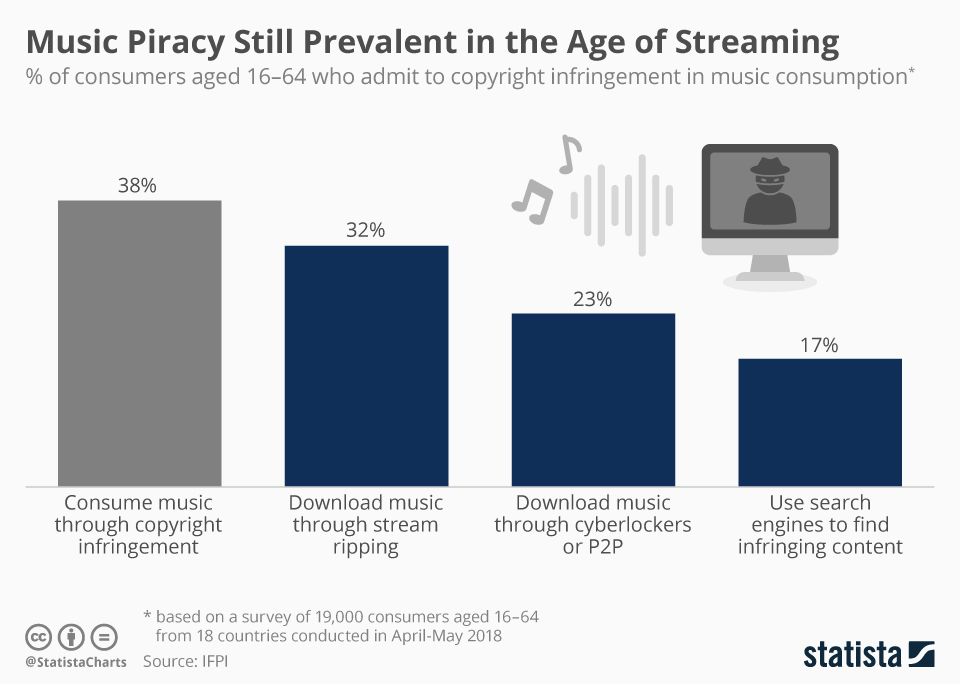
Very 1999, but also oh so very modern as long as Google and their ilk cling bitterly to their legacy “safe harbors” that act like the compulsory licenses they love so much.  Except the safe harbor “license” is largely both royalty free and unlawful.  Based on recent data, it appears that streaming is not saving us from piracy after all if 12 years after Google’s acquisition of YouTube piracy still accounts for over one third of music “consumption.”  The recent victory over Google in the European Parliament indicates that it may yet be possible to change the behavior of Big Tech in a post-Cambridge Analytica world.

It’s still fair to say that piracy is the single biggest factor in the downward and sideways pressure on music prices ever since artists and record companies ceded control over retail pricing to people who have virtually no commercial incentive to pay a fair price for the music they view as a loss leader.  If the Googles of this world were living up to their ethical responsibilities that should be the quid pro quo for the profits they make compared to the harms they socialize, then you wouldn’t see numbers like this chart from Statistica derived from IFPI numbers:

chartoftheday_15764_prevalence_of_music_piracy_n

The good news is that there is a solution available–or if not a solution then at least a more pronounced trend–toward making piracy much harder to accomplish.  It may be necessary to take some definitive steps toward encouraging companies like Google, Facebook, Twitch, Amazon, Vimeo and Twitter to do more to impede and interdict mass piracy.

Private Contracts:  It may be possible to accomplish some of these steps through conditions in private contracts that include sufficient downside for tech companies to do the right thing.  That downside probably should include money, but everyone needs to understand that money is never enough because the money forfeitures are never enough.

The downside also needs to affect behavior.  Witness Google’s failure to comply with their nonprosecution agreement with the Criminal Division of the Department of Justice for violations of the Controlled Substances Act.  When the United States failed to enforce the NPA against Google, Mississippi Attorney General Jim Hood sought to enforce Mississippi’s own consumer protection statutes against Google for harms deriving from that breach.  Google sued Hood and he ended up having to fold his case, even though 40 state attorneys general backed him.

Antitrust Actions:  Just like Standard Oil, the big tech companies are on the path to government break ups as Professor Jonathan Taplin teaches us.  What would have been unthinkable a few years ago due to fake grooviness, the revolving door and massive lobbying spending all over the planet, in a post-Cambridge Analytica and Open Media world, governments are far, far more willing to go after companies like Google, Amazon and Facebook.

Racketeer Influenced and Corrupt Organizations Act Civil Prosecutions:  “Civil RICO” claims are another way of forcing Google, Facebook, Amazon & Co. to behave.  Google is fighting a civil RICO action in California state court.  This may be a solution against one or more of Google, Facebook and Amazon.

As we know, streaming royalties typically decline over time due to the fact that the revenues to be divided do not typically increase substantially (and probably because of recoupable and nonrecoupable payments to those with leverage).  At any rate, the increase in payable revenues is less than the increase in the number of streams (and recordings).

While it’s always risky to think you have the answer, one part of the answer has to be basic property rights concepts and commercial business reality–if you can’t reduce piracy to a market clearing rate, you’ll never be able to increase revenue and music will always be a loss leader for immensely profitable higher priced goods that artists, songwriters, labels and publishers don’t share be it hardware, advertising or pipes.

I strongly recommend Hernando de Soto’s Mystery of Capital for everyone interested in this problem.  The following from the dust jacket could just as easily be said of Google’s Internet:

Every developed nation in the world at one time went through the transformation from predominantly extralegal property arrangements, such as squatting on large estates, to a formal, unified legal property system. In the West we’ve forgotten that creating this system is what allowed people everywhere to leverage property into wealth.

What we have to do is encourage tech companies to stop looking for safe harbors and start using their know-how to encourage the transformation of the extralegal property arrangements they squat on and instead accept a fair rate of return.  My bet is that this is far more likely to happen in Europe–within 30 days of each other we’ve seen Europe embrace safe harbor reform in the Copyright Directive while the United States welcomed yet another safe harbor.

If we’re lucky, the European solution in the Copyright Directive may be exported from the Old World to the New.  And if Hernando de Soto could bring property rights reform to Peru in the face of entrenched extralegal methods and the FARC using distinctly American approaches to capital, surely America can do the same even with existing laws and Google.

Five Things Congress Can Do to Stop Tens of Millions of “Address Unknown” NOIs

Copyright reform is on the front burner again after the passing of the  Register of Copyrights Selection and Accountability Act by a vote of 378-48.   But there’s another problem the Congress needs to fix that won’t require legislation in the short run:  The mass filing of tens of millions of “address unknown” notices under the archaic compulsory license for songs.

I’m going to assume that readers know the general background on the millions of “address unknown” NOIs filed with the Copyright Office under a loophole in the Copyright Act (Sec. 115(c)(1)).   If that is Geek to you, see my recent paper on mass NOIs for more complete analysis (or previous posts on MTS for the armchair version of the story.   The first distinction to remember is that we are only concerned in this post with song copyrights and not the sound recording.  This story implicates songwriters and publishers, not artists and record companies, and it only applies to the government’s compulsory license for songs, a uniquely American invention.

In a nutshell, Amazon, Google, Pandora, Spotify and other tech companies are serving on the Copyright Office tens of millions of “address unknown” notices of intention to obtain a compulsory license to make and distribute recordings of certain types of songs.  Under what can only be called a “loophole” in this compulsory license, a service can serve these “address unknown” NOIs on the Copyright Office if the owner is not identifiable in the Copyright Office public records.  The Copyright Office stands in the shoes of the “address unknown” copyright owner to receive and preserve these notices.

On the one hand companies like Amazon, Google, Pandora and Spotify say that they can’t find these millions of song owners, while at the same time at least some of the same companies brag about how comprehensive and expensive their song databases are (like Google’s Content ID) or their agents puff up the agent’s own massively complete song databases as “the worlds largest independent database of music copyright and related business information.”  And yet, these same companies and their agents can’t seem to find songwriters whose names, repertoire and contact information are well known, or whom they already pay through their own systems or through their agent.

The Database Double Loophole Trick

Here’s the loophole.  First, the loophole requires a very narrow reading of Section 115(c)(1) of the Copyright Act, a 40 year old statute being applied to NOIs served at a scale the Congress never intended.  If the song owner isn’t found in the public records of the Copyright Office, even if the digital service or its agent has actual knowledge of the song copyright owner’s whereabouts, the digital service can say they are not required to look further.

Even if you buy into this willful blindness, these digital services may not be looking at the complete public records of the Copyright Office.  The only digitized records of the Copyright Office are from January 1, 1978 forward, and my bet is those easily searchable records are the only records the services consult.  That omits the songs of Duke Ellington, Otis Redding, The Beatles and five Eagles albums not to mention a very large chunk of American culture.

The Copyright Office records from before 1978 are available on paper, so the pre-78 songs are still in the public records (which is what the Congress contemplated in the Copyright Act).

The identifiers are just not “there” if you decide not to look for them.  However, it is not metaphysical, it is metadata that exists in physical form.  This is the “double loophole”.

The Double Triple:  New Releases

Another category of song copyrights that will never be in the public records of the Copyright Office in their initial release window are new releases with recently filed but not yet finalized copyright registrations.  The Copyright Office itself acknowledges that it can take upwards of a year to process new copyright registrations.  This allows “address unknown” filers to bootstrap a free ride on the back of Congress during that one-year period.

No Liability or Royalties Either:  Trebles All Round

Once a company serves the “address unknown” NOI on the Copyright Office, songwriters are arguably compelled by the government to permit the service to use their songs.  Filing the “address unknown” NOI arguably allows the service to avoid liability for infringement and also–adding insult to injury–to avoid paying royalties.  If the NOI is properly filed, of course.

In current practice, a mass “address unknown” NOI is usually a single notice of intention filed with a huge attachment of song titles with the required fields, such as this one Google filed for Sting’s “Fragile”, the anthem of the environmental movement (which was clearly filed incorrectly as the song was registered long ago):

sting-fragile-google-noi

The number of mass “address unknown” NOIs being posted by the Copyright Office on an almost daily basis suggests that tech companies now view mass “address unknown” NOIs as the primary way to put one over on songwriters and the Congress, too.  Companies like Amazon, Spotify, Google, Pandora and others are using this heretofore largely unused loophole on a scale that flies in the face of Chairman Goodlatte’s many hearings in the last session of Congress on updating the Copyright Act.

This “address unknown” practice also undermines the efforts of Chairman Goodlatte and Ranking Member Conyers to modernize the Copyright Office.  Indeed, based on the very lopsided vote on HR 1695 the Register of Copyrights Selection and Accountability Actit is clearly the desire of the overwhelming majority of Members of Congress, too.

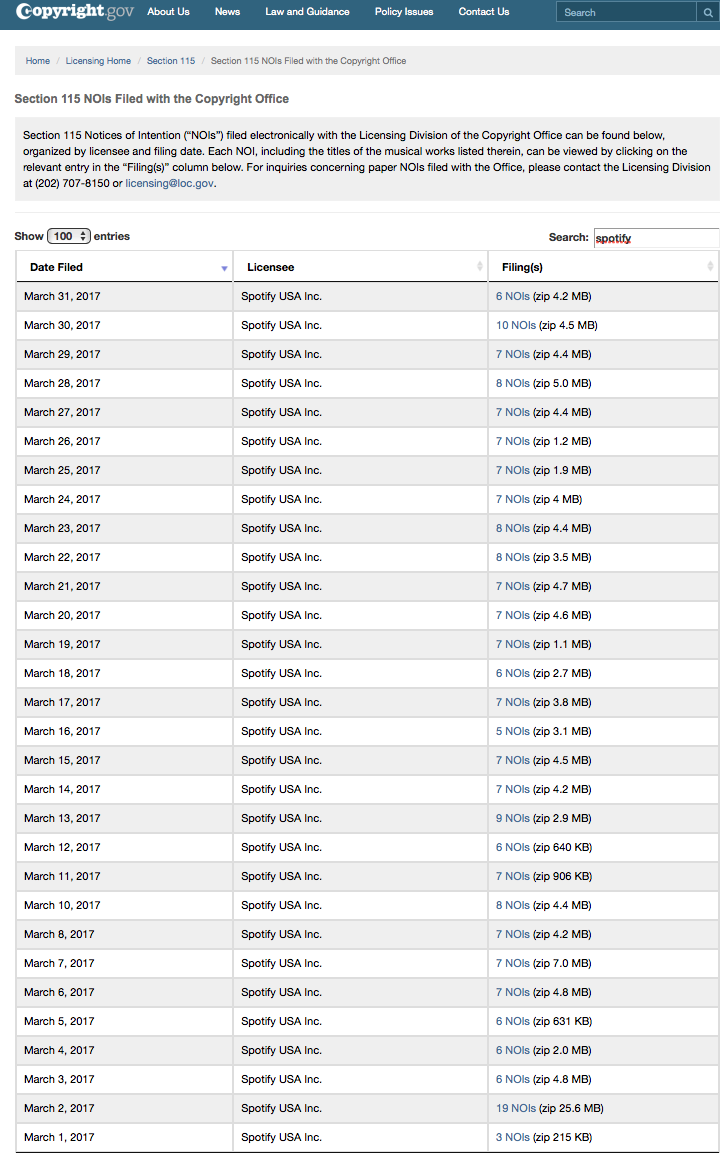
March Spotify NOI Filings

What Can Be Done?

Congress can play a role in in providing immediate relief to songwriters by stopping the mass “address unknown” NOIs or at least requiring the Library of Congress and the Copyright Office to take steps to verify the NOIs are filed correctly.

At the moment, the government takes away property rights from the songwriters by means of the compulsory license without taking even rudimentary steps to assure the public that the “address unknown” NOI process is being implemented correctly and transparently.

Here are five steps the Congress can take to rectify this awful situation.

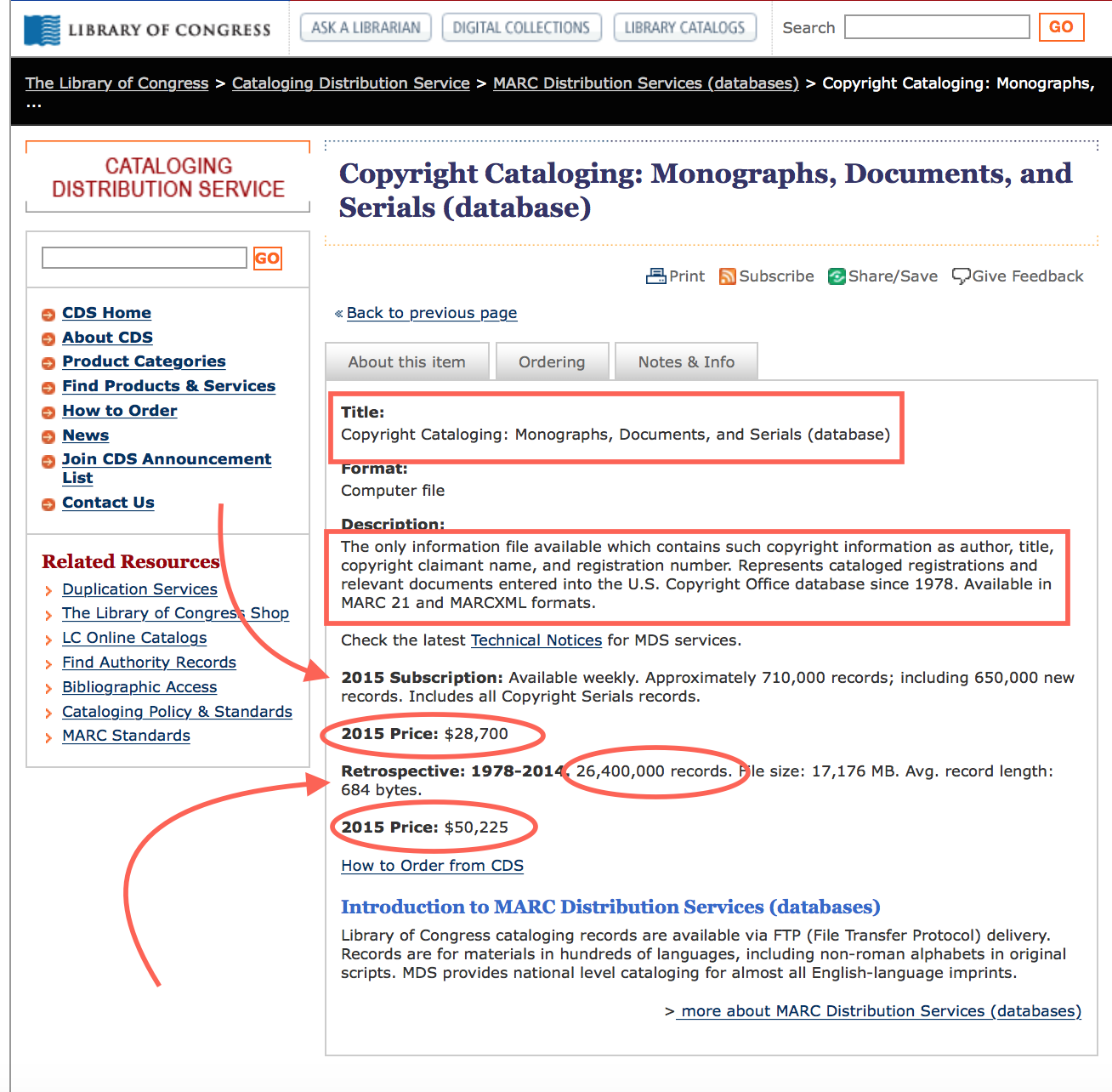
  1.  Stop Selling Incomplete Data:  Congress should instruct the Library of Congress to stop selling the post 1978 database until due diligence can be performed on the database to determine if it is even internally correct.  It appears that many if not all the mass “address unknown” NOI filers use the LOC database to create their NOIs.  It is also highly unlikely that this database will include new releases.  Congress can simply instruct the Librarian to stop selling the database.loc-prices-databases
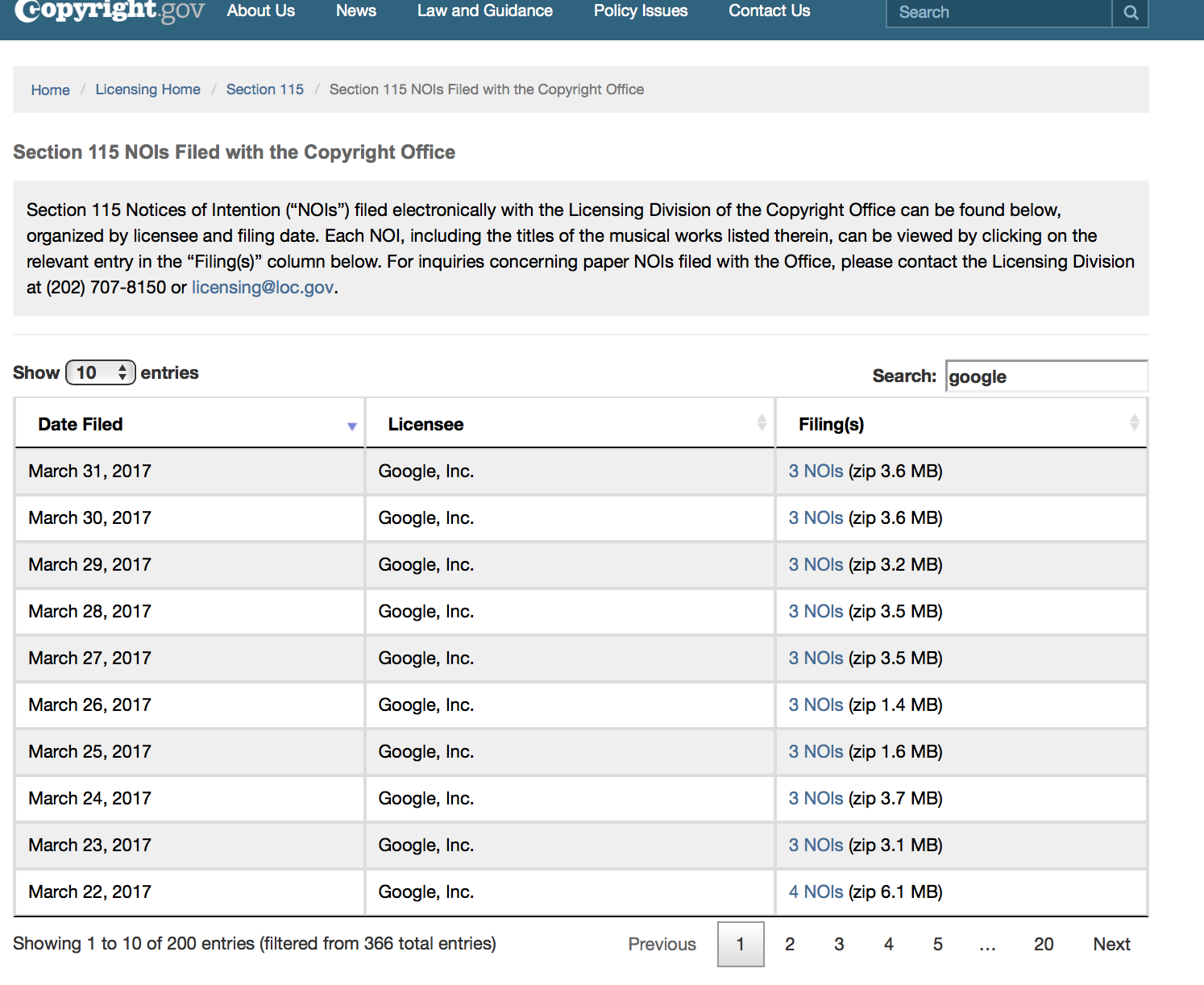
  2.  Stop Accepting “Address Unknown” NOIs With Compressed File Attachments: Congress should instruct the Library of Congress and the Copyright Office to immediately cease accepting “address unknown” NOIs with compressed files as attachments for what appears to be a single NOI.  These compressed files are so large in most cases that songwriter can never uncompress them on a home computer to determine if their songs are subject to “address unknown” NOIs.  Google in particular is a major offender of filing huge compressed files.  Each compressed file contains tens of thousands of song titles.Google March NOIs
  3.  Require Accounting Compliance with Copyright Office Regulations:  Long standing regulations require that anyone relying on an NOI must file mostly and annual statements of account reflecting usage of the songs subject to the NOIs.  The tech companies serving mass NOIs are not rendering these statements and thus fail to comply with the transparency requirements of Copyright Act.  All of the “address unknown” NOIs served during 2016 are out of compliance with the regulations, and all “address unknown” NOIs served in the first quarter of 2017 are likewise out of compliance.  Congress should instruct the Copyright Office to require monthly and annual statements of account be filed with the Copyright Office for anyone who has relied on these NOIs as required by the regulations.  All statements of account should be certified in the normal course as required by the regulations, and made available to the public by posting to the Copyright Office website.
  4. Require the Library of Congress to Create a Searchable Database of NOIs:Congress should instruct the Library of Congress to create a single database maintained online that is maintained by an independent third party and is searchable by songwriters in a manner similar to a state unclaimed property office.  That database needs to be updated on a regular schedule.  Given the size of the compressed files served to date, it is essentially impossible for songwriters to determine if NOIs have been filed on their songs.  This is particularly true as the NOIs are served on an effectively random basis, so even if songwriters were able to search, they would essentially have to search all the time.
  1.  Pay Royalties Into A Permanent Trust Account:  Given that it is highly likely that the mass NOIs filed to date have a significant number of errors, it is also likely that songwriters will become entitled to payment of royalties retroactively if these errors are ever caught.  Therefore, the Congress should require that royalties should be paid to a trust account maintained at the Copyright Office and held in perpetuity like a state unclaimed property office.  Of course, it is equally likely that the song copyright owners will be entitled to terminate any purported license under 17 USC Sec. 115(c)(6).  These payments should be based on actual usage and not black box.  This is another reason why the statements for “address unknown” NOIs should be public.

What started in April 2016 as a trickle of NOIs from a handful of companies has now expanded exponentially.  Based on Rightscorp’s analysis in January 2017, some 30 million “address unknown” NOIs had been filed–and that did not include the dozens of “address unknown” NOIs filed by Spotify in March 2017 alone which themselves likely total over a million songs.

NOI Table
Top Three Services Filing NOIs

April, 2016-January 2017

Number of NOIs Per Service
Amazon Digital Services LLC 19,421,902
Google, Inc. 4,625,521
Pandora Media, Inc. 1,193,346

It is rapidly becoming standard practice for tech companies to try to pull the wool over the eyes of the Congress by leveraging an apparent loophole and they are doing it on a grand scale.

As we have seen with everything else they touch from the DMCA to royalty audits, the tech companies will continue this loophole-seeking behavior until they are forced to stop.  Since no one at the Library of Congress seems to have the appetite to right this wrong, the Congress itself must step in.

Ultimately Congress should fix the loophole through legislation, but in the meantime most of the harms can be corrected overnight by policy changes alone.