Less Than Zero: The Significance of the Per Stream Rate and Why It Matters

Spotify’s insistence that it’s “misleading” to compare services based on a derived per-stream rate reveals exactly how out of touch the company has become with the very artists whose labor fuels its stock price. Artists experience streaming one play at a time, not as an abstract revenue pool or a complex pro-rata formula. Each stream represents a listener’s decision, a moment of engagement, and a microtransaction of trust. Dismissing the per-stream metric as irrelevant is a rhetorical dodge that shields Spotify from accountability for its own value proposition. (The same applies to all streamers, but Spotify is the only one that denies the reality of the per-stream rate.)

Spotify further claims that users don’t pay per stream but for access as if that negates the artist’s per stream rate payments. It is fallacious to claim that because Spotify users pay a subscription fee for “access,” there is no connection between that payment and any one artist they stream. This argument treats music like a public utility rather than a marketplace of individual works. In reality, users subscribe because of the artists and songs they want to hear; the value of “access” is wholly derived from those choices and the fans that artists drive to the platform. Each stream represents a conscious act of consumption and engagement that justifies compensation.

Economically, the subscription fee is not paid into a vacuum — it forms a revenue pool that Spotify divides among rights holders according to streams. Thus, the distribution of user payments is directly tied to which artists are streamed, even if the payment mechanism is indirect. To say otherwise erases the causal relationship between fan behavior and artist earnings.

The “access” framing serves only to obscure accountability. It allows Spotify to argue that artists are incidental to its product when, in truth, they are the product. Without individual songs, there is nothing to access. The subscription model may bundle listening into a single fee, but it does not sever the fundamental link between listener choice and the artist’s right to be paid fairly for that choice.

Less Than Zero Effect: AI, Infinite Supply and Erasing Artist

In fact, this “access” argument may undermine Spotify’s point entirely. If subscribers pay for access, not individual plays, then there’s an even greater obligation to ensure that subscription revenue is distributed fairly across the artists who generate the listening engagement that keeps fans paying each month. The opacity of this system—where listeners have no idea how their money is allocated—protects Spotify, not artists. If fans understood how little of their monthly fee reached the musicians they actually listen to, they might demand a user-centric payout model or direct licensing alternatives. Or they might be more inclined to use a site like Bandcamp. And Spotify really doesn’t want that.

And to anticipate Spotify’s typical deflection—that low payments are the label’s fault—that’s not correct either. Spotify sets the revenue pool, defines the accounting model, and negotiates the rates. Labels may divide the scraps, but it’s Spotify that decides how small the pie is in the first place either through its distribution deals or exercising pricing power.

Three Proofs of Intention

Daniel Ek, the Spotify CEO and arms dealer, made a Dickensian statement that tells you everything you need to know about how Spotify perceives their role as the Streaming Scrooge—“Today, with the cost of creating content being close to zero, people can share an incredible amount of content”.

That statement perfectly illustrates how detached he has become from the lived reality of the people who actually make the music that powers his platform’s market capitalization (which allows him to invest in autonomous weapons). First, music is not generic “content.” It is art, labor, and identity. Reducing it to “content” flattens the creative act into background noise for an algorithmic feed. That’s not rhetoric; it’s a statement of his values. Of course in his defense, “near zero cost” to a billionaire like Ek is not the same as “near zero cost” to any artist. This disharmonious statement shows that Daniel Ek mistakes the harmony of the people for the noise of the marketplace—arming algorithms instead of artists.

Second, the notion that the cost of creating recordings is “close to zero” is absurd. Real artists pay for instruments, studios, producers, engineers, session musicians, mixing, mastering, artwork, promotion, and often the cost of simply surviving long enough to make the next record or write the next song. Even the so-called “bedroom producer” incurs real expenses—gear, software, electricity, distribution, and years of unpaid labor learning the craft. None of that is zero. As I said in the UK Parliament’s Inquiry into the Economics of Streaming, when the day comes that a soloist aspires to having their music included on a Spotify “sleep” playlist, there’s something really wrong here.

Ek’s comment reveals the Silicon Valley mindset that art is a frictionless input for data platforms, not an enterprise of human skill, sacrifice, and emotion. When the CEO of the world’s dominant streaming company trivializes the cost of creation, he’s not describing an economy—he’s erasing one.

While Spotify tries to distract from the “per-stream rate,” it conveniently ignores the reality that whatever it pays “the music industry” or “rights holders” for all the artists signed to one label still must be broken down into actual payments to the individual artists and songwriters who created the work. Labels divide their share among recording artists; publishers do the same for composers and lyricists. If Spotify refuses to engage on per-stream value, what it’s really saying is that it doesn’t want to address the people behind the music—the very creators whose livelihoods depend on those streams. In pretending the per-stream question doesn’t matter, Spotify admits the artist doesn’t matter either.

Less Than Zero or Zeroing Out: Where Do We Go from Here?

The collapse of artist revenue and the rise of AI aren’t coincidences; they’re two gears in the same machine. Streaming’s economics rewards infinite supply at near-zero unit cost which is really the nugget of truth in Daniel Ek’s statements. This is evidenced by Spotify’s dalliances with Epidemic Sound and the like. But—human-created music is finite and costly; AI music is effectively infinite and cheap. For a platform whose margins improve as payout obligations shrink, the logical endgame is obvious: keep the streams, remove the artists.

  • Two-sided market math. Platforms sell audience attention to advertisers and access to subscribers. Their largest variable cost is royalties. Every substitution of human tracks with synthetic “sound-alikes,” noise, functional audio, or AI mashup reduces royalty liability while keeping listening hours—and revenue—intact. You count the AI streams just long enough to reduce the royalty pool, then you remove them from the system, only to be replace by more AI tracks. Spotify’s security is just good enough to miss the AI tracks for at least one royalty accounting period.
  • Perpetual content glut as cover. Executives say creation costs are “near zero,” justifying lower per-stream value. That narrative licenses a race to the bottom, then invites AI to flood the catalog so the floor can fall further.
  • Training to replace, not to pay. Models ingest human catalogs to learn style and voice, then output “good enough” music that competes with the very works that trained them—without the messy line item called “artist compensation.”
  • Playlist gatekeeping. When discovery is centralized in editorial and algorithmic playlists, platforms can steer demand toward low-or-no-royalty inventory (functional audio, public-domain, in-house/commissioned AI), starving human repertoire while claiming neutrality.
  • Investor alignment. The story that scales is not “fair pay”; it’s “gross margin expansion.” AI is the lever that turns culture into a fixed cost and artists into externalities.

Where does that leave us? Both streaming and AI “work” best for Big Tech, financially, when the artist is cheap enough to ignore or easy enough to replace. AI doesn’t disrupt that model; it completes it. It also gives cover through a tortured misreading through the “national security” lens so natural for a Lord of War investor like Mr. Ek who will no doubt give fellow Swede and one of the great Lords of War, Alfred Nobel, a run for his money. (Perhaps Mr. Ek will reimagine the Peace Prize.) If we don’t hard-wire licensing, provenance, and payout floors, the platform’s optimal future is music without musicians.

Plato conceived justice as each part performing its proper function in harmony with the whole—a balance of reason, spirit, and appetite within the individual and of classes within the city. Applied to AI synthetic works like those generated by Sora 2, injustice arises when this order collapses: when technology imitates creation without acknowledging the creators whose intellect and labor made it possible. Such systems allow the “appetitive” side—profit and scale—to dominate reason and virtue. In Plato’s terms, an AI trained on human art yet denying its debt to artists enacts the very disorder that defines injustice.

TikTok After Xi’s Qiushi Article: Why China’s Security Laws Are the Whole Ballgame

Xi Jinping’s new article in Qiushi (the Chinese Communist Party Central Committee’s flagship theoretical public policy journal) repackages a familiar message: China will promote the “healthy and high-quality development” of the private economy, but under the leadership of the Chinese Communist Party. This is expressed in China’s statutory law as the “Private Economy Promotion Law.”  And of course we have to always remember that under the PRC “constitution,” statutes are primarily designed to safeguard the authority and interests of the Chinese Communist Party (CCP) rather than to protect the rights and privileges of individuals—because individuals don’t really have any protections against the CCP.  

For U.S. policymakers weighing what to do about TikTok, this is not reassuring rhetoric in my view. It is instead a reminder that, in China, private platforms ultimately operate within a legal-and-political framework that gives state-security organs binding powers over companies, the Chinese people, and their data.

According to the South China Morning Post:

In another show of support for China’s private sector, Beijing has released the details of a speech from President Xi Jinping which included vows the country would guarantee a level playing field for private firms, safeguard entrepreneurs’ lawful rights and interests, and step up efforts to solve their long-standing challenges, including overdue payments.

The full address, delivered in February to a group of China’s leading entrepreneurs, had not been made available to the public before Friday, when Qiushi – the ruling Communist Party’s theoretical journal – posted a transcript on its website.

“The policies and measures to promote the development of the private economy must be implemented in a solid and thorough manner,” Xi said in February. “Whatever the party Central Committee has decided must be resolutely carried out – without ambiguity, delay, or compromise

I will try to explain why the emphasis of Xi’s policy speech matters, and why the divest-or-ban logic for TikTok under US law (and it is a law) remains intact regardless of what may seem like “friendly” language about private enterprise.  It’s also worth remembering that whatever the result of the TikTok divestment may be, it’s just another stop along the way in the Sino-American struggle­—or something more kinetic.  As Clausewitz wrote in his other famous quotation, the outcomes produced by war are never final. (See Book I Chapter 1 aka the good stuff.)  Even the most decisive battlefield victory may have no lasting political achievement.  As we have seen time and again, the termination of one conflict often produces the necessary conditions for future conflict.

What Xi’s piece actually signals

Xi’s article combines pro-private-sector language (property-rights protection, market access, financing support) with an explicit call for Party leadership and ideological guidance in the private economy. In other words, the promise is growth within control, and not just any control but the control of the Party. There is no carve‑out from national-security statutes, no “TikTok exemption,” and no suggestion that private firms can decline cooperation when state-security laws apply consistent with China’s “unrestricted warfare” doctrine.

Recall that the CCP has designated the TikTok algorithm as a strategic national asset, and “national” in this context and the context of Xi’s article means the Chinese Communist Party of which Xi is President-for-Life.  This brother is not playing.

The laws that define the TikTok Divestment risk (not the press releases)

The core concern about TikTok is jurisdiction, or the CCP’s extra-territorial jurisdiction, a concept we don’t fully comprehend. Xi’s Qiushi article promises support for private firms under Party leadership. That means that the National Intelligence Law, Cybersecurity Law, Counter‑Espionage Law, and China’s data‑export regime remain in force and are controlling authority over companies like TikTok. For U.S. reviewers like CIFIUS, that means ByteDance‑controlled TikTok is, by design, subject to compelled, confidential cooperation with state‑security organs. 

As long as the TikTok platform and algorithm is ultimately controlled by a company subject to the CCP’s security laws, U.S. reviewers correctly assume those laws can reach the service, even if operations are partly localized abroad. MTP readers will recall the four pillars of China’s statutory security regime that matter most in this context, being:

National Intelligence Law (2017). Requires all organizations and citizens to support, assist, and cooperate with state intelligence work, and to keep that cooperation secret. Corporate policies and NDAs do not trump statutory duties, especially in the PRC.

Cybersecurity Law (2017). Obligates “network operators” to provide technical support and assistance to public‑security and state‑security organs, and sets the baseline for security reviews and Multi‑Level Protection (MLPS) obligations.

Counter‑Espionage Law (2023 amendment). Broadens the scope of what counts as “espionage” to include data, documents, and materials related to national security or the “national interest,” increasing the zone where requests can be justified.

Data regime (Data Security Law (DSL)Personal Information Protection Law (PIPL), and the Cyberspace Administration of China (CAC) regulatory measures). Controls cross‑border transfers through security assessments or standard contracts and allows denials on national‑security grounds. Practically, many datasets can’t leave China without approval—and keys/cryptography used onshore must follow onshore rules.

None of the above is changed by the Private Economy Promotion Law or by Xi’s supportive tone toward entrepreneurs. The laws remain superior in any conflict such as the TikTok divest-or-ban law.

It is these laws that are at the bottom of U.S. concerns about TikTok’s data scraping–it is, after all, spyware with a soundtrack.  There’s a strong case to be made that U.S. artists, songwriters, creators and fans are all dupes of TikTok as a data collection tool  in a country that requires its companies to hand over to the Ministry of State Security all it needs to support the intelligence mission (MSS is like the FBI and CIA in one agency with a heavy ration of FSB).

Zhang Yiming, founder of ByteDance and former public face of TikTok, stepped down as CEO in 2021 but remains Chairman and key shareholder. He controls more than half of the company’s voting rights and retains about a 21% stake. That also makes him China’s richest man. Though low-profile publicly, he is actively guiding ByteDance’s AI strategy and long-term direction. Mr. Zhang does not discuss this part.  It should come as no surprise–according to his Wikipedia page, Mr. Zhang understands what happens when you don’t toe the Party line:

ByteDance’s first app, Neihan Duanzi, was shut down in 2018 by the National Radio and Television Administration. In response, Zhang issued an apology stating that the app was “incommensurate with socialist core values“, that it had a “weak” implementation of Xi Jinping Thought, and promised that ByteDance would “further deepen cooperation” with the ruling Chinese Communist Party to better promote its policies.

ByteDance’s AI strategy is built on aggressive large-scale data scraping including from TikTok. Its proprietary crawler, ByteSpider, dominates global web-scraping traffic, collecting vast amounts of content at speeds far beyond rivals like OpenAI. This raw data fuels TikTok’s recommendation engine and broader generative AI development, giving ByteDance rapid adaptability and massive training inputs. Unlike OpenAI, which emphasizes curated datasets, ByteDance prioritizes scale, velocity, and real-time responsiveness, integrating insights from TikTok user behavior and the wider internet. This approach positions ByteDance as a formidable AI competitor, leveraging its enormous data advantage to strengthen consumer products, expand generative AI capabilities, and consolidate global influence.

I would find it very, very hard to believe that Mr. Zhang is not a member of the Chinese Communist Party, but in any event he understands very clearly what his role is under the National Intelligence Law and related statutes.  Do you think that standing up to the MSS to protect the data privacy of American teenagers is consistent with “Xi Jinping Thought”?

Why this makes TikTok’s case harder, not easier

For Washington, the TikTok problem is not market access or entrepreneurship. It’s the data governance chain. Xi’s article underscores that private firms are expected to align with the Party Center’s decisions and to embed Party structures. Combine that political expectation with the statutory duties described above, and you get a simple inference: if China’s security services want something—from data access to algorithmic levers—ByteDance and its affiliates are obliged to give it to them or at least help, and are often barred from disclosing that help.

That’s why divestiture has become the U.S. default: the only durable mitigation against TikTok is to place ownership and effective control outside PRC legal reach, with clean technical and organizational separation (code, data, keys, staffing, and change control). Anything short of that leaves the fundamental risk untouched.

Where the U.S. law and process fit

Congress’s divest‑or‑ban statute requires TikTok to be controlled by an entity not subject to PRC direction, on terms approved by U.S. authorities. Beijing’s export‑control rules on recommendation algorithms make a full transfer difficult if not impossible; that’s why proposals have floated a U.S. “fork” with separate code, ops, and data. But Xi’s article doesn’t move the ball: it simply reinforces that CCP jurisdiction over private platforms is a feature, not a bug, of the system.

Practical implications (policy and product)

For policymakers: Treat Xi’s article as confirmation that political control and security statutes are baked in. Negotiated “promises” won’t outweigh legal duties to assist intelligence work. Any compliance plan that assumes voluntary transparency or a “hands‑off” approach is fragile by design.

For platforms: If you operate in China, assume compelled and confidential cooperation is possible and in this case almost a certainty if it hasn’t already happened. Architect China operations as least‑privilege, least‑data environments; segregate code and keys; plan for outbound data barrrers as a normal business condition.

For users and advertisers: The risk discussion is about governance and jurisdiction, not whether a particular management team “would never do that.” They would.  Corporate intent can’t override state legal authority particularly when the Party’s Ministry of State Security is doing the asking.

Now What?

Xi’s article does not soften TikTok’s regulatory problem in the United States. If anything, it sharpens it by reiterating that the private economy advances under the Party’s direction, never apart from it. When you combine Mr. Zhang’s role with Bytedance in China’s AI national champions, it’s pretty obvious whose side TikTok is on.

Wherever the divest-or-ban legislation ends up, it will inevitably set the stage for the next conflict.  If I had to bet today, my bet is that Xi has no intention of making a deal with the US that involves giving up the TikTok algorithm in violation of the Party’s export-control rules and access to US user data for AI training.

AI Needs Ever More Electricity—And Google Wants Us to Pay for It

Uncle Sugar’s “National Emergency” Pitch to Congress

At a recent Congressional hearing, former Google CEO Eric “Uncle Sugar” Schmidt delivered a message that was as jingoistic as it was revealing: if America wants to win the AI arms race, it better start building power plants. Fast. But the subtext was even clearer—he expects the taxpayer to foot the bill because, you know, the Chinese Communist Party. Yes, when it comes to fighting the Red Menace, the all-American boys in Silicon Valley will stand ready to fight to the last Ukrainian, or Taiwanese, or even Texan.

Testifying before the House Energy & Commerce Committee on April 9, Schmidt warned that AI’s natural limit isn’t chips—it’s electricity. He projected that the U.S. would need 92 gigawatts of new generation capacity—the equivalent of nearly 100 nuclear reactors—to keep up with AI demand.

Schmidt didn’t propose that Google, OpenAI, Meta, or Microsoft pay for this themselves, just like they didn’t pay for broadband penetration. No, Uncle Sugar pushed for permitting reform, federal subsidies, and government-driven buildouts of new energy infrastructure. In plain English? He wants the public sector to do the hard and expensive work of generating the electricity that Big Tech will profit from.

Will this Improve the Grid?

And let’s not forget: the U.S. electric grid is already dangerously fragile. It’s aging, fragmented, and increasingly vulnerable to cyberattacks, electromagnetic pulse (EMP) weapons, and even extreme weather events. Pouring public money into ultra-centralized AI data infrastructure—without first securing the grid itself—is like building a mansion on a cracked foundation.

If we are going to incur public debt, we should prioritize resilience, distributed energy, grid security, and community-level reliability—not a gold-plated private infrastructure buildout for companies that already have trillion-dollar valuations.

Big Tech’s Growing Appetite—and Private Hoarding

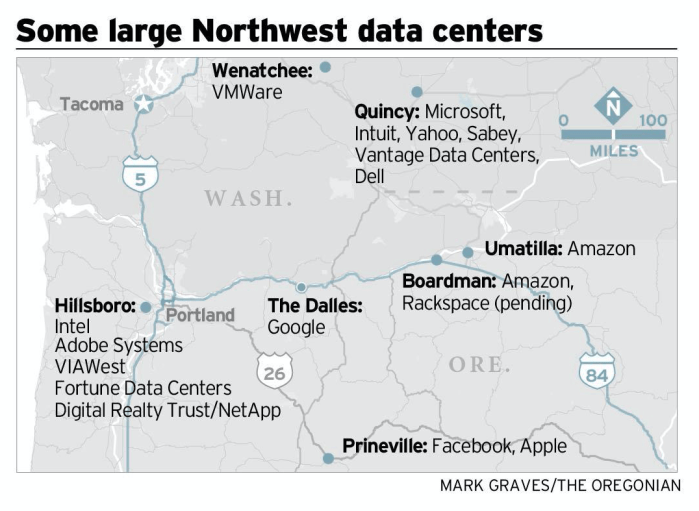
This isn’t just a future problem. The data center buildout is already in full swing and your Uncle Sugar must be getting nervous about where he’s going to get the money from to run his AI and his autonomous drone weapons. In Oregon, where electricity is famously cheap thanks to the Bonneville Power Administration’s hydroelectric dams on the Columbia River, tech companies have quietly snapped up huge portions of the grid’s output. What was once a shared public benefit—affordable, renewable power—is now being monopolized by AI compute farms whose profits leave the region to the bank accounts in Silicon Valley.

Meanwhile, Microsoft is investing in a nuclear-powered data center next to the defunct Three Mile Island reactor—but again, it’s not about public benefit. It’s about keeping Azure’s training workloads running 24/7. And don’t expect them to share any of that power capacity with the public—or even with neighboring hospitals, schools, or communities.

Letting the Public Build Private Fortresses

The real play here isn’t just to use public power—it’s to get the public to build the power infrastructure, and then seal it off for proprietary use. Moats work both ways.

That includes:
– Publicly funded transmission lines across hundreds of miles to deliver power to remote server farms;
– Publicly subsidized generation capacity (nuclear, gas, solar, hydro—you name it);
– And potentially, prioritized access to the grid that lets AI workloads run while the rest of us face rolling blackouts during heatwaves.

All while tech giants don’t share their models, don’t open their training data, and don’t make their outputs public goods. It’s a privatized extractive model, powered by your tax dollars.

Been Burning for Decades

Don’t forget: Google and YouTube have already been burning massive amounts of electricity for 20 years. It didn’t start with ChatGPT or Gemini. Serving billions of search queries, video streams, and cloud storage events every day requires a permanent baseload—yet somehow this sudden “AI emergency” is being treated like a surprise, as if nobody saw it coming.

If they knew this was coming (and they did), why didn’t they build the power? Why didn’t they plan for sustainability? Why is the public now being told it’s our job to fix their bottleneck?

The Cold War Analogy—Flipped on Its Head

Some industry advocates argue that breaking up Big Tech or slowing AI infrastructure would be like disarming during a new Cold War with China. But Gail Slater, the Assistant Attorney General leading the DOJ’s Antitrust Division, pushed back forcefully—not at a hearing, but on the War Room podcast.

In that interview, Slater recalled how AT&T tried to frame its 1980s breakup as a national security threat, arguing it would hurt America’s Cold War posture. But the DOJ did it anyway—and it led to an explosion of innovation in wireless technology.

“AT&T said, ‘You can’t do this. We are a national champion. We are critical to this country’s success. We will lose the Cold War if you break up AT&T,’ in so many words. … Even so, [the DOJ] moved forward … America didn’t lose the Cold War, and … from that breakup came a lot of competition and innovation.”

“I learned that in order to compete against China, we need to be in all these global races the American way. And what I mean by that is we’ll never beat China by becoming more like China. China has national champions, they have a controlled economy, et cetera, et cetera.

We win all these races and history has taught by our free market system, by letting the ball rip, by letting companies compete, by innovating one another. And the reason why antitrust matters to that picture, to the free market system is because we’re the cop on the beat at the end of the day. We step in when competition is not working and we ensure that markets remain competitive.”

Slater’s message was clear: regulation and competition enforcement are not threats to national strength—they’re prerequisites to it. So there’s no way that the richest corporations in commercial history should be subsidized by the American taxpayer.

Bottom Line: It’s Public Risk, Private Reward

Let’s be clear:

– They want the public to bear the cost of new electricity generation.
– They want the public to underwrite transmission lines.
– They want the public to streamline regulatory hurdles.
– And they plan to privatize the upside, lock down the infrastructure, keep their models secret and socialize the investment risk.

This isn’t a public-private partnership. It’s a one-way extraction scheme. America needs a serious conversation about energy—but it shouldn’t begin with asking taxpayers to bail out the richest companies in commercial history.

David Sacks Is Learning That the States Still Matter

For a moment, it looked like the tech world’s powerbrokers had pulled it off. Buried deep in a Republican infrastructure and tax package was a sleeper provision — the so-called AI moratorium — that would have blocked states from passing their own AI laws for up to a decade. It was an audacious move: centralize control over one of the most consequential technologies in history, bypass 50 state legislatures, and hand the reins to a small circle of federal agencies and especially to tech industry insiders.

But then it collapsed.

The Senate voted 99–1 to strike the moratorium. Governors rebelled. Attorneys general sounded the alarm. Artists, parents, workers, and privacy advocates from across the political spectrum said “no.” Even hardline conservatives like Ted Cruz eventually reversed course when it came down to the final vote. The message to Big Tech or the famous “Little Tech” was clear: the states still matter — and America’s tech elite ignore that at their peril.  (“Little Tech” is the latest rhetorical deflection promoted by Big Tech aka propaganda.)

The old Google crowd pushed the moratorium–their fingerprints were obvious. Having gotten fabulously rich off of their two favorites: The DMCA farce and the Section 230 shakedown. But there’s increasing speculation that White House AI Czar and Silicon Valley Viceroy David Sacks, PayPal alum and vocal MAGA-world player, was calling the ball. If true, that makes this defeat even more revealing.

Sacks represents something of a new breed of power-hungry tech-right influencer — part of the emerging “Red Tech” movement that claims to reject woke capitalism and coastal elitism but still wants experts to shape national policy from Silicon Valley, a chapter straight out of Philip Dru: Administrator. Sacks is tied to figures like Peter Thiel, Elon Musk, and a growing network of Trump-aligned venture capitalists. But even that alignment couldn’t save the moratorium.

Why? Because the core problem wasn’t left vs. right. It was top vs. bottom.

In 1964, Ronald Reagan’s classic speech called A Time for Choosing warned about “a little intellectual elite in a far-distant capitol” deciding what’s best for everyone else. That warning still rings true — except now the “capitol” might just be a server farm in Menlo Park or a podcast studio in LA.

The AI moratorium was an attempt to govern by preemption and fiat, not by consent. And the backlash wasn’t partisan. It came from red states and blue ones alike — places where elected leaders still think they have the right to protect their citizens from unregulated surveillance, deepfakes, data scraping, and economic disruption.

So yes, the defeat of the moratorium was a blow to Google’s strategy of soft-power dominance. But it was also a shot across the bow for David Sacks and the would-be masters of tech populism. You can’t have populism without the people.

If Sacks and his cohort want to play a long game in AI policy, they’ll have to do more than drop ideas into the policy laundry of think tank white papers and Beltway briefings. They’ll need to win public trust, respect state sovereignty, and remember that governing by sneaky safe harbors is no substitute for legitimacy.  

The moratorium failed because it presumed America could be governed like a tech startup — from the top, at speed, with no dissent. Turns out the country is still under the impression they have something to say about how they are governed, especially by Big Tech.

The OBBBA’s AI Moratorium Provision Has Existential Constitutional Concerns and Policy Implications

As we watch the drama of the One Big Beautiful Bill Act play out there’s a plot twist waiting in the wings that could create a cliffhanger in the third act: The poorly thought out, unnecessary and frankly offensive AI moratorium safe harbor that serves only the Biggest of Big Tech that we were gifted by Adam Theirer of the R Street Institute.

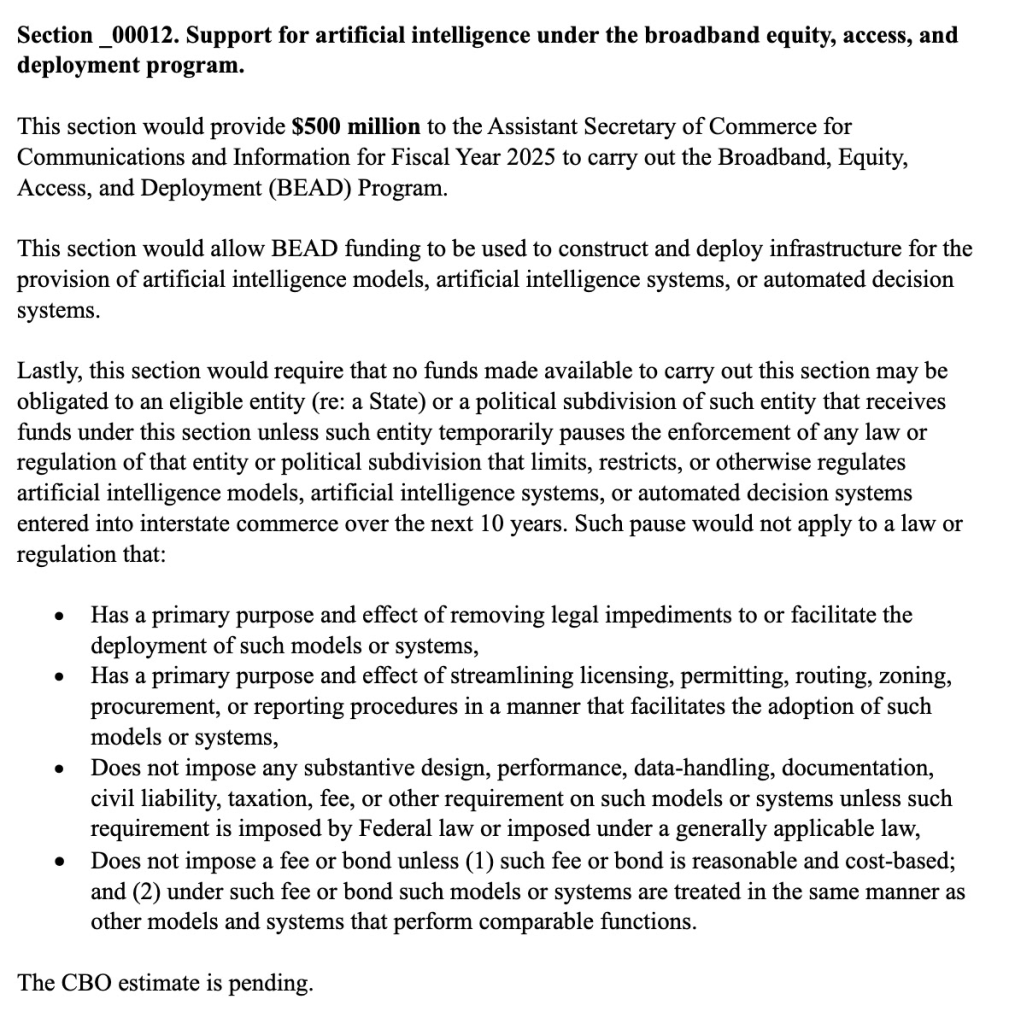
The latest version of the AI moratorium poison pill in the Senate version of OBBBA (aka HR1) reads something like this:

The AI moratorium provision within the One Big Beautiful Bill Act (OBBBA) reads like the fact pattern for a bar exam crossover question. The proposed legislation raises significant Constitutional and policy concerns. Before it even gets to the President’s desk, the legislation likely violates the Senate’s Byrd Rule that allows the OBBBA to avoid the 60 vote threshold (and the filibuster) and get voted on in “reconciliation” on a simple majority. The President’s party has a narrow simple majority in the Senate so if it were not for the moratorium the OBBBA should pass.

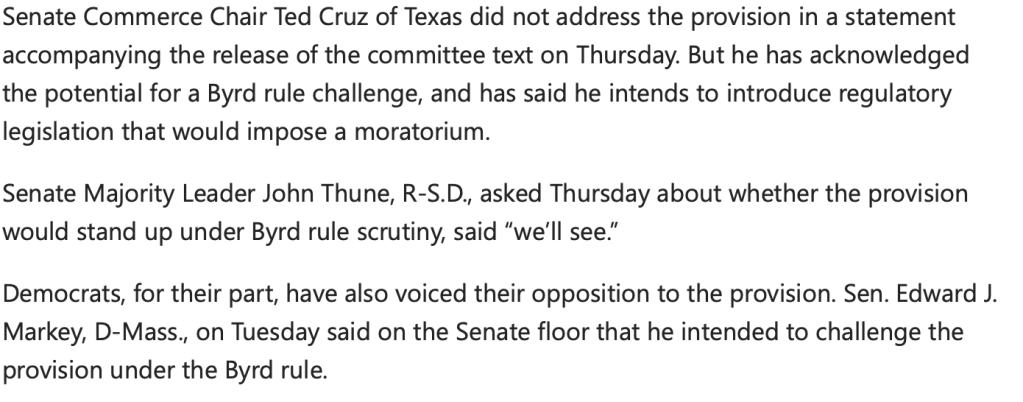
There are lots of people who think that the moratorium should fail the “Byrd Bath” analysis because it is not “germane” to the budget and tax process required to qualify for reconciliation. This is important because if the Senate Parliamentarian does not hold the line on germaine-ness, everyone will get into the act for every bill simply by attaching a chunk of money to your favorite donor, and that will not go over well. According to Roll Call, Senator Cruz is already talking about introducing regulatory legislation with the moratorium, which would likely only happen if the OBBBA poison pill was cut out:

The AI moratorium has already picked up some serious opponents in the Senate who would likely have otherwise voted for the President’s signature legislation with the President’s tax and spending policies in place. The difference between the moratorium and spending cuts is that money is fungible and a moratorium banning states from acting under their police powers really, really, really is not fungible at all. The moratorium is likely going to fail or get close to failing, and if the art of the deal says getting 80% of something is better than 100% of nothing, that moratorium is going to go away in the context of a closing. Maybe.

And don’t forget, the bill has to go back to the House which passed it by a single vote and there are already Members of the House who are getting buyers remorse about the AI moratorium specifically. So when they get a chance to vote again…who knows.

Even if it passes, the 40 state Attorneys General who oppose it may be gearing up to launch a Constitutional challenge to the provision on a number of grounds starting with the Tenth Amendment, its implications for federalism, and other Constitutional issues that just drip out of this thing. And my bet is that Adam Thierer will be eyeball witness #1 in that litigation.

So to recap the vulnerabilities:

Byrd Rule Violation

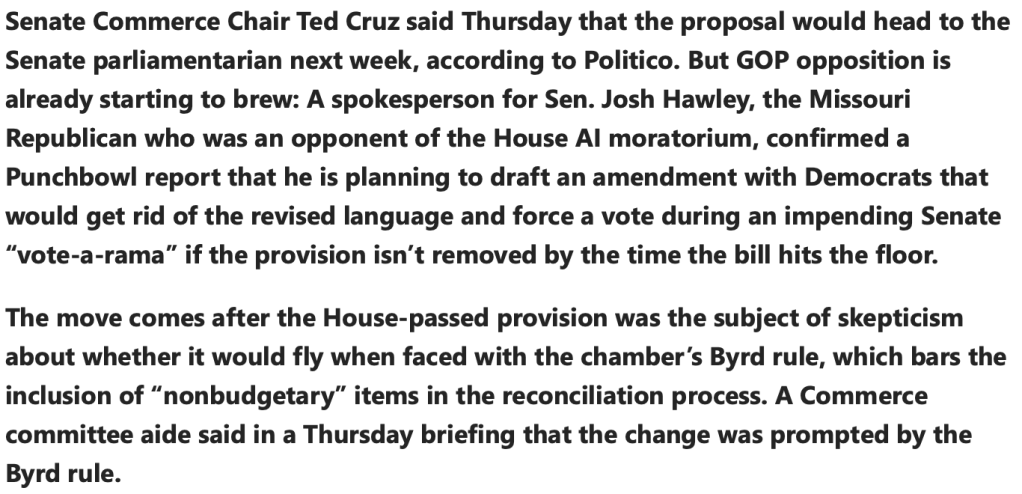
The Byrd Rule prohibits non-budgetary provisions in reconciliation bills. The AI moratorium’s primary effect is regulatory, not fiscal, as it preempts state laws without directly impacting federal revenues or expenditures. Senators, including Ed Markey (D-MA) as reported by Roll Call, have indicated intentions to challenge the provision under the Byrd Rule. The Hill reports:

Federal Preemption, the Tenth Amendment and Anti-Commandeering Doctrine

The Tenth Amendment famously reserves powers not delegated to the federal government to the states and to the people (remember them?). The constitutional principle of “anticommandeering” is a doctrine under U.S. Constitutional law that prohibits the federal government from compelling states or state officials to enact, enforce, or administer federal regulatory programs.

Anticommandeering is grounded primarily in the Tenth Amendment. Under this principle, while the federal government can regulate individuals directly under its enumerated powers (such as the Commerce Clause), it cannot force state governments to govern according to federal instructions. Which is, of course, exactly what the moratorium does, although the latest version would have you believe that the feds aren’t really commandeering, they are just tying behavior to money which the feds do all the time. I doubt anyone believes it.

The AI moratorium infringes upon the good old Constitution by:

  • Overriding State Authority: It prohibits states from enacting or enforcing AI regulations, infringing upon their traditional police powers to legislate for the health, safety, and welfare of their citizens.
  • Lack of Federal Framework: Unlike permissible federal preemption, which operates within a comprehensive federal regulatory scheme, the AI moratorium lacks such a framework, making it more akin to unconstitutional commandeering.
  • Precedent in Murphy v. NCAA: The Supreme Court held that Congress cannot prohibit states from enacting laws, as that prohibition violates the anti-commandeering principle. The AI moratorium, by preventing states from regulating AI, mirrors the unconstitutional aspects identified in Murphy. So there’s that.

The New Problem: Coercive Federalism

By conditioning federal broadband funds (“BEAD money”) on states’ agreement to pause AI regulations , the provision exerts undue pressure on states, potentially violating principles established in cases like NFIB v. Sebelius. Plus, the Broadband Equity, Access, and Deployment (BEAD) Program is a $42.45 billion federal initiative established under the Infrastructure Investment and Jobs Act of 2021. Administered by the National Telecommunications and Information Administration (NTIA), BEAD aims to expand high-speed internet access across the United States by funding planning, infrastructure deployment, and adoption programs. In other words, BEAD has nothing to do with the AI moratorium. So there’s that.

Supremacy Clause Concerns

The moratorium may conflict with existing state laws, leading to legal ambiguities and challenges regarding federal preemption. That’s one reason why 40 state AGs are going to the mattresses for the fight.

Lawmakers Getting Cold Feet or In Opposition

Several lawmakers have voiced concerns or opposition to the AI moratorium:

  • Rep. Marjorie Taylor Greene (R-GA): Initially voted for the bill but later stated she was unaware of the AI provision and would have opposed it had she known. She has said that she will vote no on the OBBBA when it comes back to the House if the Mr. T’s moratorium poison pill is still in there.
  • Sen. Josh Hawley (R-MO): Opposes the moratorium, emphasizing the need to protect individual rights over corporate interests.
  • Sen. Marsha Blackburn (R-TN): Expressed concerns that the moratorium undermines state protections, particularly referencing Tennessee’s AI-related laws.
  • Sen. Edward Markey (D-MA): Intends to challenge the provision under the Byrd Rule, citing its potential to harm vulnerable communities.

Recommendation: Allow Dissenting Voices

Full disclosure, I don’t think Trump gives a damn about the AI moratorium. I also think this is performative and is tied to giving the impression to people like Masa at Softbank that he tried. It must be said that Masa’s billions are not quite as important after Trump’s Middle East roadshow than they were before, speaking of leverage. While much has been made of the $1 million contributions that Zuckerberg, Tim Apple, & Co. made to attend the inaugural, there’s another way to look at that tableau–remember Titus Andronicus when the general returned to Rome with Goth prisoners in chains following his chariot? That was Tamora, the Queen of the Goths, her three sons Alarbus, Chiron, and Demetrius along with Aaron the Moor. Titus and the Goth’s still hated each other. Just sayin’.

Somehow I wouldn’t be surprised if this entire exercise was connected to the TikTok divestment in ways that aren’t entirely clear. So, given the constitutional concerns and growing opposition, it is advisable for President Trump to permit members of Congress to oppose the AI moratorium provision without facing political repercussions, particularly since Rep. Greene has already said she’s a no vote–on the 214-213 vote the first time around. This approach would:

  • Respect the principles of federalism and states’ rights.
  • Tell Masa he tried, but oh well.
  • Demonstrate responsiveness to legitimate legislative concerns on a bi-partisan basis.
  • Ensure that the broader objectives of the OBBBA are not jeopardized by a contentious provision.

Let’s remember: The tax and spend parts of OBBBA are existential to the Trump agenda; the AI moratorium definitely is not, no matter what Mr. T wants you to believe. While the OBBBA encompasses significant policy initiatives which are highly offensive to a lot of people, the AI moratorium provision presents constitutional and procedural challenges and fundamental attacks on our Constitution that warrant its removal. Cutting it out will strengthen the bill’s likelihood of passing and uphold the foundational principles of American governance, at least for now.

Hopefully Trump looks at it that way, too.

Grifting Under Heaven: What happens if TikTok Shuts Itself Down?

It finally happened–Congress passed the  Protecting Americans from Foreign Adversary Controlled Applications Act that prohibits the distribution, maintenance, or provision of internet hosting services for applications that are directly or indirectly operated by foreign adversaries. This legislation would include applications owned by ByteDance, Ltd. (the company that owns TikTok) or social media companies controlled by foreign adversaries that pose a significant threat to national security.

According to a Reuters exclusive, the response from Bytedance is that they would rather shut down TikTok than sell it–if the sale included the TikTok algorithm:

“The algorithms TikTok relies on for its operations are deemed core to ByteDance’s overall operations, which would make a sale of the app with algorithms highly unlikely, said the sources close to the parent….

TikTok shares the same core algorithms with ByteDance domestic apps like short video platform Douyin, three of the sources said. Its algorithms are considered better than ByteDance rivals such as Tencent and Xiaohongshu, said one of them.

It would be impossible to divest TikTok with its algorithms as their intellectual property licence is registered under ByteDance in China and thus difficult to disentangle from the parent company, said the sources.”

Well then. Of course, one of the primary national security arguments supporting any First Amendment defense on a challenge by TikTok to the content neutral, time, place and manner regulation will involve both the data privacy and foreign actor mass media manipulation evidentiary hearings. I don’t know how you make that defense without access to the algorithm. So why so secretive?

One could therefore plausibly argue that refusing to put the algorithm on the table is as good as admitting that TikTok is manipulating US users through algorithmic emotional targeting and scraping their users private data to do so. That would directly undermine their First Amendment attack on the US government and be a big step toward proving the government’s case.

And, of course, that secret algorithm uses music as the honeypot to attract users from the very young to the not so young. Remember, if this issue ever comes up in a court as a defense for the government, it will likely be because TikTok brought the underlying lawsuit that gave rise to the defense, and then refused to comply with a subpoena for the key piece of evidence. We call that “bootstrapping” in the trade.

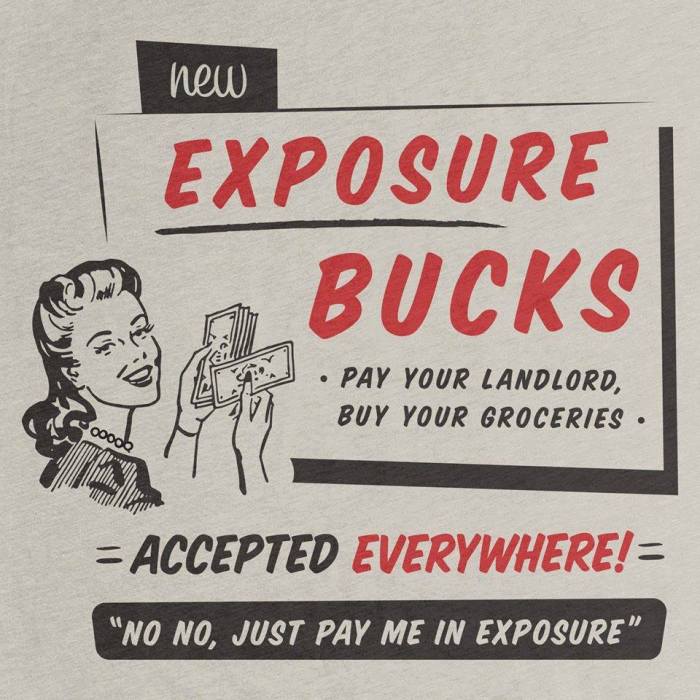
In the interest of full disclosure, I’ve been supporting a version of the foreign adversary divestment legislation since 2020 and did so publicly that year when I moderated a great panel at the Music Biz conference on this very subject. If that panel or this topic made you uncomfortable, it may be because you felt such a strong…let’s say attraction…to TikTok as either a marketer or user that you couldn’t imagine living without it. Or maybe you bought into the “exposure” benefits of TikTok. Or maybe you’d had no reason to think about the larger implications. More about that another time.

After the legislation passed–despite a US lobbying campaign against it worthy of The Internet Association…ahem–people are asking, now what? So let’s think about that.

The Universal Connection

TikTok’s future cannot be well understood without taking into account the withdrawal of Universal’s recordings and songs from the platform for commercial reasons. That withdrawal now looks even more prescient given the foreign adversary divestiture legislation. Is it materially different to make a deal with a company that is just another piggy Big Tech company that doesn’t value music and considers it a loss leader to get to the really big bundle of cash like Spotify stock, or to do a deal with that piggy company who has also been declared a tool of a strategic foreign adversary of the United States by none other than the President of the United States?

I think it rather is. So the two events are in some ways quite connected.

First of all, in the short run I would expect TikTok to immediately expand their direct licensing campaign which evidently has already snared Taylor Swift and do it quickly before anyone noticed that what was just a crappy licensing deal the day before President Biden signed the legislation into law, now is a crappy licensing deal from a declared foreign adversary of the United States. How that twist will affect the brand of Miss Americana remains to be seen.

One solution I would expect to get floated in coming days is the need for TikTok executives to register as foreign agents under the Foreign Agents Registration Act. According to the Congressional Research Service:

In 1938, the Foreign Agents Registration Act (22 U.S.C. §§611-621; FARA) was enacted to require individuals doing political or advocacy work on behalf of foreign entities in the United States to register with the Department of Justice and to disclose their relationship, activities, receipts, and disbursements in support of their activities. The FARA does not prohibit any specific activities; rather it seeks to require registration and disclosure of them….In 1966, FARA was amended to shift the focus from political propagandists to agents representing the economic interests of foreign principals. These amendments were partially the result of an investigation by the Senate Foreign Relations Committee into foreign sugar interests and other lobbying activities. The 1966 amendments changed several definitions in the law, prohibited contingent fee contracts, broadened exemptions to ensure legitimate commercial activities were not burdened, strengthened provisions for the disclosure and labeling of propaganda, and required the Department of Justice to issue regulations on the act (28 C.F.R. §5.1 et seq.).

FARA enforcement languished for a bit over the years. However, FARA enforcement against those who fail to register as a foreign agent has had a resurgence in popularity at the Department of Justice. I think it can fairly be said that requiring TikTok executives to register would be consistent with DOJ’s actions and is worth a discussion. The policy underlying FARA is for the public to be aware of who is whom–disclosure not imprisonment, or at least disclosure first.

Enter the Miasma of Angst

There is something of a miasma of angst around passing the foreign adversary divestment legislation as applied to TikTok which is partly due to an extraordinary amount of commercial activity between the US and China which may tend to mask the underlying kinetic tensions between our countries. It’s quite difficult for Americans to grasp this kinetic part due to the Great Firewall of China, the language and cultural barrier, and China’s own propaganda which is way, way more effective and long lasting than anything the Nazis dreamed up. TikTok is, after all, a danger close propaganda missile battery.

The legislation seems to assume that China is an “adversary” and not a “belligerent”. Is that actually true?

There are other rather inescapable events that suggests that the U.S. is already in a war with China, at least as far as the Chinese government are concerned. It helps to understand that when people say the Chinese Communist Party or “the CCP”, they mean the Chinese government and vice versa, a government ruled by Chairman for Life Xi Jinping. The Chinese constitution is, for example, the Constitution of the CCP.

Always remember that Usama Bin Laden declared war on the US but nobody took him seriously. Nuff said.

Why is that relevant to TikTok? Well, here’s another declaration of war on the US that nobody noticed. On May 14, 2019, the CCP government declared a “people’s war” against the United States as reported in the Pravda of China, the Global Times operated by Xinhua News Agency (the cabinet-level “news” agency run by the CCP):

“The most important thing is that in the China-US trade war, the US side fights for greed and arrogance … and morale will break at any point…The Chinese side is fighting back to protect its legitimate interests. The trade war in the US is the creation of one person and one administration, but it affects that country’s entire population…In China, the entire country and all its people are being threatened. For us, this is a real ‘people’s war.'”

What is the “people’s war”? It is an old Maoist phrase (remembering that Xi Jinping’s father fought with Mao during China’s Communist Revolution). It has a very specific meaning in the history of the Chinese Communist Party according to Wikipedia:

People’s war, also called protracted people’s war, is a Maoist military strategy. First developed by the Chinese communist revolutionary leader Mao Zedong (1893–1976), the basic concept behind people’s war is to maintain the support of the population and draw the enemy deep into the countryside (stretching their supply lines) where the population will bleed them dry through a mix of mobile warfare and guerrilla warfare. 

So in the dimension of “unrestricted warfare,” what end state would the CCP like to see? Bearing in mind that they will avoid a shooting war in favor of the various other dimensions of civil-military fusion and following Sun Tzu’s admonishment o subdue the enemy without fighting. One way would be to impose economic damage on the United States.

The Unrestricted Warfare Dimension

What is this “unrestricted warfare”? That is a much bigger topic and I cannot emphasize enough the importance for every American and really everyone to understand it. Literally “Unrestricted Warfare” is one of the most important books on military strategy and geopolitics that nobody has read.

We think the book was published in Mandarin In 1999; it could have been earlier. It was written by two colonels in the Peoples’ Liberation Army of the Peoples Republic of China and entitled Unrestricted Warfare. The title is variously translated as Unrestricted Warfare: Two Air Force Senior Colonels on Scenarios for War and the Operational Art in an Era of Globalization, or the more bellicose Unrestricted Warfare: China’s Master Plan to Destroy America. 

Why is this important? You must understand that when the colonels say “to destroy America” they actually mean that very thing. China’s military and civil goal is to replace the United States as the global hegemon under the “mandate of Heaven.” (See 2050 China: Understanding Xi Jinping Thought.)

No kidding.

The thesis of the book is that it is a mistake for a contemporary great power to think of war solely in military terms; war includes an economic, cyber, space, information war (especially social media like TikTok), and other dimensions–including kinetic–depending on the national interest at the time. I think of Unrestricted Warfare as an origin story for China’s civil and military fusion policy, later expressed in various statutes of the Chinese Communist Party that were on full display in the TikTok hearings before Congress.

Although the book was translated and certain of the cognoscenti read it in Mandarin (see Josh Rogan, Michal Pillsbury and Gen. Rob Spaulding), it was largely unnoticed until recently. Except in China–the CCP rewarded the authors handsomely: Colonel Qiao Liang retired as a major general in the PLA and Colonel Wang Xiangsui is a professor at Beihang University in Beijing following his retirement as a senior Colonel in the PLA (OF-5).

The point of both Bin Ladin’s 1998 fatwa and Unrestricted Warfare, and the 2019 people’s war declaration, is both that each of them declared war on America, and that no one paid attention. We know where that got us with bin Ladin, there are movies about it.

To War or Not?

So the first question is what is the argument that we are not at war currently with China under their definition? Particularly given that they declared war on us with just enough plausible deniability to make you feel bad about shutting down TikTok–see what I did there? (I think the CCP declared war started much, much longer ago, but let’s stick with their people’s war declaration as a recent tangible event to keep it manageable and ignore, oh, say island building, expanding to the largest navy in the world, and the rest of it. (Read The Hundred-Year Marathon and see what you think. It may be worth reviewing the history on the Anglo-German Naval Agreement indirectly referenced in a Noël Coward song.)

Don’t Let’s Be Beastly to the Germans by Noël Coward is reflective on “excessive humanitarians”

It is also worth remembering that should open hostilities with China actually break out, i.e., in the colonels’ words should the current level of unrestricted warfare go kinetic, CCP-owned companies operating in the US will fall under an entirely more intense level of scrutiny. This is permitted by international laws of armed conflict and doesn’t even require additional US national laws although there surely will be many.

In the first instance, is the ostensibly private company actually private? What if good old chummy Mr. Tok turned out to be a colonel in the People’s Liberation Army and just didn’t get around to telling anyone? (I don’t think anyone in Congressional hearings ever asked him.)

And what if TikTok complied with the CCP laws that apply to Bytedance for sure and may apply to TikTok that require there to be a CCP cadre in each company? (See Article 19 of China’s “Company Law.”) If a private company’s staff members are also members of the armed forces of a state or have combat functions for an organized armed group belonging to a party in the conflict, they are not considered civilians.  Further, if a private company is directly involved in military operations (e.g., cyber attacks or psy ops), it may lose its civilian status and become a legitimate military target under the Geneva Conventions. (Further reading, an excellent article from West Point on topic. I don’t think anyone ever asked Mr. Chew if he was a serving member of the PLA.)

So if China invades Taiwan and the US comes in on the side of Taiwan, but TikTok assists in even psychological warfare ops to support that war effort for China against Taiwan (and possibly the US), then what happens? What if it turns out that senior Tiks are reservists or active duty in the Peoples Liberation Army that they just kind of didn’t mention before? Good old Uncle Chew? This kind of thing can also get you sanctioned if you try hard enough. Remember this came up with Elon Musk when Starlink allegedly thwarted an attack by Ukraine (which he denied for other reasons).

So about those licenses….Do artists really want to be used as a honeypot? Especially if TikTok keeps its algorithm, ostensibly shuts down in the US, but parks outside the US and still assaults US users?