Back to Commandeering Again: David Sacks, the AI Moratorium, and the Executive Order Courts Will Hate

Why Silicon Valley’s in-network defenses can’t paper over federalism limits.

The old line attributed to music lawyer Allen Grubman is, “No conflict, no interest.” Conflicts are part of the music business. But the AI moratorium that David Sacks is pushing onto President Trump (the idea that Washington should freeze or preempt state AI protections in the absence of federal AI policy) takes that logic to a different altitude. It asks the public to accept not just conflicts of interest, but centralized control of AI governance built around the financial interests of a small advisory circle, including Mr. Sacks himself.

When the New York Times published its reporting on Sacks’s hundreds of AI investments and his role in shaping federal AI and chip policy, the reaction from Silicon Valley was immediate and predictable. What’s most notable is who didn’t show up. No broad political coalition. No bipartisan defense. Just a tight cluster of VC and AI-industry figures from he AI crypto–tech nexus, praising their friend Mr. Sacks and attacking the story.

And the pattern was unmistakable: a series of non-denial denials from people who it is fair to say are massively conflicted themselves.

No one said the Times lied.

No one refuted the documented conflicts.

Instead, Sacks’ tech bros defenders attacked tone and implied bias, and suggested the article merely arranged “negative truths” in an unflattering narrative (although the Times did not even bring up Mr. Sacks’ moratorium scheme).

And you know who has yet to defend Mr. Sacks? Donald J. Trump. Which tells you all you need to know.

The Rumored AI Executive Order and Federal Lawsuits Against States

Behind the spectacle sits the most consequential part of the story: a rumored executive order that would direct the U.S. Department of Justice to sue states whose laws “interfere with AI development.” Reuters reports that “U.S. President Donald Trump is considering an executive order that would seek to preempt state laws on artificial intelligence through lawsuits and by withholding federal funding, according to a draft of the order seen by Reuters….”

That is not standard economic policy. That is not innovation strategy. That is commandeering — the same old unconstitutional move in shiny AI packaging that we’ve discussed many times starting with the One Big Beautiful Bill Act catastrophe.

The Supreme Court has been clear on this such as in Printz v. United States (521 U.S. 898 (1997) at 925): “[O]pinions of ours have made clear that the Federal Government may not compel the States to implement,by legislation or executive action, federal regulatory programs.”

Crucially, the Printz Court teaches us what I think is the key fact. Federal policy for all the United States is to be made by the legislative process in regular order subject to a vote of the people’s representatives, or by executive branch agencies that are led by Senate-confirmed officers of the United States appointed by the President and subject to public scrutiny under the Administrative Procedures Act. Period.

The federal government then implements its own policies directly. It cannot order states to implement federal policy, including in the negative by prohibiting states from exercising their Constitutional powers in the absence of federal policy. The Supreme Court crystalized this issue in a recent Congressional commandeering case of Murphy v. NCAA (138 S. Ct. 1461 (2018)) where the court held “[t]he distinction between compelling a State to enact legislation and prohibiting a State from enacting new laws is an empty one. The basic principle—that Congress cannot issue direct orders to state legislatures—applies in either event.” Read together, Printz and Murphy extend this core principle of federalism to executive orders.

The “presumption against preemption” is a canon of statutory interpretation that the Supreme Court has repeatedly held to be a foundational principle of American federalism. It also has the benefit of common sense. The canon reflects the deep Constitutional understanding that, unless Congress clearly says otherwise—which implies Congress has spoken—states retain their traditional police powers over matters such as the health, safety, land use, consumer protection, labor, and property rights of their citizens. Courts begin with the assumption that federal law does not displace state law, especially in areas the states have regulated for generations, all of which are implicated in the AI “moratorium”.

The Supreme Court has repeatedly affirmed this principle. When Congress legislates in fields historically occupied by the states, courts require a clear and manifest purpose to preempt state authority. Ambiguous statutory language is interpreted against preemption. This is not a policy preference—it is a rule of interpretation rooted in constitutional structure and respect for state sovereignty that goes back to the Founders.

The presumption is strongest where federal action would displace general state laws rather than conflict with a specific federal command. Consumer protection statutes, zoning and land-use controls, tort law, data privacy, and child-safety laws fall squarely within this protected zone. Federal silence is not enough; nor is agency guidance or executive preference.

In practice, the presumption against preemption forces Congress to own the consequences of preemption. If lawmakers intend to strip states of enforcement authority, they must do so plainly and take political responsibility for that choice. This doctrine serves as a crucial brake on back-door federalization, preventing hidden preemption in technical provisions and preserving the ability of states to respond to emerging harms when federal action lags or stalls. Like in A.I.

Applied to an A.I. moratorium, the presumption against preemption cuts sharply against federal action. A moratorium that blocks states from legislating even where Congress has chosen not to act flips federalism on its head—turning federal inaction into total regulatory paralysis, precisely what the presumption against preemption forbids.

As the Congressional Research Service primer on preemption concludes:

The Constitution’s Supremacy Clause provides that federal law is “the supreme Law of the Land” notwithstanding any state law to the contrary. This language is the foundation for the doctrine of federal preemption, according to which federal law supersedes conflicting state laws. The Supreme Court has identified two general ways in which federal law can preempt state law. First, federal law can expressly preempt state law when a federal statute or regulation contains explicit preemptive language. Second, federal law can impliedly preempt state law when Congress’s preemptive intent is implicit in the relevant federal law’s structure and purpose.

In both express and implied preemption cases, the Supreme Court has made clear that Congress’s purpose is the “ultimate touchstone” of its statutory analysis. In analyzing congressional purpose, the Court has at times applied a canon of statutory construction known as the “presumption against preemption,” which instructs that federal law should not be read as superseding states’ historic police powers “unless that was the clear and manifest purpose of Congress.”

If there is no federal statute, no one has any idea what that purpose is, certainly no justiciabile idea. Therefore, my bet is that the Court would hold that the Executive Branch cannot unilaterally create preemption, and neither can the DOJ sue states simply because the White House dislikes their AI, privacy, or biometric laws, much less their zoning laws applied to data centers.

Why David Sacks’s Involvement Raises the Political Temperature

As Scott Fitzgerald famously wrote, the very rich are different. But here’s what’s not different—David Sacks has something he’s not used to having. A boss. And that boss has polls. And those polls are not great at the moment. It’s pretty simple, really. When you work for a politician, your job is to make sure his polls go up, not down.

David Sacks is making his boss look bad. Presidents do not relish waking up to front-page stories that suggest their “A.I. czar” holds hundreds of investments directly affected by federal A.I. strategy, that major policy proposals track industry wish lists more closely than public safeguards, or that rumored executive orders could ignite fifty-state constitutional litigation led by your supporters like Mike Davis and egged on by people like Steve Bannon.

Those stories don’t just land on the advisor; they land on the President’s desk, framed as questions of his judgment, control, and competence. And in politics, loyalty has a shelf life. The moment an advisor stops being an asset and starts becoming a daily distraction much less liability, the calculus changes fast. What matters then is not mansions, brilliance, ideology, or past service, but whether keeping that adviser costs more than cutting them loose. I give you Elon Musk.

AI Policy Cannot Be Built on Preemption-by-Advisor

At bottom, this is a bet. The question isn’t whether David Sacks is smart, well-connected, or persuasive inside the room. The real question is whether Donald Trump wants to stake his presidency on David Sacks being right—right about constitutional preemption, right about executive authority, right about federal power to block the states, and right about how courts will react.

Because if Sacks is wrong, the fallout doesn’t land on him. It lands on the President. A collapsed A.I. moratorium, fifty-state litigation, injunctions halting executive action, and judges citing basic federalism principles would all be framed as defeats for Trump, not for an advisor operating at arm’s length.

Betting the presidency on an untested legal theory pushed by a politically exposed “no conflict no interest” tech investor isn’t bold leadership. It’s unnecessary risk. When Trump’s second term is over in a few years, Trump will be in the history books for all time. No one will remember who David Sacks was.

Marc Andreessen’s Dormant Commerce Clause Fantasy

There’s a special kind of hubris in Silicon Valley, but Marc Andreessen may have finally discovered its purest form: imagining that the Dormant Commerce Clause (DCC) — a Constitutional doctrine his own philosophical allies loathe — will be his golden chariot into the Supreme Court to eliminate state AI regulation.

If you know the history, it borders on comedic, if you think that Ayn Rand is a great comedienne.

The DCC is a judge‑created doctrine inferred from the Commerce Clause (Article I, Section 8, Clause 3), preventing states from discriminating against or unduly burdening interstate commerce. Conservatives have long attacked it as a textless judicial invention. Justice Scalia called it a “judicial fraud”; Justice Thomas wants it abolished outright. Yet Andreessen’s Commerce Clause playbook is built on expanding a doctrine the conservative legal movement has spent 40 years dismantling.

Worse for him, the current Supreme Court is the least sympathetic audience possible.

Justice Gorsuch has repeatedly questioned DCC’s legitimacy and rejects free‑floating “extraterritoriality” theories. Justice Barrett, a Scalia textualist, shows no appetite for expanding the doctrine beyond anti‑protectionism. Justice Kavanaugh is business‑friendly but wary of judicial policymaking. None of these justices would give Silicon Valley a nationwide deregulatory veto disguised as constitutional doctrine. Add Alito and Thomas, and Andreessen couldn’t scrape a majority.

And then there’s Ted Cruz — Scalia’s former clerk — loudly cheerleading a doctrine his mentor spent decades attacking.

National Pork Producers Council v. Ross (2023): The Warning Shot

Andreessen’s theory also crashes directly into the Supreme Court’s fractured decision in the most recent DCC case before SCOTUS, National Pork Producers Council v. Ross (2023), where industry groups tried to use the DCC to strike down California’s animal‑welfare law due to its national economic effects.

The result? A deeply splintered Court produced several opinions.  Justice Gorsuch  announced the judgment of the Court, and delivered the opinion of the Court with respect to Parts I, II, III, IV–A, and V, in which Justices Thomas, Sotomayor, Kagan and Barrett joined, an opinion with respect to Parts IV–B and IV–D, in which Justice Thomas and Barrett joined, and an opinion with respect to Part IV–C, in which Justices Thomas, Sotomayor, and Kagan joined.  Justice Sotomayor filed an opinion concurring in part, in which Justice Kagan joined.  Justice Barrett filed an opinion concurring in part. Chief Justice Roberts filed an opinion concurring in part and dissenting in part, in which Justices Alito, Kavanaugh and Jackson joined. Justice Kavanaugh filed an opinion concurring in part and dissenting in part.

Got it?  

The upshot:
– No majority for expanding DCC “extraterritoriality.”
– No appetite for using DCC to invalidate state laws simply because they influence out‑of‑state markets.
– Multiple justices signaling that courts should not second‑guess state policy judgments through DCC balancing.
– Gorsuch’s lead opinion rejected the very arguments Silicon Valley now repackages for AI.

If Big Tech thinks this Court that decided National Pork—no pun intendedwill hand them a nationwide kill‑switch on state AI laws, they profoundly misunderstand the doctrine and the Court.

Andreessen didn’t just pick the wrong legal strategy. He picked the one doctrine the current Court is least willing to expand. The Dormant Commerce Clause isn’t a pathway to victory — it’s a constitutional dead end masquerading as innovation policy.

But…maybe he’s crazy like a fox.  

The Delay’s the Thing: The Dormant Commerce Clause as Delay Warfare

To paraphrase Saul Alinksy, the issue is never the issue, the issue is always delay.  Of course, if delay is the true objective, you couldn’t pick a better stalling tactic than hanging an entire federal moratorium on one of the Supreme Court’s most obscure and internally conflicted doctrines. The Dormant Commerce Clause isn’t a real path to victory—not with a Court where Scalia’s intellectual heirs openly question its legitimacy. But it is the perfect fig leaf for an executive order.

The point isn’t to win the case. The point is to give Trump just enough constitutional garnish to issue the EO, freeze state enforcement, and force every challenge into multi‑year litigation. That buys the AI industry exactly what it needs:  time. Time to scale. Time to consolidate. Time to embed itself into public infrastructure and defense procurement. Time  to become “too essential to regulate” or as Senator Hawley asked, too big to prosecute?

Big Tech doesn’t need a Supreme Court victory. It needs a judicial cloud, a preemption smokescreen, and a procedural maze that chills state action long enough for the industry to entrench itself permanently.  And no one knows that better than the moratorium’s biggest cheerleader, Senator Ted Cruz the Scalia clerk.

The Dormant Commerce Clause, in this context, isn’t a doctrine. It’s delay‑ware—legal molasses poured over every attempt by states to protect their citizens. And that delay may just be the real prize.

David Sacks Is Learning That the States Still Matter

For a moment, it looked like the tech world’s powerbrokers had pulled it off. Buried deep in a Republican infrastructure and tax package was a sleeper provision — the so-called AI moratorium — that would have blocked states from passing their own AI laws for up to a decade. It was an audacious move: centralize control over one of the most consequential technologies in history, bypass 50 state legislatures, and hand the reins to a small circle of federal agencies and especially to tech industry insiders.

But then it collapsed.

The Senate voted 99–1 to strike the moratorium. Governors rebelled. Attorneys general sounded the alarm. Artists, parents, workers, and privacy advocates from across the political spectrum said “no.” Even hardline conservatives like Ted Cruz eventually reversed course when it came down to the final vote. The message to Big Tech or the famous “Little Tech” was clear: the states still matter — and America’s tech elite ignore that at their peril.  (“Little Tech” is the latest rhetorical deflection promoted by Big Tech aka propaganda.)

The old Google crowd pushed the moratorium–their fingerprints were obvious. Having gotten fabulously rich off of their two favorites: The DMCA farce and the Section 230 shakedown. But there’s increasing speculation that White House AI Czar and Silicon Valley Viceroy David Sacks, PayPal alum and vocal MAGA-world player, was calling the ball. If true, that makes this defeat even more revealing.

Sacks represents something of a new breed of power-hungry tech-right influencer — part of the emerging “Red Tech” movement that claims to reject woke capitalism and coastal elitism but still wants experts to shape national policy from Silicon Valley, a chapter straight out of Philip Dru: Administrator. Sacks is tied to figures like Peter Thiel, Elon Musk, and a growing network of Trump-aligned venture capitalists. But even that alignment couldn’t save the moratorium.

Why? Because the core problem wasn’t left vs. right. It was top vs. bottom.

In 1964, Ronald Reagan’s classic speech called A Time for Choosing warned about “a little intellectual elite in a far-distant capitol” deciding what’s best for everyone else. That warning still rings true — except now the “capitol” might just be a server farm in Menlo Park or a podcast studio in LA.

The AI moratorium was an attempt to govern by preemption and fiat, not by consent. And the backlash wasn’t partisan. It came from red states and blue ones alike — places where elected leaders still think they have the right to protect their citizens from unregulated surveillance, deepfakes, data scraping, and economic disruption.

So yes, the defeat of the moratorium was a blow to Google’s strategy of soft-power dominance. But it was also a shot across the bow for David Sacks and the would-be masters of tech populism. You can’t have populism without the people.

If Sacks and his cohort want to play a long game in AI policy, they’ll have to do more than drop ideas into the policy laundry of think tank white papers and Beltway briefings. They’ll need to win public trust, respect state sovereignty, and remember that governing by sneaky safe harbors is no substitute for legitimacy.  

The moratorium failed because it presumed America could be governed like a tech startup — from the top, at speed, with no dissent. Turns out the country is still under the impression they have something to say about how they are governed, especially by Big Tech.

The OBBBA’s AI Moratorium Provision Has Existential Constitutional Concerns and Policy Implications

As we watch the drama of the One Big Beautiful Bill Act play out there’s a plot twist waiting in the wings that could create a cliffhanger in the third act: The poorly thought out, unnecessary and frankly offensive AI moratorium safe harbor that serves only the Biggest of Big Tech that we were gifted by Adam Theirer of the R Street Institute.

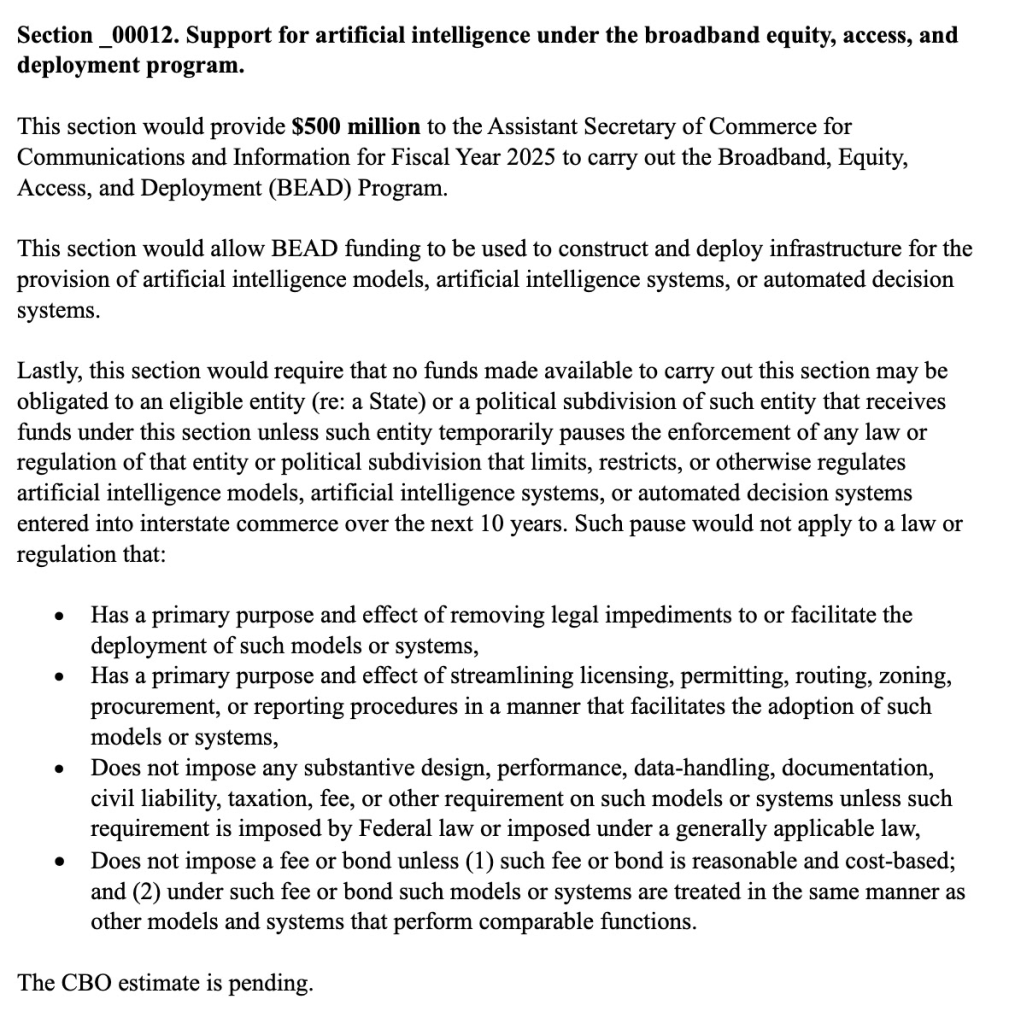
The latest version of the AI moratorium poison pill in the Senate version of OBBBA (aka HR1) reads something like this:

The AI moratorium provision within the One Big Beautiful Bill Act (OBBBA) reads like the fact pattern for a bar exam crossover question. The proposed legislation raises significant Constitutional and policy concerns. Before it even gets to the President’s desk, the legislation likely violates the Senate’s Byrd Rule that allows the OBBBA to avoid the 60 vote threshold (and the filibuster) and get voted on in “reconciliation” on a simple majority. The President’s party has a narrow simple majority in the Senate so if it were not for the moratorium the OBBBA should pass.

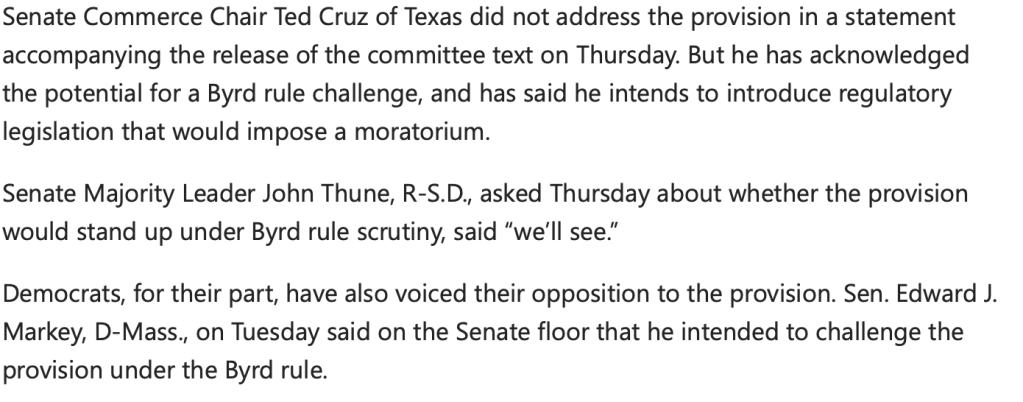
There are lots of people who think that the moratorium should fail the “Byrd Bath” analysis because it is not “germane” to the budget and tax process required to qualify for reconciliation. This is important because if the Senate Parliamentarian does not hold the line on germaine-ness, everyone will get into the act for every bill simply by attaching a chunk of money to your favorite donor, and that will not go over well. According to Roll Call, Senator Cruz is already talking about introducing regulatory legislation with the moratorium, which would likely only happen if the OBBBA poison pill was cut out:

The AI moratorium has already picked up some serious opponents in the Senate who would likely have otherwise voted for the President’s signature legislation with the President’s tax and spending policies in place. The difference between the moratorium and spending cuts is that money is fungible and a moratorium banning states from acting under their police powers really, really, really is not fungible at all. The moratorium is likely going to fail or get close to failing, and if the art of the deal says getting 80% of something is better than 100% of nothing, that moratorium is going to go away in the context of a closing. Maybe.

And don’t forget, the bill has to go back to the House which passed it by a single vote and there are already Members of the House who are getting buyers remorse about the AI moratorium specifically. So when they get a chance to vote again…who knows.

Even if it passes, the 40 state Attorneys General who oppose it may be gearing up to launch a Constitutional challenge to the provision on a number of grounds starting with the Tenth Amendment, its implications for federalism, and other Constitutional issues that just drip out of this thing. And my bet is that Adam Thierer will be eyeball witness #1 in that litigation.

So to recap the vulnerabilities:

Byrd Rule Violation

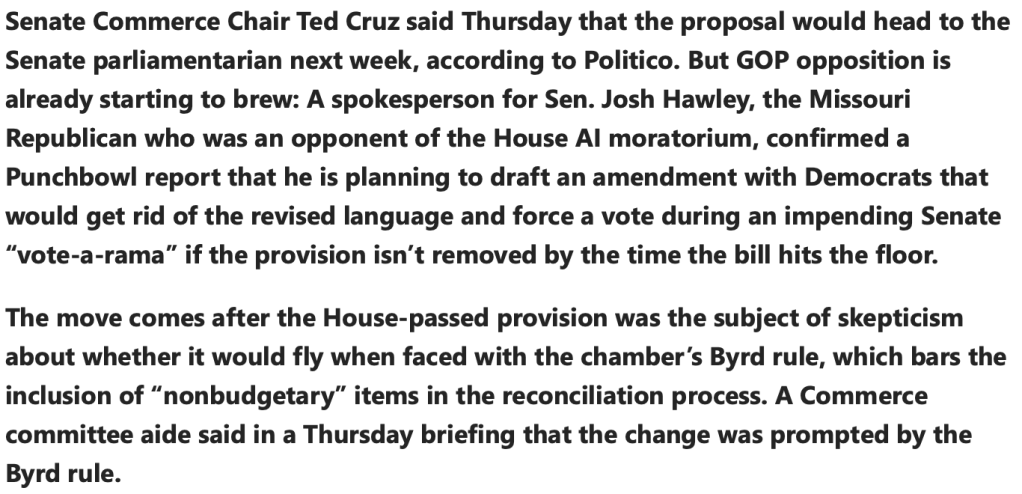
The Byrd Rule prohibits non-budgetary provisions in reconciliation bills. The AI moratorium’s primary effect is regulatory, not fiscal, as it preempts state laws without directly impacting federal revenues or expenditures. Senators, including Ed Markey (D-MA) as reported by Roll Call, have indicated intentions to challenge the provision under the Byrd Rule. The Hill reports:

Federal Preemption, the Tenth Amendment and Anti-Commandeering Doctrine

The Tenth Amendment famously reserves powers not delegated to the federal government to the states and to the people (remember them?). The constitutional principle of “anticommandeering” is a doctrine under U.S. Constitutional law that prohibits the federal government from compelling states or state officials to enact, enforce, or administer federal regulatory programs.

Anticommandeering is grounded primarily in the Tenth Amendment. Under this principle, while the federal government can regulate individuals directly under its enumerated powers (such as the Commerce Clause), it cannot force state governments to govern according to federal instructions. Which is, of course, exactly what the moratorium does, although the latest version would have you believe that the feds aren’t really commandeering, they are just tying behavior to money which the feds do all the time. I doubt anyone believes it.

The AI moratorium infringes upon the good old Constitution by:

  • Overriding State Authority: It prohibits states from enacting or enforcing AI regulations, infringing upon their traditional police powers to legislate for the health, safety, and welfare of their citizens.
  • Lack of Federal Framework: Unlike permissible federal preemption, which operates within a comprehensive federal regulatory scheme, the AI moratorium lacks such a framework, making it more akin to unconstitutional commandeering.
  • Precedent in Murphy v. NCAA: The Supreme Court held that Congress cannot prohibit states from enacting laws, as that prohibition violates the anti-commandeering principle. The AI moratorium, by preventing states from regulating AI, mirrors the unconstitutional aspects identified in Murphy. So there’s that.

The New Problem: Coercive Federalism

By conditioning federal broadband funds (“BEAD money”) on states’ agreement to pause AI regulations , the provision exerts undue pressure on states, potentially violating principles established in cases like NFIB v. Sebelius. Plus, the Broadband Equity, Access, and Deployment (BEAD) Program is a $42.45 billion federal initiative established under the Infrastructure Investment and Jobs Act of 2021. Administered by the National Telecommunications and Information Administration (NTIA), BEAD aims to expand high-speed internet access across the United States by funding planning, infrastructure deployment, and adoption programs. In other words, BEAD has nothing to do with the AI moratorium. So there’s that.

Supremacy Clause Concerns

The moratorium may conflict with existing state laws, leading to legal ambiguities and challenges regarding federal preemption. That’s one reason why 40 state AGs are going to the mattresses for the fight.

Lawmakers Getting Cold Feet or In Opposition

Several lawmakers have voiced concerns or opposition to the AI moratorium:

  • Rep. Marjorie Taylor Greene (R-GA): Initially voted for the bill but later stated she was unaware of the AI provision and would have opposed it had she known. She has said that she will vote no on the OBBBA when it comes back to the House if the Mr. T’s moratorium poison pill is still in there.
  • Sen. Josh Hawley (R-MO): Opposes the moratorium, emphasizing the need to protect individual rights over corporate interests.
  • Sen. Marsha Blackburn (R-TN): Expressed concerns that the moratorium undermines state protections, particularly referencing Tennessee’s AI-related laws.
  • Sen. Edward Markey (D-MA): Intends to challenge the provision under the Byrd Rule, citing its potential to harm vulnerable communities.

Recommendation: Allow Dissenting Voices

Full disclosure, I don’t think Trump gives a damn about the AI moratorium. I also think this is performative and is tied to giving the impression to people like Masa at Softbank that he tried. It must be said that Masa’s billions are not quite as important after Trump’s Middle East roadshow than they were before, speaking of leverage. While much has been made of the $1 million contributions that Zuckerberg, Tim Apple, & Co. made to attend the inaugural, there’s another way to look at that tableau–remember Titus Andronicus when the general returned to Rome with Goth prisoners in chains following his chariot? That was Tamora, the Queen of the Goths, her three sons Alarbus, Chiron, and Demetrius along with Aaron the Moor. Titus and the Goth’s still hated each other. Just sayin’.

Somehow I wouldn’t be surprised if this entire exercise was connected to the TikTok divestment in ways that aren’t entirely clear. So, given the constitutional concerns and growing opposition, it is advisable for President Trump to permit members of Congress to oppose the AI moratorium provision without facing political repercussions, particularly since Rep. Greene has already said she’s a no vote–on the 214-213 vote the first time around. This approach would:

  • Respect the principles of federalism and states’ rights.
  • Tell Masa he tried, but oh well.
  • Demonstrate responsiveness to legitimate legislative concerns on a bi-partisan basis.
  • Ensure that the broader objectives of the OBBBA are not jeopardized by a contentious provision.

Let’s remember: The tax and spend parts of OBBBA are existential to the Trump agenda; the AI moratorium definitely is not, no matter what Mr. T wants you to believe. While the OBBBA encompasses significant policy initiatives which are highly offensive to a lot of people, the AI moratorium provision presents constitutional and procedural challenges and fundamental attacks on our Constitution that warrant its removal. Cutting it out will strengthen the bill’s likelihood of passing and uphold the foundational principles of American governance, at least for now.

Hopefully Trump looks at it that way, too.