The Intention of Justice:  In Which The MLC Loses its Way on a Copyright Adventure

ARTHUR

Let’s get back to justice…what is justice?  What is the intention of justice?  The intention of justice is to see that the guilty people are proven guilty and that the innocent are freed.  Simple, isn’t it?  Only it’s not that simple.

From And Justice for All, screenplay written by Valerie Curtin and Barry Levinson

Something very important happened at the MLC on July 9:  The Copyright Office overruled the MLC on the position the MLC (and, in fairness, the NMPA) took on who was entitled to post-termination mechanical royalties under the statutory blanket license.  What’s important about the ruling is not just that the Copyright Office ruled that the MLC’s announced position was “incorrect”—it is that it corrected the MLC’s position that was in direct contravention of prior Copyright Office guidance.  (If this is all news to you, you can get up to speed with this helpful post about the episode on the Copyright Office website or read John Barker’s excellent comment in the rulemaking.)

“Guidance” is a kind way to put it, because the Copyright Office has statutory oversight for the MLC.  That means that on subjects yet to be well defined in a post-Loper world (the Supreme Court decision that reversed “Chevron deference”), I think it’s worth asking whether the Copyright Office is going to need to get more involved with the operations of the MLC.  Alternatively, Congress may have to amend Title I of the Music Modernization Act to fill in the blanks.  Either way, the Copyright Office’s termination ruling is yet another example of why I keep saying that the MLC is a quasi-governmental organization that is, in a way, neither fish nor fowl.  It is both a private organization and a government agency somewhat like the Tennessee Valley Authority.  Whatever it is ultimately ruled to be, it is not like the Harry Fox Agency which in my view has labored for decades under the misapprehension that its decisions carry the effect of law.  Shocking, I know.  But whether it’s the MLC or HFA, when they decide not to pay your money unless you sue them, it may as well be the law.

The MLC’s failure to follow the Copyright Office guidance is not a minor thing.  This obstreperousness has led to significant overpayments to pre-termination copyright owners (who may not even realize they were getting screwed).  This behavior by the MLC is what the British call “bolshy”, a wonderful word describing one who is uncooperative, recalcitrant, or truculent according to the Oxford Dictionary of Modern Slang.  The word is a pejorative adjective derived from Bolshevik.  “Bolshy” invokes lawlessness.

In a strange coincidence, the two most prominent public commenters supporting the MLC’s bolshy position on post-termination payments were the MLC itself and the NMPA, which holds a nonvoting board seat on the MLC’s board of directors.  This stick-togetherness is very reminiscent of what it was like dealing with HFA when the NMPA owned it.  It was hard to tell where one started and the other stopped just like it is now.  (I have often said that a nonvoting board seat is very much like a “board observer” appointed by investors in a startup to essentially spy on the company’s board of directors.  I question why the MLC even needs nonvoting board seats at all given the largely interlocking boards, aside from the obvious answer that the nonvoters have those seats because the lobbyists wrote themselves into Title I of the MMA—you know, the famous “spirit of the MMA”.)

Having said that, the height of bolshiness is captured in this quotation (89 FR 58586 (July 9, 2024)) from the Copyright Office ruling about public comments which the Office had requested (at 56588):

The only commenter to question the Office’s authority was NMPA, which offered various arguments for why the Office lacks authority to issue this [post-termination] rule. None are persuasive. [Ouch.]

NMPA first argued that the Office has no authority under section 702 of the Copyright Act or the MMA to promulgate rules that involve substantive questions of copyright law. This is clearly incorrect. [Double ouch.]

The Office ‘‘has statutory authority to issue regulations necessary to administer the Copyright Act’’ and ‘‘to interpret the Copyright Act.’’  As the [Copyright Office notice of proposed rulemaking] detailed, ‘‘[t]he Office’s authority to interpret [the Copyright Act]  in the context of statutory licenses in particular has long been recognized.’’

Well, no kidding.

What concerns me today is that wherever it originated, the net effect of the MLC’s clearly erroneous and misguided position on termination payments is like so many other “policies” of the MLC:  The gloomy result always seems to be they don’t pay the right person or don’t pay anyone at all in a self-created dispute that so far has proven virtually impossible to undo without action by the Copyright Office (which has other and perhaps better things to do, frankly).  The Copyright Office, publishers and songwriters then have to burn cycles correcting the mistake.  

In the case of the termination issue, the MLC managed to do both: They either paid the wrong person or they held the money.  That’s a pretty neat trick, a feat of financial gymnastics for which there should be an Olympic category.  Or at least a flavor of self-licking ice cream.

The reason the net effect is of concern is that this adventure in copyright has led to a massive screwup in payments illustrating what we call the legal maxim of fubar fugazi snafu.  And no one will be fired.  In fact, we don’t even know which person is responsible for taking the position in the first place.  Somebody did, somebody screwed up, and somebody should be held accountable.

Mr. Barker crystalized this issue in his comment on the Copyright Office termination rulemaking, which I call to your attention (emphasis added):

I do have a concern related to the current matter at hand, which translates to a long-term uneasiness which I believe is appropriate to bring up as part of these comments. That concern is, how did the MLC’s proposed policies [on statutory termination payments] come in to being in the first place? 

The Copyright Office makes clear in its statements in the Proposed Rules publication that “…the MLC adopted a dispute policy concerning termination that does not follow the Office’s rulemaking guidance.”, and that the policy “…decline(d) to heed the Office’s warning…”. Given that the Office observed that “[t]he accurate distribution of royalties under the blanket license to copyright owners is a core objective of the MLC”, it is a bit alarming that the MLC’s proposed policies got published in the first place. 

I am personally only able to come up with two reasons why this occurred. Either the MLC board did not fully understand the impact on termination owners and the future administration of those royalties, or the MLC board DID realize the importance, and were intentional with their guidelines, despite the Copyright Office’s warnings

Both conclusions are disturbing, and I believe need to be addressed.

Mr. Barker is more gentlemanly about it than I am, and I freely admit that I have no doubt failed the MLC in courtesy.  I do have a tendency to greet only my brothers, the gospel of Matthew notwithstanding.  Yet it irks me to no end that no one has been held accountable for this debacle and the tremendous productivity cost (and loss) of having to fix it.  Was the MLC’s failed quest to impose its will on society covered by the Administrative Assessment?  If so, why?  If not, who paid for it?  And we should call the episode by its name—it is a debacle, albeit a highly illustrative one. 

But we must address this issue soon and address it unambiguously.  The tendency of bureaucracy is always to grow and the tendency of non-profit organizations is always to seek power as a metric in the absence of for-profit revenue.  Often there are too many people in the organization who are involved in decision-making so that responsibility is too scattered.  

When something goes wrong as it inevitably does, no one ever gets blamed, no one ever gets fired, and it’s very hard to hold any one person accountable because everything is too diffused.  Instead of accepting that inevitable result and trying to narrow accountability down to one person so that an organization is manageable and functioning, the reflex response is often to throw more resources at the problem when more resources, aka money, is obviously not the solution.  The MLC already has more money than they know what to do with thanks to the cornucopia of cash from the Administrative Assessment.  That deep pocket has certainly not led to peace in the valley.

Someone needs to get their arms around this issue and introduce accountability into the process.  That is either the Copyright Office acting in its oversight role, the blanket license users acting in their paymaster role through the DLC, or a future litigant who just gets so fed up with the whole thing that they start suing everyone in sight.   

Saint Thomas Aquinas wrote in Summa Theologica that a just war requires a just cause, a rightful intention and the authority of the sovereign (Summa, Second Part of the Second Part, Question 40).  So it is with litigation.  We have a tendency to dismiss litigation as wasteful or unnecessary with a jerk of the knee, yet that is overbroad and actually wrong.  In some cases the right of the people to sue to enforce their rights is productive, necessary, inevitable and—hopefully—in furtherance of a just cause like its historical antecedents in trial by combat.  

It is also entirely in keeping with our Constitution.  The just lawsuit allows the judiciary to right a wrong when other branches of government fail to act, or as James Madison wrote in Federalist 10, so the government by “…its several constituent parts may…be the means of keeping each other in their proper places.”  

That’s a lesson the MLC, Inc. had to learn the hard way.  Let’s not do that again, shall we not?
Chronology: The Week in Review: MLC Redesignation Proceeding Highlights Ownership Issues for the Government’s Musical Works Database; TikTok’s SOPA Problem; Google’s Nonindemnity Indemnity for AI

One of the few things Congress got right in Title I of the Music Modernization Act is the five-year review of the mechanical licensing collective. Or more precisely, whether the private company previously designated by the Copyright Office to conduct the functions of the Mechanical Licensing Collective should have another five years to continue doing whatever it is they do.

Impliedly, and I think a bit unfairly, Congress told the Copyright Office to approve its own decision to appoint the current MLC or admit they made a mistake. This is yet another one of the growing list oversights in the oversight. Wouldn’t it make more sense for someone not involved in the initial decision to be evaluating the performance of the MLC? Particularly when there are at least tens of millions changing hands as well as some highly compensated MLC employees, any one of whom makes more than the Copyright Royalty Judges.

What happens if the Register of Copyright actually fires The MLC, Inc. and designates a new MLC operator? The first question probably should be what happens to the vaunted MLC musical works database and the attendant software and accounting systems which seem to be maintained out of the UK for some reason.

I actually raised this question in a comment to the Copyright Office back in 2020. In short, my question was probably more of a statement: ‘‘The musical works database does not belong to the MLC or The MLC and if there is any confusion about that, it should be cleared up right away.” The Copyright Office had a very clear response:

While the mechanical licensing collective must ‘‘establish and maintain a database containing information relating to musical works,’’ the statute and legislative history emphasize that the database is meant to benefit the music industry overall and is not ‘‘owned’’ by the collective itself….Any use by the Office referring to the public database as ‘‘the MLC’s database’’ or ‘‘its database’’ was meant to refer to the creation and maintenance of the database, not ownership. [85 FR at 58172, text accompanying notes 30 and 31.]

So if the current operator of the MLC is fired, we know from the MMA and the Copyright Office guidance that one thing The MLC, Inc. cannot do is hold the database and its attendant systems hostage, or demand payment, or any other shadiness. These items do not belong to them so they must not assert control over that which they do not own.

Which would include the hundreds of millions of black box money that the MLC, Inc. has failed to distribute in going on four years. I’ve even heard cynics suggest that the market share distribution of black box will occur immediately following The MLC, Inc.’s redesignation and the corresponding renewal of HFA’s back office contract which seems to be worth about $10 million a year all by itself.

What would also have been helpful would be for Congress to have required the Copyright Office to publish evaluation criteria for what they expected the MLC’s operator to actually do as well as performance benchmarks. Like I said, it’s a bit unfair of Congress to put the Copyright Office in the unprecedented position of evaluating such an important role with no guidance whatsoever. Surely Congress did not intend for the Copyright Office to have unfettered autonomy in deciding what standards to apply to their review of a quasi-governmental agency like the MLC, yet seems to have defaulted to the guardrail of the Administrative Procedures Act or some other backstop to sustain checks and balances on the situation.

But at least the ownership question is settled.

Breaking the Internet Yet Again: TikTok’s SOPA Problem

TikTok users swarmed over the Capitol to protest and impede a Congressional vote that would force the sale of the ubiquitous TikTok. Can Camp Pelosi redux be far behind? Well, no, because this was a digital swarm which is just different, you see. It’s just different when Big Tech tries to protect an IPO.

TikTok’s tactics are very reminiscent of Google’s tactics with SOPA or Napster’s tactics with Camp Chaos.

But not even Napster had the brass to go to full on papal indulgences. Yes, that’s right: NunTok will save the IPO.

Nuns good, TikTok bad!

I wonder which Washington lobbyist thought of NunTok? Perhaps this guy:

Google’s Nonindemnity Indemnity for AI

Some generative AI platforms are trying to make users believe that the company will actually protect them from copyright infringement claims. When you drill down on what the promise actually is, it’s pretty flimsy and may itself be consumer fraud.

Chronology: The Week in Review: Can an independent auditor look for overpayments?; @Helienne Explains the EU’s Cultural Protections Against Streaming Monopolists; @MikeHuppe Comment on AI Justice

The MLC announced it was auditing 49 users of the blanket mechanical license, a massive undertaking. This announcement sent me back to the audit provisions of Title I of the Music Modernization Act to review what the role of the auditor actually is for audits of music users by the MLC as opposed to audits of the MLC by copyright owners. As often happens when reviewing little-used code sections that abruptly become important, I was reminded of a couple nuances that were obviously flawed when drafted. The key nuance is how can a royalty examiner be looking for overpayments against the interest of the party that hired her but still be independent? 

How qualified is qualified?

The first issue is with the definition of a “qualified auditor”, a glitch that I’ve harped on a few times. The term “qualified auditor” comes up in two different contexts in the MMA–first, a qualified auditor who prepares the MLC’s audited financial statements. The definition of qualified auditor is in 17 USC § 115(e)(25) as “an independent, certified public accountant with experience performing music royalty audits.” The reason why this term is a drafting error is two fold–first, you don’t need a CPA to conduct music royalty audits and there is nothing on the CPA licensure exams that requires any knowledge of “music royalty audits.” Second, you do need a CPA to prepare audited financial statements if the books are maintained according to generally accepted accounting principles particularly if a financial audit requires an opinion as an attest service, but that role does not require knowledge of royalty audits. So the defined term has an internal contradiction. 

The Gaap, ruler of 25 legions of spirits from the Munich Manual of Demonic Magic grimoire

Not only is the definition hinky but it’s common knowledge (outside of the Imperial City, I guess) that many if not most royalty auditors are not CPAs. (There’s also a long-standing assumption among artist lawyers when this concept comes up in record or publishing deals that a CPA requirement for audits is intentionally punitive. The assumption is that CPAs charge more making the cost of auditing more burdensome (therefore less likely to happen), which remains to be proven but is pretty widely accepted.) So the definition should be limited to requiring a CPA for the MLC’s audited financial statements and the common alternate definition of “experienced royalty auditor” for the audit clauses. But let’s put that to one side. 

Overpayments and Independence

The MMA rule for auditing digital music providers states:

The qualified auditor shall determine the accuracy of royalty payments, including whether an underpayment or overpayment of royalties was made by the digital music provider to the mechanical licensing collective, except that, before providing a final audit report to the mechanical licensing collective, the qualified auditor shall provide a tentative draft of the report to the digital music provider and allow the digital music provider a reasonable opportunity to respond to the findings, including by clarifying issues and correcting factual errors.

Realize that the MLC and the services monitor payments and make frequent adjustments to royalties (which may be reflected on your royalty statement if you can find them). That’s different than an auditor who works for a client going and seeking out an overpayment as part of their audit report. Relieving the auditor of this conflict does not preclude the service from claiming an overpayment which is an ongoing part of invoicing (see, e.g., 37 CFR §210.27(d)(2)(ii)). You would not be creating a windfall for the party receiving the overpayment.

I would interpret the statute as not requiring the auditor to seek an additional overpayment not previously invoiced, but rather confirming the accuracy of any adjustments made for overpayments or underpayments already reflected on the statements that are the subject of the audit. That’s quite a different thing.

What makes an auditor independent is that they do not have a conflict of interest as to their client, in this case the MLC. The royalty auditor is intended to be an advocate for their client (who pays them) and they are hired to look for ways that the other side has failed to account to their client properly to their client’s disadvantage. Improper payments are most commonly underpayments, i.e., the music user has failed to pay all that the client is entitled to receive. Royalty statements are regularly recalculated for a host of reasons in the normal course of business without regard to the presence or absence of any audit. This is not to say that somehow the MLC (and eventually the copyright owners) get some kind of windfall because the services missed something if any auditor is not seeking out an overpayment. That’s particularly true since there will likely be multiple sets of eyes on the field work and draft audit report. And trust me, they will all be trying to find somebody else’s mistake.

Or said another way, copyright owners don’t receive a windfall that was somehow missed by the largest corporations in commercial history who can determine what floor of which building you are on at what time of day at what address, e.g., sporting goods or children’s toys, so they can serve ads to your phone. Are we really worried about these little lambs getting lost in the woods?

@Helienne Explains the EU’s Cultural Protections Against Streaming Monopolists

We were lucky to get an interview with ESCA President Helienne Lindvall about the European Parliament’s report on cultural protections against streaming monopolies. This is a very important development and something we could use in the United States where this focus is sadly lacking.

@MikeHuppe Made an Important Comment on AI Justice for Creators

SoundExchange CEO Mike Huppe’s comment on AI justice is welcome from a rights platform.

What the MLC Can Learn from Orphan Works

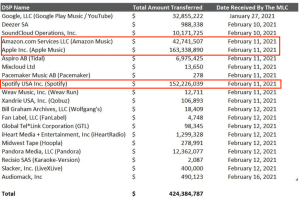
As you may be aware, The MLC recently received $424 million as payment of the “inception to date” unmatched mechanical royalties held at a number of streaming platforms, sometimes called the “black box.” Why do we have a black box at all? For the same reason you have “pending and unmatched” at record companies–somebody decided to exploit the recording without clearing the song.

Streaming services will, no doubt, try to blame the labels for this missing data, but that dog don’t hunt. First, the streaming service has an independent obligation to obtain a license and therefore to know who they are licensing from. Just because the labels do, too, doesn’t diminish the service’s obligation. It must also be said that for years, services did not accept delivery of publishing metadata even if a label wanted to give it to them. So that helps explain how we get to $424 million. Although the money was paid around mid-February, it’s clearly grown because The MLC is to hold the funds in an interest bearing account. Although The MLC has yet to disclose the current balance. Maybe someday.

This payment is, rough justice, a quid pro quo for the new “reach back” safe harbor that the drafters of Title I came up with that denies songwriters the right to sue for statutory damages if a platform complies with their rules including paying this money. That’s correct–songwriters gave up a valuable right to get paid with their own money.

The MLC has not released details about these funds as yet, but one would expect that the vast majority of the unmatched would be for accounting periods prior to the enactment of Title I of the Music Modernization Act (Oct. 11, 2018). One reason that expectation would be justified is that Title I requires services to try hard(er) to match song royalties with song owners. The statute states “…a digital music provider shall engage in good-faith, commercially reasonable efforts to identify and locate each copyright owner of such musical work (or share thereof)” as a condition of being granted the safe harbor.

The statute then goes on to list some examples of “good faith commercially reasonable efforts”. This search, or lack thereof, is at the heart of Eight Mile Style and Martin Affiliated’s lawsuit against Spotify and the Harry Fox Agency. (As the amended complaint states, “Nowhere does the MMA limitation of liability section suggest that it lets a DMP off the hook for copyright infringement liability for matched works where the DMP simply committed copyright infringement. The same should also be true where the DMP had the information, or the means, to match, but simply ignored all remedies and requirements and committed copyright infringement instead. Spotify does not therefore meet the requirements for the liability limitations of the MMA with respect to Eight Mile for this reason alone.”)

The MMA language is similar to “reasonably diligent search” obligations for orphan works, which are typically works of copyright where the owner cannot be identified by the user after trying to find them. This may be the only aspect of orphan works practice that is relevant to the black box under MMA. Since considerable effort has been put into coming up with what constitutes a proper search particularly in Europe it might be a good idea to review those standards.

We may be able to learn somethng about what we expect the services to have already done before transferring the matching problem to the MLC and what we can expect the MLC to do now that they have the hot potato. The MMA provides non-exclusive examples of what would comprise a good search, so it is relevant what other best practices may be out there.

Establishing reference points for what constitutes “good faith commercially reasonable efforts” under MMA is important to answer the threshold question: Is the $424 million payment really all there is? How did the services arrive at this number? While we are impressed by the size of the payment, that’s exactly the reason why we should inquire further about how it was arrived at, what periods it is for and whether any deductions were made. Otherwise it’s a bit like buying the proverbial pig in the proverbial poke.

One method lawmakers have arrived at for determining reasonableness is whether the work could be identified by consulting readily available databases identified by experts (or common sense). For example, if a songwriter has all their metadata correct with the PROs, it’s going to be a bit hard to stomach that either the service or the MLC can’t find them.

Fortunately, we have the Memorandum of Understanding from the European Digital Libraries initiative which brought together a number of working groups to develop best practices to search for different copyright categories of orphan works. The Music/Sound Working Group was represented by Véronique Desbrosses of GESAC and Shira Perlmutter, then of IFPI and now Register of Copyrights (head of the U.S. Copyright Office). The Music/Sound Working Group established these reasonable search guidelines:

DUE DILIGENCE GUIDELINES

The [Music/Sound] Working Group further discussed what constituted appropriate due diligence in dealing with the interests of the groups represented at the table—i.e., what a responsible [user] should, and does, do to find the relevant right holders. We agreed that at least the following searches should be undertaken:

1. Check credits and other information appearing on the work’s packaging (including names, titles, date and place of recording) and follow up through those leads to find additional right holders (e.g., contacting a record [company] to find the performers).

2. Check the databases/membership lists of relevant associations or institutions representing the relevant category of right holder (including collecting societies, unions, and membership or trade associations). In the area of music/sound, such resources are extensive although not always exhaustive.

3. Utilise public search engines to locate right holders by following up on whatever names and facts are available.

4. Review online copyright registration lists maintained by government agencies, such as the U.S. Copyright Office.

Perhaps when the MLC audits the inception to date payments we’ll have some idea of whether the services complied with these simple guidelines.