“You know who’s going to inherit the Earth? Arms dealers. Because everyone else is too busy killing each other.”
The Lord of War, Screenplay by Andrew Niccol
Aren’t you glad that we allowed YouTube to jack us around, let Google distribute pirate tracks and sell advertising to pirate sites? Oh, and don’t forget allowing Google to scan all the world’s books–good thing they’re not using any of that to train AI. All thanks to Google’s former CEO Eric Schmidt, aka Uncle Sugar.
This week, Ukraine’s Office of the President announced a strategic partnership with Swift Beat, an AI drone technology company reportedly linked to Eric Schmidt who is showing up everywhere like a latter day Zelig. Yes, that’s right–your Uncle Sugar is back. The Ukraine memorandum of understanding adds yet another layer to the quiet convergence of Silicon Valley money and 21st century warfare that is looking to be Uncle Sugar’s sweet spot. Given that Ukraine depends on the United States to fund roughly half of its defense budget, it’s a fairly safe assumption that somehow, some way, Uncle Sugar’s Washington buddies are helping to fund this deal.
The President of Ukraine’s announcement says that “[Swift Beat] will produce interceptor drones for the Armed Forces of Ukraine to destroy Russian UAVs and missiles, quadcopters for reconnaissance, surveillance, fire adjustment, and logistics, as well as medium-class strike drones for engaging enemy targets.” All based on US intel. So if Swift Beat uses US money received by Ukraine to manufacture this kit, you don’t suppose that Uncle Sugar might be planning on selling it to the good old US of A at some point in the future? Particularly given that the Russia-Ukraine war is frequently cited as a proving ground for the AI driven battle space?
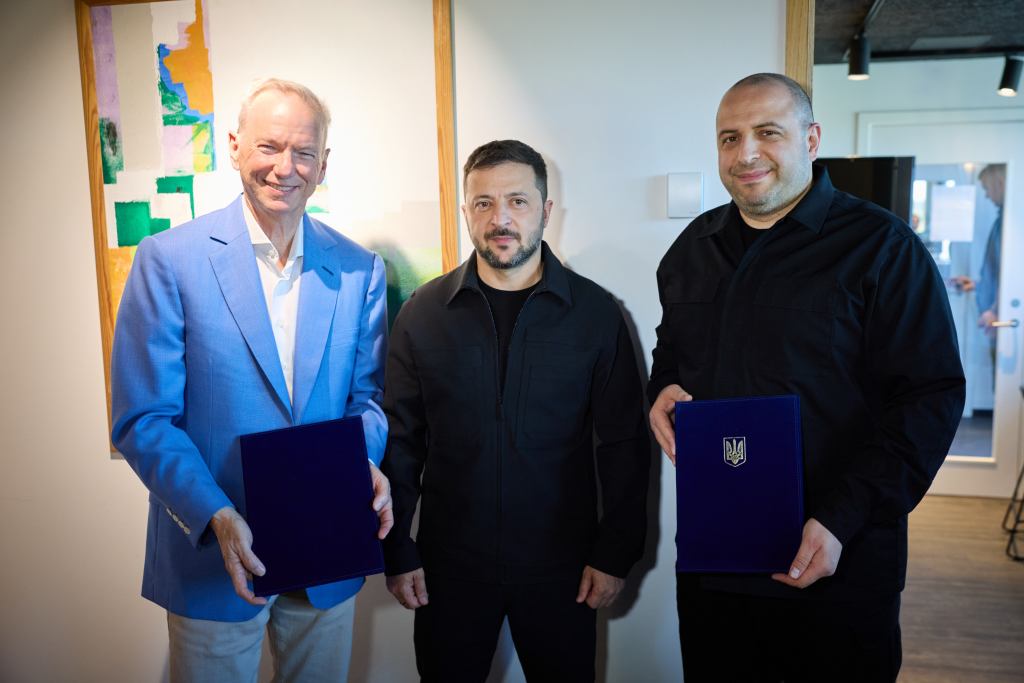
Swift Beat has been portrayed as a nimble startup positioned to bring real-time battlefield intelligence and autonomous drone operations to Ukraine’s army. But as Defence-UA reported, the company’s website is opaque, its corporate structure elusive, and its origins murky. Despite the gravity of the deal—delivering critical defense technology to a country in a kinetic war—Swift Beat appears to lack a documented track record, a history of defense contracting, or even a clear business address. Reporting suggests that Swift Beat is owned by Volya Robotics OÜ, registered in Tallinn, Estonia, with Eric Schmidt as the sole beneficiary. Yeah, that’s the kind of rock solid pedigree I want from someone manufacturing a weapon system to defend my capitol.
Defence-UA raises further questions: why did Ukraine partner with a new firm (apparently founded in 2023) whose founders are tightly linked to U.S. defense tech circles, but whose public presence is nearly nonexistent? What role, if any, did Eric Schmidt’s extensive political and financial connections play in sealing the agreement? Is this a case of wartime innovation at speed—or something more…shall we say…complicated?
The entire arrangement feels eerily familiar. Nicholas Cage’s character in *Lord of War* wasn’t just trafficking weapons—he was selling access, power, and plausible deniability. Substitute advanced AI for Kalashnikovs and you get a contemporary upgrade to the AI bubble: an ecosystem where elite technologists and financiers claim to be “helping,” while building opaque commercial networks through jurisdictions with far less oversight that your uncle would have back home in the US. Cage’s arms dealer character had swagger, but also cover. You know, babes dig the drone. Not that Uncle Sugar would know anything about that angle. Schmidt’s Swift Beat seems to be playing a similar game to Yuri Orlov—with more money, but no less ambiguity.
And this isn’t Schmidt’s first dance in this space. As readers will recall, his growing entanglement in defense procurement, battlefield innovation, and AI-powered surveillance raises not just ethical questions—but geopolitical ones. The revolving door between Big Tech and government has never spun faster, and now it’s air-dropping influence into actual war zones.
Dr. Sarah Myers West of the AI Now Institute warns that figures like Eric Schmidt—who bridge Big Tech and national security—are crafting frameworks that sideline accountability in favor of accelerated deployment. That critique lands squarely in the case of Swift Beat, whose shadowy profile and deep ties to Silicon Valley make it a case study in how defense contracts and contractors can be opaque and deeply unaccountable. And Swift Beat is definitely a company that Dr. West calls “Eric Schmidt adjacent.”
While no public allegations have been made, the unusual structure of the Swift Beat–Ukraine agreement—paired with the company’s lack of operational history and the involvement of high-profile U.S. individuals—may raise important questions under the Foreign Corrupt Practices Act (FCPA). The FCPA prohibits U.S. entities from offering anything of value to foreign officials to secure business advantages, directly or indirectly. When so-far unaudited wartime procurement contracts are awarded through opaque processes and international actors operate through newly formed entities…dare I say “cutouts”–the risk of FCPA violations needs to be explored. In other words, if Google were to get in to the military hardware business like Meta, there would be an employee revolt at the Googleplex. But if they do it through a trusted source, even one over yonder way across the river, well…what’s the evil in helping an old friend? The whole thing sounds pretty spooky.
As Ukraine deepens its relationships with U.S. technology suppliers, and as prominent U.S. investors and executives like Uncle Sugar increase their involvement with all of the above, it may be appropriate for U.S. oversight bodies to take a closer look—not as a condemnation, but in service of transparency, compliance, and public trust. You know, don’t be evil.
 Music Tech Solutions