As we watch the drama of the One Big Beautiful Bill Act play out there’s a plot twist waiting in the wings that could create a cliffhanger in the third act: The poorly thought out, unnecessary and frankly offensive AI moratorium safe harbor that serves only the Biggest of Big Tech that we were gifted by Adam Theirer of the R Street Institute.
The latest version of the AI moratorium poison pill in the Senate version of OBBBA (aka HR1) reads something like this:
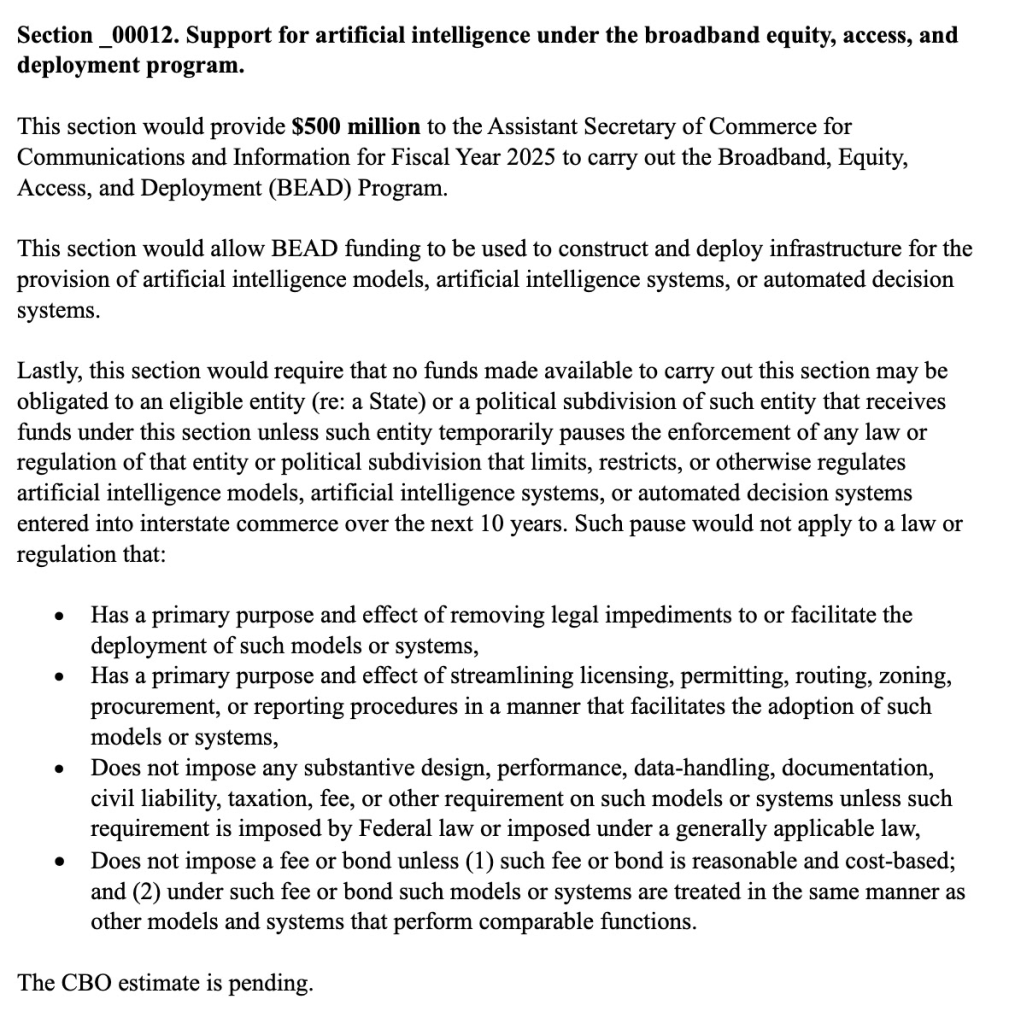
The AI moratorium provision within the One Big Beautiful Bill Act (OBBBA) reads like the fact pattern for a bar exam crossover question. The proposed legislation raises significant Constitutional and policy concerns. Before it even gets to the President’s desk, the legislation likely violates the Senate’s Byrd Rule that allows the OBBBA to avoid the 60 vote threshold (and the filibuster) and get voted on in “reconciliation” on a simple majority. The President’s party has a narrow simple majority in the Senate so if it were not for the moratorium the OBBBA should pass.
There are lots of people who think that the moratorium should fail the “Byrd Bath” analysis because it is not “germane” to the budget and tax process required to qualify for reconciliation. This is important because if the Senate Parliamentarian does not hold the line on germaine-ness, everyone will get into the act for every bill simply by attaching a chunk of money to your favorite donor, and that will not go over well. According to Roll Call, Senator Cruz is already talking about introducing regulatory legislation with the moratorium, which would likely only happen if the OBBBA poison pill was cut out:
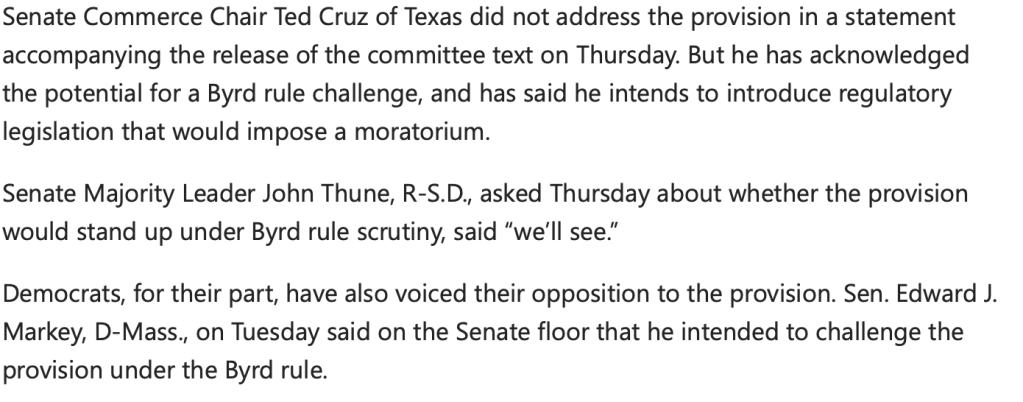
The AI moratorium has already picked up some serious opponents in the Senate who would likely have otherwise voted for the President’s signature legislation with the President’s tax and spending policies in place. The difference between the moratorium and spending cuts is that money is fungible and a moratorium banning states from acting under their police powers really, really, really is not fungible at all. The moratorium is likely going to fail or get close to failing, and if the art of the deal says getting 80% of something is better than 100% of nothing, that moratorium is going to go away in the context of a closing. Maybe.
And don’t forget, the bill has to go back to the House which passed it by a single vote and there are already Members of the House who are getting buyers remorse about the AI moratorium specifically. So when they get a chance to vote again…who knows.
Even if it passes, the 40 state Attorneys General who oppose it may be gearing up to launch a Constitutional challenge to the provision on a number of grounds starting with the Tenth Amendment, its implications for federalism, and other Constitutional issues that just drip out of this thing. And my bet is that Adam Thierer will be eyeball witness #1 in that litigation.
So to recap the vulnerabilities:
Byrd Rule Violation
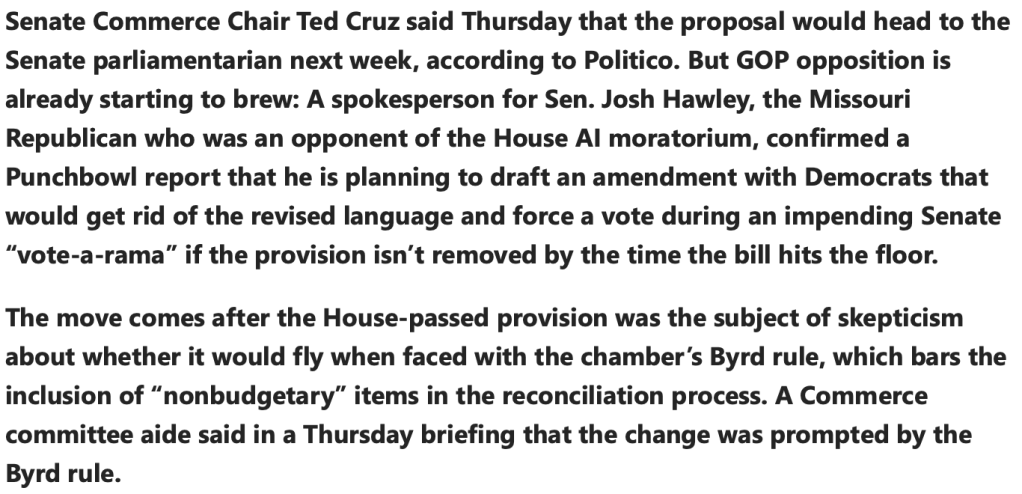
The Byrd Rule prohibits non-budgetary provisions in reconciliation bills. The AI moratorium’s primary effect is regulatory, not fiscal, as it preempts state laws without directly impacting federal revenues or expenditures. Senators, including Ed Markey (D-MA) as reported by Roll Call, have indicated intentions to challenge the provision under the Byrd Rule. The Hill reports:
Federal Preemption, the Tenth Amendment and Anti-Commandeering Doctrine
The Tenth Amendment famously reserves powers not delegated to the federal government to the states and to the people (remember them?). The constitutional principle of “anticommandeering” is a doctrine under U.S. Constitutional law that prohibits the federal government from compelling states or state officials to enact, enforce, or administer federal regulatory programs.
Anticommandeering is grounded primarily in the Tenth Amendment. Under this principle, while the federal government can regulate individuals directly under its enumerated powers (such as the Commerce Clause), it cannot force state governments to govern according to federal instructions. Which is, of course, exactly what the moratorium does, although the latest version would have you believe that the feds aren’t really commandeering, they are just tying behavior to money which the feds do all the time. I doubt anyone believes it.
The AI moratorium infringes upon the good old Constitution by:
- Overriding State Authority: It prohibits states from enacting or enforcing AI regulations, infringing upon their traditional police powers to legislate for the health, safety, and welfare of their citizens.
- Lack of Federal Framework: Unlike permissible federal preemption, which operates within a comprehensive federal regulatory scheme, the AI moratorium lacks such a framework, making it more akin to unconstitutional commandeering.
- Precedent in Murphy v. NCAA: The Supreme Court held that Congress cannot prohibit states from enacting laws, as that prohibition violates the anti-commandeering principle. The AI moratorium, by preventing states from regulating AI, mirrors the unconstitutional aspects identified in Murphy. So there’s that.
The New Problem: Coercive Federalism
By conditioning federal broadband funds (“BEAD money”) on states’ agreement to pause AI regulations , the provision exerts undue pressure on states, potentially violating principles established in cases like NFIB v. Sebelius. Plus, the Broadband Equity, Access, and Deployment (BEAD) Program is a $42.45 billion federal initiative established under the Infrastructure Investment and Jobs Act of 2021. Administered by the National Telecommunications and Information Administration (NTIA), BEAD aims to expand high-speed internet access across the United States by funding planning, infrastructure deployment, and adoption programs. In other words, BEAD has nothing to do with the AI moratorium. So there’s that.
Supremacy Clause Concerns
The moratorium may conflict with existing state laws, leading to legal ambiguities and challenges regarding federal preemption. That’s one reason why 40 state AGs are going to the mattresses for the fight.
Lawmakers Getting Cold Feet or In Opposition
Several lawmakers have voiced concerns or opposition to the AI moratorium:
- Rep. Marjorie Taylor Greene (R-GA): Initially voted for the bill but later stated she was unaware of the AI provision and would have opposed it had she known. She has said that she will vote no on the OBBBA when it comes back to the House if the Mr. T’s moratorium poison pill is still in there.
- Sen. Josh Hawley (R-MO): Opposes the moratorium, emphasizing the need to protect individual rights over corporate interests.
- Sen. Marsha Blackburn (R-TN): Expressed concerns that the moratorium undermines state protections, particularly referencing Tennessee’s AI-related laws.
- Sen. Edward Markey (D-MA): Intends to challenge the provision under the Byrd Rule, citing its potential to harm vulnerable communities.
Recommendation: Allow Dissenting Voices
Full disclosure, I don’t think Trump gives a damn about the AI moratorium. I also think this is performative and is tied to giving the impression to people like Masa at Softbank that he tried. It must be said that Masa’s billions are not quite as important after Trump’s Middle East roadshow than they were before, speaking of leverage. While much has been made of the $1 million contributions that Zuckerberg, Tim Apple, & Co. made to attend the inaugural, there’s another way to look at that tableau–remember Titus Andronicus when the general returned to Rome with Goth prisoners in chains following his chariot? That was Tamora, the Queen of the Goths, her three sons Alarbus, Chiron, and Demetrius along with Aaron the Moor. Titus and the Goth’s still hated each other. Just sayin’.
Somehow I wouldn’t be surprised if this entire exercise was connected to the TikTok divestment in ways that aren’t entirely clear. So, given the constitutional concerns and growing opposition, it is advisable for President Trump to permit members of Congress to oppose the AI moratorium provision without facing political repercussions, particularly since Rep. Greene has already said she’s a no vote–on the 214-213 vote the first time around. This approach would:
- Respect the principles of federalism and states’ rights.
- Tell Masa he tried, but oh well.
- Demonstrate responsiveness to legitimate legislative concerns on a bi-partisan basis.
- Ensure that the broader objectives of the OBBBA are not jeopardized by a contentious provision.
Let’s remember: The tax and spend parts of OBBBA are existential to the Trump agenda; the AI moratorium definitely is not, no matter what Mr. T wants you to believe. While the OBBBA encompasses significant policy initiatives which are highly offensive to a lot of people, the AI moratorium provision presents constitutional and procedural challenges and fundamental attacks on our Constitution that warrant its removal. Cutting it out will strengthen the bill’s likelihood of passing and uphold the foundational principles of American governance, at least for now.
Hopefully Trump looks at it that way, too.
 Music Tech Solutions