Spotify Conquers Wall Street Update

Music Business Worldwide reports that the Spotify corporate biography book is now being shopped as a TV series:

Yellow Bird UK, a Banijay Group company, has optioned the screen rights for Sven Carlsson and Jonas Leijonhufvud’s tell-all novel, Spotify Untold (Spotify Inifrån).

The book is currently in development for a limited series which “will examine how a secretive start-up wooed record companies, shook the music industry to its core, and conquered Wall Street,” according to a press release.

Let’s see how the conquered are reacting today:

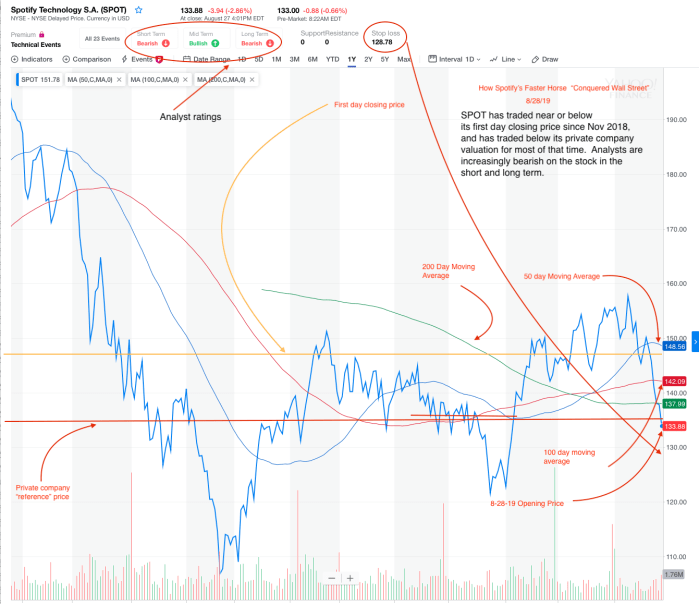
SPOT 8-28-19

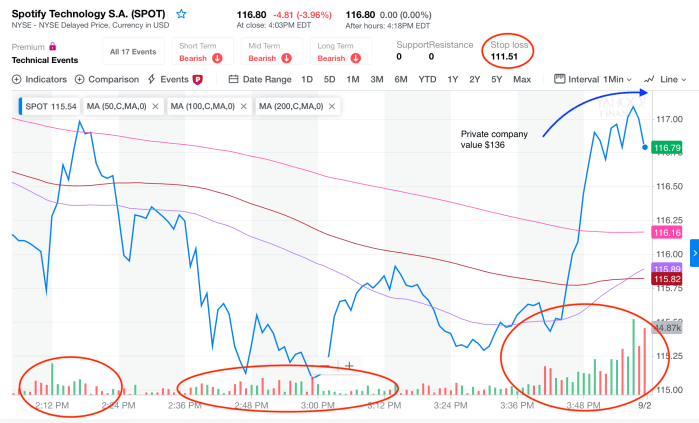
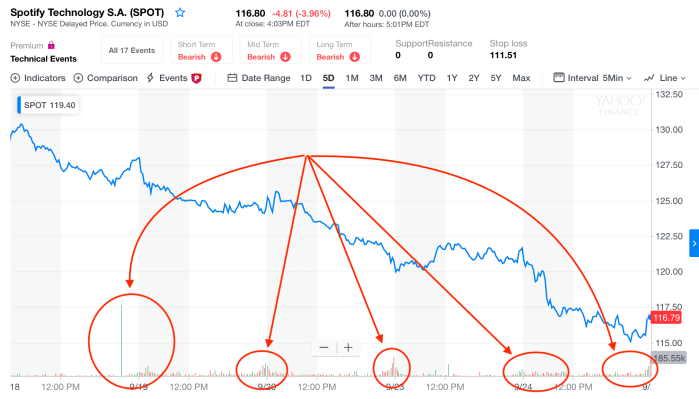
Note that Spotify has once again conquered its 200, 100 and 50 day moving averages to the downside.  Roughly speaking, in the last 12 months of trading the SPOT stock has traded near or below its benchmark closing price on the first day of trading. about 70% of the time.  It has also traded below its private company valuation (the “reference price” in the case of a direct public offering like Spotify) about 30% of those trading days including yesterday.  If that continues, SPOT investors would have been better off staying private–except for the insiders who cashed out, of course.

And it’s still loss making and just got served with an existential copyright infringement lawsuit that may eliminate the Music Modernization Act safe harbor altogether.  Just another day in Stockholm.

All hail the conquering hero.

@musictechsolve: Vote for Creator and Startup Licensing Education at SXSW

sxswedu-panelpicker_vote-facebook
Click Here to Vote on Panel Picker

I have a workshop in the SXSW.edu track titled “TEACHING ARTIST ROYALTIES TO CREATORS AND STARTUPS.”  It follows my philosophy that we need smart artists and smart startups to work together if we all are to succeed.

The workshop has three purposes:

–A building block approach to teaching artists and songwriters about the principal royalty streams that sustain them.  This is targeted financial literacy which is as critical to artists and songwriters as balancing your checkbook.

–A licensing roadmap overlay for entrepreneurship studies.  It’s far too frequent that entrepreneurs spend more time developing their product roadmap and critical path than they do developing their licensing roadmap side by side with the product.  That way when a startup gets to launch there is less likelihood they will go into the terminal holding pattern or worse–launch without licenses.

–the importance of clean and stable metadata to both artists and startups (and mature companies) and how to accomplish this goal starting with the digital audio workstation.

The class description:

Royalty rates, royalty reporting and earnings are some of the least understood–yet most important–parts of a creator’s career or a startups nightmare. Understanding royalties is as important as understanding how to balance your checkbook. Starting with metadata and simple revenue streams, leading to complex calculations and government run compulsory licenses and sometimes impenetrable royalty statements, the workshop gives educators tools and building blocks to teach the subject.

I’d really appreciate your vote for the class in the SXSW Panel Picker here. To vote, you just need to sign in to PanelPicker or create a free SXSW account with your email only.

Spotify Guides Toward “Tipping” Artists on Earnings Call

MTS readers will recall my post on what I called “Ethical Props” (OK, OK, not the best moniker I’ve ever come up with, but you’ll get the idea if you read the “Ethical Pool” post).  The concept is an expansion of the micropayments that TenCent (and lots of other sites in other businesses) permits on its music platform.  The question presented was whether Spotify would adopt a similar structure and how they would treat artists. That’s a serious question, by the way.

It turns out that the issue came up on Spotify’s latest earnings call, and was foreshadowed by Daniel Ek’s interest in Facebook’s Libra currency.  Stuart Dredge at Music Ally reports that the subject did come up:

Spotify IS interested in ways for fans to tip artists

Earlier this month, Spotify’s chief premium business officer Alex Norström hinted that the company was exploring the idea of new ways for artists to make money on its service: “You can add stuff on top like micro-payments, a la carte, prepaid plans for different contexts…”

Ek was asked about direct monetisation such as tipping during the earnings call today. “It’s something that we’re overall interested in. We definitely look at it as part of the scope of the types of marketplace tools that you can expect,” he said. “You should expect us to try a lot of things… it certainly could be very interesting specifically for a lot of artists…”

First…does anyone know what a “chief premium business officer” is?  I’m not familiar with that one, although my best is that they probably office next to the “chief exposure business officer.”

Quick review–Mr. Ek’s buddies at TenCent have made quite a business of “tipping” which explains why Ek is interested:

Simply put, Tencent allows users (all users, subscription or ad-supported service) to make virtual gifts in the form of micropayments directly to artists they love.  (The feature is actually broader than cash and applies to all content creators, but let’s stay with these socially-driven micropayments to artists or songwriters.)

Tencent, of course, makes serious bank on these system-wide micropayments.  As Jim Cramer noted in “Mad Money” last week:
“Tencent Music is a major part of the micropayment ecosystem because they let you give virtual gifts,” Cramer said. “If you want to tip your favorite blogger with a song, you do it through Tencent Music. In the latest quarter we have numbers for, 9.5 million users spent money on virtual gifts, and these purchases accounted for more than 70 percent of Tencent Music’s revenue.”

And that’s real money.  Tencent actually made this into a selling point in their IPO prospectus:  “We are pioneering the way people enjoy online music and music-centric social entertainment services. We have demonstrated that users will pay for personalized, engaging and interactive music experiences. Just as we value our users, we also respect those who create music. This is why we champion copyright protection-because unless content creators are rewarded for their creative work, there won’t be a sustainable music entertainment industry in the long run. Our scale, technology and commitment to copyright protection make us a partner of choice for artists and content owners.”
How Spotify will approach the subject has a lot to do with how they perceive their artist relations problems.  The chances are good that Spotify don’t think they have an artist relations problem.
But they do.  As I often say, if screw ups were Easter eggs, Daniel Ek would be the Easter Bunny, hopping from one to another until he had picked them all up in his basket.  (A nondenominational Easter bunny, of course.)
He could either pass through 100% of the “tip” which would make it “Ethical” as we define it, or he could take a cut like TenCent which wouldn’t.
The dreaded Apple is already in the act to a degree:
[TenCent’s] micropayments reportedly influenced Apple to change its in-app purchase policies, which make a good guideline for putting the “ethical” into an Ethical Prop:
“Apps may enable individual users to give a monetary gift to another individual without using in-app purchase, provided that (a) the gift is a completely optional choice by the giver, and (b) 100% of the funds go to the receiver of the gift. However, a gift that is connected to or associated at any point in time with receiving digital content or services must use in-app purchase.”

(That’s section 3.2.1(vii) in Apple’s App Store Review Guidelines for those reading along at home.)

So watch this space–let’s see what choices they make.

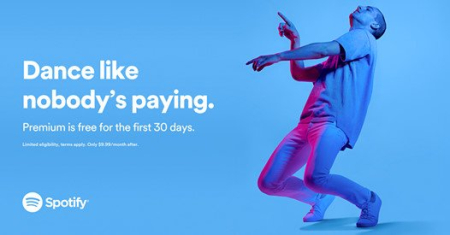
Dance Like Nobody’s Playing: Another call for user-centric royalties

I used to laugh off Spotify’s never ending stream of public messaging disasters–if screwups were Easter eggs, Daniel Ek would be the Easter Bunny hopping from one to another to make sure he scooped them all into his basket.  But the stark double entendre of Spotify’s latest campaign is the end of funny.  Hopefully it’s one more step on the road to user-centric royalties.

As reported in Hypebot, Spotify’s latest attempt to commoditize the value of music got artists and fans up in arms.

6a00d83451b36c69e20240a4bb7b77200b-450wi

This message is obviously offensive (but the underlying business practice is no doubt permitted under Spotify’s major label licenses–which raises a whole other question of how much longer does a publicly traded venture-backed money-losing company with a $25 billion market cap deserve to get special royalty free deals).

So Spotify is insulting, what else is new.  Underneath that message is another subtext, though:  Dance like nobody’s paying because nobody’s playing.  Or said another way, the machines are playing.  As Laura Kobylecky noted in a prescient post on MusicTechPolicy, the Spotify “fake artist” controversy has some ominous ancestry.

The tune had been haunting London for weeks past. It was one of countless similar songs published for the benefit of the proles by a sub-section of the Music Department.”

From1984 by George Orwell

In the dystopian world of George Orwell’s 1984, there is a machine called a “versificator.” The versificator makes what might be called “fake” music—songs that are “composed without any human intervention whatever.” In April of 2016, “A New Rembrandt” was revealed (1). The painting, like the songs of a versificator, was made by machines. In August of 2016, Music Business Worldwide (2) accused Spotify of “creating fake artists.” What is a fake artist? Can music be fake?

The world of 1984 is a grim place. Members of the “Party” have access to resources based on their rank. The rest of society are called “Proles.” The term is short for the “proletarian” and refers to the working class. The Proles make up the majority of society, and so the Party provides them with various sources of entertainment to keep them from getting too restless.

The versificator is one of the entertaining distractions made by the Party. A versificator generates songs that are “composed without any human intervention whatever.” The results range from insipid love songs like “Hopeless Fancy,” to the “savage, barking rhythm” of the “Hate Song”—designed to stir rage against political enemies.   The novel’s protagonist describes one of these songs as “dreadful rubbish.”

But the Proles like it fine. The song “Hopeless Fancy,” takes hold among them and “haunts” London for weeks. In this case, the art of the machine seems adequate for consumption.

So if you dance like nobody’s paying, realize that it’s entirely possible that nobody is paying because nobody’s playing, either.  Spotify can use either the free trial or the fake artist to drive down the royalties the company pays out to flesh-and-blood artists, particularly the ones that lack the leverage to get one of the goodie packed deals with minimum guarantees, greater of formulas, per-subscriber minima and non recoupable technology payments or breakage.  And then there’s the stock.

What would fix this is switching to user-centric royalties or what MTS readers will recall as the “ethical pool”.  No freebies, every artist is paid for every stream and fans are not deceived into believing that their monthly subscription goes to the artists they listen to rather than the ones they don’t ever stream.  If people could manage to look beyond this quarter’s results, the future is waiting.

How about “Dance like creators are paid fairly”?  Now there’s a message–it has a nice beat and you can dance to it.


New Copyright Office Regulations Regarding Pre-72 Recordings

Title II of the Music Modernization Act (“MMA”), (also known by its own bill title the Classics Protection and Access Act or the “CLASSICS Act) is self-executing legislation that gives certain federal copyright protections to recordings released prior to February 15, 1972.  One of the new protections is the right to recover the customary statutory damages for infringements of those pre-72 recordings available to copyright owners in the normal course.

However, in order to be eligible to recover statutory damages, copyright owners of pre-72 recordings must file Excel spreadsheets of schedules listing their pre-1972 recordings and contact information with the U.S. Copyright Office to be indexed by the Copyright Office into the Office’s public records.  This formality is in lieu of filing the customary copyright registrations.  Statutory damages are only available for infringements occurring more than 90 days after indexing.   The index is available at https://www.copyright.gov/music-modernization/pre1972-soundrecordings/search-soundrecordings.html.

In addition to imposing this formality on copyright owners, the MMA creates a new safe harbor for infringers.  That safe harbor was just coincidentally added at the insistence of Senator Ron Wyden under threat of a Senate hold on the entire bill.  If the infringer is making a noncommercial use of a sound recording that is not being commercially exploited, statutory damages are not available provided that the infringer has made a ‘‘good faith, reasonable search for’’ the infringed work in the indexed schedules before determining that the recording is not being commercially exploited.

The MMA creates an additional and separate safe harbor for entities that were transmitting pre-72 recordings at the time the MMA was enacted.  Rights owners must provide specific notice to such entities before pursuing remedies against them.  In order to provide such notice, that transmitting entity must register their contact information with the Copyright Office within 180 days from enactment (which expired April 9, 2019) (available at https://www.copyright.gov/music-modernization/pre1972-soundrecordings/notices-contact-information.html).

For those reading along at home, the Final Rule is found in 37 C.F.R. §201.35 (available at https://www.copyright.gov/title37/201/37cfr201-35.html) and was published at 84 Fed. Reg. 10679 (March 22, 2019) https://www.govinfo.gov/content/pkg/FR-2019-03-22/pdf/2019-05549.pdf.

@musically: Spotify CEO says Libra currency could help listeners ‘pay artists directly’ — Artist Rights Watch

Earlier this week, Facebook announced a new blockchain-powered currency called Libra, and a digital wallet for it called Calibra. Spotify was among the companies backing the plans by becoming a founder member of the independent Libra Association.

Now Spotify CEO Daniel Ek has been talking about his hopes for Libra, including the suggestion that it could one day facilitate direct payments to musicians from fans.

“I think like cryptocurrencies and blockchain are obviously two of the biggest buzzwords you can have today. And for me, I don’t think technology in itself is that interesting· What I do think is interesting is what we can do with that technology,” said Ek, in an interview for Spotify’s own Culture: Now Streaming podcast.

“What everyone who’s a part of Libra is trying to accomplish is: it’s interesting that we have all these different currencies, all of these different ways of doing things. But the reality is, there’s several billion people around the world that don’t even have access to a bank account,” he continued….(Whatever you think of Libra, the fact that Spotify is, right up to CEO level, even thinking about direct payments from fans to artists is a significant talking point for anyone mulling how the streaming service will evolve in the coming years.)

Read the post on MusicAlly

Betting on the House: Five Issues that House Judiciary Should Investigate Against Google–End Supervoting Shares for Publicly Traded Companies

The House Judiciary Committee announced yesterday that it was opening an antitrust investigation into “tech giants” including Google.  Chairman Jerry Nadler said:

[T]here is growing evidence that a handful of gatekeepers have come to capture control over key arteries of online commerce, content, and communications…Given the growing tide of concentration and consolidation across our economy, it is vital that we investigate the current state of competition in digital markets and the health of the antitrust laws.

We’re going to look at five issues Chairman Nadler should consider that relate both to Google and to some others, too.  Let’s start with reforming corporate governance and bring eyesight to the willfully blind.

1.   One Share, One Vote, Not Ten:  Anyone in the music business has had just about enough of government oversight, so I don’t recommend it as a solution in general.  But–in the absence of marketplace transparency, the government is about the only place to go to bring reforms to well-heeled corporations.  So rather than ask the government to fix specific problems on an ad hoc basis, the government would do well to ask what causes the market to fail as it clearly has with Google.

The first question to ask is where was the board?  In Google’s case, the core problem is both easy to find and easy to fix.  It lies in the voting structure of the shareholders.  Shareholder rights and corporate charters are state law matters and don’t relate to the federal government, but–the federal government does have a say about who gets to sell shares to the public and has an interest in protecting the shareholders of publicly traded corporations.  It is this nexus that gives the House Judiciary Committee clear oversight authority over the corporate structure of publicly traded corporations.

While anti-coup d’etat provisions might make sense for private companies whose investors are sophisticated financiers, or newspapers seeking to retain editorial independence, once that company is publicly traded a bald discrepancy that simply mandates voting power to the insiders forever seems like it has to go.  And as we have seen with Google, the lack of corporate oversight has resulted in unbelievable arrogance and a complete failure of corporate responsibility.  And worse yet, because Google got away with it, lots of other tech companies follow essentially the same model (including Facebook, Spotify and Linkedin).

It must also be said that stock buybacks approved by a board where insiders who benefit from the buyback have supervoting shares and control the board is a practice that reeks to high heaven.  Buybacks and dual class supervoting shares have been widely criticized including by Securities and Exchange Commission Commissioner Robert Jackson who is also a critic of supervoting shares.

So how did this happen to Google?  The supervoting structure started when Google was a private company as a way for the founders to preserve control and avoid venture capital investors pushing them around.  OK, fine, I understand that.

Google (which is really its parent company, Alphabet) trades under two ticker symbols on the  NASDAQ: GOOGL Class A and GOOG Class C.

Oops.  What happened to Class B?  Ay, there’s the rub.

Class B shares are not publicly traded and are held by insiders only.  But as you will see, they control every aspect of the company.  So why would Google’s insiders want this share structure?  There’s actually a simple answer.  Class A shares (GOOGL) get one vote per share, Class B shares get 10 votes per share and Class C shares (GOOG) get no votes.

That’s right–Class B shares cannot be purchased and their holders get 10 times the voting power of the Class A holders, often called “supervoting” shares, because their super power is…well…voting.

The Class C shares were created as part of a 1:1 stock split that doubled the number of shares, halted the price per share, but resulted in no change of the voting power of the Class A and C shareholders.

When the dust settled, the Google/Alphabet voting capitalization table looked something like this:

Class A: 298 million shares and 298 million votes, or roughly 40% of the voting power with votes counting 1:1.

Class B: 47 million shares and 470 million votes, or roughly 60% of the voting power with votes counting 10:1.

What this also means is that the holders of Class B shares voting as a bloc will never–and I mean never–be outvoted at a shareholder meeting, their board of directors will never be challenged much less replaced and shareholder meetings are a sham.

Who controls the Class B shares?  The people that Commissioner Jackson might call the “corporate royalty“:

Larry Page: 20 million shares (as of 2017)

Sergey Brin: 35,300 Class B shares plus 35,300 Class A shares (as of 2018)

Eric Schmidt: 1.19 million Class B shares, 40,934 Class A shares, and 10,983 Class A Google shares, plus 2.91 million Class B shares through family trusts.

Sundar Pichai: 6,317 Class A shares and no Class B shares.

The House Judiciary Committee has a chance to correct the supervoting system as bad policy and implement a long-term fix across the board for all dual-class companies that want to trade on the public exchanges.


Is SPOT Starting to Tank?

Stocks go up, stocks go down, can’t pick a top, can’t pick a bottom.  But it’s fun to guess.

Back in December when Spotify’s stock price hit $116 I said I expected it to retrace its price to the $120-$130 range before testing new lows.  OK, I said it would close at $95 in the near future, perhaps as soon as January based on technical indicators such as the “death cross” when 50 and 100 day moving averages cross to the downside.  So I was wrong about the timing, but the recent trading activity and momentum suggests the stock is behaving as expected.

Here’s my current chart:

Spotify 5-23-19

Note that Spotify is getting close to a second death cross at significantly lower levels than the first.  Note also that the 200 day moving average (which we didn’t have yet in December) is also pointed to the downside and is not, frankly, all that far away from the 50 and 100 day averages.

I would also point out that the stock is now trading about $10 below where it was before it listed (the “reference price”), which means, roughly speaking, that Spotify is actually valued lower than it was as a private company.  It’s also valued lower than it was in December and well below where it closed on its first day of trading.  Although not quite as much lower as it was in December.  All this for a company that still requires investment capital to survive as it has since it was founded.  If that keeps up, Spotify may soon enter the unicorn abattoir.

Remember–Spotify is not your typical IPO stock.  In fact, it is not an IPO at all, rather something called a “DPO” or a “direct listing”.  The difference is that a DPO enriches only the initial holders of the company’s stock as Marketwatch explains:

Direct listings differ from traditional initial public offerings, in that the company doesn’t issue new shares or seek to raise money through the process of going public. Rather, the listing makes it possible for existing shareholders to sell their shares to the public. After Spotify’s direct listing, many said the approach could be used by other startups, given the lack of share dilution and required lockup restrictions.

It’s also important to note that Spotify announced a $1 billion stock buyback plan on November 5, 2018 according to Variety:

Aiming to boost its flagging stock price, Spotify announced a plan Monday to repurchase up to $1 billion worth of shares.

So Spotify’s stock has continued to decline despite this price manipulation by the insiders.

We shall see.

Spotify Songwriter Town Halls: Go Ahead, Make My Day

If you’ve heard about the high turnover at Spotify, here’s the latest confirmation:  Someone at Spotify evidently thinks it’s a good idea to have “town halls” for songwriters in Nashville and Los Angeles (but not New York).  “Town halls” imply an open forum where anyone can talk about issues of importance to the community hosting the town hall.  That’s apparently not what these Spotify town halls are to be about.  The intention is to limit them to a single topic–Spotify’s appeal of the songwriter rates at the Copyright Royalty Board.

First, remember that Spotify did this kind of thing once before in 2014.  Remember, in 2014 the company got a lot of groovy from the pillars of the music business who wanted to see Spotify succeed (and make bank on the stock).  In 2014, publicly criticizing Spotify was a new thing and it took some courage for artists to go after the company in the days before Spotify executives gorged themselves on the public’s money at the public market trough.

That 2014 charm offensive foundered, to be kind.  (See Meltdown at the Soho House: Spotify’s Artist Charm Offensive Tour Self-Destructs on Opening Night and Billboard’s coverage, Spotify’s Artist Outreach Mission Backfires.)

Why was it a disaster?  Mostly because try as they might, Spotify couldn’t control a roomful of artists and get them to talk about the topic Spotify chose–especially that one thing that Spotify wanted to talk about, namely how groovy they are.  Artist rights advocate Blake Morgan attended the New York meeting and politely and articulately took the Spotify self-cheering section apart brick by brick.  This wasn’t a cage match with Big Daddies on either side waiving their arms–the artists knew what they wanted to say and they said it.  They didn’t need any help.

This is why I find it hard to believe that Spotify is about to do the exact same thing all over again and expect a different result.  The mistake they made the last time was in trying to control the agenda and treat the meeting like a corporate communications event rather than an open dialog.  That approach is guaranteed to deliver a meltdown–which it did the last time Spotify tried it.  I had to read that news a couple times to make sure it really said what I thought it said as it all seemed counterintuitive.

If the company wants to open a dialog with songwriters and artists, then have that dialog–not a monologue.  Live stream it and record it so that everyone who is not able to attend has the opportunity to hear what’s going on.  There’s been enough closed door negotiating recently and people are tired of it.  Someone’s going to record it anyway, so why not get ahead of it?

But understand this–there is live litigation going on over the CRB rates.  Anything that is said publicly by the litigants could end up being admissible in some case somewhere.  So be careful what you wish for.  There’s a reason why public companies don’t usually engage in “town halls” concerning live litigation.

And also consider this–what if the reason that punches were pulled after Spotify’s US launch was because everyone wanted to sell those shares and cash out.  That’s pretty much happened already.  Now what’s holding them back?

A town hall is not a great look for Spotify.  Particularly when they may get an earful on a host of other issues from the vendors who make their only product–music.

If the smart people really want to dig a hole for themselves, far be it from me to stop them.  By all means–dig.  I’m just a country lawyer from Texas.  I’m sure the rich city fellers know much better than I do.

Minding the Value Gap: The UK Parliament’s Report on Disinformation and Fake News

It’s been a rough couple weeks for Silicon Valley in Europe.  Hard on the heels of an embarrassing lobbying loss in the European Parliament with the Copyright Directive (aka “Article 13”), the UK Parliament issued a damning report on the failings of social media.  The title tells you a lot:  Disinformation and Fake News.  Headline readers will come away from the news reporting with the impression that the report is about the UK government regulating Facebook due to the manipulation of the platform by Russian trolls using active measures.  If you read the report, even just the summary, you will see that it is the work product of an eight-nation committee and it is targeted at all social media platforms and “user generated content” (or “UGC”).

Unlike US-style regulation that these companies simply ignore and pay the paltry fines, it is unlikely that Google, Facebook and others will be able to simply conduct business as usual in the UK or Europe (Brexit or no)–particularly when you see statements like the following from Tom Watson, the Labor Party’s Shadow Culture Secretary:

Labour agrees with the committee’s ultimate conclusion: the era of self-regulation for tech companies must end immediately. We need new independent regulation with a tough powers and sanctions regime to curb the worst excesses of surveillance capitalism and the forces trying to use technology to subvert our democracy.

Few individuals have shown contempt for our Parliamentary democracy in the way Mark Zuckerberg has. If one thing is uniting politicians of all colours during this difficult time for our country, it is our determination to bring him and his company into line.

Tom Watston BASCA

Considering that the corporate bot farming techniques and the corporate comms version of Marcuse-esque messaging that Google and Facebook used against Article 13 are even more insidious than the Russkie election manipulators who were the focus of the Parliamentary report, it’s all pretty breathtaking.

They’ll Take Us in a Rush

Corporate whack a mole is–or was–the ultimate de facto safe harbor and is at the heart of the value gap.  Two truths were obvious from the moment in 2006 when a lawyer from Google’s recently acquired YouTube told a bar association meeting in Los Angeles that they could either make a deal with her for weaponized UGC on YouTube or play whack a mole using the DMCA notice and takedown–that Google and their shills intended to fight every step of the way (see Ellen Seidler’s excellent take down of the take downs).

First, it was obvious that Google executives intended to enrich themselves building a business on the backs of artists and songwriters who couldn’t fight back (what I call the ennui of learned helplessness), and next that Google intended to use those grey market profits and their vast wealth from public markets in a particularly nasty way that would have made Leland Stanford proud.  Google would simply crush any opposition from any rights holder or competitor who stood up to them.  But most of all that UGC is the ultimate front end for the data profiling back end which is where the real money is made.

This 2006 display of corporate molery had special resonance for me.  I spoke at the OECD’s Rome conference on digital stuff early in 2006 where Professor Terry Fisher and Google lawyer-to-be Fred Von Lohmann essentially laid out the strategy of using UGC to overwhelm the system and the abuse of the safe harbors.  That strategy was at the heart of their humiliating loss in the Grokster case and should be seen as implementing Grokster by other means (recall that Fred did a first rate job of articulating the losing argument before the 9th Circuit Court of Appeals that carried the day in the 9th Circuit but failed where it mattered in the U.S. Supreme Court).

During a very spiffy dinner that probably cost enough to have provided fresh water to a million in South Sudan, Professor Fisher told the slightly boozed up crowd of bureaucrats how the world was going to work with UGC.  I was very likely the only one in the room who knew enough about Fisher and Von Lohmann and about Google’s tactics to really get the message.  I whispered to my dinner partner, “They intend to take us in a rush.”

And so they did.

Platforms Are Fit for Purpose but Their Purpose Isn’t Fit

The Parliament’s report on Disinformation and Fake News is a strong rejection of Silicon Valley data miners like Google, Amazon and Facebook.    (You could say a latter day Big Four, but the Big Three won’t let there be a fourth in the best traditions of the Big Four.)

Google is a thought leader among the aristocracy of Silicon Valley’s real-time data miners and subsidizes many other pundits who support its business model in a variety of ways.   It’s not surprising that Facebook followed the path that Google blazed with YouTube since Google got so rich doing it.

In many ways, Facebook is the ultimate UGC profiteer–and blissfully chose to largely ignore the moral malaise that UGC will inevitably bring with it.  Zuckerberg, Paige and Brin ignored these problems because The Boys Who Wouldn’t Grow Up were making too much money–and getting away with it.  The fundamental problem is that these companies care more about enriching themselves than they care about who their users are or the content their users generate–as long as users keep generating.  It is that greed that underlies the studied lack of control designed into Google and Facebook.  It’s not that bad guys exploit a design flaw–it’s that the platforms work exactly as planned.

Nowhere is this more obvious than with the failure of Google and especially Facebook to manage their platforms to prevent bad actors from using the very tools that enriched the Silicon Valley monopolists for very odious disinformation campaigns.

Despite repeated warnings, governments have allowed these nation-state level actors to play their whack a mole game so freely that by the time democracy itself was on the line it has been difficult to regulate the monopolists.

Until now–or so we hope.  The UK Parliament’s Select Committee on Digital, Culture, Media and Sport has rendered its final report on “Disinformation and Fake News.”  While the report nominally focuses solely on Facebook, lovers of democracy should welcome the broader hope for both its methods as well as its findings.

The International Grand Committee

The Select Committee’s methods are refreshing:

We invited democratically-elected representatives from eight countries to join our Committee in the UK to create an ‘International Grand Committee’, the first of its kind, to promote further cross-border co-operation in tackling the spread of disinformation, and its pernicious ability to distort, to disrupt, and to destabilise. Throughout this inquiry we have benefitted from working with other parliaments. This is continuing, with further sessions planned in 2019. This has highlighted a worldwide appetite for action to address issues similar to those that we have identified in other jurisdictions….

[A]mong the countless innocuous postings of celebrations and holiday snaps, some malicious forces use Facebook to threaten and harass others, to publish revenge porn, to disseminate hate speech and propaganda of all kinds, and to influence elections and democratic processes—much of which Facebook, and other social media companies, are either unable or unwilling to prevent. We need to apply widely-accepted democratic principles to ensure their application in the digital age.

The big tech companies must not be allowed to expand exponentially, without constraint or proper regulatory oversight. But only governments and the law are powerful enough to contain them.

Let’s hope so.  In the face of well-financed resistance by some of the biggest corporations and the most devious robber barons in commercial history since the days of the Big Four railroads, our governments and law enforcement have pretty much failed so far.  That’s how we got here and that’s how the problem evolved well past private attorney general-type remedies.

The public attorneys general need to mind the value gap.  Hopefully the European governments have the spine to stand up and show America how it’s done.