2026 Mechanical Rate 13.1¢

The Copyright Royalty Judges have announced that the new COLA-adjusted minimum statutory rate for 2026 is 13.1¢ for physical and downloads, up from 12.7¢, effective 1/1/26. This is the last year of the Phonorecords IV rate period, so that’s an increase from the 9.1¢ frozen mechanical rate that had been in effect for 15 years.

The adjusted rate stands in stark contrast to the streaming mechanical which not only has been frozen for the entire 5 year rate period, but has actually declined substantially due to Spotify’s bundling silliness. That smooth move has set up what will no doubt be a donnybrook in Phonorecords V, i.e., the next rate proceeding which is due to start any minute now (actually more like January, which is close enough).

It must be said that the reason there’s a rate increase for physical/downloads is due to the efforts of independents who filed two rounds of comments in Phonorecords IV and also the willingness of the labels to be flexible and reasonable. I suspect that has a lot to do with the fact that at the end of the day, we are all in the same business and it’s to everyone’s advantage that songwriters thrive. Obviously, the same cannot be said of the streaming platforms like Spotify that are busy seeding AI tracks with both hands. I really don’t know what business those people think they are in, but it’s not the music business.

Can Streaming Price Segmentation Avoid the Malthusian Trap?

When you see artists and songwriters getting starved out of the music business while at the same time fighting over scraps from streaming, that’s unusual. When you see more and more labels caring almost as much about acquiring ever more catalogs rather than helping artists in developing long-term careers, that’s unusual. Why is this becoming the norm? Could it be we are in a “Malthusian trap”?

Remember “nice price” CDs? The budget bin? Top line, mid price, budget price points? That’s called “price differentiation” or “price segmentation.” It’s common in pretty much any consumer good. The idea is that people will pay more for stuff they really want and less money for the nice to haves–the 10 second MBA, buy low sell high. Pretty much any consumer good except–of course–streaming music. One big difference between streaming and physical records is that with streaming, the retailer controls both the wholesale price and the retail price. Want to bet that Wal Mart would just love that model? That should explain why so many artists and especially songwriters are gasping for air. And it should explain why so many are suffering from the streaming pandemic.

Price segmentation in streaming music could be an effective way to avoid the economic concept of the “Malthusian trap.” Simply put, the Malthusian trap occurs when demand for resources outpaces the supply of available resources. This is most likely to happen when buyers with cash exploit sellers who want that cash by using price fixing and market allocation. Like the big pool method of manipulating wholesale prices.

Adopting a more sophisticated approach required by segmentation could allow the music business to move away from the “big pool” program of price controls that has been adopted by every streaming service for both songs and sound recordings.  Notice that blowing up the big pool has nothing to do with a compulsory license.

Remember that the “big pool” method allocates a “pie” which is roughly 50ish% of a defined revenue pool calculated each month for the sound recording and about 14ish% of a slightly different revenue pool for the song. Those two “pies” are then divided up based on market share or said another way, popularity. I say “defined revenue” because it is a negotiated number, not all revenue. Want to bet that defined revenue is less than actual revenue? Sure as there’s gambling at Rick’s. So there’s nothing inherent in the pie, and if you wanted to bet that share price and market valuation is not included in that defined revenue, you’d be a winner.

That “big pool” formula is calculated every month (call that Time X or “Tx”) which is essentially:

(Defined Revenue x [Your Total Streams ÷ All Streams]) = Your Revenue @Tx

and then

Your Revenue ÷ Your Streams = Wholesale Price Per Stream

There are a few bells and whistles to this calculation, but it’s easy to see why this method of price fixing is attractive to the streaming services–it’s just that it’s killing the artists and songwriters stuck in the Malthusian trap. It’s also easy to see that unless Your Total Streams are increasing at a greater rate of increase than the increase in All Streams at T1, T2, T3 and so on, or if the Defined Revenue is not increasing at a greater rate than All Streams, then whoever gets the cash called “Your Revenue” is getting screwed blued and tattooed. Why?

Because they cannot control the wholesale price. That sets into motion the big pool downward spiral and that’ downward spiral can also be called the Malthusian Trap in honor of the 18th Century economist Thomas Malthus who you’ve probably have never heard of.

The Malthusian Trap and Faux Democratization of the Denominator

The “Malthusian Trap” occurs in streaming when wholesale prices determined by the “big pool” method of price caps is overtaken by the services’ open invitation for the supposed “democratization of the denominator.” That surge in tracks uploaded to music streaming services is sometimes estimated at 120,000 per day. (I doubt that it’s exactly that number but let’s go with it on the assumption that whatever the correct number is, it’s a lot compared to what a single artist or even a single label would put into commerce.). You are not uploading 120,000 tracks per day. I doubt that the biggest labels are uploading 120,000 tracks per day and they are definitely not uploading 43,800,000 tracks per year. Granted, those tracks are not all streaming, maybe 25% never get played at all.

But that still means that the only number in the big pool formula that is increasing essentially exponentially is the denominator. And when you consider that streaming revenues are growing less than 10% or so annually, the result of the big pool formula is steadily declining. High school algebra, right?

This faux “democratization” uses artists as human shields to put control of wholesale pricing squarely in the hands of streaming services due to wholesale price caps on both the sound recording and song payouts.

When the growth of a service’s sound recording offering outpaces available revenues, the “big pool” method effectively transfers control over wholesale prices from rights holders to services and causes diminishing returns for both labels and publishers. Regardless of the terms of any one artist’s record deal or the convoluted compulsory mechanical royalty for songwriters, these diminishing returns will hit artists, producers and songwriters because returns are diminished to the labels and publishers, particularly on a per-artist basis.  Particular deals may make the decline even more or less pronounced, but the race to the bottom is baked into the model. High school algebra.

By introducing a more dynamic and differentiated pricing segmentation model, rights holders could regain control over their own wholesale prices, streaming services might better align revenue payouts with actual usage and consumer preferences. We could all potentially avoid the scenario where a fixed revenue pool gets stretched too thin across an ever-expanding catalog.

It must also be said that because performance on Spotify is closely tied–so to speak–to other commerce such as talent buyers for live shows that constantly check how a new artist has performed on Spotify before giving them a show date, a relatively simple economic decision becomes complex. A demonetized artist may be economically indifferent to continuing to support Spotify by driving fans to the platform, but removing themselves from Spotify may hurt them in booking live shows. So the big pool needs to get blown up for yet another valid, if not actionable, reason.

Blowing Up the Compulsory?

On the songwriter side, there is a sense that what we really need to do is blow up the compulsory license particularly given the reaming songwriters are taking from Spotify’s exploitation of the “bundle” loophole that has foolishly been in the Copyright Royalty Board’s regulations for many, many years.  But even so, I suggest that the path dependence of 100-plus years of reliance by a wide variety of music users on the U.S. compulsory mechanical license is unlikely to get “blown up” and abandoned by lawmakers.  But what may get “blown up” is the hated “big pool” royalty payable under that compulsory.  It may turn out that it’s the big pool that is the culprit, not the compulsory license. (And by the way–be careful what you wish for with all this “blowing up” of the compulsory. You may really not want who comes next.)

Why are we still suffering under this ancient regime? Unfortunately, when the handful of people who forced through Title I of the Music Modernization Act got done with it in 2018, they made bad choices.  For example, they had a golden opportunity to do something simple like shorten the rate period from five years to a realistic duration that more closely matches the term of direct license agreements.  It’s simply bizarre to use a five year term during a contemporary era marked by relatively high inflation when rates during the 1988-2004 period were adjusted every two years

They also had a chance to choose between perpetuating the DMV-style model of licensing administration in favor of creating an Apple Store-style model and they went for “more DMV please” like carp on bait.  And here we are, more screwed than ever.  Gee thanks, thought leaders!

Understanding the Malthusian Trap in Streaming

In the current “big pool” model, royalties are divided among artists based on the proportion of streams their music receives relative to the total number of streams on the platform. Songwriters are paid in a similar version of the “big pool.”  This system leads to diminishing payouts as the catalog expands and the user base grows, since:

  1. The total revenue pool remains relatively static due to slowing streaming growth and frozen subscription prices, while the denominator (the total number of streams) grows larger;

2. The more content added to the platform, the less valuable each individual stream becomes (regardless of particular artist deals); and

3. Artists or songwriters with fewer streams get demonetized by Spotify or are paid but fall outside the mainstream struggle to receive meaningful payouts.

The “Malthusian trap,” in this context means there is an imbalanced relationship between increasing content and relatively static revenue pools. That imbalance results in declining payouts over time for artists and songwriters. This especially true for those creators whose total streams (the numerator in the ratio) are relatively constant or declining due to falling off in fan engagement for whatever reason (including bands that break up or artists who pass away).

In other words, the big pool’s fixed cap on aggregated streaming prices creates its own scarcity despite the infinite shelf space of a streaming service. (See Chris Anderson’s rather tarnished “long tail” theory that still reigns supreme at streaming services which demonstrates once again there is no free lunch.)

“Malthusian” refers to the sometimes controversial ideas of Thomas Robert Malthus (1766–1834) the British economist, scholar, and demographer, best known for his theories on population growth and its relationship to resources, particularly food. His most influential work is “An Essay on the Principle of Population” (1798), where he argued that populations tend to grow exponentially, while food production grows at a much slower, linear rate.

This mismatch, according to Malthus, would eventually lead to overpopulation and resource scarcity, resulting in widespread poverty, famine, and social instability.  Malthus called this the “surplus population” or what the AI accelerationists call “useless eaters.” Surplus population leads to famine just like streaming leads to Discovery Mode and demonetization.  Mr. Malthus has a fairly gloomy view of the world, so no Spotify stock options for him.  He wouldn’t have his pompoms out as a streaming cheerleader our Thomas, but his ideas are very relevant to the streaming analysis.

Key Concepts of Malthusian Theory:  Also see Malthus critic Charles Dickens (“may I have some more”), England’s response to the Irish potato famine and Gangs of New York.

Exponential Population Growth: Malthus believed that if left unchecked, populations grow exponentially (doubling every 25 years), which would outpace the resources needed to sustain them.  Comparatively, the total number of tracks on Spotify has doubled approximately every four years. (This is like Sergei’s Corollary to Moore’s Law–royalties decline 50% with every two year increase in computing power.)

Limited Food Supply: Malthus argued that food production could only grow at an arithmetic (linear) rate because of the finite land, labor, and capital available to produce it. Over time, the availability of food per capita would diminish just like the per-stream rate on streaming platforms–that’s why Spotify continues to deny a per-stream rate even exists (ludicrous propaganda).  That is, populations tend to increase geometrically (2, 4, 8, 16 …), whereas food reserves grow arithmetically (2, 3, 4, 5 …). I’d say this is like a vast number of under performing recordings lead to competition for the artificially capped revenue under “big pool” and the relatively frozen subscription prices. This helps to explain Daniel Ek’s–very Malthusian–comment that artists need to work harder to keep up which was straight out of Oliver Twist.

The Malthusian Trap: The theory suggests that any improvements in living standards (through better agriculture, technology, or economic progress) would eventually lead to population growth, which would, in turn, bring the standard of living back down to subsistence levels. Essentially, population pressure would cause periodic famines, diseases, or wars–you know, demonetization–that would control population size and maintain balance with available resources. The trap helps to explain why we need to blow up the big pool model and its fixed wholesale prices.

Preventive and Positive Checks: Malthus identified two types of checks on population growth:

Preventive checks: These are voluntary actions people can take to limit population growth, such as delayed marriage and celibacy.  In the streaming analogy, this would occur if Spotify were to limit the number of royalty bearing tracks (like demonetizing under 1,000 streams).

Positive checks: These occur when the population exceeds the capacity for sustenance, leading to famine, disease, and mortality, which ultimately reduce the population.  In the streaming analogy, this occurs when artists or songwriters quit the music business or abandon streaming platforms.  Given the close ties between traction on Spotify and validation for talent buyers, for example, it is unlikely that a working artist could abandon the platform entirely no matter how much it costs them to stay on Spotify–although there are limits.

Can Price Segmentation Address the Malthusian Trap in Streaming?

Price segmentation allows streaming platforms to differentiate pricing based on different user segments, content types, or usage behaviors, which can provide several key benefits to avoid the Malthusian trap. We’ll see if the thought leaders have some other suggestions–that I cynically (I admit) think are most likely to be continuing to put bandaids on the status quo.

What Must Be Done in CRB 5?

We are rapidly approaching the next rate-setting proceeding before the three-judge panel at the Copyright Royalty Board for the royalty payable to copyright owners (and ultimately to songwriters) for exploitations of songs. These proceedings set rates for the next five year period and are numbered to tell them apart. The last proceeding, for example, was styled “Phonorecords IV” or sometimes “CRB 4” for those who struggle with long words. (Using the “CRB” acronym instead of “Phonorecords” is actually misleading because the CRB sets a number of rates.)

The proceedings will likely be divided in two: One proceeding for songs exploited in physical records like vinyl, CDs and permanent downloads and one proceeding for streaming mechanicals. These hearings are simultaneous and not sequential, so each hearing will be conducted side by side.

One reason for these simultaneous hearings is that the participants in each of the proceedings differ–the physical/download participants are songwriters and publishers on one side and the record companies on the other. The streaming participants are (often) the same songwriters and publishers on one side, but the streaming services are on the other.

The participants are incented to reach a voluntary settlement that they then present to the Copyright Royalty Judges for approval. The settlement negotiations are largely conducted in secret and no one on the songwriter side except a couple of participants knows anything about the terms of the settlement until it is presented to the Judges and the Judges make it public.

At this point, the Judges are required to entertain comments from the public as to whether the public supports the settlement (as required under a federal law applicable to all of the administrative state agencies from the Environmental Protection Agency to the Social Security Administration to the Copyright Royalty Board).

No matter how much some of the publishers would like to spin it, it is this public comment step where it all began to fall apart during the last proceeding styled “Phonorecords IV”, particularly over the “frozen mechanicals” issue. Signally, this disintegration of the initial physical/downloads “settlement” attracted a prairie fire of public comments that rejected the authority of the NMPA and NSAI to speak on behalf of all songwriters and publishers and also rejected the side deal that these groups had negotiated with the labels. The Judges listened, and the Judges rejected that settlement–I believe for the first time in the history of the rate setting proceedings.

The same was not true of the streaming mechanicals piece, however. I never did read a well-reasoned explanation for why participants lacked authority to speak on behalf of all songwriters, i.e., beyond their own members, in the frozen mechanicals proceeding, but that authority could not be questioned in the streaming proceeding. It should have been apparent to anyone paying attention that any consensus behind the time-encrusted “Big Pool” royalty calculation method for streaming mechanicals was rapidly crumbling apart. The Judges’ “39 Steps” royalty calculation is as mysterious as a Hitchcock movie and many did not trust it. And more importantly for our discussion today–still do not trust it at all.

As we approach Phonorecords V, there are some fundamental questions that all involved need to be asking themselves. The first is whether we want to go back to the same tired process of secret meetings with the big reveal resulting in public hostilities in the comments–against what is ostensibly our side. This before we even get to the negotiation with the other side.

The powers that be had the chance over the last few years to bring in some different viewpoints. Had they done so, they would have both diffused the inevitable collision, but could also have gotten the benefit of those viewpoints when there was still time to build alliances. There’s an idea–an integrative negotiation with a collaborative outcome.

Another fundamental question is whether we can reach a fairly quick deal with the labels on the physical/download side so that all concerned can turn their attention to bringing the streaming rates into some semblance of reality. Because the songwriters did such a persuasive job of raising the frozen mechanicals rates from 9.1¢ to 12¢ plus a COLA, that minimum statutory rate has now increased to 12.7¢. Given current inflation projections, it’s likely that the statutory rate will increase to about 13¢ and change by the end of 2026.

If a settlement could be reached quickly, it would not surprise me if someone came up with the idea of simply taking the then-extant minimum rate (for 2027) as the new base rate for the first year of Phonorecords V (2028) plus extending the annual COLA to protect songwriters in the out-years of PR V. Wherever the actual penny rates end up, if the songwriters and labels could reach an agreement quickly, it would save a bunch of effort and allow everyone to turn their attention to the streaming rates.

I wonder if it’s even possible to reach a negotiated settlement with the streaming services on the streaming mechanical. The entire concept of the “Big Pool” royalty rate is failing for streaming on both the sound recording and the song side of the deals. It was, frankly, a silly idea to begin with–and that takes us back to the beginning of streaming when deals were poorly negotiated with little to no accountability because physical still paid the bills. The general idea was that “superfans” would rule according to Thomas Hesse in Billboard who was around at the time: “If you get to superfans, who listen to music all the time, you get to all the money — not just from those people, but you get all the money from everybody.”  The reality is that you can replace “superfans” with “superstars” or more simply, “market share”, and you would have a much better understanding of the “Big Pool” concept. The Big Pool is actually just a hyper efficient marketshare distribution of a pool of money.

What Spotify has demonstrated with their short sighted move on bundling is simply all the reasons why they are disliked and untrustworthy. They said the quiet part out loud–we have no idea what we are doing in this business but we–and not songwriters or musicians–are getting stupid rich at it. It is unlikely that anyone is going to welcome more of the same in Phonorecords V.

What is becoming apparent to an increasing number of songwriters is that there is one metric that matters to Spotify’s CEO–stock market valuation. That is what has made him a billionaire. That is what has made plenty of people at Spotify into millionaires. That is also the one metric that songwriters and artists have never participated in. Our negotiators have had their eye on the wrong ball.

I say if we’re going to spend millions on the government’s rate proceedings anyway, let’s get something for it for a change, shall we?

Who Will Get to the Bottom of The Hundreds of Millions of Black Box Money at MLC?

One of the most common questions we get from songwriters about the MLC concerns the gigantic level of “unmatched funds” that have been sitting in the MLC’s accounts since February 2021.  Are they really just waiting until The MLC, Inc. gets redesignated and then distributes hundreds of millions on a market share basis like the lobbyists drafted into the MMA?  

Not My Monkey

Nobody can believe that the MLC can’t manage to pay out several hundred million dollars of streaming mechanical royalties for over three years so far.  (Resulting in the MLC holding $804,555,579 in stocks as of the end of 2022 on its tax return, Part X, line 11.) The proverbial monkey with a dart board could have paid more songwriters in three years.  Face it—doesn’t it just sound illegal?  In my experience, when something sounds or feels illegal, it probably is.

What’s lacking here is a champion to extract the songwriters’ money.  Clearly the largely unelected smart people in charge could have done something about it by now if they wanted to, but they haven’t.  It’s looking more and more like nobody cares or at least nobody wants to do anything about it.  There is profit in delay.

Or maybe nobody is taking responsibility because there’s nobody to complain to.  Or is there? What if such a champion exists?  What if there were no more waiting?  What if there were someone who could bring the real heat to the situation?

Let’s explore one potentially overlooked angle—a federal agency called the Office of the Inspector General.  Who can bring in the OIG?  Who has jurisdiction?  I think someone does and this is the primary reason why the MLC is different from HFA.

Does The Inspector General Have MLC Jurisdiction?

Who has jurisdiction over the MLC (aside from its severely conflicted board of directors which is not setting the world on fire to pump the hundreds of millions of black box money back into the songwriter economy).  The Music Modernization Act says that the mechanical licensing collective operates at the pleasure of the Congress under the oversight of the U.S. Copyright Office and the OIG has oversight of the Copyright Office through its oversight of the Library of Congress.

But, hold on, you say.  The MLC, Inc. is a private company and the government typically does not have direct oversight over the operations of a private company.

The key concept there is “operates” and that’s the difference between the statutory concept of a mechanical licensing collective and the actual operational collective which is a real company with real employees and real board members.  Kind of like shadows on the wall of a cave for you Plato fans.  Or the magic 8 ball.

The MLC, Inc. is all caught up with the government.  It exists because the government allows it to, it collects money under the government’s blanket mechanical license, its operating costs are set by the government, and its board members are “inferior officers” of the United States.   Even though The MLC, Inc. is technically a private organization, it is at best a quasi-governmental organization, almost like the Tennessee Valley Authority or the Corporation for Public Broadcasting.  So it seems to me that The MLC, Inc. is a stand-in for the federal government.

But The MLC, Inc. is not the federal government.  When Congress passed the MMA and it charged the Copyright Office with oversight of the MLC.  Unfortunately, Congress does not appear to have appropriated funds for the additional oversight work it imposed on the Office.  

Neither did Congress empower the Office to charge the customary reasonable fees to cover the oversight work Congress mandated.  The Copyright Office has an entire fee schedule for its many services, but not MLC oversight.  

Even though the MLC’s operating costs are controlled by the Copyright Royalty Board and paid by the users of the blanket license through an assessment, this assessment money does not cover the transaction cost of having the Copyright Office fulfill an oversight role.

An oversight role may be ill suited to the historical role of the Copyright Office, a pre-New Deal agency with no direct enforcement powers—and no culture of cracking heads about wasteful spending like sending a contingent to Grammy Week.

In fact, there’s an argument that The MLC, Inc. should write a check to the taxpayer to offset the additional costs of MLC oversight.  If that hasn’t happened in five years, it’s probably not going to happen.  

Where Does the Inspector General Fit In?

Fortunately, the Copyright Office has a deep bench to draw on at the Office of the Inspector General for the Library of Congress, currently Dr. Glenda B. Arrington.  That kind of necessary detailed oversight is provided through the OIG’s subpoena power, mutual aid relationships with law enforcement partners as well as its own law enforcement powers as an independent agency of the Department of Homeland Security.  Obviously, all of these functions are desirable but none of them are a cultural fit in the Copyright Office or are a realistic resource allocation.

The OIG is better suited to overseeing waste, fraud and abuse at the MLC given that the traditional role of the Copyright Office does not involve confronting the executives of quasi-governmental organizations like the MLC about their operations, nor does it involve parsing through voluminous accounting statements, tracing financial transactions, demanding answers that the MLC does not want to give, and perhaps even making referrals to the Department of Justice to open investigations into potential malfeasance.  

Or demanding that the MLC set a payment schedule to pry loose the damn black box money.

One of the key roles of the OIG is to conduct audits.  A baseline audit of the MLC, its closely held investment policy and open market trading in hundreds of millions in black box funds might be a good place to start.  

It must be said that the first task of the OIG might be to determine whether Congress ever authorized MLC to “invest” the black box funds in the first place.  Congress is usually very specific about authorizing an agency to “invest” other people’s money, particularly when the people doing the investing are also tasked with finding the proper owners and returning that money to them, with interest. 

None of that customary specificity is present with the MLC.

For example, MLC CEO Kris Ahrens told Congress that the simple requirement that the MLC pay interest on “unmatched” funds in its possession (commonly called “black box”) was the basis on which the MLC was investing hundreds of millions in the open market.  This because he assumed the MLC would have to earn enough from trading securities or other investment income to cover their payment obligations.  That obligation is mostly to cover the federal short term interest rate that the MLC is required to pay on black box.

The Ghost of Grammy Week

The MLC has taken the requirement that the MLC pay interest on black box and bootstrapped that mandate to justify investment of the black box in the open market.  That is quite a bootstrap.

An equally plausible explanation would be that the requirement to pay interest on black box is that the interest is a reasonable cost of the collective to be covered by the administrative assessment.  The plain meaning of the statute reflects the intent of the drafters—the interest payment is a penalty to be paid by the MLC for failing to find the owners of the money in the first place, not an excuse to create a relatively secret $800 million hedge fund for the MLC.  

I say relatively secret because The MLC, Inc. has been given the opportunity to inform Congress of how much money they made or lost in the black box quasi-hedge fund, who bears the risk of loss and who profits from trading.  They have not answered these questions.  Perhaps they could answer them to the OIG getting to the bottom of the coverup.

We do not really know the extent of the MLC’s black box holdings, but it presumably would include the hundreds of millions invested under its stewardship in the $1.9 billion Payton Limited Maturity Fund SI (PYLSX). Based on public SEC filings brought to my attention, The MLC, Inc.’s investment in this fund is sufficient to require disclosure by PYLSX as a “Control Person” that owns 25% or more of PYLSX’s $1.9 billion net asset value. PYLSX is required to disclose the MLC as a Control Person in its fundraising materials to the Securities and Exchange Commission (Form N-1A Registration Statement filed February 28, 2023).  This might be a good place to start.

Otherwise, the MLC’s investment policy makes no sense.  The interest payment is a penalty, and the black box is not a profit center.

But you don’t even have to rely on The MLC, Inc.’s quasi governmental status in order for OIG to exert jurisdiction over the MLC.  It is also good to remember that the Presidential Signing Statement for the Music Modernization Act specifically addresses the role of the MLC’s board of directors as “inferior officers” of the United States:

Because the directors [likely both voting and nonvoting] are inferior officers under the Appointments Clause of the Constitution, the Librarian [of Congress] must approve each subsequent selection of a new director. I expect that the Register of Copyrights will work with the collective, once it has been designated, to ensure that the Librarian retains the ultimate authority, as required by the Constitution, to appoint and remove all directors.

The term “inferior officers” refers to those individuals who occupy positions that wield significant authority, but whose work is directed and supervised at some level by others who were appointed by presidential nomination with the advice and consent of the Senate. Therefore, the OIG could likely review the actions of the MLC’s board (voting and nonvoting members) as they would any other inferior offices of the United States in the normal course of the OIG’s activities.

Next Steps for OIG Investigation

How would the OIG at the Library of Congress actually get involved?  In theory, no additional legislation is necessary and in fact the public might be able to use the OIG whistleblower hotline to persuade the IG to get involved without any other inputs.  The process goes something like this:

  1. Receipt of Allegations: The first step in the OIG investigation process is the receipt of allegations. Allegations of fraud, waste, abuse, and other irregularities concerning LOC  programs and operations like the MLC are received from hotline complaints or other communications. 
  2. Preliminary Review: Once an allegation is received, it undergoes a preliminary review to determine if OIG investigative attention is warranted. This involves determining whether the allegation is credible and reasonably detailed (such as providing a copy of the MLC Congressional testimony including Questions for the Record). If the Office is actually bringing the OIG into the matter, this step would likely be collapsed into investigative action.
  3. Investigative Activity: If the preliminary review warrants further investigation, the OIG conducts the investigation through a variety of activities. These include record reviews and document analysis, witness and subject interviews, IG and grand jury subpoenas, search warrants, special techniques such as consensual monitoring and undercover operations, and coordination with other law enforcement agencies, such as the FBI, as appropriate.  That monitoring might include detailed investigation into the $500,000,000 or more in black box funds, much of which is traded on open market transactions like PYLSX.
  4. Investigative Outputs: Upon completing an investigation, reports and other documents may be written for use by the public, senior decision makers and other stakeholders, including U.S. Attorneys and Copyright Office management. Results of OIG’s administrative investigations, such as employee and program integrity cases, are transmitted to officials for appropriate action. 
  5. Monitoring of Results: The OIG monitors the results of those investigations conducted based on OIG referrals to ensure allegations are sufficiently addressed.

So it seems that the Office of the Inspector General is well suited to assisting the Copyright Office by investigating how the MLC is complying with its statutory financial obligations.  In particular, the OIG is ideally positioned to investigate how the MLC is handling the black box and its open market investments that it so far has refused to disclose to Members of Congress at a Congressional hearing as well as in answers to Questions for the Record from Chairman Issa.

On the Internet, “Partners” Don’t Hear You Scream: Daniel Ek Makes a “Bundle” From the Value He Won’t Share

Here’s a quote for the ages:

MICHAEL BURRY

One of the hallmarks of mania is the rapid rise and complexity
of the rates of fraud. And did you know they’re going up?

The Big Short, screenplay by Charles Randolph and Adam McKay, based on the book by Michael Lewis

I have often said that if screwups were Easter eggs, Daniel Ek would be the Easter bunny, hop hop hopping from one to the next. I realize that is not consistent with his press agent’s pagan iconography, but it sure seems true to many.

The Bunny’s Bundle

This week was no different. Mr. Ek evidently has a “10b5-1 agreement” in place with Spotify, a common technique for insiders, especially founders, who hold at least 10% of the company’s shares to cash out and get the real money through selling their stock. The agreement establishes predetermined trading instructions for company stock (usually a sale and not a buy so not trading the shares) consistent with SEC rules under Section 10b5 of the Securities and Exchange Act of 1934 covering when the insider can sell. Why does this exist? The rule was established in 2000 to protect Silicon Valley insiders from insider trading lawsuits. Yep, you caught it–it’s yet another safe harbor for the special people.

As MusicBusinessWorldWide reported (thank you, Tim), Mr. Ek sold $118.8 million in shares of Spotify at roughly the same time that Spotify was planning to change the way the company paid songwriters on streaming mechanicals by claiming that its recent audiobook offering made it a “bundle” for purposes of the statutory mechanical rate. That would be the same rate that was heavily negotiated in 2021-22 at great expense to all concerned, not to mention torturing the Copyright Royalty Judges. The rates are in effect for five years, but the next negotiation for new rates is coming soon (called Phonorecords V or PR V for short). We’ll get to the royalty bundle but let’s talk about the cash bundle first.

As Tim notes in MBW, Mr. Ek has had a few recent sales under his 10b5-1 agreement: “Across these four transactions (today’s included), Ek has cashed out approximately $340.5 million in Spotify shares since last summer.” Rough justice, but I would place a small wager that Ek has cashed out in personal wealth all or close to all of the money that Spotify has paid to songwriters (through their publishers) for the same period. In this sense, he is no different that the usual disproportionately compensated CEOs at say Google or Raytheon.

Don’t get me wrong, I don’t begrudge Mr. Ek the opportunity to be a billionaire. I don’t at all. But I do begrudge him the opportunity to do it when the government is his “partner” as it is with statutory mechanical royalties, he benefits from various other safe harbors, has had his lobbyists rewrite Section 115 to avoid litigation in a potentially unconstitutional reach back safe harbor, and he hired the lawyer at the Copyright Office who largely wrote the rules that he’s currently bending. Yes, I do begrudge him that stuff.

And here’s the other thing. When Daniel Ek pulls down $340.5 million as a routine matter, I really don’t want to hear any poor mouthing about how Spotify cannot make a profit because of the royalty payments it makes to artists and songwriters. (Or these days, doesn’t make to some artists.) This is, again, why revenue share calculations are just the wrong way to look at the value conferred by featured and nonfeatured artists and songwriters on the Spotify juggernaut. That’s also the point we made in some detail in the paper I co-wrote with Professor Claudio Feijoo for WIPO that came up in Spain, Hungary, France, Uruguay and other countries.

The Malthusian Algebra Strikes Again

It’s not solely Mr. Ek who is the problem child here, it’s partly the fault of industry negotiators who bought into the idea that what was important was getting a share of revenue based on a model that was almost guaranteed to cause royalties to decline over time. This would be getting a share of revenue from someone who purposely suppressed (and effectively subsidized) their subscription pricing for years and years and years. (See Robert Spencer’s Get Big Fast.). If I were a betting man, I would bet that the reason they subsidized the subscription price was to boost the share price by telling a growth story to Wall Street bankers (looking at you, Goldman Sachs) and retail traders because the subsidized subscription price increased subscribers.

Just a guess.

Now about this bundled subscription issue. One of the fundamental points that I think gets missed in the statutory mechanical licensing scheme is the scheme itself. The fact that songwriters have a compulsory license forced on them for one of their primary sources of income is a HUGE concession that songwriters have been asked to agree to since 1909. That’s right–for over 100 years. A decision that seemed reasonable 100 years ago really doesn’t seem reasonable at all today in a networked world. So start there as opposed to streaming platforms are doing us a favor by paying us at all, Daniel Ek saved the music business, and all the other iconography.

Has anyone seen them in the same room at the same time?

The problem that I have with the Spotify move to bundled subscriptions is that it can happen in the middle of a rate period and at least on the surface has the look of a colorable argument to reduce royalty payments. I think if you asked songwriters what they thought the rule was, to the extent they had focused on it at all after being bombarded with self-congratulatory hoorah, they probably thought that the deal wasn’t change rates without renegotiating or at least coming back and asking.

And they wouldn’t be wrong about that, because it is reasonable to ask that any changes get run by your, you know, “partner.” Maybe that’s where it all goes wrong. Because let me suggest and suggest strongly that it is a big mistake to think of these people as your “partner” if by “partner” you mean someone who treats you ethically and politely, reasonably and in good faith like a true fiduciary.

They are not your partner. Stop using that word.

A Compulsory License is a Rent Seeker’s Presidential Suite

But let’s also point out that what is happening with the bundle pricing is a prime example of the brittleness of the compulsory licensing system which is itself like a motel in the desolate and frozen Cyber Pass with a light blinking “Vacancy: Rent Seekers Wanted” surrounded by the bones of empires lost. Unlike the physical mechanical rate which is a fixed penny rate per transaction, the streaming mechanical is a cross between a Rube Goldberg machine and a self-licking ice cream cone.

The Spotify debacle is just the kind of IED that was bound to explode eventually when you have this level of complexity camouflaging traps for the unwary written into law. And the “written into law” part is what makes the compulsory license process so insidious. When the roadside bomb goes off, it doesn’t just hit the uparmored people before the Copyright Royalty Board–it creams everyone.

Helienne Lindvall, David Lowery and Blake Morgan tried to make this point to the Copyright Royalty Judges in Phonorecords IV. They were not confused by the royalty calculations–they understood them all too well. They were worried about fraud hiding in the calculations the same way Michael Burry was worried about fraud in The Big Short. Except there’s no default swaps for songwriters.

Here’s how the Judges responded, you decide if it’s condescending or if the songwriters were prescient knowing what we know now:

While some songwriters or copyright owners may be confused by the royalties or statements of account, the price discriminatory structure and the associated levels of rates in settlement do not appear gratuitous, but rather designed, after negotiations, to establish a structure that may expand the revenues and royalties to the benefit of copyright owners and music services alike, while also protecting copyright owners from potential revenue diminution. This approach and the resulting rate setting formula is not unreasonable. Indeed, when the market itself is complex, it is unsurprising that the regulatory provisions would resemble the complex terms in a commercial agreement negotiated in such a setting.

PR IV Final Rule at 80452 https://app.crb.gov/document/download/27410

It must be said that there never has been a “commercial agreement negotiated in such a setting” that wasn’t constrained by the compulsory license so I’m not sure what that reference even means. But if what the Judges mean is that the compulsory license approximates what would happen in a free market where the songwriters ran free and good men didn’t die like dogs, the compulsory license is nothing like a free market deal. If they are going to allow services to change their business model in midstream but essentially keep their music offering the same while offloading the cost of their audiobook royalties onto songwriters (and probably labels, too, although maybe not) through a discount in the statutory rate, then there should be some downside protection or another bite at the apple.

Unfortunately, there are neither, which almost guarantees another acrimonious, scorched earth lawyer fest in PR V coming soon to a charnel house near you.

Eject, Eject!

This is really disappointing because it was so avoidable if for no other reason. It’s a great time for someone…ahem…to step forward and head off the foreseeable collision on the billable time highway. I actually think the Judges know that the rate calculation is a farce but are dealing with people who have made too much money negotiating it to ever give it up willingly. If they are looking for a way off the theme park ride run by the evil clown, grab my hand on the next pass and I’ll try to pull you out of the centrifugal force. It won’t be easy.

This inevitable dust up means other work will suffer at the CRB. It must be said in fairness that the Judges seem to find it hard enough to get to the work they’ve committed to according to a recent SoundExchange filing in a different case (SDARS III remand from 2020) brought to my attention by Mr. George Johnson.

That’s not uncharitable–I’m merely noting that when dozens of lawyers in Phonorecords proceedings engage in what many of us feel are absurd discovery excesses, you are–frankly–distracting the Judges from doing their job by making them focus on, well, bollocks. We’ll come back to this issue in future, but I think all members of the CRB bar–the dozens and hundreds of those putting children through college at the CRB bar–need to take a breath and realize that judicial resources at the CRB are a zero sum game. This behavior isn’t fair to the Judges and it’s definitely not fair to the real parties in interest–the songwriters.

Tell the Horse to Open Wider

The answer isn’t to get the judges more money, bigger courtroom, craft services and massages, like a financial printer. Some of that would be nice but it doesn’t solve what I think is the real problem. I’d say that the answer is that the participants remember that the main this is that the main thing has to be the main thing. Ultimately, it’s not about us in the phonorecords proceedings, it’s about the songwriters. How are they served?

A compulsory license in stagflationary times is an incredibly valuable gift, and when you not only look the gift horse in the mouth but ask that it open wide so you can check the molars, don’t be surprised if one day it kicks you.

Chronology: The week in review, Spotify layoffs, mechanical rate increase, FTC on copyright issues in AI

What Spotify needs is a good pandemic.  

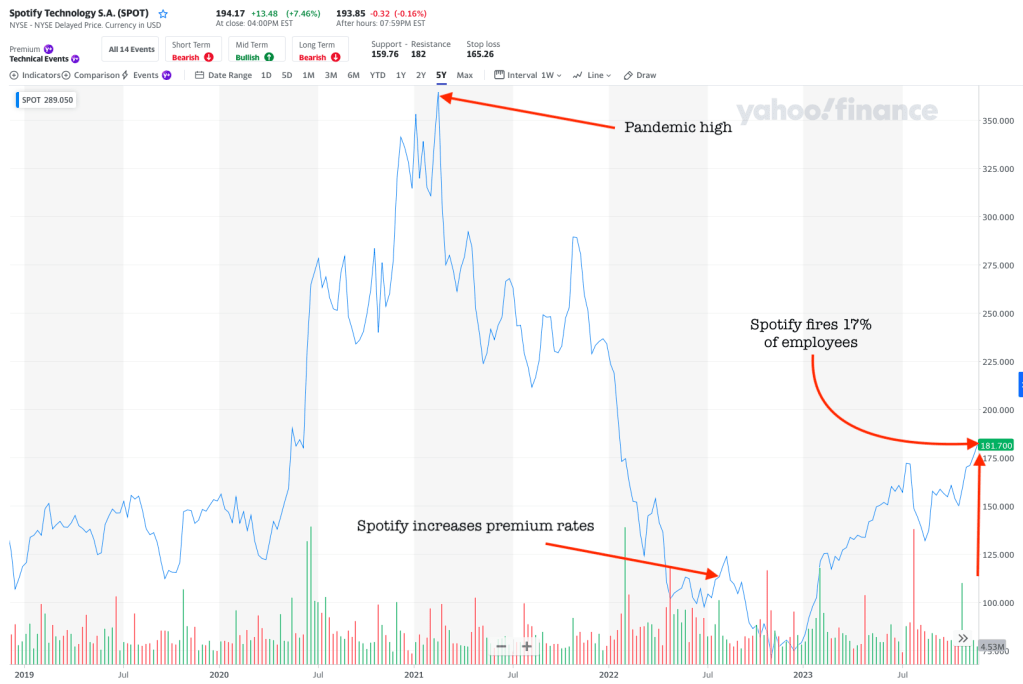
Harsh?  Not really, at least not from a share price point of view. Spotify’s all time highest share price was during the COVID pandemic.

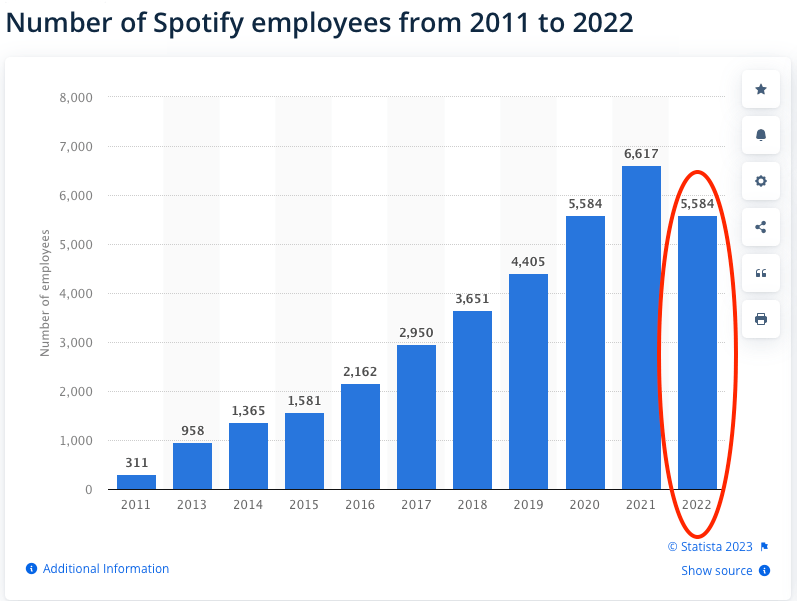
Spotify CEO Daniel Ek and the press tells us that Spotify is cutting 1,500 jobs which works out to about 17% of Spotify employees. Which works out to a pre-layoff workforce of 8,823.  So let’s start there—that workforce number seems very high and is completely out of line with some recent data from Statista which is usually reliable.

If Statista is correct, Spotify employed 5,584 as of last year. Yet somehow Spotify’s 2023 workforce grew to 9200 according to the Guardian, fully 2/3 over that 2022 level without a commensurate and offsetting growth in revenue. That’s a governance question in and of itself.

Why the layoffs? The Guardian reports that Spotify CEO Daniel Ek is concerned about costs. He says “Despite our efforts to reduce costs this past year, our cost structure for where we need to be is too big.” Maybe I missed it, but the only time I can recall Daniel Ek being vocally concerned about Spotify’s operating costs was when it came to paying royalties. Then it was full-blown poor mouthing while signing leases for very expensive office space in 4 World Trade Center as well as other pricy real estate, executive compensation and podcasters like Harry & Meghan.

Mr. Ek announced his new, new thing:

Over the last two years, we’ve put significant emphasis on building Spotify into a truly great and sustainable business – one designed to achieve our goal of being the world’s leading audio company and one that will consistently drive profitability and growth into the future. While we’ve made worthy strides, as I’ve shared many times, we still have work to do. Economic growth has slowed dramatically and capital has become more expensive. Spotify is not an exception to these realities.

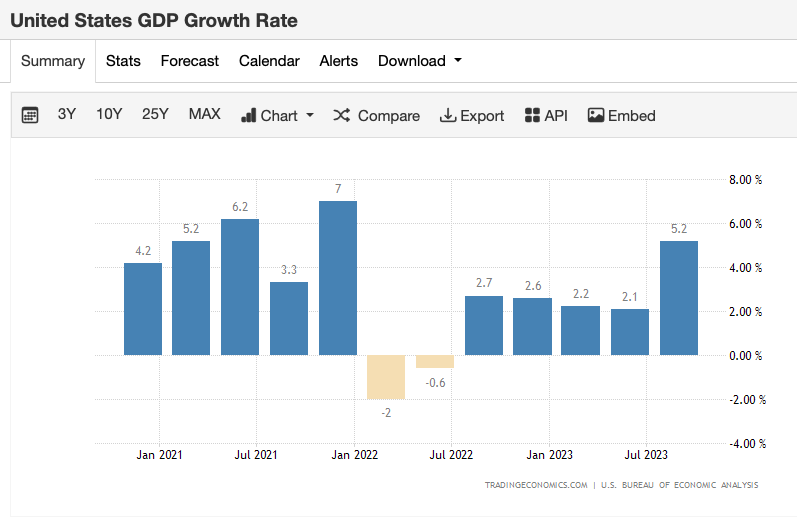
Which “economic growth” is that?

But, he is definitely right about capital costs.

Still, Spotify’s job cuts are not necessarily that surprising considering the macro economy, most specifically rents and interest rates. As recently as 2018, Spotify was the second largest tenant at 4 WTC. Considering the sheer size of Spotify’s New York office space, it’s not surprising that Spotify is now subletting five floors of 4 WTC earlier this year. That’s right, the company had a spare five floors. Can that excess just be more people working at home given Mr. Ek’s decision to expand Spotify’s workforce? But why does Spotify need to be a major tenant in World Trade Center in the first place? Renting the big New York office space is the corporate equivalent of playing house. That’s an expensive game of pretend.

Remember that Spotify is one of the many companies that rose to dominance during the era of easy money in response to the financial crisis that was the hallmark of quantitative easing and the Federal Reserve’s Zero Interest Rate Policy beginning around 2008. Spotify’s bankers were able to fuel Daniel Ek’s desire to IPO and cash out in the public markets by enabling Spotify to run at a loss because money was cheap and the stock market had a higher tolerance for risky investments. When you get a negative interest rate for saving money, Spotify stock doesn’t seem like a totally insane investment by comparison. This may have contributed to two stock buy-back programs of $1 billion each, Spotify’s deal with Barcelona FC and other notorious excesses.

As a great man said, don’t confuse leverage for genius. It was only a matter of time until the harsh new world of quantitative tightening and sharply higher inflation came back to bite. For many years, Spotify told Wall Street a growth story which deflected attention away from the company’s loss making operations. A growth story pumps up the stock price until the chickens start coming home to roost. (Growth is also the reason to put off exercising pricing power over subscriptions.) Investors bought into the growth story in the absence of alternatives, not just for Spotify but for the market in general (compare Russell Growth and Value indexes from 2008-2023). Cutting costs and seeking profit is an example of what public company CEOs might do in anticipation of a rotational shift from growth to value investing that could hit their shares.

Never forget that due to Daniel Ek’s super-voting stock (itself an ESG fail), he is in control of Spotify. So there’s nowhere to hide when the iconography turns to blame. It’s not that easy or cheap to fire him, but if the board really wanted to give him the heave, they could do it.

I expect that Ek’s newly found parsimony will be even more front and center in renegotiations of Spotify’s royalty deals since he’s always blamed the labels for why Spotify can’t turn a profit. Not that WTC lease, surely. This would be a lot more tolerable from someone you thought was actually making an effort to cut all costs not just your revenue. Maybe that will happen, but even if Spotify became a lean mean machine, it will take years to recover from the 1999 levels of stupid that preceded it.

Hellooo Apple. One big thinker in music business issues calls it “Spotify drunk” which describes the tendency of record company marketers to focus entirely on Spotify and essentially ignore Apple Music as a distribution partner. If you’re in that group drinking the Spotify Kool Aid, you may want to give Apple another look. One thing that is almost certain is that that Apple will still be around in five years.

Just sayin.

Mechanicals on Physical and Downloads Get COLA Increase; Nothing for Streaming

Recall that the “Phonorecords IV” minimum mechanical royalties paid by record companies on physical and downloads increased from 9.1¢ to 12¢ with an annual cost of living adjustment each year of the PR IV rate period. The first increase was calculated by the Copyright Royalty Judges and was announced this week. That increase was from 12¢ to 12.40¢ and is automatic effective January 1, 2024.

Note that there is no COLA increase for streaming for reasons I personally do not understand. There really is no justification for not applying a COLA to a government mandated rate that blocks renegotiation to cover inflation expectations. After all, it works for Edmund Phelps.

The Federal Trade Commission on Copyright and AI

The FTC’s comment in the Copyright Office AI inquiry shows an interesting insight to the Commission’s thinking on some of the same copyright issues that bother us about AI, especially AI training. Despite Elon Musk’s refreshing candor of the obvious truth about AI training on copyrights, the usual suspects in the Copyleft (Pam Samuelson, Sy Damle, etc.) seem to have a hard time acknowledging the unfair competition aspects of AI and AI training (at p. 5):

Conduct that may violate the copyright laws––such as training an AI tool on protected expression without the creator’s consent or selling output generated from such an AI tool, including by mimicking the creator’s writing style, vocal or instrumental performance, or likeness—may also constitute an unfair method of competition or an unfair or deceptive practice, especially when the copyright violation deceives consumers, exploits a creator’s reputation or diminishes the value of her existing or future works, reveals private information, or otherwise causes substantial injury to consumers. In addition, conduct that may be consistent with the copyright laws nevertheless may violate Section 5.

We’ve seen unfair competition claims pleaded in the AI cases–maybe we should be thinking about trying to engage the FTC in prosecutions.

Will Songwriters Wish they had Gotten Inflation Protection on Streaming Mechanicals?

When the dust settled after the last mechanical royalty rate setting we saw the Copyright Royalty Board approving two different settlements for mechanical royalties. The royalty rate for physical mechanicals and permanent downloads get a significant rate increase and the royalty rate for streaming mechanicals got a theoretical rate increase. However, only physical mechanicals and downloads got both a rate increase and a cost of living adjustment (or “inflation protection”). Streaming mechanicals did not get inflation protection–could have but did not.

This means that the same writers on the same song in the same recording will get inflation protection when that song is sold in physical formats (such as the surging vinyl configuration) or downloads, but will not when that song is sold in streaming formats. What is the logic to this? One difference is that record companies are paying on the physical and download side and the lived experience of record companies necessarily puts them closer to songwriters than the services. And the lived experience of streaming companies is…well, breakfast at Buck’s, Hefner level private jets, warmed bidets and beach volleyball courts at home with imported sand. (Although Sergey Brin has a real beach in his Malibu home. Surf’s up in geekville. Maybe he’ll send DiMA to represent him at the Malibu city council meetings if Malibew-du-bumbum is ready for Silicon Valley style lobbying to decide who can surf Sergey’s beach and the color scheme of their boards. Kind of like the Palo Alto Architectural Review Board with a tan.)

The Big Google

We heard that inflation was transitory, which may prove true–or not. Transitory or not, that’s not an argument against treating songwriters equally on two versions of the same mechanical license; rather, it’s a reason why it should be easy to afford if you cared about sustaining songwriters at least as much as investing in ChatGPT to replace them.

However, in one of the great oopsies of the 21st Century, it doesn’t look much like inflation is all that transitory. Based on some of the posts I wrote starting in 2020, I think we can see that inflation is way worse on the items that count for songwriters like “food at home,” rent, utilities and gasoline. Very often the number of Americans working a job is used to counter the lived experience of the high number of people who believe the economy is tanking. But what about that jobs report? More jobs equals good times, yes? There’s something weird about the math of the jobs report which should make you wonder about whether that’s such a great argument.

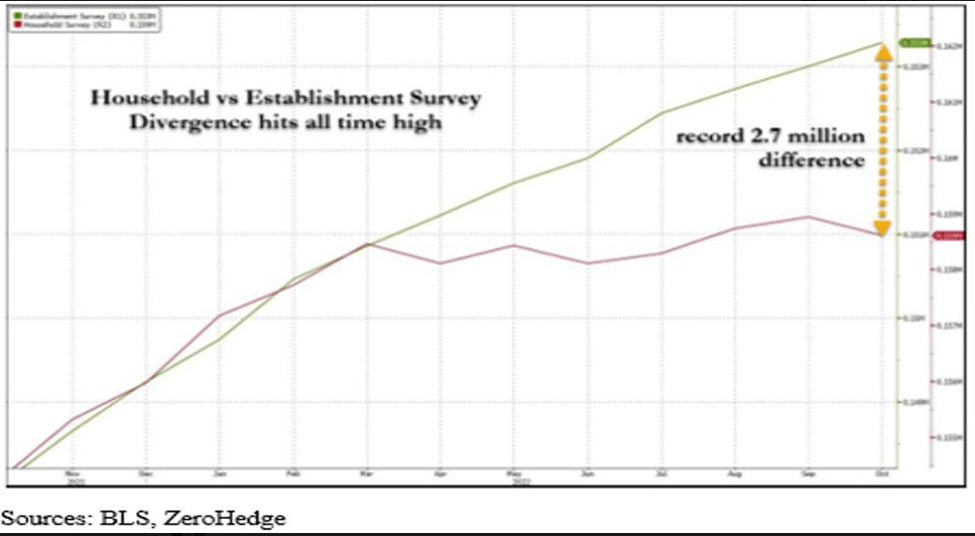
If I still have your attention after the “math” word, there are two standard surveys of the economy used to measure jobs that measure different components of the jobs created in a given measurement period. These data are the “Establishment Payroll Survey” which measures the total number of jobs in the U.S. economy. That’s the number most people refer to with the “jobs report” you hear so much about. (More formally titled the “Current Establishment Statistics (Establishment Survey).”)

There’s another number called the “Household Survey” that measures the total number of jobs per household (more formally titled the Current Population Survey).

Note that the Establishment survey measures all jobs; the Household survey measures jobs per household. If you had two or three jobs, the Household survey would count you as “employed”; the Establishment survey would count the number of jobs you had. Now note that there is currently 2.7 million job difference between the two. Why?

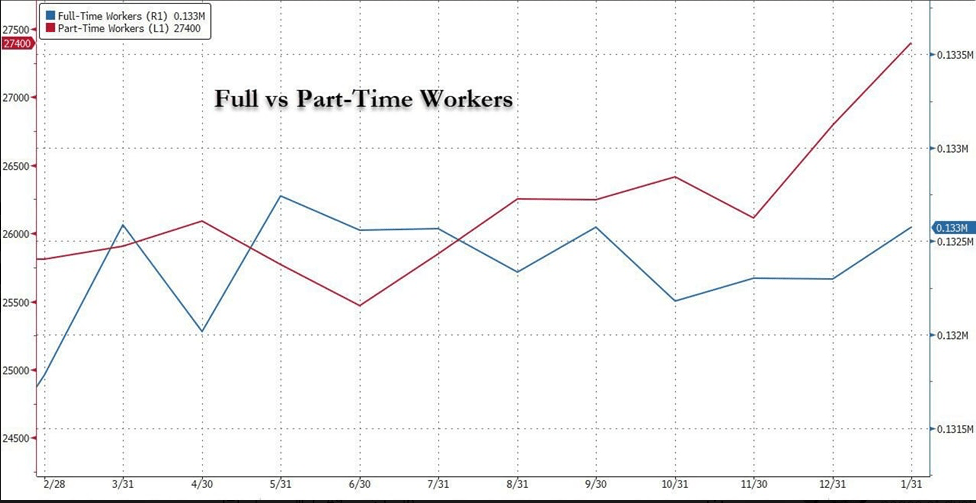
I’m not really sure, but it would appear that there are more jobs than households. That difference may occur from time to time, but it’s quite a big difference at the moment and seems to be a trend that’s confirmed by another statistic: the surge in part-time jobs as shown in this chart:

So what’s missing is how many jobs that are counted in the Establishment survey are held by any one or two household members in the Household survey. If you were to draw the conclusion that every job in the Establishment survey is a full time job held by the primary source of support in a household and that when the Establishment number is rising things are looking up, that may be a leap unsupported by evidence. That may be one of the things you’d want to know if you were trying to predict how well the government’s songwriter royalties would hold their value over the five year rate period.

The sharp increase since June in the number of part time workers may suggest that more people are working multiple jobs and not that more people are working. In fact, the total number of full time workers seems to have declined by a bit over the same period.

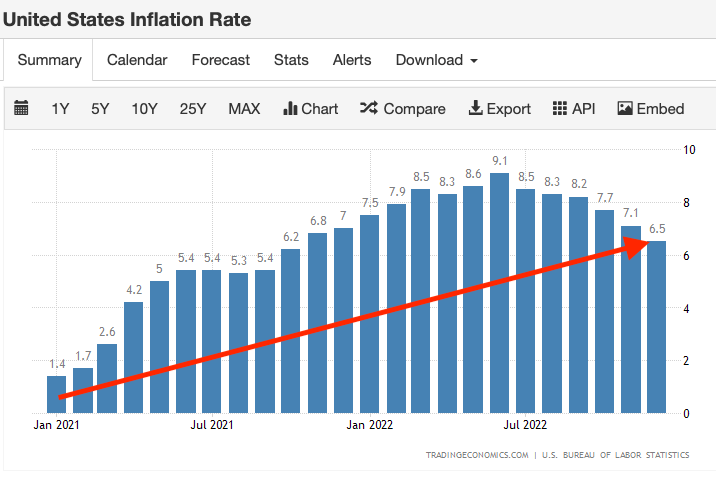
That’s not to say that inflation protection is not a serious requirement of everyone who relies on the government for their livelihood. While the inflation rate has declined a bit recently, possibly due to the Federal Reserve abandoning its zero interest rate policy, it is still significant. In my view, nothing in the employment report suggests otherwise and continues to highlight the importance of songwriters being accorded the same inflation protection on streaming as they are on physical and downloads.

Just because the physical rate is paid by the record companies and the streaming rate is paid by the richest corporations in history does not excuse the distinction. Each should be protected equally.

The Enemy Gets a Vote: How will Big Tech respond to “CRB Reform”?

You may recently have heard the term “CRB reform” tossed around by various music industry entities. The term usually means changes to the law or regulations governing the Copyright Royalty Board in the interests of the lobbyists or the big music publishers. And yes, so far it has just been the publishers raising “CRB reform” aside from the odd comment of A2IM filed with the CRB that would, if adopted, create a massive change to the Copyright Act and make controlled composition clauses even more pernicious. (As I explained in my reply comment, I don’t think the CRB has the authority to make the change A2IM asked nor do I think they have the inclination for self-surgery judging by their opinion concluding the “Subpart B” proceeding in Phonorecords IV.)

What you don’t hear, what you never hear, is how the music users will respond, particularly the Big Tech companies that participate in the Phonorecords proceedings for streaming mechanicals. You don’t even hear speculation about that little issue, which ignores the very important fact that the enemy gets a vote. (If you don’t think Amazon, Apple, Google, Pandora and Spotify are the enemy, then ask yourself why they brought 26 lawyers to the Phonorecords IV streaming mechanical proceeding and conducted a scorched earth discovery campaign in that proceeding. Not to mention dragging out Phonorecords III as long as they possibly could without remorse. And then there’s UGC 2.0 called AI and ChatGPT designed to take the human out of transhumanism. That’s not how friends treat each other.)

The fact that you don’t hear anything about how Big Tech views “CRB Reform” suggests one of two things is happening. Either there is no deal in place with the services or worse yet there is a deal but it just hasn’t been surfaced yet. That would be in keeping with the disastrous 2006 S1RA legislation (“Section 115 Reform Act“) the first version of the Harry Fox Preservation Act that failed, but eventually became Title I of the Music Modernization Act.

The way that one worked was Big Tech woke up and said, oh, you want to amend the Copyright Act? We have some things we want, too. (Big Tech in those days mostly Google led by their many proxy NGO front groups including the person of Gigi Sohn who is now unbelievably an FCC commissioner). So not only could Big Tech bring their considerable lobbying muscle to bear on any statutory “reform” (which usually means a further consolidation of power in the ruling class by closing loopholes favorable to the people), but they might make it actually worse.

For example, it would not be difficult for Big Tech to leverage their superior numbers and legal geographical advantage by expanding the discovery and appeal rights in CRB proceedings. That will essentially be the death knell of songwriters ever being able to defend themselves. Both the publishers and Big Tech would probably like to make certain that there is never again a George Johnson figure appearing in the proceedings much less 50 George Johnson’s (apologies for the casual objectification, but you get the idea). The lobbyists and lawyers on both sides share that special Washington moral hazard of wanting everything involving the government to be as complicated and lengthy as possible. Boy have they done that with the impenetrable streaming mechanicals calculations and expensive negotiations to keep it complicated so only the big guys can afford the accounting systems to use the government’s license.

How would anyone keep Big Tech from slurping at that trough if you opened up the CRB statutes and regulations? You can’t stop them–except one way.

If our side in the proceedings found voluntary changes everyone could agree to that would not require amending the statutes, then for better or worse we would be able to operate on the status quo. For example, the publishers could agree that there would be an independent songwriter advocate who would be included in the negotiations. They could agree any one of a number of things that would result in better treatment of songwriters. As long as we are stuck with the compulsory license, we could at least make it more representative.

But what no one wants is to have Big Tech leverage disagreements inside our house over the length of our table to come up with even more limitations and exceptions to copyright. To my knowledge, there is no agreement from the other side to stay out of this issue. If there is such a deal, I’d really like to know what was given up to get it. If there isn’t, I’d love to hear the plan from the smart people.

I’m all ears.

Applying a Cost of Living Adjustment to Streaming Mechanicals

You are no doubt aware that the Copyright Royalty Judges handed down a final rule adopting the settlement covering streaming mechanicals reached by the major publishers and the richest and most dominant corporations in the history of Planet Earth: Apple, Amazon, Google, Pandora and Spotify. There are many who are dissatisfied with the negotiated rate, no doubt. There are many who are disappointed that the Judges perpetuated the mind-numbing complexity of the royalty calculation methodology (which probably costs more to account on a per-stream basis than the payable royalty).

That’s all true, but is a byproduct of the discriminatory practices frozen in time at the CRB, a libertarian hell-scape preserved in amber. As if taking a trip to Jurassic World (or at least 2009) wasn’t bad enough, the Judges refused even to place a toe onto the arc of the moral universe as they just did in the Subpart B rate setting in the same proceeding (i.e., the Phonorecords IV rates that abandoned the frozen mechanical and adopted an annual cost of living adjustment for physical and permanent download configurations).

I discuss this in more detail in a post on MusicTechPolicy in which I question whether a hidebound adoption of rates that fail to apply a COLA equally and treat likes alike in the same proceeding is lawful, much less good policy. While the Judges focus on giving the negotiating parties, aka the rich people, what they want and ignore the notorious unfairness of the Copyright Royalty Board whose rulings apply to all songwriters in the world who ever lived or may ever live regardless of representation, I argue that applying the same COLA calculation to streaming as to Subpart B configurations solves the problem. This post will lay out a simple method of implementing a COLA for streaming.

The policy goal would be to apply the COLA formula to streaming. Because the streaming formula is so unduly complex, it’s easy to understand the resistance to adding still another step. Remember that the greater than/lesser of monthly calculation is a series of steps that gets to a per-play rate of sorts. All of the greater of/lesser than calculations have been fought and salivated over by dozens of lawyers (literally) so changing any one of them is probably not productive and in my mind is not necessary to give effect to the COLA. Remember that in the history of the government’s mechanical rate, the COLA was applied to a rate as an uplift, not as a way to calculate a rate. The point of a COLA is always to preserve the value of the government’s rate and recognizes that the songwriter will not have a chance to revisit the rate for five year tranches and a lot can happen in five years.

The easiest way to apply a COLA to streaming is to derive the per-play rate given the current formula and then uplift it with a COLA. The Judges already have a COLA based on CPI-U . The Judges need only apply the COLA as a legal modification to the streaming mechanical and accept the base line rates in the negotiated settlement. Otherwise, the exact same songs with the exact same songwriters for the exact same recording in the exact same proceeding will have a COLA when exploited by record companies and none when exploited by the rich people. This result just seems arbitrary. The labels having shown the way to a fair result should be followed by the DSPs.

We raised this approach in a Phonorecords IV comment I filed for David Lowery, Helienne Lindvall and Blake Morgan:

Applying the COLA to Section 115 may actually have a simple solution. The Judges already have a COLA formula. That formula can simply be applied as a step (5) in 37 CFR §385.21(b). This way the negotiated settlement terms are not re- opened.

Adding a COLA uplift to the applicable royalty calculation is simple. First, determine the applicable payable royalty for the accounting period concerned under the negotiated rates. Then apply the COLA formula derived by the Judges as an uplift to the payable royalties as a last step in the royalty calculation. The COLA could be calculated either annually or monthly although monthly seems more appropriate and accurate.

The uplifted amount (after any uplifted overtime adjustment to plays) would then be reflected on the applicable Copyright Owner’s royalty statement as the payable royalty for that accounting period.

This seems like a simple solution that brings the streaming mechanical out of Jurassic World and into the Era of the Songwriter.

Thinking Outside the Pie: @legrandnetwork Study for GESAC Highlights Streaming Impact on Choking Diversity and Songwriter Royalties

Emmanuel Legrand prepared an excellent and important study for the European Grouping of Societies of Authors and Composers (GESAC) that identifies crucial effects of streaming on culture, creatives and especially songwriters. The study highlights the cultural effects of streaming on the European markets, but it would be easy to extend these harms globally as Emmanuel observes.

For example, consider the core pitch of streaming services that started long ago with the commercial Napster 2.0 pitch of “Own Nothing, Have Everything”. This call-to-serfdom slogan may sound good but having infinite shelf space with no cutouts or localized offering creates its own cultural imperative. And that’s even if you accept the premise the algorithmically programed enterprise playlists on streaming services should not be subject to the same cultural protections for performers and songwriters as broadcast radio–its main competitor.

[This] massive availability of content on [streaming] platforms is overshadowed by the fact that these services are under no positive obligations to ensure visibility and discoverability of more diverse repertoires, particularly European works….[plus]  the initial individual subscription fee of 9.99 (in Euros, US dollars, or British pound) set in 2006, has never increased, despite the exponential growth in the quality, amount of songs, and user-friendliness of music streaming services.

Artists working new recordings, especially in a language other than English, are forced to fight for “shelf space” and “mindshare”–that is, recognition–against every recording ever released. While this was always true theoretically; you never had that same fight the same way at Tower Records.

This is not theoretically true on streaming platforms–it is actually true because these tens of millions of historical recordings are the competition on streaming services. When you look at the global 100 charts for streaming services, almost all of the titles are in English and are largely Anglo-American releases. Yes, we know–Bad Bunny. But this year’s exception proves the rule.

And then Emmanuel notes that it is the back room algorithms–the terribly modern version of the $50 handshake–that support various payola schemes:

The use of algorithms, as well as bottleneck represented by the most popular playlists, exacerbates this. Furthermore, long-standing flaws in the operations of music streaming platforms, such as “streaming fraud”, “ghost/fake artists”, “payola schemes”, “royalty free content” and other coercive practices [not to mention YouTube withholding access to Content ID] worsen the impact on many professional creators….

This report suggests solutions to bring greater transparency in the use of algorithms and invites stakeholders to undertake a review of the economic models of streaming services and evaluate how they currently affect cultural diversity which should be promoted in its various forms — music genres, languages, origin of performers and songwriters, in particular through policy actions.

MTS readers will recall my extensive dives into the hyperefficient market share distribution of streaming royalties known as the “big pool” compared to my “ethical pool” proposal and the “user centric” alternative. As Emmanuel points out, the big pool royalty model belies a cultural imperative–if you are counting streams on a market share basis that results in the rich getting richer based on “stream share” that same stream share almost guarantees that Anglo American repertoire will dominate in every market the big streamers operate.

Emmanuel uses French-Canadian repertoire as an example (a subject I know a fair amount about since I performed and recorded with many vedettes before Quebecoise was cool).

A lot of research has been made in Canada with regards to discoverability, in particular in the context of French-Canadian music, which is subject to quotas for over the air broadcasters which however do not apply to music streaming services. The research shows that while the lists of new releases from Québec studied are present in a large proportion on streaming platforms, they are “not very visible and very little recommended.” 

It further shows that the situation is even worse when it is not about new releases, including hit music, when the presence of titles “drops radically.” It is not very difficult to imagine that if we were to swap Québec in the above sentence with the name of any country from the European Union [or any non-Anglo American country], and even with music from the European Union as a whole, we could find similar results.

In other words, there may be aggregators with repertoire in languages other than English that deliver tracks to streamers in their countries, but–absent localized airplay rules–a Spotify user might never know the tracks were there unless the user already knew about the recording, artist or songwriter. (Speaking of Canada, check the MAPL system.)

This is a prime example of why Professor Feijoo and I proposed streaming remuneration in our WIPO study to allow performers to capture the uncompensated capital markets value to the enterprise driven by these performers. Because of the market share royalty system, revenues and royalties do not compensate all performers, particularly regional or non-featured performers (i.e., session players and singers) who essentially get zero compensation for streaming.

Emmanuel also comments on the imbalance in song royalty payments and invites a re-look at how the streaming system biases against songwriters. I would encourage everyone to stop thinking of a pie to be shared or that Johnny has more apples–when the services refuse to raise prices in order to tell a growth story to Wall Street or The City, measuring royalties by a share of some mythical royalty pie is not ever going to get it done. It will just perpetuate a discriminatory system that fails to value the very people on whose backs it was built be they songwriters or session players.

We must think outside the pie.