Blowing up the Compulsory in Washington DC

There is loose talk these days about something called “blowing up the compulsory” license for songs in the US under Section 115 of the Copyright Act. This is odd. It is particularly odd given that a lot of the same people now trying to find a parade to get in front of were the very people who championed–barely five years ago–the bizarre and counterintuitive Title I of the Music Modernization Act (aka the Harry Fox Preservation Act). Title I was the part of the MMA legislation that created the Mechanical Licensing Collective and invited Big Tech even further into our house. (Don’t forget there were other important parts of what became the MMA that were actually well thought out and helpful.)

The geniuses who came up with Title I are also the same people who refused to include artist pay for radio play in the package of bills that became the sainted MMA back in 2018. So at the very least before anyone takes seriously any plan to “blow up the compulsory”, the proponents who want buy-in on that change in policy can get right with history and atone by declaring their support–vocal support–for artist pay for radio play. This would be supporting the American Music Fairness Act recently introduced in this Congress by our allies Senator Blackburn and Rep. Issa and their colleagues.

It is important to realize that “blowing up the compulsory” cannot be a shoot-from-the-hip reaction to Spotify taking advantage of the gaping bundling loophole left wide open in the highly negotiated streaming mechanical settlement under Phonorecords IV. There are too many factors in that big a shock to the system. Songwriters around the world should not get caught up in throwing toys out of the pram along with 100 years of licensing practice just because they made a bad deal. This is particularly true given that the smart people handed over the industry’s bargaining leverage against Big Tech as part of the MMA debacle in return for what? Allowing Spotify’s public stock offering to go forward on schedule? Another genius move by the smart people. I wonder what they got out of that deal? I mean this stock offering, you know, the one that made Daniel Ek a billionaire:

A good thing we didn’t let another MTV build their business on our backs.

It is also important to recognize the obvious–the compulsory is not really a compulsory, it’s a compulsory in the absence of a negotiated direct agreement such as the one that Universal recently made with Spotify. Copyright owners have always been free to make direct deals with music users. The compulsory is not just a license, it is also a compulsory rate that casts a long commercial shadow over even the big industry negotiations and certainly over rates in the rest of the world.

And for reasons of historical accident those rates are not determined in Nashville, or New York, or Los Angeles, or even Austin, but rather in Washington, DC in front of the Copyright Royalty Board–an agency that itself is on pretty shakey Constitutional grounds after a Supreme Court decision in the 2020 Term. So if we’re going to “blow up the compulsory”, maybe a good place to start is not having lobbyists make these decisions.

Even if the former opponents of artist pay for radio play come to their senses and support fundamental fairness for artists, that’s just a good start. We have to acknowledge that “blowing up the compulsory” is not going to be well received by the streaming services for starters. (Not to mention the labels.) Those would be the same streaming services that the smart people invited into our house by means of underwriting the costs of the Mechanical Licensing Collective.

I don’t know how others feel about it, but I for one am not inclined to go to the mattresses to assuage the multimillion dollar whiplash that the services must feel. We should understand that Big Tech are being asked to abandon their intensely successful lobbying campaign that led songwriters and publishers right down the garden path with the MMA. Not to mention the millions they have spent creating the MLC so the MLC could pass through some of those monies to HFA.

Before Congress goes along with blowing up Title I of the MMA, they’re probably going to want an explanation of why this isn’t just another fine mess in a long string of fine messes. That will probably involve a study by the Copyright Office like the one the Office was asked by a songwriter to conduct as part of the MLC’s five year review (but declined to undertake at that time). Fortunately that five year review is still dragging on over a year after it started so this would be a perfect time to launch that study. Perhaps Congress will instruct them to do so? At this rate, it will be time for a new five year review before the first one gets completed, so as usual, time is not a factor.

Even if the services and Congress would go along with “blowing up the compulsory” what does that mean for the MLC and the sainted musical works database? Remember, the lack of a database was the excuse that services relied on for years for their sloppy licensing practices. The database was the fig leaf they needed to avoid iterative infringement lawsuits for their failure–or the failure of the services outside licensing consultants.

It also must be said that the services were invited by the same smart people to spend millions on setting up the MLC. In fairness they have a right to get the benefit of the bargain they were invited to make by the same people who now want to blow it up. Or get their money back. Plus they have to like the leverage they were handed to go to Congress and complain, and complain quite believably with great credibility.

And perhaps most important of all is what happens to the $1.2 BILLION in publicly traded securities that the MLC announced on their 2023 tax return that they are (or at least were) holding in their name? Does that get blown up, too?

Fired for Cause:  @RepFitzgerald Asks for Conditional Redesignation of the MLC

U.S. Representative Scott Fitzgerald joined in the MLC review currently underway and sent a letter to Register of Copyrights Shira Perlmutter on August 29 regarding operational and performance issues relating to the MLC.  The letter was in the context of the five year review for “redesignation” of The MLC, Inc. as the mechanical licensing collective.  (That may be confusing because of the choice of “The MLC” as the name of the operational entity that the government permits to run the mechanical licensing collective.  The main difference is that The MLC, Inc. is an entity that is “designated” or appointed to operationalize the statutory body.  The MLC, Inc. can be replaced.  The mechanical licensing collective (lower case) is the statutory body created by Title I of the Music Modernization Act) and it lasts as long as the MMA is not repealed or modified. Unlikely, but we live in hope.)

I would say that songwriters probably don’t have anything more important to do today in their business beyond reading and understanding Rep. Fitzgerald’s excellent letter.

Rep. Fitzgerald’s letter is important because he proposes that the MLC, Inc. be given a conditional redesignation, not an outright redesignation.  In a nutshell, that is because Rep. Fitzgerald raises many…let’s just say “issues”…that he would like to see fixed before committing to another five years for The MLC, Inc.  As a member of the House Judiciary Subcommittee on Courts, Intellectual Property, and the Internet, Rep. Fitzgerald’s point of view on this subject must be given added gravitas.

In case you’re not following along at home, the Copyright Office is currently conducting an operational and performance review of The MLC, Inc. to determine if it is deserving of being given another five years to operate the mechanical licensing collective.  (See Periodic Review of the Mechanical Licensing Collective and the Digital Licensee Coordinator (Docket 2024-1), available at https://www.copyright.gov/rulemaking/mma-designations/2024/.)

The redesignation process may not be quickly resolved.  It is important to realize that the Copyright Office is not obligated to redesignate The MLC, Inc. by any particular deadline or at all.  It is easy to understand that any redesignation might be contingent on The MLC, Inc. fixing certain…issues…because the redesignation rulemaking is itself an operational and performance review.  It is also easy to understand that the Copyright Office might need to bring in some technical and operational assistance in order to diligence its statutory review obligations.  This could take a while.

Let’s consider the broad strokes of Rep. Fitzgerald’s letter.

Budget Transparency

Rep. Fitzgerald is concerned with a lack of candor and transparency in The MLC, Inc.’s annual report among other things. If you’ve read the MLC’s annual reports, you may agree with me that the reports are long on cheerleading and short on financial facts.  It’s like The MLC, Inc. thought they were answering the question “How can you tolerate your own awesomeness?”   That question is not on the list.  Rep. Fitzgerald says “Unfortunately, the current annual report lacks key data necessary to examine the MLC’s ability to execute these authorities and functions.”  He then goes on to make recommendations for greater transparency in future annual reports.

I agree with Rep. Fitzgerald that these are all important points.  I disagree with him slightly about the timing of this disclosure.  These important disclosures need not be prospective–they could be both prospective and retroactive. I see no reason at all why The MLC, Inc. cannot be required to revise all of its four annual reports filed to date (https://www.themlc.com/governance) in line with this expanded criteria.  I am just guessing, but the kind of detail that Rep. Fitzgerald is focused on are really just data that any business would accumulate or require in the normal course of prudently operating its business.  That suggests to me that there is no additional work required in bringing The MLC, Inc. into compliance; it’s just a matter of disclosure.

There is nothing proprietary about that disclosure and there is no reason to keep secrets about how you handle other people’s money.  It is important to recognize that The MLC, Inc. only handles other people’s money.  It has no revenue because all of the money under its management comes from either royalties that belong to copyright owners or operating capital paid by the services that use the blanket license.  It should not be overlooked that the services rely on the MLC and it has a duty to everyone to properly handle the funds. The MLC, Inc. also operates at the pleasure of the government, so it should not be heard to be too precious about information flow, particularly information related to its own operational performance. Those duties flow in many directions.

Board Neutrality

The board composition of the mechanical licensing collective (and therefore The MLC, Inc.) is set by Congress in Title I.  It should come as no surprise to anyone that the major publishers and their lobbyists who created Title I wrote themselves a winning hand directly into the statute itself.  (And FYI, there is gambling at Rick’s American Café, too.)  As Rep. Fitzgerald says:  

Of the 14 voting members, ten are comprised of music publishers and four are songwriters. Publishers were given a majority of seats in order to assist with the collective’s primary task of matching and distributing royalties. However, the MMA did not provide this allocation in order to convert the MLC into an extension of the music publishers.

I would argue with him about that, too, because I believe that’s exactly what the MMA was intended to do by those who drafted it who also dictated who controlled the pen.  This is a rotten system and it was obviously on its way to putrefaction before the ink was dry.

For context, Section 8 of the Clayton Act, one of our principal antitrust laws, prohibits interlocking boards on competitor corporations.  I’m not saying that The MLC, Inc. has a Section 8 problem–yet–but rather that interlocking boards is a disfavored arrangement by way of understanding Rep. Fitzgerald’s issue with The MLC, Inc.’s form of governance:

Per the MMA, the MLC is required to maintain an independent board of directors. However, what we’ve seen since establishing the collective is anything but independent. For example, in both 2023 and 2024, all ten publishers represented by the voting members on the MLC Board of Directors were also members of the NMPA’s board.  This not only raises questions about the MLC’s ability to act as a “fair” administrator of the blanket license but, more importantly, raises concerns that the MLC is using its expenditures to advance arguments indistinguishable from those of the music publishers-including, at times, arguments contrary to the positions of songwriters and the digital streamers.

Said another way, Rep. Fitzgerald is concerned that The MLC, Inc. is acting very much like HFA did when it was owned by the NMPA.  That would be HFA, the principal vendor of The MLC, Inc. (and that dividing line is blurry, too).

It is important to realize that the gravamen of Rep. Fitzgerald’s complaint (as I understand it) is not solely with the statute, it is with the decisions about how to interpret the statute taken by The MLC, Inc. and not so far countermanded by the Copyright Office in its oversight role.  That’s the best news I’ve had all day.  This conflict and competition issue is easily solved by voluntary action which could be taken immediately (with or without changing the board composition).  In fact, given the sensitivity that large or dominant corporations have about such things, I’m kind of surprised that they walked right into that one.  The devil may be in the details, but God is in the little things.

Investment Policy

Rep. Fitzgerald is also concerned about The MLC, Inc.’s “investment policy.”  Readers will recall that I have been questioning both the provenance and wisdom of The MLC, Inc. unilaterally deciding that it can invest the hundreds of millions in the black box in the open market.  I personally cannot find any authority for such a momentous action in the statute or any regulation.  Rep. Fitzgerald also raises questions about the “investment policy”:

Further, questions remain regarding the MLC’s investment policy by which it may invest royalty and assessment funds. The MLC’s Investment Policy Statement provides little insight into how those funds are invested, their market risk, the revenue generated from those investments, and the percentage of revenue (minus fees) transferred to the copyright owner upon distribution of royalties. I would urge the Copyright Office to require more transparency into these investments as a condition of redesignation.

It should be obvious that The MLC, Inc.’s “investment policy” has taken on a renewed seriousness and can no longer be dodged.

Black Box

It should go without saying that fair distribution of unmatched funds starts with paying the right people.  Not “connect to collect” or “play your part” or any other sloganeering.  Tracking them down. Like orphan works, The MLC, Inc. needs to take active measures to find the people to whom they owe money, not wait for the people who don’t know they are owed to find out that they haven’t been paid.  

Although there are some reasonable boundaries on a cost/benefit analysis of just how much to spend on tracking down people owed small sums, it is important to realize that the extraordinary benefits conferred on digital services by the Music Modernization Act, safe harbors and all, justifies higher expectations of those same services in finding the people they owe money.  The MLC, Inc. is uniquely different than its counterparts in other countries for this reason.

I tried to raise the need for increased vigilance at the MLC during a Copyright Office roundtable on the MMA. I was startled that the then-head of DiMA (since moved on) had the brass to condescend to me as if he had ever paid a royalty or rendered a royalty statement.  I was pointing out that the MLC was different than any other collecting society in the world because the licensees pay the operating costs and received significant legal benefits in return. Those legal benefits took away songwriters’ fundamental rights to protect their interests through enforcing justifiable infringement actions which is not true in other countries.

In countries where the operating cost of their collecting society is deducted from royalties, it is far more appropriate for that society to consider a more restrictive cost/benefit analysis when expending resources to track down the songwriters they owe. This is particularly true when no black box writer is granting nonmonetary consideration like a safe harbor whether they know it or not.

I got an earful from this person about how the services weren’t an open checkbook to track down people they owed money to (try that argument when failing to comply with Know Your Customer laws).  Grocers know more about ham sandwiches than digital services know about copyright owners. The general tone was that I should be grateful to Big Daddy and be more careful how I spend my lunch money. And yes I do resent this paternalistic response which I’m sorry to say was not challenged by the Copyright Office lawyer presiding who shortly thereafter went to work for Spotify.  Nobody ever asked for an open check.  I just asked that they make a greater effort than the effort that got Spotify sued a number of times resulting in over $50 million in settlements, a generous accommodation in my view. If anyone should be grateful, it is the services who should be grateful, not the songwriters.

And yet here we are again in the same place.  Except this time the services have a safe harbor against the entire world which I believe has value greater than the operating costs of the MLC.  I’d be perfectly happy to go back to the way it was before the services got everything they wanted and then some in Title I of the MMA, but I bet I won’t get any takers on that idea.

Instead, I have to congratulate Rep. Fitzgerald for truly excellent work product in his letter and for framing the issue exactly as it should be posed.  Failing to fix these major problems should result in no redesignation—fired for cause.

What to do with the MLC’s interest “float” on the black box?

MusicTechPolicy readers will have seen my post about the interest rate paid by the MLC on the rather sizable black box of “unmatched” funds sitting at a bank account (rumored to be City National Bank in Nashville).

That rate was modernized in the Music Modernization Act to be a floating rate: The Federal short term interest rate essentially set by the Federal Reserve. In fact, that particular federal rate is one of the lowest interest rates set by the Federal government and is the kind of interest rate you would want to be obligated pay–very low–if you knew you’d be in the business of holding large sums of money that you wanted to earn interest on yourself and make money on the spread, often called “the float.” (The black box is usually free money, so it’s actually an improvement.). For example, the bank prime loan rate is currently 5.5% that may be a good indicator of what you could get in the way of relatively risk free interest for a big lump sum–if not better for a really big lump sum, say $500,000,000.

The MLC is not, after all, the government, however much that fact might be lost on them. Why should the lowball government rate apply to the MLC instead of a competitive bank rate? Particularly when it comes to the substantial unmatched funds that songwriters and publishers are forced by the government to allow the MLC to hold and for which they control distribution–a bit of the old moral hazard there.

Indeed, you could also express that rate of involuntary saving as “prime plus x” where “x” is an additional money factor like 1%, so the rate floats upward to the songwriters’ advantage. Get some inspiration for this by looking at your credit card interest rate.

You probably have heard that the Federal Reserve is increasing the federal funds rate, and therefore all interest rates that are a function of the federal funds rate including the short term rate that the MLC is required by law to pay on the black box. The Federal Reserve is expecting to keep making significant increases in the federal interest rates in an effort to get inflation under control, which means that the MLC’s black box interest rate will also continue to increase significantly.

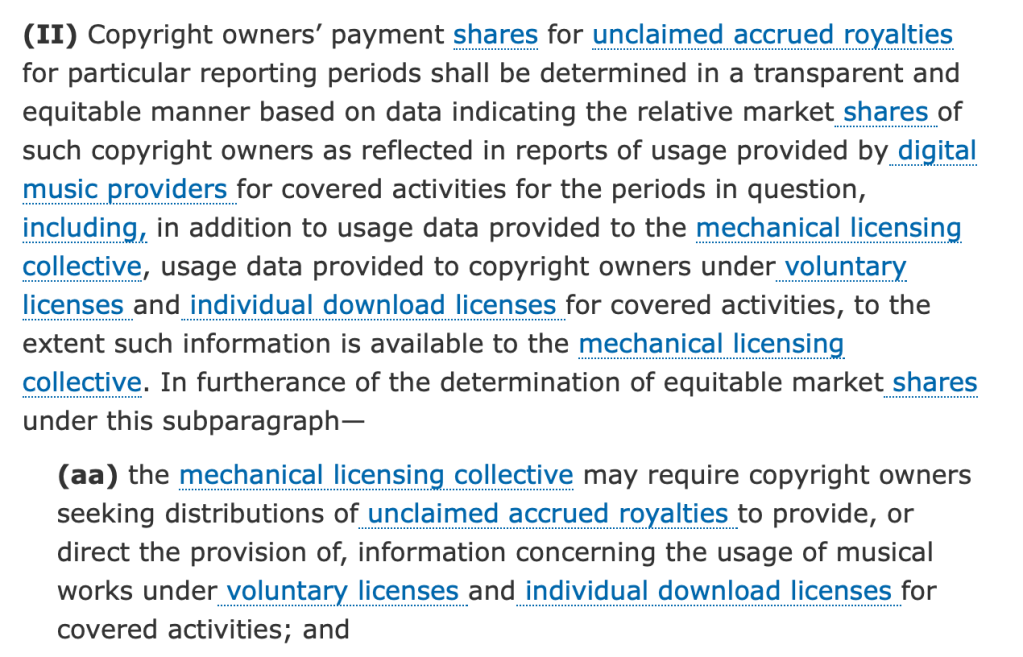
A quick recap: The MLC’s short term interest rate was 0.44% in January in keeping with then-prevailing Zero Interest Rate Policy (or the “lower bound”) of the Fed for the easy money years since the crash of 2008. But in August 2022 (that is, now) the MLC’s rate has increased to 2.84% monthly. The modern black box holding period in the Music Modernization Act is pretty clear:

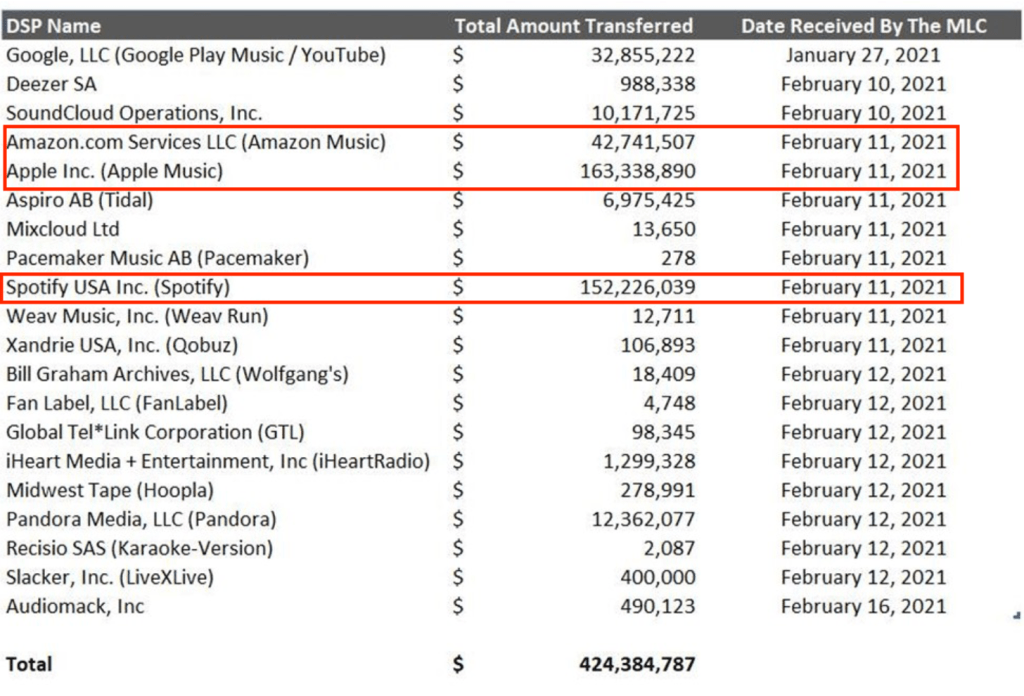
Also recall that the black box is to be held for an arbitrarily modern period of time while the MLC attempts to locate the rightful recipients as is their statutory burden under the MMA. Different numbers are thrown around for this holding period, but a three year holding period seems to be popular and has the benefit of having been modernized in the Music Modernization Act itself (see above). Bear in mind that the first tranche of “historical” black box (“historical” means “late” in this context) was $424,384,787 and was paid in February of 2021–nearly 18 months ago.

Also recall that we were not given any information that I am aware of as to when the services paying this rather large sum of other people’s money first accrued the black box. People who line up on the shorter holding period side of the argument generally favor rapid market share distributions which tends to help the majors; people on the longer holding period of time generally favor redoubled efforts to find the people who are actually owed the money.

The third group is that the MLC should simply find who is owed the money, have the money being held earn the highest rate of risk-free interest possible, and pay all of the interest money to the correct people when found and not have this cutesy limitation on the money factor paid out for holding OPM. Their argument goes something like your government takes away my right to negotiate my own rates, tells me how much I can charge, then makes it difficult to find me but easy to use my song and now you also want to take away the money you say I’m owed and give it to rich people I don’t know before I’ve had a change to claim it and pay yourselves to not do your jobs?

So we are at the midpoint of the three year statutory holding period. Although remember that this is a two pronged holding period of the earlier of 3 years after the MLC got the cash or 3 years after the date the service started holding the money that it subsequently transferred–a different holding period which would likely end sooner than the date the money was transferred to the MLC.

Although we know the date that the money was transferred in the aggregate to the MLC we may not know exactly when the money was accrued without auditing (although you would think that the MLC would release those dates since the timing of the accrual is relevant to the MMA calculation).

According to my reading of the statute, the modernized interest rate would likely attach from the time the money was accrued by the service, so should have been transferred to the MLC with accrued interest, if any. This may be in lieu of or in addition to a late fee. Very modern.

This leaves us with a couple questions. Remember that after the holding period, the black box is to be transferred on a market share basis to all the copyright owners who could be identified based on usage, which includes usage under voluntary licenses that are not administered by the MLC.

So this raises some questions:

  1. Why should the black box be divided up amongst copyright owners who have voluntary licenses and who are not administered by the MLC? They presumably have the most accurate books and statements and may have already had a chance to recover.
  2. What happens to the accrued interest at the time of distribution? Why should the market share distribution include interest on money that didn’t belong to the recipients?
  3. The statute takes the position that the MLC must pay the interest rate but is silent on how much interest the MLC can earn from the bank holding the substantial deposit of the unmatched monies. There’s nothing that requires the MLC to pay over all earned interest.

    Here’s a rough justice calculation of 3 years compound interest at current rates with steadily increasing black box. While the holding period started at the .44% rate, I ran the numbers at the 2.84% rate because it was easier–but also left out an estimate of the increase in rates that is surely to come. Since we are at the midpoint of the holding period already, this gives you an idea:

Hypothetical chart of growth rate of unmatched funds (historical and current) over a three year period at 2.84% compounded monthly interest rate

Is MLC Getting it Right in a Post-MMA World?

It’s becoming more obvious that the Mechanical Licensing Collective is not succeeding in its Congressional mandate to build the definitive music rights database so that all songwriters get paid. We often hear about MLC match rates being consistent with the “industry standard,” but this is pre-MMA thinking and is no longer relevant in a post-MMA world. (Not to mention the fact that it was these very “industry standards” that produced gigantic levels of unmatched payments that the MLC is mandated to fix.) As we will see, any match rate less than 100% is inconsistent with the MLC’s Congressional mandate which will be relevant when those in control of the MLC’s operations are reviewed by Congress in the not too distant future. Remember, The MLC, Inc. may be a private company in the traditional sense, but the MLC (different than The MLC, Inc.) is a statutory creation whose functionality is awarded to the current operators if they do a good job giving effect to the Congressional mandate. Congress can take that deal away and essentially “fire” The MLC, Inc.

It’s also becoming increasingly apparent that the Copyright Office has no stomach for its Congressionally mandated oversight role as they have been silent as the tomb so far no matter how absurd the results coming from MLC. The difference in post-MMA planning is that every royalty audit of MLC should be accompanied by a FOIA request to the Copyright Office regarding what they knew and when they knew it. Neither of those remedies were available in combination to songwriters in a pre-MMA environment. (If you took the king’s shilling and signed up for HFA you got a piece of an audit recovery of unknown providence for the most part often based on projections.)

Thankfully, due to the services paying for MLC operations as well as cost-shifting combinations of direct licensing, modified compulsory and service-supported blanket (and significant non-blanket) licensing, cost will never be a factor for The MLC, so the only consideration should be the benefit to all songwriters from getting it right

Not everyone sees it that way. I raised this point on a Copyright Office roundtable about the MLC and was immediately jumped on by both the Head of Government Relations for Spotify and the head of the Digital Media Association (neither of whom have rendered a royalty statement in their lives in all likelihood). They rejected my position that the MMA requires that there should be no cost benefit analysis in matching–remember, the services are supposed to pay for that matching functionality as part of their deal for the MMA safe harbor giveaway.

Now I’m sure that these DIMA companies are perfectly capable of getting a match rate that’s in the limit. Just because they’ve never done it before doesn’t mean they can’t ever do it. They just need a little guidance.

Fortunately we have Congressional guidance on this issue in the legislative history of Title I of the Music Modernization Act which states:

Testimony provided by Jim Griffin at the June 10, 2014 Committee hearing highlighted the need for more robust metadata to accompany the payment and distribution of music royalties….In an era in which Americans can buy millions of products via an app on their phone based upon the UPC code on the product, the failure of the music industry to develop and maintain a master database has led to significant litigation and underpaid royalties for decades. The Committee believes that this must end so that all artists are paid for their creations and that so-called ‘‘black box’’ revenue is not a drain on the success of the entire industry.

H. Rep. 115-651 (115th Cong. 2nd Sess. April 25, 2018) at 8. (my emphasis)

I realize that the Head of Government Relations for Spotify would want to protect her employer as would the head of DIMA and immediately try to kill the idea that the MLC had to set new industry standards and that the services would pay for it. And that’s a reasonable deal in exchange for the safe harbor giveaway.

But that wasn’t the deal they made. Now you can well say that the services are not required to give a blank check, that the costs should be reasonable, and that the services have something to say about how the money is spent particularly given their expertise with supporting the world’s intelligence agencies in finding things and people, or so says Mr. Snowden. But we already see that the services got a rube deal for their tens of millions in MLC costs if the match rate is simply as bad as it was before MMA (or worse). That wasn’t their deal, either.

The deal they made was to see to it that “all artists are paid for their creations”. No qualifiers.

All means all.


The Sound and the Fury: The Copyright Office Unmatched Report’s Confused Thesis

One of the first world problems with the Copyright Office unmatched report (and frankly the legislative history) is that the Office seems to confound matching transitory royalty payments with building a permanent asset. There is an inherent tension in utilizing a cost benefit analysis to decide which songs are “worth” identifying and paying compared to which songs are “worth” identifying to build the Congressionally mandated core asset of the Mechanical Licensing Collective–the public’s musical works database.

These are two entirely different projects. The unmatched report misses the opportunity to properly distinguish them and emphasize the priority that must be given to building the gold standard musical works database–for which the services pay and in consideration for which the services received a Congressionally mandated retroactive safe harbor for the legion of past infringements. It now becomes apparent that the services were not really serious about doing the hard work and wanted to do just enough to be able to get their safe harbor.

But what about the $424 million in black box, you say? Didn’t they pay beaucoup bucks to settle up with songwriters? Yes, it’s true–the services paid songwriters with what services said was the amount of the songwriters own money that the services owed them due to extraordinarily sloppy licensing practices. Hopefully when the accounting data is made public, we will have a better idea of whether this $424 million makes sense as the semi-accurate number. If, however, it turns out that the vast bulk of the retroactive payment of $424 million accrued over the last few years, that is, since the passing of the MMA Title I safe harbor to benefit those who need it least, it will become apparent that the “historic” retroactive payment was neither historic nor particularly retroactive. Watch the Eight Mile Style case in Tennessee for some answers on this where both Spotify and the Harry Fox Agency are being sued by Eminem’s publishers.

Yet this confusion over the difference between complying with the Congressional mandate to build an authoritative musical works database and some line in the legislative history that the lobbyists inserted about “play your part” is another reason why using a cost benefit analysis for identifying long tail royalty payments makes no sense.

The MLC is charged by Congress with creating the public musical works database–an asset. The MLC is also charged with accounting for royalties–a payment. The report says “The MLC should take reasonable steps to ensure that its data is of the highest possible quality, meaning, among other things, that it is as complete, accurate, up-to-date, and de-conflicted as possible, and is obtained from authoritative sources.” But not if the cost of quality data exceeds the royalties payable in a particular month?

Payments change, assets do not. The MLC are either building a “highest possible quality asset” or they are doing the usual 80/20 “industry standard” slop that is already becoming the MLC’s go-to excuse for failure. Because rest assured–it will always be someone else’s fault. Who do you think caused that “industry standard” to exist? One of the MLC’s principal vendors, mebbbie?

The services like the Title I safe harbor just fine, but obviously no one is interested in actually building an asset of the “highest quality” which is a different enterprise than royalty accounting.

Which is it going to be? I think we all know the answer. If we let it, it will be a lot of sound and fury signifying nothing.

What the MLC Can Learn from Orphan Works

As you may be aware, The MLC recently received $424 million as payment of the “inception to date” unmatched mechanical royalties held at a number of streaming platforms, sometimes called the “black box.” Why do we have a black box at all? For the same reason you have “pending and unmatched” at record companies–somebody decided to exploit the recording without clearing the song.

Streaming services will, no doubt, try to blame the labels for this missing data, but that dog don’t hunt. First, the streaming service has an independent obligation to obtain a license and therefore to know who they are licensing from. Just because the labels do, too, doesn’t diminish the service’s obligation. It must also be said that for years, services did not accept delivery of publishing metadata even if a label wanted to give it to them. So that helps explain how we get to $424 million. Although the money was paid around mid-February, it’s clearly grown because The MLC is to hold the funds in an interest bearing account. Although The MLC has yet to disclose the current balance. Maybe someday.

This payment is, rough justice, a quid pro quo for the new “reach back” safe harbor that the drafters of Title I came up with that denies songwriters the right to sue for statutory damages if a platform complies with their rules including paying this money. That’s correct–songwriters gave up a valuable right to get paid with their own money.

The MLC has not released details about these funds as yet, but one would expect that the vast majority of the unmatched would be for accounting periods prior to the enactment of Title I of the Music Modernization Act (Oct. 11, 2018). One reason that expectation would be justified is that Title I requires services to try hard(er) to match song royalties with song owners. The statute states “…a digital music provider shall engage in good-faith, commercially reasonable efforts to identify and locate each copyright owner of such musical work (or share thereof)” as a condition of being granted the safe harbor.

The statute then goes on to list some examples of “good faith commercially reasonable efforts”. This search, or lack thereof, is at the heart of Eight Mile Style and Martin Affiliated’s lawsuit against Spotify and the Harry Fox Agency. (As the amended complaint states, “Nowhere does the MMA limitation of liability section suggest that it lets a DMP off the hook for copyright infringement liability for matched works where the DMP simply committed copyright infringement. The same should also be true where the DMP had the information, or the means, to match, but simply ignored all remedies and requirements and committed copyright infringement instead. Spotify does not therefore meet the requirements for the liability limitations of the MMA with respect to Eight Mile for this reason alone.”)

The MMA language is similar to “reasonably diligent search” obligations for orphan works, which are typically works of copyright where the owner cannot be identified by the user after trying to find them. This may be the only aspect of orphan works practice that is relevant to the black box under MMA. Since considerable effort has been put into coming up with what constitutes a proper search particularly in Europe it might be a good idea to review those standards.

We may be able to learn somethng about what we expect the services to have already done before transferring the matching problem to the MLC and what we can expect the MLC to do now that they have the hot potato. The MMA provides non-exclusive examples of what would comprise a good search, so it is relevant what other best practices may be out there.

Establishing reference points for what constitutes “good faith commercially reasonable efforts” under MMA is important to answer the threshold question: Is the $424 million payment really all there is? How did the services arrive at this number? While we are impressed by the size of the payment, that’s exactly the reason why we should inquire further about how it was arrived at, what periods it is for and whether any deductions were made. Otherwise it’s a bit like buying the proverbial pig in the proverbial poke.

One method lawmakers have arrived at for determining reasonableness is whether the work could be identified by consulting readily available databases identified by experts (or common sense). For example, if a songwriter has all their metadata correct with the PROs, it’s going to be a bit hard to stomach that either the service or the MLC can’t find them.

Fortunately, we have the Memorandum of Understanding from the European Digital Libraries initiative which brought together a number of working groups to develop best practices to search for different copyright categories of orphan works. The Music/Sound Working Group was represented by Véronique Desbrosses of GESAC and Shira Perlmutter, then of IFPI and now Register of Copyrights (head of the U.S. Copyright Office). The Music/Sound Working Group established these reasonable search guidelines:

DUE DILIGENCE GUIDELINES

The [Music/Sound] Working Group further discussed what constituted appropriate due diligence in dealing with the interests of the groups represented at the table—i.e., what a responsible [user] should, and does, do to find the relevant right holders. We agreed that at least the following searches should be undertaken:

1. Check credits and other information appearing on the work’s packaging (including names, titles, date and place of recording) and follow up through those leads to find additional right holders (e.g., contacting a record [company] to find the performers).

2. Check the databases/membership lists of relevant associations or institutions representing the relevant category of right holder (including collecting societies, unions, and membership or trade associations). In the area of music/sound, such resources are extensive although not always exhaustive.

3. Utilise public search engines to locate right holders by following up on whatever names and facts are available.

4. Review online copyright registration lists maintained by government agencies, such as the U.S. Copyright Office.

Perhaps when the MLC audits the inception to date payments we’ll have some idea of whether the services complied with these simple guidelines.

Good News for Music Tech Startups: DLC Changes Fee Structure for Using Blanket Compulsory License

Title I of the Music Modernization Act established a blanket mechanical royalty license, the mechanical licensing collective to create the musical works database and collect royalties, the Digital Licensee Coordinator (which represents the music users under the blanket license) and a system where the services pay for the millions evidently required to operate the MLC and create the musical works database (which may happen eventually but which currently is the Harry Fox Agency accessed via API).

Title I also established another first (to my knowledge):  The United States became the first country in the world to charge music users a fee for availing themselves of a compulsory license.  The way that works is that all users of the blanket license have to bear a share of the costs of operating the MLC and eventually establishing the musical works database (and whatever else is in the MLC’s budget like legal fees, executive pension contributions, bonuses, etc.).  This is called the “administrative assessment” and is established by the Copyright Royalty Judges through a hearing that only the DLC and the MLC were (and probably are) allowed to attend, yet sets the rates for music users not present.

The initial administrative assessment is divided into two parts: The startup costs for developing the HFA API and the operating costs of the MLC.  The startup costs for the API, vendor payments, etc., were assessed to be $33,500,000; that’s a pricey API.  The first year MLC operating costs were assessed to be $28,500,000.  Because it’s always groundhog day when it comes to music publishing proceedings before the Copyright Royalty Judges, the method of allocating these costs are a mind-numbing calculation that will require lawyers to interpret.  With all respect, the poor CRJs must wonder how anything ever actually happens in the music business based on the distorted view that parades before them.  You do have to ask yourself is this really the best we can do?  Imagine that the industry elected to solve its startup problems by single combat with one songwriter and one entrepreneur staying in a room until they made a deal.  Do you think that the best they could come up with is the system of compulsory licensing as it exists in the US?  Maybe.  Or maybe they’d come up with something simpler and less costly to administer in the absence of experts , lobbyists and lawyers.

My feeling is that the entire administrative assessment process is fraught with conflicts of interest, a view I made known in an op-ed and to the Senate Judiciary Committee staff at their request when the MMA was being drafted.  The staff actually agreed, but said their hands were tied because of “the parties”–which of course means “the lobbyists” because the MMA looked like what they call a “Two Lexus” lobbying contract.  Not for songwriters, of course.

Yet, the DLC appears to have reconsidered some of this tom foolery and should be praised for doing so.  The good news is that the market’s gravitational pull has caused the allocation of the assessment on startups to come back to earth in a much more realistic methodology.  Markets are funny that way, even markets for compulsory licenses.  While still out of step with the rest of the world, at least the US precedent appears much less likely to have the counterproductive effects that were obvious before MMA was signed into law due to the statute’s anticompetitive lock in.  And the DLC should be commended for having the courage and the energy to make the fairness-making changes.  That’s a wow moment.

Hats off to the DLC for getting out ahead of the issue.  I recommend reading the DLC filing supporting the revisions (technically a joint filing with MLC but it reads like it came from DLC with MLC signing off).  It’s clearly written and I think the narrative will be understandable and informative to a layperson (once you get past the bizarre structure of the entire thing).  The DLC tells us the reasons for revisiting the allocation:

Since the Judges adopted the initial administrative assessment regulations, the Parties [i.e., the DLC and MLC since no one else was allowed to participate even if they had a stake in the outcome] have gained a better understanding of the overall usage of sound recordings within the digital audio service industry, as well as the relative usage of various categories of services. This information has led the Parties to conclude that the allocation methodology could have significant impacts on smaller Licensees, and that the allocation methodology should be modified to better accommodate these Licensees, and that such is reasonable and appropriate. This is particularly the case as these Licensees transition to the new mechanical licensing system set forth in the Music Modernization Act (“MMA”) and navigate new reporting requirements, and further as the country continues to generally struggle through the economic and health effects of the ongoing COVID-19 pandemic. While the cost, reporting requirements, and impacts of the pandemic are experienced by all Licensees, the Parties believe that it is reasonable and appropriate to modify the administrative assessment to better address the situations of smaller Licensees.

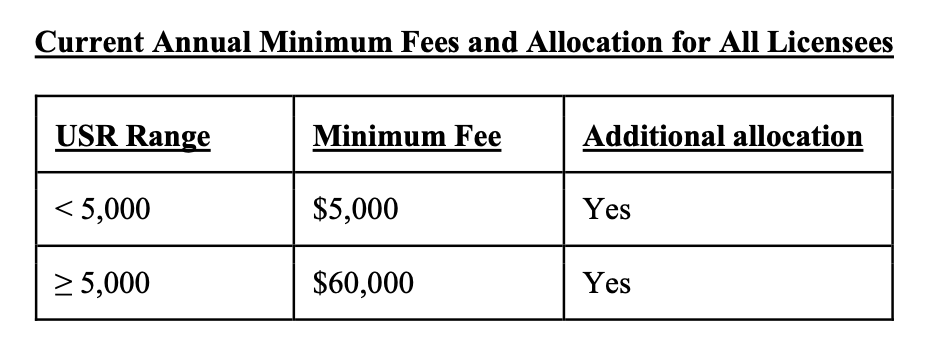
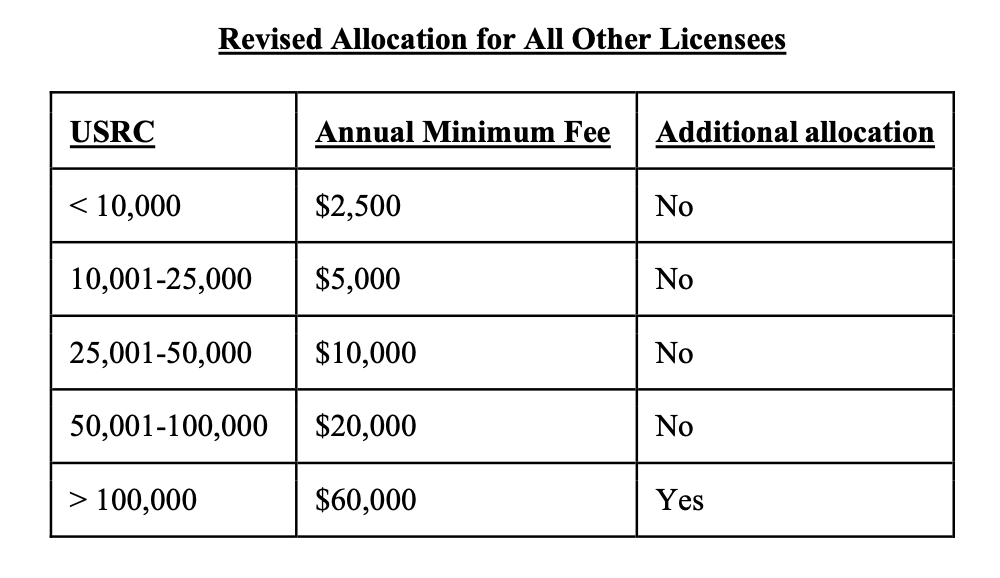
The “old” allocation resulted in this payment structure for services buying into the blanket license (setting aside download stores for the moment):

Old Assessment Alloction

It was that $60,000 plus an indeterminate share of operating costs that was the killer.  The new allocation is more precise applicable to other than download stores:

New Assessment Alloction

This makes a lot more sense and one can believe that some startups actually were asked what they think. Remember, David Lowery sent an open letter to the CRJs in 2019 raising this exact point reacting to the bizarre initial administrative assessment hearings:

The Judges should take into account that no startup has been present or able to negotiate the many burdens placed on them by this settlement. In particular, they have not been able to be heard by the Judges on the scope of these financial burdens that their competitors—some of the richest multinational corporations in history—have unilaterally decided to place on them with no push back.

This isn’t to say that any would be brave enough to come forward and challenge their betters if given a chance. But they should at least be given a chance.

There are some twists and turns to the new rule which was adopted by the CRJs as a final rule on January 8, 2021, and any startup should obviously get smart about the rules. But–these latest amendments have established two really great things: First, the DLC is paying attention. That is very good for the reasons David raises. The other is that the DLC is apparently actually talking to someone other than Google and Spotify and coming up with reasonable compromises. This is very, very good. Let’s hope it continues.

We’ll be watching.

Making Sense of the New Blanket Mechanical License and the Mechanical Licensing Collective

This is a recording of a webinar about the Mechanical Licensing Collective that I did with Abby North and Gwen Seale, sponsored by Texas Accountants and Lawyers for the Arts, Austin Texas Musicians and Austin Music Foundation.  

The webinar is from the point of view of self-published songwriters who are trying to make sense of the Mechanical Licensing Collective (currently, “The MLC, Inc.”) and what is going to happen to their mechanical licensing revenue now that the blanket license is available to digital music providers (or “DMPs”).  

Here’s a couple basic concepts:  

A “mechanical” royalty must be licensed by a DMP for the “mechanical” reproduction of the song, and a separate royalty paid for uses under that “mechanical license.”  The mechanical license also covers distribution of the copies permitted.  See the Copyright Office Circulars on the digital side and the physical side (somewhat different rules apply to each configuration).

Up until January 1, 2021, mechanical licenses were issued on a song-by-song basis in the United States under a compulsory license.  There was no blanket compulsory license.  The Music Modernization Act established both the blanket compulsory license for permanent downloads, limited downloads, and interactive streaming (available after January 1, 2021) and a mechanical licensing collective which can be run by different non-profit corporations at different times.  The head of the Copyright Office “designates” or “approves” the non-profit corporation to be the mechanical licensing collective and reviews the performance of the designated company every five years.  The Copyright Office approved a non-profit corporation that styles itself “The MLC, Inc.” or “The MLC” so it gets confusing as to whether you are talking about “the mlc” or the organization described in the Music Modernization Act or The MLC, Inc., the corporation approved by the Copyright Office with the backing of the National Music Publishers Association among others.

So it is the usual government alphabet soup, but be clear about one thing–unless you know with certainty that your song catalog is being paid under voluntary licenses outside of the blanket license, you will stop being paid however you have been paid and you will start being paid by The MLC if you can be matched to revenue.  

That means that your songs must be registered with The MLC correctly, including your banking information.  Do not count on that happening by itself.

Here are a few links as a companion to the webinar:

Please take the MLC Awareness Questionnaire, 10 questions, responses and responders are anonymous.

The MLC, Inc.

When Do I Get Paid By the MLC?

Most recent Copyright Office rules for payments by DMPs to the MLC of your money

Rules for when MLC must pay copyright owners (including copyright owners who are self-published songwriters)

Guest Post: The Music Modernization Act is Stifling Innovation in the Music Industry

[The chickens are coming home to roost.  As I warned before the Music Modernization Act was passed, Title I has big problems.  Remember that Title I established the Mechanical Licensing Collective (publishers and songwriters) and the Digital Licensee Coordinator (digital music platforms). It was sold to songwriters on the basis that “the services pay for everything”.  We will see how true that ends up being (as the copyright owners have to pay their costs to populate or correct the HFA database which is a massive undertaking).  Nobody talked to any DMP startups when the legislation was drafted or when the “administrative assessment” was litigated before the Copyright Royalty Judges.  But now startups are getting the bill and they’re not too happy, particularly 115 services that never had to pay for a license other than royalties.  I addressed some of this in a 2018 post on MusicTech Solutions that was reposted on Newsmax Finance.]

From: Max Fergus
Date: Tue, Nov 10, 2020 at 11:06 AM
Subject:
To: LUM Team

A Letter to the Music Industry,  

Beware, the future of music is in jeopardy.

The Music Licensing Collective (“MLC”) recently announced that it will begin to regulate the largest major music streaming platforms in 2021. However, this agency, formed behind closed doors between the major labels and streaming services themselves, will only hurt those of us who are actively fighting the unjust practices of the platforms that are being regulated in the first place.

The Music Modernization Act is a “competition killer” set out to destroy the platforms that are trying to create a new tomorrow for independent musicians and stifling current and future innovation within the industry.

We are not alone and it’s time to fight. 
Please find our LinkedIn Article here as well as a link to our post
Please share and repost if possible in our fight against the MMA.

___________________________________________
Article Preview
We were told when we started our company that the institutions within the music industry were always going to be against us. In fact, many people told us these institutions would do everything in their power to curb innovation to make sure the money stayed where it always has – in the pockets of the major labels and the major music streaming services.

Finally, after 10 years of archaic practices in the music streaming industry, which widened the financial gap between the one percent of the music industry stakeholders and the rest of the starving artists, the Music Modernization Act (“MMA”) was created. At its most basic level, the goal was to take the onus off of major streaming platforms to track and remit royalties generated from these major platforms into the pockets of the right artists/labels in a more timely fashion through a new government-subsidized organization known as the Mechanical Licensing Collective (“MLC”).

Sounds great, right? Wrong. This will set back the music industry for years to come.

Imagine starting a process to MODERNIZE MUSIC and how music is monetized for all artists, yet the only stakeholders the MLC brought in to discuss how the MMA and the MLC would operate are the major streaming platforms and major labels themselves. So, what did they do? They structured the MLC in a way that will save these major corporations millions of dollars while completely neglecting the reason why the law was written in the first place – to oversee the music streaming platforms that have consistently, purposefully and negligently not paid the creators – whose content drives their service – their fair share in a transparent and efficient way.

The MMA was designed to regulate and modernize the practices of “royalty-bearing” music streaming services like Spotify, YouTube, and Apple. Next year, the MLC will open its doors and, as part of its first year of operations, it requires the companies included within the MLC to help pay for “start-up fees.” Companies outside of the largest music streaming companies, such as smaller DSPs and smaller royalty-bearing music streaming platforms, must also share unproportionally in these expenses. Essentially, the MLC and the largest streaming platforms want smaller services to pay more than their fair share for the MLC to oversee and audit the largest players in the music streaming industry…even those services who operate to fix the same problems as the new entity itself.

It gets worse.

LÜM was created to serve a similar foundational mission to these entities – to help guide an industry that needs to better support its creators through innovation. Because of that, we made a choice to not be a part of the traditional recorded music industry. We pay NO royalties and instead have proven that there is a better future. Instead of royalties, LÜM created the first virtual gifting system in a music discovery platform that allows fans to help directly support their favorite independent artists. The result?

Artists on LÜM earn an average of ~6x more per stream than every single other music streaming platform in the U.S.

Just like so many other companies that are trying to advance the music industry, LÜM is now facing an uphill battle against an organization (MLC) that was developed in conjunction with the same stakeholders who put the music industry in this position in the first place. The fees LÜM and other innovative companies are facing, to help fund the MLC, are substantial. Every new innovative company will face them and will provide a financial hurdle that will leave the majority of current and future innovative music startups dead in the water. No new entrants and no new competition mean the industry will stay exactly where it has for the last 15 years – putting money in the pockets of the rich and neglecting those that are trying to change the industry for the better.

We cannot let this happen. Innovation must continue or we face a scary reality for the music industry and the majority of artists and innovators that have been neglected by it.

— 
Max Fergus | Chief Executive Officer

Check out my favorite song on LÜM Here!

The World is not Flat: @CISACNews and BIEM Focus on Vendor Lock-in at the MLC

One of the many U.S.-centric shortcomings of Title I of the Music Modernization Act (that created the Mechanical Licensing Collective, the safe harbor giveaway and the blanket license) is that it pretty much ignores the entire complex system of content management organizations outside the U.S. As they describe themselves, “CISAC and BIEM are international organisations representing Collective Management Organisations (“CMOs”) worldwide that are entrusted with the management of creators’ rights and, as such, have a direct interest in the Regulations governing the functioning of the Database and the transparency of MLC’s operations. CISAC and BIEM would like to thank the Office for highlighting the existence and particularity of entities such as CMOs that are not referred to in the MMA.”

I have to say at the outset that as someone who lived outside the U.S. for a big chunk of time, it’s rather embarrassing but sadly unsurprising that so little attention has been paid to the global system of CMOs and the cold fact that we are now weeks away from the January 1, 2021 deadline.

You would not be aware of this unless you read the many comments to the Copyright Office on the MLC oversight rule makings. Aside from the fact that these organizations have decades of experience with blanket mechanical licensing (which the MLC might benefit from), CISAC and BIEM should have been included in the MLC itself, particularly since the MLC promoters appear to have been handing out non-voting directorships to themselves. It is embarrassing, kind of like those Americans who think the best way to speak French is to speak English louder.

CISAC and BIEM raise excellent issues in their comments, which often are accompanied by gentle hint language indicating the points have been raised before and ignored, or at least not responded to. According to a recently posted “ex parte” letter, CISAC and BIEM have focused in on a critical issue–where is the MLC’s statutorily required database and what benefits accrue to its vendor–principally HFA which was recently reunited in the MLC with its former owners.

You can read the CISAC and BIEM ex parte letter here. (Ex parte letters essentially document private discussions by the Copyright Office on matters they are currently regulating. Ex parte letters help to build a full record on matters placed before the Copyright Office by interested parties that may or may not be addressed in regulations.)

Here’s a key excerpt that I think deserves more attention (and is not going to be covered by the trade press until the system collapses in all likelihood).

CISAC/BIEM also raised further concerns regarding potential competitive advantages that The MLC or its vendors’ access to information may have and risks that such information could potentially be used for purposes outside of Section 115 mechanicals. The USCO assured the CMOs that they were perfectly aware of this issue, which had also been raised by other parties, and considered that these concerns were being addressed in the Confidentiality Rulemaking, and that the Statute requires Regulations to prevent the disclosure or improper use of information or MLC records. The proposed Rule establishes that MLC vendors cannot use the data obtained for processing for other purposes. The USCO further confirmed that it was very much aware of the need to ensure the necessary balance and that it was still contemplating how best to resolve this, including whether there should be more regulation.

I have to say that this is not the impression I got from the first panel of “MLC week” rather that the panel seemed to think that at least any member of the public could use the data provided to the MLC for any purpose. Since the MLC’s vendors would also be members of the public ostensibly, it does seem that disconnect needs to be cleared up.

The ex parte letter continues:

The CMOs CISAC/BIEM considered that some of these concerns were based on the January 1 deadline and whether The MLC would be operating with HFA’s database or with its’ own DQI processed separate database.

This depends on the antecedent of “its” in the last clause. If you take The MLC as the antecedent, the meaning would be “or with The MLC’s own DQI processed separate database.” If you take HFA as the antecedent, the meaning would be “whether The MLC would be operating with HFA’s database or with HFA’s own DQI processed separate database.”

While I think that CISAC and BIEM meant the former, the reality appears to be the latter however nonsensical it may seem. This is because there do not appear to be two separate databases, just the HFA database that The MLC accesses through an API. The DQI operation is designed to improve the data quality of the HFA database which benefits both The MLC and HFA.

There seems to be more than a little confusion about this:


USCO noted that there are still open questions regarding this issue, as it seemed that the HFA database would be used as a starting point, but through programmes like DQI data was being updated, so it did not seem as if both databases were identical.

I would argue with this (and have). This idea that DQI was updating a database other than the HFA database sounds like there is a stand-alone musical works database as required by the statute. If so, where is it? Why does the DQI produce search results like this:

HFA DQI

The USCO reiterated that the proposed Confidentiality Rulemaking specifies the limitations imposed on proposed vendors and that The MLC had in writing acknowledged that neither The MLC nor its vendor owned the data. The USCO acknowledged that there was a lot of concern expressed about this issue and ensured the CMOs it was going to address this issue.

Ownership alone is not the only issue and misdirects attention. On the one hand, The MLC says it does not own the database (another example of drafting oversights in Title I of the MMA–ownership is one of those issues you would think would be clearly spelled out but was only referenced indirectly).

I come away from reading the ex parte letter more concerned than ever that the core issue that The MLC was tasked with by the Congress is simply not being addressed–where is the Congress’s musical works database? Remember the words of the legislative history:

“Music metadata has more often been seen as a competitive advantage for the party that controls the database, rather than as a resource for building an industry on.”