The Chief asks the most relevant foundational question in the first five minutes–and it was straight downhill for TikTok after that. See transcript at p. 8.
This is a recording of a webinar about the Mechanical Licensing Collective that I did with Abby North and Gwen Seale, sponsored by Texas Accountants and Lawyers for the Arts, Austin Texas Musicians and Austin Music Foundation.
The webinar is from the point of view of self-published songwriters who are trying to make sense of the Mechanical Licensing Collective (currently, “The MLC, Inc.”) and what is going to happen to their mechanical licensing revenue now that the blanket license is available to digital music providers (or “DMPs”).
Here’s a couple basic concepts:
A “mechanical” royalty must be licensed by a DMP for the “mechanical” reproduction of the song, and a separate royalty paid for uses under that “mechanical license.” The mechanical license also covers distribution of the copies permitted. See the Copyright Office Circulars on the digital side and the physical side (somewhat different rules apply to each configuration).
Up until January 1, 2021, mechanical licenses were issued on a song-by-song basis in the United States under a compulsory license. There was no blanket compulsory license. The Music Modernization Act established both the blanket compulsory license for permanent downloads, limited downloads, and interactive streaming (available after January 1, 2021) and a mechanical licensing collective which can be run by different non-profit corporations at different times. The head of the Copyright Office “designates” or “approves” the non-profit corporation to be the mechanical licensing collective and reviews the performance of the designated company every five years. The Copyright Office approved a non-profit corporation that styles itself “The MLC, Inc.” or “The MLC” so it gets confusing as to whether you are talking about “the mlc” or the organization described in the Music Modernization Act or The MLC, Inc., the corporation approved by the Copyright Office with the backing of the National Music Publishers Association among others.
So it is the usual government alphabet soup, but be clear about one thing–unless you know with certainty that your song catalog is being paid under voluntary licenses outside of the blanket license, you will stop being paid however you have been paid and you will start being paid by The MLC if you can be matched to revenue.
That means that your songs must be registered with The MLC correctly, including your banking information. Do not count on that happening by itself.
Here are a few links as a companion to the webinar:
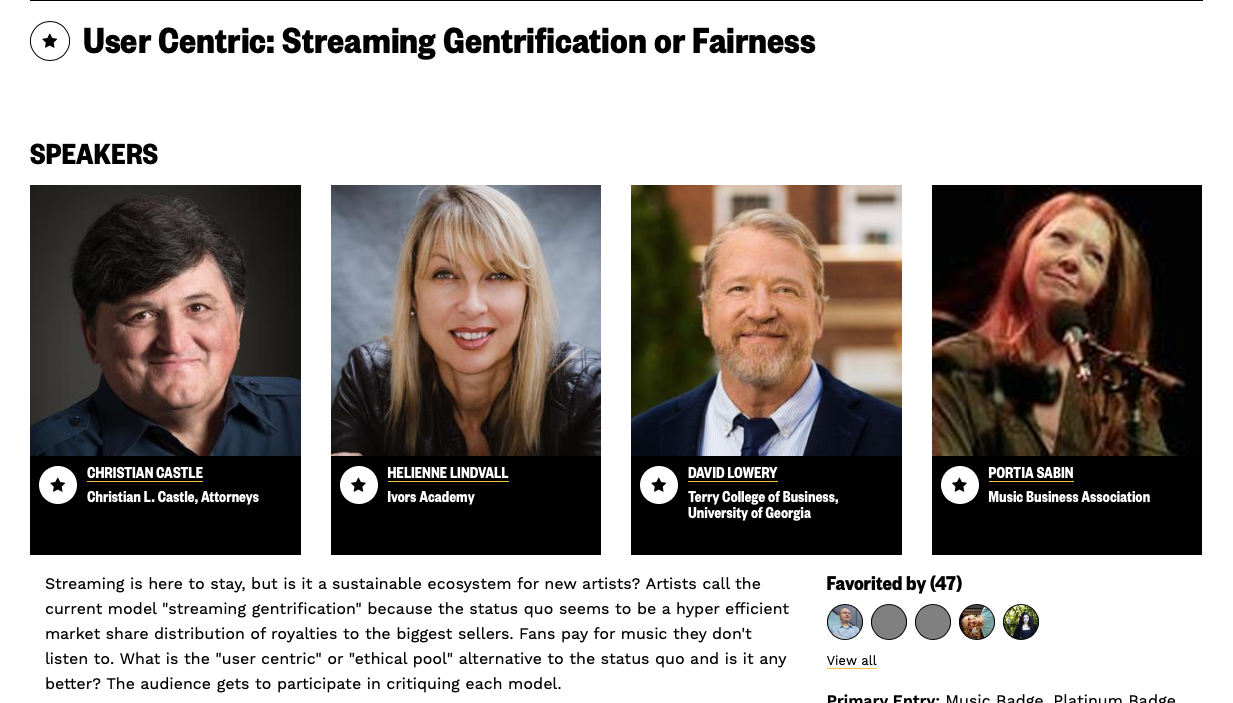
I’m pleased to be moderating a panel on user-centric streaming royalties with some of the smartest people in the music business at SXSW on Thursday, March 19 at 3:30. Helienne Lindvall from Ivors Academy, David Lowery of Cracker and Camper Van Beethoven and Portia Sabin from the Music Business Association will join me in a discussion of this important topic that seems to pick up support daily.
Please put us on your calendar if you’re coming to Austin for the conference! We really want this one to be collaborative with the audience. Watch this space for further updates. If you are new to the topic, a good place to start is the “ethical pool” post from last year.
I have a workshop in the SXSW.edu track titled “TEACHING ARTIST ROYALTIES TO CREATORS AND STARTUPS.” It follows my philosophy that we need smart artists and smart startups to work together if we all are to succeed.
The workshop has three purposes:
–A building block approach to teaching artists and songwriters about the principal royalty streams that sustain them. This is targeted financial literacy which is as critical to artists and songwriters as balancing your checkbook.
–A licensing roadmap overlay for entrepreneurship studies. It’s far too frequent that entrepreneurs spend more time developing their product roadmap and critical path than they do developing their licensing roadmap side by side with the product. That way when a startup gets to launch there is less likelihood they will go into the terminal holding pattern or worse–launch without licenses.
–the importance of clean and stable metadata to both artists and startups (and mature companies) and how to accomplish this goal starting with the digital audio workstation.
The class description:
Royalty rates, royalty reporting and earnings are some of the least understood–yet most important–parts of a creator’s career or a startups nightmare. Understanding royalties is as important as understanding how to balance your checkbook. Starting with metadata and simple revenue streams, leading to complex calculations and government run compulsory licenses and sometimes impenetrable royalty statements, the workshop gives educators tools and building blocks to teach the subject.
I’d really appreciate your vote for the class in the SXSW Panel Picker here. To vote, you just need to sign in to PanelPicker or create a free SXSW account with your email only.
11:50am-12:50 pm Music Modernization Act (US) / International Developments
The Music Modernization Act could be the most consequential copyright legislation in a generation. This panel will describe what it does, what it doesn’t do, how it affects current business and legal practices, and its effect on domestic and international copyright holders. Bring your questions.
Panelists: Marc Jacobson, Esq. (Moderator) Chris Castle, Esq. – CC Legal Firm and Music Tech Solutions Blog Charlie Sanders, Esq. – Counsel-Songwriters Guild of America Alexander Ross, Esq. – Wiggin LLP (UK) Christine Pepe, Esq. (IP, Music, and Digital Law Consultant)
We have proposed a panel for SXSW in the Panel Picker with some great speakers I’ll be moderating. “Getting to Beta Without Getting Beat Up” will emphasize the importance of licensing strategy milestones that overlay a music-tech startup’s product development strategy milestones.
A well-executed licensing strategy is every bit as much a part of the supply chain logistics as any other element of product development, if not more important.
A buggy product can usually be fixed. Failure to execute a bespoke licensing strategy can subject the entire company to crippling and endless copyright infringement lawsuits. In fact, if you are unlicensed or insufficiently licensed, one thing is a pretty sure bet: The more successful you are, the more likely it is you’ll be sued–a proposition ripped from the headlines.
That scenario can waste the stockholders’ money, be defocusing in the extreme for management and severely damage relationships with the creative community–the life blood of any music startup.
On the other hand, “over clearing” while less costly than litigation still syphons off resources that for the most part lie fallow.
Our panel are all experienced hands in the licensing and metadata world and are themselves entrepreneurs:
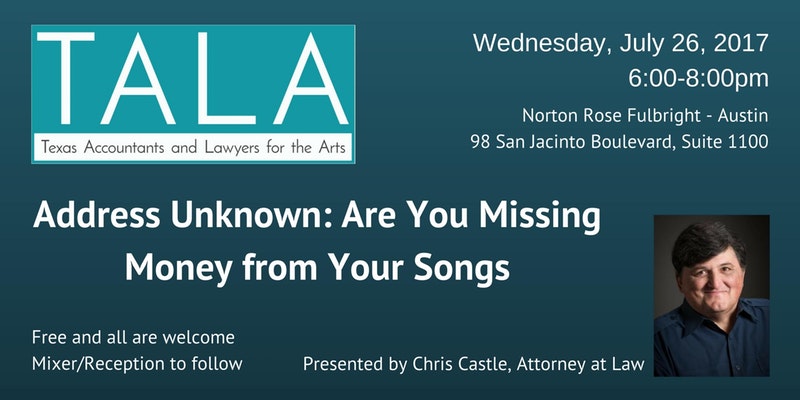
Big thanks to Texas Accountants & Lawyers for the Arts and Norton Rose Fulbright for hosting my presentation on the “address unknown” loophole and what to do about it. As MTS and MTP readers will recall, this is a vital issue for songwriters that is a festering sore that no one has addressed. We appreciate the support from I Respect Music Austin!
All are welcome. One hour of Texas CLE credit pending.
6:15-7:15pm Presentation “Address Unknown: Are You Missing Money from Your Songs”
7:15-8:00pm Mixer with attorneys, artists, managers, and other participants
Save the Date! On June 20, 7 pm at Capitol Factory (Austin Omni), Chris Castle presents “Music Tech Licensing: Getting Your Beta Out without Getting Beaten Up” with special guest Keith Bernstein, CEO of Crunch Digital, sponsored by the Austin Music Tech Meetup. Topics will be copyright basics and licensing strategy for startups.
I’m looking forward to participating on a great panel on fixing our future in the music business, moderated by the brilliant Dr. Gigi Johnson, founder and executive director of the UCLA Center for Music Innovation.
Music 2020: Recreating Music’s Future will be a lunch time panel held on October 13 in Los Angeles under the auspices of the Association of Independent Music Publishers an important voice for independent publishers in our policy efforts. I’m part of an august group: Sam Kling,SVP Creative Operations, SESAC & AIMP Board Member and Vickie Nauman,Founder & Owner, CrossBorderWorks, both of whom I know to be deep thinkers on problem solving in our business.
The event is to be held at Lawry’s, 100 North La Cienega Blvd. (near Wilshire) in Beverly Hills from 11:30 am to 1:45 pm on October 13. Reservations are required and lunch is served. Tickets are $44 for AIMP members and $57 for non-members.
 Music Tech Solutions