@ArtistRights Symposium 5 Panel: Beware the AI Opt-In: Hidden Right of Publicity Waivers

Registration is open for Artist Rights Symposium 5 at Eventbrite!

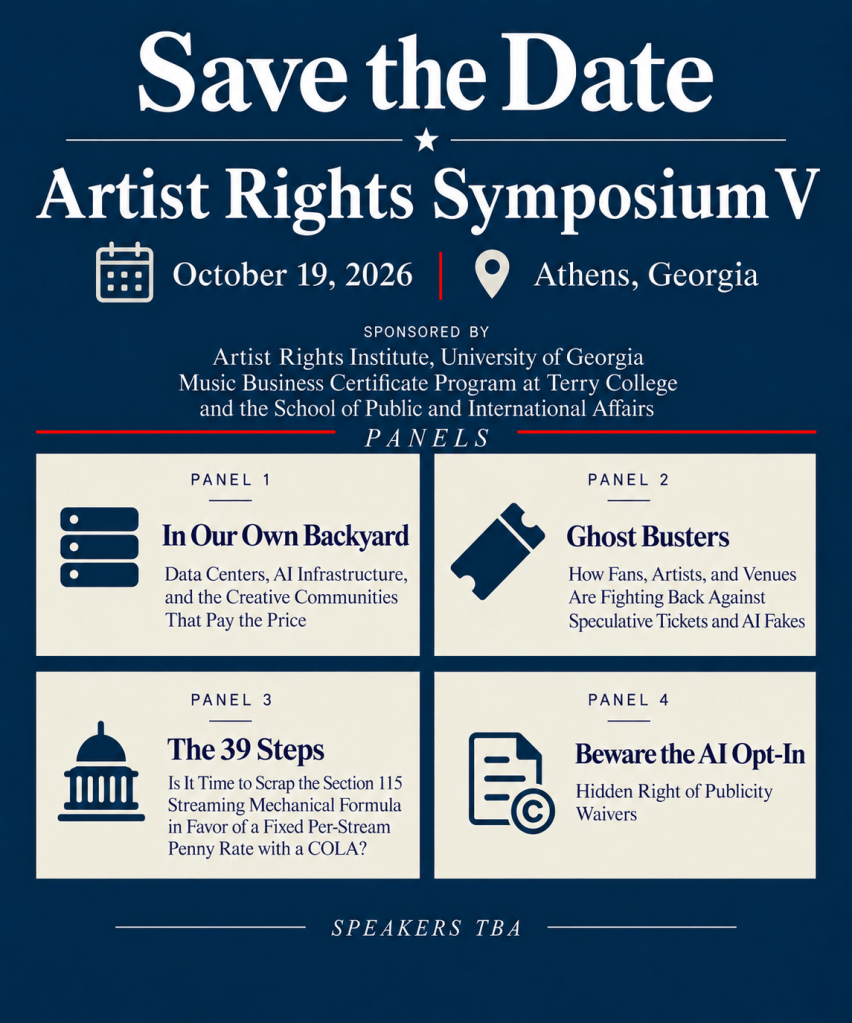
The Artist Rights Symposium 5 is coming on October 19 at Tweed Recording in Athens, GA hosted by the University of Georgia Terry College of Business Music Certificate Program and the School of Policy and International Affairs, and the Artist Rights Institute. More about the Symposium here and register on Eventbrite here.

As AI companies like Suno and Udio settle copyright lawsuits with record companies and music publishers, they introduce new licensing arrangements. Artists and songwriters may be offered the “opportunity” to “opt in” to the settlements and “new revenue streams”. But not all revenue streams are equal, remember streaming? Remember “Let’s help that plucky startup Spotify”? We have seen this movie before and we know how it ends.

Why a Suno Copyright Settlement Is Different from Spotify, LimeWire—or Even Bartz

The music industry has settled copyright infringement disputes before. Spotify’s mechanical royalty settlements in David Lowery’s class action resolved claims over unpaid or improperly licensed compositions. LimeWire’s settlement addressed unauthorized reproduction and distribution of copyrighted recordings. In both cases, the essential bargain concerned compensation for past copyright infringement, not permission to reproduce the identity of the human beings who created the music. Identity theft never came up.

Suno presents a fundamentally different problem. Its generative AI technology can potentially reproduce not merely copyrighted expression but recognizable characteristics of an artist’s voice, performance and identity—what Chris has called  personhood signals. A settlement that licenses recordings for future training may therefore implicate rights that neither the record company nor publisher controls. That’s why they need the “opt in” agreement to waive these rights because the AI platform doesn’t want to pay for the artist’s identify if the artist would even consider that deal. Many artists and songwriters, if not most, will not.

The Bartz v. Anthropic settlement illustrates the limitation of treating AI disputes exclusively as copyright cases. Bartzcompensates copyright owners for specified historical conduct involving pirated books. It settles the claims brought in litigation, so does not expressly resolve the separate problem of extracting and commercializing human identity. That is what a conventional copyright settlement misses.

Settling infringement of the work does not settle exploitation of the person. And no copyright settlement should quietly become consent to commercialize someone’s voice, identity or personhood.

So artists, their managers and lawyers are asking, what exactly are we being asked to agree to this time? Before you even get to the “new revenue stream,” an opt-in for an apparent copyright settlement may also include permission for future AI training, broad releases, perpetual covenants not to sue, or waivers of an artist’s rights in their name, voice and identity. These are fundamentally different transactions, with potentially permanent consequences. Before signing, creators need to understand not only what they will be paid, but what rights they are surrendering, how those rights may be exploited, and whether they can ever get them back.

Meet the Panelists

Chris Castle will lead the closing panel at Artist Rights Symposium 5, that warns “Beware the AI Opt-In: Hidden Right of Publicity Waivers.” The panel brings together four speakers with complementary perspectives on artist advocacy, litigation and music-industry licensing.

Jen Jacobsen, Artist Rights Alliance.  Friend of the show Jen Jacobsen is a long time artist rights advocate who brings the artist-advocacy perspective, focusing on meaningful consent, transparency and protecting musicians from agreements that may surrender irreversible grants of rights with hidden waivers.

George Zelcs of Korein Tillery.  George Zelcs is the lead counsel on the Jason Isbell/David Lowery personhood class action against Suno to help us understand the implications of “opt in” agreements with waivers on rights of publicity and the practical question of what remedies artists should retain.

Gwendolyn Seale — Gwen Seale PLLC.  Gwen brings experience representing songwriters and music copyright owners, with particular relevance to licensing authority, co-writer and co-owner interests, compensation and contractual protections.

Tim Kappel — Wells Kappel.  Tim is a copyright expert and artist rights advocate who successfully argued in federal trial court and the Fifth Circuit Court of Appeals that his client Cyril Vetter should retain foreign rights as part of a statutory copyright termination— a case now before the U.S. Supreme Court. 

The panel is scheduled for 3:00–4:00 p.m. on October 19. 

Three Deals Disguised as One?

An AI opt-in may combine three distinct transactions as part of the copyright settlement and go-forward license: compensation for past unauthorized uses (probably not shared by the label, but check), licensing for future model training, and revenue sharing from products built on those models (but don’t hold your breath). But accepting settlement compensation for yesterday’s conduct should not automatically mean consenting to tomorrow’s exploitation. 

There may also be a fourth transaction: authorization to use an artist’s name, voice, likeness or other personhood rights which could not have been brought by a record company or music publisher because they do not control those rights.

A copyright license is not permission to commercialize personhood.

The panel will examine how these rights can become entangled, particularly when record companies, publishers or other representatives may not control all the rights an AI company seeks.

What Happens After You Sign?

The panel will address the questions that can be overlooked when attention focuses on the size of a settlement or the promise of future royalties.

What exactly is inside the AI company’s “walled garden”? How are revenues attributed to particular recordings or compositions? Can users generate synthetic voices or prompt an artist’s name? Can artists examine the product before consenting? 

And what happens when an artist wants out later when the term expires (if there is a term)? Deleting a source recording does not necessarily remove its influence from an already-trained model. Termination, machine unlearning, continuing model exploitation and rights that survive expiration may determine whether an opt-in becomes a one-way door in an AI Hotel California.

Register for Artist Rights Symposium V on Eventbrite

Related reading: The AI “License” That Isn’t: A Musician’s Checklist for Spotting a Covenant Not to Sue Censorship Trap in Disguise.

@ArtistRights Symposium 5 Panelists: Ghost Busters: Fighting Back Against Speculative Tickets

Registration is open for Artist Rights Symposium V at Eventbrite!

The Artist Rights Symposium V is coming on October 19 at Tweed Recording in Athens, GA hosted by the University of Georgia Terry College of Business Music Certificate Program and the School of Policy and International Affairs, and the Artist Rights Institute. More about the Symposium here and register on Eventbrite here.

We’ll be posting panel overviews to introduce you to the speakers, starting with the ticketing panel. From nonexistent World Cup tickets to a growing state-by-state push for resale reform, the ticketing debate is moving quickly. “Ghost Busters: How Fans, Artists, and Venues Are Fighting Back Against Speculative Tickets” will examine what artists, venues and lawmakers can do about ghost tickets, predatory resale and a secondary market increasingly disconnected from the artists who create the event. 

The panel begins at 11:30 a.m. on October 19 at Tweed Recording with these experts: 

Randy Nichols, a board member of the National Independent Talent Organization, leads NITO research and policy efforts addressing predatory resale practices. A longtime artist manager and entrepreneur, his advocacy draws on two decades of experience in the live-music business.

Jay Gilbert, co-founder of Label Logic and co-host of Your Morning Coffee, brings decades of music-industry experience, including executive roles with Universal, Sony and Warner and marketing campaigns for artists ranging from Nirvana and The Police to Bob Marley and Johnny Cash.

Moderating is Mala Sharma, co-founder and president of Georgia Music Partners, whose career spans record labels, artist management, entertainment banking, the Atlanta Symphony Orchestra and public policy.

The conversation:  Who should control a ticket after it goes on sale—and how do we stop people from selling tickets they never owned in the first place?

UGA School of Public and International Affairs Joins Artist Rights Symposium 5

We’re pleased to announce that the University of Georgia’s School of Public and International Affairs has joined the Artist Rights Institute and UGA’s Music Business Certificate Program at Terry College as a sponsor of the fifth annual Artist Rights Symposium, October 19, 2026, in Athens, Georgia.

The addition of SPIA is especially timely. This year’s Symposium reaches beyond traditional music-industry issues to examine the broader public-policy consequences of artificial intelligence—from the massive data centers, energy infrastructure, and local communities supporting AI development to the legal and policy questions surrounding artist consent, identity, compensation, and the use of creative work.

Bringing together music business, law, public policy, artists, advocates, and policymakers is exactly what this moment requires.

Artist Rights Symposium V
October 19, 2026 — Athens, Georgia
Speakers and additional program details coming soon.

Speaker Updates for September 18 Artist Rights Roundtable in DC

We’re pleased to welcome Josh Hurvitz, Partner, NVG and Head of Advocacy for A2IM and Kevin Amer, Chief Legal Officer, The Authors Guild to the Roundtable on September 18 at American University in DC!

Artist Rights Roundtable on AI and Copyright: 
Coffee with Humans and the Machines     

Join the Artist Rights Institute (ARI) and Kogod’s Entertainment Business Program for a timely morning roundtable on AI and copyright from the artist’s perspective. We’ll explore how emerging artificial intelligence technologies challenge authorship, licensing, and the creative economy — and what courts, lawmakers, and creators are doing in response.

🗓️ Date: September 18, 2025
🕗 Time: 8:00 a.m. – 12:00 noon
📍 Location: Butler Board Room, Bender Arena, American University, 4400 Massachusetts Ave NW, Washington D.C. 20016

🎟️ Admission:
Free and open to the public. Registration required at Eventbrite. Seating is limited.

🅿️ Parking map is available here. Pay-As-You-Go parking is available in hourly or daily increments ($2/hour, or $16/day) using the pay stations in the elevator lobbies of Katzen Arts Center, East Campus Surface Lot, the Spring Valley Building, Washington College of Law, and the School of International Service

Hosted by the Artist Rights Institute & American University’s Kogod School of Business, Entertainment Business Program

🔹 Overview:

☕ Coffee served starting at 8:00 a.m.
🧠 Program begins at 8:50 a.m.
🕛 Concludes by 12:00 noon — you’ll be free to have lunch with your clone.

🗂️ Program:

8:00–8:50 a.m. – Registration and Coffee

8:50–9:00 a.m. – Introductory Remarks by KOGOD Dean David Marchick and ARI Director Chris Castle

9:00–10:00 a.m. – Topic 1: AI Provenance Is the Cornerstone of Legitimate AI Licensing:

Speakers:

  • Dr. Moiya McTier Human Artistry Campaign
  • Ryan Lehnning, Assistant General Counsel, International at SoundExchange
  • The Chatbot

Moderator: Chris Castle, Artist Rights Institute

10:10–10:30 a.m. – Briefing: Current AI Litigation

  • Speaker: Kevin Madigan, Senior Vice President, Policy and Government Affairs, Copyright Alliance

10:30–11:30 a.m. – Topic 2: Ask the AI: Can Integrity and Innovation Survive Without Artist Consent?

Speakers:

  • Erin McAnally, Executive Director, Songwriters of North America
  • Jen Jacobsen, Executive Director, Artist Rights Alliance
  • Josh Hurvitz, Partner, NVG and Head of Advocacy for A2IM
  • Kevin Amer, Chief Legal Officer, The Authors Guild

Moderator: Linda Bloss-Baum, Director, Business and Entertainment Program, KOGOD School of Business

11:40–12:00 p.m. – Briefing: US and International AI Legislation

  • Speaker: George York, SVP, International Policy Recording Industry Association of America

🔗 Stay Updated:

Watch this space and visit Eventbrite for updates and speaker announcements.

@CrispinHunt on the TikTok showdown

Please take our Songwriter MLC Awareness Survey

Please take a few minutes (4 or so) to help us understand how the Mechanical Licensing Collective and the Copyright Office is doing getting the word out about signing up with the MLC and getting paid royalties (including your share of the $424 million black box/unmatched payment that has been sitting at MLC for months).

Your response are anonymous and we’ll post the results when we get a threshold number of responses. We’d really appreciate your help!

To take the survey on Survey Monkey, click here.

Because the fight is never done: Support the CASE Act #myskillspaymybills

The arc of justice may be long, but it only bends when you will it.  Support the CASE Act because the fight is never done.

Chris Castle

D8uFIZEXsAAJWY6.jpg-large


Ethical Pool Discussion on Break the Business Podcast

Chris discusses the Ethical Pool model with Ryan Kairalla on the Break the Business podcast (see “Arithmetic on the Internet: The Ethical Pool Solution to Streaming Royalty Allocation“).

@robertblevine_: Will Tech Startups Finally Make Record Labels Obsolete? Not So Fast — Artist Rights Watch

[Editor Charlie sez:  Great analysis of Google’s “United Masters” adventure by Robert Levine.]

Stop me if you’ve heard this one before: Record labels are irrelevant because they’ve been disrupted by a venture-funded technology start-up. The major labels exploit artists, who can now distribute their music directly to consumers online, plus get the data they need to make money playing concerts, selling merch or doing sponsorships. Sound familiar?

via @robertblevine_: Will Tech Startups Finally Make Record Labels Obsolete? Not So Fast — Artist Rights Watch

@KRSfow: Future of What Podcast on the Transparency in Music Licensing and Ownership Act


Episode #94: Recently, a bill was introduced by Republican congressman Jim Sensenbrenner which calls for the creation of a comprehensive database of compositions and recordings. The “Transparency in Music Licensing and Ownership Act” claims to make things easier for coffee shops, bars and restaurants who want to license music to play in their establishments. To many in the music industry, the bill seems like a wolf in sheep’s clothing with the potential cause big problems. On this episode we dig deep into the bill with Future of Music Coalition’s Kevin Erickson and attorney Chris Castle.

Subscribe to The Future of What on iTunes: apple.co/1P4Apk0

Follow us:
Twitter: bit.ly/2gOYMYM
Facebook: www.facebook.com/thefutureofwhat/
Instagram: bit.ly/1L6T8fl