Less Than Zero: The Significance of the Per Stream Rate and Why It Matters

Spotify’s insistence that it’s “misleading” to compare services based on a derived per-stream rate reveals exactly how out of touch the company has become with the very artists whose labor fuels its stock price. Artists experience streaming one play at a time, not as an abstract revenue pool or a complex pro-rata formula. Each stream represents a listener’s decision, a moment of engagement, and a microtransaction of trust. Dismissing the per-stream metric as irrelevant is a rhetorical dodge that shields Spotify from accountability for its own value proposition. (The same applies to all streamers, but Spotify is the only one that denies the reality of the per-stream rate.)

Spotify further claims that users don’t pay per stream but for access as if that negates the artist’s per stream rate payments. It is fallacious to claim that because Spotify users pay a subscription fee for “access,” there is no connection between that payment and any one artist they stream. This argument treats music like a public utility rather than a marketplace of individual works. In reality, users subscribe because of the artists and songs they want to hear; the value of “access” is wholly derived from those choices and the fans that artists drive to the platform. Each stream represents a conscious act of consumption and engagement that justifies compensation.

Economically, the subscription fee is not paid into a vacuum — it forms a revenue pool that Spotify divides among rights holders according to streams. Thus, the distribution of user payments is directly tied to which artists are streamed, even if the payment mechanism is indirect. To say otherwise erases the causal relationship between fan behavior and artist earnings.

The “access” framing serves only to obscure accountability. It allows Spotify to argue that artists are incidental to its product when, in truth, they are the product. Without individual songs, there is nothing to access. The subscription model may bundle listening into a single fee, but it does not sever the fundamental link between listener choice and the artist’s right to be paid fairly for that choice.

Less Than Zero Effect: AI, Infinite Supply and Erasing Artist

In fact, this “access” argument may undermine Spotify’s point entirely. If subscribers pay for access, not individual plays, then there’s an even greater obligation to ensure that subscription revenue is distributed fairly across the artists who generate the listening engagement that keeps fans paying each month. The opacity of this system—where listeners have no idea how their money is allocated—protects Spotify, not artists. If fans understood how little of their monthly fee reached the musicians they actually listen to, they might demand a user-centric payout model or direct licensing alternatives. Or they might be more inclined to use a site like Bandcamp. And Spotify really doesn’t want that.

And to anticipate Spotify’s typical deflection—that low payments are the label’s fault—that’s not correct either. Spotify sets the revenue pool, defines the accounting model, and negotiates the rates. Labels may divide the scraps, but it’s Spotify that decides how small the pie is in the first place either through its distribution deals or exercising pricing power.

Three Proofs of Intention

Daniel Ek, the Spotify CEO and arms dealer, made a Dickensian statement that tells you everything you need to know about how Spotify perceives their role as the Streaming Scrooge—“Today, with the cost of creating content being close to zero, people can share an incredible amount of content”.

That statement perfectly illustrates how detached he has become from the lived reality of the people who actually make the music that powers his platform’s market capitalization (which allows him to invest in autonomous weapons). First, music is not generic “content.” It is art, labor, and identity. Reducing it to “content” flattens the creative act into background noise for an algorithmic feed. That’s not rhetoric; it’s a statement of his values. Of course in his defense, “near zero cost” to a billionaire like Ek is not the same as “near zero cost” to any artist. This disharmonious statement shows that Daniel Ek mistakes the harmony of the people for the noise of the marketplace—arming algorithms instead of artists.

Second, the notion that the cost of creating recordings is “close to zero” is absurd. Real artists pay for instruments, studios, producers, engineers, session musicians, mixing, mastering, artwork, promotion, and often the cost of simply surviving long enough to make the next record or write the next song. Even the so-called “bedroom producer” incurs real expenses—gear, software, electricity, distribution, and years of unpaid labor learning the craft. None of that is zero. As I said in the UK Parliament’s Inquiry into the Economics of Streaming, when the day comes that a soloist aspires to having their music included on a Spotify “sleep” playlist, there’s something really wrong here.

Ek’s comment reveals the Silicon Valley mindset that art is a frictionless input for data platforms, not an enterprise of human skill, sacrifice, and emotion. When the CEO of the world’s dominant streaming company trivializes the cost of creation, he’s not describing an economy—he’s erasing one.

While Spotify tries to distract from the “per-stream rate,” it conveniently ignores the reality that whatever it pays “the music industry” or “rights holders” for all the artists signed to one label still must be broken down into actual payments to the individual artists and songwriters who created the work. Labels divide their share among recording artists; publishers do the same for composers and lyricists. If Spotify refuses to engage on per-stream value, what it’s really saying is that it doesn’t want to address the people behind the music—the very creators whose livelihoods depend on those streams. In pretending the per-stream question doesn’t matter, Spotify admits the artist doesn’t matter either.

Less Than Zero or Zeroing Out: Where Do We Go from Here?

The collapse of artist revenue and the rise of AI aren’t coincidences; they’re two gears in the same machine. Streaming’s economics rewards infinite supply at near-zero unit cost which is really the nugget of truth in Daniel Ek’s statements. This is evidenced by Spotify’s dalliances with Epidemic Sound and the like. But—human-created music is finite and costly; AI music is effectively infinite and cheap. For a platform whose margins improve as payout obligations shrink, the logical endgame is obvious: keep the streams, remove the artists.

  • Two-sided market math. Platforms sell audience attention to advertisers and access to subscribers. Their largest variable cost is royalties. Every substitution of human tracks with synthetic “sound-alikes,” noise, functional audio, or AI mashup reduces royalty liability while keeping listening hours—and revenue—intact. You count the AI streams just long enough to reduce the royalty pool, then you remove them from the system, only to be replace by more AI tracks. Spotify’s security is just good enough to miss the AI tracks for at least one royalty accounting period.
  • Perpetual content glut as cover. Executives say creation costs are “near zero,” justifying lower per-stream value. That narrative licenses a race to the bottom, then invites AI to flood the catalog so the floor can fall further.
  • Training to replace, not to pay. Models ingest human catalogs to learn style and voice, then output “good enough” music that competes with the very works that trained them—without the messy line item called “artist compensation.”
  • Playlist gatekeeping. When discovery is centralized in editorial and algorithmic playlists, platforms can steer demand toward low-or-no-royalty inventory (functional audio, public-domain, in-house/commissioned AI), starving human repertoire while claiming neutrality.
  • Investor alignment. The story that scales is not “fair pay”; it’s “gross margin expansion.” AI is the lever that turns culture into a fixed cost and artists into externalities.

Where does that leave us? Both streaming and AI “work” best for Big Tech, financially, when the artist is cheap enough to ignore or easy enough to replace. AI doesn’t disrupt that model; it completes it. It also gives cover through a tortured misreading through the “national security” lens so natural for a Lord of War investor like Mr. Ek who will no doubt give fellow Swede and one of the great Lords of War, Alfred Nobel, a run for his money. (Perhaps Mr. Ek will reimagine the Peace Prize.) If we don’t hard-wire licensing, provenance, and payout floors, the platform’s optimal future is music without musicians.

Plato conceived justice as each part performing its proper function in harmony with the whole—a balance of reason, spirit, and appetite within the individual and of classes within the city. Applied to AI synthetic works like those generated by Sora 2, injustice arises when this order collapses: when technology imitates creation without acknowledging the creators whose intellect and labor made it possible. Such systems allow the “appetitive” side—profit and scale—to dominate reason and virtue. In Plato’s terms, an AI trained on human art yet denying its debt to artists enacts the very disorder that defines injustice.

What the Algocrats Want You to Believe: Weird Al’s Sandwich

There are five key assumptions that support the streamer narrative and we will look at them each in turn. I introduced assumption #1: Streamers are not in the music business, they are in the data business, and assumption #2 : Spotify crying poor. Today we’ll assess assumption #3–streaming royalties are fair no matter what the artists and songwriters say. Like Weird Al.

Assumption 3: The Malthusian Algebra Claims Revenue Share Royalty Pools Are Fair

A corollary of Assumption 2 is that revenue royalty share deals are fair.  The way this scam works is that tech companies want to limit their royalty exposure by allocating a chunk of cash that is capped and throwing that bacon over the cage so the little people can fight over it.  This produces an implied per-stream rate instead of negotiating an express per stream rate.  Why?  So they can tell artists–and more importantly regulators, especially antitrust regulators—all the billions they pay “the music business”, whoever that is.

And yet, very few artists or songwriters can live off of streaming royalties, largely because the “big pool” method of hyper-efficient market share distribution that constantly adds mouths to feed is a race to the bottom. The realities of streaming economics should sound familiar to anyone who studied the work of the British economist and demographer Thomas Malthus. Malthus is best known for his theory on population growth in his 1798 book An Essay on the Principle of Population”. This theory, often referred to as the Malthusian theory (which is why I call the big pool royalty model the “Malthusian algebra”), posits that population growth tends to outstrip food production, leading to inevitable shortages and suffering because, he argued, while food production increases arithmetically, population grows geometrically.

Signally, the big pool model allows the unfettered growth in the denominator while slowing growth in the revenue to increase market valuation based on a growth story. And, of course, the numerator (the productive output of any one artist) is limited by human capacity.

Per-Stream Rate = [Monthly Defined Revenue x (Your Streams ÷ All Streams)]

If the royalty was actually calculated as a fixed penny rate (as is the mechanicals paid by labels on physical and downloads), no artist would be fighting against all other artists for a scrap. In the true Malthus universe, populations increase until they overwhelm the available food supply, which causes humanity’s numbers to be reversed by pandemics, disease, famine, war, or other deadly problems–a Malthusian race to the bottom. Malthus may have inspired Darwin’s theory of natural selection. As a side note, the real attention to abysmal streaming royalties came during the COVID pandemic–which Malthus might have predicted.

Malthus believed that welfare for the poor, inadvertently encouraged marriages and larger families that the poor could not support1. He argued that the only way to break this cycle was to abolish welfare and championed a welfare law revision in 1834 that made conditions in workhouses less appealing than the lowest-paying jobs. You know, “Are there no prisons?” (Not a casual connection to Scrooge in A Christmas Carol.)

Crucially, the difference between Malthusian theory and the reality of streaming is that once artists deliver their tracks, Daniel Ek is indifferent to whether the streaming economics causes them to “die” or retire or actually starve to actual death. He’s already got the tracks and he’ll keep selling them forever like an evil self-licking ice cream cone.

As Daniel Ek told MusicAlly, “There is a narrative fallacy here, combined with the fact that, obviously, some artists that used to do well in the past may not do well in this future landscape, where you can’t record music once every three to four years and think that’s going to be enough.” This is kind of like TikTok bragging about how few children hung themselves in the latest black out challenge compared to the number of all children using the platform. Pretty Malthusian. It’s not a fallacy; it’s all too true.

Crucially, capping the royalty pool allowed Spotify to also cap their subscription rates for a decade or so. Cheap subscriptions drove Spotify’s growth rate and that also droves up their stock price.  You’ll never get rich off of streaming royalties, but Daniel Ek got even richer driving up Spotify’s share price. Daniel Ek’s net worth varies inversely to streaming rates–when he gets richer, you get poorer.

Weird Al’s Streaming Sandwich: Using forks and knives to eat their bacon

This race to the bottom is not lost on artists.  Al Yankovic, a card-carrying member of the pantheon of music parodists from Tom Leher to Spinal Tap to the Rutles, released a hysterical video about his “Spotify Wrapped” account.  

Al said he’d had 80 million streams and received enough cash from Spotify to buy a $12 sandwich.  This was from an artist who made a decades-long career from—parody.  Remember that–parody.

Do you think he really meant he actually got $12 for 80 million streams?  Or could that have been part of the gallows humor of calling out Spotify Wrapped as a propaganda tool for…Spotify?  Poking fun at the massive camouflage around the Malthusian algebra of streaming royalties? Gallows humor, indeed, because a lot of artists and especially songwriters are gradually collapsing as predicted by Malthus.

The services took the bait Al dangled, and they seized upon Al’s video poking fun at how ridiculously low Spotify payments are to make a point about how Al’s sandwich price couldn’t possibly be 80 million streams and if it were, it’s his label’s fault.  (Of course, if you ever worked at a label you know that if you haven’t figured out how anything and everything is the label’s fault, you just haven’t thought about it long enough.)

Nothing if not on message, right? Even if by doing so they commit the cardinal sin—don’t try to out-funny a comedian.  Or a parodist. Bad, bad idea.  (Classic example is Lessig trying to be funny with Stephen Colbert.) Just because Mom laughs at your jokes doesn’t mean you’re funny. And you run the risk of becoming the gag yourself because real comedians will escalate beyond anywhere you’re comfortable.

Weird Al from UHF

It turns out that I have some insight into Al’s thinking and I can tell you he’s a very, very smart guy. The sandwich gag was a joke that highlights the more profound point that streaming sucks. Remember, Al’s the one who turned Dr. Demento tapes into a brand that’s lasted many years.  We’ll see if Spotify’s business lasts as long as Weird Al’s career.

I’d suggest that Al was making the point that if you think of everyday goods, like bacon for example, in terms of how many streams you would have to sell in order to buy a pound of bacon, a dozen eggs, a gallon of gasoline, Internet access, or a sandwich in a nice restaurant, you start to understand that the joke really is on us.

What the Algocrats Want You to Believe: Spotify Crying Poor

There are five key assumptions that support the streamer narrative and we will look at them each in turn. I introduced assumption #1: Streamers are not in the music business, they are in the data business. That shouldn’t be a controversial thought. Today we’ll assess assumption #2–streamers like Spotify can’t make a profit.

Assumption #2: Spotify can’t make a profit.

Spotify commonly tells you that they pay 70% of their “revenue” to “the music business” in the “big pool” royalty method.  The assumption they want you to make is that they pay billions and if it doesn’t trickle down to artists and songwriters, it’s not their fault.

Remember The Trichordist Streaming Price Bible? If you recall, the abysmal per-stream rates that made headlines were derived by “a mid-sized indie label with an approximately 350+ album catalog now generating over 1.5b streams annually.” Those penny rates were not the artist share, they were derived at the label level. The artist share had to be even worse. And those rates were in 2020–we’ve since had five years of the expansion of the denominator without an offsetting increase in revenues.

Streamers will avoid discussing penny rates like the plague because the rates are just so awful and paupering. They do this by gaslighting–not only artists and songwriters, but also gaslighting regulators. They will tell you that they pay billions “to the music industry” and don’t pay on a per-stream basis so nothing to see here. But they omit the fact that even if they make a lump sum payment to labels or distributors, those labels or distributors have to break down that lump sum to per stream rates in order to account to their artists. So even if the streamers don’t account on a per-stream basis, there is an implied per-stream rate that is simple to derive. Which brings us full-circle to the Streaming Price Bible no matter how they gaslight that supposed 70% revenue share.

And then there’s a remaining 30% because the “revenue” share would have to sum to 100%, right?.  That’s true if you assume that the company’s actual revenue is defined the same way as the “revenue” they share with “the music business”.  Is it?  I think not.  I think the actual revenue is higher, and perhaps much higher than the “revenue” as defined in Spotify’s licensing agreements.

Crucially, Spotify’s cash benefits exceed the “revenue” definition on which they account if you don’t ignore the stock market valuation that has made Daniel Ek a billionaire and many Spotify employees into millionaires.  Spotify throws off an awful lot of cash for millionaires and billionaires for a company that can’t make a profit.

Good thing that artists and songwriters got compensated for the value their music added to Spotify’s market capitalization and the monetization of all the fans they send to Spotify, right?  

Oh yeah. They don’t.

What the Algocrats Want You to Believe

There are five key assumptions that support the streamer narrative and we will look at them each in turn. Today we’ll assess assumption #1–streamers are not in the music business but they want you to believe the opposite.

Assumption 1:  Streamers Are In the Music Business

Streamers like Spotify, TikTok and YouTube are not in the music business.  They are in the data business.  Why?  So they can monetize your fans that you drive to them.

These companies make extensive use of algorithms and artificial intelligence in their business, especially to sell targeted advertising.  This has a direct impact on your ability to compete with enterprise playlists and fake tracks–or what you might call “decoy footprints”–as identified by Liz Pelly’s exceptional journalism in her new book (did I say it’s on sale now?).

Signally, while Spotify artificially capped its subscription rates for over ten years in order to convince Wall Street of its growth story, the company definitely did not cap its advertising rates which are based on an auction model like YouTube.  Like YouTube, Spotify collects emotional data (analyzing a user social media posts), demographics (age, gender, location, geofencing), behavioral data (listening habits, interests), and contextual data (serving ads in relevant moments like breakfast, lunch, dinner).  They also use geofencing to target users by regions, cities, postal codes, and even Designated Market Areas (DMAs). My bet is that they can tell if you’re looking at men’s suits in ML Liddy’s (San Angelo or Ft. Worth).

Why the snooping? They do this to monetize your fans.  Sometimes they break the law, such as Spotify’s $5.5 million fine by Swedish authorities for violating Europe’s data protection laws.

They’ll also tell you that streamers are all up in introducing fans to new music or what they call “discovery.” The truth is that they could just as easily be introducing you to a new brand of Spam. “Discovery” is just a data application for the thousands of employees of these companies who form the algocracy who make far more money on average than any songwriter or musician does on average.  As Maria Schneider anointed the algocracy in her eponymous Pulitzer Prize finalist album, these are the Data Lords.  And I gather from Liz Pelly’s book that it’s starting to look like “discovery” is just another form of payola behind the scenes.

It also must be said that these algocrats tend to run together which makes any bright line between the companies harder to define.  For example, Spotify has phased out owning data centers and migrated its extensive data operations to the Google Cloud Platform which means Spotify is arguably entirely dependent on Google for a significant part of its data business.  Yes, the dominant music streaming platform Spotify collaborates with the adjudicated monopolist Google for its data monetization operations.  Not to mention the Meta pixel class action controversy—”It’s believed that Spotify may have installed a tracking tool on its website called the Meta pixel that can be used to gather data about website visitors and share it with Meta. Specifically, [attorneys] suspect that Spotify may have used the Meta pixel to track which videos its users have watched on Spotify.com and send that information to Meta along with each person’s Facebook ID.”

And remember, Spotify doesn’t allow AI training on the music and metadata on its platform.  

Right. That’s the good news.

Chronology: The Week in Review: Could Spotify Extend Stream Discrimination to Songs, the No AI Fraud Act, Chairman Issa Has Questions on MLC Investment Policy

Spotify has announced they are “Modernizing Our Royalty System.” Beware of geeks bearing “modernization”–that almost always means they get what they want to your disadvantage. Also sounds like yet another safe harbor. At a minimum, they are demonstrating the usual lack of understanding of the delicate balance of the music business they now control. But if they can convince you not to object, then they get away with it.

Don’t let them.

An Attack on Property Rights

There’s some serious questions about whether Spotify has the right to unilaterally change the way it counts royalty-bearing streams and to encroach on the private property rights of artists. 

Here’s their plan: Evidently the plan is to only pay on streams over 1,000 per song accruing during the previous 12 months. I seriously doubt that they can engage in this terribly modern “stream discrimination” in a way that doesn’t breach any negotiated direct license with a minimum guarantee (if not others). 

That doubt also leads me to think that Spotify’s unilateral change in “royalty policy” (whatever that is) is unlikely to affect everyone the same. Taking a page from 1984 newspeakers, Spotify calls this discrimination policy “Track Monetization Eligibility”. It’s not discrimination, you see, it’s “eligibility”, a whole new thing. Kind of like war is peace, right? Or bouillabaisse.

According to Spotify’s own announcement this proposed change is not an increase in the total royalty pool that Spotify pays out (God forbid the famous “pie” should actually grow): ”There is no change to the size of the music royalty pool being paid out to rights holders from Spotify; we will simply use the tens of millions of dollars annually [of your money] to increase the payments to all eligible tracks, rather than spreading it out into $0.03 payments [that we currently owe you].” 

Yep, you won’t even miss it, and you should sacrifice for all those deserving artists who are more eligible than you. They are not growing the pie, they are shifting money around–rearranging the deck chairs.

Spotify’s Need for Living Space

So why is Spotify doing this to you? The simple answer is the same reason monopolists always use: they need living space for Greater Spotify. Or more simply, because they can, or they can try. They’ll tell you it’s to address “streaming fraud” but there are a lot more direct ways to address streaming fraud such as establishing a simple “know your vendor” policy, or a simple pruning policy similar to that established by record companies to cut out low-sellers (excluding classical and instrumental jazz). But that would require Spotify to get real about their growth rates and be honest with their shareholders and partners. Based on the way Spotify treated the country of Uruguay, they are more interested in espoliating a country’s cultural resources than they are in fairly compensating musicians.

Of course, they won’t tell you that side of the story. They won’t even tell you if certain genres or languages will be more impacted than others (like the way labels protected classical and instrumental jazz from getting cut out measured by pop standards). Here’s their explanation:

It’s more impactful [says who?] for these tens of millions of dollars per year to increase payments to those most dependent on streaming revenue — rather than being spread out in tiny payments that typically don’t even reach an artist (as they do not surpass distributors’ minimum payout thresholds). 99.5% of all streams are of tracks that have at least 1,000 annual streams, and each of those tracks will earn more under this policy.

This reference to “minimum payout thresholds” is a very Spotifyesque twisting of a generalization wrapped in cross reference inside of spin. Because of the tiny sums Spotify pays artists due to the insane “big pool” or “market centric” royalty model that made Spotify rich, extremely low royalties make payment a challenge. 

Plus, if they want to make allegations about third party distributors, they should say which distributors they are speaking of and cite directly to specific terms and conditions of those services. We can’t ask these anonymous distributors about their policies if we don’t know who they are. 

What’s more likely is that tech platforms like PayPal stack up transaction fees to make the payment cost more than the royalty paid. Of course, you could probably say that about all streaming if you calculate the cost of accounting on a per stream basis, but that’s a different conversation.

So Spotify wants you to ignore the fact that they impose this “market centric” royalty rate that pays you bupkis in the first place. Since your distributor holds the tiny slivers of money anyway, Spotify just won’t pay you at all. It’s all the same to you, right? You weren’t getting paid anyway, so Spotify will just give your money to these other artists who didn’t ask for it and probably wouldn’t want it if you asked them.

There is a narrative going around that somehow the major labels are behind this. I seriously doubt it–if they ever got caught with their fingers in the cookie jar on this scam, would it be worth the pittance that they will end up getting in pocket after all mouths are fed? The scam is also 180 out from Lucian Grange’s call for artist centric royalty rates, so as a matter of policy it’s inconsistent with at least Universal’s stated goals. So I’d be careful about buying into that theory without some proof.

What About Mechanical Royalties?

What’s interesting about this scam is that switching to Spotify’s obligations on the song side, the accounting rules for mechanical royalties say (37 CFR § 210.6(g)(6) for those reading along at home) seem to contradict the very suckers deal that Spotify is cramming down on the recording side:

Royalties under 17 U.S.C. 115 shall not be considered payable, and no Monthly Statement of Account shall be required, until the compulsory licensee’s [i.e., Spotify’s] cumulative unpaid royalties for the copyright owner equal at least one cent. Moreover, in any case in which the cumulative unpaid royalties under 17 U.S.C. 115 that would otherwise be payable by the compulsory licensee to the copyright owner are less than $5, and the copyright owner has not notified the compulsory licensee in writing that it wishes to receive Monthly Statements of Account reflecting payments of less than $5, the compulsory licensee may choose to defer the payment date for such royalties and provide no Monthly Statements of Account until the earlier of the time for rendering the Monthly Statement of Account for the month in which the compulsory licensee’s cumulative unpaid royalties under section 17 U.S.C. 115 for the copyright owner exceed $5 or the time for rendering the Annual Statement of Account, at which time the compulsory licensee may provide one statement and payment covering the entire period for which royalty payments were deferred.

Much has been made of the fact that Spotify may think it can unilaterally change its obligations to pay sound recording royalties, but they still have to pay mechanicals because of the statute. And when they pay mechanicals, the accounting rules have some pretty low thresholds that require them to pay small amounts. This seems to be the very issue they are criticizing with their proposed change in “royalty policy.”

But remember that the only reason that Spotify has to pay mechanical royalties on the stream discrimination is because they haven’t managed to get that free ride inserted into the mechanical royalty rates alongside all the other safe harbors and goodies they seem to have bought for their payment of historical black box.

So I would expect that Spotify will show up at the Copyright Royalty Board for Phonorecords V and insist on a safe harbor to enshrine stream discrimination into the Rube Goldberg streaming mechanical royalty rates. After all, controlled compositions are only paid on royalty bearing sales, right? And since it seems like they get everything else they want, everyone will roll over and give this to them, too. Then the statutory mechanical will give them protection.

To Each According to Their Needs

Personally, I have an issue with any exception that results in any artist being forced to accept a royalty free deal. Plus, it seems like what should be happening here is that underperforming tracks get dropped, but that doesn’t support the narrative that all the world’s music is on offer. Just not paid for.

Is it a lot of money to any one person? Not really, but it’s obviously enough money to make the exercise worthwhile to Spotify. And notice that they haven’t really told you how much money is involved. It may be that Spotify isn’t holding back any small payments from distributors if all payments are aggregated. But either way it does seem like this new new thing should start with a clean slate–and all accrued royalties should be paid.

This idea that you should be forced to give up any income at all for the greater good of someone else is kind of an odd way of thinking. Or as they say back in the home country, from each according to their ability and to each according to their needs. And you don’t really need the money, do you?

By the way, can you break a $20?

The NO AI Fraud Act

Thanks to U.S. Representatives Salazar and Dean, there’s an effort underway to limit Big Tech’s AI rampage just in time for Davos. (Remember, the AI bubble got started at last year’s World Economic Forum Winter Games in Davos, Switzerland).

Chairman Issa Questions MLC’s Secretive Investment Policy for Hundreds of Millions in Black Box

As we’ve noted a few times, the MLC has a nontransparent–some might say “secretive”–investment policy that has the effect of a government rule. This has caught the attention of Chairman Darrell Issa and Rep. Ben Cline at a recent House oversight hearing. Chairman Issa asked for more information about the investment policy in follow-up “questions for the record” directed to MLC CEO Kris Ahrend. It’s worth getting smart about what the MLC is up to in advance of the upcoming “redesignation” proceeding at the Copyright Office. We all know the decision is cooked and scammed already as part of the Harry Fox Preservation Act (AKA Title I of the MMA), but it will be interesting to see if anyone actually cares and the investment policy is a perfect example. It will also be interesting to see which Copyright Office examiner goes to work for one of the DiMA companies after the redesignation as is their tradition.

Chronology: The week in review: The MLC’s First Royalty Audit, @CommonsCMS hears from @VVBrown, Spotify discovers cost cutting

It is commonplace for artists to conduct a royalty examination of their record company, sometimes called an “audit.” Until the Music Modernization Act, the statutory license did not permit songwriters to audit users of the statutory license. The Harry Fox Agency “standard” license for physical records had two principal features that differed from the straight statutory license: quarterly accounting and an audit right. When streaming became popular, the services both refused to comply with the statutory regulations and also refused to allow anyone to audit because the statutory regulations they failed to comply with did not permit an audit. I brought this absurdity to the attention of the Copyright Office in 2011.

After much hoopla, the lobbyists wrote an audit right for copyright owners into the Music Modernization Act. However, rather than permitting copyright owners to audit music users as is long standing common practice on the record side, the lobbyists decided to allow copyright owners to audit the Mechanical Licensing Collective. This is consistent with the desire of services to distance themselves from those pesky songwriters by inserting the MLC in between the services and their ultimate vendors, the songwriters and copyright owners. The services can be audited by the MLC (whose salaries are paid by the services), but that hasn’t happened yet to my knowledge.

But the MLC has received what I believe is its first audit notice that was just published by the Copyright Office after receiving it on November 9. First up is Bridgeport Music, Inc. for the period January 1, 2021, through December 31, 2023. January 1, 2021 was the “license availability date” or the date that the MLC began accounting for royalties under the MMA’s blanket license.

Why Audit Now?

Bridgeport’s audit is wise. There are no doubt millions if not billions of streams to be verified. The MLC’s systems are largely untested, compared to other music users such as record companies that have been audited hundreds, if not thousands of times depending on how long they are operating. Competent royalty examiners will look under the hood and find out whether it’s even possible to render reasonably accurate accounting statements given the MLC’s systems. Maybe it’s all fine, but maybe it’s not. The wisdom of Bridgeport’s two year audit window is that two years is long enough to have a chance at a recovery but it’s not so long that you are drowned in data and susceptible to taking shortcuts.

In other words, why wait around?

Auditing the Black Box

A big difference between the audit rules the lobbyists wrote into the MMA and other audits is that the MLC audit is based on payments, not statements. The relevant language in the statute makes this very clear:

A copyright owner entitled to receive payments of royalties for covered activities from the mechanical licensing collective may, individually or with other copyright owners, conduct an audit of the mechanical licensing collective to verify the accuracy of royalty payments by the mechanical licensing collective to such copyright owner…The qualified auditor shall determine the accuracy of royalty payments, including whether an underpayment or overpayment of royalties was made by the mechanical licensing collective to each auditing copyright owner.

Royalty payments would include a share of black box royalties distributed to copyright owners. It seems reasonable that on audit a copyright owner could verify how this share was arrived at and whatever calculations would be necessary to calculate those payments, or maybe the absence of such payments that should have been made. Determining what is not paid that should have been paid is an important part of any royalty verification examination.

Systems Transparency

Information too confidential to be detected cannot be corrected.  It is important to remember that copyright owner audits of the MLC will be the first time an independent third party has had a look at the accounting systems and functional technology of The MLC. If those audits reveal functional defects in the MLC’s systems or technology that affects any output of The MLC, i.e., not just the royalties being audited, it seems to me that those defects should be disclosed to the public. Audit settlements should not be used as hush money payments to keep embarrassing revelations from being publicly disclosed.

Unsurprisingly, The MLC lobbied to have broadly confidential treatment of all audits. Realize that there may well be confidential financial information disclosed as part of any audit that both copyright owners and The MLC will want to keep secret. There is no reason to keep secrets about The MLC’s systems. To take an extreme example, if on audit the auditors discovered that The MLC’s systems added 2 plus 2 and got 5, that is a fact that others have a legitimate interest in having disclosed to include the Copyright Office itself that is about to launch a 5 year review of The MLC for redesignation. Indeed, auditors may discover systemic flaws that could arguably require The MLC to recalculate many if not all statements or at least explain why they should not. (Note that a royalty auditor is required to deliver a copy of the auditor’s final report to The MLC for review even before giving it to their client. This puts The MLC on notice of any systemic flaws in The MLC’s systems found by the auditor and gives it the opportunity to correct any factual errors.)

I think that systemic flaws found by an auditor should be disclosed publicly after taking care to redact any confidential financial information. This will allow both the Copyright Office and MLC members to fix any discovered flaws.

The “Qualified Auditor” Typo

It is important to realize that there is no good reason why a C.P.A. must conduct the audit; this is another drafting glitch in the MMA that requires both The MLC’s audited financial statements and royalty compliance examinations be conducted by a C.P.A, defined as a “Qualified Auditor” (17 USC § 115(e)(25)). It’s easy to understand why audited financials prepared according to GAAP should be opined by a C.P.A. but it is ludicrous that a C.P.A. should be required to conduct a royalty exam for royalties that have nothing to do with GAAP and never have.

As Warner Music Group’s Ron Wilcox testified to the CRJs, “Because royalty audits require extensive technical and industry-specific expertise, in WMG’s experience a CPA certification is not generally a requirement for conducting such audits. To my knowledge, some of the. most experienced and knowledgeable royalty auditors in the music industry are not CPAs.”

The “Qualified Auditor” defined term should be limited to the MLC’s financials and removed from the audit clauses.

@VVBrown Articulates the Need for a Complete Reset of Streaming

Spotify Discovers Cost Cutting

After laying off 1500 employees in its latest layoffs, Spotify may consider other costs like rent in its many floors of 4 World Trade Center.

The Longer Table: The UK Government Working Group for Fair Pay for Creators

Will Songwriters Wish they had Gotten Inflation Protection on Streaming Mechanicals?

When the dust settled after the last mechanical royalty rate setting we saw the Copyright Royalty Board approving two different settlements for mechanical royalties. The royalty rate for physical mechanicals and permanent downloads get a significant rate increase and the royalty rate for streaming mechanicals got a theoretical rate increase. However, only physical mechanicals and downloads got both a rate increase and a cost of living adjustment (or “inflation protection”). Streaming mechanicals did not get inflation protection–could have but did not.

This means that the same writers on the same song in the same recording will get inflation protection when that song is sold in physical formats (such as the surging vinyl configuration) or downloads, but will not when that song is sold in streaming formats. What is the logic to this? One difference is that record companies are paying on the physical and download side and the lived experience of record companies necessarily puts them closer to songwriters than the services. And the lived experience of streaming companies is…well, breakfast at Buck’s, Hefner level private jets, warmed bidets and beach volleyball courts at home with imported sand. (Although Sergey Brin has a real beach in his Malibu home. Surf’s up in geekville. Maybe he’ll send DiMA to represent him at the Malibu city council meetings if Malibew-du-bumbum is ready for Silicon Valley style lobbying to decide who can surf Sergey’s beach and the color scheme of their boards. Kind of like the Palo Alto Architectural Review Board with a tan.)

The Big Google

We heard that inflation was transitory, which may prove true–or not. Transitory or not, that’s not an argument against treating songwriters equally on two versions of the same mechanical license; rather, it’s a reason why it should be easy to afford if you cared about sustaining songwriters at least as much as investing in ChatGPT to replace them.

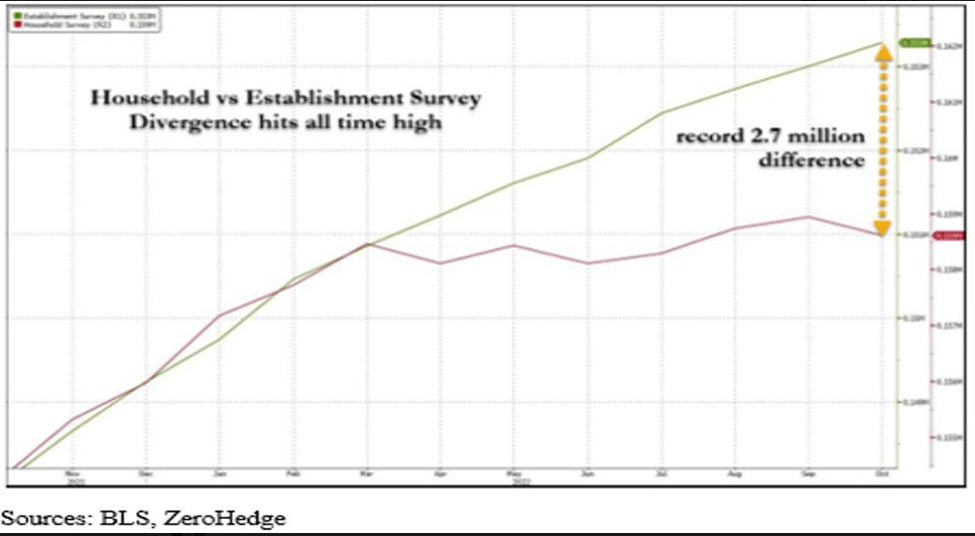
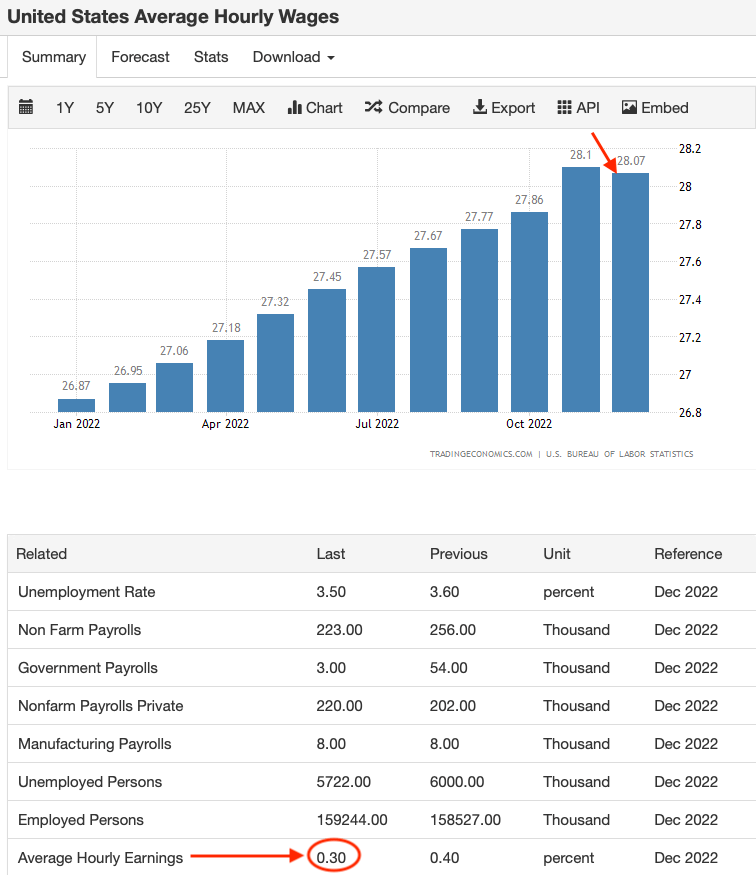
However, in one of the great oopsies of the 21st Century, it doesn’t look much like inflation is all that transitory. Based on some of the posts I wrote starting in 2020, I think we can see that inflation is way worse on the items that count for songwriters like “food at home,” rent, utilities and gasoline. Very often the number of Americans working a job is used to counter the lived experience of the high number of people who believe the economy is tanking. But what about that jobs report? More jobs equals good times, yes? There’s something weird about the math of the jobs report which should make you wonder about whether that’s such a great argument.

If I still have your attention after the “math” word, there are two standard surveys of the economy used to measure jobs that measure different components of the jobs created in a given measurement period. These data are the “Establishment Payroll Survey” which measures the total number of jobs in the U.S. economy. That’s the number most people refer to with the “jobs report” you hear so much about. (More formally titled the “Current Establishment Statistics (Establishment Survey).”)

There’s another number called the “Household Survey” that measures the total number of jobs per household (more formally titled the Current Population Survey).

Note that the Establishment survey measures all jobs; the Household survey measures jobs per household. If you had two or three jobs, the Household survey would count you as “employed”; the Establishment survey would count the number of jobs you had. Now note that there is currently 2.7 million job difference between the two. Why?

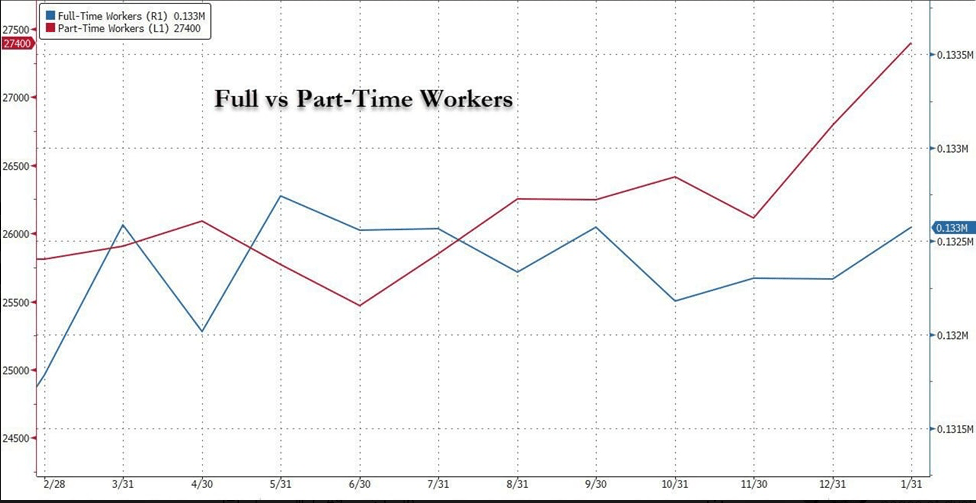
I’m not really sure, but it would appear that there are more jobs than households. That difference may occur from time to time, but it’s quite a big difference at the moment and seems to be a trend that’s confirmed by another statistic: the surge in part-time jobs as shown in this chart:

So what’s missing is how many jobs that are counted in the Establishment survey are held by any one or two household members in the Household survey. If you were to draw the conclusion that every job in the Establishment survey is a full time job held by the primary source of support in a household and that when the Establishment number is rising things are looking up, that may be a leap unsupported by evidence. That may be one of the things you’d want to know if you were trying to predict how well the government’s songwriter royalties would hold their value over the five year rate period.

The sharp increase since June in the number of part time workers may suggest that more people are working multiple jobs and not that more people are working. In fact, the total number of full time workers seems to have declined by a bit over the same period.

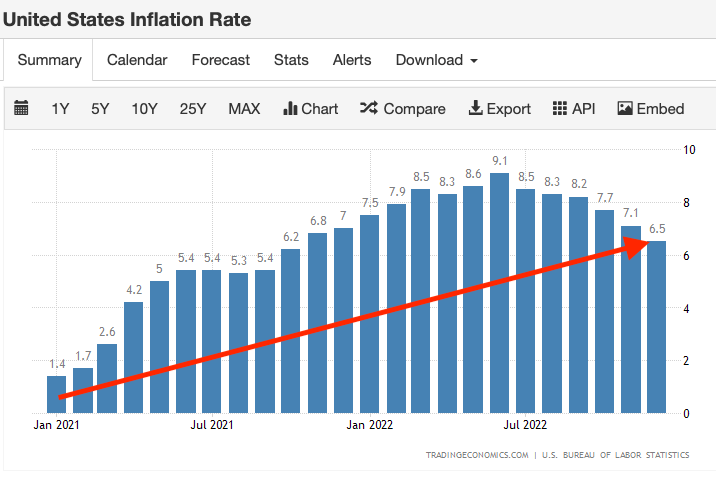
That’s not to say that inflation protection is not a serious requirement of everyone who relies on the government for their livelihood. While the inflation rate has declined a bit recently, possibly due to the Federal Reserve abandoning its zero interest rate policy, it is still significant. In my view, nothing in the employment report suggests otherwise and continues to highlight the importance of songwriters being accorded the same inflation protection on streaming as they are on physical and downloads.

Just because the physical rate is paid by the record companies and the streaming rate is paid by the richest corporations in history does not excuse the distinction. Each should be protected equally.

The Enemy Gets a Vote: How will Big Tech respond to “CRB Reform”?

You may recently have heard the term “CRB reform” tossed around by various music industry entities. The term usually means changes to the law or regulations governing the Copyright Royalty Board in the interests of the lobbyists or the big music publishers. And yes, so far it has just been the publishers raising “CRB reform” aside from the odd comment of A2IM filed with the CRB that would, if adopted, create a massive change to the Copyright Act and make controlled composition clauses even more pernicious. (As I explained in my reply comment, I don’t think the CRB has the authority to make the change A2IM asked nor do I think they have the inclination for self-surgery judging by their opinion concluding the “Subpart B” proceeding in Phonorecords IV.)

What you don’t hear, what you never hear, is how the music users will respond, particularly the Big Tech companies that participate in the Phonorecords proceedings for streaming mechanicals. You don’t even hear speculation about that little issue, which ignores the very important fact that the enemy gets a vote. (If you don’t think Amazon, Apple, Google, Pandora and Spotify are the enemy, then ask yourself why they brought 26 lawyers to the Phonorecords IV streaming mechanical proceeding and conducted a scorched earth discovery campaign in that proceeding. Not to mention dragging out Phonorecords III as long as they possibly could without remorse. And then there’s UGC 2.0 called AI and ChatGPT designed to take the human out of transhumanism. That’s not how friends treat each other.)

The fact that you don’t hear anything about how Big Tech views “CRB Reform” suggests one of two things is happening. Either there is no deal in place with the services or worse yet there is a deal but it just hasn’t been surfaced yet. That would be in keeping with the disastrous 2006 S1RA legislation (“Section 115 Reform Act“) the first version of the Harry Fox Preservation Act that failed, but eventually became Title I of the Music Modernization Act.

The way that one worked was Big Tech woke up and said, oh, you want to amend the Copyright Act? We have some things we want, too. (Big Tech in those days mostly Google led by their many proxy NGO front groups including the person of Gigi Sohn who is now unbelievably an FCC commissioner). So not only could Big Tech bring their considerable lobbying muscle to bear on any statutory “reform” (which usually means a further consolidation of power in the ruling class by closing loopholes favorable to the people), but they might make it actually worse.

For example, it would not be difficult for Big Tech to leverage their superior numbers and legal geographical advantage by expanding the discovery and appeal rights in CRB proceedings. That will essentially be the death knell of songwriters ever being able to defend themselves. Both the publishers and Big Tech would probably like to make certain that there is never again a George Johnson figure appearing in the proceedings much less 50 George Johnson’s (apologies for the casual objectification, but you get the idea). The lobbyists and lawyers on both sides share that special Washington moral hazard of wanting everything involving the government to be as complicated and lengthy as possible. Boy have they done that with the impenetrable streaming mechanicals calculations and expensive negotiations to keep it complicated so only the big guys can afford the accounting systems to use the government’s license.

How would anyone keep Big Tech from slurping at that trough if you opened up the CRB statutes and regulations? You can’t stop them–except one way.

If our side in the proceedings found voluntary changes everyone could agree to that would not require amending the statutes, then for better or worse we would be able to operate on the status quo. For example, the publishers could agree that there would be an independent songwriter advocate who would be included in the negotiations. They could agree any one of a number of things that would result in better treatment of songwriters. As long as we are stuck with the compulsory license, we could at least make it more representative.

But what no one wants is to have Big Tech leverage disagreements inside our house over the length of our table to come up with even more limitations and exceptions to copyright. To my knowledge, there is no agreement from the other side to stay out of this issue. If there is such a deal, I’d really like to know what was given up to get it. If there isn’t, I’d love to hear the plan from the smart people.

I’m all ears.

Are Songwriters and Artists Financing Inflation With Their Credit Cards?

Recent data suggests that songwriters and artists are financing the necessities in the face of persistent inflation the same way as everyone else–with their credit cards. This can lead to a very deep hole, particularly if it turns out that this inflation is actually the leading edge of stagflation (that I predicted in October of 2021).

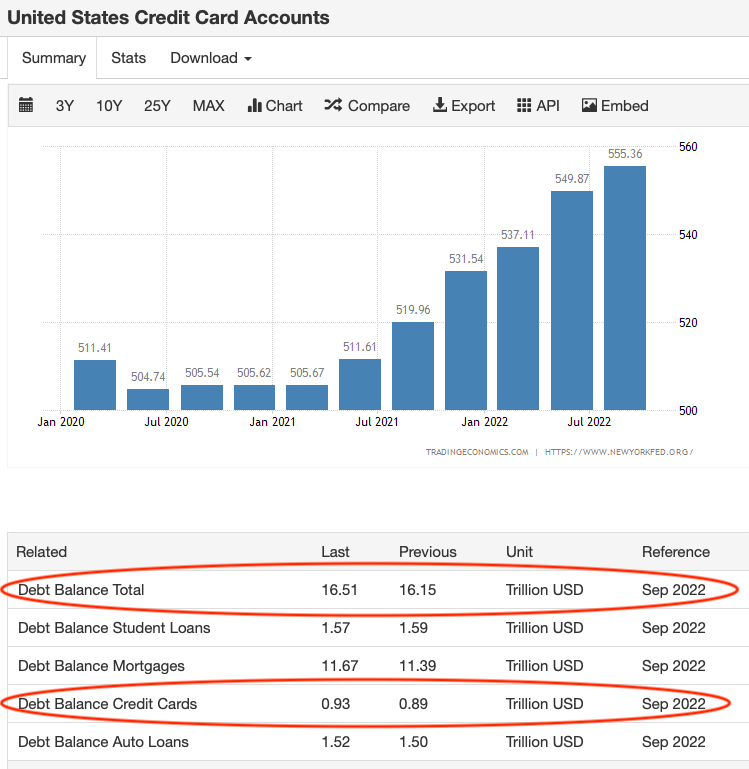
According to the first data release for the US Census Bureau’s recent Household Plus survey, over 1/3 of Americans are using credit cards to finance necessities at an average interest rate of 19%. Credit card balances show an increase that maps the spike in inflation CPI over the same time period. This spike results in a current debt balance of $16.51 trillion (including credit cards). There’s nothing “transitory” about credit card debt no matter the helping of word salad from the Treasury Department. Going into the Christmas season (a bit after this chart) U.S. credit card debt increased to the highest rate in 20 years

According to the Federal Reserve Bank of New York:

These balance increases, being practically across the board, are not surprising given the strong levels of nominal consumption we have seen. With prices more than 8 percent higher than they were a year ago, it is perhaps unsurprising that balances are increasing. Notably, credit card balances have grown at nearly double that rate since last year. The real test, of course, will be to follow whether these borrowers will be able to continue to make the payments on their credit cards. Below, we show the flow into delinquency (30+ days late) grouped by zip code-income. Here, it’s clear—delinquency rates have begun increasing, albeit from the unusually low levels that we saw through the pandemic recession. But they remain low in comparison to the levels we saw through the Great Recession and even through the period of economic growth in the ten years preceding the pandemic. For borrowers in the highest-income areas, delinquency rates remain well below historical trends. It will be important to monitor the path of these delinquency rates going forward: Is this simply a reversion to earlier levels, with forbearances ending and stimulus savings drying up, or is this a sign of trouble ahead?

What does it mean for artists and songwriters? It is more important than ever that creators work is valued and compensated. When it comes to government-mandated royalty rates like webcasting for artists and streaming for songwriters, due to the long-term nature of these government rates, it is crucial that creators be protected by a cost of living adjustment. (Remember, a cost of living adjustment or “COLA” is simply an increase in a government rate based on the rise of the Consumer Price Index, also set by the government.)

Thankfully, the webcasting rates (set in “Web V”) are protected by the benchmark cost of living adjustment, as are the mechanical royalty rates paid to songwriters for physical and download.

The odd man out, though, is the streaming mechanical rate which has no cost of living adjustment protection. This is troubling and exposes songwriters to the ravages and rot of inflation in what we continue to be told is the most important income stream for songwriters. If it’s the most important royalty, why shouldn’t it also have the most protection from inflation?