Sony Sues Rdio Executives for Fraud, A Cautionary Tale for Entrepreneurs

I’m on the alert for signals and other signs and portends that the Bubble Riders are about to bring down the U.S. economy yet again.  My theory is that Dot Bomb II: All Dogs Go to BK is casting right now, and will go into principal photography later this year.  Three signs are Spotify’s bonds (where a year maturity can be a “century bond“), Deezer’s busted IPO and of course the Rdio bankruptcy.

When bubbles burst, the harsh reality of the rules of bankruptcy suddenly become part of the vocabulary instead of aggregating bricks-and-clicks niches or facilitating user-centric content. And before you think that Rdio’s disaster is Pandora’s blessing, realize we also may be seeing a bubble bursting signal with the lawsuit that Sony Music filed against Rdio executives Anthony Bay, Elliot Peters and Jim Rondinelli.

The cautionary tale begins right there–note that this lawsuit is against these men individually.  If the case withstands the various means of dismissing it before it gets started which time will tell, this is about personal conduct, not the corporate actions of Rdio which has filed for bankruptcy.  Another reason that Sony may be suing these men individually is to pursue their action outside of the bankruptcy court that has jurisdiction over Rdio, a legitimate, but potentially intricate maneuver.

Of course you should realize that we haven’t heard the other side of the story yet, so keep that in mind.  There will be defenses and another side to the facts.  But what you should also keep in mind is that given the current state of the business, if a streaming service owes you money, you will have virtually no way to find that out.  Streaming services are very snide about affording artists and especially songwriters the right to conduct a royalty compliance examination (or “audit” for short, although it has nothing to do with CPAs, GAAP or financial audits).  Often the only time an artist or songwriter knows they are owed money is when the service goes bankrupt and the creator finds their name on the unsecured creditors list.

According to the Sony lawsuit (read it here) the defendants seem to have been some or all of the negotiating team for Rdio that came to Sony and asked for help.  Pay close attention to the timeline and remember that if your company is insolvent and either shuts down or actually files for bankruptcy, what you did in the run up to your bankruptcy will get scrutinized in bankruptcy.  Or as I prefer to call bankruptcy, volunteering to have a federal judge oversee every breath you take and ever have taken (key concepts are highlighted):

Unbeknownst to SME [Sony Music Entertainment], however, at the same time that Rdio was negotiating the amendment to its Content Agreement with SME, it was simultaneously negotiating its deal with Pandora—under which Rdio would file for bankruptcy [also known as a “prepack” or “prepackaged bankruptcy” usually requiring the advance approval of the creditors, including SME in this case]; Pandora would  buy Rdio’s assets out of bankruptcy; defendant Bay (as part-owner, executive officer, and  director of Rdio’s secured creditor) [potentially conflicting duties in a bankruptcy setting] would expect to be first in line to receive proceeds of the Pandora  deal; and SME (as an unsecured creditor) would receive pennies on the dollar for the amounts owed to it under the amended Content Agreement.

To summarize Sony’s allegations:  You guys came crying to us about renegotiating your deal, we were nice and gave you a break.  Even while you were crying to us, you were conspiring with Pandora to screw us because you knew that we would be in a weak position compared to the secured creditors like you.

That highlights another part of the cautionary tale–while officers and directors of a company have a fiduciary duty to stockholders under “normal” circumstances, when the company is essentially or actually insolvent, that fiduciary duty shifts to the creditors including the unsecured creditors.  Why?  (For a trip down memory lane on this subject, see the New York Times coverage of a judge’s ruling that denied Bertelsmann the ability to bid on Napster assets due to the “divided loyalty” of Napster’s CEO, a former Bertelsmann executive.)

Because the law puts the onus on the officers and directors to protect the creditors when it is likely that the officers and directors are the only ones who know that the company is going under.  Is this surprising?  On the schoolyard, you are supposed to protect the weaker kid before they get beat up, especially before they get beat up by your crazy brother.

The difference in these streaming service bankruptcies is going to be numerosity–the number of unsecured creditors will include every songwriter, artist, publisher and record company who is owed money.  Another reason why experienced digital service royalty auditors like Keith Bernstein of Royalty Review Council advises creators lucky enough to have an audit right to audit annually.  Don’t wait around for the service to go bust.

And here it comes in the next paragraph of Sony’s complaint:

Defendants knew that, had SME learned about Rdio’s negotiations with  Pandora at any time during the negotiations to amend the Content Agreement, SME would have  demanded immediate payment of the $5.5 million that Rdio owed to SME, and would have refused to grant Rdio further access to the recordings owned by SME. That in turn would have  diminished Rdio’s business and jeopardized the secret proposed sale to Pandora….Unbeknownst to SME at the time, Rdio had one day earlier signed a Letter of Intent with Pandora concerning the intended bankruptcy filing, which would prevent Rdio’s performance of its obligations to SME under the Renewal Amendment. Rdio never intended to fulfill the commitments it made in the Renewal Amendment.

I would point out that it takes two to tango (or maybe four or five in this case) and I’m surprised that Pandora isn’t in this lawsuit as well.  It would have made sense for Pandora to ask for some evidence that Rdio had the approval of all of its creditors (or at least all of the major creditors) before committing to buy Rdio’s assets.  Gutting the company of its ability to earn revenues (like buying its major assets and hiring its relevant employees) has its own set of problems.  Time will tell.

The timeline in this case is crucial:

On July 8, 2015, Pandora presented Rdio with a preliminary Letter of Intent to proceed with a sale of Rdio’s assets in bankruptcy. This was followed by further negotiations that culminated in a signed Letter of Intent between Rdio and Pandora on September 29, 2015, one day prior to Anthony Bay’s signing of the Renewal Amendment with SME. In other words, Rdio and Pandora had agreed in writing to proceed with a bankruptcy sale before Bay executed the Renewal Amendment [with SME]….

A material provision of the Renewal Amendment was Rdio’s obligation to pay SME $2 million on October 1, 2015—the day after the Renewal Amendment was executed.  This presented a dilemma for Rdio: the Pandora deal would be jeopardized either upon Rdio’s taking $2 million in cash out of its business, or upon Rdio failing to make the payment to  SME and putting its ongoing access to SME’s content at risk. To escape this bind, Defendants made false statements designed to induce SME to extend the due date for the payment rather than terminate the Renewal Amendment. Defendants Bay and Rondinelli fraudulently misrepresented to SME that Rdio was raising capital that would enable it to make this payment, when in fact Rdio was finalizing its deal with Pandora, under which Rdio would pay SME neither the $2 million, nor the monthly fees it owed for the rights to SME’s content that Rdio continued to exploit, nor the millions of dollars in other payments required under the Renewal Amendment.

And here is the Old Testament ending you knew was coming, sure as Cain and Abel:

As detailed below, Rdio ultimately succeeded in hiding the Pandora deal from SME until November 16, 2015, the date on which Rdio and Pandora signed an Asset Purchase Agreement and Rdio filed for Chapter 11 relief. As a result of this fraud, SME lost millions of dollars owed to it by Rdio.  Each of the Defendants was an officer or director of Rdio, and each of them knew of and participated in the fraud on SME. Defendants Bay and Peters were both personally involved in Rdio’s simultaneous negotiations with Pandora and SME, and knew that Rdio’s representations to SME were false. In addition, Defendants Bay and Rondinelli personally made fraudulent misrepresentations to SME in furtherance of the fraudulent scheme.  Defendants’ fraudulent actions substantially harmed SME, and enriched the individual Defendants by making the Pandora deal possible.

These are very serious charges, and Sony has a lot to prove.  But the cautionary tale is this: When you get into these situations, streamers have to be very careful about the sequence in which you do things and be very clear with all concerned about who benefits.  The timing of pre-bankruptcy events that affect the value of the bankruptcy estate will definitely get questioned.

On the licensor’s side, you have to always ask yourself, what happens if they go bankrupt tomorrow?  Is my minimum guarantee going to get caught up in the bankruptcy, either as a preference or am I never going to see the money?  There are ways to get comfortable with this, but it requires some extra precautions.
What is Texas Pacific Group Up To with Pandora and Spotify? Something? Anything?

by Chris Castle

As I’ve noted a couple times, convertible debt financing is all the rage with digital music service these days.  Deezer turned to it after a busted IPO in France, and now both Pandora and Spotify went there.  What’s attractive about debt?  Different reasons depending on the company’s situation.

Convertible debt is a special form of (usually) secured or collateralized loan that looks like any other loan except that it is convertible into the shares of the company.  The amount of time between the funding of the notes and the call on the debt gives the company some running room.  Given that the shares of the company may be worth less (or worthless) at the time the note converts, there’s usually some equity kickers in there along with a pretty bullet proof “event of default” clause.

Depending on how much money is involved and the negotiating position of the lender (usually near infinite leverage at this point), it’s possible for the lenders to effectively take over the company.  If you’re in the management team, that kind of thing can ruin your whole day.

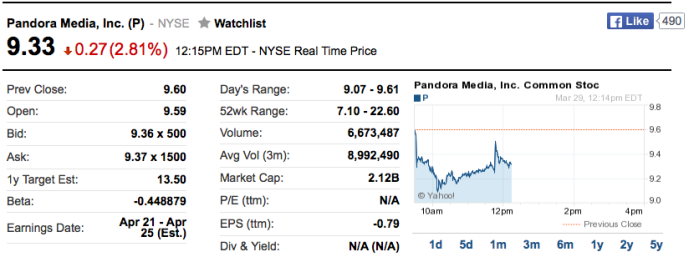
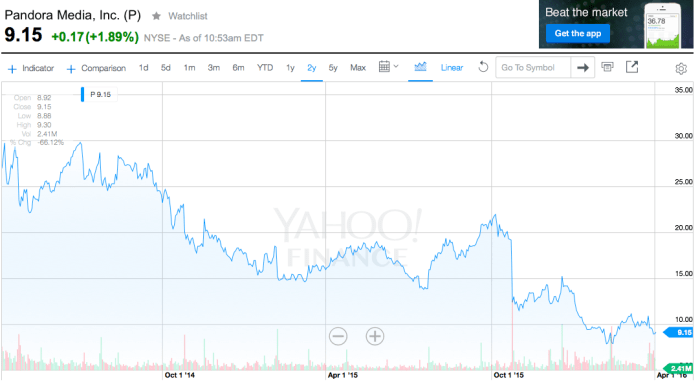
When a company has already been to the well  in the public equity market like Pandora, sometimes going a third time is just not in the cards.  This is particularly true when the company’s share price is going the wrong direction, like Pandora.

Pandora 4-4-16

For Spotify, I’ve already speculated that the main reason Spotify would like converts is because it avoids establishing a valuation for the company.  This can either be a clever move or a desperation hail Mary.  Since both Pandora and Spotify are suddenly in the debt business in a big way (Pandora $300,000,000 and Spotify $1 billion) something common to both caught my eye and that is Texas Pacific Group (or “TPG”).

According to the Wall Street Journal and Bloomberg, TPG is a lender in Spotify’s $1 billion line of convertible debt.  As Spotify is not publicly traded (and I presume these are not publicly traded bonds), we don’t have all the details you’d get in a public offering.  But it looks to be a pretty rich deal for the lenders as you would expect.

According to the WSJ:

Private-equity firm TPG, hedge fund Dragoneer Investment Group and clients of Goldman Sachs Group Inc. [which probably means Sean Parker] participated in the deal, which has been signed and is expected to close at the end of this week, these people said.

But wait, there’s more:

In return for the financing, Spotify promised its new investors strict guarantees tied to an IPO. If Spotify holds a public offering in the next year, TPG and Dragoneer will be able to convert the debt into equity at a 20% discount to the share price of the public offering, according to two people briefed on the deal. After a year, that discount increases by 2.5 percentage points every six months, the people said.

Spotify also agreed to pay annual interest on the debt that starts at 5% and increases by 1 percentage point every six months until the company goes public, or until it hits 10%, the people said. This interest—also called a “coupon” and in this case paid in the form of additional debt, rather than cash—is commonly used in private-equity deals but rarely seen in venture funding.

In addition, TPG and Dragoneer are permitted to cash out their shares as soon as 90 days after an IPO, instead of the 180-day period “lockup” employees and other shareholders are forced to wait before selling shares, the people said.

TPG and Dragoneer will buy $750 million worth of the deal, with the remainder going to clients of Goldman Sachs Group Inc., which advised on the financing, according to people familiar with the deal.

Spotify indicated to new investors it plans to go public in the next two years, people familiar with the matter said.

It’s possible to get more expensive money, but that would involve credit cards.  One thing I feel confident in guaranteeing about TPG, they got their pound of flesh.  And for Spotify–this deal looks pretty desperate.

As an aside, the Bloomberg reporting continued the thoughtless canard:

[L]ike other streamers, Spotify makes losses because it has to pay high fees to the music labels. On about 1 billion euros ($1.1 billion) of revenue in 2014, Spotify suffered an operating loss of 165 million euros, with some 70 percent of costs going to pay labels.

Wrong–the reason that Spotify loses money is because it is trying to maintain a near vertical growth curve.  Remember “get big fast”?  The mantra of the Dot Bomb Collapse?  And then there’s that nasty bit of not actually paying songwriters or bothering to get a license.

But TPG also turned up at Pandora where they got a board seat.  According to a Pandora press release:

[Pandora] is expanding the size of Pandora’s board from nine seats to 10 seats with the addition of Anthony J. “Tony” Vinciquerra, a technology, media and telecom expert with over 30 years of industry experience. Vinciquerra will join the board as a Class III Director and will be included in Pandora’s proxy statement for election at the 2017 Annual Meeting of Stockholders.

Mr. Vinciquerra has a background working very successfully for that well-known milktoast, Rupert Murdoch.  I find it interesting that within a month of Mr. Vinciquerra joining the board Brian McAndrews is out and Pandora is reportedly selling the radio station it bought for the sole purpose of sticking it to songwriters.  Hard to say if Mr. Vinciquerra is kicking ass and taking names, but ousting the guy who championed dropping $450 million on Ticketfly, antagonizing creators to the point of rank hostility and did not understand the definition of payola might be a step in the right direction.

Whether he can do the same for Spotify is an open question.

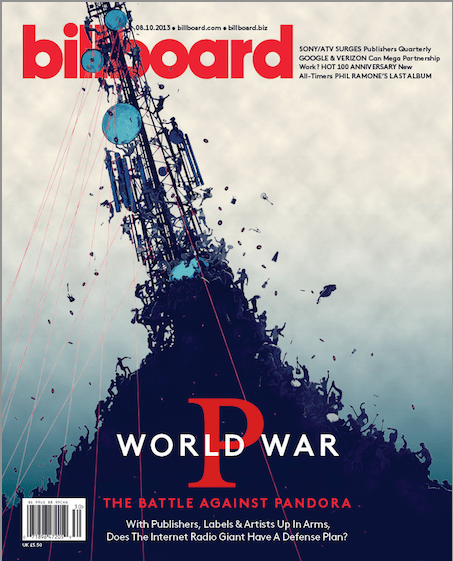
pandora_500_billboard_cover

Who knows?  Peace could be breaking out all over.  And that would be nice for all of us.


Musonomics Podcast: Songwriters, Consent and the Age of Discontent

I was honored to be included on an episode of the Musonomics podcast hosted by the brilliant Larry Miller of the NYU Steinhardt Music Business Program.  “Songwriters, Consent and the Age of Discontent” is a deeper dive into the state of the songwriter economy with songwriters Brett James and Ari Leff, ASCAP General Counsel Clara Kim, New Yorker writer John Seabrook and me.

You can subscribe to the podcast on iTunes (which I recommend as I think it’s in the top 3 music business podcasts) or listen to it on SoundCloud.

What Does Spotify’s Billion Dollars of Debt Mean for Labels and Artists?

The Wall Street Journal reports that Spotify has raised $1 billion in convertible debt with this telling analysis:

Music-streaming site Spotify AB has raised $1 billion in convertible debt from investors, a deal that extends the money-losing company’s runway but comes with some strict guarantees, people familiar with the matter said.

Private-equity firm TPG, hedge fund Dragoneer Investment Group and clients of Goldman Sachs Group Inc. participated in the deal, which has been signed and is expected to close at the end of this week, these people said.

Tech startups are increasingly turning to convertible debt—bonds that can be exchanged for stock—as investors push back on rich valuations amid a volatile stock market and economic uncertainty.

By raising debt instead of equity, Spotify adds to its war chest without the possibility of setting a lower price for its stock, which can sap momentum and hamper recruiting.

That last paragraph is very telling.  As I have warned about before, the main reason for any privately held company to take on convertible debt, particularly large amounts of convertible debt, is to avoid a “down round”, meaning a round of investment at a lower valuation than the previous round.  This means the new investors buying in the down round pay a lower price per share, and receive certain rights and preferences that are superior to the rights of the previous rounds’ investors.

The main reason for existing stockholders (like the major labels and Merlin in Spotify’s case) to avoid a down round is to protect the preferences that the prior investors have built into their stock ownership.  Those preferences can require the company to issue more shares to protect the percentage ownership of the insiders and key executives, for example, and that can lead to washout financings and recapitalizations to incentivize investors in the down round (who often are not, as one might say, “babies”).

Down rounds are also one indicator that a bubble is about to burst but that investors have not yet capitulated.  (Down rounds are a precursor to failed capital calls, which are the real sign of a bubble bursting.)  Down rounds were very common in the dot bomb bubble burst.

An example of down round protection would be lowering (or “resetting”) the strike price of a warrant if the company issues securities at a lower price in the future–the down round.  In any event, the company must sell more shares than in the previous rounds in order to generate the new investment, so down rounds will almost inevitably dilute existing stockholders even if they give up their preferences.

So why did Spotify raise convertible debt?  To avoid a down round, which means that there is a good possibility that the company was told either that their proposed valuation that they wanted to get in their next round of finance was too high or that their last valuation (over $8 billion) was too high.

Convertible debt is secured debt.  That means holders of convertible debt will be at the head of the line in a bankruptcy.  This is almost certainly going to create a new hierarchy overnight and should start every royalty recipient thinking differently about Spotify because it introduces the concept of preferences in bankruptcy.  And if you find yourself thinking that Spotify could never go bankrupt, welcome to bubble mania.

Get what you’re owed out of the company as fast as possible.  You are now looking at a senior secured creditor who will almost certainly take the lion’s share of any recovery from a bankrupt Spotify after washing out all the equity the labels gave up in return for discounted royalty rates (which would be Daniel Ek’s last laugh on the music business).  I’m using Spotify as an example, but it could be any of them–Pandora also has a large debt financing.

Audit Early and Often:  The first thing that should happen is that instead of auditing at the “bankers hours” pace that the industry usually operates at (every three to five years), everyone who is owed royalties by Spotify should conduct a royalty compliance examination every year.  The longer you wait, the greater the chance that you will become known as an unsecured creditor.  This is true of artists, songwriters, labels, publishers, PROs, the lot.  Unions that have any residuals based on streaming?  Get in there.

Contractors, Get Your Money:  If you’re an independent contractor for Spotify, get your money paid.  Don’t wait.  Ask any independent contractor for a dot com that’s gone under and they’ll tell you–kiss that delivery payment goodbye after the whip goes down.  This especially includes lawyers–you will be the first to go.

Employees, Don’t Count on Bonuses:  Employees should take some advice on how protected they are on bonuses or deferred compensation.  And of course, your common stock will likely get washed out completely in order to protect the holders of preferred stock.

Settlements and Preferences:  Get the money, get the money and be sure you get the money.  Consult with bankruptcy counsel to determine whether you are receiving a preference that can be undone in  a later bankruptcy filing.

Fiduciary Duties of Officers and Directors:  When a company becomes insolvent, there is a point along that path where the primary fiduciary duty of officers and directors shifts from the stockholders to the creditors.  Get smart about this.


What’s Next for Pandora?

Tim Westergren has returned to Pandora as the company’s CEO.  He’s got a golden opportunity to change how Pandora is viewed–we all want Pandora to succeed, but there’s little support for the path the company has been on for years now.  The 42% decline in Pandora’s stock price over the last 12 months hasn’t been helped by the company’s rocky relationship with the vendors of their main product: music.

pandora stock price

With some analysts giving Pandora a fair value stock price of $7, here’s a little unsolicited advice.

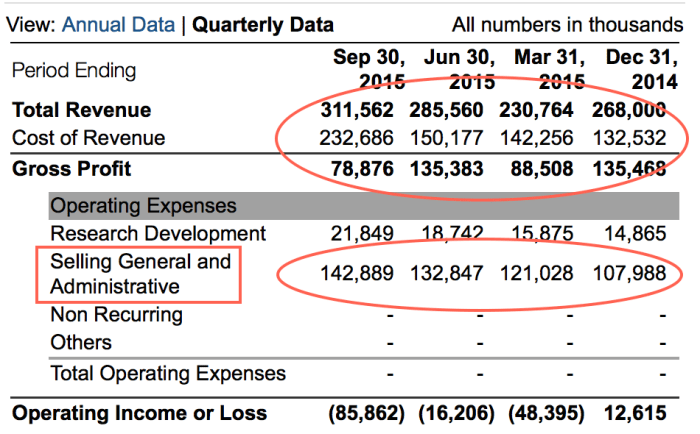
Overhead:  Pandora’s overhead is out of control.  They will blame it on royalties, but a closer look shows that the company has a problem with its operating costs that they would like you to ignore (hence the $7 fair value price target).

Pandora 2015 YOY

Integrity:  Westergren arrives at Pandora in a much different point in the zeitgeist than when he founded the company in terms of artist relations.  He made a huge misstep by associating himself with a string of attempts to lower Pandora’s royalty payment to artists and songwriters all of which have either outright failed or created more hostility than they ever would be worth.  In an atmosphere where artists are increasingly suspecting digital music services of cooking the books or operating without licenses, Pandora needs to be doing it better than the next guy.  Westergren doesn’t want to get stuck with Pandora’s “Enron moment”.

Legislation: Pandora backed the failed Internet Radio Fairness Act that was designed to lower artist royalties and created a huge backlash from the artist community.  Some refer to its spectacular failure as “lobbying malpractice.”  One time can be chalked up to bad advice. Don’t make it twice.

Litigation Against Compensating Artists: Pandora became the poster child for refusing to pay royalties on recordings made prior to February 15, 1972 which has come to be known as the “Pandora loophole”.  This would mean that if you were to record “Sophisticated Lady” or “Hello Dolly” tomorrow, Pandora would pay you but not the estates of Duke Ellington or Louis Armstrong.  In a move reminiscent of Spotify’s settlement with the NMPA, Pandora settled with just the major labels and is continuing to litigate against the class lead by The Turtles.  Westergren should settle Pandora’s case and treat all artists fairly.  Again, bad advice can get forgiven if the company does the right thing.  Avoid having loopholes named after your company on a go forward basis.

Litigation Against Compensating Songwriters:  Pandora has lead the way in using the rate courts against songwriters at great expense to ASCAP and BMI.  While Pandora is reportedly trying to make direct agreements with publishers, the company is using the rate courts to drag songwriters through the muck.  Westergren should stop trying to litigate royalty rates and ask yourself if you really saved that much money compared to your own legal fees and brand damage.

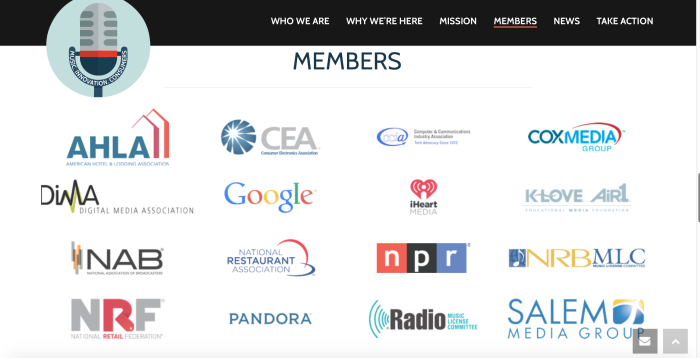
Lobbying With MIC Coalition:  Pandora is a member of the MIC Coalition, an alliance of companies against songwriters and artists—companies with a combined market capitalization of over $2 trillion.  (I stopped counting at $2 trillion dollars as I get confused by that many zeros to the left of the decimal place like I get confused by zeros to the right of the decimal place on Pandora’s royalty payments.)  There’s no good reason for Pandora to be in the MIC Coalition–whose first official act was to file an antitrust complaint against SESAC.  That’s right–because Google, Clear Channel (iHeart) and all the rest need protection from songwriters.  (The MIC Coalition even had a fake panel at SXSW moderated by their lobbyist who failed to identify her connection to the “McCoalition”.)

MIC Coalition

Tim Westergren built the better mousetrap, but it’s managed to catch a rat.   By pursuing a path of high integrity and fair dealing with creators, Pandora might have a chance to make it.  It would be a shame to see it go under.  Westergren’s brief should be to do everything he can to get the creative community back on board instead of looking like a stock-rich bubble boy having breakfast at Buck’s.

Investors Deserve a Standard for Measuring Music Service Subscribers

“Today, Spotify CEO Daniel Ek officially announced that the streaming service has hit the 30 million paying subscribers.”

Digital Music News.

Spotify “officially” announced today that it has 30 million paying subscribers.  What does “officially” mean?

I wonder if that’s like its announcement that it pays 70% of its revenue to rights holders–except when it doesn’t as David Lowery’s class action and other challenges to Spotify’s arithmetic credibility have revealed.

How do we know that Spotify has 30 million subscribers?  Because Spotify’s CEO says so.  Moral hazard much?  Isn’t that the same guy who claims to be the savior of the music industry but is underpaying songwriters to the tune of millions of dollars?

The ability of advertising supported media to deliver a reliable audience is hardly news, so it is hardly news that someone figured out that these numbers need to have some independent third party auditing those statements.

The Alliance for Audited Media is just such an independent third party.  AAM describes itself:

The Alliance for Audited Media connects North America’s top advertisers, ad agencies, media companies and platform providers. Our clients stand for trusted media analysis across all brand platforms—print, web, mobile, email and more—to make smart decisions. AAM delivers insightful, audited cross-media metrics that matter. We are one of the world’s most experienced providers of technology certification audits to industry standards established by the Interactive Advertising Bureau, Media Rating Council and Mobile Marketing Association. As a third-party auditor, we deliver media assurance via our verification and information services and provide solutions that empower media professionals to transact with greater trust and confidence.

It would be helpful for investors to know exactly what a “subscriber” means to Spotify (and other DSPs for that matter).  If the user is “subscribing” to an ad supported service, such as Spotify’s dearly beloved “freemium” service with Ads by Google, what does that mean?  Does it mean that a user has paid their bill for 90 consecutive days, or does it mean that the user is on their fourth 90 day free trial?

Given complaints by experts like WPP’s CEO Sir Martin Sorrell that click fraud and false billing is rampant on YouTube, shouldn’t investors expect to have subscribers audited by an impartial source?  (Harvard Business School Professor Ben Edelman called it back in 2009 with his prescient “Toward a Bill of Rights for Online Advertisers“.)

In this particular context, “investor” takes on a broader meaning.  Spotify and its defenders routinely ask that artists and songwriters “trust” but “don’t verify” to help Spotify grow–that is, to “invest” in Spotify’s future by taking a low royalty today for a burger on Thursday.  Now that class action lawsuits from songwriters are motivating the company to cover its tracks, it’s starting to look like Spotify is asking for a burger today for a dollar on Thursday.

It’s time that all investors in music services got independent verification of exactly what these subscriber numbers actually mean.

YouTube Revenues Explainer

I had the good fortune to participate in a SXSW panel about the mechanics of YouTube revenues.  If I say so myself, it was a wonderful panel with some deep expertise (“Stop Complaining and Start Monetizing“).  There was a real interest in the audience about the mechanics of the rights involved and the revenues paid.

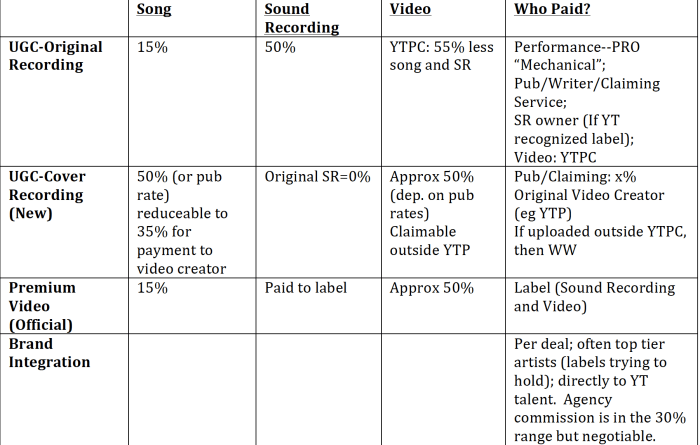
If you have that same interest and you weren’t able to go to SXSW, here’s a basic chart of revenue splits that may help you:

YouTube Chart

Source: Billboard

YTP, YTPC= “YouTube Partner“, “YouTube Partner Channel”
SR= Sound Recording
WW= “Wild West” meaning no particular rule.

Notice that the basic categories are song, sound recording and video which track the main three copyright categories of musical work, sound recording and audiovisual work.

The percentages refer to shares of “Net Ad Revenue” often defined as:

“Net Ad Revenues” means all gross revenues recognized by YouTube attributable to any sponsorship of or advertising displayed on, incorporated in, streamed from and/or otherwise presented in or in conjunction with any User Video displayed on a Covered Service including, without limitation, banner advertisements, synchronized banner advertisements, co-ads, in-stream advertising, pre-roll advertising, post-roll advertising, video player branding, and companion ads, less ten percent (10%) of such gross revenues for operating costs, including bandwidth and third-party (affiliated or unaffiliated) advertising fees. Net Ad Revenues excludes any e-commerce referral fees received by YouTube from “buy buttons” or “buy links” on the Covered Services that facilitate recorded music “upsells” when a Publisher separately receives payment from a third party in connection with such an upsell (e.g., royalties for a CD or sheet music sale); provided, however, for the avoidance of doubt, that such exclusion does not extend to (a) advertising of the type described in the first sentence of this Section for recorded music products, the revenues from which shall be included in Net Ad Revenues; and (b) all other types of e-commerce referral fees and revenues, which shall be included in Net Ad Revenues.

One key component of your YouTube earnings is the “CPM” paid by advertisers to Google.  Even if you have the right to audit YouTube (which few do), it is highly unlikely that you will ever be able to determine what the CPM is that Google uses to pay you on YouTube.  Multichannel networks (“MCNs”) like Machinima have reportedly tied creators to CPMs that were well below market, particularly considering that the highest CPMs on YouTube are often associated with exactly the kind of talent most frequently signed to an MCN.

“Official” or “Premium” Videos

When a label uploads an “official” music video on YouTube or Vevo, the video has higher production values than UGC and is usually supported by a sustained marketing effort outside of YouTube that drives traffic to the site.  If the premium video appears on Vevo, then 100% of the royalty is paid to the label, which in turn has licenses from the publishers for the song.  If the video is on YouTube proper, then the label’s share is reduced by the publisher royalty, often around 15% of net ad revenue.

Claiming and YouTube’s Content Management System (“CMS”)

Because of a combination of YouTube’s monopoly position in the market, Google’s controversial reliance on the notice and takedown provisions of the Copyright Act and its sheer litigation muscle, YouTube will let anyone upload anything also known as “user generated content” or “UGC”.  If you have access to YouTube’s “Content Management System” or “CMS” you have the chance to block UGC through YouTube’s “Content ID” fingerprinting tool.

Compared to the massive volume of videos uploaded to YouTube, a very, very small percentage of copyright owners have direct access to Content ID.  According to YouTube:

YouTube only grants Content ID to copyright owners who meet specific criteria. To be approved, they must own exclusive rights to a substantial body of original material that is frequently uploaded by the YouTube user community.

Participating in Content ID allows you to help YouTube create a vast and valuable library of reference versions of  your works.  (YouTube does not compensate you for participating in Content ID.)  Rightsholders usually participate in Content ID for two reasons which are not mutually exclusive:  Blocking or “monetizing”.  Monetizing means that you give YouTube permission to sell advertising against your works.  Naturally, YouTube hopes you will choose to monetize because over 90% of Google’s revenue comes from selling advertising online.

YouTube creates a reference version of your work in the form of a “fingerprint” (a psychoacoustic technique that has long been in use by the U.S. Navy among others to distinguish sound patterns–see Jonesy in The Hunt for Red October). A fingerprint is a mathematical rendering of the waveform of an audio file that essentially reduces a sound recording to a kind of hash that makes comparing fingerprints quicker and more accurate.

YouTube maps the reference fingerprint to other identifiers such as the International Standard Recording Code for sound recordings, song title, artist name and copyright owners for all of the above including song splits in many cases.  When a work is in the Content ID system, YouTube will compare an uploaded video to the Content ID database reference fingerprint and most of the time will follow the rules established by the copyright owner to block or monetize (often called “match policies“).  If the match is done before the UGC video is uploaded, then it won’t go live, and if the match is done after it is live, then the users will see one of YouTube’s controversial messages saying the file is blocked due to a claim by copyright owner X.

What this boils down to is that if you don’t have a label or publisher, you will need to go to a claiming service like Adshare, The Collective or Onramp in order to get access to CMS and Content ID in order to monetize your works outside of a YouTube Partner Channel (which is done through an Adsense account associated with your YouTube Partner account).  If you have a label, publisher or claiming service, then all of these entities should have access to CMS and Content ID and will be able to claim your songs, sound recordings or videos and monetize them if you wish.

Deciding if Monetization is Right For You

If you’re familiar with term recording artist agreements or publishing agreements (or what is normally called a “record deal” or “publishing deal”), you’ll probably remember negotiating “marketing restrictions” involving the use of your recording or song in advertising.  Those clauses usually restrict the use of your works in political ads, certain kinds of products (firearms, tobacco for example), or more artist-specific restrictions.  There are also restrictions on the kinds of movies or television programs (even videogames) in which your works can be used.

If you allow your work to be used in UGC and you elect to monetize, you can just forget all that on YouTube.  “UGC” includes just about anything you can imagine short of explicit pornography, but would include, for example, sex tourist home movies, jihadi recruiting videos (although “songs” are unlikely to appear there), hate speech and the like.  All of those are on YouTube and frequently are not behind any kind of age restriction wall.

The ads that get served as preroll for these videos are themselves often unsavory.  For example, Google serves ads for “dating” sites that are in categories frequently identified as thinly disguised human trafficking operations.  There are ways to block these particular uses if you have access to CMS but due to YouTube’s “catch me if you can” business practices, you may have to spend the time to track down each use which otherwise can stay on YouTube for months or years.

Winning the Lottery

We often hear about “YouTube stars” with elite channels (1 million plus subscribers) who are very well compensated.  The source of this high level of compensation is rarely limited to advertising revenue.  Most of the time, their ad revenue is salted with a high number of payments for what are essentially sponsorships, endorsements or product placements, often called “brand integrations“.

In the music and movie businesses, the term “star” is usually reserved for a relatively small group of performers who have demonstrated ability over time to reach a large audience, often a global audience.  YouTube “stars” may have large YouTube communities and may be able to introduce products to fans on YouTube, but whether that will hold up on YouTube over time or translate to other platforms remains to be seen in most cases.

It is also important to realize that advertising is a highly regulated business, particularly when it comes to false or deceptive advertising that is regulated by the Federal Trade Commission.  Machinima has just entered a 20 year consent decree with the FTC to settle claims that it misled consumers by passing off paid endorsers as independent reviewers.  Given that Machinima and other MCNs are supposed to protect their talent from such missteps suggests that YouTube stars may well have more to watch out for on YouTube than do recording artists or songwriters on record labels or music publishers.

Online Advertising in Decline

Whether it is ubiquitous ad blocking software, “do not track” settings on browsers, or distrust of advertisers, online advertising is in decline.  Like a ship that is sinking very slowly, it is sometimes difficult to tell if you’re really lower in the water, or if that was just a wave.  And remember, over 90% of Google’s revenues come from online advertising, moonshots notwithstanding.

If the online advertising ship really does sink, all the driverless cars, military robots and Google Glass will not save Google or YouTube.  That’s something to keep in mind when you agree to participate in the YouTube monetization game.


Investor Alert: Multichannel Networks Have Exposure to Deceptive Advertising Prosecution

We’ve all seen “brand integration” videos on YouTube promoted or produced by multichannel networks such as Maker, Machnima and others.  I’ve been convinced that if these videos were on television, they would violate the “sponsorship identification” or payola rules that require disclosure of consideration paid or exchanged for placement.  (As an aside, David Lowery has raised this issue in the context of “steering agreements” by Clear Channel and Pandora.)

Even so, there’s a straight up false advertising claim that could apply in these cases and the Federal Trade Commission has now prosecuted a claim against Machinima, one of the biggest.  (Read the FTC endorsement guidelines for social media here.)  All MCNs and YouTube itself should take note.  (Good thing for YouTube that they have extraordinary political influence at the FTC, but that’s another story.)

The FTC first published the case on September 2, 2015:

A California-based online entertainment network has agreed to settle Federal Trade Commission charges that it engaged in deceptive advertising by paying “influencers” to post YouTube videos endorsing Microsoft’s Xbox One system and several games. The influencers paid by Machinima, Inc., failed to adequately disclose that they were being paid for their seemingly objective opinions, the FTC charged.

Under the proposed settlement, Machinima is prohibited from similar deceptive conduct in the future, and the company is required to ensure its influencers clearly disclose when they have been compensated in exchange for their endorsements.

“When people see a product touted online, they have a right to know whether they’re looking at an authentic opinion or a paid marketing pitch,” said Jessica Rich, Director of the Bureau of Consumer Protection. “That’s true whether the endorsement appears in a video or any other media.”

Seems pretty simple, right?

According to the FTC’s complaint, Machinima and its influencers were part of an Xbox One marketing campaign managed by Microsoft’s advertising agency, Starcom MediaVest Group. Machinima guaranteed Starcom that the influencer videos would be viewed at least 19 million times.

In the first phase of the marketing campaign, a small group of influencers were given access to pre-release versions of the Xbox One console and video games in order to produce and upload two endorsement videos each. According to the FTC, Machinima paid two of these endorsers $15,000 and $30,000 for producing You Tube videos that garnered 250,000 and 730,000 views, respectively. In a separate phase of the marketing program, Machinima promised to pay a larger group of influencers $1 for every 1,000 video views, up to a total of $25,000. Machinima did not require any of the influencers to disclose they were being paid for their endorsement.

While it’s good that the FTC brought this case, the dollars are truly small potatoes in the world of YouTube stars with elite channels boasting over 1 million subscribers.

YouTube star Nikki Phillippi told Frontline:

“[W]hat is happening with YouTube is there is this weird line where I won’t rep a product I do not like, but, that being said, I don’t work with brands that don’t understand the value of YouTube either. I would rather not make as much and do stuff by myself, for free, with stuff I have picked up from the drugstore, than work with a company who either doesn’t understand the value of it, or does understand the value of it, but they think that we don’t, and are like here is $100, and I realize that that sounds really strange to people […] but it’s really what is going on in the industry and a matter of trying to elevate and help the entertainment industry kind of segue and understand the value of digital marketing.”

The FTC announced the consent decree today (songwriters take note–it’s not just you).

Following a public comment period, the Federal Trade Commission has approved a final consent order with Machinima, Inc., requiring the company to disclose when it has compensated “influencers” to post YouTube videos or other online product endorsements as part of “influencer campaigns.”

According to the FTC’s complaint, announced in September 2015, the California-based online entertainment network engaged in deceptive advertising by paying influencers to post YouTube videos endorsing Microsoft’s Xbox One system and several games. The influencers paid by Machinima failed to adequately disclose that they were being paid for their seemingly objective opinions, the complaint alleges.

The final order settling the complaint prohibits Machinima from misrepresenting in any influencer campaign that the endorser is an independent user of the product or service being promoted. Among other things, it also requires Machinima to ensure that all of its influencers are aware of their responsibility to make required disclosures, requires Machinima to monitor its influencers’ representations and disclosures, and prohibits Machinima from compensating influencers who make misrepresentations or fail to make the required disclosures.

On PBS’s Frontline, YouTube star Tyler Oakley says:

“If you want to get involved, then you have to play by our rules. This is our platform. We have built this up in our own capacity, in our own way without you. So if you want to come on and if you want to get involved, you can’t just come in like a bully and kind of get your way. You may have to like, play by our rules a little bit. Which is FUN!”

Actually, we all have to play by the same rules.  MCNs take note: You could be next.

As Ben Popper in The Verge summed it up:

As consumers increasingly turn to ad blockers, brands and the media companies are blurring the boundaries of advertising and independent content. Add in teenagers with little business experience and millions of passionate followers on platforms like YouTube, Instagram, and Snapchat, and you have a recipe for unscrupulous advertising that the FTC is clearly working hard to bring under control.

Is It Possible for Songwriter Metadata to Be Delivered to Retailers?

Metadata delivery is a hot topic at SXSW this year.  On a panel about data featuring representatives from two large digital aggregators, a question from the audience raised a salient issue:  If retailers are being sued because they are not licensing songs properly, is it even possible for labels or aggregators to deliver song share information to retailers directly?

If aggregators were able to collect the split data on songs, particularly the long tail, at the time the tracks were “ingested” into the aggregators systems, would that do any good if the retailers aren’t set up to take delivery.

One aggregator said that they didn’t collect publisher information “because publishers change all the time.”  That’s really not entirely true.  Another said that they don’t require the information, and that they don’t collect splits.  That suggests that the information is being collected for credits purposes.

In a separate conversation with a songwriter, it turns out that she had been told by a third aggregator that they don’t collect the data because the retailers don’t accept delivery of it. Between those three aggregators, I would guess that they cover over 50% of the market, and probably closer to 2/3.

This is pretty good anecdotal evidence that even if the “global rights database” existed, retailers would be unable to take full advantage of it without retooling their systems.  At the moment, it seems that the consensus thinking at aggregators is that since the retailers don’t collect the information, why bother requiring it as delivery item?

Aside from the fact that the market is failing to produce the information from an accurate source (the sound recording owner) at a key moment when transaction costs would be lowest (before the track and song go live).

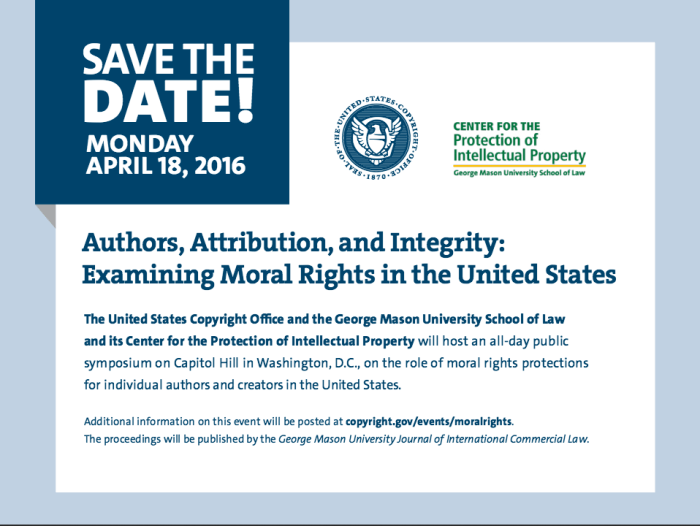
Save the Date April 18th in DC: Chris Castle on Copyright Office Moral Rights Symposium

CO Program

I am honored to have been asked to participate in this symposium on moral rights co-sponsored by the U.S. Copyright Office and the Center for the Protection of Intellectual Property at the George Mason University School of Law.

Moral rights is a key area of the law of copyright that is sadly lacking in the United States and an important legal tool to protect the rights of artists.  You can find more about the symposium on the Copyright Office page.