Chronology: The Week in Review: Could Spotify Extend Stream Discrimination to Songs, the No AI Fraud Act, Chairman Issa Has Questions on MLC Investment Policy

Spotify has announced they are “Modernizing Our Royalty System.” Beware of geeks bearing “modernization”–that almost always means they get what they want to your disadvantage. Also sounds like yet another safe harbor. At a minimum, they are demonstrating the usual lack of understanding of the delicate balance of the music business they now control. But if they can convince you not to object, then they get away with it.

Don’t let them.

An Attack on Property Rights

There’s some serious questions about whether Spotify has the right to unilaterally change the way it counts royalty-bearing streams and to encroach on the private property rights of artists. 

Here’s their plan: Evidently the plan is to only pay on streams over 1,000 per song accruing during the previous 12 months. I seriously doubt that they can engage in this terribly modern “stream discrimination” in a way that doesn’t breach any negotiated direct license with a minimum guarantee (if not others). 

That doubt also leads me to think that Spotify’s unilateral change in “royalty policy” (whatever that is) is unlikely to affect everyone the same. Taking a page from 1984 newspeakers, Spotify calls this discrimination policy “Track Monetization Eligibility”. It’s not discrimination, you see, it’s “eligibility”, a whole new thing. Kind of like war is peace, right? Or bouillabaisse.

According to Spotify’s own announcement this proposed change is not an increase in the total royalty pool that Spotify pays out (God forbid the famous “pie” should actually grow): ”There is no change to the size of the music royalty pool being paid out to rights holders from Spotify; we will simply use the tens of millions of dollars annually [of your money] to increase the payments to all eligible tracks, rather than spreading it out into $0.03 payments [that we currently owe you].” 

Yep, you won’t even miss it, and you should sacrifice for all those deserving artists who are more eligible than you. They are not growing the pie, they are shifting money around–rearranging the deck chairs.

Spotify’s Need for Living Space

So why is Spotify doing this to you? The simple answer is the same reason monopolists always use: they need living space for Greater Spotify. Or more simply, because they can, or they can try. They’ll tell you it’s to address “streaming fraud” but there are a lot more direct ways to address streaming fraud such as establishing a simple “know your vendor” policy, or a simple pruning policy similar to that established by record companies to cut out low-sellers (excluding classical and instrumental jazz). But that would require Spotify to get real about their growth rates and be honest with their shareholders and partners. Based on the way Spotify treated the country of Uruguay, they are more interested in espoliating a country’s cultural resources than they are in fairly compensating musicians.

Of course, they won’t tell you that side of the story. They won’t even tell you if certain genres or languages will be more impacted than others (like the way labels protected classical and instrumental jazz from getting cut out measured by pop standards). Here’s their explanation:

It’s more impactful [says who?] for these tens of millions of dollars per year to increase payments to those most dependent on streaming revenue — rather than being spread out in tiny payments that typically don’t even reach an artist (as they do not surpass distributors’ minimum payout thresholds). 99.5% of all streams are of tracks that have at least 1,000 annual streams, and each of those tracks will earn more under this policy.

This reference to “minimum payout thresholds” is a very Spotifyesque twisting of a generalization wrapped in cross reference inside of spin. Because of the tiny sums Spotify pays artists due to the insane “big pool” or “market centric” royalty model that made Spotify rich, extremely low royalties make payment a challenge. 

Plus, if they want to make allegations about third party distributors, they should say which distributors they are speaking of and cite directly to specific terms and conditions of those services. We can’t ask these anonymous distributors about their policies if we don’t know who they are. 

What’s more likely is that tech platforms like PayPal stack up transaction fees to make the payment cost more than the royalty paid. Of course, you could probably say that about all streaming if you calculate the cost of accounting on a per stream basis, but that’s a different conversation.

So Spotify wants you to ignore the fact that they impose this “market centric” royalty rate that pays you bupkis in the first place. Since your distributor holds the tiny slivers of money anyway, Spotify just won’t pay you at all. It’s all the same to you, right? You weren’t getting paid anyway, so Spotify will just give your money to these other artists who didn’t ask for it and probably wouldn’t want it if you asked them.

There is a narrative going around that somehow the major labels are behind this. I seriously doubt it–if they ever got caught with their fingers in the cookie jar on this scam, would it be worth the pittance that they will end up getting in pocket after all mouths are fed? The scam is also 180 out from Lucian Grange’s call for artist centric royalty rates, so as a matter of policy it’s inconsistent with at least Universal’s stated goals. So I’d be careful about buying into that theory without some proof.

What About Mechanical Royalties?

What’s interesting about this scam is that switching to Spotify’s obligations on the song side, the accounting rules for mechanical royalties say (37 CFR § 210.6(g)(6) for those reading along at home) seem to contradict the very suckers deal that Spotify is cramming down on the recording side:

Royalties under 17 U.S.C. 115 shall not be considered payable, and no Monthly Statement of Account shall be required, until the compulsory licensee’s [i.e., Spotify’s] cumulative unpaid royalties for the copyright owner equal at least one cent. Moreover, in any case in which the cumulative unpaid royalties under 17 U.S.C. 115 that would otherwise be payable by the compulsory licensee to the copyright owner are less than $5, and the copyright owner has not notified the compulsory licensee in writing that it wishes to receive Monthly Statements of Account reflecting payments of less than $5, the compulsory licensee may choose to defer the payment date for such royalties and provide no Monthly Statements of Account until the earlier of the time for rendering the Monthly Statement of Account for the month in which the compulsory licensee’s cumulative unpaid royalties under section 17 U.S.C. 115 for the copyright owner exceed $5 or the time for rendering the Annual Statement of Account, at which time the compulsory licensee may provide one statement and payment covering the entire period for which royalty payments were deferred.

Much has been made of the fact that Spotify may think it can unilaterally change its obligations to pay sound recording royalties, but they still have to pay mechanicals because of the statute. And when they pay mechanicals, the accounting rules have some pretty low thresholds that require them to pay small amounts. This seems to be the very issue they are criticizing with their proposed change in “royalty policy.”

But remember that the only reason that Spotify has to pay mechanical royalties on the stream discrimination is because they haven’t managed to get that free ride inserted into the mechanical royalty rates alongside all the other safe harbors and goodies they seem to have bought for their payment of historical black box.

So I would expect that Spotify will show up at the Copyright Royalty Board for Phonorecords V and insist on a safe harbor to enshrine stream discrimination into the Rube Goldberg streaming mechanical royalty rates. After all, controlled compositions are only paid on royalty bearing sales, right? And since it seems like they get everything else they want, everyone will roll over and give this to them, too. Then the statutory mechanical will give them protection.

To Each According to Their Needs

Personally, I have an issue with any exception that results in any artist being forced to accept a royalty free deal. Plus, it seems like what should be happening here is that underperforming tracks get dropped, but that doesn’t support the narrative that all the world’s music is on offer. Just not paid for.

Is it a lot of money to any one person? Not really, but it’s obviously enough money to make the exercise worthwhile to Spotify. And notice that they haven’t really told you how much money is involved. It may be that Spotify isn’t holding back any small payments from distributors if all payments are aggregated. But either way it does seem like this new new thing should start with a clean slate–and all accrued royalties should be paid.

This idea that you should be forced to give up any income at all for the greater good of someone else is kind of an odd way of thinking. Or as they say back in the home country, from each according to their ability and to each according to their needs. And you don’t really need the money, do you?

By the way, can you break a $20?

The NO AI Fraud Act

Thanks to U.S. Representatives Salazar and Dean, there’s an effort underway to limit Big Tech’s AI rampage just in time for Davos. (Remember, the AI bubble got started at last year’s World Economic Forum Winter Games in Davos, Switzerland).

Chairman Issa Questions MLC’s Secretive Investment Policy for Hundreds of Millions in Black Box

As we’ve noted a few times, the MLC has a nontransparent–some might say “secretive”–investment policy that has the effect of a government rule. This has caught the attention of Chairman Darrell Issa and Rep. Ben Cline at a recent House oversight hearing. Chairman Issa asked for more information about the investment policy in follow-up “questions for the record” directed to MLC CEO Kris Ahrend. It’s worth getting smart about what the MLC is up to in advance of the upcoming “redesignation” proceeding at the Copyright Office. We all know the decision is cooked and scammed already as part of the Harry Fox Preservation Act (AKA Title I of the MMA), but it will be interesting to see if anyone actually cares and the investment policy is a perfect example. It will also be interesting to see which Copyright Office examiner goes to work for one of the DiMA companies after the redesignation as is their tradition.

What to do with the MLC’s interest “float” on the black box?

MusicTechPolicy readers will have seen my post about the interest rate paid by the MLC on the rather sizable black box of “unmatched” funds sitting at a bank account (rumored to be City National Bank in Nashville).

That rate was modernized in the Music Modernization Act to be a floating rate: The Federal short term interest rate essentially set by the Federal Reserve. In fact, that particular federal rate is one of the lowest interest rates set by the Federal government and is the kind of interest rate you would want to be obligated pay–very low–if you knew you’d be in the business of holding large sums of money that you wanted to earn interest on yourself and make money on the spread, often called “the float.” (The black box is usually free money, so it’s actually an improvement.). For example, the bank prime loan rate is currently 5.5% that may be a good indicator of what you could get in the way of relatively risk free interest for a big lump sum–if not better for a really big lump sum, say $500,000,000.

The MLC is not, after all, the government, however much that fact might be lost on them. Why should the lowball government rate apply to the MLC instead of a competitive bank rate? Particularly when it comes to the substantial unmatched funds that songwriters and publishers are forced by the government to allow the MLC to hold and for which they control distribution–a bit of the old moral hazard there.

Indeed, you could also express that rate of involuntary saving as “prime plus x” where “x” is an additional money factor like 1%, so the rate floats upward to the songwriters’ advantage. Get some inspiration for this by looking at your credit card interest rate.

You probably have heard that the Federal Reserve is increasing the federal funds rate, and therefore all interest rates that are a function of the federal funds rate including the short term rate that the MLC is required by law to pay on the black box. The Federal Reserve is expecting to keep making significant increases in the federal interest rates in an effort to get inflation under control, which means that the MLC’s black box interest rate will also continue to increase significantly.

A quick recap: The MLC’s short term interest rate was 0.44% in January in keeping with then-prevailing Zero Interest Rate Policy (or the “lower bound”) of the Fed for the easy money years since the crash of 2008. But in August 2022 (that is, now) the MLC’s rate has increased to 2.84% monthly. The modern black box holding period in the Music Modernization Act is pretty clear:

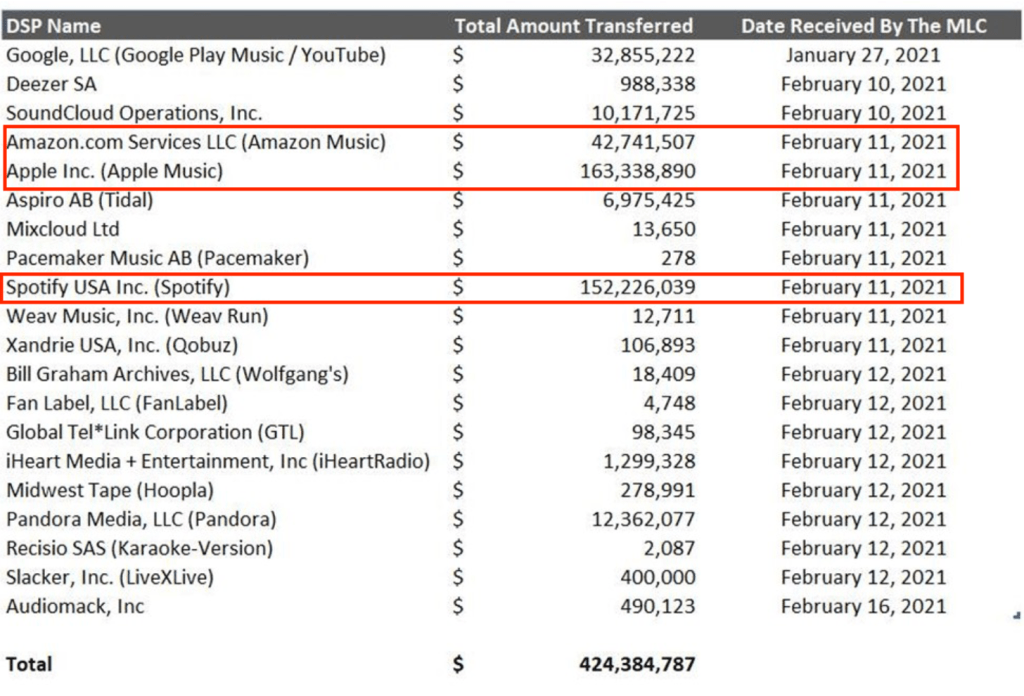
Also recall that the black box is to be held for an arbitrarily modern period of time while the MLC attempts to locate the rightful recipients as is their statutory burden under the MMA. Different numbers are thrown around for this holding period, but a three year holding period seems to be popular and has the benefit of having been modernized in the Music Modernization Act itself (see above). Bear in mind that the first tranche of “historical” black box (“historical” means “late” in this context) was $424,384,787 and was paid in February of 2021–nearly 18 months ago.

Also recall that we were not given any information that I am aware of as to when the services paying this rather large sum of other people’s money first accrued the black box. People who line up on the shorter holding period side of the argument generally favor rapid market share distributions which tends to help the majors; people on the longer holding period of time generally favor redoubled efforts to find the people who are actually owed the money.

The third group is that the MLC should simply find who is owed the money, have the money being held earn the highest rate of risk-free interest possible, and pay all of the interest money to the correct people when found and not have this cutesy limitation on the money factor paid out for holding OPM. Their argument goes something like your government takes away my right to negotiate my own rates, tells me how much I can charge, then makes it difficult to find me but easy to use my song and now you also want to take away the money you say I’m owed and give it to rich people I don’t know before I’ve had a change to claim it and pay yourselves to not do your jobs?

So we are at the midpoint of the three year statutory holding period. Although remember that this is a two pronged holding period of the earlier of 3 years after the MLC got the cash or 3 years after the date the service started holding the money that it subsequently transferred–a different holding period which would likely end sooner than the date the money was transferred to the MLC.

Although we know the date that the money was transferred in the aggregate to the MLC we may not know exactly when the money was accrued without auditing (although you would think that the MLC would release those dates since the timing of the accrual is relevant to the MMA calculation).

According to my reading of the statute, the modernized interest rate would likely attach from the time the money was accrued by the service, so should have been transferred to the MLC with accrued interest, if any. This may be in lieu of or in addition to a late fee. Very modern.

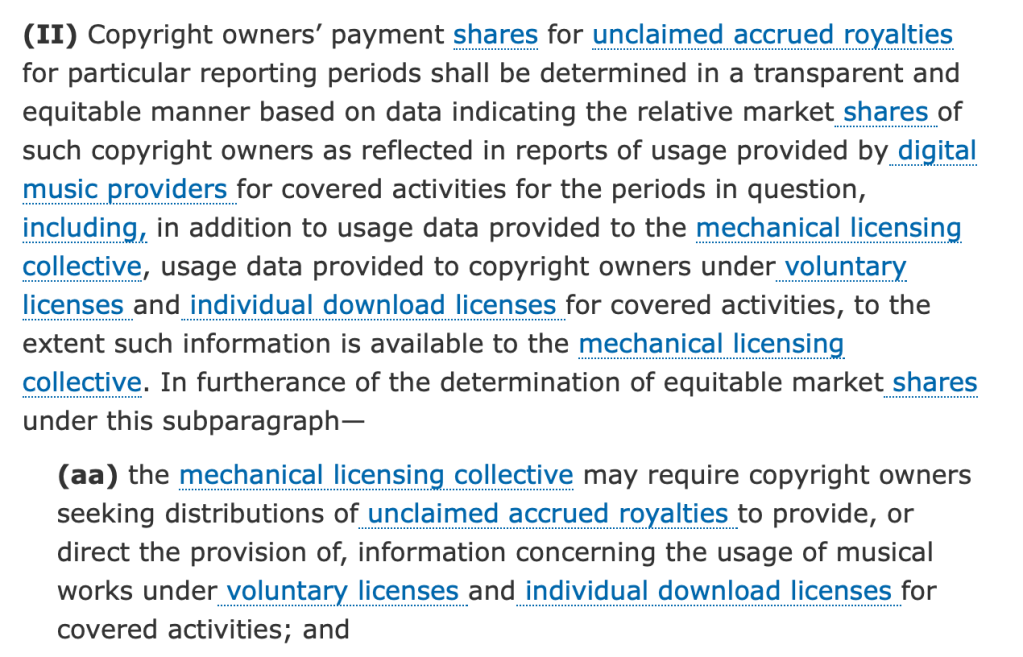
This leaves us with a couple questions. Remember that after the holding period, the black box is to be transferred on a market share basis to all the copyright owners who could be identified based on usage, which includes usage under voluntary licenses that are not administered by the MLC.

So this raises some questions:

  1. Why should the black box be divided up amongst copyright owners who have voluntary licenses and who are not administered by the MLC? They presumably have the most accurate books and statements and may have already had a chance to recover.
  2. What happens to the accrued interest at the time of distribution? Why should the market share distribution include interest on money that didn’t belong to the recipients?
  3. The statute takes the position that the MLC must pay the interest rate but is silent on how much interest the MLC can earn from the bank holding the substantial deposit of the unmatched monies. There’s nothing that requires the MLC to pay over all earned interest.

    Here’s a rough justice calculation of 3 years compound interest at current rates with steadily increasing black box. While the holding period started at the .44% rate, I ran the numbers at the 2.84% rate because it was easier–but also left out an estimate of the increase in rates that is surely to come. Since we are at the midpoint of the holding period already, this gives you an idea:

Hypothetical chart of growth rate of unmatched funds (historical and current) over a three year period at 2.84% compounded monthly interest rate

What the MLC Can Learn from Orphan Works

As you may be aware, The MLC recently received $424 million as payment of the “inception to date” unmatched mechanical royalties held at a number of streaming platforms, sometimes called the “black box.” Why do we have a black box at all? For the same reason you have “pending and unmatched” at record companies–somebody decided to exploit the recording without clearing the song.

Streaming services will, no doubt, try to blame the labels for this missing data, but that dog don’t hunt. First, the streaming service has an independent obligation to obtain a license and therefore to know who they are licensing from. Just because the labels do, too, doesn’t diminish the service’s obligation. It must also be said that for years, services did not accept delivery of publishing metadata even if a label wanted to give it to them. So that helps explain how we get to $424 million. Although the money was paid around mid-February, it’s clearly grown because The MLC is to hold the funds in an interest bearing account. Although The MLC has yet to disclose the current balance. Maybe someday.

This payment is, rough justice, a quid pro quo for the new “reach back” safe harbor that the drafters of Title I came up with that denies songwriters the right to sue for statutory damages if a platform complies with their rules including paying this money. That’s correct–songwriters gave up a valuable right to get paid with their own money.

The MLC has not released details about these funds as yet, but one would expect that the vast majority of the unmatched would be for accounting periods prior to the enactment of Title I of the Music Modernization Act (Oct. 11, 2018). One reason that expectation would be justified is that Title I requires services to try hard(er) to match song royalties with song owners. The statute states “…a digital music provider shall engage in good-faith, commercially reasonable efforts to identify and locate each copyright owner of such musical work (or share thereof)” as a condition of being granted the safe harbor.

The statute then goes on to list some examples of “good faith commercially reasonable efforts”. This search, or lack thereof, is at the heart of Eight Mile Style and Martin Affiliated’s lawsuit against Spotify and the Harry Fox Agency. (As the amended complaint states, “Nowhere does the MMA limitation of liability section suggest that it lets a DMP off the hook for copyright infringement liability for matched works where the DMP simply committed copyright infringement. The same should also be true where the DMP had the information, or the means, to match, but simply ignored all remedies and requirements and committed copyright infringement instead. Spotify does not therefore meet the requirements for the liability limitations of the MMA with respect to Eight Mile for this reason alone.”)

The MMA language is similar to “reasonably diligent search” obligations for orphan works, which are typically works of copyright where the owner cannot be identified by the user after trying to find them. This may be the only aspect of orphan works practice that is relevant to the black box under MMA. Since considerable effort has been put into coming up with what constitutes a proper search particularly in Europe it might be a good idea to review those standards.

We may be able to learn somethng about what we expect the services to have already done before transferring the matching problem to the MLC and what we can expect the MLC to do now that they have the hot potato. The MMA provides non-exclusive examples of what would comprise a good search, so it is relevant what other best practices may be out there.

Establishing reference points for what constitutes “good faith commercially reasonable efforts” under MMA is important to answer the threshold question: Is the $424 million payment really all there is? How did the services arrive at this number? While we are impressed by the size of the payment, that’s exactly the reason why we should inquire further about how it was arrived at, what periods it is for and whether any deductions were made. Otherwise it’s a bit like buying the proverbial pig in the proverbial poke.

One method lawmakers have arrived at for determining reasonableness is whether the work could be identified by consulting readily available databases identified by experts (or common sense). For example, if a songwriter has all their metadata correct with the PROs, it’s going to be a bit hard to stomach that either the service or the MLC can’t find them.

Fortunately, we have the Memorandum of Understanding from the European Digital Libraries initiative which brought together a number of working groups to develop best practices to search for different copyright categories of orphan works. The Music/Sound Working Group was represented by Véronique Desbrosses of GESAC and Shira Perlmutter, then of IFPI and now Register of Copyrights (head of the U.S. Copyright Office). The Music/Sound Working Group established these reasonable search guidelines:

DUE DILIGENCE GUIDELINES

The [Music/Sound] Working Group further discussed what constituted appropriate due diligence in dealing with the interests of the groups represented at the table—i.e., what a responsible [user] should, and does, do to find the relevant right holders. We agreed that at least the following searches should be undertaken:

1. Check credits and other information appearing on the work’s packaging (including names, titles, date and place of recording) and follow up through those leads to find additional right holders (e.g., contacting a record [company] to find the performers).

2. Check the databases/membership lists of relevant associations or institutions representing the relevant category of right holder (including collecting societies, unions, and membership or trade associations). In the area of music/sound, such resources are extensive although not always exhaustive.

3. Utilise public search engines to locate right holders by following up on whatever names and facts are available.

4. Review online copyright registration lists maintained by government agencies, such as the U.S. Copyright Office.

Perhaps when the MLC audits the inception to date payments we’ll have some idea of whether the services complied with these simple guidelines.

Copyright Office Unclaimed Royalties Study Meeting 12/6/19


One of the loose ends from Title I of the Music Modernization Act is how the Congress is going to permit the Mechanical Licensing Collective and the Digital Licensee Coordinator to process the “black box” or unclaimed royalties.   It’s common to hear people using the experience with various private settlements as a guide for how to handle the MLC’s black box.  It is said that a small percentage of the black box was actually claimed, so it’s the fault of those who failed to make their claim that they missed out.

There may be a kernel of truth in that, but the real question is why was there such a small percentage claimed in the first place?  Wouldn’t the administration of settlements with poor claiming history be an example of what not to do in the future?  Certainly with a government mandate forcing the issue?

Congress clearly recognized their oversight role on the black box by mandating the Copyright Office conduct an unclaimed royalties study to develop best practices:

Not later than 2 years after the date on which the Register of Copyrights initially designates the mechanical licensing collective…the Register,in consultation with the Comptroller General of the UnitedStates, and after soliciting and reviewing comments and relevant information from music industry participants and other interested parties, shall submit to the Committee on theJudiciary of the Senate and the Committee on the Judiciary of the House of Representatives a report that recommends best practices that the collective may implement in order to—

(A) identify and locate musical work copyrightowners with unclaimed accrued royalties held by thecollective;

(B) encourage musical work copyright owners to claimthe royalties of those owners; and

(C) reduce the incidence of unclaimed royalties.

The Copyright Office held the first public consultation on the study last December, and posted a video of the meeting that is well worth watching.  As I noted in an MTP post last year:

There are two currently existing standards that the Copyright Office can reference for examples of industry best practices-the SoundExchange unclaimed royalty search for new members and the Lowery-Ferrick Spotify class action Songclaims portal powered by Crunch Digital.  It seems inescapable that these claiming standards should be guideposts for both the Copyright Office and the Copyright Royalty Judges.

Having such clear cut standards–already operational so not theoretical–is fortunate because it seems obvious that the Congress is both concerned with the black box distributions not being gamed and also intends to exercise its statutory authority to retain oversight over the Mechanical Licensing Collective’s operations.  In fact, Senator Grassley specifically stated in his questions for the record following the Copyright Office oversight hearing that:

“The success of the Music Modernization Act (MMA) will depend, to a large extent, on the effective and efficient operation of the Mechanical Licensing Collective (MLC). The MMA included provisions to ensure that there was robust ongoing oversight of the MLC by both the Copyright Office and Congress, and that the new MLC would be accountable to the stakeholders.”