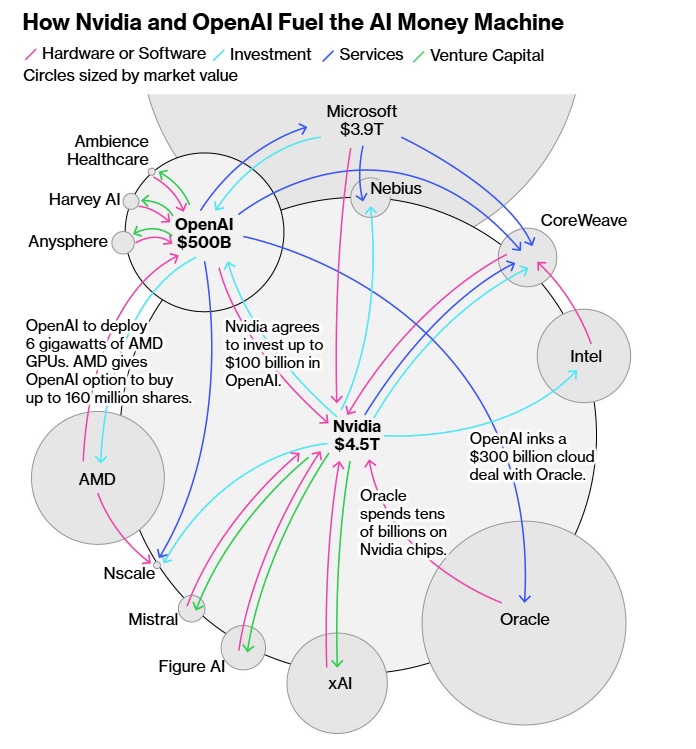
There may be another brake on the AI data-center boom that has received surprisingly little attention: insurance may become a binding constraint on financing and completion long before anyone runs out of enthusiasm for artificial intelligence.
This is not simply a question of whether underwriters will insure a $10 billion building against fire. The deeper problem is that modern hyperscale data centers are becoming extraordinarily large, expensive and interdependent infrastructure projects that struggle to maintain a semblance of a capex construction budget. A single campus can combine data halls, substations, specialized transformers and switchgear, cooling systems, fiber, batteries, transmission infrastructure and, increasingly, dedicated power generation—each component of which is a complex system with a significant overbudget risk.
Once a developer adds on-site generation, what looks like a single data-center development can effectively become two major construction projects—a data center and a power plant. That creates something much more consequential than ordinary construction risk. It creates completion risk. The movie business knows all about completion bonds, but no movie ever cost as much as a data center.
Ninety-Eight Percent Finished Can Still Mean Zero Revenue
A data center is not economically complete merely because the building is standing. It must be electrified. The cooling systems have to work. Transformers and switchgear must be installed and commissioned. Fiber must be connected. The facility must satisfy its performance requirements. And, most importantly, there must actually be enough continuous electricity available to operate it. 24/7/365.
A hypothetical $8 billion facility that is 98% physically complete but cannot obtain its final power connection isn’t necessarily worth $7.84 billion. As an operating data center—which it isn’t—it may be worth very little until somebody solves the missing 2%. It might even be worth zero.
And that is where the insurance problem gets interesting. Traditional builder’s-risk insurance generally responds to physical loss or damage. Delay-in-start-up coverage can protect against certain resulting revenue losses, but ordinarily there must first be an insured event triggering the coverage. A project delayed because a transformer was destroyed in a fire presents a familiar insurance problem.
But a project delayed because its grid connection never materializes, a transmission line project is cancelled, a regulator changes course, a federal or state political moratorium intervenes, or sufficient electricity simply isn’t available presents a very different one. This includes a data center that is planned with behind the meter nuclear power, but the nuclear plant cannot get built.
Physical damage is easy to understand. Yet, there can be catastrophic economic loss without catastrophic physical damage. That distinction could become increasingly important as the industry attempts to build larger facilities in places where electricity infrastructure is already the project’s principal constraint.
Now Add the Banks
The problem becomes considerably more interesting when viewed through the capital structure. Large infrastructure projects increasingly rely on project-level financing in which lenders ultimately expect repayment from cash flows generated by the completed facility. During construction, however, lenders typically want considerably more protection against the possibility that the asset never reaches commercial operation. We joke that the music business is the only business in the world where an asset is worth more before it’s put in service than after. Not so funny applied to data centers.
That protection can include sponsor guarantees, cost-overrun commitments, completion guarantees, debt-service support and other forms of recourse. The project’s economics therefore change dramatically depending upon whether it successfully crosses the line from construction risk to operating risk. And that creates what might be called the data-center completion trap.
Imagine an $8 billion data center. Seven billion dollars has already been spent. The buildings are substantially complete. Equipment is installed. Customers may be waiting. Then the transmission solution fails.
Walking away means potentially crystallizing an enormous loss. So spending another $500 million to solve the power problem may appear perfectly rational. Then another problem emerges. Another $750 million may still look rational compared with abandoning the original $7.5 billion. The project has entered the classic sunk-cost problem—but with a particularly dangerous infrastructure twist:
The more capital that has already been sunk into the project, the greater the economic incentive to commit additional capital to rescue it, even as the assumptions that justified the original investment deteriorate. That is the completion trap.
Going Off Grid Doesn’t Necessarily Solve It
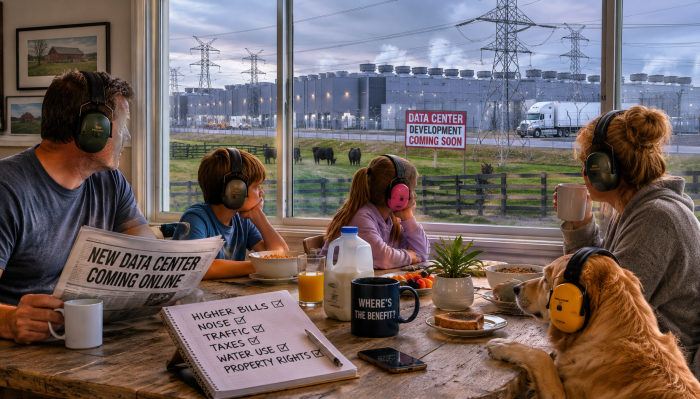
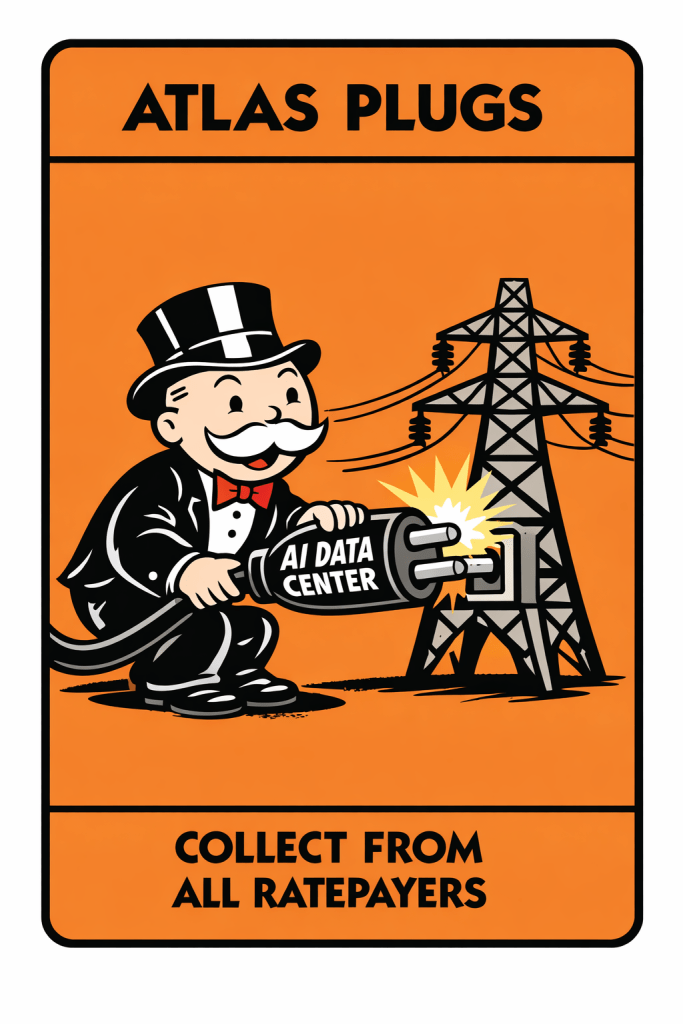
One increasingly popular response to grid constraints is behind-the-meter generation. Can’t get enough electricity from the grid? Build your own. That’s not really an answer if you’re actually doing it. It’s right up there with “because China” as the AI rationale. That may solve one problem while creating several others.
The developer now needs not merely a functioning data center but a functioning generating plant. That can introduce fuel-supply agreements, turbines, pipelines, environmental permits, additional construction contracts, emissions requirements and entirely new categories of operating and equipment risk.
The project’s dependency chain gets longer and longer. And every additional dependency creates another possible route by which a nearly completed project can fail to reach commercial operation. Reuters recently reported that grid bottlenecks are pushing businesses toward larger on-site power systems. That trend deserves to be understood not simply as an electricity story.
It is also a risk-transfer story. The grid constraint doesn’t disappear. Some of the risk associated with solving it simply migrates onto the developer’s balance sheet.
The Insurance Capacity Feedback Loop
Now consider what happens to insurers. Insurers don’t evaluate a $10 billion hyperscale campus solely by asking whether the building is likely to catch fire. They also manage aggregate exposure. How much capital is exposed at one location? To one natural catastrophe? To one electrical system? To one equipment manufacturer? To one utility? To one geographic concentration?
Aon has warned that the enormous concentration of value in hyperscale facilities creates the possibility that a single event can produce a portfolio-level loss for insurers and reinsurers. That creates a potentially important feedback loop:
Bigger projects → larger probable maximum losses → scarcer insurance capacity → higher premiums and deductibles → lower available limits → greater retained sponsor risk → tighter lender requirements → higher cost of capital → weaker project economics.
There is something important buried in that sequence. Insurance capacity is itself capital. And unlike GPUs, transformers or gas turbines, developers cannot simply manufacture more of it. An insurer or reinsurer must be willing to put its own balance sheet behind the risk. At sufficient concentrations, the rational answer may be higher prices, lower limits, exclusions, syndication across numerous carriers—or simply no. That can ultimately produce a constraint that receives far less attention than electricity or chips: bankability.
The Bankability Cliff
Consider the conversation among the three principal sources of risk capital. The lender asks: Is completion risk adequately transferred? The insurer answers: We don’t cover all of it.
The sponsor therefore has to retain the uncovered risk. The lender responds: Then we need more sponsor support.
The sponsor recalculates its expected return. At some point, the additional equity, guarantees, contingency reserves, insurance costs and financing expenses required to make the project bankable can push the project’s risk-adjusted return below the sponsor’s required return.
Understand how weirds this is. Nothing has physically prevented construction. There may still be enormous demand for AI. The developer may still believe its long-term demand forecast. And yet the project doesn’t finance.
That is the bankability cliff.
Now Connect It to Stranded Assets
This brings us back to the larger problem surrounding the data-center infrastructure boom. A data center cancelled before construction begins may be embarrassing, but the economic damage is comparatively containable. A project that fails after billions of dollars have been spent is something else entirely. And if this starts happening at a rate that anyone can call “frequently” cold feet will break out all over.
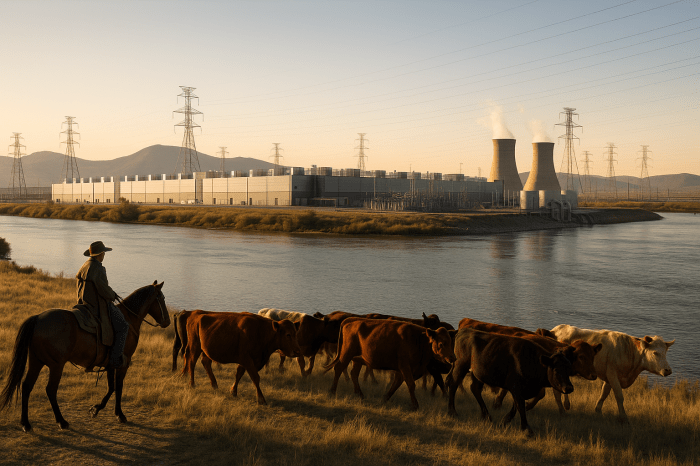
By then there may already be substations, transmission lines, gas pipelines, generating plants, water infrastructure and roads built specifically to accommodate the expected load. There may also be something much harder to reverse: eminent domain.
Property may have been condemned and permanent transmission easements imposed on landowners because planners concluded that enormous future electrical loads required new infrastructure. What happens if the private project that justified that infrastructure never reaches commercial operation? The developer takes a loss—although loss doesn’t quite cover it. The lender restructures the debt. Investors write down their equity.
But the landowner doesn’t get their family ranch back. And the transmission corridor doesn’t magically disappear.
Completion Risk Is Therefore a Public-Policy Question
This suggests that regulators may be asking the wrong question when evaluating enormous new data-center loads.
It isn’t enough to ask: Does the developer have financing? Nor is it enough to ask: Has somebody agreed to build the data center?
The better question is:
Has the developer demonstrated sufficient committed capital, insurance, power supply, equipment availability, completion guarantees and contingency resources to reach commercial operation if the original construction and power plan fails?
That is a much tougher test. And if data centers become poster children for bad investments…lenders will want out.
Before approving billions of dollars of transmission investment—or allowing eminent domain to be exercised on the assumption that a 1-gigawatt data center will exist—regulators might reasonably demand evidence that the project is not merely financeable enough to start. It needs to be financeable enough to finish.
The Risk Nobody Is Pricing Correctly
Much of the debate over stranded AI infrastructure assumes a particular sequence: AI boom → enormous data-center construction → AI bubble bursts → completed facilities become stranded assets.
There is another possibility. Some projects may never reach the third step. The constraint may arrive during construction, when increasingly enormous and interconnected projects encounter an insurance market unwilling to absorb all of their risk, lenders unwilling to accept what remains, and sponsors unwilling or unable to provide unlimited completion support.
The resulting stranded asset would not be an obsolete data center.
It could be a half-completed infrastructure ecosystem. And some portion of that abandoned ecosystem—transmission lines, substations, generating plants, pipelines and condemned rights-of-way—may already have been imposed on communities because somebody’s spreadsheet said the projected load was coming. Or because China.
That is why insurance belongs in the data-center backlash discussion. Insurance risk becomes completion risk. Completion risk becomes credit risk. Credit risk becomes stranded-asset risk. And when public infrastructure and eminent domain have already been committed to the project, private completion risk can become public risk.
The most dangerous data-center forecast may therefore not be the one predicting how much electricity artificial intelligence will consume in 2035. It may be the assumption hidden underneath it: that every project we are building the infrastructure for today will actually make it to the finish line.
That assumption must be phrased as a question: Will this project get finished on time and at least somewhat on budget.
Good luck with that.