Five Things Congress Can Do to Stop Tens of Millions of “Address Unknown” NOIs

Copyright reform is on the front burner again after the passing of the  Register of Copyrights Selection and Accountability Act by a vote of 378-48.   But there’s another problem the Congress needs to fix that won’t require legislation in the short run:  The mass filing of tens of millions of “address unknown” notices under the archaic compulsory license for songs.

I’m going to assume that readers know the general background on the millions of “address unknown” NOIs filed with the Copyright Office under a loophole in the Copyright Act (Sec. 115(c)(1)).   If that is Geek to you, see my recent paper on mass NOIs for more complete analysis (or previous posts on MTS for the armchair version of the story.   The first distinction to remember is that we are only concerned in this post with song copyrights and not the sound recording.  This story implicates songwriters and publishers, not artists and record companies, and it only applies to the government’s compulsory license for songs, a uniquely American invention.

In a nutshell, Amazon, Google, Pandora, Spotify and other tech companies are serving on the Copyright Office tens of millions of “address unknown” notices of intention to obtain a compulsory license to make and distribute recordings of certain types of songs.  Under what can only be called a “loophole” in this compulsory license, a service can serve these “address unknown” NOIs on the Copyright Office if the owner is not identifiable in the Copyright Office public records.  The Copyright Office stands in the shoes of the “address unknown” copyright owner to receive and preserve these notices.

On the one hand companies like Amazon, Google, Pandora and Spotify say that they can’t find these millions of song owners, while at the same time at least some of the same companies brag about how comprehensive and expensive their song databases are (like Google’s Content ID) or their agents puff up the agent’s own massively complete song databases as “the worlds largest independent database of music copyright and related business information.”  And yet, these same companies and their agents can’t seem to find songwriters whose names, repertoire and contact information are well known, or whom they already pay through their own systems or through their agent.

The Database Double Loophole Trick

Here’s the loophole.  First, the loophole requires a very narrow reading of Section 115(c)(1) of the Copyright Act, a 40 year old statute being applied to NOIs served at a scale the Congress never intended.  If the song owner isn’t found in the public records of the Copyright Office, even if the digital service or its agent has actual knowledge of the song copyright owner’s whereabouts, the digital service can say they are not required to look further.

Even if you buy into this willful blindness, these digital services may not be looking at the complete public records of the Copyright Office.  The only digitized records of the Copyright Office are from January 1, 1978 forward, and my bet is those easily searchable records are the only records the services consult.  That omits the songs of Duke Ellington, Otis Redding, The Beatles and five Eagles albums not to mention a very large chunk of American culture.

The Copyright Office records from before 1978 are available on paper, so the pre-78 songs are still in the public records (which is what the Congress contemplated in the Copyright Act).

The identifiers are just not “there” if you decide not to look for them.  However, it is not metaphysical, it is metadata that exists in physical form.  This is the “double loophole”.

The Double Triple:  New Releases

Another category of song copyrights that will never be in the public records of the Copyright Office in their initial release window are new releases with recently filed but not yet finalized copyright registrations.  The Copyright Office itself acknowledges that it can take upwards of a year to process new copyright registrations.  This allows “address unknown” filers to bootstrap a free ride on the back of Congress during that one-year period.

No Liability or Royalties Either:  Trebles All Round

Once a company serves the “address unknown” NOI on the Copyright Office, songwriters are arguably compelled by the government to permit the service to use their songs.  Filing the “address unknown” NOI arguably allows the service to avoid liability for infringement and also–adding insult to injury–to avoid paying royalties.  If the NOI is properly filed, of course.

In current practice, a mass “address unknown” NOI is usually a single notice of intention filed with a huge attachment of song titles with the required fields, such as this one Google filed for Sting’s “Fragile”, the anthem of the environmental movement (which was clearly filed incorrectly as the song was registered long ago):

sting-fragile-google-noi

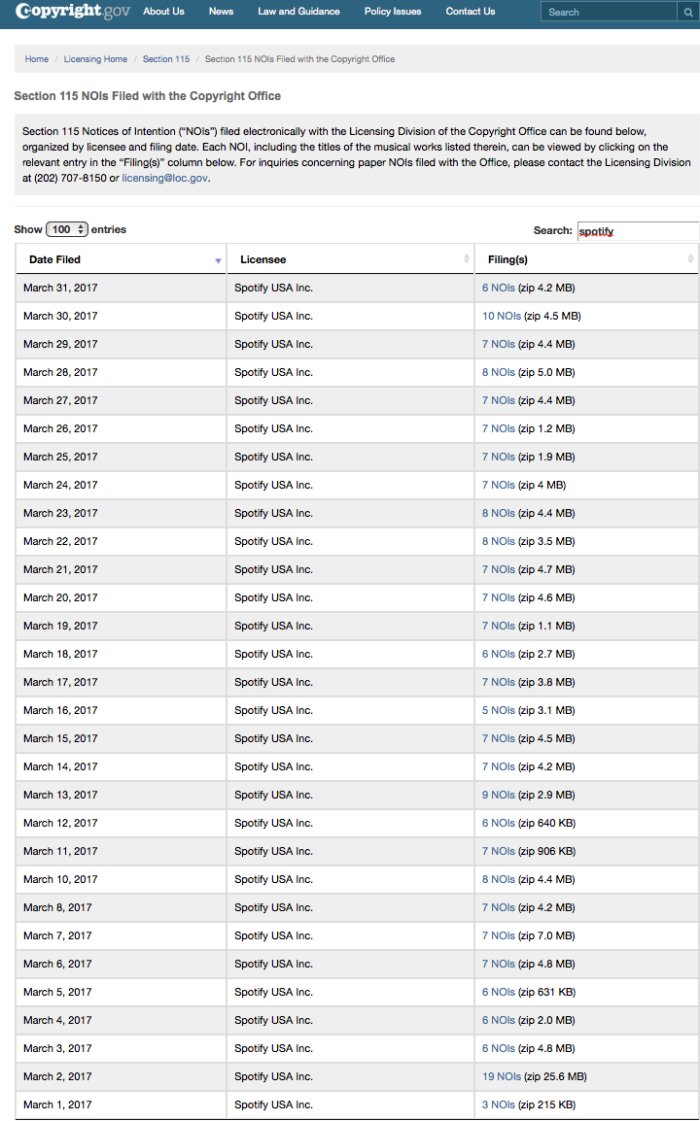
The number of mass “address unknown” NOIs being posted by the Copyright Office on an almost daily basis suggests that tech companies now view mass “address unknown” NOIs as the primary way to put one over on songwriters and the Congress, too.  Companies like Amazon, Spotify, Google, Pandora and others are using this heretofore largely unused loophole on a scale that flies in the face of Chairman Goodlatte’s many hearings in the last session of Congress on updating the Copyright Act.

This “address unknown” practice also undermines the efforts of Chairman Goodlatte and Ranking Member Conyers to modernize the Copyright Office.  Indeed, based on the very lopsided vote on HR 1695 the Register of Copyrights Selection and Accountability Actit is clearly the desire of the overwhelming majority of Members of Congress, too.

March Spotify NOI Filings

What Can Be Done?

Congress can play a role in in providing immediate relief to songwriters by stopping the mass “address unknown” NOIs or at least requiring the Library of Congress and the Copyright Office to take steps to verify the NOIs are filed correctly.

At the moment, the government takes away property rights from the songwriters by means of the compulsory license without taking even rudimentary steps to assure the public that the “address unknown” NOI process is being implemented correctly and transparently.

Here are five steps the Congress can take to rectify this awful situation.

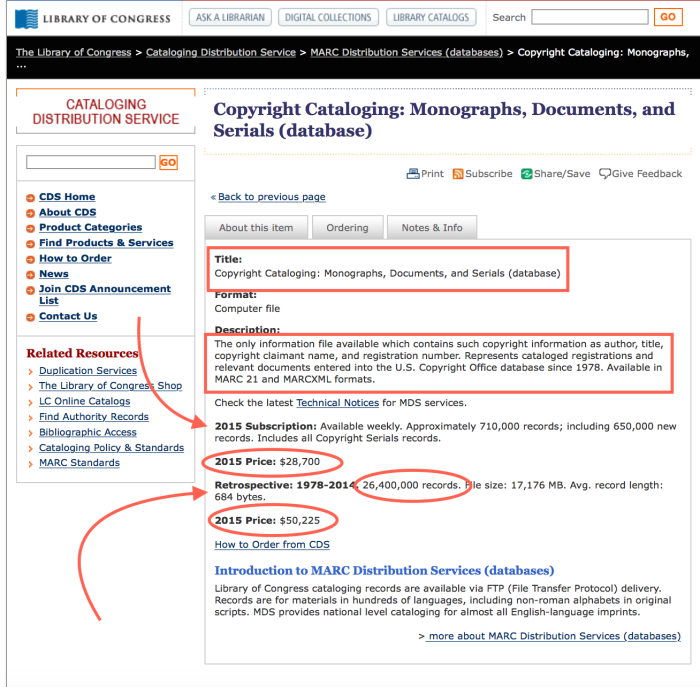
  1.  Stop Selling Incomplete Data:  Congress should instruct the Library of Congress to stop selling the post 1978 database until due diligence can be performed on the database to determine if it is even internally correct.  It appears that many if not all the mass “address unknown” NOI filers use the LOC database to create their NOIs.  It is also highly unlikely that this database will include new releases.  Congress can simply instruct the Librarian to stop selling the database.loc-prices-databases
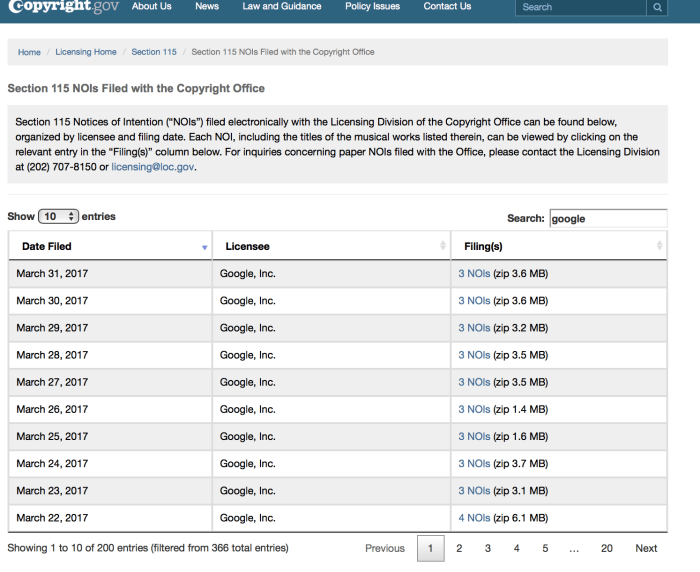
  2.  Stop Accepting “Address Unknown” NOIs With Compressed File Attachments: Congress should instruct the Library of Congress and the Copyright Office to immediately cease accepting “address unknown” NOIs with compressed files as attachments for what appears to be a single NOI.  These compressed files are so large in most cases that songwriter can never uncompress them on a home computer to determine if their songs are subject to “address unknown” NOIs.  Google in particular is a major offender of filing huge compressed files.  Each compressed file contains tens of thousands of song titles.Google March NOIs
  3.  Require Accounting Compliance with Copyright Office Regulations:  Long standing regulations require that anyone relying on an NOI must file mostly and annual statements of account reflecting usage of the songs subject to the NOIs.  The tech companies serving mass NOIs are not rendering these statements and thus fail to comply with the transparency requirements of Copyright Act.  All of the “address unknown” NOIs served during 2016 are out of compliance with the regulations, and all “address unknown” NOIs served in the first quarter of 2017 are likewise out of compliance.  Congress should instruct the Copyright Office to require monthly and annual statements of account be filed with the Copyright Office for anyone who has relied on these NOIs as required by the regulations.  All statements of account should be certified in the normal course as required by the regulations, and made available to the public by posting to the Copyright Office website.
  4. Require the Library of Congress to Create a Searchable Database of NOIs:Congress should instruct the Library of Congress to create a single database maintained online that is maintained by an independent third party and is searchable by songwriters in a manner similar to a state unclaimed property office.  That database needs to be updated on a regular schedule.  Given the size of the compressed files served to date, it is essentially impossible for songwriters to determine if NOIs have been filed on their songs.  This is particularly true as the NOIs are served on an effectively random basis, so even if songwriters were able to search, they would essentially have to search all the time.
  1.  Pay Royalties Into A Permanent Trust Account:  Given that it is highly likely that the mass NOIs filed to date have a significant number of errors, it is also likely that songwriters will become entitled to payment of royalties retroactively if these errors are ever caught.  Therefore, the Congress should require that royalties should be paid to a trust account maintained at the Copyright Office and held in perpetuity like a state unclaimed property office.  Of course, it is equally likely that the song copyright owners will be entitled to terminate any purported license under 17 USC Sec. 115(c)(6).  These payments should be based on actual usage and not black box.  This is another reason why the statements for “address unknown” NOIs should be public.

What started in April 2016 as a trickle of NOIs from a handful of companies has now expanded exponentially.  Based on Rightscorp’s analysis in January 2017, some 30 million “address unknown” NOIs had been filed–and that did not include the dozens of “address unknown” NOIs filed by Spotify in March 2017 alone which themselves likely total over a million songs.

NOI Table
Top Three Services Filing NOIs

April, 2016-January 2017

Number of NOIs Per Service
Amazon Digital Services LLC 19,421,902
Google, Inc. 4,625,521
Pandora Media, Inc. 1,193,346

It is rapidly becoming standard practice for tech companies to try to pull the wool over the eyes of the Congress by leveraging an apparent loophole and they are doing it on a grand scale.

As we have seen with everything else they touch from the DMCA to royalty audits, the tech companies will continue this loophole-seeking behavior until they are forced to stop.  Since no one at the Library of Congress seems to have the appetite to right this wrong, the Congress itself must step in.

Ultimately Congress should fix the loophole through legislation, but in the meantime most of the harms can be corrected overnight by policy changes alone.

Chris Castle’s Colaborator Podcast Pt. 2: Is “Conversion” From Free to Subscription Correlation or Causation?

https://www.youtube.com/watch?v=o2deLBBFuWc

Spotify IPO Watch: Will Spotify’s “IPO” Be a Cautionary Tale for Stock-for-Royalty Deals?

The Wall Street Journal and other business news outlets are reporting that the much anticipated Spotify initial public offering may not look like what everyone was expecting and may end up not looking much like what almost everyone was thinking it would look like.

If you asked anyone in the music business over the history of Spotify, they would probably tell you that this time was different.  This time MTV wasn’t going to build a business on our backs–we had the Spotify stock.  So if the “tech guys” go into their mysterious counting house and come out with billions, then the people who built and invested in the one product that they all depend on would be treated fairly this time.  The people who really invested in the only product these companies sold–music–would be along for the ride.

Time will tell if that will turn out to be true, but it’s starting to look like there are some serious questions about what will be in the pot at the end of the rainbow, or even if the rainbow will actually end at all.

The assumption all along has been that Spotify will float what’s called a “full commitment underwriting” as opposed to a “busted underwriting” aka Deezer.  In a full commitment underwriting, an underwriter (like Spotify banker Goldman Sachs) agrees to buy all the shares of the issuing company that are available–generally less than all, maybe around 25% of the shares issued and outstanding on an “as-if-converted” basis (an important distinction in Spotify’s case that we will come back to).

What actually happens then is that the issuer doesn’t actually sell shares to the public in the traditional sense, they instead sell shares to underwriters who then sell the shares to the public.  The underwriters usually have a lead (like Goldman Sachs) who then puts together an underwriting syndicate to buy up all the shares that are available.

The proceeds, aka money, from those shares sold to the underwriters go into the issuing company’s treasury, aka bank account.  Thus the primary function of the IPO is fulfilled-raising money for the issuing company.  The company passes the market risk to the underwriters in return for locking in a share price.  So far the shares have not be available to trade, although all of the regulatory hurdles will have been met by this point, SEC clearances, etc. (a final approved Form S-1, for example).

The underwriters then sell the shares are then registered for sale to the public by licensed broker dealers with the idea that the underwriters will get at least a “2 handle” or “3 handle” on the first day of trading because there is a lot of enthusiasm for the stock with the retail stock market.  That means that the underwriters will double or triple their money (give or take) overnight, plus get some nice fees for doing the work and taking the market risk off of the issuer’s books.

The underwriters don’t want a whole bunch of shares of stock crowding into the market and interfering with the 2x or 3x (or more x) that they plan on making.  That’s why issuers have lock up agreements with certain investors (especially insiders) that prevent the sale of shares for anywhere from 90 to 180 days after an IPO.  That’s also why there are some executives (like Pandora’s Tim Westergren) who sell a predetermined number of shares on a predetermined date, which is almost always a sign of a “10b5” agreement that allows insiders to gradually cash out over a fairly long period of time (while not “trading” as in both selling and buying the company’s shares).

So what does all this mean for Spotify?  According to the Wall Street Journal, Spotify is not going the full commitment underwriting route at all–but remember, none of this is coming from the company directly, so they could still back out.  But they’re not denying the story so  far.

Spotify evidently is skipping the underwriting step altogether.  MTS readers will recall in our “Spotify IPO Watch” series that I was skeptical about Spotify’s ability to put together an underwriting syndicate, and the decision to skip an underwriter is being passed off as a way to save some millions in fees.  That’s whistling past the graveyard–those fees are high, but are more than justified if the IPO raises a bunch of money which is usually the point.

According to the Wall Street Journal:

The Swedish company, last valued at $8.5 billion, is seriously considering not holding a public sale of shares. Instead it is exploring simply listing its shares on an exchange in what is known as a direct listing, according to people familiar with the matter. It wouldn’t raise money—the hallmark of an IPO—or use underwriters to sell the stock.

The approach has advantages for Spotify and its existing investors. It could enable the firm to save tens of millions of dollars in underwriting fees, prevent its existing holders from having their stakes diluted, and enable executives to publicly tout the company ahead of its listing, unlike a strictly regulated IPO, the people said….

In direct listings, early investors would be subject to less stringent lockups governing the sale of insiders’ shares and the company could avoid the first-day trading pop that characterizes many IPOs shepherded by underwriters. They are good for some investors but also indicate a company potentially left money on the table. Having a public stock would also give Spotify’s investors and employees the opportunity to cash in their shares.

There are risks to this approach, whose consideration by Spotify was earlier reported by Mergermarket. With market forces determining the share price from the outset, the company’s public debut could be more volatile and unpredictable. Also missing would be the large blocks of stock underwriters typically allocate to investors they believe will hold the shares for the long term and promote trading stability.

Spotify last year issued a $1 billion convertible bond to parties including TPG and Dragoneer Investment Group. The interest rate of 5% increases 1 percentage point every six months until the company goes public, giving it a potential incentive to pursue a listing sooner rather than later. If it lists directly, Spotify would likely need to renegotiate terms of the facility, one of the people said.

Spotify had agreed that the investors could convert the debt into equity at a 20% discount to the share price if an IPO takes place one year hence. If it takes place later, the discount increases. Since this wouldn’t be a typical public offering, it may not trigger a conversion. So Spotify may need to negotiate with the investors a price at which they would receive equity.

I find it hard to believe that sophisticated investors like Texas Pacific Group and Dragoneer will be bamboozled by Spotify taking a loophole on their IPO.  The rest of the shareholders–hard to say.

One thing is almost certain–that “need to negotiate” the WSJ refers to is almost certainly going to result in more stock or cash or relief from lockups or some preferential goodie going to the bond holders who very likely have a first position security interest on all the assets of the company as collateral for their $1 billion plus loan.  (Assuming, of course, that a direct registration doesn’t constitute an event of default under the loan that could allow the bondholders to take over the company.)

It is also almost certainly going to result in other “investors”–the stock for royalties folk–not getting those same benefits.

Stay tuned–Spotify may give us the best argument yet for not taking equity-in-lieu of cash in companies that should be paying royalties like everyone else.


Chris Castle on Artists’ Right to Streaming Exclusives

https://www.youtube.com/watch?v=8tWAIDbNCyg

via @colaboratorpcn: Douglas Caballero interviews Chris Castle — Artist Rights Watch

via Chris Castle on Artist’s Right to Streaming Exclusives — MUSIC • TECHNOLOGY • POLICY

Fighting for a Straight Count: Does Streaming Accounting Cost More than the Royalties?

When you drill down on exactly what goes into tracking and accounting for songs and recordings on streaming services one thing becomes apparent:  No matter how much you automate, those systems are expensive and the royalties are minuscule.  This is in large part because of the revenue share method of royalty payments that creates a vastly more complex accounting world than a simple per-use penny rate would require.  It’s time to make that change to simplify the reporting.

A recent post by a founder of a digital distributor gives you a sense of the complexity involved:

It’s easy to figure out how much an artist made. But if you want to figure out how much each collaborator is owed from each stream… now you’re looking at millions of rows in hundreds of royalty reports from dozens of sources — every month.

Payments are paid in fractions of cents.

Did I say fractions? I meant 20 decimal places.

Did I say cents? I meant 30 different currencies.

Did I say 30 different currencies? I meant a 350-row exchange rate lookup table. “Customer currency: Swedish Krona, royalty currency: Ukrainian Hryvnia” is a thing (and so on, and so on).

Did I say a 350-row exchange rate lookup table? I meant a different table every month — from every streaming provider.

This gives you a look under the hood of the number of transactions that are inherent in a royalty system that pays every time an end user listens to a track.  It also informs why artists and especially songwriters are royally cheesed about the sharp decrease in the size of their royalty payments.

The hidden transaction costs of the configuration shift from album bundles to singles with  the coming of iTunes was challenging but was at least manageable.  The shift from singles to individual streams is cost multiplier of significant proportion above the shift from albums to digital singles.  I would submit that not only is the cost not manageable, but when distributors promote themselves based on their ability to handle twenty decimal places to the right, it probably never will be.

When a firm’s costs exceed revenue, the firm must either take on debt, sell equity or shut down the insolvent business or business unit–or delay paying royalties, more about that later.  Royalty accounting is, of course, a core business function of distributors, but it is also a core function of the parties receiving those royalties out to twenty decimal places to the right–record companies and music publishers.  There are even more accounting costs incurred by the labels and publishers in calculating the artist or writer shares and their own share of revenue, which will cause the decimal places to increase–to the right.

What this means is that in order to stay in business, be able to meet contractual obligations and pay their artists or writers, royalty systems must be able to handle a new level of complexity they were never before required to process.  Sound expensive?

Add to this complexity that many digital music services use the compulsory mechanical license that requires monthly statements and a true-up annual accounting signed by a CPA and no audit right–instead of quarterly or semi-annual accounting with an audit right.  Even if a publisher is accounted to monthly and pays writers quarterly or semi-annually, the publisher still bears the cost of processing the monthly accounting.  The frequency of ingesting these monthly payments may compound the transaction costs at the publisher and songwriter level.

One technique employed in the Pandora on-demand song license (paragraph 6(a)) is to defer both payment of mechanicals and royalty statements until the revenue payable is $50.  While this may seem reasonable on its face, it’s not–for largely the same reasons that the Copyright Office rejected this approach (37 CFR Sec. 210.16(g)(6)).  Pandora’s license is clearly a variation on the law, which limits the deferral to $5 (not Pandora’s $50) and requires that Pandora pay any deferred royalties on the Annual Statement of Account.

That means that the service cannot write itself an indefinite interest free loan with the songwriters money and not tell the songwriter it is doing so.  And, of course, you can’t audit statements you don’t receive.

Holding these sums is one way to finance the cost of running these accounting systems that deliver ever-smaller fractions of a penny paid to songwriters and artists.  That should sound familiar–new money used to pay old obligations.  Does the name Madoff come to mind?

It’s also important to note that in a revenue share world where money is allocated based on a core calculation of uses of your catalog divided by all songs used on the service in a month, that fraction will produce an ever smaller share of revenue if the rate of change in your catalog titles is less than the rate of change in the number of all songs on the service. (This will likely be true even if the service revenue increases, because your share of it will decline on a relative basis.)

So what is twenty decimal places today, could be even more decimal places in a year or two.

Where the industry went wrong was in the beginning when services got us to buy into the idea that getting something was better than piracy and that we owed the services a chance to find an audience.  When the revenue shared was low and higher margin goods were the focus, that was one thing.

The current state of plays is another thing altogether and revenue share deals for per listen payments require a level of complexity we can’t continue to support.

And yes, that means you, Facebook negotiators.

How Accurate are Music Subscription Service Subscriber Numbers?

All of you who subscribe to the New York Times, fly Quantas, use any of a number of mobile carriers or who are in the 6th month of your third Spotify 30 day (or 90) free trial may be interested in this post.

According to Billboard in a story titled “Spotify Officially Hits 50 Million Paid Subscribers“, the “official” announcement came from a tweet:

I found this intriguing–how did we go from “Spotify Officially Hits 50 Million Paid Subscribers” in the headline to a tweet that doesn’t really say the same thing?  Maybe like this?

screenshot_20170224-140304

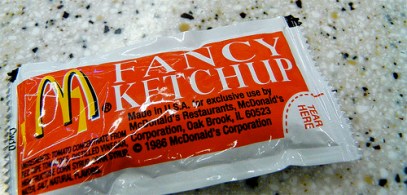
First, what makes a tweet “official”?  Much less “official” totals of “paid subscribers”?  Finding out may be like asking what makes ketchup “fancy”.

w27cz

Newspaper subscriptions have long been verified by a company specializing in verifying circulation.  Television has the Nielsen ratings, music has Soundscan, and so on.  None of these systems are perfect, but they make it harder to outright misrepresent success in a business where frequently the only people who really know how well they are doing are the people who would like you to believe they are doing well.  This is nothing new, it’s as old as moral hazard.

The quest for truth leads one to independent verification services.

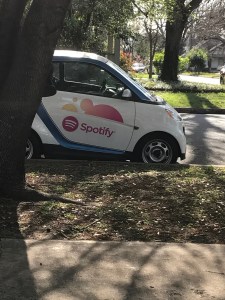
spotify-clown-car
A clown car for 6 million streams

Reuters reported the same story with a more subdued headline: “Spotify Says It Reached 50 Million Subscribers“.  A little more factual, a little less Kool Aid.

This is important because I have yet to find anyplace that Spotify actually says the 50 million subscribers were “paid”.  The press leaped to that conclusion, but Spotify did not say that.

And neither does Apple, a company which is already public and has to be careful what they say about the money they are making or not making.  Yet somehow nobody transforms Eddie Cue’s statement that Apple has “well past 20 million subscribers” into an “official” statement implying a verified number of “paid” subs.

Actually–it may well be that there is a significant revenue difference between “paid subscribers” and “subscribers”.  As the Music Industry Blog wrote last year:

[T]here is a more important story here: Spotify’s accelerated growth in Q2 2016 was driven by widespread use of its $0.99 for 3 months promotional offer. Which itself comes on the back of similar offers having supercharged Spotify’s subscriber growth for the last 18 months or so. In short, 9.99 needs to stop being 9.99 in order to appeal to consumers.

As Spotify has been “dominant” in the music subscription business for a while now (and yes, I mean that in an antitrust sense of “dominant”), it seems that it’s high time for someone to independently audit the veracity of the number of their subscribers.

Or would the Securities and Exchange Commission like to rely on a tweet?


Big Tech’s Latest Infringement Loophole: Mass Filings of NOIs to Avoid Paying Statutory Royalties (Part 1)

If the music-tech industry has one major failing from which all of their messaging and legal problems flow, it is their fascination with loopholes that predictably harm creators.  Whether it’s YouTube’s nefarious reliance on a tortured interpretation of the DMCA safe harbors that bears no relation to the law, Pandora and SiriusXM’s bone headed refusal to pay statutory royalties on pre-72 sound recordings (not to mention Pandora’s purchase of a radio station in a failed attempt to pay songwriters lower royalties), Spotify’s absurdly unnecessary collision with Taylor Swift over windowing, the MIC Coalition’s ridiculous manipulation of the Department of Justice on 100% licensing, or Amazon’s bizarre fascination with compulsory licenses for which songwriters have no audit right, these companies rival each other in the undignified pursuit of loopholes.

And in particular, loopholes that hurt songwriters who can’t afford the litigation and lobbying machine that is always the not-so-veiled threat brought by all these companies.  The latest debacle is no different–mass filings of NOIs to avoid paying mechanical royalties because of a loophole that is detritus left over from the 1909 Copyright Act that is being manipulated to benefit the rich Silicon Valley companies at the expense of songwriters.

Yes, that’s right.  They’d rather pay enormous sums in filing fees that vastly exceed any royalties payable just to get out of paying royalties at all.  You have a better chance of recovering an old utility deposit from a state unclaimed property office than you have of getting mechanicals once you fall victim to this latest move.

I have been reliably informed that Google, Amazon and Music Reports among others are filing “millions” of “address unknown” NOIs with the Copyright Office based on a database that these companies are purchasing for tens of thousands of dollars from the Library of Congress (remember that the Copyright Office is under the jurisdiction of the Library of Congress).  And by the way–once they file this NOI, they don’t pay royalties until the copyright owner can be identified in the records of the Copyright Office.  Regardless of how easily the copyright owner could be found in other readily accessible databases.

Mystified?  I will explain.  Rest assured, you’re not the only one who is surprised.  And remember that bit about the utility deposit, we’ll come back to that one.

As you read this post, remember one thing–it didn’t have to be this way.  This is all happening for the same reason.  Google, Amazon, Spotify, and likely soon Pandora (for its yet-to-be-launched on demand service) are all far more likely to take the legalistic and aggressive route rather than reach out to the songwriting community to work cooperatively to find a solution.

One music tech executive told me, we decide what’s fair and then we jam it down your throat.

That doesn’t work.

Mechanical Licensing and the Compulsory License

For one reason or another, the U.S. Government has a tradition of being very interested in regulating songwriters.  The Copyright Act of 1909 established the baseline rules that compel songwriters to license their songs and sets the terms on which those songs are licensed including the royalty rate.

Even if you are not troubled by this degree of attention that is probably the original wage and price control, it would be nice if the USG is going to pay enough attention to songwriters that they set the price at which they can license their work, that the same USG not forget to raise that rate for 60-odd years.

That’s right–the government set the mechanical rate in 1909 at 2 cents and refused to raise it until 1978 (as part of the 1976 Copyright Act revision).  Adjusted for inflation, that 2 cent rate would now be about 80 cents.  Instead, it’s been 9.1 cents for the last 10 years.

The current compulsory license law was crafted in 1909 and slightly amended in 1976, and amended again a couple times to include the concept of “digital phonorecord deliveries” which essentially makes that compulsory applicable to streaming.

The 1976 Act also got rid of the copyright registrations that formed the basis of copyright under the 1909 Act with the exception of requiring a registration to sue for statutory damages and attorneys fees in a copyright infringement lawsuit.  (Not quite that straight a line, but that’s where we ended up.)

But here’s the twist–the compulsory license rules are a notice based system.  A music user who intends to use a song that is subject to the compulsory license must send a notice to the copyright owner.  These notices are called a “notice of intention” or “NOI”.  If you’re going to require an NOI, then how do you deal with copyright owners who cannot be found?

There was an easy answer to this that derives from the registration requirements–look them up in the Copyright Office.  If the copyright owner can’t be identified in the records of the Copyright Office, then the music user can send a notice to the Copyright Office which the Copyright Office then publishes.  Just like when your state publishes a list of unclaimed utility deposits, closed bank account balances, etc.

Now we all know that nobody uses the records of the Copyright Office to find a copyright owner, or if they use those records they don’t use them exclusively.  Most people will look first at the PRO databases, cue sheets, publisher websites, other materials like that.  When all else fails, then they look at the Copyright Office.  This is partly due to the lag time between filing a copyright registration and receiving a conformed copy of that registration (which is when it is “official”).

There is also another public record maintained by the Copyright Office called the “recordation section”.  This is where people file documents relating to works of copyright, such as a notice of assignment or a mortgage of copyright (which is kind of like a UCC-1 financing statement).  The recordation section requires paper filings and typically only ingests a handful of titles from a large acquisition.  That results in a filing of “‘Yesterday’ and 10,000 other songs” or something along those lines.

In other words, the recordation section is not all that reliable either–and neither is dispositive because there hasn’t been a registration requirement for decades.  Is it a good practice to register?  Yes.  Is it required to have valid copyright?  No.

And it’s particularly not required for non-US songwriters.  In fact, there’s a good argument that a registration requirement in order to enjoy your rights (such as the statutory mechanical royalty, however poorly handled by the government) is actually barred by the Berne Convention’s prohibition on formalities.

Yet, the U.S. Copyright Act allows a valid compulsory license to issue for a copyright owner who may be listed in the PRO databases, may be a foreign copyright owner, or be under license (even direct license) for other songs with the same music user–if that copyright owner of a particular song cannot be identified from the public records of the Copyright Office–as determined by the music user.

Now why is this a moral hazard that should not be resolved by the music user?

Because the Copyright Act also provides that the music user filing that “address unknown” NOI is not required to pay royalties until that copyright owner is identifiable in the public records of the Copyright Office.

And who decides if the NOI is properly filed for the right song title?  That’s right–the music user.  Who is incented to play games with the song metadata?  That’s right–the music user.

So what comes next should be of no surprise given the bad advice that these giant companies receive about their artist and writer relations.

Continued in Part 2.


Spotify IPO Watch: Blame ≠ Profit

11949849771043985234traffic_light_red_dan_ge_01-svg-med


By its own calculation, Spotify dominates the global streaming music market.  According to a 2014 speech by Will Page, Spotify’s director of economics, as reported by Billboard:

….Page noted Spotify has launched in 32 of the 37 countries where streaming is the primary digital source of revenue. Page also pointed out that Spotify is half of the $1.5 billion global subscription streaming market. In the U.S. market, Spotify made up approximately 90 percent of last year’s growth in subscription revenue, according to Page.

While competition from Apple is certainly heating up, Spotify still is the dominant company in the space.  According to the Wall Street Journal, Spotify’s revenues nearly doubled to $2 billion last year and is expected to do well again this year.

Like Pandora and every other IPO-focused music service except for perhaps Tidal, Spotify blames its inability to make a profit on royalty payments rather than on its self-inflicted battle with Apple and spending levels based on a growth strategy.

Spotify also took on a billion dollar convertible loan at what will turn out to be credit card interest rates to fund that grown strategy.   Not to fund royalties, but to fund growth and competition with Apple.

Spotify’s main arguments about why no IPO is summed up in a Wall Street Journal article that misses a few key points, but the lead paragraph is revealing:

As Spotify AB gears up for a potential initial public offering next year, the music-streaming service is missing one key component in its pitch to investors: rights to play the music in years to come, according to people familiar with the matter.

First–as predicted, no Spotify IPO this year or for the foreseeable future.  And also as predicted, the blame for no IPO is not due to mismanagement by Spotify’s executive team, it’s due to The Evil Record Companies.  Due to solid reporting by Hanna Karp at WSJ,  Spotify’s “leak when you’re weak” strategy didn’t really give them what they wanted.

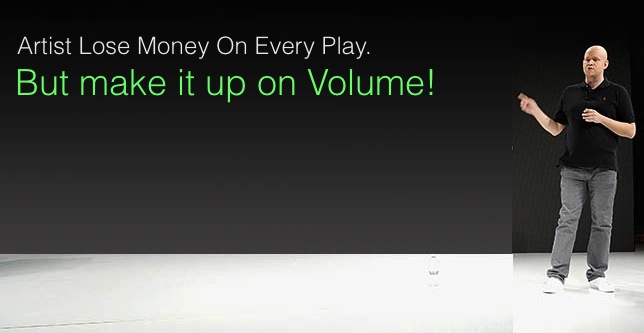
daniel-ek-spotify-ceo-2012billoardspoof-2

Leak When You’re Weak

Spotify has a long history of leaks, and in particular leaks that backfired.  This WSJ story is no exception.  The actual story is not one of “scrappy little startup beset by The Evil Record Companies” which is the narrative that Big Tech has been selling since 1999 and is getting a little dog eared.  This is particularly true of Spotify with a valuation greater than any record company’s.  However misguided that valuation, that is the one they have.

Rather, the story is that inexperienced management has tried to play in the tall weeds with the big dogs on Wall Street and are embarrassing themselves from the financial corner they are painted into by the shortcomings of their own business strategy.

Nobody but Spotify got Spotify into the corner they’re in.  And that’s the story that the WSJ is telling.

How did they get there?  Lavish spending, rapid expansion, high executive salaries and a general failure to capitalize on the many markets in which Spotify operates before entering new and uncertain markets is not a good look for a “start up” with a higher market capitalization than that of any one record company they do business with.

And then there’s the songwriters–not mentioned once by the WSJ.  Spotify is outright stealing from songwriters by using unlicensed songs for which they don’t pay royalties.  So where ever Spotify comes up with this “we pay 70% of revenues in royalties” begs the question–if that’s true, then why are there two class action lawsuits brought against Spotify by songwriters for nonpayment?

Why did Spotify have to make a quick settlement with the National Music Publishers Association (former owner of Spotify’s licensing service provider)?  Why are there rumors that many independent publishers rejected that settlement and are planning their own class action?

That part of the story didn’t get included in the WSJ’s reporting, but you know who notices that kind of story?  Bondholders.

And bondholders have a clause in the typical bond that in extreme cases allows them to take over the company in cases of insolvency and a reasonable expectation that the bonds can’t be paid due to the uncured mismanagement of the debtor–an event which, at best, may result in a call for accelerated repayment of the loan or a reset of the bond’s interest rate–higher, and with even more warrant coverage.

Market Conditions

While the publicly traded tech sector leaders and the broader indices have recovered somewhat from earlier lows driven by downward pressure on oil prices and the Brexit crash, the U.S. IPO market is still in the doldrums and is likely to stay there for the rest of 2016 and probably at least the first quarter or two of 2017.

In order for a high risk investment like Spotify to get a full commitment underwriting syndicate interested in floating the company’s stock on a public exchange at a valuation that smells like victory in the morning, it’s going to need to do better than it’s doing now or has done in the last few years.  This is the point at which underwriters ask why a company with a $2 billion top line cannot seem to make a profit.  Will those underwriters be willing to accept The Evil Record Company story more than The Incompetent Management story?  Or The Incompetent Management Can’t Manage Their Vendors story?

Absent the “greater fool” frothiness in the markets which I don’t see coming back from 1999 any time soon, a lack of “irrational exuberance” may means goodbye IPO for Spotify and hello Chapter 11.

And Then There’s the Debt

Said another way, the earliest that Spotify could IPO in the U.S. is likely to be more than one year from March 29, 2016, the date that Spotify announced its $1 billion convertible note with Texas Pacific Group, hedge fund Dragoneer and Goldman Sachs clients.

If Spotify holds a public offering in the next year [that is, before March 29, 2016], TPG and Dragoneer will be able to convert the debt into equity at a 20% discount to the share price of the public offering, according to two people briefed on the deal. After a year, that discount increases by 2.5 percentage points every six months, the people said.

Spotify also agreed to pay annual interest on the debt that starts at 5% and increases by 1 percentage point every six months until the company goes public, or until it hits 10%, the people said. This interest—also called a “coupon” and in this case paid in the form of additional debt, rather than cash—is commonly used in private-equity deals but rarely seen in venture funding.

So the equity warrants start to decrease 18 months out, i.e., starting around September 2017, but the interest rate will increase from 5% to 6% around the end of September 2016–next month, that is.

Running Spotify will get very much more expensive in about 30 days from today.  That has nothing to do with royalty payments or licenses.

Do you think that Spotify executives will be asked to take salary cuts?  Cancel magazine subscriptions?  Fly coach? Move from Manhattan to Syracuse?  No more Uber black cars?

And will that make the bondholders happy?

When is a Down Round Not Called A Down Round?

When it is convertible debt, apparently.  Companies often use debt to avoid closing a round of financing at a valuation that is lower than the last round of financing.  Why?  Because there are usually antidilution penalties that are triggered to protect the “pre-money” shareholders from being diluted by the subsequent down round that they may or may not invest in, too.

Even so, Spotify’s debt may have already diluted the pre-debt valuation of the company. Again, according to the Wall Street Journal:

While Spotify’s valuation doesn’t technically change with the debt round, one of its mutual-fund investors has marked down its stake. Fidelity Investments held its Spotify shares at [absurdly high stock price of] $1,643 a share in January, down 27% from last August, according to regulatory filings. [That’s a markdown from an implied share price of an even more exuberant share price of $2,250.] Another mutual fund, Vanguard International Growth, paid $2,229 a share for a stake in Spotify and still held it at that price as of December.  [Attention Vanguard shareholders!]

The Deal is Bad and They Are Untrustworthy

If the songwriter experience with Spotify is any guide, you can’t trust these people to run what is essentially a glorified record club unless they are under the watchful eye of a magistrate judge.

On top of that, they routinely seem to leak terms in an effort to get themselves a better deal with the people who actually own the rights they need to license.

If people want to do exclusives with Apple, they’re going to do them even if the dominant multinational in the space–that means Spotify–doesn’t like Apple getting those deals.  Maybe if Spotify got caught up on all their songwriter payments they’d be more worthy of sympathy.  In fact, maybe the songwriters (who are often the artists, too) might even take their side occasionally.

These deals should have been closed long ago, and that’s a reflection on poor management at Spotify that can manage to borrow $1 billion, but can’t close a box when it comes to licensing their one product.

Show Me the Proof

There are two great canards at Spotify (and all subscription services that offer a free tier, to be fair):  Exclusives hurt their business and if consumers get something for free long enough, they’ll want to pay for it instead.

There is no public consumer research that I’m aware of that supports either of these conclusions.

I’d love to hear about that research, I’m all ears.  Maybe its just another excuse for not being able to turn a profit on $2 billion of top line revenue.

Conclusion:  No Spotify IPO, not now, maybe never

As I’ve written before on Spotify IPO Watch, a combination of factors have gotten Spotify where it is now.  Market conditions, bad management, arrogance, stiffing songwriters and getting too big, too fast.

Until all those things change to one degree or another, it’s likely that the Spotify IPO myth will remain just that.

Are Legacy Revenue Share Deals More Trouble Than They Are Worth?

By Chris Castle

As an important publisher panel observed at MIDEM this year, revenue share deals make it virtually impossible for publishers to tell songwriters what their royalty rate is.  That’s especially true of streaming royalties payable under direct licenses for either sound recordings or songs or the compulsory licenses available for songs.

There are some good reasons why streaming rates developed without a penny rate–or at least some reasons that are the product of sequential thought–but there are also good reasons for creators to be distrustful of the revenue share calculation.  This is particularly true of compulsory licenses for songs where songwriters and publishers don’t even have the right to examine the services books to check if the service complied with the terms of the compulsory license (known as an “audit” or “royalty compliance examination”).

If you thought record deals were complicated, you will probably have to find a new vocabulary to describe streaming royalties.  (Calling Dr. Freud.)  But even under direct licenses for songs or sound recording licenses where there usually is an audit right, the information that needs to be audited is so closely held, so over-consolidated and the calculations so complex that there may as well be no audit right.

The result is that smart people with resources at big publishing houses cannot determine the penny rate coming out of Spotify and others with the information that is on their accounting statements.  That is hard to explain to songwriters (or artists for that matter, as they have similar problems).

Why is the calculation so complex?  The artist revenue share calculation looks something like this in its generic configuration:

[Monthly Service Advertising Revenue or Monthly Subscription Revenue] x [Your Total Monthly Streams on the Service/All Monthly Streams on the Service] x [Revenue Share] = Royalty per stream

Both monthly revenue and monthly usage change each month–because they are monthly.  In order to get a nominal royalty rate, you have many calculations on both sides of the equation.  Because these calculations are made monthly, it is not possible to state in pennies the royalty rate for any one song or recording at any one time.  There’s actually an additional eye-crossing wrinkle on subscription deals of setting a negotiated minimum per subscriber which can vary by country, but we will leave that complexity aside for this post–YouTube’s “Exhibit D” lists 3 pages of one line entries for per subscriber minima around the world.

In a simple example, if both advertising revenue and subscription revenue were $100, your one recording was played 10 times in a month, all recordings were played 100 times in a month and the revenue share was 50% for the sound recording then you would get:

$100 x [10/100] x .50 = $0.50 for that month.  How you get to the multiplicand in the revenue pot is not so simple and has gotten more complex over the years.  In fact, the contract language for these calculations make the Single Bullet Theory seem more plausible.

Revenue share formulas produce a different product when the factors change–which for the most part changes every month.  The formula we’re using is for the sound recording side, but publishers have a version of this calculation for their songwriter’s royalties, too.  The statutory rates are a version of this formula (see the nearly unintelligible 37 CFR §385.12).

Most of this information is under the exclusive control of the service, and largely stays that way, even if you are one of the lucky few who has an audit right.  Bear in mind that the “Monthly Service Advertising Revenue” in our formula is a function of advertising rates charged by the service, and “Monthly Subscription Revenue” is a function of net subscription rates charged by the service.  These calculations take into account day passes, free trial periods, and other exceptions to the royalty obligation.  There is essentially no way to confirm the revenue pot when the royalty rates appear on the publisher or label statements.

The problem is that the entire concept of revenue share deals is out of step with how artists and songwriters are used to getting paid, even for other statutory mechanical rates such as that for downloads.  If a publisher or label can’t come up with a nice crisp answer for what the songwriter or artist royalty is based on, the assumption often is that the creator is being lied to.  And who’s to say that’s an unreasonable conclusion to jump to?  The question is–who is lying?  Here’s a tip–it’s probably not the publisher or label because they’re essentially in the same boat as the artist.

How Did We Ever Get Here?

Let me take you back to 1999.  Fish were jumpin’, the cotton was high, and limited partners showed up for capital calls.  Startups were starting up their engines–some to drive into a brick wall at scale, others to an IPO (and then into a brick wall at even greater scale).

On the Internet, you didn’t just do business with a company, they were your “partner.”  You didn’t just negotiate a commercial relationship with a behemoth Fortune 50 company that could crush you like a bug–in the utopian value system your little company “partnered” with AOL for example.  Or Intel.  Or later, Google.

What that meant for music licensing was that startups wanted rights owners to take the ride with them so if they made money, the rights owner made money.  Rights owners shared their revenue, you know, like a partner.  Except you only shared some of their revenue.  You weren’t really a partner and had no control over how they ran their business even if the only business they’d had previously run was a lemonade stand.

The revenue share deal was born.  To some people, it seemed like a good idea at the time.  And it might have been if there were relatively few participants in that revenue share.  But revenue share deals don’t scale very well.

Enter Professor Coase and His Pesky Theorem 

Here’s the basic flaw with revenue share deals:  Calculating the share of revenue for the entire catalog of licensed music on a global basis requires a large number of calculations.  For companies like Spotify, Apple or YouTube, calculating the share of revenue for millions of songs and recordings requires billions of calculations.

Free services like Spotify or YouTube involve billions of essentially unauditable calculations, all of which are based on a share of advertising revenue.  Advertising revenue which is itself essentially unauditable due to the nearly pathological level of secrecy that prevents any royalty participant from ever knowing what’s in the pie they are sharing.

That secrecy runs both upstream, downstream and across streams.  And as we all know, keeping secrets from your partner is the first step on the road to ruining a relationship.

But before you get too deep into nuances, let’s start with a basic problem with the entire revenue share approach.  In order to get to a per unit royalty, you have to multiply one dynamic number (the revenue) by another dynamic number (the usage).  Meaning that the thing being multiplied and the thing by which it is multiplied change from month to month.  The only constant in the formula is the actual percentage of the pie payable to the rights owner (50% in our example).

Remember–this all started with the digital service proposing that artists, songwriters, labels and publishers should take a share of what the service makes.  If you have a significant catalog, however, you do what you do with everyone who wants to license your catalog–you require the payment of a minimum guarantee as a prepayment of anticipated royalties (also called an “advance”).

So in our simple example, if the service is pitching that they will invest heavily in growth and make the catalog owner $50 over a two year contract, the catalog owner is justified in responding that however much confidence they have in the service, they’d like that $50 today and not a burger on Tuesday.  The service can apply the $50 minimum guarantee against the catalog’s earnings during the term of the contract, but if the minimum guarantee doesn’t earn out, the catalog owner keeps the change.  This shifts the credit or default risk from the catalog owner partner to the digital service partner (who actually controls the fate of the business).

But–given the complexity of the revenue share calculations, at least three questions arise:

Question: How will creators ever know if they are getting straight count from the service due to the complexity of the calculations?

Answer: The vast majority will never know.

Question:  How will anyone know if the advance ever recoups with any degree of certainty if they cannot verify the revenue pot they are to share?

Answer: The royalty receiver has to rely on statements based on effectively unverifiable information.

Question:  And most importantly, if streaming really is our future as industry leaders keep telling us, then which publisher wants to sign up for a lifetime of explaining the inexplicable to songwriters and artists who question their royalty statements?

Let’s Get Rid of Revenue Share Deals

There’s really no reason to keep this charade going any longer.  If the revenue share deal was converted to a penny rate, life would get so much easier and calculations would get so much simpler.  There would be arguments as always about what that penny rate ought to be.  Hostility levels might not go away entirely, but would probably lessen.

Transaction costs should go down substantially as there would be far fewer moving parts.  Realize that it’s entirely possible that the transaction costs of reporting royalties in revenue share deals (including  productivity loss and the cost of servicing songwriters and artists) likely exceeds the royalties paid.  My bet is that the costs vastly exceed the benefits.

And the people who really count the most in this business–the songwriters and artists–should have a lot more transparency.  Transparency that is essentially impossible with compulsory licenses.

Because when you take into account the total transaction costs, including all the correcting and noticing and calculating and explaining on the publisher and label side, and all the correcting and processing and calculating and messaging that has to be done on the service side, surely–surely–there has to be a simpler way.


What is Texas Pacific Group Up To with Pandora and Spotify? Something? Anything?

by Chris Castle

As I’ve noted a couple times, convertible debt financing is all the rage with digital music service these days.  Deezer turned to it after a busted IPO in France, and now both Pandora and Spotify went there.  What’s attractive about debt?  Different reasons depending on the company’s situation.

Convertible debt is a special form of (usually) secured or collateralized loan that looks like any other loan except that it is convertible into the shares of the company.  The amount of time between the funding of the notes and the call on the debt gives the company some running room.  Given that the shares of the company may be worth less (or worthless) at the time the note converts, there’s usually some equity kickers in there along with a pretty bullet proof “event of default” clause.

Depending on how much money is involved and the negotiating position of the lender (usually near infinite leverage at this point), it’s possible for the lenders to effectively take over the company.  If you’re in the management team, that kind of thing can ruin your whole day.

When a company has already been to the well  in the public equity market like Pandora, sometimes going a third time is just not in the cards.  This is particularly true when the company’s share price is going the wrong direction, like Pandora.

Pandora 4-4-16

For Spotify, I’ve already speculated that the main reason Spotify would like converts is because it avoids establishing a valuation for the company.  This can either be a clever move or a desperation hail Mary.  Since both Pandora and Spotify are suddenly in the debt business in a big way (Pandora $300,000,000 and Spotify $1 billion) something common to both caught my eye and that is Texas Pacific Group (or “TPG”).

According to the Wall Street Journal and Bloomberg, TPG is a lender in Spotify’s $1 billion line of convertible debt.  As Spotify is not publicly traded (and I presume these are not publicly traded bonds), we don’t have all the details you’d get in a public offering.  But it looks to be a pretty rich deal for the lenders as you would expect.

According to the WSJ:

Private-equity firm TPG, hedge fund Dragoneer Investment Group and clients of Goldman Sachs Group Inc. [which probably means Sean Parker] participated in the deal, which has been signed and is expected to close at the end of this week, these people said.

But wait, there’s more:

In return for the financing, Spotify promised its new investors strict guarantees tied to an IPO. If Spotify holds a public offering in the next year, TPG and Dragoneer will be able to convert the debt into equity at a 20% discount to the share price of the public offering, according to two people briefed on the deal. After a year, that discount increases by 2.5 percentage points every six months, the people said.

Spotify also agreed to pay annual interest on the debt that starts at 5% and increases by 1 percentage point every six months until the company goes public, or until it hits 10%, the people said. This interest—also called a “coupon” and in this case paid in the form of additional debt, rather than cash—is commonly used in private-equity deals but rarely seen in venture funding.

In addition, TPG and Dragoneer are permitted to cash out their shares as soon as 90 days after an IPO, instead of the 180-day period “lockup” employees and other shareholders are forced to wait before selling shares, the people said.

TPG and Dragoneer will buy $750 million worth of the deal, with the remainder going to clients of Goldman Sachs Group Inc., which advised on the financing, according to people familiar with the deal.

Spotify indicated to new investors it plans to go public in the next two years, people familiar with the matter said.

It’s possible to get more expensive money, but that would involve credit cards.  One thing I feel confident in guaranteeing about TPG, they got their pound of flesh.  And for Spotify–this deal looks pretty desperate.

As an aside, the Bloomberg reporting continued the thoughtless canard:

[L]ike other streamers, Spotify makes losses because it has to pay high fees to the music labels. On about 1 billion euros ($1.1 billion) of revenue in 2014, Spotify suffered an operating loss of 165 million euros, with some 70 percent of costs going to pay labels.

Wrong–the reason that Spotify loses money is because it is trying to maintain a near vertical growth curve.  Remember “get big fast”?  The mantra of the Dot Bomb Collapse?  And then there’s that nasty bit of not actually paying songwriters or bothering to get a license.

But TPG also turned up at Pandora where they got a board seat.  According to a Pandora press release:

[Pandora] is expanding the size of Pandora’s board from nine seats to 10 seats with the addition of Anthony J. “Tony” Vinciquerra, a technology, media and telecom expert with over 30 years of industry experience. Vinciquerra will join the board as a Class III Director and will be included in Pandora’s proxy statement for election at the 2017 Annual Meeting of Stockholders.

Mr. Vinciquerra has a background working very successfully for that well-known milktoast, Rupert Murdoch.  I find it interesting that within a month of Mr. Vinciquerra joining the board Brian McAndrews is out and Pandora is reportedly selling the radio station it bought for the sole purpose of sticking it to songwriters.  Hard to say if Mr. Vinciquerra is kicking ass and taking names, but ousting the guy who championed dropping $450 million on Ticketfly, antagonizing creators to the point of rank hostility and did not understand the definition of payola might be a step in the right direction.

Whether he can do the same for Spotify is an open question.

pandora_500_billboard_cover

Who knows?  Peace could be breaking out all over.  And that would be nice for all of us.