Data Center Backlash: Eminent Domain and Stranded Asset Forecast Risk

The most important data center story today wasn’t a zoning hearing, a transmission line fight, or a new hyperscaler valuation announcement.

The most important story is a poll.  And that poll may not only capture the sentiment of the public, it may also indicate which way elected officials and financiers are leaning, too.


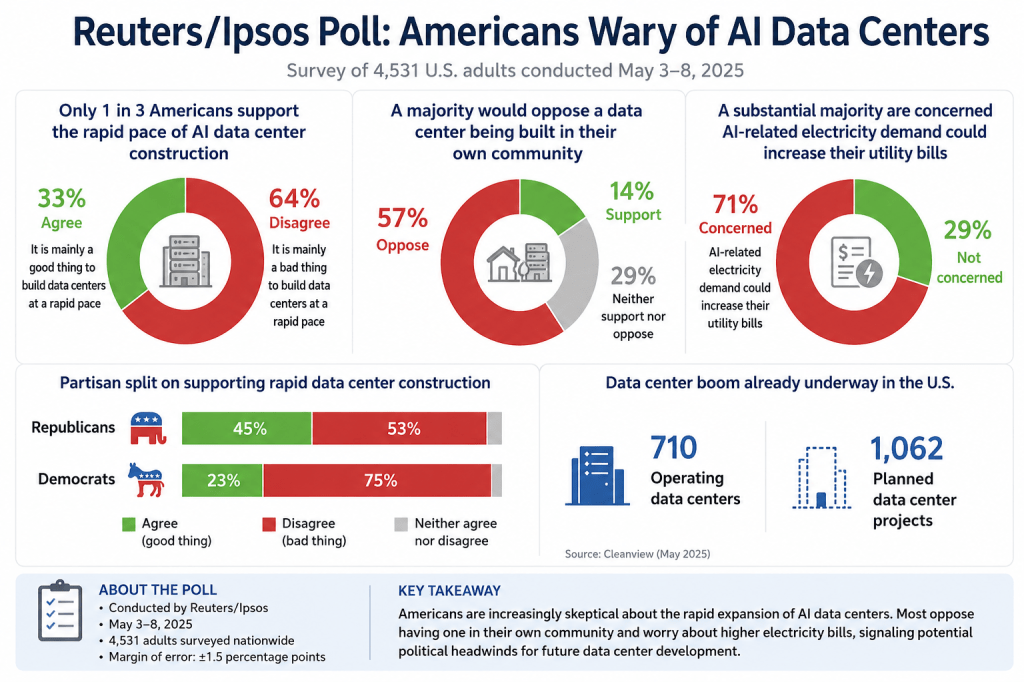
A new Reuters/Ipsos survey found that only one-third of Americans support the current pace of AI data center construction, while nearly two-thirds oppose it. More than half said they would oppose a data center in their own community, and a substantial majority expressed concern that AI-related electricity demand could increase their utility bills.

The six-day poll, which surveyed 4,531 people across the country and closed on Monday, showed just 33% of Americans agreed with a statement that it was mainly a good thing to build data centers at a rapid pace. Some 64% disagreed….Some 57% of people surveyed – including two-thirds of Democrats and half of ‌Republicans – also said they would oppose a data center ⁠being built in their community. Just 14% of survey takers said they were okay with a center being built near them, according to the Reuters/Ipsos poll.

The lopsided result should not be surprising.

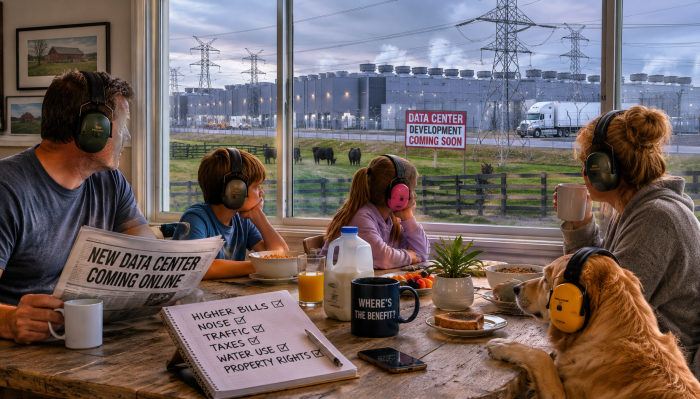
For the past two years, the public conversation around data centers has focused on American AI leadership (“because China”), economic development, and technological competitiveness. But many communities are experiencing something very different: transmission line easements criss-crossing private property, industrial-scale facilities near homes, rising utility concerns, water consumption, noise, and tax incentives for some of the world’s largest companies.  It may be starting to dawn on the public why the White House AI Czar David Sacks was so obsessed with blocking any state laws that got in the way of AI.

In some cases, the issue goes even further. Landowners are being asked to surrender property rights through eminent domain—or the threat of eminent domain—so that transmission infrastructure can be built to serve facilities whose ultimate beneficiaries are among the wealthiest technology companies in the world.

Imagine you were the man who fell to earth and you knew nothing about AI workflow.  Would you look at all these data centers, substations, behind the meter nuclear reactors and transmission lines and say “oh, that makes total sense”?  Or would you ask what are these people thinking building a supply chain this kludgy with myriad points of failure?  Data centers in space?  Really?  What could possibly go wrong?

That is where the national security narrative begins to collide with local reality. “We have to do this because China” is a powerful slogan in Washington. For many landowners outside the Imperial City, however, it begins to ring hollow when the immediate consequence is a transmission easement across family property that will never happen in an urban setting.  

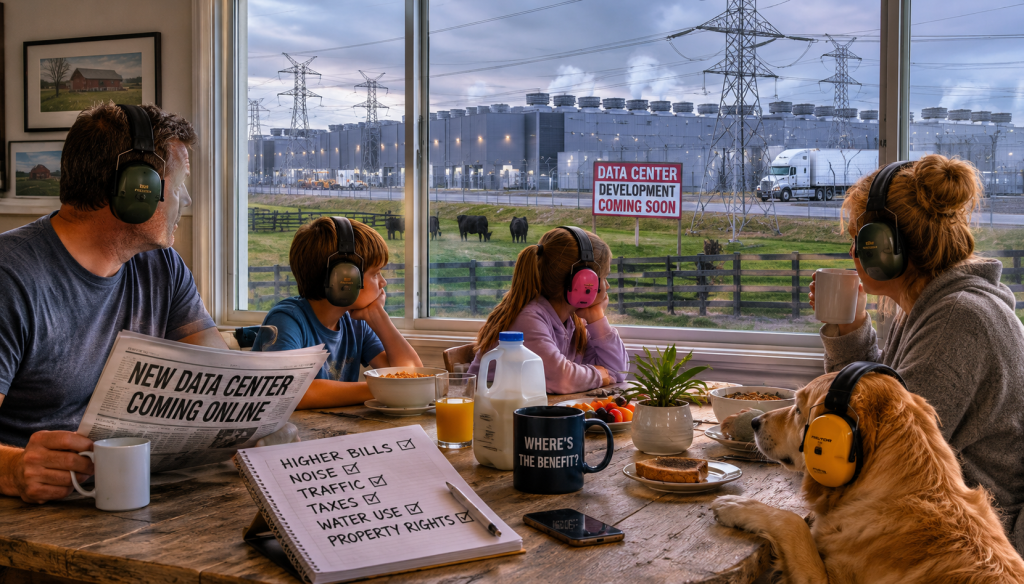
This is particularly true when the economic justification depends on AI demand forecasts that may not even be tested—much less achieved—for years. Viewed from a kitchen window looking out at a new transmission corridor in what used to be your vegetable garden or a pasture for livestock, the sacrifice is immediate and personal, while the promised strategic benefits remain abstract and distant.

We’ve already seen an econometric study from Professor Michael Hicks at Ball State University showing that all the hundreds of data centers in Texas have led to pretty much a wash in job creation, a major selling point that few ever believed.  A University of Texas study shows that data centers could potentially account for 3% to 9% of Texas’ water use by 2040, according to a new white paper. In other words, Big Data has largely been talking about the benefits of AI while residents have been living with the costs of that infrastructure.

Chief Veterinary Officer for Greater Birmingham Humane Society Testifying against data center
Reverse Angle Showing City Council Left the building

The Reuters/Ipsos poll suggests the issue may be evolving from a collection of local land-use disputes into a national political movement. Historically, that is the point where elected officials begin to change their behavior. Local opposition can often be dismissed as isolated resistance. National polling is harder to ignore and could be the harbinger of somebody getting unelected.

The challenge for policymakers, utilities, and developers is that public concerns are becoming increasingly tangible while many projected benefits remain tied to forecasts extending years into the future with no current evidence. Voters tend to react more strongly to immediate and permanent impacts than to promised future gains that may never come to pass, particularly gains to other people who don’t have a transmission line in their garden or who were not forced to sell their family home to a power company.

That leads to a data center mobilization question that has received far less attention than corrupting farm land, water use, noise, or electricity rates: what happens if the forecasts are simply wrong?


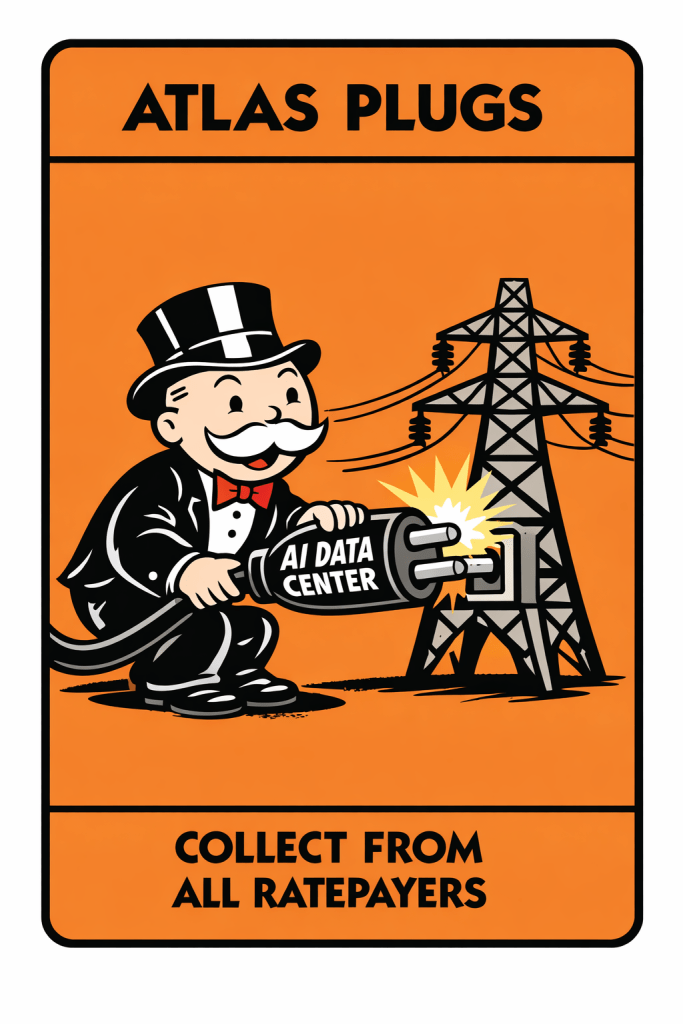
Communities are being asked to accept transmission corridors, substations, power plants, and massive industrial facilities today based on projections of future AI demand that may extend a decade or more into the future. Yet the economics of AI remain highly uncertain as this week’s Google $85 billion equity round confirms.  When Google’s AI capital expenditures exceeded even Google’s free cash flow, the Leviathan of Mountain View turned to a Silicon Valley favorite:  Other people’s money. Revenue models are still evolving, competition is intense, and many of the assumptions underlying today’s infrastructure buildout have not yet been tested through a full business cycle.

Crucially, Investors are funding unprecedented AI capex on the assumption of durable competitive advantages, yet the underlying LLM asset increasingly exhibits commodity characteristics. Meaning the models are all very similar in the fundamental components. As hyperscalers converge on functionally similar models, infrastructure, and services at extraordinary cost, there is less and less that distinguishes one from the other.  When Google chooses to finance capex out of equity rather than continue financing from free cash flow and debt, that may also tell us something about the appetite of lenders getting a little skeptical.

It’s not just Google.  Consider the implications of the recent reports surrounding SoftBank’s OpenAI investment. SoftBank participated in OpenAI’s February 2026 funding round at a valuation of approximately $840 billion and emerged with roughly 13% ownership. On paper, SoftBank’s stake in OpenAI carried an implied value of approximately $109 billion. 

Yet when SoftBank reportedly sought to get a margin loan on those same shares a few weeks ago (three months after the $840 billion valuation was set) using that position as collateral, lenders appear to have viewed the value of the OpenAI shares very differently. The company initially sought a $10 billion loan secured by its OpenAI shares, later reducing the request to approximately $6 billion after lender interest reportedly proved limited. Even at the lower amount, loan negotiations have reportedly stalled.

The significance is not just  that SoftBank’s OpenAI position is worth only $6 billion (implied $46B valuation) or $10 billion as margin loan collateral, if that. Rather, it highlights the distinction between venture valuation, financing valuation, and realizable value. An $840 billion venture valuation reflects what investors were willing to pay in a private financing round under specific assumptions about future growth, profitability, and market structure.

A margin lender asks a different question: if the collateral must be liquidated under adverse circumstances like a bubble burst or the recent semiconductor crash, what is it actually worth? The resulting margin discount can be substantial, even taking into account the usual 50%-ish haircut on marginable securities. For AI investors, this episode may be one of the first visible indications that sophisticated credit markets are assigning materially different risk assessments to AI assets than those implied by headline-grabbing private-market valuations fueled by cheerleading from the financial press and, it must be said, the Oval Office.

Similar valuation disconnects have appeared before other major public offerings, including Spotify’s direct listing, WeWork’s failed IPO, and several high-profile technology listings where private-market expectations ultimately confronted public-market price discovery. For AI investors, the significance is less about OpenAI itself than what the episode may reveal about the difference between AI forecasts and the willingness of sophisticated creditors to finance those assumptions with actual cash.


If those forecasts prove overly optimistic, the result may not simply be disappointed investors. The result could be stranded assets: transmission lines cutting across ranches and farms, substations occupying valuable land, and industrial facilities looming over communities long after the expected economic justification has faded. That burden may ultimately become the defining political challenge of the AI infrastructure era. People are not merely being asked to tolerate temporary construction. They are being asked to accept permanent changes both to their homes, to their property ownership, and to their communities in support of forecasts that may or may not materialize. If a ranch is involuntarily divided, a neighborhood industrialized, or a home taken for infrastructure justified by projected future AI demand, the consequences are real regardless of whether the forecast is ultimately correct.

The Reuters/Ipsos poll suggests that the next phase of the debate may be less about artificial intelligence itself and more about who bears the risks, costs, and consequences of the infrastructure being built to support it—and who bears the consequences for an unpopular mobilization if those forecasts turn out to be wrong.

That conversation—and the inevitable litigation—is only beginning.

Infrastructure, Not Aspiration: Why Permissioned AI Begins With a Hard Reset

Paul Sinclair’s framing of generative music AI as a choice between “open studios” and permissioned systems makes a basic category mistake. Consent is not a creative philosophy or a branding position. It is a systems constraint. You cannot “prefer” consent into existence. A permissioned system either enforces authorization at the level where machine learning actually occurs—or it does not exist at all.

That distinction matters not only for artists, but for the long-term viability of AI companies themselves. Platforms built on unresolved legal exposure may scale quickly, but they do so on borrowed time. Systems built on enforceable consent may grow more slowly at first, but they compound durability, defensibility, and investor confidence over time. Legality is not friction. It is infrastructure. It’s a real “eat your vegetables” moment.

The Great Reset

Before any discussion of opt-in, licensing, or future governance, one prerequisite must be stated plainly: a true permissioned system requires a hard reset of the model itself. A model trained on unlicensed material cannot be transformed into a consent-based system through policy changes, interface controls, or aspirational language. Once unauthorized material is ingested and used for training, it becomes inseparable from the trained model. There is no technical “undo” button.

The debate is often framed as openness versus restriction, innovation versus control. That framing misses the point. The real divide is whether a system is built to respect authorization where machine learning actually happens. A permissioned system cannot be layered on top of models trained without permission, nor can it be achieved by declaring legacy models “deprecated.” Machine learning systems do not forget unless they are reset. The purpose of a trained model is remembering—preserving statistical patterns learned from its data—not forgetting. Models persist, shape downstream outputs, and retain economic value long after they are removed from public view. Administrative terminology is not remediation.

Recent industry language about future “licensed models” implicitly concedes this reality. If a platform intends to operate on a consent basis, the logical consequence is unavoidable: permissioned AI begins with scrapping the contaminated model and rebuilding from zero using authorized data only.

Why “Untraining” Does Not Solve the Problem

Some argue that problematic material can simply be removed from an existing model through “untraining.” In practice, this is not a reliable solution. Modern machine-learning systems do not store discrete copies of works; they encode diffuse statistical relationships across millions or billions of parameters. Once learned, those relationships cannot be surgically excised with confidence. It’s not Harry Potter’s Pensieve.

Even where partial removal techniques exist, they are typically approximate, difficult to verify, and dependent on assumptions about how information is represented internally. A model may appear compliant while still reflecting patterns derived from unauthorized data. For systems claiming to operate on affirmative permission, approximation is not enough. If consent is foundational, the only defensible approach is reconstruction from a clean, authorized corpus.

The Structural Requirements of Consent

Once a genuine reset occurs, the technical requirements of a permissioned system become unavoidable.

Authorized training corpus. Every recording, composition, and performance used for training must be included through affirmative permission. If unauthorized works remain, the model remains non-consensual.

Provenance at the work level. Each training input must be traceable to specific authorized recordings and compositions with auditable metadata identifying the scope of permission.

Enforceable consent, including withdrawal. Authorization must allow meaningful limits and revocation, with systems capable of responding in ways that materially affect training and outputs.

Segregation of licensed and unlicensed data. Permissioned systems require strict internal separation to prevent contamination through shared embeddings or cross-trained models.

Transparency and auditability. Permission claims must be supported by documentation capable of independent verification. Transparency here is engineering documentation, not marketing copy.

These are not policy preferences. They are practical consequences of a consent-based architecture.

The Economic Reality—and Upside—of Reset

Rebuilding models from scratch is expensive. Curating authorized data, retraining systems, implementing provenance, and maintaining compliance infrastructure all require significant investment. Not every actor will be able—or willing—to bear that cost. But that burden is not an argument against permission. It is the price of admission.

Crucially, that cost is also largely non-recurring. A platform that undertakes a true reset creates something scarce in the current AI market: a verifiably permissioned model with reduced litigation risk, clearer regulatory posture, and greater long-term defensibility. Over time, such systems are more likely to attract durable partnerships, survive scrutiny, and justify sustained valuation.

Throughout technological history, companies that rebuilt to comply with emerging legal standards ultimately outperformed those that tried to outrun them. Permissioned AI follows the same pattern. What looks expensive in the short term often proves cheaper than compounding legal uncertainty.

Architecture, Not Branding

This is why distinctions between “walled garden,” “opt-in,” or other permission-based labels tend to collapse under technical scrutiny. Whatever the terminology, a system grounded in authorization must satisfy the same engineering conditions—and must begin with the same reset. Branding may vary; infrastructure does not.

Permissioned AI is possible. But it is reconstructive, not incremental. It requires acknowledging that past models are incompatible with future claims of consent. It requires making the difficult choice to start over.

The irony is that legality is not the enemy of scale—it is the only path to scale that survives. Permission is not aspiration. It is architecture.