Chronology: The Week in Review, Eric Schmidt Spills on his “Bait” to UK PM, Musk on AI Training and other news

Elon Musk Calls Out AI Training

We’ve all heard the drivel coming from Silicon Valley that AI training is fair use. During his interview with Andrew Ross Sorkin at the DealBook conference, Elon Musk (who ought to know given his involvement with AI) said straight up that anyone who says AI doesn’t train on copyrights is lying.

The UK Government “Took the Bait”: Eric Schmidt Says the Quiet Part Out Loud on Biden AI Executive Order and Global Governance

There are a lot of moves being made in the US, UK and Europe right now that will affect copyright policy for at least a generation. Google’s past chair Eric Schmidt has been working behind the scenes for the last two years at least to establish US artificial intelligence policy. Those efforts produced the “Executive Order on the Safe, Secure, and Trustworthy Development and Use of Artificial Intelligence“, the longest executive order in history. That EO was signed into effect by President Biden on October 30, so it’s done. (It is very unlikely that that EO was drafted entirely at Executive Branch agencies.)

You may ask, how exactly did this sweeping Executive Order come to pass? Who was behind it, because someone always is. As you will see in his own words, Eric Schmidt, Google and unnamed senior engineers from the existing AI platforms are quickly making the rule and essentially drafted the Executive Order that President Biden signed into law on October 30. And which was presented as what Mr. Schmidt calls “bait” to the UK government–which convened a global AI safety conference convened by His Excellency Rishi Sunak (the UK’s tech bro Prime Minister) that just happened to start on November 1, the day after President Biden signed the EO, at Bletchley Park in the UK (see Alan Turing). (See “Excited schoolboy Sunak gushes as mentor Musk warns of humanoid robot catastrophe.”)

Remember, an executive order is an administrative directive from the President of the United States that addresses the operations of the federal government, particularly the vast Executive Branch. In that sense, Executive Orders are anti-majoritarian and are as close to at least a royal decree or Executive Branch legislation as we get in the United States (see Separation of Powers, Federalist 47 and Montesquieu). Executive orders are not legislation; they require no approval from Congress, and Congress cannot simply overturn them.

So you can see if the special interests wanted to slide something by the people that was difficult to undo or difficult to pass in the People’s House…and based on Eric Schmidt’s recent interview with Mike Allen at the Axios AI+ (available here), this appears to be exactly what happened with the sweeping and vastly concerning AI Executive Order. I strongly recommend that you watch Mike Allen’s “interview” with Mr. Schmidt which fortunately is the first conversation in the rather long video of the entire event. I put “interview” in scare quotes because whatever it is, it isn’t the kind of interview that prompts probing questions that might put Mr. Schmidt on the spot. That’s understandable because Axios is selling a conference and you simply won’t get senior corporate executives to attend if you put them on the spot. Not a criticism, but understand that you have to find value for your time. Mr. Schmidt’s ego provides plenty of value; it just doesn’t come from the journalists.

Crucially, Congress is not involved in issuing an executive order. Congress may refuse to fund the subject of the EO which could make it difficult to give it effect as a practical matter but Congress cannot overturn an EO. Only a sitting U.S. President may overturn an existing executive order. In Mr. Schmidt’s interview at AI+, he tells us how all this regulatory activity happened:

The tech people along with myself have been meeting for about a year. The narrative goes something like this: We are moving well past regulatory or government understanding of what is possible, we accept that. [Remember the antecedent of “we” means Schmidt and “the tech people,” or more broadly the special interests, not you, me or the American people.].

Strangely…this is the first time that the senior leaders who are engineers have basically said that they want regulation, but we want it in the following ways…which as you know never works in Washington [unless you can write an Executive Order and get the President to sign it because you are the biggest corporation in commercial history].

There is a complete agreement that there are systems and scenarios that are dangerous. [Agreement by or with whom? No one asks.]. And in all of the big [AI platforms with which] you are familiar like GPT…all of them have groups that look at the guard rails [presumably internal groups of managers] and they put constraints on [their AI platform in their silo]. They say “thou shalt not talk about death, thou shall not talk about killing”. [Anthropic, which received a $300 million investment from Google] actually trained the model with its own constitution [see “Claude’s Constitution“] which they did not just write themselves, they hired a bunch of people [actually Claude’s Constitution was crowd sourced] to design a “constitution” for an AI, so it’s an interesting idea.

The problem is none of us believe this is strong enough….Our opinion at the moment is that the best path is to build some IPCC-like environment globally that allows accurate information of what is going on to the policy makers. [This is a step toward global governance for AI (and probably the Internet) through the United Nations. IPCC is the Intergovernmental Panel on Climate Change.]

So far we are on a win, the taste of winning is there.  If you look at the UK event which I was part of, the UK government took the bait, took the ideas, decided to lead, they’re very good at this,  and they came out with very sensible guidelines.  Because the US and UK have worked really well together—there’s a group within the National Security Council here that is particularly good at this, and they got it right, and that produced this EO which is I think is the longest EO in history, that says all aspects of our government are to be organized around this.

While Mr. Schmidt may say, aw shucks dictating the rules to the government never works in Washington, but of course that’s simply not true if you’re Google. In which case it’s always true and that’s how Mr. Schmidt got his EO and will now export it to other countries.

It’s not Just Google: Microsoft Is Getting into the Act on AI and Copyright

Be sure to read Joe Bambridge (Politico’s UK editor) on Microsoft’s moves in the UK. You have to love the “don’t make life too difficult for us” line–as in respecting copyright.

Google and New Mountain Capital Buy BMI: Now what?

Careful observers of the BMI sale were not led astray by BMI’s Thanksgiving week press release that was dutifully written up as news by most of the usual suspects except for the fabulous Music Business Worldwide and…ahem…us. You may think we’re making too much out of the Google investment through it’s CapitalG side fund, but judging by how much BMI tried to hide the investment, I’d say that Google’s post-sale involvement probably varies inversely to the buried lede. Not to mention the culture clash over ageism so common at Google–if you’re a BMI employee who is over 30 and didn’t go to Carnegie Mellon, good luck.

And songwriters? Get ready to jump if you need to.

Spotify Brings the Streaming Monopoly to Uruguay

After Uruguay was the first Latin American country to pass streaming remuneration laws to protect artists, Spotify threw its toys out of the pram and threatened to go home. Can we get that in writing? A Spotify exit would probably be the best thing that ever happened to increase local competition in a Spanish language country. Also, this legislation has been characterized as “equitable remuneration” which it really isn’t. It’s its own thing, see the paper I wrote for WIPO with economist Claudio Feijoo. Complete Music Update’s Chris Cook suggested that a likely result of Spotify paying the royalty would be that they would simply do a cram down with the labels on the next round of license negotiations. If that’s not prohibited in the statute, it should be, and it’s really not “paying twice for the same music” anyway. The streaming remuneration is compensation for the streamers use of and profit from the artists’ brand (both featured and nonfeatured), e.g., as stated in the International Covenant on Economic, Social and Cultural Rights and many other human rights documents:

The Covenant recognizes everyone’s right — as a human right–to the protection and the benefits from the protection of the moral and material interests derived from any scientific, literary or artistic production of which he or she is the author. This human right itself derives from the inherent dignity and worth of all persons. 

Spotify ESG fail: Governance

[This is an extension of Spotify’s ESG Fail: Environment and Spotify’s ESG Fail: Social. “ESG” is a Wall Street acronym often attributed to Larry Finkat Blackrock that designates a company as suitable for socially conscious investing based on its “Environmental, Social and Governance” business practices. See the Upright Net Impact data model on Spotify’s sustainability score. As of this writing, the last update of Spotify’s Net Impact score was before the Neil Young scandal.]

Spotify has one big governance problem that permeates its governance like a putrid miasma in the abattoir: “Dual-class stock” sometimes referred to as “supervoting” stock. If you’ve never heard the term, buckle up. I wrote an extensive post on this subject for the New York Daily News that you may find interesting.

Dual class stock allows the holders of those shares–invariably the founders of the public company when it was a private company–to control all votes and control all board seats. Frequently this is accomplished by giving the founders a special class of stock that provides 10 votes for every share or something along those lines. The intention is to give the founders dead hand control over their startup in a kind of corporate reproductive right so that no one can interfere with their vision as envoys of innovation sent by the Gods of the Transhuman Singularity. You know, because technology.

Google was one of the first Silicon Valley startups to adopt this capitalization structure and it is consistent with the Silicon Valley venture capital investor belief in infitilism and the Peter Pan syndrome so that the little children may guide us. The problem is that supervoting stock is forever, well after the founders are bald and porky despite their at-home beach volleyball courts and warmed bidets.

Spotify, Facebook and Google each have a problem with “dual class” stock capitalizations.  Because regulators allow these companies to operate with this structure favoring insiders, the already concentrated streaming music industry is largely controlled by Daniel Ek, Sergey Brin, Larry Page and Mark Zuckerberg.  (While Amazon and Apple lack the dual class stock structure, Jeff Bezos has an outsized influence over both streaming and physical carriers.  Apple’s influence is far more muted given their refusal to implement payola-driven algorithmic enterprise playlist placement for selection and rotation of music and their concentration on music playback hardware.)

The voting power of Ek, Brin, Page and Zuckerberg in their respective companies makes shareholder votes candidates for the least suspenseful events in commercial history.  However, based on market share, Spotify essentially controls the music streaming business.  Let’s consider some of the  implications for competition of this disfavored capitalization technique.

Commissioner Robert Jackson, formerly of the U.S. Securities and Exchange Commission, summed up the problem:

“[D]ual class” voting typically involves capitalization structures that contain two or more classes of shares—one of which has significantly more voting power than the other. That’s distinct from the more common single-class structure, which gives shareholders equal equity and voting power. In a dual-class structure, public shareholders receive shares with one vote per share, while insiders receive shares that empower them with multiple votes. And some firms [Snap, Inc. and Google Class B shares] have recently issued shares that give ordinary public investors no vote at all.

For most of the modern history of American equity markets, the New York Stock Exchange did not list companies with dual-class voting. That’s because the Exchange’s commitment to corporate democracy and accountability dates back to before the Great Depression. But in the midst of the takeover battles of the 1980s, corporate insiders “who saw their firms as being vulnerable to takeovers began lobbying [the exchanges] to liberalize their rules on shareholder voting rights.”  Facing pressure from corporate management and fellow exchanges, the NYSE reversed course, and today permits firms to go public with structures that were once prohibited.

Spotify is the dominant streaming firm and the voting power of Spotify stockholders is concentrated in two men:  Daniel Ek and Martin Lorentzon.  Transitively, those two men literally control the music streaming sector through their voting shares, are extending their horizontal reach into the rapidly consolidating podcasting business and aspire soon to enter the audiobooks vertical.  Where do they get the money is a question on every artists lips after hearing the Spotify poormouthing and seeing their royalty statements.

The effects of that control may be subtle; for example, Spotify engages in multi-billion dollar stock buybacks and debt offerings, but has yet makes ever more spectacular losses while refusing to exercise pricing power.  

So yes, Spotify is starting to look like the kind of Potemkin Village that investment bankers love because they see oodles of the one thing that matters: Fees.

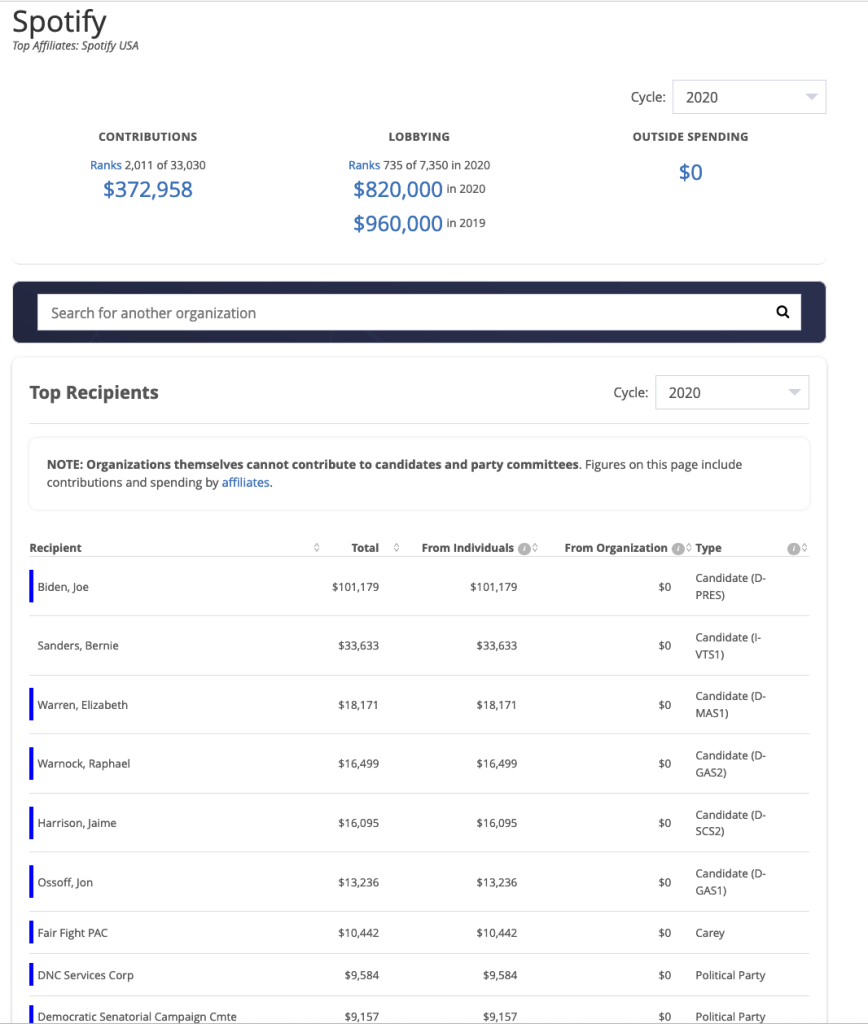
On the political side, let’s see what the company’s campaign contributions tell us:

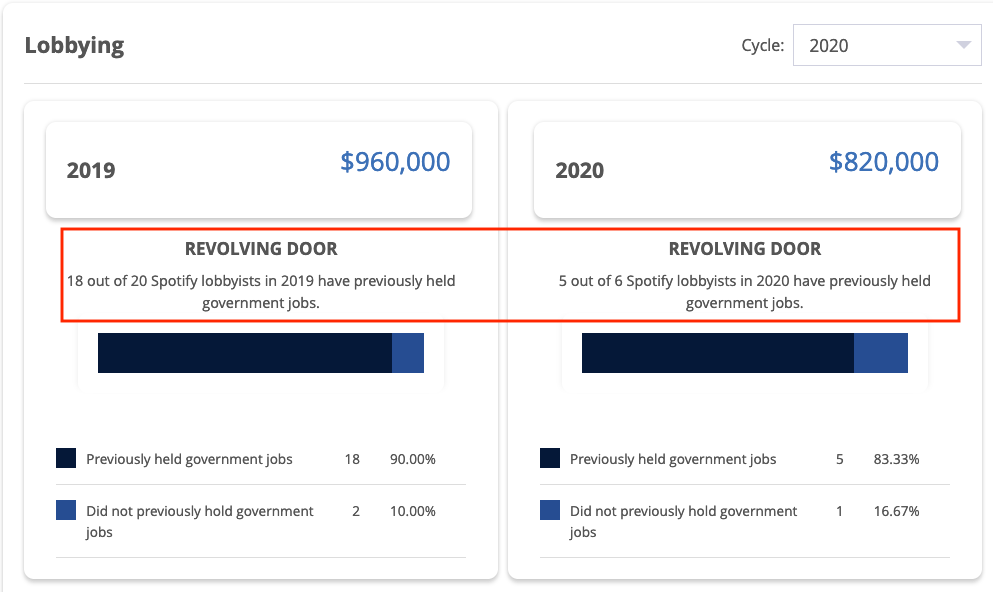
Spotify has also made a habit out of hiring away government regulators like Regan Smith, the former General Counsel and Associate Register of the US Copyright Office who joined Spotify as head of US public policy (a euphemism for bag person) after drafting all of the regulations for the Mechanical Licensing Collective;

Whether this is enough to trip Spotify up on the abuse of political contributions I don’t know, but the revolving door part certainly does call into question Spotify’s ethics.

It does seem that these are the kinds of facts that should be taken into account when determining Spotify’s ESG score.

Spotify’s ESG Problem: Environment Fail

Spotify has an ESG problem, and a closer look may offer insights into a wider problem in the tech industry as a whole. If a decade of destroying artist and songwriter revenues isn’t enough to get your attention, maybe the Neil Young and Joe Rogan imbroglio will. But a minute’s analysis shows you that Spotify was already an ESG fail well before Neil Young’s ultimatum.

Streaming is an Environmental Fail

I first began posting about streaming as an environmental fail years ago in the YouTube and Google world. Like so many other ways that the BIg Tech PR machine glosses over their dependence on cheap energy right through their supply chain from electric cars to cat videos, YouTube did not want to discuss the company as a climate disaster zone. To hear them tell it, YouTube, and indeed the entire Google megalopolis right down to the Google Street View surveillance team was powered by magic elves running on appropriate golden flywheels with suitable work rules. Or other culturally appropriate spin from Google’s ham handed PR teams.

Greenpeace first wrote about “dirty data” in 2011–the year Spotify launched in the US. Too bad Spotify ignored the warnings. Harvard Business Review also tells us that 2011 was a demarcation point for environmental issues at Microsoft following that Greenpeace report:

In 2011, Microsoft’s top environmental and sustainability executive, Rob Bernard, asked the company’s risk-assessment team to evaluate the firm’s exposure. It soon concluded that evolving carbon regulations and fluctuating energy costs and availability were significant sources of risk. In response, Microsoft formed a centralized senior energy team to address this newly elevated strategic issue and develop a comprehensive plan to mitigate risk. The team, comprising 14 experts in electricity markets, renewable energy, battery storage, and local generation (or “distributed energy”), was charged by corporate senior leadership with developing and executing the firm’s energy strategy. “Energy has become a C-suite issue,” Bernard says. “The CFO and president are now actively involved in our energy road map.”

If environment is a C-suite issue at Spotify, there’s no real evidence of it in Spotify’s annual report (but then there isn’t at the Mechanical Licensing Collective, either). “Environment” word search reveals that at Spotify, the environment is “economic”, “credit”, and above all “rapidly changing.” Not “dirty”–or “clean” for that matter.

The fact appears to be that Spotify isn’t doing anything special and nobody seems to want to talk about it. But wait, you say–what about the sainted Music Climate Pact? Guess who hasn’t signed up to the MCP? Any streaming service. There is a “Standard Commitment Letter” that participants are supposed to sign up to but I wasn’t able to read it. Want to guess why?

That’s right. You know who wants to know what you’re up to.

Next: Spotify’s “Social” Fail: Rogan, Royalties and The Uyghurs

The Return of the Ethical Pool: @marchogan on User Centric Royalties

Marc Hogan has an interesting post on Pitchfork about “user centric” royalties.  (“Is There a Fairer Way for Streaming Services to Pay Artists?”)

He echoes the common arguments about user centric.  These theories are mostly about  comparisons to the current model of the “big pool” and its hyper-efficient market share distribution of streaming service revenues.  Or as Mr. Hogan puts it, a direct democracy vs. electoral college approach.  (Let’s remember what happened when the Greeks tried direct democracy.)

It’s not just that user centric is fair.  Life ain’t fair.  It’s that the big pool model is wildly inaccurate and deceives fans.  The problem with user centric isn’t that it’s too complex, it’s that by comparison the “big pool” method isn’t complex enough.

And let’s also realize that when you pay artists’ at a royalty rate that starts several decimal places to the right, there is no measurable downside in “not playing”–or withdrawing from the service altogether.  So the alternatives are not direct democracy or electoral college, it’s the much simpler choice of in or out.  If you don’t give me a good reason to be in, and if by being in I cannibalize higher margin sales, then maybe I just sit this one out.  (Hundreds of Quebec artists made this point recently.)

Of course, I’m willing to be educated otherwise, but it seems that the really simple thing would be to have a fixed per-play rate.  That’s definitely not true now, which makes this statement a bit bizarre:

Spotify’s chief economist, Will Page, has raised a couple of points in defense of the existing model. Under the current system, every time you stream a song, it has the same value….

If by “value” they mean “same pennies”, that is definitely not true in the big pool model.  Some labels have complex greater-of formulas (not to mention breakage and minimum guarantees) so while the streams may be counted the same (no bonus plays), the per play rates are definitely not identical.  That’s a big reason it takes so long to close Spotify’s label deals.  (There are two ways to juice royalties–play with the units (the plays for streaming) or play with the royalties (the micro pennies for streaming).  Streamers play with the royalties.  So far.)

I don’t underestimate the complexity in running the big pool and the true user centric models side by side under the same roof.  That is what makes it complex.  I have a solution to this challenge I call the ethical pool that is an intermediate step between the two that allows both to co-exist if the fans and the artists elect it to be so.  The problem the ethical pool seeks to solve is best summarized by a fan:  “Sick of my money funding crap”.

Mr. Hogan also makes another interesting point courtesy of ex-Spotify economist Will Page:

The biggest argument against the user-centric model is that it could be too complex. Calculating payouts based on every individual user’s listening is, inevitably, more complicated than just adding up the total and divvying up the pot. The extra administrative cost—say, figuring out what each person’s streams are worth each quarter and then distilling that into a semi-coherent pay statement—could actually leave artists with less money to go around, Page has maintained in a paper co-authored with an executive from music-licensing giant ASCAP. Changing systems wouldn’t be the right decision if it ends up hurting the people it’s supposed to help.

So it appears that Will is making a fundamental error here (presumably on behalf of Spotify).  The question is not whether Spotify will pass through its administrative costs to the artists.   Those costs come out of Spotify’s share.  I simply cannot imagine Apple or Amazon trying to pass along their costs of accurate accountings to the artists.  Google would certainly, but not the real competition for Spotify.

The question is which floor of the World Trade Center is Spotify going to sacrifice to cover these costs?

@musically: Spotify CEO says Libra currency could help listeners ‘pay artists directly’ — Artist Rights Watch

Earlier this week, Facebook announced a new blockchain-powered currency called Libra, and a digital wallet for it called Calibra. Spotify was among the companies backing the plans by becoming a founder member of the independent Libra Association.

Now Spotify CEO Daniel Ek has been talking about his hopes for Libra, including the suggestion that it could one day facilitate direct payments to musicians from fans.

“I think like cryptocurrencies and blockchain are obviously two of the biggest buzzwords you can have today. And for me, I don’t think technology in itself is that interesting· What I do think is interesting is what we can do with that technology,” said Ek, in an interview for Spotify’s own Culture: Now Streaming podcast.

“What everyone who’s a part of Libra is trying to accomplish is: it’s interesting that we have all these different currencies, all of these different ways of doing things. But the reality is, there’s several billion people around the world that don’t even have access to a bank account,” he continued….(Whatever you think of Libra, the fact that Spotify is, right up to CEO level, even thinking about direct payments from fans to artists is a significant talking point for anyone mulling how the streaming service will evolve in the coming years.)

Read the post on MusicAlly

The Elusive Obelus: Streaming’s Problem With Denominators

“How did you go bankrupt?” Bill asked.
“Two ways,” Mike said. “Gradually and then suddenly.”

Ernest Hemingway, The Sun Also Rises.

No matter how much people would like to deflect it, the unvarnished per stream rate is an ever diminishing income stream.  Given the number of calculations involved for both sound recording and song, it is likely that the total end-to-end cost of rendering the accountings for the streams costs more than the royalty earned on that stream by any one royalty participant.  Solving this problem is the difference between a short-term stock-fueled sugar high and a long-term return of shareholder value for all concerned.  So now what?

If you’re someone who receives or calculates streaming royalties, you’re already familiar with the  problem of the ever-decreasing per-stream rate.  The Trichordist’s definitive “Streaming Price Bible” for 2018 confirms this trend yet again, but simple math explains the problem of the revenue share allocation.

Remember that the way streaming royalties are calculated in voluntary agreements (aka “direct deals”) revolves around a simple formula (Formula A):

(Payable Revenue ÷ Total Service Streams) x Your Streams = Per Stream Rate

Which may also be expressed as Formula B:

Payable Revenue x (Your Streams ÷ Total Service Streams) = Your share of revenue

(Formula A and B are also known as “the big pool” in the user-centric or Ethical Pool models.)

Here’s the trick–it’s in the correlation of the rate of increase over time of the numerator and the denominator.  If you focus on any single calculation you won’t see the problem.  You have to calculate the rate of change over time.  Simply put, if the numerator in either Formula A or Formula B increases at a lower rate than the denominator, then the quotient, or the result of the division, will always decline as long as those conditions are met.  That’s why the Streaming Price Bible shows a declining per-stream rate–a contrarian fact among the hoorah from streaming boosters that sticks in the craw.

Services make these accounting calculations monthly for the most part, and they are calculated a bit differently depending on the service.  This is why the Streaming Price Bible has different rates for different services, rates that vary depending on the terms of the contract and also the amount of “Payable Revenue” that the service attributes to the particular sound recordings.

The quotient will also vary depending on the copyright owner’s deal.  If you add downside protection elements such as contractual per stream or per subscriber minimums, then you can cushion the decline.

This is also true of non-recoupable payments (such as direct payments that are deemed to be recoupable but not returnable, or “breakage”).  Nonrecoupable payments are just another form of nominal royalty payable to the copyright owner, and increase the overall payout.  And of course, the biggest nonrecoupable payment is stock which sometimes pays off as we saw with Spotify.  These payments may or may not be shared with the artist.  (See the WIN Fair Digital Deals Pledge.)

So each of the elements of both Formula A and Formula B are a function of other calculations. We’re not going to dive into those other elements too deeply in this post–but we will note that there are some different elements to the formulas depending on the bargaining power of the rights owner, in this case the owner of sound recordings.

So how is it that the per-stream rate declines over time in the Streaming Price Bible?

Putting the Demon in the Denominator

Back to Formula B, you’ll note that the function “Your Streams ÷ Total Service Streams” looks a lot like a market share allocation.  In fact, if the relevant market is limited to the service calculating the revenue share allocation, it is a market share allocation of service revenue by another name.  When you consider that the customary method of calculating streaming royalties across all services is a similar version of Formula B, it may as well be an allocation of the total market on a market share basis.

Note that this is very different from setting a wholesale price for your goods that implies a retail price.  A wholesale price is a function of what you think a consumer would or should pay.  When a service agrees to a minimum per stream or per subscriber rate, they are essentially accepting a price term that behaves like a wholesale price.

For most artists and indie labels, the price is set by your market share of the subscription fees or ad rates that the service thinks the market will bear based on the service’s business goalsnot based on your pricing decision.

Why is this important?  A cynic might say it’s because Internet companies are in the free lunch crowd–they would give everything away for free since their inflated salaries and sky-high rents are paid by venture capitalists who don’t understand a thing about breaking artists and investing in talent.  You know, the kind of people who would give Daniel Ek a million dollar bonus when he hadn’t met his performance targets, stiffed songwriters for years and gotten the company embroiled in multimillion dollar lawsuits.  But had met the only performance target that mattered which was to put some cosmetics on that porker and push it out the door into a public stock offering.  (SPOT F-1 at p. 133: “In February 2018, our board of directors determined to pay Mr. Ek the full $1,000,000 bonus based on the Company’s 2017 performance though certain performance goals were not achieved…”)

But long-term, it’s important because one way that royalties will rise is if the service can only acquire its only product at a higher price.  Or not.  The other way that royalties will rise is if services are required to pay a per-stream rate that is higher than the revenue share rate.  How that increase is passed to the consumer is up to them.  Maybe a move from World Trade Center to Poughkeepsie would help.

The Streaming Price Bible is based on revenue for an indie label that did not have the massive hits we see on Spotify.  In this sense, it is the unvarnished reality of streaming without the negotiated downside protection goodies, unrecoupable or nonreturnable payments, and of course shares of stock.  While some may say the Bible lacks hits, that’s kind of the point–hits mask a thousand sins.  Ask any label accountant.

Will Consumption Eat Your Free Lunch?

Let’s say again: The simple explanation for the longitudinal decline of streaming royalties measured by the Streaming Price Bible is that the rate of change across accounting periods in the “Payable Revenue” must be greater than the rate of change in the total number of streams in order for the per-stream rate to increase–otherwise the per-stream rate will always decrease.  Another way to think of it is that revenue has to increase faster than consumption, or consumption will eat your lunch.

What if you left the formula the same and just increased the revenue being allocated?  Services will probably resist that move.  After all, when artists complain about their per-stream rate, the services often answer that the problem is not with them, it is with the artist’s labels because the services pay hundreds of millions to the labels.

We don’t really have much meaningful control over what goes in the monthly payable revenue number (i.e., the mathematical “dividend” or numerator).  What kinds of revenue should be included?  Here are a few:

–all advertising revenue from all sources
–e-commerce transactions
–bounties or referral fees, including  recoupable or non-refundable guarantees
–sponsorships
–subscription income
–traffic or tariff charges paid by telcos
–revenue from the sale of data

Services will typically deduct “small off the tops” which would include
–VAT or sales tax
–ad commissions paid to unaffiliated third parties (usually subject to a cap)

Indie labels and independent artists may not have the leverage to negotiate some of these revenue elements such as revenue from the sale of data for starters.  Other elements of the revenue calculation for indie labels and artists will also likely not include the downside protections, subscriber target top up fees and the like.

And of course the biggest difference is that indie labels (at least not in the Merlin group who may) typically do not get nonreturnable advances,  nonrecoupable payments, or stock.

Is That All There Is?

Why should we care about all this?  There is a story that is told of negotiations to settle a lawsuit against a well-known pirate site.  One of the venture capitalists backing the pirates told one of the label negotiators that he could make them all richer through an IPO than any settlement they’d ever be able to negotiate.

The label executive asked, lets’ say we did that, but then what happens?  You say we should adapt, but you’re still destroying the industry ecosystem so that there’s nothing left to adapt to.  The most we could make from an IPO would cover our turnover for a year at best.  And we would be dependent on your success, not our artists’ success.

Then what?


More Evidence of DPO Conflicts: Is Spotify’s Stock Buyback Plan Taking it to the Shorts?

Spotify is experiencing the joys of being a public company–or at least a quasi public company if you count public companies as ones whose shares are actually held by the public as in Mrs. & Mr. America.  But both analysts and investors have to always remember that Spotify did not conduct an IPO in the traditional sense where an underwriting syndicate of bankers bought a block of shares from the company that the syndicate then resold to the public.  This is why Spotify’s recently announced $1 billion stock buy-back program bears closer scrutiny.

Instead they conducted a DPO, a direct public offering which is unusual and radically different than an IPO.  The DPO has an essential conflict–the sellers of shares are insiders in the issuer and have an incentive to keep the stock price high and to manipulate that stock price however they can.  Like through a stock buy back after less than a year of trading, for example.

From a financial markets point of view, that DPO makes almost everything about Spotify’s stock a different analysis than a market traded IPO–including Spotify’s recently announced stock buy back.  Stock buy backs happen all the time, particularly in declining markets.  But what is unusual is for a company that’s still in its first year of operating as a public company whose shares are largely traded by insiders and is a money losing company to take the odd step of using $1 billion of the shareholders money to buy back stock.

Or maybe not so unusual if the shareholders whose money it is are both the sellers of those shares and the beneficiaries of the stock buy back–as they try to find a bigger fool to sell the shares to in the retail market.  Another core problem with DPOs is that you don’t have an independent body setting the opening price as you would with an underwriting syndicate.  DPOs have to get an opening price from somewhere–so Spotify’s pricing problem started with the SEC and NYSE allowing Spotify to price at its last privately traded price (as some shares of Spotify traded in what used to be called a “Rule 4(a)(1)1/2” exemption for resale of restricted stock, now codified in Section 4(a)(7) of the Securities Act by the FAST [Breakfast at Buck’s] Act–a bit of a gloss but OK for our purposes here).

So by letting Spotify use the private market for restricted stock as a proxy for a market price, at a minimum the SEC and the NYSE assume that the rights, preferences and privileges of an unregistered share of Spotify stock are the same as a share of registered SPOT.  They’re not.  They also assume there are no price distortions from the relatively low number of unlegended restricted shares available in the private market.  They also assume that there’s nothing odd about a company like Spotify–staring down relatively slam dunk infringement lawsuits of significant value and in a money-losing business run from 10 floors of the World Trade Center like it was Apple or something–pricing way above the opening prices of Amazon, Facebook, Google and so on.

If that sounds cynical, it really isn’t once you understand the dynamics of a DPO compared to an IPO.  The DPO produces a market effect that is similar to the business model of Larry Ellison’s famous 1999 “HeyIdiot.com” parody of an Internet company:

HEYIDIOT.COM is tightly focused on selling just one product. Elegantly enough, that product is the stock of HEYIDIOT.COM, which will be offered to you for sale on-line at our web site of the same name. Buying the stock is simple, you can buy as much stock as you want with the only rule being that each new purchase must be executed at a successively higher price.  We call it a cash portal.

We’re seeing the result of the DPO come home to roost in Spotifyland which looks something like this:


Spotify 11-16-18 Basic
SPOT 11-6-18

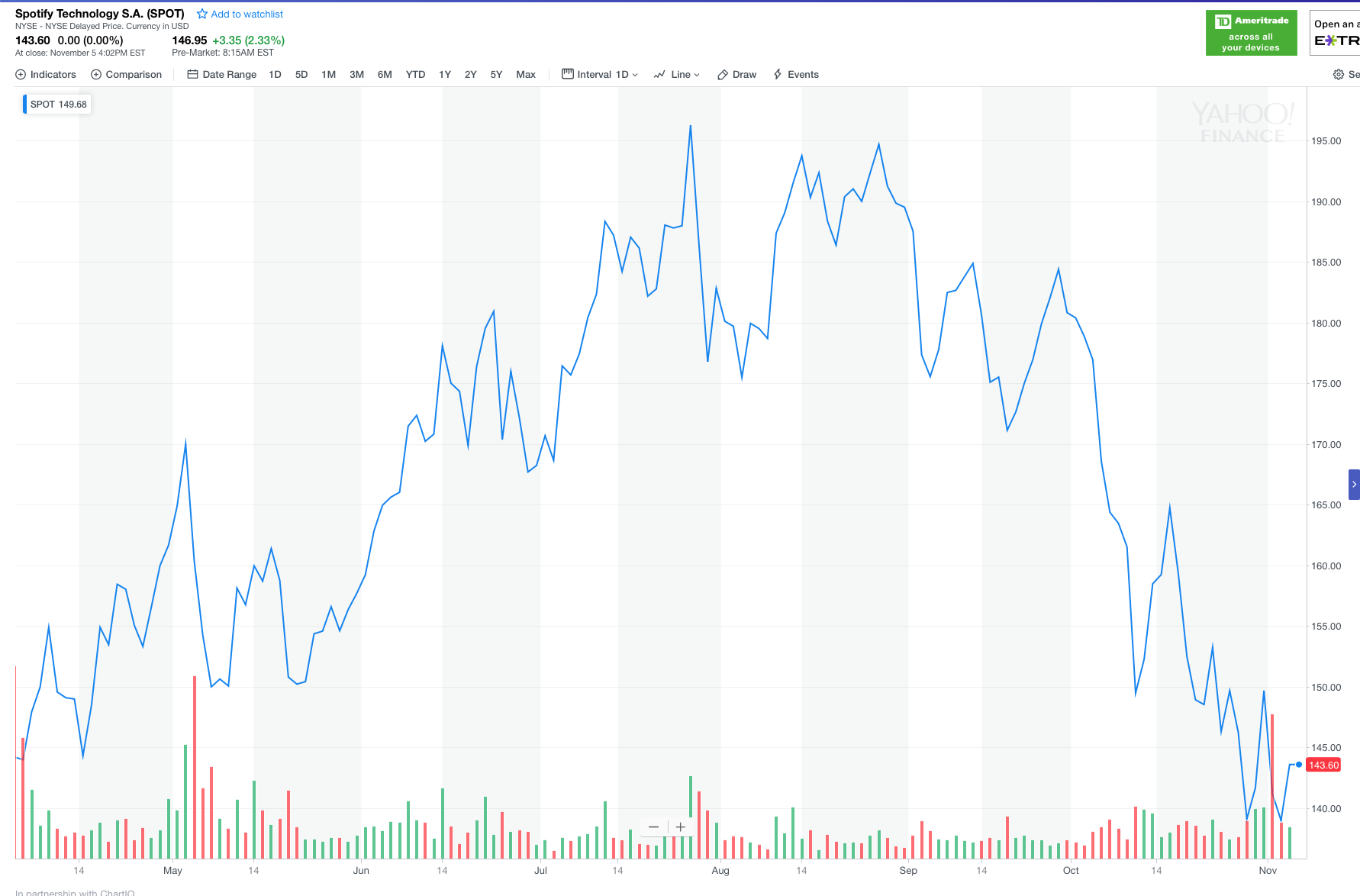
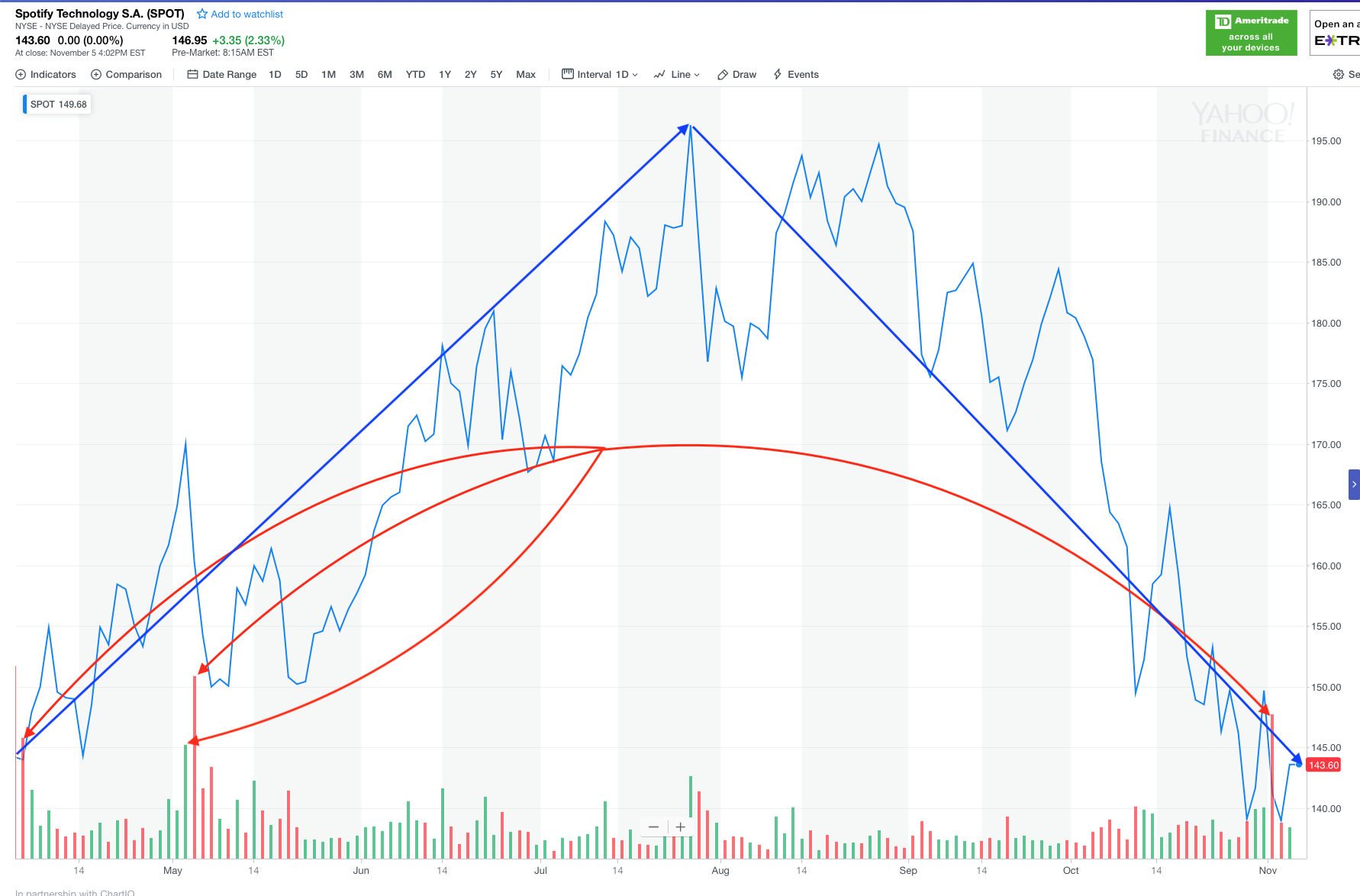
After a run up in the stock price–on low volume and with no meaningful news–the stock retraces its steps and suggests its testing lower lows.  It’s hard to say what “price support” there is for a stock that’s had less then a year of trading, but let’s just say that if it broke through $100 to the downside, there would be rending of garments and closer examination of executive compensation unless Spotify executives could continue to blame artists for “high” royalties.

Also note that three out of four of Spotify’s biggest volume days were to the downside, and that the stock has been trading down, essentially, since August.Spotify 11-16-18 Volume


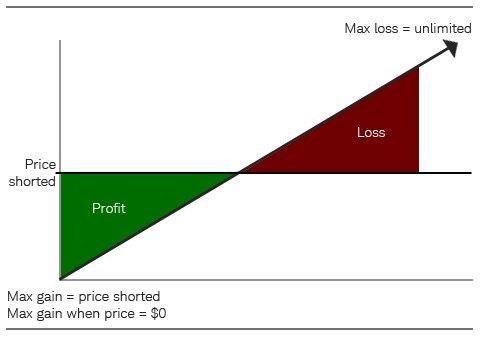
We can also assume that at these low trading volumes, the shares have gradually been accumulating in the trading accounts of Mrs. & Mr. America which also means that there are potentially more and more shares available to short sellers–the buy high sell low crowd that I discussed back in March.

short_sell_example

In fact, there are a few November 30 puts in the $115 range already.  Daniel Ek has announced he’ll be selling Spotify shares with a value of about $20 million on a monthly basis for a while.  You have to notice that those board-approved sales are overlapping with the board-approved Spotify stock buy back that will help to support the higher price point while insiders dump their shares.  This is another inherent conflict problem with the whoe DPO concept–but when you have the 1:10 voting power over your board as does Mr. Ek, many things are possible.

It’s nice work for a “cash portal.”

See SPOT Fall–Does the Decline of Spotify’s Stock Price Mean Anything?

Stocks go up, stocks go down, what does it all mean?  In the very recent declines of the stock price of credible companies, you saw them punished for good quarters but guiding lower.  Even “big tech” stocks like Google and Amazon were punished for revenue misses and cloudy guidance.

And then there’s China–is the US in a trade war or a new cold war?  (Read Mike Pillsbury for the answer.)  Spotify’s has double whammy exposure to China trade woes plus the Ten Cent investment (itself getting hammered by China’s President for Life’s concerns about videogame addiction).

What’s happening with the Spotify stock price?  I would argue the main downward driver for SPOT is much more straightforward–the market is simply catching up to the Spotify DPO and its insider-heavy stock sales.  We won’t really know the hard numbers on insider trades until the SEC starts making those insider Form 4 sales more easily available online.  That should should happen any day now (and none of the mainstream music industry publications seem to be interested enough in the the truth setting them free to actually dig through the SEC Form 4 filings at the source).

But–there could be enough shares out there in the marketplace that SPOT may be starting to trade like an IPO as opposed to an insider cash-out (or DPO).  And once the market really becomes part of the Spotify trading day and trading volume increases, a few things start happening.  One is that as more shares are held by the public, there are an increasing number of shares available to allow the “buy high, sell low” short trading that can cause big swings in a stock’s price due to short covering if nothing else.

SPOT also starts to become more susceptible to the other stocks in its cohort as more retail investors have to answer the question, what will I sell to buy Spotify?  The answer will be different for different people, but if there are more sellers than there are buyers, we know what happens.  That’s why the majors, Sony in particular, were very smart to start selling their holdings almost immediately.

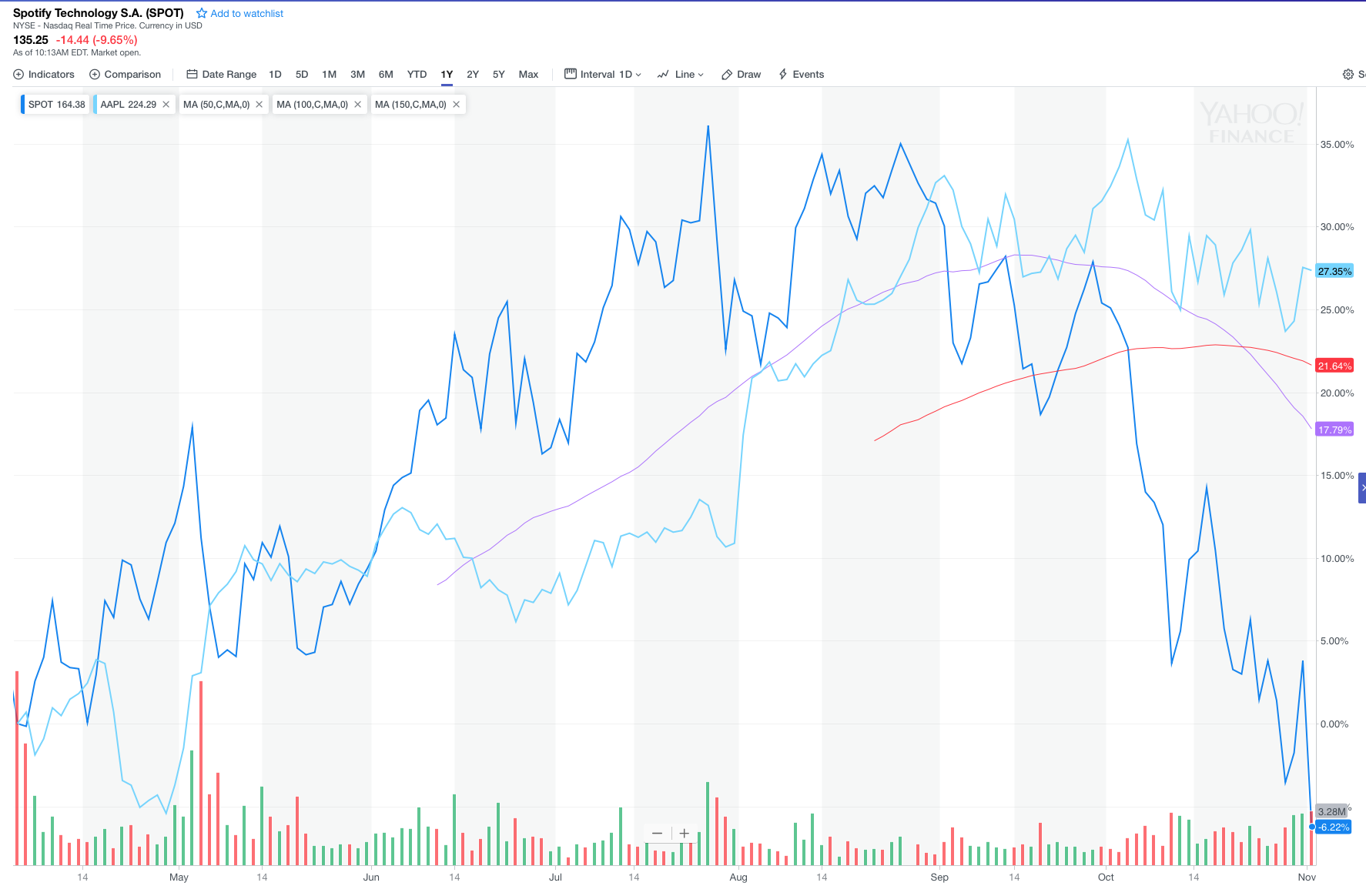
What would you sell to buy Spotify?  Probably not its competitor Apple–whose shares trade almost opposite to Spotify on a relative basis.


SPOT Apple Moving averages
SPOT-APPL 11-1-18


If you’re looking at the performance of SPOT, you have to ask yourself what about this chart says “buy”?


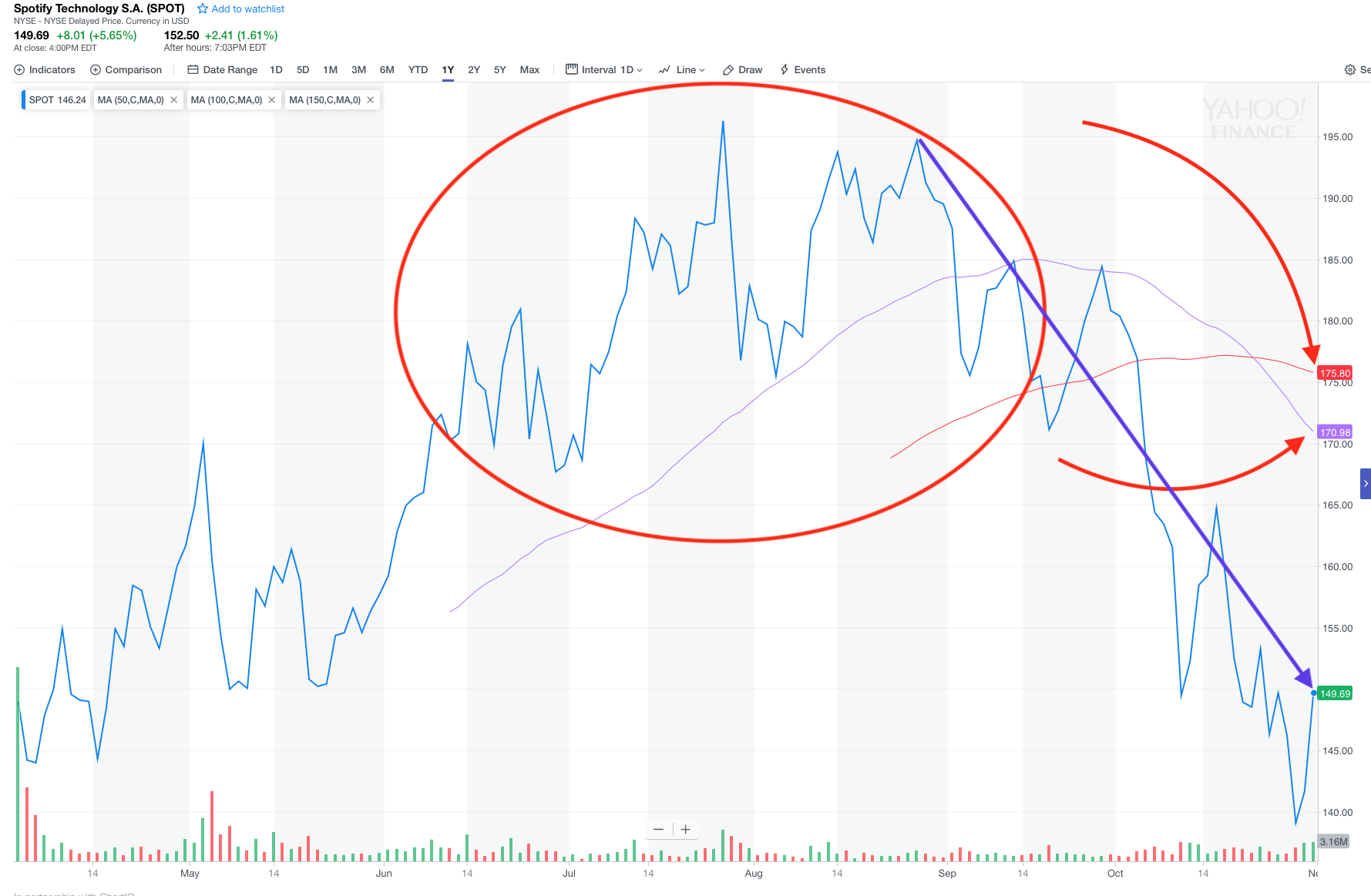
Spot moving averages
SPOT 50 and 100 Day Moving Averages 10-31-18


You have a stock that’s broken through both its 100 and 50 day moving averages to the downside as of yesterday, and so far in today’s action is testing lower lows.  And not surprisingly sank like a stone following a “head and shoulders” top technical chart pattern indicating a potential bearish trend that has now been confirmed (as I began watching in June on Music Tech Policy before the stock gave up almost $50 of its share price).

I guess the MMA safe harbor is priced in.

Keep asking yourself that question:  What would I sell to buy SPOT?  If you’re not an insider, that question will eventually guide you (and the market) to the right share price. That will have nothing to do with Spotify’s royalty payouts, how many floors of World Trade Center it rents, or competition with YouTube or Apple.  Don’t let the analysts (or the company) fool you–although some analyists are starting to face the Spotify reality.

That will be–I would suggest–a problem with the insider-controlled Direct Public Offering structure and the SEC’s decision to allow Spotify to price at a meaninglessly high number.  What goes up on fantasy comes down hard on reality.

Buckle your chin strap.

Five Things Congress Can Do to Stop Tens of Millions of “Address Unknown” NOIs

Copyright reform is on the front burner again after the passing of the  Register of Copyrights Selection and Accountability Act by a vote of 378-48.   But there’s another problem the Congress needs to fix that won’t require legislation in the short run:  The mass filing of tens of millions of “address unknown” notices under the archaic compulsory license for songs.

I’m going to assume that readers know the general background on the millions of “address unknown” NOIs filed with the Copyright Office under a loophole in the Copyright Act (Sec. 115(c)(1)).   If that is Geek to you, see my recent paper on mass NOIs for more complete analysis (or previous posts on MTS for the armchair version of the story.   The first distinction to remember is that we are only concerned in this post with song copyrights and not the sound recording.  This story implicates songwriters and publishers, not artists and record companies, and it only applies to the government’s compulsory license for songs, a uniquely American invention.

In a nutshell, Amazon, Google, Pandora, Spotify and other tech companies are serving on the Copyright Office tens of millions of “address unknown” notices of intention to obtain a compulsory license to make and distribute recordings of certain types of songs.  Under what can only be called a “loophole” in this compulsory license, a service can serve these “address unknown” NOIs on the Copyright Office if the owner is not identifiable in the Copyright Office public records.  The Copyright Office stands in the shoes of the “address unknown” copyright owner to receive and preserve these notices.

On the one hand companies like Amazon, Google, Pandora and Spotify say that they can’t find these millions of song owners, while at the same time at least some of the same companies brag about how comprehensive and expensive their song databases are (like Google’s Content ID) or their agents puff up the agent’s own massively complete song databases as “the worlds largest independent database of music copyright and related business information.”  And yet, these same companies and their agents can’t seem to find songwriters whose names, repertoire and contact information are well known, or whom they already pay through their own systems or through their agent.

The Database Double Loophole Trick

Here’s the loophole.  First, the loophole requires a very narrow reading of Section 115(c)(1) of the Copyright Act, a 40 year old statute being applied to NOIs served at a scale the Congress never intended.  If the song owner isn’t found in the public records of the Copyright Office, even if the digital service or its agent has actual knowledge of the song copyright owner’s whereabouts, the digital service can say they are not required to look further.

Even if you buy into this willful blindness, these digital services may not be looking at the complete public records of the Copyright Office.  The only digitized records of the Copyright Office are from January 1, 1978 forward, and my bet is those easily searchable records are the only records the services consult.  That omits the songs of Duke Ellington, Otis Redding, The Beatles and five Eagles albums not to mention a very large chunk of American culture.

The Copyright Office records from before 1978 are available on paper, so the pre-78 songs are still in the public records (which is what the Congress contemplated in the Copyright Act).

The identifiers are just not “there” if you decide not to look for them.  However, it is not metaphysical, it is metadata that exists in physical form.  This is the “double loophole”.

The Double Triple:  New Releases

Another category of song copyrights that will never be in the public records of the Copyright Office in their initial release window are new releases with recently filed but not yet finalized copyright registrations.  The Copyright Office itself acknowledges that it can take upwards of a year to process new copyright registrations.  This allows “address unknown” filers to bootstrap a free ride on the back of Congress during that one-year period.

No Liability or Royalties Either:  Trebles All Round

Once a company serves the “address unknown” NOI on the Copyright Office, songwriters are arguably compelled by the government to permit the service to use their songs.  Filing the “address unknown” NOI arguably allows the service to avoid liability for infringement and also–adding insult to injury–to avoid paying royalties.  If the NOI is properly filed, of course.

In current practice, a mass “address unknown” NOI is usually a single notice of intention filed with a huge attachment of song titles with the required fields, such as this one Google filed for Sting’s “Fragile”, the anthem of the environmental movement (which was clearly filed incorrectly as the song was registered long ago):

sting-fragile-google-noi

The number of mass “address unknown” NOIs being posted by the Copyright Office on an almost daily basis suggests that tech companies now view mass “address unknown” NOIs as the primary way to put one over on songwriters and the Congress, too.  Companies like Amazon, Spotify, Google, Pandora and others are using this heretofore largely unused loophole on a scale that flies in the face of Chairman Goodlatte’s many hearings in the last session of Congress on updating the Copyright Act.

This “address unknown” practice also undermines the efforts of Chairman Goodlatte and Ranking Member Conyers to modernize the Copyright Office.  Indeed, based on the very lopsided vote on HR 1695 the Register of Copyrights Selection and Accountability Actit is clearly the desire of the overwhelming majority of Members of Congress, too.

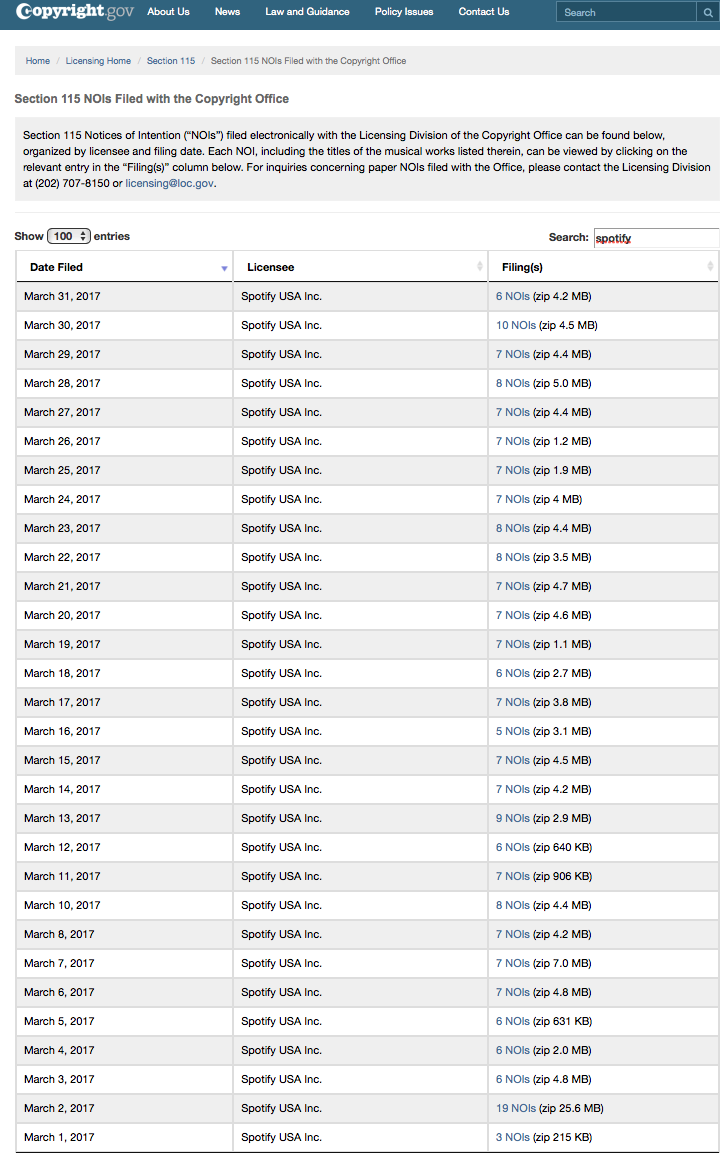
March Spotify NOI Filings

What Can Be Done?

Congress can play a role in in providing immediate relief to songwriters by stopping the mass “address unknown” NOIs or at least requiring the Library of Congress and the Copyright Office to take steps to verify the NOIs are filed correctly.

At the moment, the government takes away property rights from the songwriters by means of the compulsory license without taking even rudimentary steps to assure the public that the “address unknown” NOI process is being implemented correctly and transparently.

Here are five steps the Congress can take to rectify this awful situation.

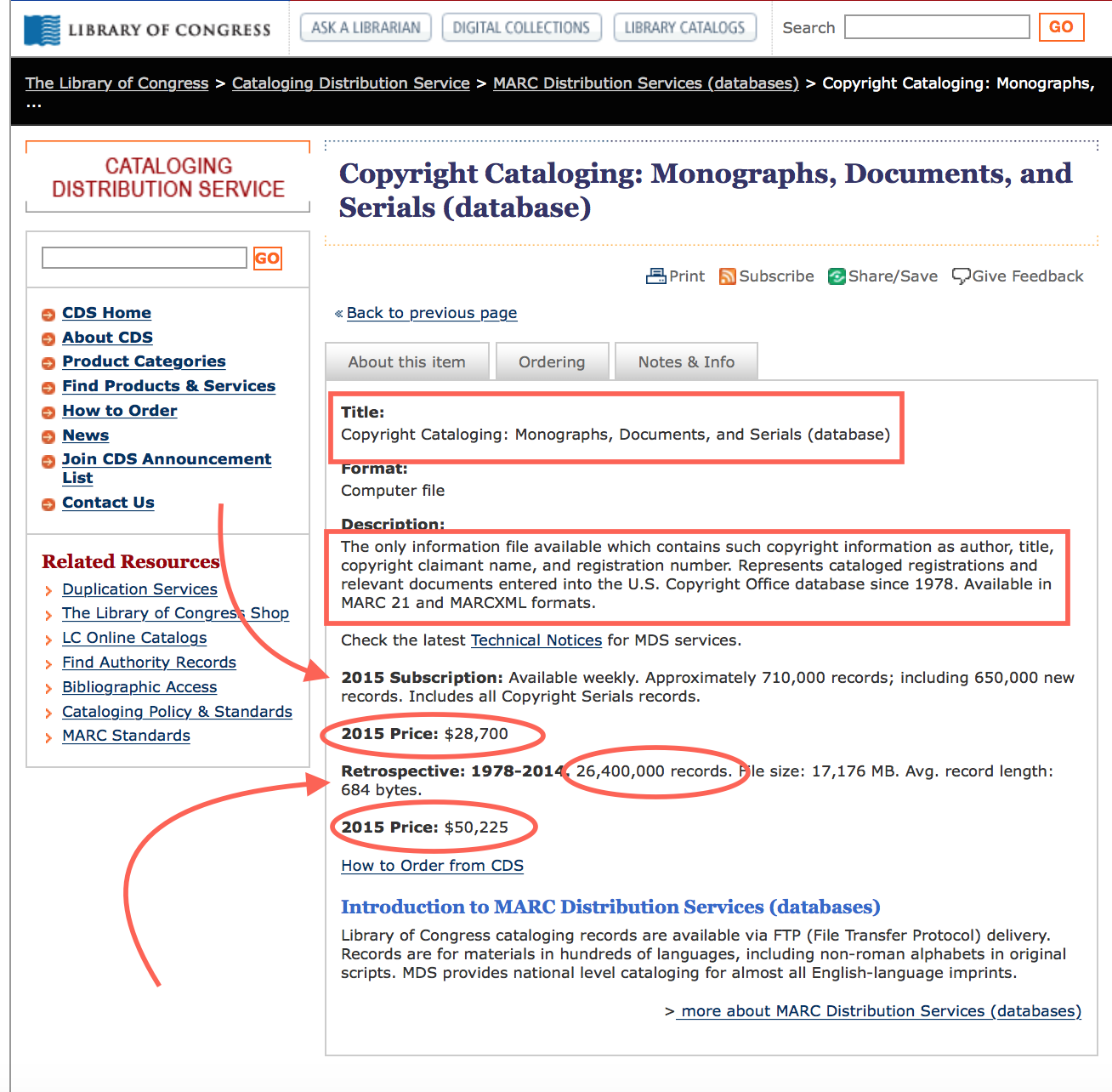
  1.  Stop Selling Incomplete Data:  Congress should instruct the Library of Congress to stop selling the post 1978 database until due diligence can be performed on the database to determine if it is even internally correct.  It appears that many if not all the mass “address unknown” NOI filers use the LOC database to create their NOIs.  It is also highly unlikely that this database will include new releases.  Congress can simply instruct the Librarian to stop selling the database.loc-prices-databases
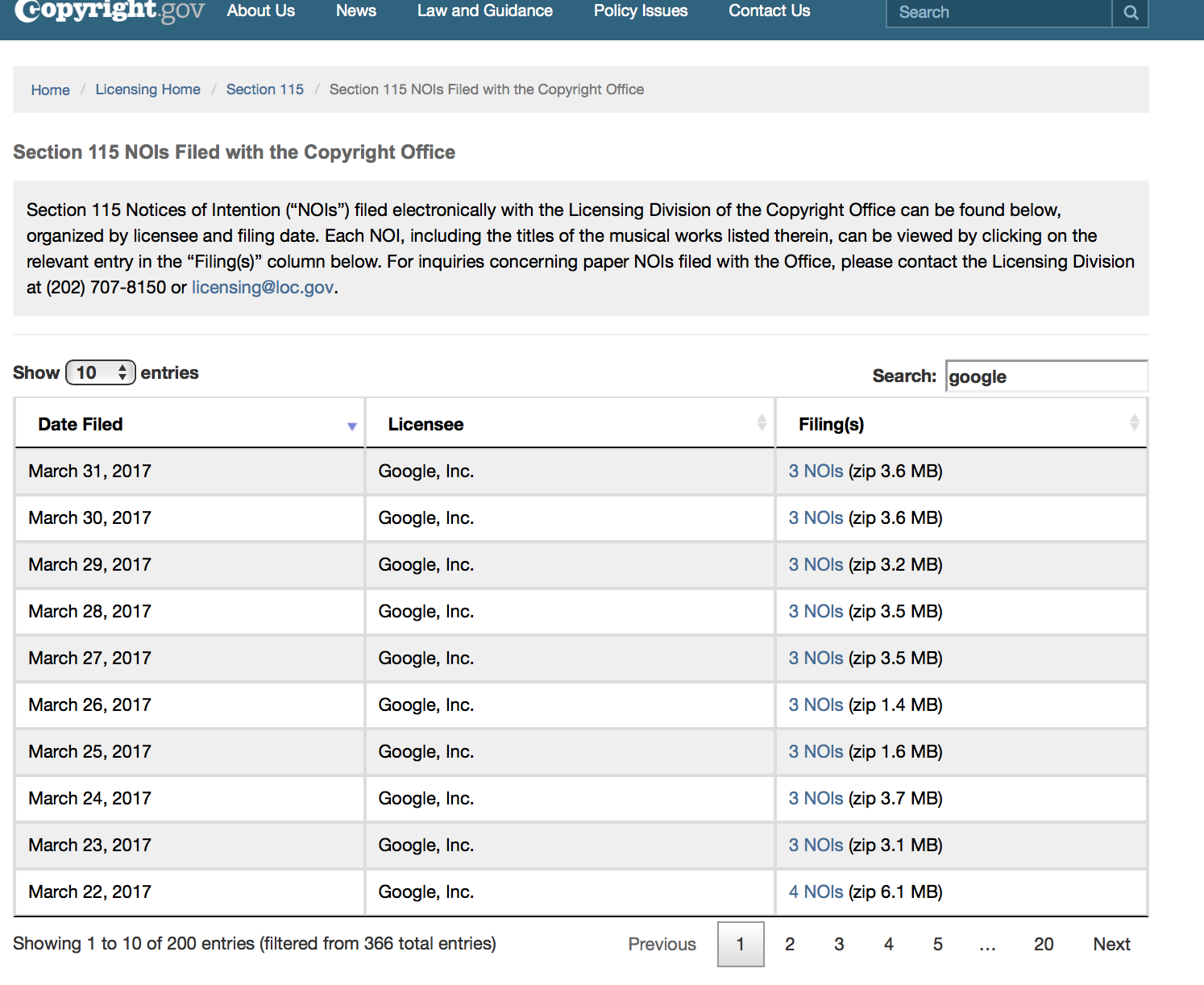
  2.  Stop Accepting “Address Unknown” NOIs With Compressed File Attachments: Congress should instruct the Library of Congress and the Copyright Office to immediately cease accepting “address unknown” NOIs with compressed files as attachments for what appears to be a single NOI.  These compressed files are so large in most cases that songwriter can never uncompress them on a home computer to determine if their songs are subject to “address unknown” NOIs.  Google in particular is a major offender of filing huge compressed files.  Each compressed file contains tens of thousands of song titles.Google March NOIs
  3.  Require Accounting Compliance with Copyright Office Regulations:  Long standing regulations require that anyone relying on an NOI must file mostly and annual statements of account reflecting usage of the songs subject to the NOIs.  The tech companies serving mass NOIs are not rendering these statements and thus fail to comply with the transparency requirements of Copyright Act.  All of the “address unknown” NOIs served during 2016 are out of compliance with the regulations, and all “address unknown” NOIs served in the first quarter of 2017 are likewise out of compliance.  Congress should instruct the Copyright Office to require monthly and annual statements of account be filed with the Copyright Office for anyone who has relied on these NOIs as required by the regulations.  All statements of account should be certified in the normal course as required by the regulations, and made available to the public by posting to the Copyright Office website.
  4. Require the Library of Congress to Create a Searchable Database of NOIs:Congress should instruct the Library of Congress to create a single database maintained online that is maintained by an independent third party and is searchable by songwriters in a manner similar to a state unclaimed property office.  That database needs to be updated on a regular schedule.  Given the size of the compressed files served to date, it is essentially impossible for songwriters to determine if NOIs have been filed on their songs.  This is particularly true as the NOIs are served on an effectively random basis, so even if songwriters were able to search, they would essentially have to search all the time.
  1.  Pay Royalties Into A Permanent Trust Account:  Given that it is highly likely that the mass NOIs filed to date have a significant number of errors, it is also likely that songwriters will become entitled to payment of royalties retroactively if these errors are ever caught.  Therefore, the Congress should require that royalties should be paid to a trust account maintained at the Copyright Office and held in perpetuity like a state unclaimed property office.  Of course, it is equally likely that the song copyright owners will be entitled to terminate any purported license under 17 USC Sec. 115(c)(6).  These payments should be based on actual usage and not black box.  This is another reason why the statements for “address unknown” NOIs should be public.

What started in April 2016 as a trickle of NOIs from a handful of companies has now expanded exponentially.  Based on Rightscorp’s analysis in January 2017, some 30 million “address unknown” NOIs had been filed–and that did not include the dozens of “address unknown” NOIs filed by Spotify in March 2017 alone which themselves likely total over a million songs.

NOI Table
Top Three Services Filing NOIs

April, 2016-January 2017

Number of NOIs Per Service
Amazon Digital Services LLC 19,421,902
Google, Inc. 4,625,521
Pandora Media, Inc. 1,193,346

It is rapidly becoming standard practice for tech companies to try to pull the wool over the eyes of the Congress by leveraging an apparent loophole and they are doing it on a grand scale.

As we have seen with everything else they touch from the DMCA to royalty audits, the tech companies will continue this loophole-seeking behavior until they are forced to stop.  Since no one at the Library of Congress seems to have the appetite to right this wrong, the Congress itself must step in.

Ultimately Congress should fix the loophole through legislation, but in the meantime most of the harms can be corrected overnight by policy changes alone.

How Accurate are Music Subscription Service Subscriber Numbers?

All of you who subscribe to the New York Times, fly Quantas, use any of a number of mobile carriers or who are in the 6th month of your third Spotify 30 day (or 90) free trial may be interested in this post.

According to Billboard in a story titled “Spotify Officially Hits 50 Million Paid Subscribers“, the “official” announcement came from a tweet:

I found this intriguing–how did we go from “Spotify Officially Hits 50 Million Paid Subscribers” in the headline to a tweet that doesn’t really say the same thing?  Maybe like this?

screenshot_20170224-140304

First, what makes a tweet “official”?  Much less “official” totals of “paid subscribers”?  Finding out may be like asking what makes ketchup “fancy”.

w27cz

Newspaper subscriptions have long been verified by a company specializing in verifying circulation.  Television has the Nielsen ratings, music has Soundscan, and so on.  None of these systems are perfect, but they make it harder to outright misrepresent success in a business where frequently the only people who really know how well they are doing are the people who would like you to believe they are doing well.  This is nothing new, it’s as old as moral hazard.

The quest for truth leads one to independent verification services.

spotify-clown-car
A clown car for 6 million streams

Reuters reported the same story with a more subdued headline: “Spotify Says It Reached 50 Million Subscribers“.  A little more factual, a little less Kool Aid.

This is important because I have yet to find anyplace that Spotify actually says the 50 million subscribers were “paid”.  The press leaped to that conclusion, but Spotify did not say that.

And neither does Apple, a company which is already public and has to be careful what they say about the money they are making or not making.  Yet somehow nobody transforms Eddie Cue’s statement that Apple has “well past 20 million subscribers” into an “official” statement implying a verified number of “paid” subs.

Actually–it may well be that there is a significant revenue difference between “paid subscribers” and “subscribers”.  As the Music Industry Blog wrote last year:

[T]here is a more important story here: Spotify’s accelerated growth in Q2 2016 was driven by widespread use of its $0.99 for 3 months promotional offer. Which itself comes on the back of similar offers having supercharged Spotify’s subscriber growth for the last 18 months or so. In short, 9.99 needs to stop being 9.99 in order to appeal to consumers.

As Spotify has been “dominant” in the music subscription business for a while now (and yes, I mean that in an antitrust sense of “dominant”), it seems that it’s high time for someone to independently audit the veracity of the number of their subscribers.

Or would the Securities and Exchange Commission like to rely on a tweet?