“Formal property’s contribution to mankind is not the protection of ownership… Property’s real breakthrough is that it radically improved the flow of communications about assets and their potential.”
Hernando de Soto, The Mystery of Capital.
Musicians and other creators are unfortunately familiar with many efforts by big business to extract the economic value of their authorship through expansive free-riding copyright loopholes that pretend property rights don’t exist. The current AI crisis did not originate with Big Tech—they learned it from Big Radio. I distinctly recall having lunch with a Big Tech Washington lobbyist for XM radio (pre-merger) who had just found out that broadcast radio didn’t pay sound recording performances and wanted that same deal for satellite radio. I had to put the quietus on that pronto. And they didn’t even know how close they came to disaster. Sheesh.
In case you were wondering, Congress modernized copyright law in 1995 through the Digital Performance Right in Sound Recordings Act. The 1995 law created the statutory framework that launched licensed webcasting while preserving the archaic terrestrial radio performance loophole—preserved due to lobbying by Big Radio.
For decades, terrestrial AM/FM broadcasters have relied on a statutory copyright exception that allows them to broadcast sound recordings without compensating the featured artists, session musicians, and backup singers whose performances attract listeners, or the record companies who bear the substantial costs of discovering, recording, marketing, and promoting those works. Despite years of bipartisan efforts to end that free ride through legislation like the American Music Fairness Act (AMFA) and its predecessor bills, broadcasters have vigorously defended the exemption with overwhelming money and utilization of the very broadcast license they abuse to feather their nests. We have put excellent witnesses in front of Congress only to be outspent by smarmy swamp creatures from the National Association of Broadcasters.
AI disputes echo that familiar pattern. In the end, it all comes down to vast wealth accumulated through safe harbors of one kind or another. Instead of relying on a terrestrial performance exemption, AI companies advance absurd interpretations of fair use and text-and-data-mining doctrines to justify the uncompensated use of stolen works for commercial model training “because China.” They use influence peddlers like White House AI Viceroy David Sacks to try to sneak retroactive safe harbors into the law through Congress in the form of groundless federal preemption of state and local regulation or executive orders that are clearly bought and paid for under the guise of “data center factories” which are not factories at all. Although the legal theories differ between AI and broadcasting, the economic consequence is remarkably similar: sweeping commercial enterprises seek to build profitable businesses by lobbying or litigating (two sides of the same King’s shilling) to expand exceptions to the exclusive rights Congress granted creators, while forcing artists, musicians, writers, journalists, film makers and photographers to absorb the resulting loss in value.
That concern is no longer theoretical. In a recent Bloomberg podcast, SoundExchange President and CEO Michael Huppe—whose organization distributes more than $1 billion annually in digital performance royalties derived from rights created by that market-making 1995 legislation—described AI as “something that has a lot of danger, but also a lot of potential.” But he cautioned that “we need to make sure that human creators are protected” and that “there need to be guardrails so that [AI] doesn’t steamroll over the whole creative industry.” I couldn’t agree more. Rather than treating property rights as obstacles to AI, Congress should remember Hernando de Soto’s lesson that clearly defined ownership creates wealth—a principle it proved when licensing sound recordings gave birth to the webcasting industry largely thanks to SoundExchange and the infrastructure it brings to the table.
Huppe’s concerns are rooted in measurable economics rather than speculation. Streaming now accounts for approximately 85% of U.S. recorded music revenue, and streaming services distribute a finite, shared royalty pool among eligible recordings. Huppe noted that some services report receiving roughly 75,000 new recordings every day, with reports suggesting that more than 80% are AI-generated.
Whether those estimates ultimately prove higher or lower, the underlying economic principle is unavoidable: every AI-generated recording entering the marketplace competes for listener attention and, if streamed, competes for a share of the same finite, shared royalty pool. Huppe also warned that AI facilitates streaming fraud, allowing bad actors to generate AI recordings, deploy bots to inflate plays, and “siphon away payment from the pipeline that would otherwise go to real artists and real record labels.” His conclusion was unequivocal: “It’s fraud, basically. Straight-up fraud.”
Moreover, generative AI takes legitimate recorded performances to create competing works substituting for the originals themselves. This economic effect echoes Judge Vince Chhabria’s observations in the Kadrey v. Meta books litigation, where he suggested that flooding markets with AI-generated works competing against originals could constitute the type of market harm that would block a fair use defense to copyright infringement.
The explosion of AI-generated music that Mike Huppe cites therefore provides strong evidence of repeatable and measurable market harm identified by Judge Chhabria. Every AI-generated stream competes for listener attention while simultaneously reducing each human artist’s share of a finite, shared royalty pool. Unlike speculative claims of future injury, this dilution can be observed, quantified, and modeled using actual streaming and royalty distributions.
The economics become even more troubling when combined with large-scale scraping. As we have seen litigated in the cases against Udio, Anthropic and Meta (and I think will continue to see proven through all of the AI models including Suno), AI has trained on enormous quantities of illegally acquired works without obtaining licenses or compensating the creators whose recordings, performances, writings, images, and other expressive works supplied the raw material that makes those models commercially valuable. Sound familiar?
The same creative ecosystem that furnished the training corpus is then required to compete against a cascading and endless supply of AI-generated outputs while receiving no payment for either the training use or the resulting competition. Worse yet, because nothing says freedom like getting away with it, AI platforms connected to Google, Facebook and Amazon are so used to ignoring copyrights in their day jobs that they clearly planned to ignore our rights.
In music, the effect is especially stark: the recordings that taught music-generation systems how to produce theoretically commercially appealing songs also become the works displaced by those outputs in the marketplace. Creators are effectively asked to finance their own displacement. They suffer a double economic injury—first, uncompensated exploitation of their works to build commercial AI systems, and second, measurable erosion of their share of a finite, shared royalty pool as AI-generated recordings compete for the same listeners and revenues that streamers like Spotify seem unable to stop from invading the ecosystem.
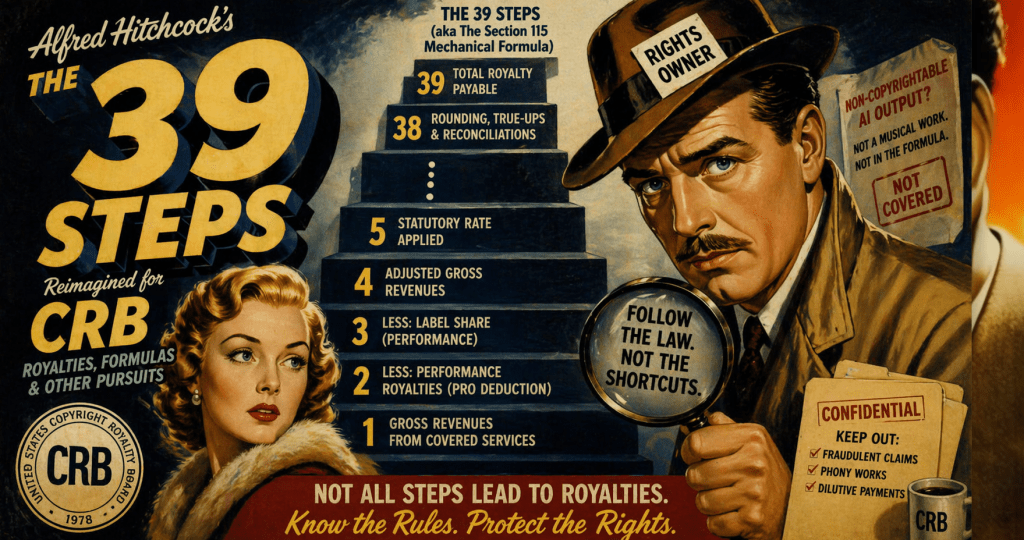
Because of the insane pool allocation formula used for streaming mechanical royalties on interactive services like Spotify, Amazon, Apple and Deezer, songwriters are also subject to the same kind of dilution as artists. Hopefully the Copyright Royalty Judges will address this new humiliation in the current statutory rate proceeding and clearly state that AI works are not eligible for the statutory license under Section 115.
This measurable dilution also helps illustrate the broader market-flooding concern identified by Judge Chhabria. If AI-generated outputs systematically occupy the same commercial markets as human-created works, reducing revenues through sheer volume rather than direct substitution alone, then streaming provides one of the first empirical laboratories for proving market harm for “the effect of the use upon the potential market for or value of the copyrighted work.” Because streaming royalties are transparent, pooled, and data-driven, music offers unusually strong evidence that AI-generated competition can inflict repeatable, measurable, and scalable economic injury. If courts follow Judge Chhabria in recognizing this analysis, the same analytical framework could extend beyond music to books, journalism, visual art, film, software, and other creative industries in which AI-generated outputs compete for the same audiences, revenues, and licensing opportunities as human creators.
Against that backdrop, the American Music Fairness Act is no longer simply a current solution to a decades-old copyright reform proposal. If AI companies are correct that generative AI will place unprecedented pressure on the economics of human creativity, then Congress should strengthen—not further weaken—all of the economic foundations supporting human creators. AMFA would finally require terrestrial broadcasters to compensate featured artists, session musicians, and vocalists for the use of their sound recordings, just as streaming and satellite radio already do. It would also unlock reciprocal foreign performance royalties that American performers currently forfeit because the United States remains an international outlier.
At a moment when AI is intensifying the struggle for creative labor to survive even while platforms seek broad legal exceptions for uncompensated training through lobbying and executive orders, eliminating one of copyright law’s oldest uncompensated uses would send an important signal: the future of artificial intelligence should not be financed by the continued erosion of the livelihoods of human creators.
The AI industry’s habit of predicting existential harm while aggressively commercializing the same technology presents a profound ethical contradiction that Professor Cal Newport calls “doom trolling” in a recent New York Times post. This leads to a conclusion that AI companies cannot credibly claim their technology poses existential risks while continuing to accelerate its commercialization without meaningful restraint.
Newport gives this example reminiscent of my personal favorite, the exploding gas tank in Ford Pintos (not to pick on Ford):
Imagine if the Ford Motor Company put out a report saying that it feared its popular F-150 trucks might soon start bursting into flames, but that there was nothing the company could do about it because automotive technology was too inevitable and important to slow down. You’re probably struggling to picture this scenario because no reasonable consumer product company would ever act like this.
The A.I. companies could start behaving the same way. To do so would require that they stop treating A.I. like some inevitable force that they’re struggling to steward. It’s not. It’s a collection of specific tools that these companies are choosing to design and sell according to specific business plans. Accordingly, they need to talk about their offerings like any other consumer product. This means explaining clearly whom these products are for, justifying their benefits and, critically, taking full responsibility for any harm they might cause. Just because A.I. currently enjoys a high-tech sheen doesn’t make it exceptional with respect to common-sense safety standards.
If these A.I. companies insist on continuing to pretend that they’re merely stoic observers of an unavoidable dystopian future, then perhaps it’s time to force the issue. As consumers, we can refuse to play the doom-trolling game. Next time Anthropic releases a dire report, or Sam Altman’s voice cracks as he imagines the disruption that OpenAI is unleashing, we can pivot back to the pragmatic: “OK, but what benefits am I getting by spending $1,000 a month on tokens?” If they continue to ratchet up the doom, then perhaps it’s time to transform dread into ridicule: The earnest pseudoscience of Anthropic’s white papers already borders on satire. The current zeitgeist surrounding A.I. encourages a fretful submission to these tech leaders, but this could rapidly change.
The AI industry cannot have it both ways. It cannot warn that generative AI will fundamentally transform—or even eliminate—millions of creative jobs while simultaneously insisting that the law should expand uncompensated access to the very works that make those systems possible. If AI companies genuinely believe their own predictions, then the appropriate public policy response is not to weaken copyright, broaden fair use, or create new exceptions for commercial training. It is to reinforce every remaining economic support for human creativity.
The evidence emerging from music streaming already demonstrates why. AI-generated works are not merely theoretical substitutes; they compete for attention, streams, and revenue, measurably reducing each creator’s share of a finite, shared royalty pool. That provides some of the clearest real-world evidence yet of repeatable market harm from generative AI at commercial scale. Congress should take note. The question is no longer whether creators deserve compensation for their work. It is whether the United States will choose to finance the AI economy by systematically eroding the economic incentives that have sustained human creativity for generations—or whether it will insist that technological progress, like every other successful industry before it, pays its own way.
Perhaps the greatest lesson of the American Music Fairness Act is not about radio at all. It is about refusing to repeat yesterday’s policy mistakes in tomorrow’s technology. As Mike Huppe observed on Bloomberg, Congress should not be creating new copyright exceptions while it is still trying to fix old ones. That warning applies with even greater force to artificial intelligence. If policymakers know that generative AI is likely to place extraordinary pressure on the economics of human creativity—as many AI companies themselves readily acknowledge—then the answer cannot be to expand uncompensated uses of creative works in the name of innovation and unintended consequences be damned.
The webcasting revolution showed what Hernando de Soto long argued: respecting property rights doesn’t kill innovation—it gives innovators the legal foundation to build sustainable markets. AMFA is a cautionary tale: a narrow copyright exception adopted decades ago has deprived generations of American performers of compensation and remains difficult to unwind. Congress should learn from that history, not repeat it. The AI economy should be built by paying for the creative works that make it possible and respecting the rights of all creators—not by creating another exception that future generations will spend decades trying to reverse and an entrenched bureaucracy of the richest corporations in commercial history will oppose with all the resources they can muster.