The SXSW–PwC Report Is Polished—But It’s Still a Conference Echo Chamber of an Echo Chamber

The 2026 SXSW–PwC Insights Report is well-written, highly readable, and professionally assembled with lots of graphics. It succeeds at what it sets out to do: synthesize themes from a sprawling, interdisciplinary conference into something digestible for executives and strategists.

But it is important to be clear about what this document actually is—and what it is not.

It is not a study.
It is not an empirical analysis.
And it is certainly not the product of anything resembling peer review.

It is a reflection of conference discourse. And lunches. But at least they don’t mention “because China.”

The missing story: creators and labor

Perhaps the most notable gap—particularly given SXSW’s cultural footprint as a music festival that never paid a musician it couldn’t stiff—is the absence of a meaningful discussion of creators and labor.

Adding insult to injury, the report’s most conspicuous nod to the music business that spawned SXSW is in the report section titled “Replay vs. Breakout Hit,” a cute music metaphor for what is essentially a self-grading exercise. Why are we not surprised. For a conference rooted in the labor and culture of musicians, the report has remarkably little to say about musicians as workers or rights-holders. Or at all. It reads a bit like those tech offices that name their conference rooms after artists while inside those rooms people figure out how to disintermediate, devalue, or extract from the artists themselves. Not mentioning names but their initials are Google.

Technology throughout the report is framed as expanding capability, but not as transferring wealth.

There is little engagement with:
– whether creators are compensated or displaced
– how value flows through AI systems
– the asymmetry between platforms and individuals

This is not a minor omission. It goes to the core of whether the trends being described are sustainable—or extractive.

The “Replay vs. Breakout Hit” page is less a retrospective than a self-grading exercise. It does not test last year’s insights against events or outcomes. It simply shows that if you keep attending the same conference circuit, you can usually hear enough of the same themes to call your prior buzzwords validated.

SXSW sits at the intersection of music, film, and technology. If a report emerging from that environment cannot meaningfully account for creators, it is not just incomplete—it is asking the wrong question.

Start with the source: SXSW is not a neutral environment

The report is based on PwC’s attendance at more than 100 SXSW sessions and conversations with “thought leaders.” That sounds comprehensive, but it also tells you everything you need to know about the limits of the exercise. And that’s a whole lot of lunches.

SXSW—like TED and similar marquee events—is not designed to test ideas. It is designed to showcase them.

Panels are curated. Speakers are selected. Topics are framed in advance. And most importantly, participants are there for a reason: to promote something. A company. A framework. A product. A worldview. And oh, yes. A band.

That doesn’t make the content worthless. But it does mean the incentives are not aligned with truth-seeking.

They are aligned with visibility.

When panels become pitch environments

In practice, this structure often produces what anyone who has spent time in these rooms recognizes immediately: panels that function less as discussions and more as coordinated signaling exercises.

Especially in the tech space, you frequently see:
– Panelists advancing aligned narratives about “inevitable” technological change
– Framing that assumes adoption rather than interrogates the wisdom of adoption
– Soft, non-adversarial questioning that avoids meaningful challenge

And yes, there have long been instances where the “moderator” is not a neutral facilitator at all, but an industry advocate or policy lobbyist shaping the conversation, sometimes with only a token dissenting voice on stage who wasn’t in on the joke and looked confused.

The result is not debate. It is choreography.

Narrative momentum is not economic reality

SXSW is a narrative marketplace. It is very good at surfacing what people are excited about. But more precisely, SXSW is very good at surfacing what people with funding are excited about—which is usually themselves. And also their products and the narratives that make both more valuable. It is also a place where the ability to show up is itself a form of signaling—funding is not just the topic, it is the price of admission. Did I say “themselves”?

That framing matters because it explains why the output looks the way it does. The report is not simply identifying trends—it is reflecting a filtered environment in which access, funding, investment capital, and narrative are tightly intertwined.

The report expands and echoes those incentives like a meta-leave behind pitch sheet.

The SXSW–PwC report does not correct for this dynamic—it amplifies it.

By design, the report takes curated panels featuring self-selected speakers operating in a self-promotional environment
and distills them into “insights” for business leaders.

That is a closed loop.

What emerges is not independent analysis, but a refined version of the same narratives that were already being performed on stage—particularly around AI, innovation, and organizational transformation. Like every other tech-influenced conference.

The AI story: all acceleration, limited friction

Unsurprisingly, AI dominates the report.

The framing is familiar:
– AI as a creative amplifier
– AI as a competitive necessity
– AI as an organizational transformation layer

What is much less developed are the counterweights:
– Substitution effects (especially in creative labor markets)
– Market dilution and “flooding” dynamics
– Legal and regulatory constraints (copyright, privacy, liability)
– The question of who actually captures the value created

Instead, AI is largely treated as a capability problem: How quickly can organizations adopt and deploy? Thinking that leads to statements like this:

Complex stories underperform, while reactive, emotionally charged content thrives—and bad actors reverse-engineer those dynamics to move from the margins to the mainstream. Compounding the problem, under-resourced newsrooms are losing experienced journalists needed to maintain editorial standards, leaving the information vacuum to be filled by algorithmically optimized noise.

Yes, experienced journalists are just up and leaving, wowza. What’s the world coming to? Any interest in connecting some dots there, PwC lunchers?

Not only does the report not even dig an inch deep into any issue involving labor, or question the bargaining leverage that AI confers on employers much less ask who benefits, who loses, and under what terms?

“Act now or fall behind” is not analysis. Like many consulting-adjacent outputs, the report leans heavily on urgency. But these claims are not tied to measurable benchmarks or falsifiable outcomes.

One More Thing

The real issue with reports like this is not that they are wrong.

It is that they are produced within an environment where skepticism is disincentivized and narratives are shaped before the conversation even begins.

The SXSW–PwC report captures that environment faithfully. But it does not escape it.

And in that sense, it perfectly illustrates why you don’t turn to a firm like PwC to analyze creators—they’re looking through the wrong lens from the start. The report shows little evidence that anyone with direct experience representing creators was meaningfully involved in reviewing it.

To be clear, this is not inherently a flaw. SXSW has hosted genuinely thoughtful and introspective panels, alongside plenty of circular admiration society panels as well. But no one has ever suggested that polling those panels would produce anything resembling decision-maker work product. And, to be fair, bravo to the PwC employees who managed to get their trip expensed to talk their book. That’s the true spirit of SXSW.
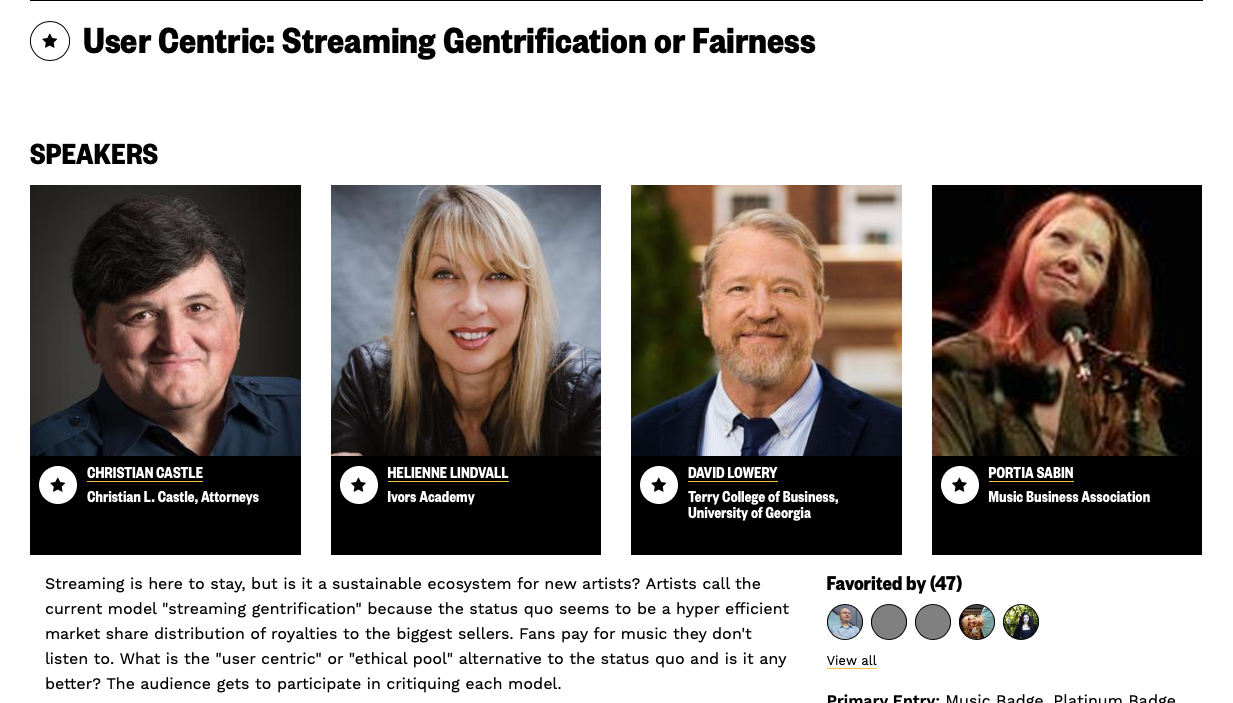


Save the Date: User Centric: Streaming Gentrification or Fairness at SXSW

I’m pleased to be moderating a panel on user-centric streaming royalties with some of the smartest people in the music business at SXSW on Thursday, March 19 at 3:30.  Helienne Lindvall from Ivors Academy, David Lowery of Cracker and Camper Van Beethoven and Portia Sabin from the Music Business Association will join me in a discussion of this important topic that seems to pick up support daily.

Please put us on your calendar if you’re coming to Austin for the conference!  We really want this one to be collaborative with the audience.  Watch this space for further updates.  If you are new to the topic, a good place to start is the “ethical pool” post from last year.

SXSW User Centric
https://schedule.sxsw.com/2020/events/PP103941

YouTube Revenues Explainer

I had the good fortune to participate in a SXSW panel about the mechanics of YouTube revenues.  If I say so myself, it was a wonderful panel with some deep expertise (“Stop Complaining and Start Monetizing“).  There was a real interest in the audience about the mechanics of the rights involved and the revenues paid.

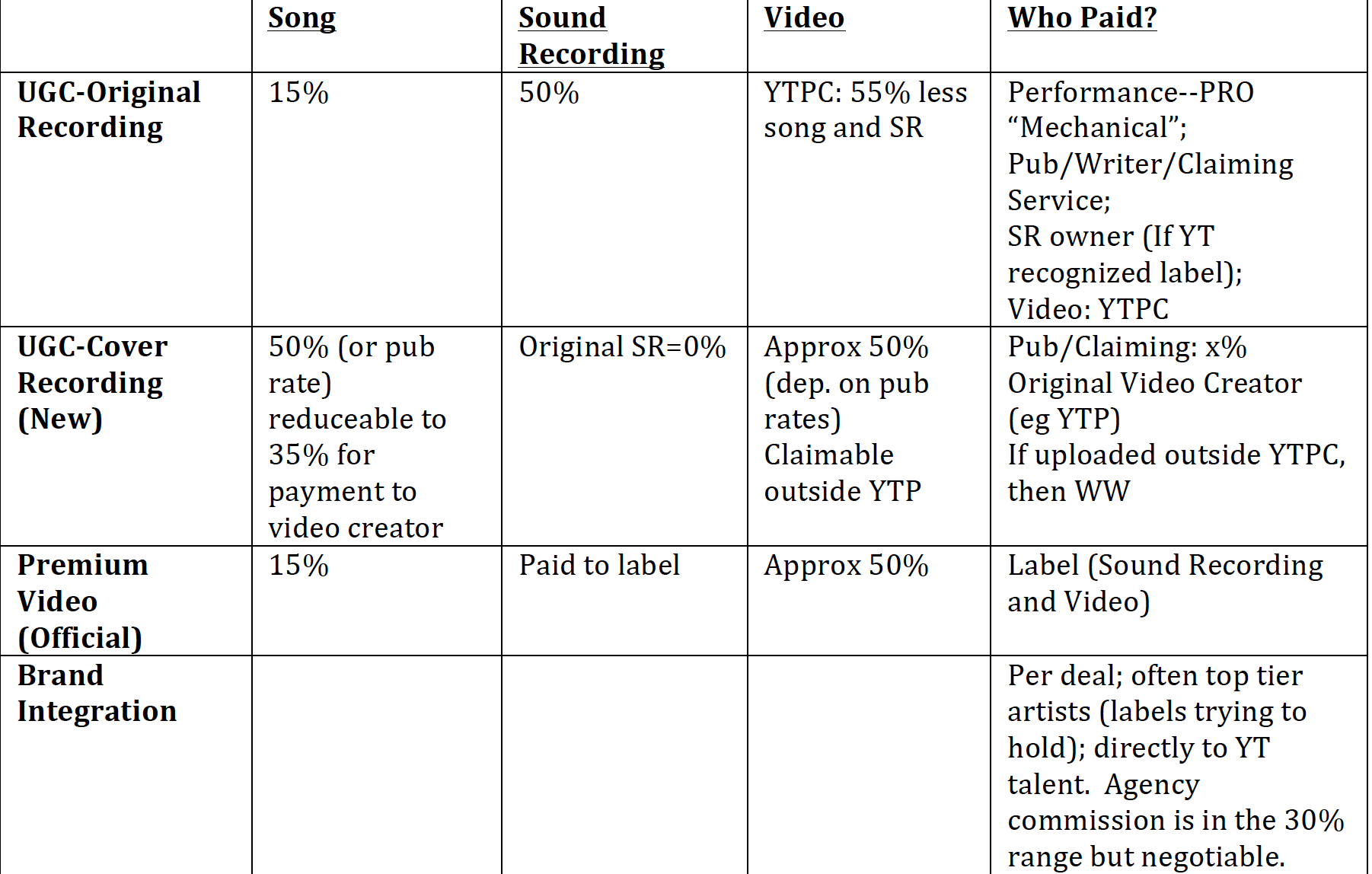
If you have that same interest and you weren’t able to go to SXSW, here’s a basic chart of revenue splits that may help you:

YouTube Chart

Source: Billboard

YTP, YTPC= “YouTube Partner“, “YouTube Partner Channel”
SR= Sound Recording
WW= “Wild West” meaning no particular rule.

Notice that the basic categories are song, sound recording and video which track the main three copyright categories of musical work, sound recording and audiovisual work.

The percentages refer to shares of “Net Ad Revenue” often defined as:

“Net Ad Revenues” means all gross revenues recognized by YouTube attributable to any sponsorship of or advertising displayed on, incorporated in, streamed from and/or otherwise presented in or in conjunction with any User Video displayed on a Covered Service including, without limitation, banner advertisements, synchronized banner advertisements, co-ads, in-stream advertising, pre-roll advertising, post-roll advertising, video player branding, and companion ads, less ten percent (10%) of such gross revenues for operating costs, including bandwidth and third-party (affiliated or unaffiliated) advertising fees. Net Ad Revenues excludes any e-commerce referral fees received by YouTube from “buy buttons” or “buy links” on the Covered Services that facilitate recorded music “upsells” when a Publisher separately receives payment from a third party in connection with such an upsell (e.g., royalties for a CD or sheet music sale); provided, however, for the avoidance of doubt, that such exclusion does not extend to (a) advertising of the type described in the first sentence of this Section for recorded music products, the revenues from which shall be included in Net Ad Revenues; and (b) all other types of e-commerce referral fees and revenues, which shall be included in Net Ad Revenues.

One key component of your YouTube earnings is the “CPM” paid by advertisers to Google.  Even if you have the right to audit YouTube (which few do), it is highly unlikely that you will ever be able to determine what the CPM is that Google uses to pay you on YouTube.  Multichannel networks (“MCNs”) like Machinima have reportedly tied creators to CPMs that were well below market, particularly considering that the highest CPMs on YouTube are often associated with exactly the kind of talent most frequently signed to an MCN.

“Official” or “Premium” Videos

When a label uploads an “official” music video on YouTube or Vevo, the video has higher production values than UGC and is usually supported by a sustained marketing effort outside of YouTube that drives traffic to the site.  If the premium video appears on Vevo, then 100% of the royalty is paid to the label, which in turn has licenses from the publishers for the song.  If the video is on YouTube proper, then the label’s share is reduced by the publisher royalty, often around 15% of net ad revenue.

Claiming and YouTube’s Content Management System (“CMS”)

Because of a combination of YouTube’s monopoly position in the market, Google’s controversial reliance on the notice and takedown provisions of the Copyright Act and its sheer litigation muscle, YouTube will let anyone upload anything also known as “user generated content” or “UGC”.  If you have access to YouTube’s “Content Management System” or “CMS” you have the chance to block UGC through YouTube’s “Content ID” fingerprinting tool.

Compared to the massive volume of videos uploaded to YouTube, a very, very small percentage of copyright owners have direct access to Content ID.  According to YouTube:

YouTube only grants Content ID to copyright owners who meet specific criteria. To be approved, they must own exclusive rights to a substantial body of original material that is frequently uploaded by the YouTube user community.

Participating in Content ID allows you to help YouTube create a vast and valuable library of reference versions of  your works.  (YouTube does not compensate you for participating in Content ID.)  Rightsholders usually participate in Content ID for two reasons which are not mutually exclusive:  Blocking or “monetizing”.  Monetizing means that you give YouTube permission to sell advertising against your works.  Naturally, YouTube hopes you will choose to monetize because over 90% of Google’s revenue comes from selling advertising online.

YouTube creates a reference version of your work in the form of a “fingerprint” (a psychoacoustic technique that has long been in use by the U.S. Navy among others to distinguish sound patterns–see Jonesy in The Hunt for Red October). A fingerprint is a mathematical rendering of the waveform of an audio file that essentially reduces a sound recording to a kind of hash that makes comparing fingerprints quicker and more accurate.

YouTube maps the reference fingerprint to other identifiers such as the International Standard Recording Code for sound recordings, song title, artist name and copyright owners for all of the above including song splits in many cases.  When a work is in the Content ID system, YouTube will compare an uploaded video to the Content ID database reference fingerprint and most of the time will follow the rules established by the copyright owner to block or monetize (often called “match policies“).  If the match is done before the UGC video is uploaded, then it won’t go live, and if the match is done after it is live, then the users will see one of YouTube’s controversial messages saying the file is blocked due to a claim by copyright owner X.

What this boils down to is that if you don’t have a label or publisher, you will need to go to a claiming service like Adshare, The Collective or Onramp in order to get access to CMS and Content ID in order to monetize your works outside of a YouTube Partner Channel (which is done through an Adsense account associated with your YouTube Partner account).  If you have a label, publisher or claiming service, then all of these entities should have access to CMS and Content ID and will be able to claim your songs, sound recordings or videos and monetize them if you wish.

Deciding if Monetization is Right For You

If you’re familiar with term recording artist agreements or publishing agreements (or what is normally called a “record deal” or “publishing deal”), you’ll probably remember negotiating “marketing restrictions” involving the use of your recording or song in advertising.  Those clauses usually restrict the use of your works in political ads, certain kinds of products (firearms, tobacco for example), or more artist-specific restrictions.  There are also restrictions on the kinds of movies or television programs (even videogames) in which your works can be used.

If you allow your work to be used in UGC and you elect to monetize, you can just forget all that on YouTube.  “UGC” includes just about anything you can imagine short of explicit pornography, but would include, for example, sex tourist home movies, jihadi recruiting videos (although “songs” are unlikely to appear there), hate speech and the like.  All of those are on YouTube and frequently are not behind any kind of age restriction wall.

The ads that get served as preroll for these videos are themselves often unsavory.  For example, Google serves ads for “dating” sites that are in categories frequently identified as thinly disguised human trafficking operations.  There are ways to block these particular uses if you have access to CMS but due to YouTube’s “catch me if you can” business practices, you may have to spend the time to track down each use which otherwise can stay on YouTube for months or years.

Winning the Lottery

We often hear about “YouTube stars” with elite channels (1 million plus subscribers) who are very well compensated.  The source of this high level of compensation is rarely limited to advertising revenue.  Most of the time, their ad revenue is salted with a high number of payments for what are essentially sponsorships, endorsements or product placements, often called “brand integrations“.

In the music and movie businesses, the term “star” is usually reserved for a relatively small group of performers who have demonstrated ability over time to reach a large audience, often a global audience.  YouTube “stars” may have large YouTube communities and may be able to introduce products to fans on YouTube, but whether that will hold up on YouTube over time or translate to other platforms remains to be seen in most cases.

It is also important to realize that advertising is a highly regulated business, particularly when it comes to false or deceptive advertising that is regulated by the Federal Trade Commission.  Machinima has just entered a 20 year consent decree with the FTC to settle claims that it misled consumers by passing off paid endorsers as independent reviewers.  Given that Machinima and other MCNs are supposed to protect their talent from such missteps suggests that YouTube stars may well have more to watch out for on YouTube than do recording artists or songwriters on record labels or music publishers.

Online Advertising in Decline

Whether it is ubiquitous ad blocking software, “do not track” settings on browsers, or distrust of advertisers, online advertising is in decline.  Like a ship that is sinking very slowly, it is sometimes difficult to tell if you’re really lower in the water, or if that was just a wave.  And remember, over 90% of Google’s revenues come from online advertising, moonshots notwithstanding.

If the online advertising ship really does sink, all the driverless cars, military robots and Google Glass will not save Google or YouTube.  That’s something to keep in mind when you agree to participate in the YouTube monetization game.