The AI moratorium fight was never really about “innovation.” It was about preemption. More specifically, it was about what might be called federally guaranteed financial preemption.
That phrase matters because the walk-back campaign around the original proposal has become almost surreal. After backlash exploded over the broad federal effort to block state and local AI regulation, supporters suddenly insisted nobody was trying to force unwanted data centers, transmission lines, substations, gas plants, or hyperscale industrial infrastructure onto communities that did not want them.
Technically, that is true. Washington does not necessarily need to directly order a county commission to approve a data center. It can accomplish much the same thing by structuring the financial system around the assumption that the buildout will occur.
That is the trick.
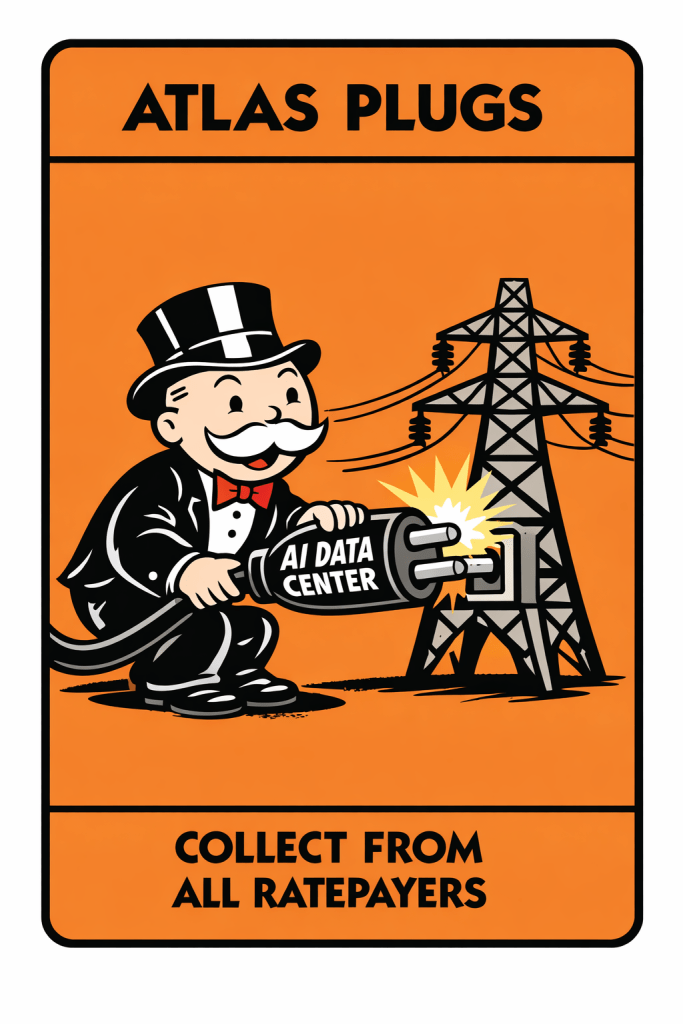
David Sacks’ original moratorium language he stuck in the One Big Beautiful Bill Act reportedly reached not only states but “political subdivisions” as well. That means cities, counties, municipalities, and local authorities. The proposal was not merely about preventing fifty different state AI laws. It threatened to freeze local democratic responses before they could harden into enforceable policy. (And of course there was always a whiff of 5th Amendment taking about the whole doomed process.)
Then came the backlash. Suddenly the rhetoric softened into something more comforting: We just need one national framework. We are not trying to override local control. We are not trying to force data centers on anyone. But that framing ignores how infrastructure power actually works in the United States. You do not need formal federal commands if you can create overwhelming financial momentum.
Suppose the federal government provides taxpayer-backed loan guarantees for utility expansion tied to AI growth forecasts. Utilities then build new generation, transmission, substations, and grid upgrades designed around hyperscale demand projections. State utility commissions approve cost recovery. Transmission planners treat the load forecasts as inevitable. Investors price future growth into regional infrastructure decisions.
At that point, local communities are no longer arguing with a speculative proposal. They are arguing with a federally supported capital structure. That’s much harder to control.
The county commissioner is suddenly told: The transmission line is already planned. The utility already committed the generation. The state already approved portions of the recovery mechanism. The jobs are supposedly coming. The tax base is supposedly coming. The grid supposedly depends on it.
See, it’s magic. Nobody “forced” anything. Whatever were you thinking?

The machinery simply narrowed the realistic range of outcomes. That is federally guaranteed financial preemption.
And it matters because the economics of AI infrastructure are unusually fragile beneath the surface confidence. Data centers are not shopping centers. They are highly specialized industrial assets tied to assumptions about compute demand, electricity pricing, capital availability, chip supply, and continued investor faith in the AI growth curve.
Much of the current buildout depends on debt markets behaving rationally indefinitely.
That may not happen.
If AI demand softens, if monetization disappoints, if venture funding tightens, or if hyperscalers pull back from aggressive expansion schedules, communities may discover they absorbed the physical consequences of a speculative infrastructure cycle they never fully controlled in the first place.
And then comes the final insult in the “local choice” narrative.
Communities remain theoretically free to say no before the infrastructure becomes politically inevitable. They also remain theoretically free to clean up the wreckage after failure.
That means: condemnation fights, stranded industrial facilities, utility disputes, ratepayer battles, bondholder litigation, abandoned transmission corridors, water conflicts, and enormous demolition costs.
The same officials who insisted nobody forced anything can simply shrug and say: “Well, local communities always retained sovereignty.”
This is why local opposition has accelerated so dramatically across the country. Residents increasingly understand that hyperscale AI infrastructure is not an abstract software issue. It is physical industrial policy: land, water, electricity, noise, substations, transmission lines, tax incentives, utility rate structures, and debt.
The fight stopped being theoretical once people realized they were not debating apps. They were debating permanent industrial transformation of their communities.
That is also why the original AI moratorium language frightened so many people once they read it carefully. It was not merely a debate about chatbot regulation or algorithmic bias. It looked increasingly like a mechanism for suppressing state and local resistance before communities fully understood the infrastructure consequences of the AI buildout itself.
And that may explain why the rhetoric shifted so quickly after public scrutiny intensified.
Because once people understand the difference between legal preemption and financial preemption, the conversation changes entirely.
The federal government does not always need to formally eliminate local authority. Sometimes it only needs to guarantee enough money that resistance becomes structurally difficult.
That is a far more sophisticated form of power.
And a far more dangerous one,