Chronology: The Week in Review: Could Spotify Extend Stream Discrimination to Songs, the No AI Fraud Act, Chairman Issa Has Questions on MLC Investment Policy

Spotify has announced they are “Modernizing Our Royalty System.” Beware of geeks bearing “modernization”–that almost always means they get what they want to your disadvantage. Also sounds like yet another safe harbor. At a minimum, they are demonstrating the usual lack of understanding of the delicate balance of the music business they now control. But if they can convince you not to object, then they get away with it.

Don’t let them.

An Attack on Property Rights

There’s some serious questions about whether Spotify has the right to unilaterally change the way it counts royalty-bearing streams and to encroach on the private property rights of artists. 

Here’s their plan: Evidently the plan is to only pay on streams over 1,000 per song accruing during the previous 12 months. I seriously doubt that they can engage in this terribly modern “stream discrimination” in a way that doesn’t breach any negotiated direct license with a minimum guarantee (if not others). 

That doubt also leads me to think that Spotify’s unilateral change in “royalty policy” (whatever that is) is unlikely to affect everyone the same. Taking a page from 1984 newspeakers, Spotify calls this discrimination policy “Track Monetization Eligibility”. It’s not discrimination, you see, it’s “eligibility”, a whole new thing. Kind of like war is peace, right? Or bouillabaisse.

According to Spotify’s own announcement this proposed change is not an increase in the total royalty pool that Spotify pays out (God forbid the famous “pie” should actually grow): ”There is no change to the size of the music royalty pool being paid out to rights holders from Spotify; we will simply use the tens of millions of dollars annually [of your money] to increase the payments to all eligible tracks, rather than spreading it out into $0.03 payments [that we currently owe you].” 

Yep, you won’t even miss it, and you should sacrifice for all those deserving artists who are more eligible than you. They are not growing the pie, they are shifting money around–rearranging the deck chairs.

Spotify’s Need for Living Space

So why is Spotify doing this to you? The simple answer is the same reason monopolists always use: they need living space for Greater Spotify. Or more simply, because they can, or they can try. They’ll tell you it’s to address “streaming fraud” but there are a lot more direct ways to address streaming fraud such as establishing a simple “know your vendor” policy, or a simple pruning policy similar to that established by record companies to cut out low-sellers (excluding classical and instrumental jazz). But that would require Spotify to get real about their growth rates and be honest with their shareholders and partners. Based on the way Spotify treated the country of Uruguay, they are more interested in espoliating a country’s cultural resources than they are in fairly compensating musicians.

Of course, they won’t tell you that side of the story. They won’t even tell you if certain genres or languages will be more impacted than others (like the way labels protected classical and instrumental jazz from getting cut out measured by pop standards). Here’s their explanation:

It’s more impactful [says who?] for these tens of millions of dollars per year to increase payments to those most dependent on streaming revenue — rather than being spread out in tiny payments that typically don’t even reach an artist (as they do not surpass distributors’ minimum payout thresholds). 99.5% of all streams are of tracks that have at least 1,000 annual streams, and each of those tracks will earn more under this policy.

This reference to “minimum payout thresholds” is a very Spotifyesque twisting of a generalization wrapped in cross reference inside of spin. Because of the tiny sums Spotify pays artists due to the insane “big pool” or “market centric” royalty model that made Spotify rich, extremely low royalties make payment a challenge. 

Plus, if they want to make allegations about third party distributors, they should say which distributors they are speaking of and cite directly to specific terms and conditions of those services. We can’t ask these anonymous distributors about their policies if we don’t know who they are. 

What’s more likely is that tech platforms like PayPal stack up transaction fees to make the payment cost more than the royalty paid. Of course, you could probably say that about all streaming if you calculate the cost of accounting on a per stream basis, but that’s a different conversation.

So Spotify wants you to ignore the fact that they impose this “market centric” royalty rate that pays you bupkis in the first place. Since your distributor holds the tiny slivers of money anyway, Spotify just won’t pay you at all. It’s all the same to you, right? You weren’t getting paid anyway, so Spotify will just give your money to these other artists who didn’t ask for it and probably wouldn’t want it if you asked them.

There is a narrative going around that somehow the major labels are behind this. I seriously doubt it–if they ever got caught with their fingers in the cookie jar on this scam, would it be worth the pittance that they will end up getting in pocket after all mouths are fed? The scam is also 180 out from Lucian Grange’s call for artist centric royalty rates, so as a matter of policy it’s inconsistent with at least Universal’s stated goals. So I’d be careful about buying into that theory without some proof.

What About Mechanical Royalties?

What’s interesting about this scam is that switching to Spotify’s obligations on the song side, the accounting rules for mechanical royalties say (37 CFR § 210.6(g)(6) for those reading along at home) seem to contradict the very suckers deal that Spotify is cramming down on the recording side:

Royalties under 17 U.S.C. 115 shall not be considered payable, and no Monthly Statement of Account shall be required, until the compulsory licensee’s [i.e., Spotify’s] cumulative unpaid royalties for the copyright owner equal at least one cent. Moreover, in any case in which the cumulative unpaid royalties under 17 U.S.C. 115 that would otherwise be payable by the compulsory licensee to the copyright owner are less than $5, and the copyright owner has not notified the compulsory licensee in writing that it wishes to receive Monthly Statements of Account reflecting payments of less than $5, the compulsory licensee may choose to defer the payment date for such royalties and provide no Monthly Statements of Account until the earlier of the time for rendering the Monthly Statement of Account for the month in which the compulsory licensee’s cumulative unpaid royalties under section 17 U.S.C. 115 for the copyright owner exceed $5 or the time for rendering the Annual Statement of Account, at which time the compulsory licensee may provide one statement and payment covering the entire period for which royalty payments were deferred.

Much has been made of the fact that Spotify may think it can unilaterally change its obligations to pay sound recording royalties, but they still have to pay mechanicals because of the statute. And when they pay mechanicals, the accounting rules have some pretty low thresholds that require them to pay small amounts. This seems to be the very issue they are criticizing with their proposed change in “royalty policy.”

But remember that the only reason that Spotify has to pay mechanical royalties on the stream discrimination is because they haven’t managed to get that free ride inserted into the mechanical royalty rates alongside all the other safe harbors and goodies they seem to have bought for their payment of historical black box.

So I would expect that Spotify will show up at the Copyright Royalty Board for Phonorecords V and insist on a safe harbor to enshrine stream discrimination into the Rube Goldberg streaming mechanical royalty rates. After all, controlled compositions are only paid on royalty bearing sales, right? And since it seems like they get everything else they want, everyone will roll over and give this to them, too. Then the statutory mechanical will give them protection.

To Each According to Their Needs

Personally, I have an issue with any exception that results in any artist being forced to accept a royalty free deal. Plus, it seems like what should be happening here is that underperforming tracks get dropped, but that doesn’t support the narrative that all the world’s music is on offer. Just not paid for.

Is it a lot of money to any one person? Not really, but it’s obviously enough money to make the exercise worthwhile to Spotify. And notice that they haven’t really told you how much money is involved. It may be that Spotify isn’t holding back any small payments from distributors if all payments are aggregated. But either way it does seem like this new new thing should start with a clean slate–and all accrued royalties should be paid.

This idea that you should be forced to give up any income at all for the greater good of someone else is kind of an odd way of thinking. Or as they say back in the home country, from each according to their ability and to each according to their needs. And you don’t really need the money, do you?

By the way, can you break a $20?

The NO AI Fraud Act

Thanks to U.S. Representatives Salazar and Dean, there’s an effort underway to limit Big Tech’s AI rampage just in time for Davos. (Remember, the AI bubble got started at last year’s World Economic Forum Winter Games in Davos, Switzerland).

Chairman Issa Questions MLC’s Secretive Investment Policy for Hundreds of Millions in Black Box

As we’ve noted a few times, the MLC has a nontransparent–some might say “secretive”–investment policy that has the effect of a government rule. This has caught the attention of Chairman Darrell Issa and Rep. Ben Cline at a recent House oversight hearing. Chairman Issa asked for more information about the investment policy in follow-up “questions for the record” directed to MLC CEO Kris Ahrend. It’s worth getting smart about what the MLC is up to in advance of the upcoming “redesignation” proceeding at the Copyright Office. We all know the decision is cooked and scammed already as part of the Harry Fox Preservation Act (AKA Title I of the MMA), but it will be interesting to see if anyone actually cares and the investment policy is a perfect example. It will also be interesting to see which Copyright Office examiner goes to work for one of the DiMA companies after the redesignation as is their tradition.

Should the Compulsory License be Re-Upped?

[This post first appeared on MusicTechPolicy]

The wisest of those among you learn to read your portents well
There’s no need to hurry, it’s all downhill to Hell…

Don’t Stand Still, written by The Original Snakeboy, performed by Guy Forsyth

Congress is considering whether to renew The MLC, Inc.‘s designation as the mechanical licensing collective. If that sentence seems contradictory, remember those are two different things: the mechanical licensing collective is the statutory body that administers the compulsory license under Section 115. The MLC, Inc. is the private company that was “designated” by Congress through its Copyright Office to do the work of the mechanical licensing collective. This is like the form of a body that performs a function (the mechanical licensing collective) and having to animate that form with actual humans (The MLC, Inc.), kind of like Plato’s allegory of the cave, shadows on the wall being what they are.

Congress reviews the work product of The MLC, Inc. every five years (17 USC §115(d)(3)(B)(ii)) to decide if The MLC, Inc. should be allowed to continue another five years. In its recent guidance to The MLC, Inc. about artificial intelligence, the Copyright Office correctly took pains to make that distinction in a footnote (footnote 2 to be precise. Remember–always read the footnotes, it’s often where the action is.). This is why it is important that we be clear that The MLC, Inc. does not “own” the data it collects (and that HFA as its vendor doesn’t own it either, a point I raised to Spotify’s lobbyist several years ago). Although it may be a blessing if Congress fired The MLC, Inc. and the new collective had to start from scratch.

But Congress likely would only re-up The MLC, Inc. if it had already decided to extend the statutory license and all its cumbersome and byzantine procedures, proceedings and prohibitions on the freedom of songwriters to collectively bargain. Not to mention an extraordinarily huge thumbs down on the scales in favor of the music user and against the interest of the songwriters. The compulsory license is so labyrinthine and Kafka-esque it is actually an insult to Byzantium, but that’s another story.

Rather than just deciding about who is going to get the job of administering the revenues for every songwriter in the world, maybe there should be a vote. Particularly because songwriters cannot be members of the mechanical licensing collective as currently operated. Congress did not ask songwriters what they thought when the whole mechanical licensing scheme was established, so how about now?

Before the Congress decides to continue The MLC, Inc. many believe strongly that the body should reconsider the compulsory license itself. It is the compulsory license that is the real issue that plagues songwriters and blocks a free market. The compulsory license really has passed its sell by date and it’s pretty easy to understand why its gone so sour. Eliminating the Section 115 license will have many implications and we should tread carefully, but purposefully.

Party Like it’s 1909

First of all, consider the actual history of the compulsory license. It’s over 100 years old, and it was established at a time, believe it or not, when the goal of Congress was to even the playing field between, music users and copyright owners. They were worried about music users being hard done by because of the anticompetitive efforts of songwriters and copyright owners. As the late Register Marybeth Peters told Congress, when Congress created the exclusive right to control reproduction and distribution in 1909, “…due to concerns about potential monopolistic behavior [by the copyright owners], Congress also created a compulsory license to allow anyone to make and distribute a mechanical reproduction of a nondramatic musical work without the consent of the copyright owner provided that the person adhered to the provisions of the license, most notably paying a statutorily established royalty to the copyright owner.”

Well, that ship has sailed, don’t you think? 

This is kind of incredible when you think about it today because the biggest users of the compulsory license are those who torture the bejesus out of songwriters by conducting lawfare at the Copyright Royalty Board–the richest corporations in commercial history that dominate practically every moment of American life. In fact, the statutory license was hardly used at all before these fictional persons arrived on the scene and have been on a decades-long crusade to hack the Copyright Act through lawfare ever since. This is particularly true since about 2007 when Big Tech discovered Section 115. (And they’re about to do it again with AI–first they send the missionaries.)

If the purpose of the statutory scheme was to create a win-win situation that floats all boats, you would have expected to see songwriters profiting like never before, right? If the compulsory was so great, what we really needed was for everyone to use Section 115, right? Actually, the opposite has happened, even with decades of price fixing at 2¢ by the federal government. When hardly anyone used the compulsory license, songwriters prospered. When its use became widespread, songwriters suffered, and suffered badly.

Songwriters have been relegated to the bottom of the pile in compensation, a sure sign of no leverage because whatever leverage songwriters may have is taken–there’s that word again–by the compulsory license. I don’t think Google, a revanchist Microsoft, Apple, Amazon or Spotify need any protection from the anticompetitive efforts of songwriters. Google, Amazon, Apple, Microsoft, Spotify are only worried about “monopolistic behavior” when one of them does it to one of the others. The Five Families would tell you its nothing personal, it’s just business. 

Yet these corporate neo-colonialists would have you believe that the first thing that happens when the writing room door closes is that songwriters collude against them. (Sounding very much like the Radio Music Licensing Committee–so similar it makes you wonder, speaking of collusion.) 

The Five Year Plan

Merck Mercuriadis makes the good point that there is no time like the present to evolve: “In the United States, we have a position of stability for the next five years – at the highest rates paid to songwriters to date – in the evolution of the streaming economy. We are now working towards improving the songwriters’ share of the streaming revenue ‘pie’ yet further and, eventually, getting to a free market.” The clock is ticking on the next five years, a reference to the rate period set by the Copyright Royalty Board in the Phonorecords IV proceeding. (And that five years is a different clock than the five years clock on the MLC which is itself an example of the unnecessary confusion in the compulsory license.)

What would happen if the compulsory license vanished? Very likely the industry would continue its easily documented history of voluntary catalog licenses. The evidence is readily apparent for how the industry and music users handled services that did not qualify for a compulsory license like YouTube or TikTok. However stupid the deals were doesn’t change the fact that they happened in the absence of a compulsory license. That Invisible Hand thing, dunno could be good. Seems to work out fine for other people.

Let’s also understand that there is a cottage industry complete with very nice offices, pensions and rich salaries that has grown up around the compulsory license (or consent decrees for that matter). A cottage industry where collecting the songwriters’ money results in dozens of jobs paying more in a year than probably 95% of songwriters will make, maybe ever. (The Trichordist published an excerpt from a recent MLC tax return showing the highest compensated MLC employees.) Generations of lawyers and lobbyists have put generations of children through college and law school from legal fees charged in the pursuit of something that has never existed in the contemporary music business–a willing buyer and a willing seller. Those people will not want to abandon the very government policy that puts food on their tables, but both sides are very, very good at manufacturing excuses why the compulsory license really must be continued to further humanity.

The even sadder reality is that as much as we would like to simply terminate the compulsory license, there is a certain legitimacy to being clear-eyed about a transition. (An example is the proposals for transitioning from PRO consent decrees–ASCAP’s consent decree has been around a long time, too.) There would likely need to be a certain grandfathering in of services that were pre or post the elimination of the compulsory, but that’s easily done, albeit not without a last hurrah of legal fees and lobbyist invoices. Register Pallante noted in the well-received 2015 Copyright Office study (Copyright and the Music Marketplace at 5) “The Office thus believes that, rather than eliminating section 115 altogether, section 115 should instead become the basis of a more flexible collective licensing system that will presumptively cover all mechanical uses except to the extent individual music publishers choose to opt out.”  An opt out is another acceptable stop along the way to liberation, or even perhaps a destination itself. David Lowery had a very well thought-out idea along these lines in the pre-MLC era that should be revisited.

X Day

However, while there is a certain attractiveness to having a plan that the dreaded “stakeholders” and their legions of lobbyists and lawyers agree with, it is crucially important for Congress to fix a date certain by which the compulsory license will expire. Rain or shine, plan or no plan, it goes away on the X Day, say five years from now as Merck suggests. So wakey, wakey. 

That transparency drives a wedge into the process because otherwise millions will be spent in fees for profiting from moral hazard and surely the praetorians protecting the cottage industry wouldn’t want that. If you doubt that asking for a plan before establishing X Day would fail as a plan, just look at the Copyright Royalty Board and in particular the Phonorecords III remand. Years and years, multiple court rulings, and the rates still are not in effect.  Perseveration is not perseverance, it’s compulsive repetition when you know the same unacceptable result will occur.

But don’t let people tell you that the sky will fall if Congress liberates songwriters from the government mandate. The sky will not fall and songwriters will have a generational opportunity to organize a collective bargaining unit with the right to say no to a deal. 

The closest that Congress has come to a meaningful “vote” in the songwriting world is inviting public comments through interventions, rule makings, roundtables and the like–information gathering that is not controlled by the lobbyists. Indeed, it was this very process at the Copyright Royalty Board that resulted in many articulate comments by songwriters and publishers themselves that were clearly quite at odds with what the CRB was being fed by the lobbyists and lawyers. So much so that the Copyright Royalty Judges rejected not only the “Subpart B” settlement reached by the insiders but the very premise of that settlement. Imagine what might happen if the issue of the compulsory license itself was placed upon the table?

Now that songwriters have had a taste of how The MLC, Inc. has been handling their money, maybe this would be a good time to ask them what they think about how things are going. And whether they want to be liberated from the entire sinking ship that is designed to help Big Tech. And you can start by asking how they feel about the $500 million in black box money that is still sitting in the bank account of The MLC, Inc. and has not been paid–with an infuriating lack of transparency. Yet is being “invested” by The MLC, Inc. with less transparency than many banks with smaller net assets.

This “investment” is another result of the compulsory license which has no transparency requirements for such “investments” of other peoples’ money, perhaps “invested” in the very Big Tech companies that fund the The MLC, Inc. That wasn’t a question that was on the minds of Congress in 1909 but it should be today.

Attention Must Be Paid

Let’s face facts. The compulsory license has coexisted in the decimation of songwriting as a profession. That destruction has increased at an increasing rate roughly coincident with the time the Big Tech discovered Section 115 and sent their legions of lawyers to the Copyright Royalty Board to grind down publishers, and very successfully. That success is in large part due to the very mismatch that the compulsory license was designed to prevent back in 1909 except stood on its head waiting for loophole seekers to notice the potential arbitrage opportunity. 

The Phonorecords III and IV proceedings at the Copyright Royalty Board tell Congress all they need to know about how the game is played today and how it has changed since 1909, or the 1976 revision of the Copyright Act for that matter. The compulsory license is no longer fit for purpose and songwriters should have a say in whether it is to be continued or abandoned.

We see the Writers Guild striking and SAG-AFTRA taking a strike authorization vote. When was the last time any songwriters voted on their compensation? Maybe never? Voting, hmm. There’s a concept. Now where have I heard that before?

Unrealized Losses and the Black Box Investment Policy

The “risk free rate” is often thought of as the rate of interest paid on US government bonds. That interest rate is thought of as risk free because it is backed by the full faith and credit of the United States. Want to know where you can find that full faith and credit? Look in the mirror.

When you ask around about what collective management organizations do with their “black box” monies while they are waiting to match money with songwriters or at least copyright owners, you often hear that the money is invested in very safe instruments, like U.S. treasury bonds. This might be particularly true of CMOs that are required to pay interest on black box because that interest has to come from somewhere.

But–and here it is–but, as we have learned from the Silicon Valley Bank collapse and the number of federal government officials in the mumble tank about why these banks are failing and why they are getting bailed out by, you know, the full faith and credit of the United States, “risk free” seems to be a relative concept. When you buy US government bonds, there are a number of different maturity dates available to you, kind of like buying a certificate of deposit. A common maturity date is the 10-year bond and the two-year bond, both of which were recently down sharply.

But–there is a connection between the interest rate that the bond pays, the price of the bond, and the maturity date of that bond. When bond interest rates increase, the face price tends to decrease. So if you paid $100 for a bond with a interest rate of say .08% and that rate then increased to say 4.5%, the face price of that bond will no longer be $100, it will be less. If that increase happens fairly quickly, you can have difficulty finding a buyer. The good news is that when the Federal Reserve raises the interest rate, there is about as much news coverage of the event as it is theoretically possible to have, both before during and after the rate increase, not to mention the Federal Reserve chair testifying to Congress. It’s very public. Closely watched doesn’t really capture that level of attention.

When bond prices decline, holders only “realize” the loss or gain if they sell the bond unless the bond is marked to market so the firm has to disclose the amount of what the loss would be if they sold the bond. Hence the concept of “unrealized losses,” “maturity risk,” or “interest rate risk.” Some think that US banks currently have $620 billion in unrealized losses due to interest rate risk. And don’t forget, these are your betters. These are the smart people. These are the city fellers.

This interest rate risk issue is not limited to banks, however. It is also present anytime that an entity tasked with caring for other people’s money invests that money in treasury bonds, crypto, or whatever. You don’t have to be Wall Street Bets to end up losing your shirt or something in this environment.

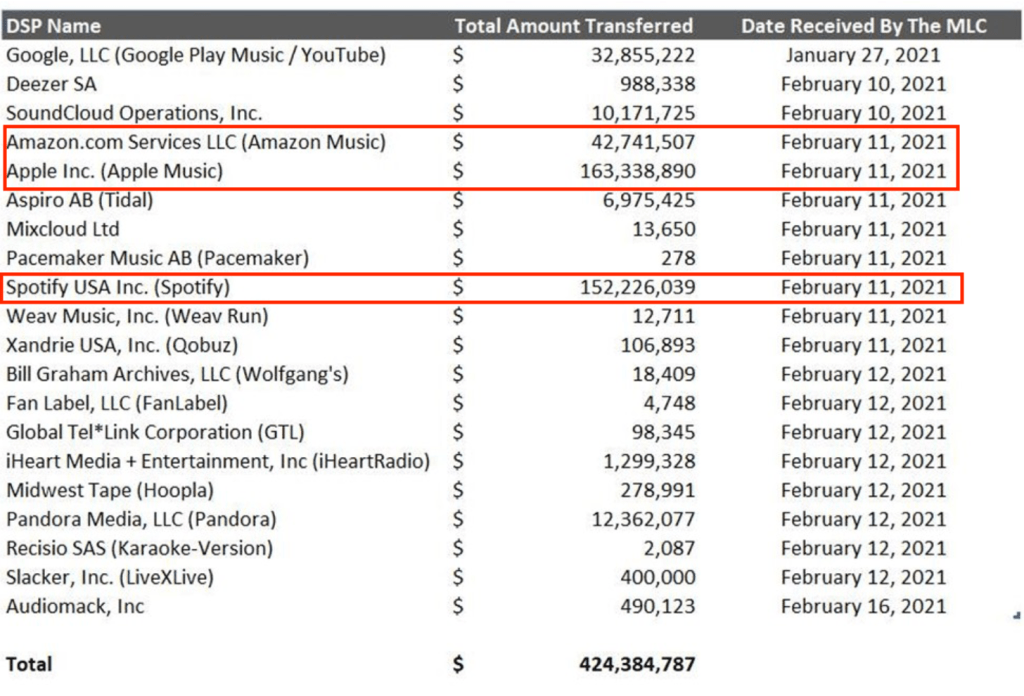
So the point is that the same problem of interest rate risk and unrealized losses could apply to CMOs, such as The MLC, Inc. because of their undisclosed “investment policy” of investing the $424 million of black box they were paid by the services. They don’t disclose what the investment policy is and they don’t disclose their holdings so we don’t really know what has happened, if anything. The money could be perfectly safe.

Or not.

What to do with the MLC’s interest “float” on the black box?

MusicTechPolicy readers will have seen my post about the interest rate paid by the MLC on the rather sizable black box of “unmatched” funds sitting at a bank account (rumored to be City National Bank in Nashville).

That rate was modernized in the Music Modernization Act to be a floating rate: The Federal short term interest rate essentially set by the Federal Reserve. In fact, that particular federal rate is one of the lowest interest rates set by the Federal government and is the kind of interest rate you would want to be obligated pay–very low–if you knew you’d be in the business of holding large sums of money that you wanted to earn interest on yourself and make money on the spread, often called “the float.” (The black box is usually free money, so it’s actually an improvement.). For example, the bank prime loan rate is currently 5.5% that may be a good indicator of what you could get in the way of relatively risk free interest for a big lump sum–if not better for a really big lump sum, say $500,000,000.

The MLC is not, after all, the government, however much that fact might be lost on them. Why should the lowball government rate apply to the MLC instead of a competitive bank rate? Particularly when it comes to the substantial unmatched funds that songwriters and publishers are forced by the government to allow the MLC to hold and for which they control distribution–a bit of the old moral hazard there.

Indeed, you could also express that rate of involuntary saving as “prime plus x” where “x” is an additional money factor like 1%, so the rate floats upward to the songwriters’ advantage. Get some inspiration for this by looking at your credit card interest rate.

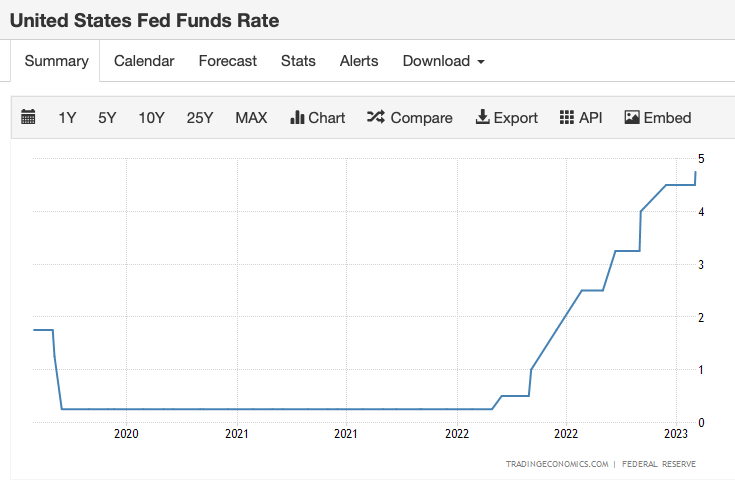
You probably have heard that the Federal Reserve is increasing the federal funds rate, and therefore all interest rates that are a function of the federal funds rate including the short term rate that the MLC is required by law to pay on the black box. The Federal Reserve is expecting to keep making significant increases in the federal interest rates in an effort to get inflation under control, which means that the MLC’s black box interest rate will also continue to increase significantly.

A quick recap: The MLC’s short term interest rate was 0.44% in January in keeping with then-prevailing Zero Interest Rate Policy (or the “lower bound”) of the Fed for the easy money years since the crash of 2008. But in August 2022 (that is, now) the MLC’s rate has increased to 2.84% monthly. The modern black box holding period in the Music Modernization Act is pretty clear:

Also recall that the black box is to be held for an arbitrarily modern period of time while the MLC attempts to locate the rightful recipients as is their statutory burden under the MMA. Different numbers are thrown around for this holding period, but a three year holding period seems to be popular and has the benefit of having been modernized in the Music Modernization Act itself (see above). Bear in mind that the first tranche of “historical” black box (“historical” means “late” in this context) was $424,384,787 and was paid in February of 2021–nearly 18 months ago.

Also recall that we were not given any information that I am aware of as to when the services paying this rather large sum of other people’s money first accrued the black box. People who line up on the shorter holding period side of the argument generally favor rapid market share distributions which tends to help the majors; people on the longer holding period of time generally favor redoubled efforts to find the people who are actually owed the money.

The third group is that the MLC should simply find who is owed the money, have the money being held earn the highest rate of risk-free interest possible, and pay all of the interest money to the correct people when found and not have this cutesy limitation on the money factor paid out for holding OPM. Their argument goes something like your government takes away my right to negotiate my own rates, tells me how much I can charge, then makes it difficult to find me but easy to use my song and now you also want to take away the money you say I’m owed and give it to rich people I don’t know before I’ve had a change to claim it and pay yourselves to not do your jobs?

So we are at the midpoint of the three year statutory holding period. Although remember that this is a two pronged holding period of the earlier of 3 years after the MLC got the cash or 3 years after the date the service started holding the money that it subsequently transferred–a different holding period which would likely end sooner than the date the money was transferred to the MLC.

Although we know the date that the money was transferred in the aggregate to the MLC we may not know exactly when the money was accrued without auditing (although you would think that the MLC would release those dates since the timing of the accrual is relevant to the MMA calculation).

According to my reading of the statute, the modernized interest rate would likely attach from the time the money was accrued by the service, so should have been transferred to the MLC with accrued interest, if any. This may be in lieu of or in addition to a late fee. Very modern.

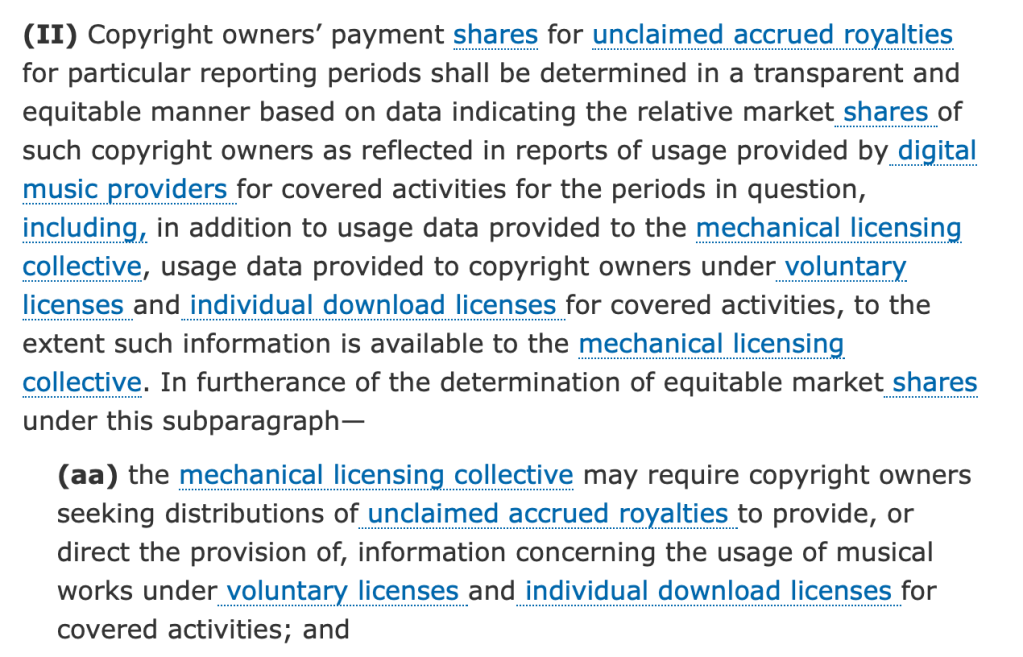
This leaves us with a couple questions. Remember that after the holding period, the black box is to be transferred on a market share basis to all the copyright owners who could be identified based on usage, which includes usage under voluntary licenses that are not administered by the MLC.

So this raises some questions:

  1. Why should the black box be divided up amongst copyright owners who have voluntary licenses and who are not administered by the MLC? They presumably have the most accurate books and statements and may have already had a chance to recover.
  2. What happens to the accrued interest at the time of distribution? Why should the market share distribution include interest on money that didn’t belong to the recipients?
  3. The statute takes the position that the MLC must pay the interest rate but is silent on how much interest the MLC can earn from the bank holding the substantial deposit of the unmatched monies. There’s nothing that requires the MLC to pay over all earned interest.

    Here’s a rough justice calculation of 3 years compound interest at current rates with steadily increasing black box. While the holding period started at the .44% rate, I ran the numbers at the 2.84% rate because it was easier–but also left out an estimate of the increase in rates that is surely to come. Since we are at the midpoint of the holding period already, this gives you an idea:

Hypothetical chart of growth rate of unmatched funds (historical and current) over a three year period at 2.84% compounded monthly interest rate

Is MLC Getting it Right in a Post-MMA World?

It’s becoming more obvious that the Mechanical Licensing Collective is not succeeding in its Congressional mandate to build the definitive music rights database so that all songwriters get paid. We often hear about MLC match rates being consistent with the “industry standard,” but this is pre-MMA thinking and is no longer relevant in a post-MMA world. (Not to mention the fact that it was these very “industry standards” that produced gigantic levels of unmatched payments that the MLC is mandated to fix.) As we will see, any match rate less than 100% is inconsistent with the MLC’s Congressional mandate which will be relevant when those in control of the MLC’s operations are reviewed by Congress in the not too distant future. Remember, The MLC, Inc. may be a private company in the traditional sense, but the MLC (different than The MLC, Inc.) is a statutory creation whose functionality is awarded to the current operators if they do a good job giving effect to the Congressional mandate. Congress can take that deal away and essentially “fire” The MLC, Inc.

It’s also becoming increasingly apparent that the Copyright Office has no stomach for its Congressionally mandated oversight role as they have been silent as the tomb so far no matter how absurd the results coming from MLC. The difference in post-MMA planning is that every royalty audit of MLC should be accompanied by a FOIA request to the Copyright Office regarding what they knew and when they knew it. Neither of those remedies were available in combination to songwriters in a pre-MMA environment. (If you took the king’s shilling and signed up for HFA you got a piece of an audit recovery of unknown providence for the most part often based on projections.)

Thankfully, due to the services paying for MLC operations as well as cost-shifting combinations of direct licensing, modified compulsory and service-supported blanket (and significant non-blanket) licensing, cost will never be a factor for The MLC, so the only consideration should be the benefit to all songwriters from getting it right

Not everyone sees it that way. I raised this point on a Copyright Office roundtable about the MLC and was immediately jumped on by both the Head of Government Relations for Spotify and the head of the Digital Media Association (neither of whom have rendered a royalty statement in their lives in all likelihood). They rejected my position that the MMA requires that there should be no cost benefit analysis in matching–remember, the services are supposed to pay for that matching functionality as part of their deal for the MMA safe harbor giveaway.

Now I’m sure that these DIMA companies are perfectly capable of getting a match rate that’s in the limit. Just because they’ve never done it before doesn’t mean they can’t ever do it. They just need a little guidance.

Fortunately we have Congressional guidance on this issue in the legislative history of Title I of the Music Modernization Act which states:

Testimony provided by Jim Griffin at the June 10, 2014 Committee hearing highlighted the need for more robust metadata to accompany the payment and distribution of music royalties….In an era in which Americans can buy millions of products via an app on their phone based upon the UPC code on the product, the failure of the music industry to develop and maintain a master database has led to significant litigation and underpaid royalties for decades. The Committee believes that this must end so that all artists are paid for their creations and that so-called ‘‘black box’’ revenue is not a drain on the success of the entire industry.

H. Rep. 115-651 (115th Cong. 2nd Sess. April 25, 2018) at 8. (my emphasis)

I realize that the Head of Government Relations for Spotify would want to protect her employer as would the head of DIMA and immediately try to kill the idea that the MLC had to set new industry standards and that the services would pay for it. And that’s a reasonable deal in exchange for the safe harbor giveaway.

But that wasn’t the deal they made. Now you can well say that the services are not required to give a blank check, that the costs should be reasonable, and that the services have something to say about how the money is spent particularly given their expertise with supporting the world’s intelligence agencies in finding things and people, or so says Mr. Snowden. But we already see that the services got a rube deal for their tens of millions in MLC costs if the match rate is simply as bad as it was before MMA (or worse). That wasn’t their deal, either.

The deal they made was to see to it that “all artists are paid for their creations”. No qualifiers.

All means all.


Please take our Songwriter MLC Awareness Survey

Please take a few minutes (4 or so) to help us understand how the Mechanical Licensing Collective and the Copyright Office is doing getting the word out about signing up with the MLC and getting paid royalties (including your share of the $424 million black box/unmatched payment that has been sitting at MLC for months).

Your response are anonymous and we’ll post the results when we get a threshold number of responses. We’d really appreciate your help!

To take the survey on Survey Monkey, click here.

The Sound and the Fury: The Copyright Office Unmatched Report’s Confused Thesis

One of the first world problems with the Copyright Office unmatched report (and frankly the legislative history) is that the Office seems to confound matching transitory royalty payments with building a permanent asset. There is an inherent tension in utilizing a cost benefit analysis to decide which songs are “worth” identifying and paying compared to which songs are “worth” identifying to build the Congressionally mandated core asset of the Mechanical Licensing Collective–the public’s musical works database.

These are two entirely different projects. The unmatched report misses the opportunity to properly distinguish them and emphasize the priority that must be given to building the gold standard musical works database–for which the services pay and in consideration for which the services received a Congressionally mandated retroactive safe harbor for the legion of past infringements. It now becomes apparent that the services were not really serious about doing the hard work and wanted to do just enough to be able to get their safe harbor.

But what about the $424 million in black box, you say? Didn’t they pay beaucoup bucks to settle up with songwriters? Yes, it’s true–the services paid songwriters with what services said was the amount of the songwriters own money that the services owed them due to extraordinarily sloppy licensing practices. Hopefully when the accounting data is made public, we will have a better idea of whether this $424 million makes sense as the semi-accurate number. If, however, it turns out that the vast bulk of the retroactive payment of $424 million accrued over the last few years, that is, since the passing of the MMA Title I safe harbor to benefit those who need it least, it will become apparent that the “historic” retroactive payment was neither historic nor particularly retroactive. Watch the Eight Mile Style case in Tennessee for some answers on this where both Spotify and the Harry Fox Agency are being sued by Eminem’s publishers.

Yet this confusion over the difference between complying with the Congressional mandate to build an authoritative musical works database and some line in the legislative history that the lobbyists inserted about “play your part” is another reason why using a cost benefit analysis for identifying long tail royalty payments makes no sense.

The MLC is charged by Congress with creating the public musical works database–an asset. The MLC is also charged with accounting for royalties–a payment. The report says “The MLC should take reasonable steps to ensure that its data is of the highest possible quality, meaning, among other things, that it is as complete, accurate, up-to-date, and de-conflicted as possible, and is obtained from authoritative sources.” But not if the cost of quality data exceeds the royalties payable in a particular month?

Payments change, assets do not. The MLC are either building a “highest possible quality asset” or they are doing the usual 80/20 “industry standard” slop that is already becoming the MLC’s go-to excuse for failure. Because rest assured–it will always be someone else’s fault. Who do you think caused that “industry standard” to exist? One of the MLC’s principal vendors, mebbbie?

The services like the Title I safe harbor just fine, but obviously no one is interested in actually building an asset of the “highest quality” which is a different enterprise than royalty accounting.

Which is it going to be? I think we all know the answer. If we let it, it will be a lot of sound and fury signifying nothing.

What the MLC Can Learn from Orphan Works

As you may be aware, The MLC recently received $424 million as payment of the “inception to date” unmatched mechanical royalties held at a number of streaming platforms, sometimes called the “black box.” Why do we have a black box at all? For the same reason you have “pending and unmatched” at record companies–somebody decided to exploit the recording without clearing the song.

Streaming services will, no doubt, try to blame the labels for this missing data, but that dog don’t hunt. First, the streaming service has an independent obligation to obtain a license and therefore to know who they are licensing from. Just because the labels do, too, doesn’t diminish the service’s obligation. It must also be said that for years, services did not accept delivery of publishing metadata even if a label wanted to give it to them. So that helps explain how we get to $424 million. Although the money was paid around mid-February, it’s clearly grown because The MLC is to hold the funds in an interest bearing account. Although The MLC has yet to disclose the current balance. Maybe someday.

This payment is, rough justice, a quid pro quo for the new “reach back” safe harbor that the drafters of Title I came up with that denies songwriters the right to sue for statutory damages if a platform complies with their rules including paying this money. That’s correct–songwriters gave up a valuable right to get paid with their own money.

The MLC has not released details about these funds as yet, but one would expect that the vast majority of the unmatched would be for accounting periods prior to the enactment of Title I of the Music Modernization Act (Oct. 11, 2018). One reason that expectation would be justified is that Title I requires services to try hard(er) to match song royalties with song owners. The statute states “…a digital music provider shall engage in good-faith, commercially reasonable efforts to identify and locate each copyright owner of such musical work (or share thereof)” as a condition of being granted the safe harbor.

The statute then goes on to list some examples of “good faith commercially reasonable efforts”. This search, or lack thereof, is at the heart of Eight Mile Style and Martin Affiliated’s lawsuit against Spotify and the Harry Fox Agency. (As the amended complaint states, “Nowhere does the MMA limitation of liability section suggest that it lets a DMP off the hook for copyright infringement liability for matched works where the DMP simply committed copyright infringement. The same should also be true where the DMP had the information, or the means, to match, but simply ignored all remedies and requirements and committed copyright infringement instead. Spotify does not therefore meet the requirements for the liability limitations of the MMA with respect to Eight Mile for this reason alone.”)

The MMA language is similar to “reasonably diligent search” obligations for orphan works, which are typically works of copyright where the owner cannot be identified by the user after trying to find them. This may be the only aspect of orphan works practice that is relevant to the black box under MMA. Since considerable effort has been put into coming up with what constitutes a proper search particularly in Europe it might be a good idea to review those standards.

We may be able to learn somethng about what we expect the services to have already done before transferring the matching problem to the MLC and what we can expect the MLC to do now that they have the hot potato. The MMA provides non-exclusive examples of what would comprise a good search, so it is relevant what other best practices may be out there.

Establishing reference points for what constitutes “good faith commercially reasonable efforts” under MMA is important to answer the threshold question: Is the $424 million payment really all there is? How did the services arrive at this number? While we are impressed by the size of the payment, that’s exactly the reason why we should inquire further about how it was arrived at, what periods it is for and whether any deductions were made. Otherwise it’s a bit like buying the proverbial pig in the proverbial poke.

One method lawmakers have arrived at for determining reasonableness is whether the work could be identified by consulting readily available databases identified by experts (or common sense). For example, if a songwriter has all their metadata correct with the PROs, it’s going to be a bit hard to stomach that either the service or the MLC can’t find them.

Fortunately, we have the Memorandum of Understanding from the European Digital Libraries initiative which brought together a number of working groups to develop best practices to search for different copyright categories of orphan works. The Music/Sound Working Group was represented by Véronique Desbrosses of GESAC and Shira Perlmutter, then of IFPI and now Register of Copyrights (head of the U.S. Copyright Office). The Music/Sound Working Group established these reasonable search guidelines:

DUE DILIGENCE GUIDELINES

The [Music/Sound] Working Group further discussed what constituted appropriate due diligence in dealing with the interests of the groups represented at the table—i.e., what a responsible [user] should, and does, do to find the relevant right holders. We agreed that at least the following searches should be undertaken:

1. Check credits and other information appearing on the work’s packaging (including names, titles, date and place of recording) and follow up through those leads to find additional right holders (e.g., contacting a record [company] to find the performers).

2. Check the databases/membership lists of relevant associations or institutions representing the relevant category of right holder (including collecting societies, unions, and membership or trade associations). In the area of music/sound, such resources are extensive although not always exhaustive.

3. Utilise public search engines to locate right holders by following up on whatever names and facts are available.

4. Review online copyright registration lists maintained by government agencies, such as the U.S. Copyright Office.

Perhaps when the MLC audits the inception to date payments we’ll have some idea of whether the services complied with these simple guidelines.

The World is not Flat: @CISACNews and BIEM Focus on Vendor Lock-in at the MLC

One of the many U.S.-centric shortcomings of Title I of the Music Modernization Act (that created the Mechanical Licensing Collective, the safe harbor giveaway and the blanket license) is that it pretty much ignores the entire complex system of content management organizations outside the U.S. As they describe themselves, “CISAC and BIEM are international organisations representing Collective Management Organisations (“CMOs”) worldwide that are entrusted with the management of creators’ rights and, as such, have a direct interest in the Regulations governing the functioning of the Database and the transparency of MLC’s operations. CISAC and BIEM would like to thank the Office for highlighting the existence and particularity of entities such as CMOs that are not referred to in the MMA.”

I have to say at the outset that as someone who lived outside the U.S. for a big chunk of time, it’s rather embarrassing but sadly unsurprising that so little attention has been paid to the global system of CMOs and the cold fact that we are now weeks away from the January 1, 2021 deadline.

You would not be aware of this unless you read the many comments to the Copyright Office on the MLC oversight rule makings. Aside from the fact that these organizations have decades of experience with blanket mechanical licensing (which the MLC might benefit from), CISAC and BIEM should have been included in the MLC itself, particularly since the MLC promoters appear to have been handing out non-voting directorships to themselves. It is embarrassing, kind of like those Americans who think the best way to speak French is to speak English louder.

CISAC and BIEM raise excellent issues in their comments, which often are accompanied by gentle hint language indicating the points have been raised before and ignored, or at least not responded to. According to a recently posted “ex parte” letter, CISAC and BIEM have focused in on a critical issue–where is the MLC’s statutorily required database and what benefits accrue to its vendor–principally HFA which was recently reunited in the MLC with its former owners.

You can read the CISAC and BIEM ex parte letter here. (Ex parte letters essentially document private discussions by the Copyright Office on matters they are currently regulating. Ex parte letters help to build a full record on matters placed before the Copyright Office by interested parties that may or may not be addressed in regulations.)

Here’s a key excerpt that I think deserves more attention (and is not going to be covered by the trade press until the system collapses in all likelihood).

CISAC/BIEM also raised further concerns regarding potential competitive advantages that The MLC or its vendors’ access to information may have and risks that such information could potentially be used for purposes outside of Section 115 mechanicals. The USCO assured the CMOs that they were perfectly aware of this issue, which had also been raised by other parties, and considered that these concerns were being addressed in the Confidentiality Rulemaking, and that the Statute requires Regulations to prevent the disclosure or improper use of information or MLC records. The proposed Rule establishes that MLC vendors cannot use the data obtained for processing for other purposes. The USCO further confirmed that it was very much aware of the need to ensure the necessary balance and that it was still contemplating how best to resolve this, including whether there should be more regulation.

I have to say that this is not the impression I got from the first panel of “MLC week” rather that the panel seemed to think that at least any member of the public could use the data provided to the MLC for any purpose. Since the MLC’s vendors would also be members of the public ostensibly, it does seem that disconnect needs to be cleared up.

The ex parte letter continues:

The CMOs CISAC/BIEM considered that some of these concerns were based on the January 1 deadline and whether The MLC would be operating with HFA’s database or with its’ own DQI processed separate database.

This depends on the antecedent of “its” in the last clause. If you take The MLC as the antecedent, the meaning would be “or with The MLC’s own DQI processed separate database.” If you take HFA as the antecedent, the meaning would be “whether The MLC would be operating with HFA’s database or with HFA’s own DQI processed separate database.”

While I think that CISAC and BIEM meant the former, the reality appears to be the latter however nonsensical it may seem. This is because there do not appear to be two separate databases, just the HFA database that The MLC accesses through an API. The DQI operation is designed to improve the data quality of the HFA database which benefits both The MLC and HFA.

There seems to be more than a little confusion about this:


USCO noted that there are still open questions regarding this issue, as it seemed that the HFA database would be used as a starting point, but through programmes like DQI data was being updated, so it did not seem as if both databases were identical.

I would argue with this (and have). This idea that DQI was updating a database other than the HFA database sounds like there is a stand-alone musical works database as required by the statute. If so, where is it? Why does the DQI produce search results like this:

HFA DQI

The USCO reiterated that the proposed Confidentiality Rulemaking specifies the limitations imposed on proposed vendors and that The MLC had in writing acknowledged that neither The MLC nor its vendor owned the data. The USCO acknowledged that there was a lot of concern expressed about this issue and ensured the CMOs it was going to address this issue.

Ownership alone is not the only issue and misdirects attention. On the one hand, The MLC says it does not own the database (another example of drafting oversights in Title I of the MMA–ownership is one of those issues you would think would be clearly spelled out but was only referenced indirectly).

I come away from reading the ex parte letter more concerned than ever that the core issue that The MLC was tasked with by the Congress is simply not being addressed–where is the Congress’s musical works database? Remember the words of the legislative history:

“Music metadata has more often been seen as a competitive advantage for the party that controls the database, rather than as a resource for building an industry on.”