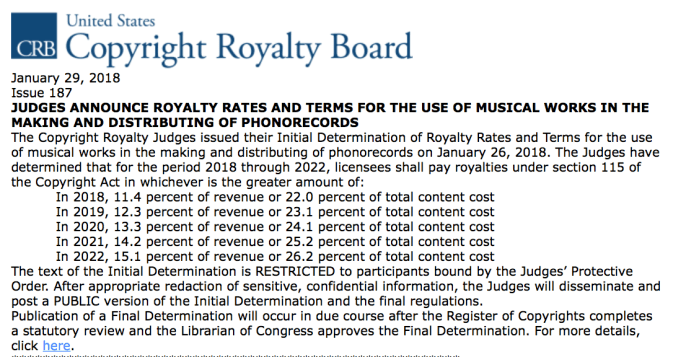
This appears to mean that the mechanical for “physical phonorecords” and permanent downloads has been frozen since 2009 and will remain frozen until 2022. “Physical phonorecords” are CDs and vinyl and permanent downloads is iTunes. These configurations are not nothing and are still about $800 million industry wide in the US alone for the first half of 2017 alone. And while its declining, that’s still a lot of songs.
Readers may be wondering why we haven’t seen a solution to the mass NOI loophole in the controversial Music Modernization Act or otherwise. (For background, read my article on the subject from the ABA Entertainment & Sports Lawyer last year.)
There is one solution to the NOI loophole problem that is entirely within the power of the Congress to solve immediately–instruct the Librarian of Congress to require the Copyright Office to get the lead out on processing copyright registrations. The current turn around time is over six to eight months for electronic filing and eight to 10 months for paper registrations! These bureaucratic delays have a disastrous effect on new registrations (usually new releases) that get caught up in the mass NOI loophole because the registration does not appear in the public records of the Copyright Office until the Copyright Office processes a registration.
Ordering the Copyright Office to bust a move is not an ideal long term solution to closing the mass NOI loophole. It is a solution that commends itself by the speed with which the operational change could be accomplished. Because it is the Congress requiring a change to the operational efficiency of the Library of Congress, I personally don’t believe this instruction would require anything like an Act of Congress to accomplish, or even regulations. Surely not even the federal government requires passing a law to order a government agency to accomplish that which they already have the statutory authority to do, just do it more efficiently. The issue could probably be solved with a phone call, strong letter to follow.
It’s fair to say that songwriters should accept as a given that the Congress does not intend to fix the mass NOI problem. To my knowledge, there has been no official discussion of the issue by any Member of Congress, much less the Copyright Office itself, and the Music Modernization Act doesn’t solve the problem, either, at least not retroactively. But this shouldn’t surprise anyone because the Congress and the Copyright Office also forgot to raise the mechanical royalty rate from 1909 to 1978–sixty nine years. And has frozen the mechanical rate for physical and downloads at 9.1 cents for thirteen years.
Failure to address the loophole will hand DiMA companies like Google, Spotify, Amazon and Pandora a sobering royalty free windfall for the period April 2016 to the effective date of the MMA. The least Congress could do is to require the Copyright Office to start processing copyright registrations in 10 business days. And start that schedule immediately.
If the Copyright Office fails to process registrations in that time, there should arise after 10 business days a rebuttable legal presumption that the registration was properly filed until such time as the copyright owner filing the registration receives a conformed registration or a rejection from the Copyright Office. The contact information for the copyright owner of the pending registration could easily be placed in a searchable database so that those wishing to file NOIs under the current regime–all 60 million or so–could be found and removed from the loophole. So praesumptio iuris tantum to you, too.
A music user and putative compulsory licensee could challenge the presumption of a valid registration if they were sued before the registration were approved (which of course they would and do anyway as a matter of drill). But they would still send their notice, accountings and payment to the copyright owner at the address in the new “public records” of the Copyright Office.
It’s important to note that the loophole is based entirely on whether the copyright owner is identifiable in the public records of the Copyright Office–not whether the copyright owner actually owns the copyright or has filed a registration. It is merely coincidental that the registration is the easiest way to get into the public records of the Copyright Office. Therefore, it is entirely appropriate that the Copyright Office include contact information from “work in progress” registrations in a more searchable format–the filing itself is arguably in the public records already as it could no doubt be obtained with a Freedom of Information Act request.
The current situation where the Copyright Office simply sits on a registration for an unlimited period of time–thus preventing the registration from appearing in the “public records” of the Copyright Office and inserting new song registrations into the loophole pool for mass NOIs–is likely unlawful and unconstitutional. It certainly is for other types of government work like SEC filings in the securities context and parade permits in another free expression context.
Conversely, the Copyright Office promptly processes the mass NOIs while expressly and unilaterally disclaiming responsiblity for verifying whether the NOIs were filed properly. The Copyright Office tells songwriters that their sole remedy is to sue (37 CFR Sec. 201.18(g)):
If any issue (other than an issue related to fees) arises as to whether a Notice filed in the Copyright Office is sufficient as a matter of law under this section, that issue shall be determined not by the Copyright Office, but shall be subject to a determination of legal sufficiency by a court of competent jurisdiction.
This seems to be a violation of due process on its face.
If this new solution for the government’s responsibility to copyright owners would cost money, never fear. The Copyright Office is enjoying a financial windfall in the form of millions of dollars in filing fees for mass NOIs that should cover these costs. Or the Congress could simply increase the Office’s budget to bring it into compliance with common sense if not its Constitutional responsibilities. What the Office should be barred from doing is increasing the filing fees for basic copyright registrations simply because they have to pick up the very sleepy pace.
And by the way, I recall that the Constitution says something about due process and the government’s effective annexation of property rights by an unmovable government agency. The Copyright Office has had two years to fix this problem which is entirely within their operational control. Failing to do so, Congress could act–without an Act of Congress.
Somebody needs to pick up the phone, strong letter to follow.
MTS readers will recall what I’ve called the “mass NOI” problem–the flawed loophole in the Copyright Act created in 1976 that the biggest digital services have turned into a cottage industry to avoid embracing comprehensive song licensing on their services.
In a nutshell, the government takes away a songwriter’s property right to control how their songs are exploited and forces songwriters to allow those songs to be reproduced and distributed by others. This is a Bill of Rights constitutional issue because the government is prohibited by the 5th Amendment from taking property from citizens without just compensation.
The compensation in the case of the compulsory mechanical license is that the government requires the user to comply with certain requrements that increase the likelihood that the songwriter will know of the use and have the ability to chase the royalty that the government also sets as part of the “just compensation” for taking away those rights. (Professor Richard Epstein wrote a highly influential and must-read book on the subject of “takings.”) Thus you have the quid–the compulsory license–and the pro quo–the obligation to notify, account and pay royalties.
The government froze the mechanical royaly from 1909 to 1978 and again in 2009 for no apparent reason, but that’s another story. Aside from the inexplicable failure of the controversial Music Modernization Act to modernize the 2009 freezing of the mechanical rate.
After the class actions filed by David Lowery and Melissa Ferrick in December 2015 and January 2016 respectively, Amazon, Google, Spotify, Pandora and others suddenly became very interested in a loophole in the Copyright Act relating to filing these notices. If they can’t “find” the copyright owner in the public records of the Copyright Office, then these services can send their notice of intent to use (or “NOI”) to the Copyright Office and receive a rebuttable compulsory license–without the obligation to pay royalties until the copyright owner became identifiable in the Copyright Office records.
Sounds reasonable, right? Wrong. What may have seemed reasonable in 1976 is certainly not in 2016 or now. Note that the obligation isn’t to find the copyright owner, the obligation is only to find the copyright owner in the public records of the Copyright Office. The most common way for song owners to end up in those public records is by registering their songs which they are not obligated to do unless they want to sue for statutory damages and attorneys fees under the Copyright Act’s “private attorney general” provisions. Certainly no foreign owner is obligated to register as that is a clear violation of international law.
As MTS readers know, the digital services, many of whom are represented by the Digital Media Association or the MIC Coalition, began filing these notices at the Copyright Office at a rate of millions of notices per month. There is a growing belief that none of these services are actually attempting to find the copyright owners at all, they are simply serving all these notices on the Copyright Office. The party in the best place to determine the legitimacy of these notices is, of course, the Copyright Office itself, which has not lifted a finger that I can see to even confirm if a sample of these notices have been correctly filed.
Now comes the Music Modernization Act (“MMA”) which has a golden opportunity to clean up the past and to require retroactive payment of royalties on all these notices–no black box required because each song has already been identified and no royalties have been paid at all to date.
Unfortunately, the MMA does nothing that I have been able to find to address the some 60 million of these notices that have been served on the Copyright Office other than to say that the MMA’s blanket license would govern and that:
previously filed notices of intention will no longer be effective or provide license authority with respect to covered activities; provided, however, that there shall be no liability pursuant to section 501 [for infringement] for the reproduction or distribution of a musical work (or share thereof) under a validly filed notice of intention through the license availability date [Jan 1 following the second anniversary of the passing of MMA].
No retroactive payment, no review of the mass NOIs, nothing except a sweep of the magic wand from Washington–because they’re here to help. Absolution for all involved.
This is simply wrong. The solution to the issue is to freeze the mass NOIs (since they like freezing royalties so much), review what harm has been done, and enact suitable regulations to provice the legitimate safety valve that the Congress intended in 1976. The fact that Members didn’t anticipate the loophole seeking behavior should not be bootstrapped into a payday holiday for companies with a combined market cap of over $2 trillion in the business of search. Otherwise, the government is rewarding loophole seeking behavior and abusing the 5th Amendment protection from takings of property without just compensation–property that is itself created by the same Constitution in the case of copyright.
But the MMA misses this opportunity to right a wrong. As songwriter Guy Forsyth said in his iconic “Long Long Time,” Americans are freedom loving people and nothing says freedom like getting away with it.
I always impress on music tech startups that their licensing strategy roadmap is just as important as their product development roadmap. Both are interdependent and neither should get too far out ahead of the other. This is almost always met with resistance and a recitation of the popular cant that “copyright is broken”, music has a “market failure” or some similar incantation of a Potter-esque invisibility cloak–the end result being a satisfaction of the dopamine induced desire to rush to market.
Not only does that cloak not exist, invoking it does not help you protect your business from devastating claims downstream. You’re not starting your company to pray for failure so no one finds you and decides if you’re worth suing.
But–you know you have a functioning market when the market itself produces a privately funded entrepreneurial solution to a market misallocation. Crunch Digital is just that solution–and a solution that could solve through bespoke direct licensing the inefficient cycle of litigation that has become necessary to at least try to force the market back on the rails, especially for songwriters.
Crunch Digital, which helps technology companies handle accounting and payments for the music they use, today announced that it’s launching Crunch Digital Sandbox, a platform that will expedite for app developers the process of licensing music from big labels and publishers. The idea isn’t to negotiate the kinds of complicated contracts needed by big online music distributors — just to quickly create what Crunch Digital founder Keith Bernstein calls “an experimental license” so they can prove their concepts.
Crunch will not license music itself. Rather, it will bring together startups with rightsholders that are participating in the Sandbox program, including BMG Rights Management. “Sandbox strikes the perfect balance, allowing startups to properly license music while ensuring that songwriters are fairly compensated,” says Keith Hauprich, BMG general counsel and senior vp business and legal affairs, North America. “This new model squarely addresses a long-standing concern of the industry.”
The problem that most music tech startups have with getting started is almost always the licensing piece followed closely by their accounting obligations. I often hear complaints of high transaction costs of music licensing that inhibits innovation. I have just as frequently seen music-tech startups completely underestimate the complexity of royalty accounting for both songs and sound recordings, especially songs. And unless you are trying to create the black box, that’s bad.
Some startups just ignore the licensing and wait to get sued. This is unfair to those who seek to do it right, and creates the false impression that licenses cannot be obtained, and that the industry is litigious and a bad investment. That perception is not good for anyone and almost guarantees that innovation will be smothered.
Once a startup launches at scale without all licenses, the startup has created an unfixable problem and potentially endless litigation in a room of mirrors. By “without all licenses”, I don’t necessarily mean that the service has no licenses, just that it has no licenses for a significant number of works, such as songs. There is a tendency at tech companies to view low earning songs as not being entitled to fair treatment, or at least not as worthy of fairness as the hits. They often learn the hard way that users don’t get to call that moral hazard and that the law protects all songs, even if the songs happen to be a small percentage of a particular service’s revenue.
Tracking down all those songs creates a problem that is a cross between the stone of Sisyphus and the labors of Hercules. Crunch’s Sandbox service helps startups solve that complex problem.
Crucially, the rights owners participating in the Sandbox appear to be offering a wide variety of works and not just a handful of lesser known songs and recordings. The Sandbox could allow startups to launch their business in a safe environment without spending undue resources on licensing and reporting–instead, focusing on their product which I would suggest is what they should be doing.
And the Sandbox brings this equilibrium without any public money, amendment to the Copyright Act or loophole seeking behavior. If successful, the Sandbox will help startups get launched properly, keep startups from reinventing the wheel on royalty reporting, avoid litigation and get artists and songwriters paid.
[Editor Charlie sez: Great analysis of Google’s “United Masters” adventure by Robert Levine.]
Stop me if you’ve heard this one before: Record labels are irrelevant because they’ve been disrupted by a venture-funded technology start-up. The major labels exploit artists, who can now distribute their music directly to consumers online, plus get the data they need to make money playing concerts, selling merch or doing sponsorships. Sound familiar?
An update on the state of the Copyright Office debacle also known as mass filing of “address unknown” notices under Section 115 (you can see the largely unusable posting of these notices at this link on the Copyright Office site). Here’s some charts you won’t see in the trades or even on the Copyright Office site-Royalty Claim’s Address “Unknown” Mass NOI chart that Royalty Claim measured by number of filings January 1-June 30, 2017.
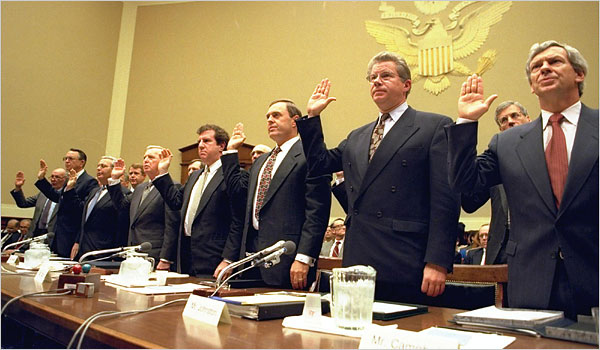
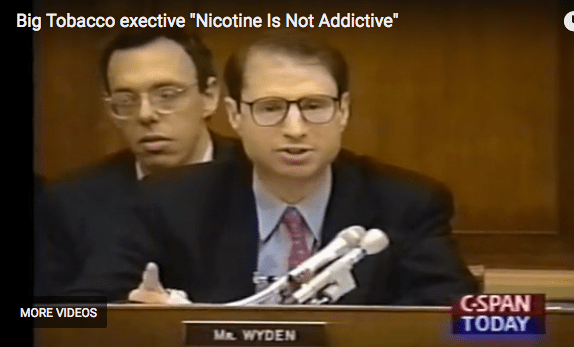
Remember when Senator Ron Wyden (D-Google Data Center) asked the Big Tobacco CEOs whether they thought nicotine was addictive? In one of the more dramatic moments in the Senate’s history, each of the CEOs denied that nicotine was addictive.
And then it turned out that Big Tobacco had been scientifically engineering tobacco to make it as addictive as possible. Oops. If you haven’t seen The Insideryou really should, as you will better understand the problem with corporations profiting from stimulating addictive behavior. And that is the real problem–it’s not that one thing or another is more or less addictive. It is that corporations know that their product is addictive and they try to make it even more addictive than it already is. They conduct secret research and make secret product modifications to enhance its addictiveness for one reason and one reason only–to make money off of human misery.
And then they tell us “Don’t be evil.”
Dr. Adam Alter’s new book suggests that the same type of Senate hearing could well be held on another type of addiction–addiction to smartphones, social media and the Internet. And wouldn’t it be great if Senator Wyden could reprise his Big Tobacco performance from so many years ago, except this time with Eric Schmidt, Jeff Bezos, Mark Zuckerberg, Jack Dorsey and many, many more.
If you doubt the behavioral addiction to social media and your smartphone, try this experiment. Try only using your phone for phone calls for 36 hours. Just check your email on your computer. No email, Facebook, Twitter, Instagram, Google on your phone for 36 hours. Sleep with your phone in another room, and don’t touch it until after breakfast. See how you react.
Do you really think that Big Tech hasn’t studied these issues? Do you really think that this study of addiction is qualitatively or morally different than Big Tobacco’s use of various chemicals to increase the addictive attributes of nicotine? As Dr. Alter demonstrates, behavioral addictions are just as real–and profitable–as substance addictions.
And don’t forget that Big Tech studies us, their users, in real time and continually. When the study sample is the size of all the billions of users of monopoly platforms like Google and Facebook, that data is very, very predictive. For example, Facebook data lord Adam Kramer (more about him shortly) said in an interview that Facebook’s large user base was one of the reasons he joined Facebook:
Q: Why did you join Facebook?
A: Facebook data constitutes the largest field study in the history of the world. Being able to ask–and answer–questions about the world in general is very, very exciting to me. At Facebook, my research is also immediately useful: When I discover something, we can use this to make improvements to the product. In an academic position, I would have to have a paper accepted, wait for publication, and then hope someone with the means to usefully implement my work takes notice. At Facebook, I just message someone on the right team and my research has an impact within weeks if not days.
Q: What are some of the interesting questions you’ve answered since you’ve been here?
A: Do emotions spread contagiously? What do the words we choose have to say about how we are and who we are?
A 2014 study commissioned by Facebook “Experimental evidence of massive-scale emotional contagion through social networks” written by Adam D. I. Kramer of Facebook’s “Core Data Science Team” and two academics from Cornell further demonstrates the power of Facebook’s data set.
The study concluded:
Emotional states can be transferred to others via emotional contagion, leading people to experience the same emotions without their awareness. Emotional contagion is well established in laboratory experiments, with people transferring positive and negative emotions to others….
In an experiment with people who use Facebook, we test whether emotional contagion occurs outside of in-person interaction between individuals by reducing the amount of emotional content in the News Feed. When positive expressions were reduced, people produced fewer positive posts and more negative posts; when negative expressions were reduced, the opposite pattern occurred.
These results indicate that emotions expressed by others on Facebook influence our own emotions, constituting experimental evidence for massive-scale contagion via social networks. This work also suggests that, in contrast to prevailing assumptions, in-person interaction and nonverbal cues are not strictly necessary for emotional contagion, and that the observation of others’ positive experiences constitutes a positive experience for people.
If Facebook is studying something as sophisticated as “emotional contagion through social networks” in a study that we know about, what do you think they are studying that we do not know about? Is it more or less likely that these huge companies are creating studies like the Brown & Williamson tobacco study on adding addictive agents like ammonia and coumarin to cigarettes, or Ford’s infamous “Pinto memo” analyzing the cost/benefit fixing the Pinto’s exploding gas tank?
Dr. Alter devotes the first few chapters of Irresistable to the history and scientific foundations of the study of addiction. You may find this exposition a bit dry, but stick with it. The background is well applied in his detailed discussion of Big Tech’s dependence on addiction.
Alter lays out some of the most important issues of our time that affect both adults and children indiscriminantly. In one of the first books of its kind, Dr. Alter arms us with the knowledge to combat this attack on our sensibilities.
It is important to note that when Steve Jobs introduced the iPad, he forbade his own children from using it. If anyone knew what he was doing and what the risks were, it would have been Steve Jobs. He probably forbade them from smoking, too. My bet is that it was for the same reasons.
There’s a school in Silicon Valley that doesn’t allow the use of any tech. It’s called the Waldorf School and it’s fascinating because the school has no computers, no iPads, no iPhones. They try to minimize tech altogether and so people enjoy a lot of time face-to-face, they go outside a lot. What’s interesting about this school is 75% of the students there are the children of Silicon Valley tech execs, which is striking. These are people who, publicly, will expound on the wonders of the products they’re producing and at the same time they decided in all their wisdom that their kids didn’t belong in a school that used that same tech.
It is very likely that we will hear about a move to make significant amendments to the Copyright Act at some point before the beginning of campaign season in 2018. There are a significant number of copyright-related bills that have been introduced in the House of Representatives in the current session, so brace yourself for an “omnibus” copyright bill that would try to cobble them all together Frankenstein-style.
A Frankenstein omnibus bill would be a very bad idea in my view and will inevitably lead to horse trading of fake issues against a false deadline. Omnibus bills are a bad idea for songwriters and artists, particularly independent songwriters and artists, because omnibus bills tend to bring together Corporate America in attack formation.
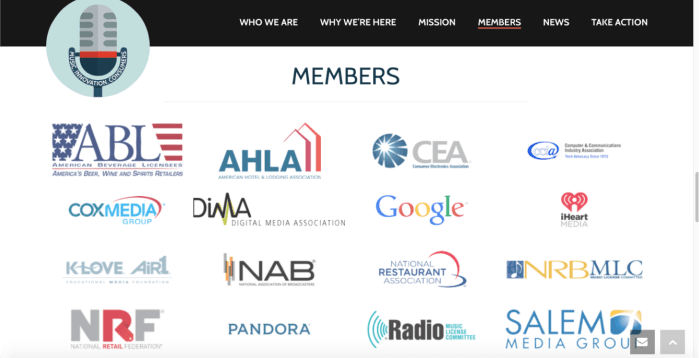
The MIC Coalition
When you consider that Google and Facebook are part of Corporate America (not to mention Apple), the odds of the independent songwriter and artist, but really any songwriter and artist, just holding onto the few crumbs they currently have crash and burn. The odds of actually righting wrongs or–God forbid–getting rid of the legacy consent decrees that protect Big Business vanish into the limit.
Of course, what certain elements of Big Tech would really like to do is push all licensing of music into one organization that they could then control through consent decrees or other government regulation and supervision by exercise of the massive lobbying and litigation muscle of the MIC Coalition and DIMA. While I realize that may actually sound anti-competitive, it is typical of monopolists to use the antitrust law to destroy competition (as Professor Taplin has taught us). That’s certainly what has happened with the PRO consent decrees–reduced competition and lower royalties. Not to mention such a licensing organization would collapse under its own complexity. This is probably why the Copyright Office envisioned a “Music Rights Organization” that would combine the PROs and mechanical rights licensing but provided the relief valve of an new opt-out right so that songwriters could escape the madness. (“Under the Office’s proposal, except to the extent they chose to opt out of the blanket statutory system, publishers and songwriters would license their public performance and mechanical rights through MROs.” Copyright Office Music Licensing Study at p. 9)
If you want some ideas about the kinds of property rights that Big Tech wants the government to take away from songwriters and artists, just read Spotify’s most recent filing in the songwriter litigation in Nashville where their lawyer tries to define away mechanical royalties (unsurprisingly, the lawyer is a long-time protege of Lessig). Why? Because they are being brought to a trial by their peers on statutory damages for copyright infringement and the potential for having to pay the songwriters’ lawyers due to a statutory right to recover attorneys fees. (Statutory damages for copyright infringement has long been an attack point of Big Tech and we get a preview of where they want it to go in Pamela Samuelson’s “Copyright Principles Project”–essentially abolished.)
One way or another, the Big Tech cartel (which includes all the companies in the MIC Coalition and MIC Coalition member the Digital Media Association which itself has members like Spotify and, curiously, Apple) is very likely going to go after statutory damages and try to create yet another “safe harbor” for themselves with no burdens–a “friction free” way to infringe pretty much at will because the actual damages for streaming royalties will be pennies.
If the cartel succeeds in eliminating statutory damages and attorneys fees awards, this will truly make copyright infringement litigation toothless and entirely eliminate the one tool that independent songwriters and artists have to protect their rights. It will neuter massive copyright infringement as alleged in all of the Spotify class actions, not to mention cases like Limewire.
Oh, you say–did you just switch from song copyrights to sound recording copyrights by referencing Limewire? Yes, I did–because that’s exactly what I predict the DIMA and MIC Coalition have in mind. Why do I say this? Because that’s what these companies are backing in the radioactive Transparency in Music Licensing and Ownership bill (HR 3350). And if you blow up all the current separate bills into one omnibus copyright “reform” bill, the pieces may reconstitute in forms you didn’t expect.
But realize that in almost all the many copyright bills currently before the House of Representatives, the other side is trying to bootstrap unjust harm into a negotiation chip to shakedown creators. And it’s not just pending legislation–the shakedown is especially observable with the millions of notices of intention to rely on statutory mechanical licenses for songs filed with the Copyright Office. That’s a nice song you got there, it would be a shame if something happened to it.
Big Tech’s basic negotiation method is to rely on a loophole, bootstrap the loophole to build up the pressure on people who can’t fight back, then run the shakedown to get concessions that should never be made. This is what Google has done with the DMCA and is the same shakedown tactic on mass NOIs taken by Google, Amazon, Pandora, Spotify, and others–but curiously not Apple. Somehow Apple has made it work with the most successful digital music platform in history.
Let’s go down the issue list:
Bootstrapped Issue
Fix
Bill
Pandora and Sirius stopped paying artists for digital royalties on pre-72 recordings—because of loophole based on federal copyright protection for sound recordings
Start paying artist royalties on classic recordings made before 1972
CLASSICS Act
Terrestrial radio created a loophole so they don’t have to pay performance royalties to artists on sound recordings; stop artists from opting out
Start paying artist royalties for broadcast radio (with protection for noncommercial and small broadcasters)
Fair Pay Fair Play Act, PROMOTE Act
Big tech suddenly started using a loophole to file millions of “address unknown” NOIs with Copyright Office after indie songwriters filed class actions
Require Big Tech to use existing databases to look up copyright owners or don’t use the songs or recordings.
None
No “central database” that has all songs (but no requirement to actually look up anything), requires double registration
If songwriters and artists don’t register, then no statutory damages
Transparency in Music Licensing and Ownership Act
Blown up into parts:
–Avoid raising mechanical royalty rate or paying artist royalties on terrestrial at all
–How to use the lack of the mythical “central database” as a bright and shiny object to avoid paying royalties and shirk liability for not doing copyright research, an absurd position for companies that owe much of their wealth to their unprecedented ability to profile people around the world and “organize the world’s information”
–Avoid paying statutory damages
–How to avoid paying royalties that should have paid anyway (pre-72, terrestrial, mass NOI) through distorted interpretations of the law or even safer harbors
–Avoid an obligation to actually look up anything (new databases)
–Use any work they want if all they have to pay is actual damages and no attorneys fees
–Keep songwriters and artists from opting out
–Create biggest black box possible
It should be apparent which way Big Tech is trying to push the creative community. It is important for creators to understand that any legislative concession that the MIC Coalition or DIMA win against songwriters or artists they will then turn around and try to extract in the next shakedown–authors, photographers, film makers, all the copyright categories.
It is in everyone’s interest to support a healthy creative community that will continue to engage fans and do enough commerce to create value for the tech monopolies. But–it is crucial to understand that it doesn’t work the other way around.
The purpose of the creative community is not to create value for tech monopolies. It is to support compelling artists and help them engage with fans, and sometimes it is art for art’s sake alone. If those artists throw off some commercial gain that the tech monopolies can turn to profit themselves, fine. But creating profit for these monopolists is not the goal of artists.
Instead of creating fake problems to try to extract concessions that further undermine creators like offering ice in winter, the tech monopolies like Google, Spotify, Amazon and Pandora should identify real problems and work with us toward real solutions–and not a loophole-driven shakedown.
Episode #94: Recently, a bill was introduced by Republican congressman Jim Sensenbrenner which calls for the creation of a comprehensive database of compositions and recordings. The “Transparency in Music Licensing and Ownership Act” claims to make things easier for coffee shops, bars and restaurants who want to license music to play in their establishments. To many in the music industry, the bill seems like a wolf in sheep’s clothing with the potential cause big problems. On this episode we dig deep into the bill with Future of Music Coalition’s Kevin Erickson and attorney Chris Castle.
We have proposed a panel for SXSW in the Panel Picker with some great speakers I’ll be moderating. “Getting to Beta Without Getting Beat Up” will emphasize the importance of licensing strategy milestones that overlay a music-tech startup’s product development strategy milestones.
A well-executed licensing strategy is every bit as much a part of the supply chain logistics as any other element of product development, if not more important.
A buggy product can usually be fixed. Failure to execute a bespoke licensing strategy can subject the entire company to crippling and endless copyright infringement lawsuits. In fact, if you are unlicensed or insufficiently licensed, one thing is a pretty sure bet: The more successful you are, the more likely it is you’ll be sued–a proposition ripped from the headlines.
That scenario can waste the stockholders’ money, be defocusing in the extreme for management and severely damage relationships with the creative community–the life blood of any music startup.
On the other hand, “over clearing” while less costly than litigation still syphons off resources that for the most part lie fallow.
Our panel are all experienced hands in the licensing and metadata world and are themselves entrepreneurs:

 Music Tech Solutions