For the past two years, Wall Street has treated artificial intelligence as a one-way trade. Hyperscalers, semiconductor companies, utilities, private-credit funds, and data-center developers have committed hundreds of billions of dollars to what may ultimately become nearly $1 trillion in AI-related infrastructure investment over roughly two years.
The underlying assumption has been remarkably consistent: demand for increasingly powerful AI models will continue growing fast enough to justify unprecedented spending on chips, data centers, transmission lines, substations, and electric generation.
But investment booms rarely end because one assumption proves wrong. They end when several assumptions begin to weaken at the same time.
That appears to be happening.
Ed Dowd’s recent Substack analysis argues that the economics supporting today’s AI buildout are becoming increasingly fragile. Financing is tightening. Enterprise customers are demanding clearer returns on investment. Open-weight models continue improving while driving prices lower. And perhaps most importantly, the physical infrastructure required to support AI is becoming a political issue.
Gary Marcus recently challenged David Sacks’ argument that regulation is the principal threat to American AI leadership (Sacks really needs some new sheet music). Marcus instead argued that the industry faces a far more fundamental economic problem:
“The real issue is that LLMs are commodities; lots of people know how to make them, and everybody is doing more or less the same thing, training on more or less the same data. That means nobody has a technical moat. Which means you get price wars and low margins and more and more competitors over time.”
If Marcus is right, Wall Street may eventually discover that AI resembles cloud computing more than pharmaceuticals. There may be tremendous demand—but not necessarily extraordinary profits. That observation dovetails with Goldman Sachs’ increasingly cautious assessment of the AI investment cycle. Goldman has repeatedly warned investors that the buildout depends on continued access to capital, sustained enterprise demand, adequate electric power, and enough economically valuable use cases to justify unprecedented capital expenditures.
AI does not exist in ‘the cloud.’ It exists on electric grids. Every new model depends on substations, transmission lines, transformers, cooling systems, water supplies, and local political consent.
For months, we’ve tracked what has become a genuine data center backlash. Communities across Texas, Georgia, Louisiana, Virginia, Oklahoma, Utah, Alabama, and elsewhere are increasingly questioning the costs of hosting massive AI infrastructure.
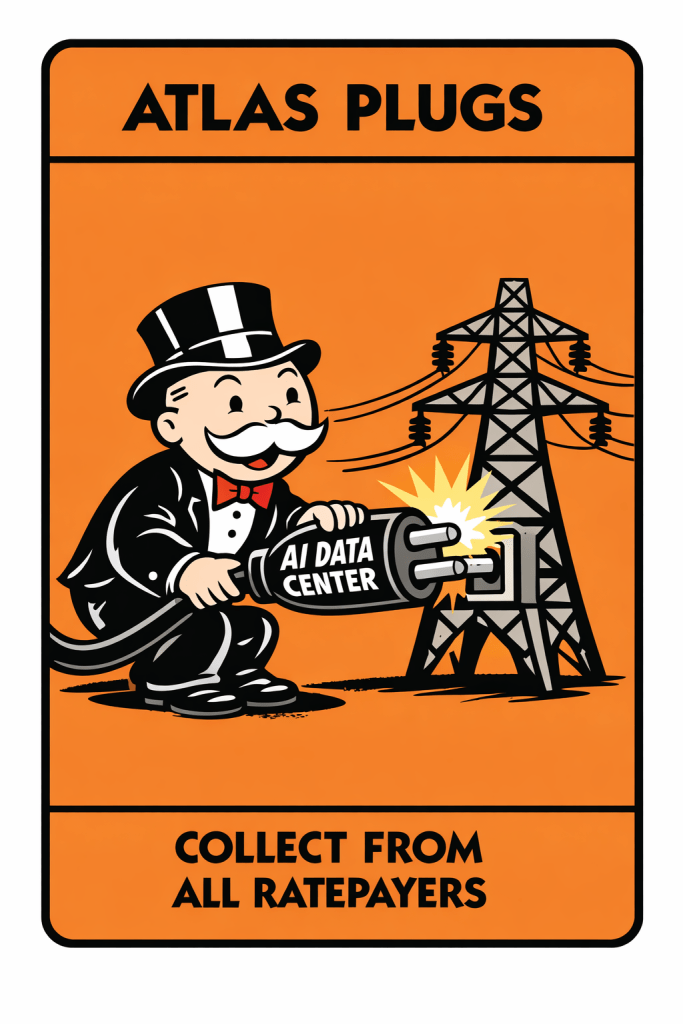
Politicians, meanwhile, are discovering that AI infrastructure is much easier to announce than it is to build. Many governors and local officials have promoted data centers by assuring taxpayers that the projects will ‘pay their own way.’ But that message begins to unravel the moment the infrastructure breaks ground or annexes farmland.
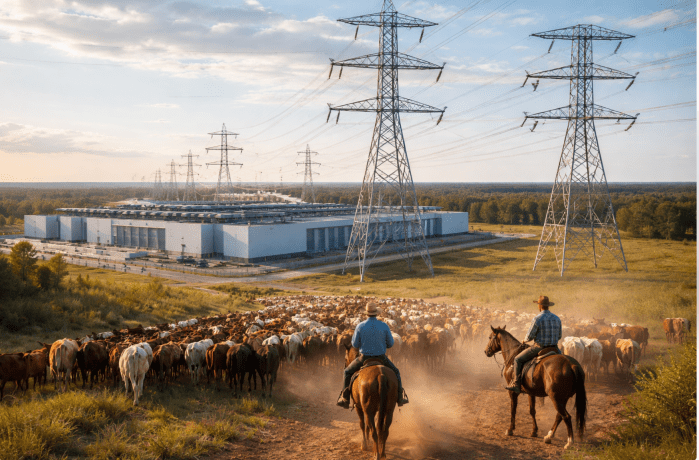
A homeowner facing a 765-kV transmission line across family property is unlikely to be persuaded that the project is privately financed. Likewise, a rancher confronting eminent domain does not care whether the transmission costs appear on a utility bill, a corporate balance sheet, or a tax-abatement agreement. The injury is the same: the family home, ranch, or farm is permanently altered to support infrastructure serving distant customers—who are often anonymous.
In the Texas Hill Country, landowners have mobilized against new transmission corridors intended to serve future electric demand, including AI-related growth. In Coweta County, Georgia, residents organized after learning that transmission infrastructure associated with large-scale data-center development could cut through long-held family properties. The debate quickly ceased being about economics and became about land, community, and the limits of eminent domain.
This is where many elected officials have found themselves trying to have it both ways. They assure taxpayers that private investment will shoulder the costs while simultaneously offering substantial tax abatements, infrastructure incentives, expedited permitting, and other forms of public support. Then, when opposition emerges, they discover that the political issue is no longer who pays for the infrastructure—it’s who lives with it.
For families whose property lies in the path of a transmission corridor, ‘the data centers will pay for themselves’ is not an answer. Their concern is not the financing model. Their concern is keeping the home that has been in the family for generations.
None of this means AI is a passing fad. Transformative technologies often survive speculative bubbles. The internet certainly did. But many companies that financed the dot-com boom did not survive intact, and many investors paid dearly for assuming that technological transformation automatically translated into sustainable profits.
Today’s AI investment cycle rests on multiple pillars: inexpensive capital, robust enterprise demand, premium pricing, abundant electricity, and political support for rapid infrastructure expansion. Gary Marcus questions the durability of the competitive moat. Goldman Sachs questions whether the economics can support the investment. Communities across America are questioning whether they should bear the physical burdens.
Those three conversations are converging. The story is no longer simply about faster models or larger training runs. It is about economics, infrastructure, and public acceptance. The market has spent the last two years pricing AI as though all three will remain aligned indefinitely. History suggests that is a very demanding assumption.
The most important data center story today wasn’t a zoning hearing, a transmission line fight, or a new hyperscaler valuation announcement.
The most important story is a poll. And that poll may not only capture the sentiment of the public, it may also indicate which way elected officials and financiers are leaning, too.
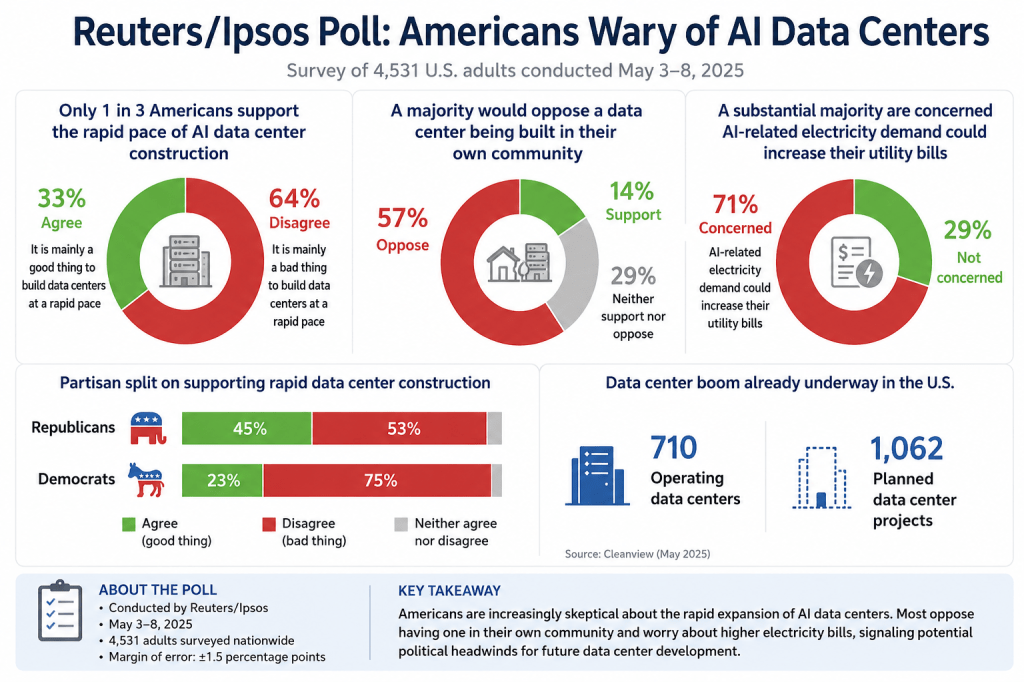
A new Reuters/Ipsos survey found that only one-third of Americans support the current pace of AI data center construction, while nearly two-thirds oppose it. More than half said they would oppose a data center in their own community, and a substantial majority expressed concern that AI-related electricity demand could increase their utility bills.
The six-day poll, which surveyed 4,531 people across the country and closed on Monday, showed just 33% of Americans agreed with a statement that it was mainly a good thing to build data centers at a rapid pace. Some 64% disagreed….Some 57% of people surveyed – including two-thirds of Democrats and half of Republicans – also said they would oppose a data center being built in their community. Just 14% of survey takers said they were okay with a center being built near them, according to the Reuters/Ipsos poll.
The lopsided result should not be surprising.
For the past two years, the public conversation around data centers has focused on American AI leadership (“because China”), economic development, and technological competitiveness. But many communities are experiencing something very different: transmission line easements criss-crossing private property, industrial-scale facilities near homes, rising utility concerns, water consumption, noise, and tax incentives for some of the world’s largest companies. It may be starting to dawn on the public why the White House AI Czar David Sacks was so obsessed with blocking any state laws that got in the way of AI.
In some cases, the issue goes even further. Landowners are being asked to surrender property rights through eminent domain—or the threat of eminent domain—so that transmission infrastructure can be built to serve facilities whose ultimate beneficiaries are among the wealthiest technology companies in the world.
Imagine you were the man who fell to earth and you knew nothing about AI workflow. Would you look at all these data centers, substations, behind the meter nuclear reactors and transmission lines and say “oh, that makes total sense”? Or would you ask what are these people thinking building a supply chain this kludgy with myriad points of failure? Data centers in space? Really? What could possibly go wrong?
That is where the national security narrative begins to collide with local reality. “We have to do this because China” is a powerful slogan in Washington. For many landowners outside the Imperial City, however, it begins to ring hollow when the immediate consequence is a transmission easement across family property that will never happen in an urban setting.
This is particularly true when the economic justification depends on AI demand forecasts that may not even be tested—much less achieved—for years. Viewed from a kitchen window looking out at a new transmission corridor in what used to be your vegetable garden or a pasture for livestock, the sacrifice is immediate and personal, while the promised strategic benefits remain abstract and distant.
We’ve already seen an econometric study from Professor Michael Hicks at Ball State University showing that all the hundreds of data centers in Texas have led to pretty much a wash in job creation, a major selling point that few ever believed. A University of Texas study shows that data centers could potentially account for 3% to 9% of Texas’ water use by 2040, according to a new white paper. In other words, Big Data has largely been talking about the benefits of AI while residents have been living with the costs of that infrastructure.
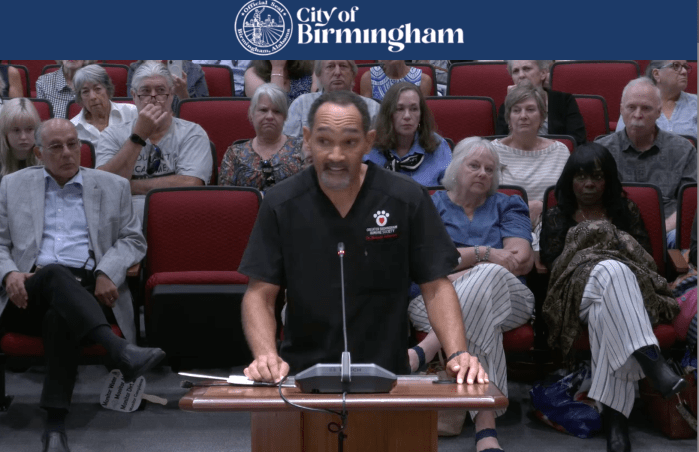
Chief Veterinary Officer for Greater Birmingham Humane Society Testifying against data center
Reverse Angle Showing City Council Left the building
The Reuters/Ipsos poll suggests the issue may be evolving from a collection of local land-use disputes into a national political movement. Historically, that is the point where elected officials begin to change their behavior. Local opposition can often be dismissed as isolated resistance. National polling is harder to ignore and could be the harbinger of somebody getting unelected.
The challenge for policymakers, utilities, and developers is that public concerns are becoming increasingly tangible while many projected benefits remain tied to forecasts extending years into the future with no current evidence. Voters tend to react more strongly to immediate and permanent impacts than to promised future gains that may never come to pass, particularly gains to other people who don’t have a transmission line in their garden or who were not forced to sell their family home to a power company.
That leads to a data center mobilization question that has received far less attention than corrupting farm land, water use, noise, or electricity rates: what happens if the forecasts are simply wrong?
Communities are being asked to accept transmission corridors, substations, power plants, and massive industrial facilities today based on projections of future AI demand that may extend a decade or more into the future. Yet the economics of AI remain highly uncertain as this week’s Google $85 billion equity round confirms. When Google’s AI capital expenditures exceeded even Google’s free cash flow, the Leviathan of Mountain View turned to a Silicon Valley favorite: Other people’s money. Revenue models are still evolving, competition is intense, and many of the assumptions underlying today’s infrastructure buildout have not yet been tested through a full business cycle.
Crucially, Investors are funding unprecedented AI capex on the assumption of durable competitive advantages, yet the underlying LLM asset increasingly exhibits commodity characteristics. Meaning the models are all very similar in the fundamental components. As hyperscalers converge on functionally similar models, infrastructure, and services at extraordinary cost, there is less and less that distinguishes one from the other. When Google chooses to finance capex out of equity rather than continue financing from free cash flow and debt, that may also tell us something about the appetite of lenders getting a little skeptical.
It’s not just Google. Consider the implications of the recent reports surrounding SoftBank’s OpenAI investment. SoftBank participated in OpenAI’s February 2026 funding round at a valuation of approximately $840 billion and emerged with roughly 13% ownership. On paper, SoftBank’s stake in OpenAI carried an implied value of approximately $109 billion.
Yet when SoftBank reportedly sought to get a margin loan on those same shares a few weeks ago (three months after the $840 billion valuation was set) using that position as collateral, lenders appear to have viewed the value of the OpenAI shares very differently. The company initially sought a $10 billion loan secured by its OpenAI shares, later reducing the request to approximately $6 billion after lender interest reportedly proved limited. Even at the lower amount, loan negotiations have reportedly stalled.
The significance is not just that SoftBank’s OpenAI position is worth only $6 billion (implied $46B valuation) or $10 billion as margin loan collateral, if that. Rather, it highlights the distinction between venture valuation, financing valuation, and realizable value. An $840 billion venture valuation reflects what investors were willing to pay in a private financing round under specific assumptions about future growth, profitability, and market structure.
A margin lender asks a different question: if the collateral must be liquidated under adverse circumstances like a bubble burst or the recent semiconductor crash, what is it actually worth? The resulting margin discount can be substantial, even taking into account the usual 50%-ish haircut on marginable securities. For AI investors, this episode may be one of the first visible indications that sophisticated credit markets are assigning materially different risk assessments to AI assets than those implied by headline-grabbing private-market valuations fueled by cheerleading from the financial press and, it must be said, the Oval Office.
Similar valuation disconnects have appeared before other major public offerings, including Spotify’s direct listing, WeWork’s failed IPO, and several high-profile technology listings where private-market expectations ultimately confronted public-market price discovery. For AI investors, the significance is less about OpenAI itself than what the episode may reveal about the difference between AI forecasts and the willingness of sophisticated creditors to finance those assumptions with actual cash.
Homes will be sacrificed – said Holly Lovett, spokeswoman for @GeorgiaPower this article is our local newspaper from November of last year. https://t.co/VsVNDg8P05
If those forecasts prove overly optimistic, the result may not simply be disappointed investors. The result could be stranded assets: transmission lines cutting across ranches and farms, substations occupying valuable land, and industrial facilities looming over communities long after the expected economic justification has faded. That burden may ultimately become the defining political challenge of the AI infrastructure era. People are not merely being asked to tolerate temporary construction. They are being asked to accept permanent changes both to their homes, to their property ownership, and to their communities in support of forecasts that may or may not materialize. If a ranch is involuntarily divided, a neighborhood industrialized, or a home taken for infrastructure justified by projected future AI demand, the consequences are real regardless of whether the forecast is ultimately correct.
The Reuters/Ipsos poll suggests that the next phase of the debate may be less about artificial intelligence itself and more about who bears the risks, costs, and consequences of the infrastructure being built to support it—and who bears the consequences for an unpopular mobilization if those forecasts turn out to be wrong.
That conversation—and the inevitable litigation—is only beginning.
2 LOCAL ENGINEERS refute the @DCBLOXinc rep’s claims: “Waterless cooling does not mean more environmentally-friendly… they are going to continually burn fossil fuels and pollute our communities… not just the one @NashvilleZoo, the one at @Fisk1866 too.” pic.twitter.com/MpZuqYEQ4j
For years, the political conversation around AI data centers followed a familiar script that was straight out of the Chamber of Commerce. Governors competed to announce the next hyperscale campus. Counties rezoned farmland and conservation land into heavy industrial corridors. Legislatures approved enormous tax abatements with little debate. Utilities promised “economic development.” And local officials were told that if they moved too slowly, some other state would take the project instead. Kind of like because China.
Data centers are receiving billions in tax breaks from the state of Georgia and they’re using eminent domain to take people’s family homes.
I’m the only candidate for Lt. Gov talking about this because I’m the only one who voted against it. pic.twitter.com/4jwIQJdVqF
— Senator Greg Dolezal (@DolezalForGA) May 23, 2026
Residents in Crowell, Texas are being forced to live with constant artificial daylight because of Google’s AI data center that is being built right next to them. Residents report severe 24/7 light pollution that creates artificial daylight at night (photo proof shown)
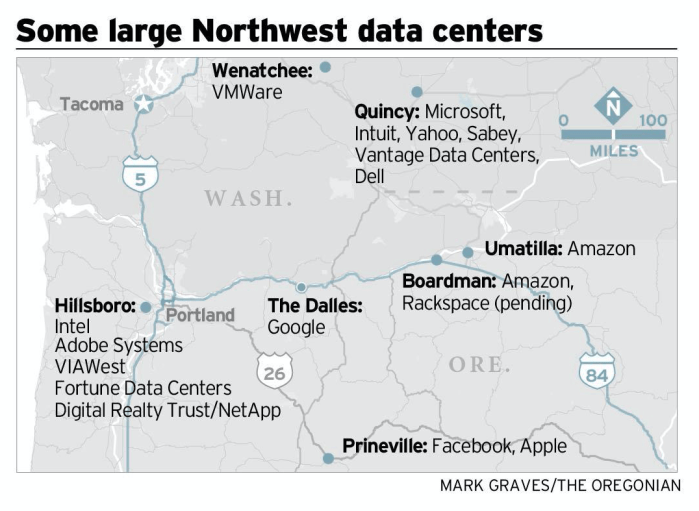
Why? Because even 10 years ago it was self-evidently true that there was no political opposition to Big Tech and nobody looked too hard at the reality of data centers in the places we had observable data like Oregon, for example. If they had, they would have known there was one thing that was absolutely true—data centers were not factories and they produced higher electric bills and fewer jobs. At least once the sugar high of construction had passed.
And speaking of jobs, in a November 2025 difference-in-differences study, economist Michael J. Hicks examined every data center opened in Texas and found zero statistically significant net employment effect — job gains in the data center sector were fully offset by losses in other industries, yielding an average treatment effect of roughly 46 workers per facility that the author concludes is “correctly interpreted as zero,” less than one-tenth the jobs generated by a single Walmart Supercenter.
Good Jobs First has found that the three states that have measured their data center return on investment lose 52 to 91 cents on the dollar, and in Virginia alone, the sales and use tax exemption for data centers consumed 81.3% of the state’s entire economic development incentives budget in FY 2024.
But it’s not just light pollution. Even though it was patently obvious that the massive data centers that were getting built in Louisiana, Georgia, Utah and Nevada were vastly larger than the already operating data centers in Oregon and were guaranteed to chew up the environment way more, nobody bothered to put 2 and 2 together and check how deep the foundations were compared to local aquifers.
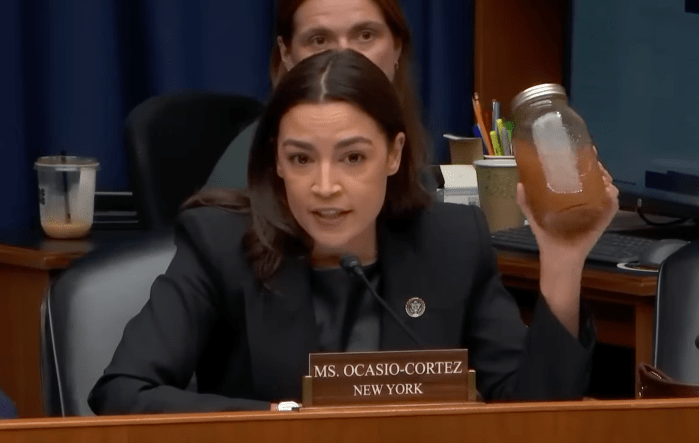
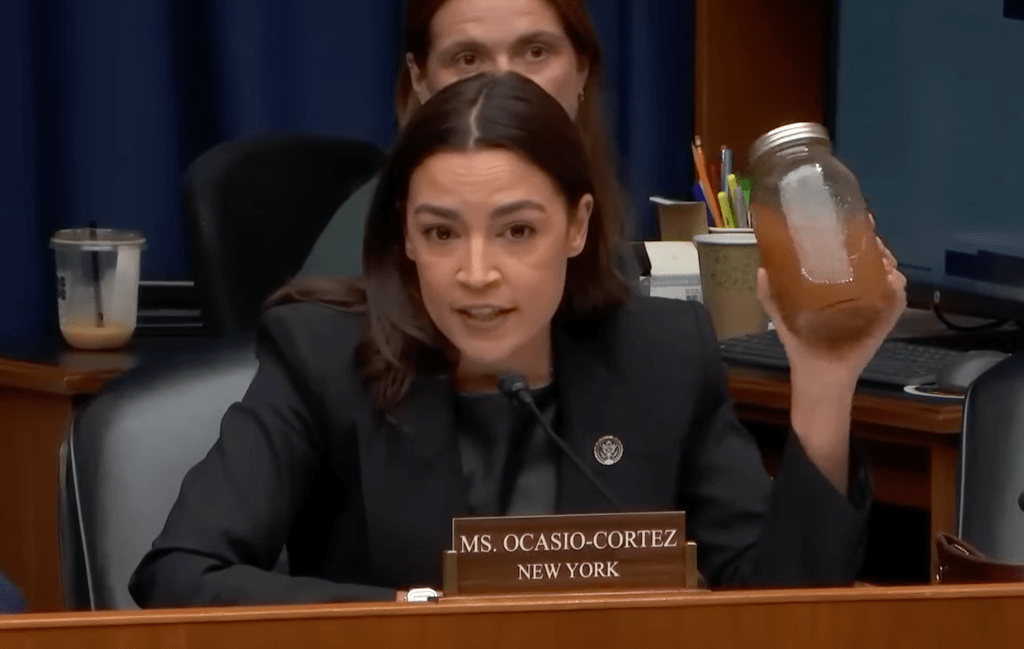
Just because she’s a socialist, doesn’t mean she’s wrong.
That script is now breaking down. I’m shocked, said no one.
As we told the UK Intellectual Property Office:
We call the IPO’s attention to the real-world example of the U.S. State of Oregon, a state that is roughly the geographical size of the UK. Google built the first Oregon data centre in The Dalles, Oregon in 2006. Oregon now has 125 of the very data centres that Big Tech will necessarily need to build in the UK to implement AI. In other words, Oregon was sold much the same story that Big Tech is selling you today.
The rapid growth of Oregon data centres driven by the same tech giants like Amazon, Apple, Google, Oracle, and Meta, has significantly increased Oregon’s demand for electricity. This surge in demand has led to higher power costs, which are often passed on to local rate payers while data centre owners receive tax benefits. This increase in price foreshadows the market effect of crowding out local rate payers in the rush for electricity to run AI—demand will only increase and increase substantially as we enter what the International Energy Agency has called “the age of electricity”.
Portland General Electric, a local power operator, has faced increasing criticism for raising rates to accommodate the encroaching electrical power needs of these data centers. Local residents argue that they unfairly bear the increased electrical costs while data centers benefit from tax incentives and other advantages granted by government.
This is particularly galling in that the hydroelectric power in Oregon is largely produced by massive taxpayer-funded hydroelectric and other power projects built long ago. The relatively recent 125 Oregon data centres received significant tax incentives during their construction to be offset by a promise of future jobs. While there were new temporary jobs created during the construction phase of the data centres, there are relatively few permanent jobs required to operate them long term as one would expect from digitized assets owned by AI platforms.
Of course, the UK has approximately 16 times the population of Oregon. Given this disparity, it seems plausible that whatever problems that Oregon has with the concentration of data centers, the UK will have those same problems many times over due to the concentration of populations.
This message is getting through to elected officials around the world because citizens are freaking out.
Quietly at first, and then all at once, states and local governments across the country began pushing back. Some are freezing approvals entirely. Others are reconsidering billions in tax incentives. Some are demanding that data centers pay the real cost of the transmission infrastructure they require instead of socializing those costs onto ordinary ratepayers and anyone else who drinks water and breathes air.
This is no longer a niche zoning issue in Northern Virginia or some European bureaucratic nonsense. It is becoming a national political movement that has some real populist overtones worthy of a Brexiteer. According to the National Conference of State Legislatures (NCSL), at least 11 states have introduced statewide moratorium or ban legislation targeting data centers. Meanwhile, Good Jobs First reports more than 60 local moratorium efforts nationwidethat at least 14 states and scores of localities are failing to disclose tax abatement revenue losses they are suffering to data centers — even though they have been required to do so under Generally Accepted Accounting Principles (GAAP) since FY 2017.
The reasons vary by region as you’d suspect, but the themes are becoming remarkably consistent, many of which Artist Rights Institute raised in our comments on the US AI Action Plan and the UK IPO AI consultation:
• massive electricity demand; • water consumption; • transmission line expansion; • opaque tax subsidies; • industrialization of rural communities; • secrecy surrounding the ultimate hyperscale users; • and growing fear that ordinary households will subsidize AI infrastructure through higher utility bills.
What is striking is not merely the existence of resistance. It is the geographic breadth of it.
In Texas, lawmakers enacted new large-load interconnection rules while Hill County adopted a temporary construction pause and Agriculture Commissioner Sid Miller publicly called for broader scrutiny of data centers. In Virginia, long considered the unquestioned capital of the data center industry, legislators are openly debating whether to scale back tax exemptions that helped fuel “Data Center Alley.” In Illinois, Governor Pritzker proposed suspending new tax incentives entirely for two years.
Even places that aggressively courted data centers are beginning to hesitate.
In Reno, Nevada, officials adopted a pause on approving new data centers while they reevaluate land-use and infrastructure impacts. Duh. Ya think?
The Reno–Tahoe industrial corridor became a symbol of how quickly hyperscale development can transform an entire region once incentives and transmission infrastructure align. Nevada approved hundreds of millions in projected abatements over the last decade. Now local officials are asking whether the public actually understood the scale of what was being built. If you build it they will come, and they will take a huge dump in your backyard.
That same questions are emerging everywhere else: Who is the real end user? Who pays for the substations and 765-kV transmission lines? What happens if AI demand projections collapse halfway through construction? And why are local taxpayers subsidizing facilities that often employ surprisingly few permanent workers once operational? Well…not really surprisingly, but surprisingly if you believed the Chamber of Commerce hoorah.
The politics are changing because the physical footprint of AI is no longer abstract. The cloud is becoming visible. And you cannot bribe your way out of that one.
Pour some Sucre on them….
Residents now see the cooling towers. They see the transmission corridors. They hear the backup generators. In some communities they are learning about low-frequency industrial noise and infrasound issues that do not show up on ordinary decibel measurements. They see conservation land rezoned into industrial districts almost overnight. They see shell companies quietly assembling land while refusing to identify the ultimate hyperscale beneficiary.
Most importantly, they are beginning to understand that these projects are not temporary construction booms. They are permanent industrialization decisions. A 765-kV transmission corridor is not a pop-up startup. Neither is a hyperscale campus consuming as much electricity as a mid-sized city. And once the infrastructure is built, communities live with the consequences for generations.
The result is a new kind of political coalition that cuts across ideological lines. Environmental advocates, fiscal conservatives, rural landowners, grid-reliability hawks, and anti-subsidy activists are increasingly finding themselves on the same side of the debate. That does not mean the data center industry is stopping. Far from it. Billions are still flowing into AI infrastructure. Utilities continue planning enormous generation and transmission expansions. States remain eager for construction spending and property tax growth.
But the era of automatic approval is ending. The central political question is no longer whether AI infrastructure will expand. It is who bears the cost.
And there is another revealing development occurring at the federal level. What does it tell you that President Trump reportedly pulled back an executive-order framework that would have required certain AI labs to obtain government cybersecurity approval or clearance before launching advanced systems?
Whatever one thinks of the policy itself, the episode suggests intense behind-the-scenes conflict inside the administration and the AI industry over whether any meaningful federal guardrails should exist at all. Sources around Washington describe the push as a last-ditch effort by what critics derisively call the “Zombie AI Viceroy” David Sacks, the lobbyist who seemingly cannot be fired because the entire AI infrastructure race has become too politically and financially entangled. We will see whether federal safeguards reappear in another form. But at this moment, the practical reality is striking: the only governments actively imposing meaningful friction on AI infrastructure expansion are states, counties, and local municipalities.
State and Local Data Center Restriction / Tax Rollback Tracker (May 2026)
Alabama — Considering rules requiring data centers to bear infrastructure/grid costs
Arizona — Chandler pause; grid-cost proposals under consideration
California — Bills addressing ratepayer and environmental protections
Colorado — Denver moratorium; Larimer County pause; Logan County restrictions
Florida — Enacted protections for local zoning authority and ratepayer safeguards
Georgia — HB 1059 introduced forbidding local permitting until December 2028; local pauses; estimated $2.5 billion per year in tax abatement revenue losses (highest in nation)
Illinois — Governor called for two-year pause of data center tax incentives
Indiana — Considering restructuring of tax incentive revenue sharing; fails to disclose data center costs despite ranking fifth-best in subsidy transparency nationally
Louisiana — New Orleans temporary moratorium
Maine — LD 307 moratorium on data centers over 20 MW (vetoed by Governor); local moratoria
Michigan — State moratorium proposals; Ypsilanti pause
Minnesota — Removed electricity sales tax exemption; created new annual energy-use fee; Minneapolis moratorium discussions
Nevada — Reno approval pause; growing tax-abatement controversy; Controller issues exemplary annual report of local revenue losses from state-awarded abatements
New Hampshire — HB 1265 one-year moratorium on data center construction (failed)
New Jersey — Millville ban/restrictions; prevailing wage requirement for data center construction (enacted February 2026)
New York — AB 10141 / SB 9144 statewide moratorium and Public Utility Commission rulemaking (introduced); Athens/Dryden/Mount Morris local restrictions
North Carolina — Chatham County moratorium; additional local reviews
North Dakota — Oliver County temporary moratorium activity
Ohio — Numerous local pauses; growing subsidy backlash
Oklahoma — SB 1488 moratorium until November 2029 (introduced); incentive rollback proposals
Oregon — Affordability/reliability proposals tied to large-load users
Pennsylvania — Moratorium discussions underway (HB 1370 introduced per NCSL)
South Carolina — SB 567 proposal to restrict approvals pending oversight framework (introduced)
Texas — Large-load legislation; local moratoria and review fights; estimated $1 billion or more per year in tax abatement revenue losses; Hicks (2025) causal study found zero net job growth from data centers statewide
Vermont — S 205 proposed moratorium through 2030 with impact study requirement (introduced)
Virginia — HB 1515 prohibiting new approvals until interconnection requests fulfilled or July 2028 (continued); major debate over scaling back tax exemptions; estimated $1.94 billion per year in revenue losses; data center exemptions consumed 81.3% of state’s entire incentive budget in FY 2024
Washington — Restrictions tied to emissions-credit eligibility
Wisconsin — Moratorium proposal (status unverified; not listed in NCSL tracker)
The important point is not that every proposal will pass, which it may or may not. The important point is that resistance is no longer isolated. The backlash has become national. And resistance is not futile.
The AI moratorium fight was never really about “innovation.” It was about preemption. More specifically, it was about what might be called federally guaranteed financial preemption.
That phrase matters because the walk-back campaign around the original proposal has become almost surreal. After backlash exploded over the broad federal effort to block state and local AI regulation, supporters suddenly insisted nobody was trying to force unwanted data centers, transmission lines, substations, gas plants, or hyperscale industrial infrastructure onto communities that did not want them.
Technically, that is true. Washington does not necessarily need to directly order a county commission to approve a data center. It can accomplish much the same thing by structuring the financial system around the assumption that the buildout will occur.
That is the trick.
David Sacks’ original moratorium language he stuck in the One Big Beautiful Bill Act reportedly reached not only states but “political subdivisions” as well. That means cities, counties, municipalities, and local authorities. The proposal was not merely about preventing fifty different state AI laws. It threatened to freeze local democratic responses before they could harden into enforceable policy. (And of course there was always a whiff of 5th Amendment taking about the whole doomed process.)
Then came the backlash. Suddenly the rhetoric softened into something more comforting: We just need one national framework. We are not trying to override local control. We are not trying to force data centers on anyone. But that framing ignores how infrastructure power actually works in the United States. You do not need formal federal commands if you can create overwhelming financial momentum.
Suppose the federal government provides taxpayer-backed loan guarantees for utility expansion tied to AI growth forecasts. Utilities then build new generation, transmission, substations, and grid upgrades designed around hyperscale demand projections. State utility commissions approve cost recovery. Transmission planners treat the load forecasts as inevitable. Investors price future growth into regional infrastructure decisions.
At that point, local communities are no longer arguing with a speculative proposal. They are arguing with a federally supported capital structure. That’s much harder to control.
The county commissioner is suddenly told: The transmission line is already planned. The utility already committed the generation. The state already approved portions of the recovery mechanism. The jobs are supposedly coming. The tax base is supposedly coming. The grid supposedly depends on it.
See, it’s magic. Nobody “forced” anything. Whatever were you thinking?
The machinery simply narrowed the realistic range of outcomes. That is federally guaranteed financial preemption.
And it matters because the economics of AI infrastructure are unusually fragile beneath the surface confidence. Data centers are not shopping centers. They are highly specialized industrial assets tied to assumptions about compute demand, electricity pricing, capital availability, chip supply, and continued investor faith in the AI growth curve.
Much of the current buildout depends on debt markets behaving rationally indefinitely.
That may not happen.
If AI demand softens, if monetization disappoints, if venture funding tightens, or if hyperscalers pull back from aggressive expansion schedules, communities may discover they absorbed the physical consequences of a speculative infrastructure cycle they never fully controlled in the first place.
And then comes the final insult in the “local choice” narrative.
Communities remain theoretically free to say no before the infrastructure becomes politically inevitable. They also remain theoretically free to clean up the wreckage after failure.
That means: condemnation fights, stranded industrial facilities, utility disputes, ratepayer battles, bondholder litigation, abandoned transmission corridors, water conflicts, and enormous demolition costs.
The same officials who insisted nobody forced anything can simply shrug and say: “Well, local communities always retained sovereignty.”
This is why local opposition has accelerated so dramatically across the country. Residents increasingly understand that hyperscale AI infrastructure is not an abstract software issue. It is physical industrial policy: land, water, electricity, noise, substations, transmission lines, tax incentives, utility rate structures, and debt.
The fight stopped being theoretical once people realized they were not debating apps. They were debating permanent industrial transformation of their communities.
That is also why the original AI moratorium language frightened so many people once they read it carefully. It was not merely a debate about chatbot regulation or algorithmic bias. It looked increasingly like a mechanism for suppressing state and local resistance before communities fully understood the infrastructure consequences of the AI buildout itself.
And that may explain why the rhetoric shifted so quickly after public scrutiny intensified.
Because once people understand the difference between legal preemption and financial preemption, the conversation changes entirely.
The federal government does not always need to formally eliminate local authority. Sometimes it only needs to guarantee enough money that resistance becomes structurally difficult.
One of the most important things about the White House AI framework released last week is what it is not.
It is not an executive order.
That may sound like a technical distinction, but it is doing an enormous amount of work here. Because by avoiding the form of an executive order, the framework avoids something even more important: Judicial review.
An executive order that attempted to declare AI training on copyrighted works lawful—or to constrain Congress from acting—would immediately invite challenge in the very judicial branch the framework also seeks to influence. Oh, that would be fun.
It would raise Administrative Procedure Act questions. It would trigger separation-of-powers scrutiny. It would likely be litigated within days.
This framework does none of that and is not susceptible to judicial challenge.
Instead, it achieves much of the same practical effect—shaping legal outcomes, constraining policy space, and signaling preferred doctrine—without creating a justiciable action. It is, in effect, law without law, and outcomes by positioning. Silicon Valley’s favorite.
Takings by Policy, Not Statute
Start with the most obvious constitutional issue: the Takings Clause of Fifth Amendment of the U.S. Constitution which states that “private property [cannot] be taken for public use, without just compensation.”
Copyright is a form of property. That is not controversial. It is a statutory property right grounded in the Constitution’s Intellectual Property Clause, and it carries exclusive rights that have long been understood as economically valuable.
Now consider what the White House framework does.
It declares that AI training—mass, indiscriminate ingestion of copyrighted works—as lawful. It does so without requiring compensation. And it does so in a context where the resulting systems can substitute for, or diminish the market for, the original works.
If that official policy position of the Executive Branch were enacted into law, it would raise a straightforward question:
Has the government authorized the use of private property for public and commercial purposes without compensation? Or more directly, has the Executive Branch just announced that will not prosecute that indiscriminate ingestion for any reason? Can we expect to see amicus briefs from the Solicitor General opposing copyright owners pursuing their rights in court?
That is sounding a lot like a taking.
But because the framework is not law, it avoids the moment where that question must be answered. It does not extinguish rights formally. It renders them economically hollow in practice, while leaving the formal structure intact.
That is the key move: functional elimination without formal abolition.
Ex Post Facto in Everything but Name
The framework also raises a second, less discussed issue: the logic of ex post facto lawmaking.
The Ex Post Facto Clause technically applies to criminal law. But the underlying principle is broader: the government should not change the legal consequences of past conduct to benefit favored actors or disadvantage others. Of course, copyright owners raising this argument will have the Spotify retroactive safe harbor in Title I of the Music Modernization Act thrown in their face as rank hypocrisy, which they would richly deserve, although as any 10 year old can tell you, two wrongs don’t make a right, at least in theory.
Here, the timeline matters.
Massive datasets have already been scraped.
Models have already been trained.
The conduct that enabled this may, in many instances, have been legally questionable—and in cases of willful infringement, potentially criminal under federal copyright law. Or if you listen to me, the largest case of criminal copyright infringement in history.
Now comes the policy years after the fact in the face of over 150 AI lawsuits all based on copyright infringement to one degree or another:
Training is lawful.
That looks less like interpretation and more like retroactive validation.
Even if framed as civil doctrine, the effect is similar to retroactive decriminalization of conduct tied to vested rights. It sends a clear message: conduct that may have been unlawful when undertaken will be treated as lawful because it is now economically indispensable to the broligarchs.
That is not how the rule of law is supposed to work.
Separation of Powers by Suggestion
The framework’s treatment of Congress is equally striking. It does not say Congress lacks authority to legislate. The President cannot say that. Well…he can, but there’s no foundation for the statement. The Constitution is clear: Congress defines copyright.
Instead, the framework says Congress should not act in ways that would affect judicial resolution of the training question.
That is an unusual formulation. Congress legislates in areas under litigation all the time. Indeed, it is often expected to clarify statutory ambiguity.
What the framework is doing is more subtle: It is attempting to shape the legislative field without formally constraining it.
And it pairs that with an implicit second message:
Legislation that restricts training or mandates licensing is inconsistent with executive policy.
Such legislation is therefore unlikely to be signed by the President. So why bring it?
That is a veto signal—delivered without the political cost of an actual veto.
Judicial Signaling Without Command
The same dynamic applies to the courts.
The framework claims to “defer” to the judiciary. But it simultaneously declares a preferred outcome: training is lawful.
That is not deference. That is signaling.
Judges are, of course, independent. But they do not operate in a vacuum. They are aware of executive priorities, legislative inaction, and market realities. When all three align around a single policy direction, it creates an interpretive gravitational force that is difficult to ignore.
And the signal travels further.
To lawyers. To regulators. To anyone whose career may intersect with executive appointment.
It normalizes what counts as a “reasonable” position within the current policy environment.
Prosecutorial Silence as Policy
There is also a more immediate, practical consequence.
While the framework does not have the force of law, it functions as an indirect directive to the Department of Justice. By declaring training lawful as a matter of policy, it signals that federal enforcement resources should not be used to pursue cases premised on the opposite view.
In effect, it tells prosecutors:
Do not spend time considering criminal enforcement for large-scale copyright violations tied to AI training. Do not spend time considering antitrust enforcement against the broligarchs. In fact, don’t spend any time prosecuting anyone regarding AI.
That matters because, for example, willful copyright infringement at scale can, in certain circumstances, give rise to criminal liability. I mean if that doesn’t, what does? Yet under this framework, even the possibility of such enforcement is quietly set aside.
This is not formal immunity. But in practice, it can look very similar.
Why “Not an Executive Order” Matters
If this were an executive order, all of these issues would be front and center:
Is this a taking?
Does it exceed executive authority?
Does it interfere with Congress?
Does it interfere with the Judiciary?
Because it is not and EO, these important issues remain in the background—present but untested.
That is the genius, and the danger, of the approach.
It allows the executive branch to:
Shape doctrine
Influence courts
Constrain Congress
Guide enforcement priorities
Normalize contested conduct
—all without triggering the mechanisms designed to check it.
The Constitutional Shadow
The AI framework does not violate the Constitution in any formal sense.
It does something more complicated.
It operates in the constitutional shadow—where policy can reshape rights, incentives, and expectations without ever crossing the line that would allow a court to say no.
But shadows matter.
Because by the time the law catches up—if it ever does—the world the Constitution was meant to govern and protect may already have changed.
If the tech industry has a signature fallacy for the 2020s aside from David Sacks, it belongs to Jensen Huang. The CEO of Nvidia has perfected a circular, self-consuming logic so brazen that it deserves a name: The Paradox of Huang’s Rope. It is the argument that China is too dangerous an AI adversary for the United States to regulate artificial intelligence at home or control export of his Nvidia chips abroad—while insisting in the very next breath that the U.S. must allow him to keep selling China the advanced Nvidia chips that make China’s advanced AI capabilities possible. The justification destroys its own premise, like handing an adversary the rope to hang you and then pointing to the length of that rope as evidence that you must keep selling more, perhaps to ensure a more “humane” hanging. I didn’t think it was possible to beat “sharing is caring” for utter fallacious bollocks.
The Paradox of Huang’s Rope works like this: First, hype China as an existential AI competitor. Second, declare that any regulatory guardrails—whether they concern training data, safety, export controls, or energy consumption—will cause America to “fall behind.” Third, invoke national security to insist that the U.S. government must not interfere with the breakneck deployment of AI systems across the economy. And finally, quietly lobby for carveouts that allow Nvidia to continue selling ever more powerful chips to the same Chinese entities supposedly creating the danger that justifies deregulation.
It is a master class in circularity: “China is dangerous because of AI → therefore we can’t regulate AI → therefore we must sell China more AI chips → therefore China is even more dangerous → therefore we must regulate even less and export even more to China.” At no point does the loop allow for the possibility that reducing the United States’ role as China’s primary AI hardware supplier might actually reduce the underlying threat. Instead, the logic insists that the only unacceptable risk is the prospect of Nvidia making slightly less money.
This is not hypothetical. While Washington debates export controls, Huang has publicly argued that restrictions on chip sales to China could “damage American technology leadership”—a claim that conflates Nvidia’s quarterly earnings with the national interest. Meanwhile, U.S. intelligence assessments warn that China is building fully autonomous weapons systems, and European analysts caution that Western-supplied chips are appearing in PLA research laboratories. Yet the policy prescription from Nvidia’s corner remains the same: no constraints on the technology, no accountability for the supply chain, and no acknowledgment that the market incentives involved have nothing to do with keeping Americans safe. And anyone who criticizes the authoritarian state run by the Chinese Communist Party is a “China Hawk” which Huang says is a “badge of shame” and “unpatriotic” because protecting America from China by cutting off chip exports “destroys the American Dream.” Say what?
The Paradox of Huang’s Rope mirrors other Cold War–style fallacies, in which companies invoke a foreign threat to justify deregulation while quietly accelerating that threat through their own commercial activity. But in the AI context, the stakes are higher. AI is not just another consumer technology; its deployment shapes military posture, labor markets, information ecosystems, and national infrastructure. A strategic environment in which U.S. corporations both enable and monetize an adversary’s technological capabilities is one that demands more regulation, not less.
Naming the fallacy matters because it exposes the intellectual sleight of hand. Once the circularity is visible, the argument collapses. The United States does not strengthen its position by feeding the very capabilities it claims to fear. And it certainly does not safeguard national security by allowing one company’s commercial ambitions to dictate the boundaries of public policy. The Paradox of Huang’s Rope should not guide American AI strategy. It should serve as a warning of how quickly national priorities can be twisted into a justification for private profit.
“Operation Gatekeeper has exposed a sophisticated smuggling network that threatens our Nation’s security by funneling cutting-edge AI technology to those who would use it against American interests,” said Ganjei. “These chips are the building blocks of AI superiority and are integral to modern military applications. The country that controls these chips will control AI technology; the country that controls AI technology will control the future. The Southern District of Texas will aggressively prosecute anyone who attempts to compromise America’s technological edge.”
That divergence from the prosecutors is not industrial policy. That is incoherence. But mostly it’s just bad advice, likely coming from White House AI Czar David Sacks, Mr. Trump’s South African AI policy advisor who may have a hard time getting a security clearance in the first place..
On one hand, DOJ is rightly bringing cases over the illegal diversion of restricted AI chips—recognizing that these processors are strategic technologies with direct national-security implications. On the other hand, the White House is signaling that access to those same chips is negotiable, subject to licensing workarounds, regulatory carve-outs, or political discretion.
You cannot treat a technology as contraband in federal court and as a commercial export in the West Wing.
Pick one.
AI Chips Are Not Consumer Electronics
The United States does not sell China F-35 fighter jets. We do not sell Patriot missile systems. We do not sell advanced avionics platforms and then act surprised when they show up embedded in military infrastructure. High-end AI accelerators are in the same category.
NVIDIA’s most advanced chips are not merely commercial products. They are general-purpose intelligence infrastructure or what China calls military-civil fusion. They train surveillance systems, military logistics platforms, cyber-offensive tools, and models capable of operating autonomous weapons and battlefield decision-making pipelines with no human in the loop.
If DOJ treats the smuggling of these chips into China as a serious federal crime—and it should—there is no coherent justification for authorizing their sale through executive discretion. Except, of course, money, or in Mr. Sacks case, more money.
Fully Autonomous Weapons—and Selling the Rope
China does not need U.S. chips to build consumer AI. It wants them for military acceleration.Advanced NVIDIA AI chips are not just about chatbots or recommendation engines. They are the backbone of fully autonomous weapons systems—autonomous targeting, swarm coordination, battlefield logistics, and decision-support models that compress the kill chain beyond meaningful human control.
There is an old warning attributed to Vladimir Lenin—that capitalists would sell the rope by which they would later be hanged. Apocryphal or not, it captures this moment with uncomfortable precision.
If NVIDIA chips are powerful enough to underpin autonomous weapons systems for allied militaries, they are powerful enough to underpin autonomous weapons systems for adversaries like China. Trump’s own National Security Strategy statement clearly says previous U.S. elites made “mistaken” assumptions about China such as the famous one that letting China into the WTO would integrate Beijing into the famous rules-based international order. Trump tells us that instead China “got rich and powerful” and used this against us, and goes on to describe the CCP’s well known predatory subsidies, unfair trade, IP theft, industrial espionage, supply-chain leverage, and fentanyl precursor exports as threats the U.S. must “end.” By selling them the most advanced AI chips?
Western governments and investors simultaneously back domestic autonomous-weapons firms—such as Europe-based Helsing, supported by Spotify CEO Daniel Ek—explicitly building AI-enabled munitions for allied defense. That makes exporting equivalent enabling infrastructure to a strategic competitor indefensible.
The AI Moratorium Makes This Worse, Not Better
This contradiction unfolds alongside a proposed federal AI moratorium executive order originating with Mr. Sacks and Adam Thierer of Google’s R Street Institute that would preempt state-level AI protections. States are told AI is too consequential for local regulation, yet the federal government is prepared to license exports of AI’s core infrastructure abroad.
If AI is too dangerous for states to regulate, it is too dangerous to export. Preemption at home combined with permissiveness abroad is not leadership. It is capture.
This Is What Policy Capture Looks Like
The common thread is not national security. It is Silicon Valley access. David Sacks and others in the AI–VC orbit argue that AI regulation threatens U.S. competitiveness while remaining silent on where the chips go and how they are used.
When DOJ prosecutes smugglers while the White House authorizes exports, the public is entitled to ask whose interests are actually being served. Advisory roles that blur public power and private investment cannot coexist with credible national-security policymaking particularly when the advisor may not even be able to get a US national security clearance unless the President blesses it.
A Line Has to Be Drawn
If a technology is so sensitive that its unauthorized transfer justifies prosecution, its authorized transfer should be prohibited absent extraordinary national interest. AI accelerators meet that test.
Until the administration can articulate a coherent justification for exporting these capabilities to China, the answer should be no. Not licensed. Not delayed. Not cosmetically restricted.
And if that position conflicts with Silicon Valley advisers who view this as a growth opportunity, they should return to where they belong. The fact that the US is getting 25% of the deal (which i bet never finds its way into America’s general account), means nothing except confirming Lenin’s joke about selling the rope to hang ourselves, you know, kind of like TikTok.
David Sacks should go back to Silicon Valley.
This is not venture capital. This is our national security and he’s selling it like rope.
Why Silicon Valley’s in-network defenses can’t paper over federalism limits.
The old line attributed to music lawyer Allen Grubman is, “No conflict, no interest.” Conflicts are part of the music business. But the AI moratorium that David Sacks is pushing onto President Trump (the idea that Washington should freeze or preempt state AI protections in the absence of federal AI policy) takes that logic to a different altitude. It asks the public to accept not just conflicts of interest, but centralized control of AI governance built around the financial interests of a small advisory circle, including Mr. Sacks himself.
When the New York Times published its reporting on Sacks’s hundreds of AI investments and his role in shaping federal AI and chip policy, the reaction from Silicon Valley was immediate and predictable. What’s most notable is who didn’t show up. No broad political coalition. No bipartisan defense. Just a tight cluster of VC and AI-industry figures from he AI crypto–tech nexus, praising their friend Mr. Sacks and attacking the story.
And the pattern was unmistakable: a series of non-denial denials from people who it is fair to say are massively conflicted themselves.
No one said the Times lied.
No one refuted the documented conflicts.
Instead, Sacks’ tech bros defenders attacked tone and implied bias, and suggested the article merely arranged “negative truths” in an unflattering narrative (although the Times did not even bring up Mr. Sacks’ moratorium scheme).
And you know who has yet to defend Mr. Sacks? Donald J. Trump. Which tells you all you need to know.
The Rumored AI Executive Order and Federal Lawsuits Against States
Behind the spectacle sits the most consequential part of the story: a rumored executive order that would direct the U.S. Department of Justice to sue states whose laws “interfere with AI development.” Reuters reports that “U.S. President Donald Trump is considering an executive order that would seek to preempt state laws on artificial intelligence through lawsuits and by withholding federal funding, according to a draft of the order seen by Reuters….”
That is not standard economic policy. That is not innovation strategy. That is commandeering — the same old unconstitutional move in shiny AI packaging that we’ve discussed many times starting with the One Big Beautiful Bill Act catastrophe.
The Supreme Court has been clear on this such as in Printz v. United States (521 U.S. 898 (1997) at 925): “[O]pinions of ours have made clear that the Federal Government may not compel the States to implement,by legislation or executive action, federal regulatory programs.”
Crucially, the Printz Court teaches us what I think is the key fact. Federal policy for all the United States is to be made by the legislative process in regular order subject to a vote of the people’s representatives, or by executive branch agencies that are led by Senate-confirmed officers of the United States appointed by the President and subject to public scrutiny under the Administrative Procedures Act. Period.
The federal government then implements its own policies directly. It cannot order states to implement federal policy, including in the negative by prohibiting states from exercising their Constitutional powers in the absence of federal policy. The Supreme Court crystalized this issue in a recent Congressional commandeering case of Murphy v. NCAA (138 S. Ct. 1461 (2018)) where the court held “[t]he distinction between compelling a State to enact legislation and prohibiting a State from enacting new laws is an empty one. The basic principle—that Congress cannot issue direct orders to state legislatures—applies in either event.” Read together, Printz and Murphy extend this core principle of federalism to executive orders.
The “presumption against preemption” is a canon of statutory interpretation that the Supreme Court has repeatedly held to be a foundational principle of American federalism. It also has the benefit of common sense. The canon reflects the deep Constitutional understanding that, unless Congress clearly says otherwise—which implies Congress has spoken—states retain their traditional police powers over matters such as the health, safety, land use, consumer protection, labor, and property rights of their citizens. Courts begin with the assumption that federal law does not displace state law, especially in areas the states have regulated for generations, all of which are implicated in the AI “moratorium”.
The Supreme Court has repeatedly affirmed this principle. When Congress legislates in fields historically occupied by the states, courts require a clear and manifest purpose to preempt state authority. Ambiguous statutory language is interpreted against preemption. This is not a policy preference—it is a rule of interpretation rooted in constitutional structure and respect for state sovereignty that goes back to the Founders.
The presumption is strongest where federal action would displace general state laws rather than conflict with a specific federal command. Consumer protection statutes, zoning and land-use controls, tort law, data privacy, and child-safety laws fall squarely within this protected zone. Federal silence is not enough; nor is agency guidance or executive preference.
In practice, the presumption against preemption forces Congress to own the consequences of preemption. If lawmakers intend to strip states of enforcement authority, they must do so plainly and take political responsibility for that choice. This doctrine serves as a crucial brake on back-door federalization, preventing hidden preemption in technical provisions and preserving the ability of states to respond to emerging harms when federal action lags or stalls. Like in A.I.
Applied to an A.I. moratorium, the presumption against preemption cuts sharply against federal action. A moratorium that blocks states from legislating even where Congress has chosen not to act flips federalism on its head—turning federal inaction into total regulatory paralysis, precisely what the presumption against preemption forbids.
The Constitution’s Supremacy Clause provides that federal law is “the supreme Law of the Land” notwithstanding any state law to the contrary. This language is the foundation for the doctrine of federal preemption, according to which federal law supersedes conflicting state laws. The Supreme Court has identified two general ways in which federal law can preempt state law. First, federal law can expressly preempt state law when a federal statute or regulation contains explicit preemptive language. Second, federal law can impliedly preempt state law when Congress’s preemptive intent is implicit in the relevant federal law’s structure and purpose.
In both express and implied preemption cases, the Supreme Court has made clear that Congress’s purpose is the “ultimate touchstone” of its statutory analysis. In analyzing congressional purpose, the Court has at times applied a canon of statutory construction known as the “presumption against preemption,” which instructs that federal law should not be read as superseding states’ historic police powers “unless that was the clear and manifest purpose of Congress.”
If there is no federal statute, no one has any idea what that purpose is, certainly no justiciabile idea. Therefore, my bet is that the Court would hold that the Executive Branch cannot unilaterally create preemption, and neither can the DOJ sue states simply because the White House dislikes their AI, privacy, or biometric laws, much less their zoning laws applied to data centers.
Why David Sacks’s Involvement Raises the Political Temperature
As Scott Fitzgerald famously wrote, the very rich are different. But here’s what’s not different—David Sacks has something he’s not used to having. A boss. And that boss has polls. And those polls are not great at the moment. It’s pretty simple, really. When you work for a politician, your job is to make sure his polls go up, not down.
David Sacks is making his boss look bad. Presidents do not relish waking up to front-page stories that suggest their “A.I. czar” holds hundreds of investments directly affected by federal A.I. strategy, that major policy proposals track industry wish lists more closely than public safeguards, or that rumored executive orders could ignite fifty-state constitutional litigation led by your supporters like Mike Davis and egged on by people like Steve Bannon.
Those stories don’t just land on the advisor; they land on the President’s desk, framed as questions of his judgment, control, and competence. And in politics, loyalty has a shelf life. The moment an advisor stops being an asset and starts becoming a daily distraction much less liability, the calculus changes fast. What matters then is not mansions, brilliance, ideology, or past service, but whether keeping that adviser costs more than cutting them loose. I give you Elon Musk.
AI Policy Cannot Be Built on Preemption-by-Advisor
At bottom, this is a bet. The question isn’t whether David Sacks is smart, well-connected, or persuasive inside the room. The real question is whether Donald Trump wants to stake his presidency on David Sacks being right—right about constitutional preemption, right about executive authority, right about federal power to block the states, and right about how courts will react.
Because if Sacks is wrong, the fallout doesn’t land on him. It lands on the President. A collapsed A.I. moratorium, fifty-state litigation, injunctions halting executive action, and judges citing basic federalism principles would all be framed as defeats for Trump, not for an advisor operating at arm’s length.
Betting the presidency on an untested legal theory pushed by a politically exposed “no conflict no interest” tech investor isn’t bold leadership. It’s unnecessary risk. When Trump’s second term is over in a few years, Trump will be in the history books for all time. No one will remember who David Sacks was.
If we let a hyped “AI gap” dictate land and energy policy, we’ll privatize essential infrastructure and socialize the fallout.
Every now and then, it’s important to focus on what our alleged partners in music distribution are up to, because the reality is they’re not record people—their real goal is getting their hands on the investment we’ve all made in helping compelling artists find and keep an audience. And when those same CEOs use the profits from our work to pivot to “defense tech” or “dual use” AI (civilian and military), we should hear what that euphemism really means: killing machines.
Daniel Ek is backing battlefield-AI ventures; Eric Schmidt has spent years bankrolling and lobbying for the militarization of AI while shaping the policies that green-light it. This is what happens when we get in business with people who don’t share our values: the capital, data, and social license harvested from culture gets recycled into systems built to find, fix, and finish human beings. As Bob Dylan put it in Masters of War, “You fasten the triggers for the others to fire.” These deals aren’t value-neutral—they launder credibility from art into combat. If that’s the future on offer, our first duty is to say so plainly—and refuse to be complicit.
The same AI outfits that for decades have refused to license or begrudgingly licensed the culture they ingest are now muscling into the hard stuff—power grids, water systems, and aquifers—wherever governments are desperate to win their investment. Think bespoke substations, “islanded” microgrids dedicated to single corporate users, priority interconnects, and high-volume water draws baked into “innovation” deals. It’s happening globally, but nowhere more aggressively than in the U.S., where policy and permitting are being bent toward AI-first infrastructure—thanks in no small part to Silicon Valley’s White House “AI viceroy,” David Sacks. If we don’t demand accountability at the point of data and at the point of energy and water, we’ll wake up to AI that not only steals our work but also commandeers our utilities. Just like Senator Wyden accomplished for Oregon.
These aren’t pop-up server farms; they’re decades-long fixtures. Substations and transmission are built on 30–50-year horizons, generation assets run 20–60, with multi-decade PPAs, water rights, and recorded easements that outlive elections. Once steel’s in the ground, rate designs and priority interconnects get contractually sticky. Unlike the Internet fights of the last 25 years—where you could force a license for what travels through the pipe—this AI footprint binds communities for generations; it’s essentially forever. So we will be stuck for generations with the decisions we make today.
Because China–The New Missle Gap
There’s a familiar ring to the way America is now talking about AI, energy, and federal land use (and likely expropriation). In the 1950s Cold War era, politicians sold the country on a “missile gap” that later proved largely mythical, yet it hardened budgets, doctrine, and concrete in ways that lasted decades.
Today’s version is the “AI gap”—a story that says China is sprinting on AI, so we must pave faster, permit faster, and relax old guardrails to keep up. Of course, this diverts attention from China’s advances in directed-energy weapons and hypersonic missiles which are here right now today and will play havoc in an actual battlefield—which the West has no counter to. But let’s not talk about those (at least not until we lose a carrier in the South China Sea), let’s worry about AI because that will make Silicon Valley even richer.
Watch any interview of executives from the frontier AI labs and within minutes they will hit their “because China” talking point. National security and competitiveness are real concerns, but they don’t justify blank checks and Constitutional-level safe harbors. The missile‑gap analogy is useful because it reminds us how a compelling threat narrative propaganda can swamp due diligence. We can support strategic compute and energy without letting an AI‑gap story permanently bulldoze open space and saddle communities with the bill.
Energy Haves (Them) and Have Nots (Everyone else)
The result is a two‑track energy state AKA hell on earth. On Track A, the frontier AI lab hyperscalers like Google, Meta, Microsoft, OpenAI & Co. build company‑town infrastructure for AI—on‑site electricity generation by microgrids outside of everyone else’s electric grid, dedicated interties and other interconnections between electric operators—often on or near federal land. On Track B, the public grid carries everyone else: homes, hospitals, small manufacturers, water districts. As President Trump said at the White House AI dinner this week, Track A promises to “self‑supply,” but even self‑supplied campuses still lean on the public grid for backup and monetization, and they compete for scarce interconnection headroom.
President Trump is allowing the hyperscalers to get permanent rights to build on massive parcels of government land, including private utilities to power the massive electricity and water cooling needs for AI data centers. Strangely enough, this is continuing a Biden policy under an executive order issued late in Biden Presidency that Trump now takes credit for, and is a 180 out from America First according to people who ought to know like Steve Bannon. And yet it is happening.
White House Dinners are Old News in Silicon Valley
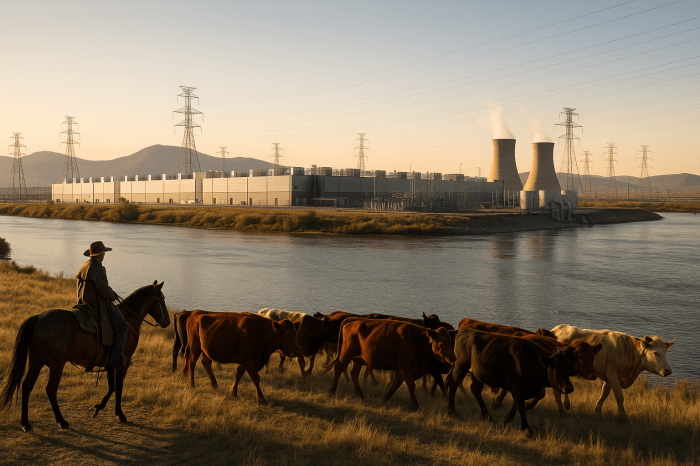
If someone says “AI labs will build their own utilities on federal land,” that land comes in two flavors: Department of Defense (now War Department) or Department of Energy sites and land owned by the Bureau of Land Management (BLM). This are vastly different categories. DoD/DOE sites such as Idaho National Laboratory Oak Ridge Reservation, Paducah GDP, and the Savannah River Site, imply behind-the-fence, mission-tied microgrids with limited public friction; BLM land implies public-land rights-of-way and multi-use trade-offs (grazing, wildlife, cultural), longer timelines, and grid-export dynamics with potential “curtailment” which means prioritizing electricity for the hyperscalers. For example, Idaho National Laboratory (INL) as one of the four AI/data-center sites. INL’s own environmental reports state that about 60% of the INL site is open to livestock grazing, with monitoring of grazing impacts on habitat. That’s likely over.
This is about how we power anything not controlled by a handful of firms. And it’s about the land footprint: fenced solar yards, switchyards, substations, massive transport lines, wider roads, laydown areas. On BLM range and other open spaces, those facilities translate into real, local losses—grazable acres inside fences, stock trails detoured, range improvements relocated.
What the two tracks really do
Track A solves a business problem: compute growth outpacing the public grid’s construction cycle. By putting electrons next to servers (literally), operators avoid waiting years for a substation or a 230‑kV line. Microgrids provide islanding during emergencies and participation in wholesale markets when connected. It’s nimble, and it works—for the operator.
Track B inherits the volatility: planners must consider a surge of large loads that may or may not appear, while maintaining reliability for everyone else. Capacity margins tighten; transmission projects get reprioritized; retail rates absorb the externalities. When utilities plan for speculative loads and those projects cancel or slide, the region can be left with stranded costs or deferred maintenance elsewhere.
The land squeeze we’re not counting
Public agencies tout gigawatts permitted. They rarely publish the acreage fenced, AUMs affected, or water commitments. Utility‑scale solar commonly pencils out to on the order of 5–7 acres per megawatt of capacity depending on layout and topography. At that ratio, a single gigawatt occupies thousands of acres—acres that, unlike wind, often can’t be grazed once panels and security fences go in. Even where grazing is technically possible, access roads, laydown yards, and vegetation control impose real costs on neighboring users.
Wind is more compatible with grazing, but it isn’t footprint‑free. Pads, roads, and safety buffers fragment pasture. Transmission to move that energy still needs corridors—and those corridors cross someone’s water lines and gates. Multiple use is a principle; on the ground it’s a schedule, a map, and a cost. Just for reference, a rule‑of‑thumb for acres/electricity produces is approximately 5–7 acres per megawatt of direct current (“MWdc”), but access roads, laydown, and buffers extend beyond the fence line.
We are going through this right now in my part of the world. Central Texas is bracing for a wave of new high-voltage transmission. These are 345-kV corridors cutting (literally) across the Hill Country to serve load growth for chip fabricators and data centers and tie-in distant generation (so big lines are a must once you commit to the usage). Ranchers and small towns are pushing back hard: eminent-domain threats, devalued land, scarred vistas, live-oak and wildlife impacts, and routes that ignore existing roads and utility corridors. Packed hearings and county resolutions demand co-location, undergrounding studies, and real alternatives—not “pick a line on a map” after the deal is done. The fight isn’t against reliability; it’s against a planning process that externalizes costs onto farmers, ranchers, other landowners and working landscapes.
Texas’s latest SB 6 is the case study. After a wave of ultra-large AI/data-center loads, frontier labs and their allies pushed lawmakers to rewrite reliability rules so the grid would accommodate them. SB 6 empowers the Texas grid operator ERCOT to police new mega-loads—through emergency curtailment and/or firm-backup requirements—effectively reshaping interconnection priorities and shifting reliability risk and costs onto everyone else. “Everyone else” means you and me, kind of like the “full faith and credit of the US”. Texas SB 6 was signed into law in June 2025 by Gov. Greg Abbott. It’s now in effect and directs PUCT/ERCOT to set new rules for very large loads (e.g., data centers), including curtailment during emergencies and added interconnection/backup-power requirements. So the devil will be in the details and someone needs to put on the whole armor of God, so to speak.
The phantom problem
Another quiet driver of bad outcomes is phantom demand: developers filing duplicative load or interconnection requests to keep options open. On paper, it looks like a tidal wave; in practice, only a slice gets built. If every inquiry triggers a utility study, a route survey, or a placeholder in a capital plan, neighborhoods can end up paying for capacity that never comes online to serve them.
A better deal for the public and the range
Prioritize already‑disturbed lands—industrial parks, mines, reservoirs, existing corridors—before greenfield BLM range land. Where greenfield is unavoidable, set a no‑net‑loss goal for AUMs and require real compensation and repair SLAs for affected range improvements.
Milestone gating for large loads: require non‑refundable deposits, binding site control, and equipment milestones before a project can hold scarce interconnection capacity or trigger grid upgrades. Count only contracted loads in official forecasts; publish scenario bands so rate cases aren’t built on hype.
Common‑corridor rules: make developers prove they can’t use existing roads or rights‑of‑way before claiming new footprints. Where fencing is required, use wildlife‑friendly designs and commit to seasonal gates that preserve stock movement.
Public equity for public land: if a campus wins accelerated federal siting and long‑term locational advantage, tie that to a public revenue share or capacity rights that directly benefit local ratepayers and counties. Public land should deliver public returns, not just private moats.
Grid‑help obligations: if a private microgrid islands to protect its own uptime, it should also help the grid when connected. Enroll batteries for frequency and reserve services; commit to emergency export; and pay a fair share of fixed transmission costs instead of shifting them onto households.
Or you could do what the Dutch and Irish governments proposed under the guise of climate change regulations—kill all the cattle. I can tell you right now that that ain’t gonna happen in Texas.
Will We Get Fooled Again?
If we let a hyped latter day “missile gap” set the terms, we’ll lock in a two‑track energy state: private power for those who can afford to build it, a more fragile and more expensive public grid for everyone else, and open spaces converted into permanent infrastructure at a discount. The alternative is straightforward: price land and grid externalities honestly, gate speculative demand, require public returns on public siting, and design corridor rules that protect working landscapes. That’s not anti‑AI; it’s pro‑public. Everything not controlled by Big Tech—will be better for it.
Let’s be clear: the data-center onslaught will be financed by the taxpayer one way or another—either as direct public outlays or through sweet-heart “leases” of federal land to build private utilities behind the fence for the richest corporations in commercial history. After all the goodies that Trump is handing to the AI platforms, let’s not have any loose talk of “selling” excess electricity to the public–that price should be zero. Even so, the sales pitch about “excess” electricity they’ll generously sell back to the grid is a fantasy; when margins tighten, they’ll throttle output costs, not volunteer philanthropy. Picture it: do you really think these firms won’t optimize for themselves first and last? We’ll be left with the bills, the land impacts, and a grid redesigned around their needs. Ask yourself—what in the last 25 years of Big Tech behavior says “trustworthy” to you?
More than a century ago, writers like Edward Bellamy and Edward Mandell House asked a question that feels as urgent in 2025 as it did in their era: Should society be shaped by its people, or designed by its elites? Both grappled with this tension in fiction. Bellamy’s Looking Backward(1888) imagined a future society run by rational experts — technocrats and bureaucrats centralizing economic and social life for the greater good. House’s Philip Dru: Administrator (1912) went a step further, envisioning an American civil war where a visionary figure seizes control from corrupt institutions to impose a new era of equity and order. Sound familiar?
Today, Silicon Valley’s titans are rehearsing their own versions of these stories. In an era dominated by artificial intelligence, climate crisis, and global instability, the tension between democratic legitimacy and technocratic efficiency is more pronounced than ever.
The Bellamy Model: Eric Schmidt and Biden’s AI Order
President Biden’s sweeping Executive Order on AI issued in late 2023 feels like a chapter lifted from Looking Backward. Its core premise is unmistakable: Trust our national champion “trusted” technologists to design and govern the rules for an era shaped by artificial intelligence. At the heart of this approach is Eric Schmidt, former CEO of Google and a key advisor in shaping the AI order at least according to Eric Schmidt.
Schmidt has long advocated for centralizing AI policymaking within a circle of vetted, elite technologists — a belief reminiscent of Bellamy’s idealistic vision. According to Schmidt, AI and other disruptive technologies are too pivotal, too dangerous, and too impactful to be left to messy democratic debates. For people in Schmidt’s cabal, this approach is prudent: a bulwark against AI’s darker possibilities. But it doesn’t do much to protect against darker possibilities from AI platforms. For skeptics like me, it raises a haunting question posed by Bellamy himself: Are we delegating too much authority to a technocratic elite?
The Philip Dru Model: Musk, Sacks, and Trump’s Disruption Politics
Meanwhile, across the aisle, another faction of Silicon Valley is aligning itself with Donald Trump and making a very different bet for the future. Here, the nonfiction playbook is closer to the fictional Philip Dru. In House’s novel, an idealistic and forceful figure emerges from a broken system to impose order and equity. Enter Elon Musk and David Sacks, both positioning themselves as champions of disruption, backed by immense platforms, resources, and their own venture funds.
Musk openly embraces a worldview wherein technologists have both the tools and the mandate to save society by reshaping transportation, energy, space, and AI itself. Meanwhile, Sacks advocates Silicon Valley as a de facto policymaker, disrupting traditional institutions and aligning with leaders like Trump to advance a new era of innovation-driven governance—with no Senate confirmation or even a security clearance. This competing cabal operates with the implicit belief that traditional democratic institutions, inevitiably bogged down by process, gridlock, and special interests can no longer solve society’s biggest problems. To Special Government Employees like Musk and Sacks, their disruption is not a threat to democracy, but its savior.
A New Gilded Age? Or a New Social Contract?
Both threads — Biden and Schmidt’s technocratic centralization and Musk, Sacks, and Trump’s disruption-driven politics — grapple with the legacy of Bellamy and House. In the Gilded Age that inspired those writers, industrial barons sought to justify their dominance with visions of rational, top-down progress. Today’s Silicon Valley billionaires carry a similar vision for the digital era, suggesting that elite technologists can govern more effectively than traditional democratic institutions like Plato’s “guardians” of The Republic.
But at what cost? Will AI policymaking and its implementation evolve as a public endeavor, shaped by citizen accountability? Or will it be molded by corporate elites making decisions in the background? Will future leaders consolidate their role as philosopher-kings and benevolent administrators — making themselves indispensable to the state?
The Stakes Are Clear
As the lines between Silicon Valley and Washington continue to blur, the questions posed by Bellamy and House have never been more relevant: Will technologist philosopher-kings write the rules for our collective future? Will democratic institutions evolve to balance AI and climate crisis effectively? Will the White House of 2025 (and beyond) cede authority to the titans of Silicon Valley? In this pivotal moment, America must ask itself: What kind of future do we want — one that is chosen by its citizens, or one that is designed for its citizens? The answer will define the character of American democracy for the rest of the 21st century — and likely beyond.