Data Center Backlash: Eminent Domain and Stranded Asset Forecast Risk

The most important data center story today wasn’t a zoning hearing, a transmission line fight, or a new hyperscaler valuation announcement.

The most important story is a poll.  And that poll may not only capture the sentiment of the public, it may also indicate which way elected officials and financiers are leaning, too.


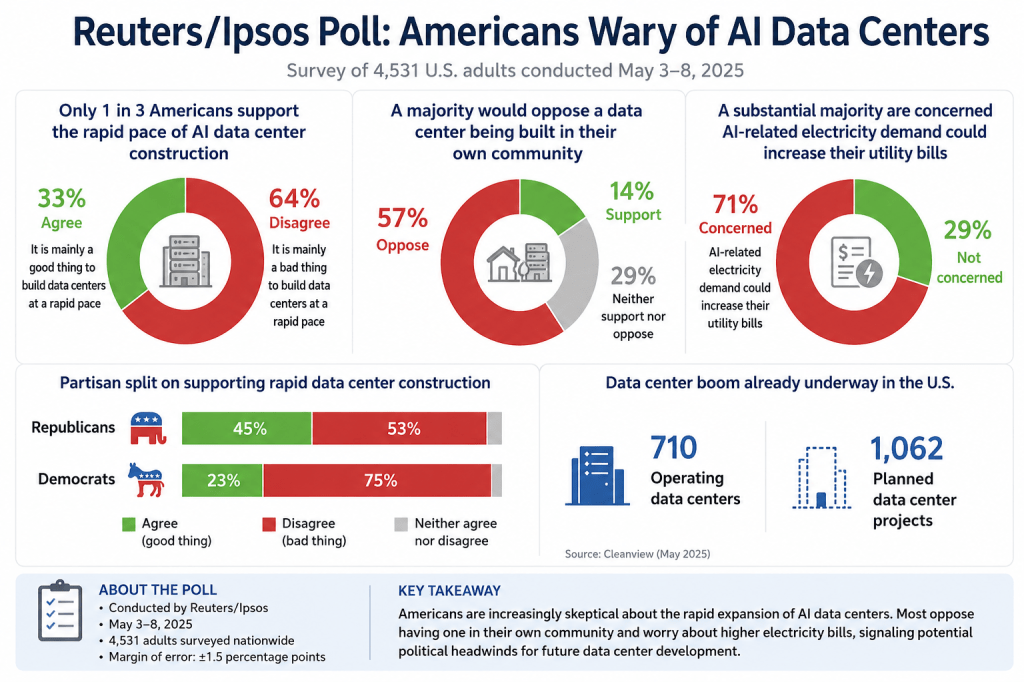
A new Reuters/Ipsos survey found that only one-third of Americans support the current pace of AI data center construction, while nearly two-thirds oppose it. More than half said they would oppose a data center in their own community, and a substantial majority expressed concern that AI-related electricity demand could increase their utility bills.

The six-day poll, which surveyed 4,531 people across the country and closed on Monday, showed just 33% of Americans agreed with a statement that it was mainly a good thing to build data centers at a rapid pace. Some 64% disagreed….Some 57% of people surveyed – including two-thirds of Democrats and half of ‌Republicans – also said they would oppose a data center ⁠being built in their community. Just 14% of survey takers said they were okay with a center being built near them, according to the Reuters/Ipsos poll.

The lopsided result should not be surprising.
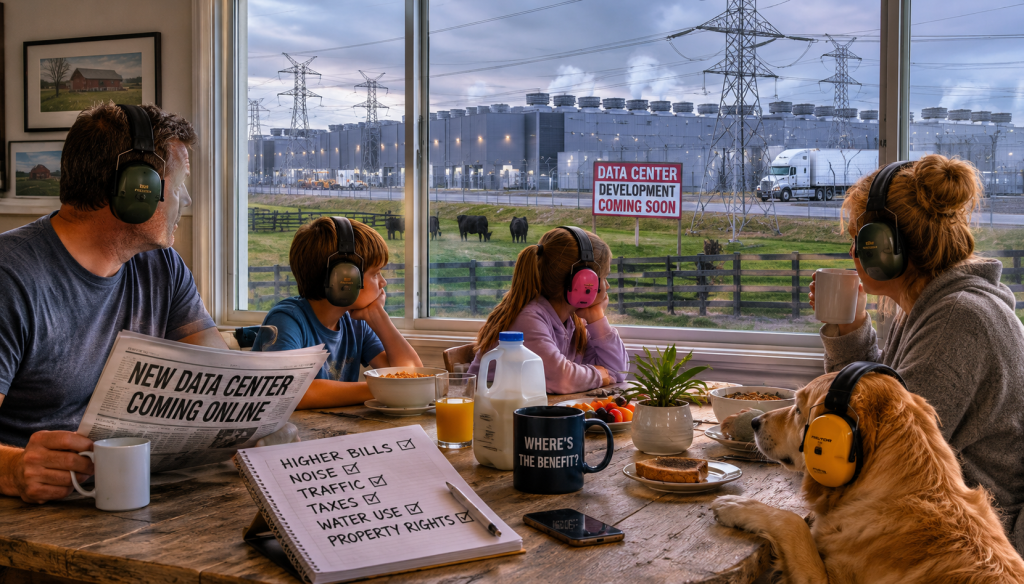
For the past two years, the public conversation around data centers has focused on American AI leadership (“because China”), economic development, and technological competitiveness. But many communities are experiencing something very different: transmission line easements criss-crossing private property, industrial-scale facilities near homes, rising utility concerns, water consumption, noise, and tax incentives for some of the world’s largest companies.  It may be starting to dawn on the public why the White House AI Czar David Sacks was so obsessed with blocking any state laws that got in the way of AI.
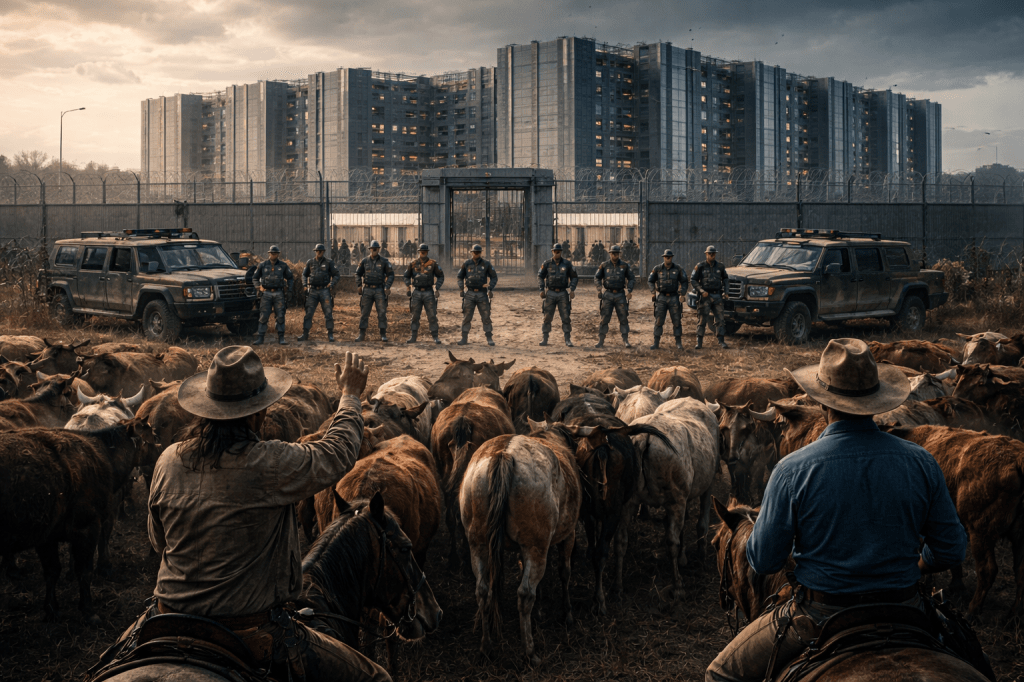
In some cases, the issue goes even further. Landowners are being asked to surrender property rights through eminent domain—or the threat of eminent domain—so that transmission infrastructure can be built to serve facilities whose ultimate beneficiaries are among the wealthiest technology companies in the world.

Imagine you were the man who fell to earth and you knew nothing about AI workflow.  Would you look at all these data centers, substations, behind the meter nuclear reactors and transmission lines and say “oh, that makes total sense”?  Or would you ask what are these people thinking building a supply chain this kludgy with myriad points of failure?  Data centers in space?  Really?  What could possibly go wrong?
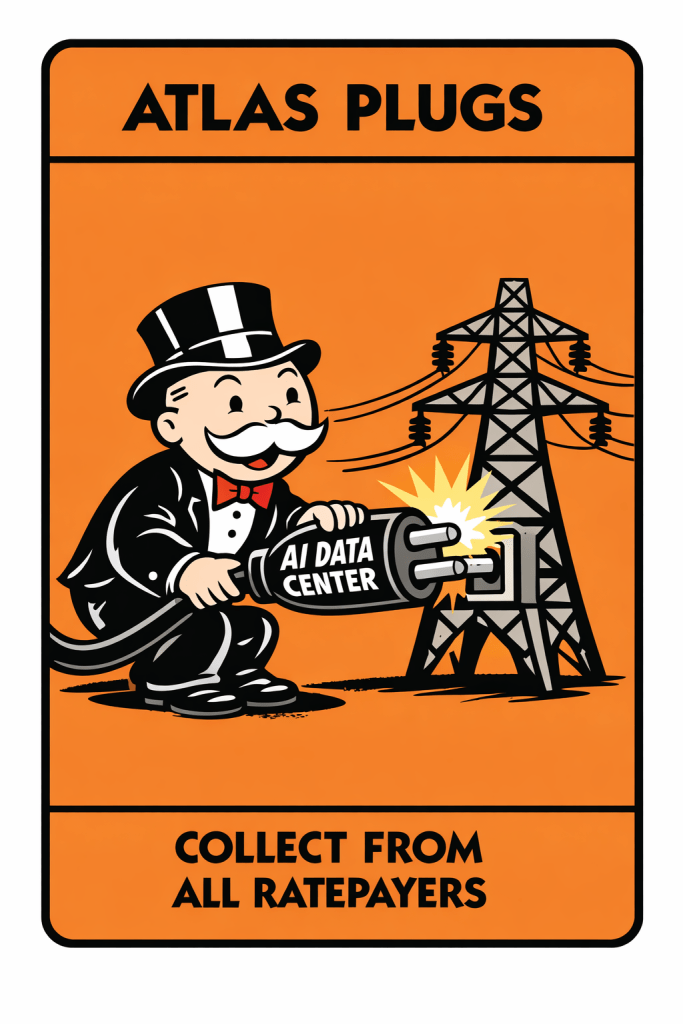
That is where the national security narrative begins to collide with local reality. “We have to do this because China” is a powerful slogan in Washington. For many landowners outside the Imperial City, however, it begins to ring hollow when the immediate consequence is a transmission easement across family property that will never happen in an urban setting.  

This is particularly true when the economic justification depends on AI demand forecasts that may not even be tested—much less achieved—for years. Viewed from a kitchen window looking out at a new transmission corridor in what used to be your vegetable garden or a pasture for livestock, the sacrifice is immediate and personal, while the promised strategic benefits remain abstract and distant.

We’ve already seen an econometric study from Professor Michael Hicks at Ball State University showing that all the hundreds of data centers in Texas have led to pretty much a wash in job creation, a major selling point that few ever believed.  A University of Texas study shows that data centers could potentially account for 3% to 9% of Texas’ water use by 2040, according to a new white paper. In other words, Big Data has largely been talking about the benefits of AI while residents have been living with the costs of that infrastructure.
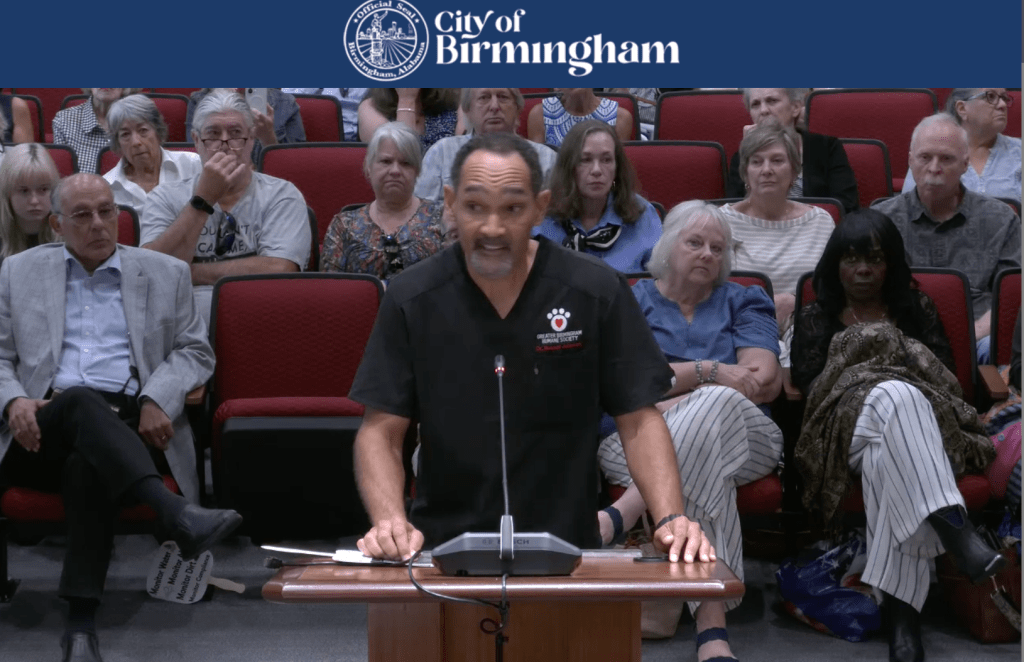
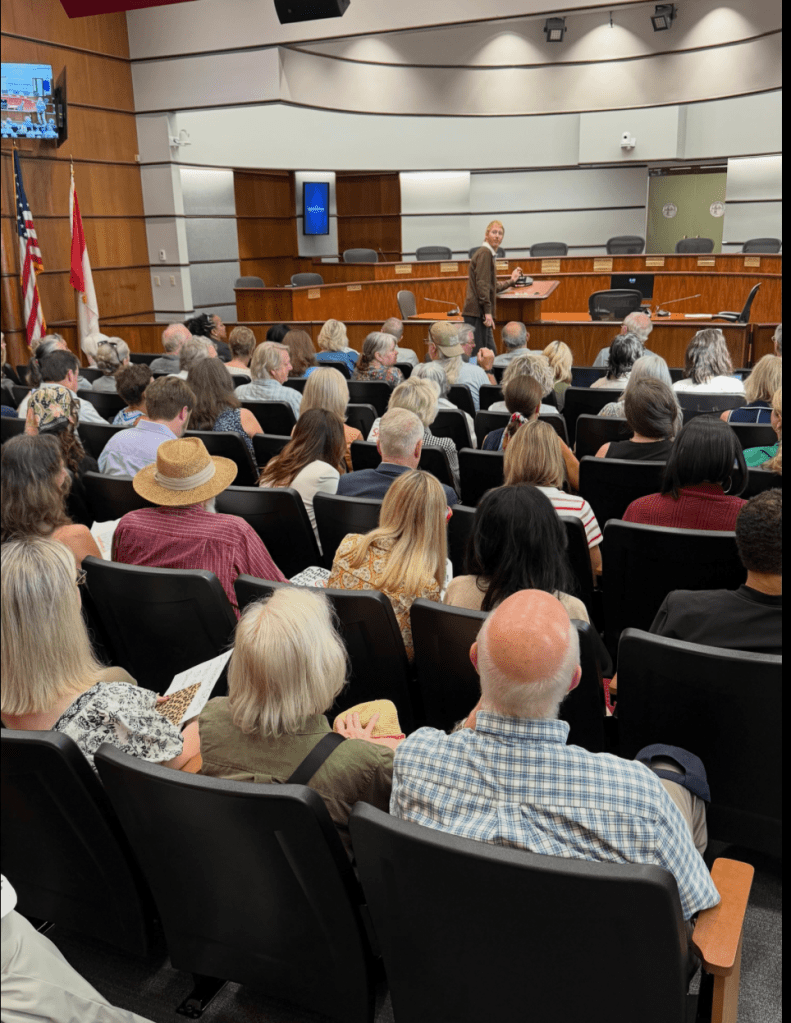
Chief Veterinary Officer for Greater Birmingham Humane Society Testifying against data center
Reverse Angle Showing City Council Left the building

The Reuters/Ipsos poll suggests the issue may be evolving from a collection of local land-use disputes into a national political movement. Historically, that is the point where elected officials begin to change their behavior. Local opposition can often be dismissed as isolated resistance. National polling is harder to ignore and could be the harbinger of somebody getting unelected.

The challenge for policymakers, utilities, and developers is that public concerns are becoming increasingly tangible while many projected benefits remain tied to forecasts extending years into the future with no current evidence. Voters tend to react more strongly to immediate and permanent impacts than to promised future gains that may never come to pass, particularly gains to other people who don’t have a transmission line in their garden or who were not forced to sell their family home to a power company.

That leads to a data center mobilization question that has received far less attention than corrupting farm land, water use, noise, or electricity rates: what happens if the forecasts are simply wrong?


Communities are being asked to accept transmission corridors, substations, power plants, and massive industrial facilities today based on projections of future AI demand that may extend a decade or more into the future. Yet the economics of AI remain highly uncertain as this week’s Google $85 billion equity round confirms.  When Google’s AI capital expenditures exceeded even Google’s free cash flow, the Leviathan of Mountain View turned to a Silicon Valley favorite:  Other people’s money. Revenue models are still evolving, competition is intense, and many of the assumptions underlying today’s infrastructure buildout have not yet been tested through a full business cycle.

Crucially, Investors are funding unprecedented AI capex on the assumption of durable competitive advantages, yet the underlying LLM asset increasingly exhibits commodity characteristics. Meaning the models are all very similar in the fundamental components. As hyperscalers converge on functionally similar models, infrastructure, and services at extraordinary cost, there is less and less that distinguishes one from the other.  When Google chooses to finance capex out of equity rather than continue financing from free cash flow and debt, that may also tell us something about the appetite of lenders getting a little skeptical.

It’s not just Google.  Consider the implications of the recent reports surrounding SoftBank’s OpenAI investment. SoftBank participated in OpenAI’s February 2026 funding round at a valuation of approximately $840 billion and emerged with roughly 13% ownership. On paper, SoftBank’s stake in OpenAI carried an implied value of approximately $109 billion. 

Yet when SoftBank reportedly sought to get a margin loan on those same shares a few weeks ago (three months after the $840 billion valuation was set) using that position as collateral, lenders appear to have viewed the value of the OpenAI shares very differently. The company initially sought a $10 billion loan secured by its OpenAI shares, later reducing the request to approximately $6 billion after lender interest reportedly proved limited. Even at the lower amount, loan negotiations have reportedly stalled.

The significance is not just  that SoftBank’s OpenAI position is worth only $6 billion (implied $46B valuation) or $10 billion as margin loan collateral, if that. Rather, it highlights the distinction between venture valuation, financing valuation, and realizable value. An $840 billion venture valuation reflects what investors were willing to pay in a private financing round under specific assumptions about future growth, profitability, and market structure.

A margin lender asks a different question: if the collateral must be liquidated under adverse circumstances like a bubble burst or the recent semiconductor crash, what is it actually worth? The resulting margin discount can be substantial, even taking into account the usual 50%-ish haircut on marginable securities. For AI investors, this episode may be one of the first visible indications that sophisticated credit markets are assigning materially different risk assessments to AI assets than those implied by headline-grabbing private-market valuations fueled by cheerleading from the financial press and, it must be said, the Oval Office.

Similar valuation disconnects have appeared before other major public offerings, including Spotify’s direct listing, WeWork’s failed IPO, and several high-profile technology listings where private-market expectations ultimately confronted public-market price discovery. For AI investors, the significance is less about OpenAI itself than what the episode may reveal about the difference between AI forecasts and the willingness of sophisticated creditors to finance those assumptions with actual cash.


If those forecasts prove overly optimistic, the result may not simply be disappointed investors. The result could be stranded assets: transmission lines cutting across ranches and farms, substations occupying valuable land, and industrial facilities looming over communities long after the expected economic justification has faded. That burden may ultimately become the defining political challenge of the AI infrastructure era. People are not merely being asked to tolerate temporary construction. They are being asked to accept permanent changes both to their homes, to their property ownership, and to their communities in support of forecasts that may or may not materialize. If a ranch is involuntarily divided, a neighborhood industrialized, or a home taken for infrastructure justified by projected future AI demand, the consequences are real regardless of whether the forecast is ultimately correct.

The Reuters/Ipsos poll suggests that the next phase of the debate may be less about artificial intelligence itself and more about who bears the risks, costs, and consequences of the infrastructure being built to support it—and who bears the consequences for an unpopular mobilization if those forecasts turn out to be wrong.

That conversation—and the inevitable litigation—is only beginning.

Structural Capture and the Trump AI Executive Order

The AI Strikes Back: When an Executive Order empowers the Department of Justice to sue states, the stakes go well beyond routine federal–state friction. 


In the draft Trump AI Executive Order, DOJ is directed to challenge state AI laws that purportedly “interfere with national AI innovation.”  This is not mere oversight—it operates as an in terrorem clause, signaling that states regulating AI may face federal litigation driven as much by private interests as by public policy.

AI regulation sits squarely at the intersection of longstanding state police powers: consumer protection, public safety, impersonation harms, utilities, land and water use, and labor conditions.  States also control the electrical utilities and zoning infrastructure that AI data centers depend on. 

Directing DOJ to attack these state laws, many of which already exist and were duly passed by state legislatures, effectively deputizes the federal government as the legal enforcer for a handful of AI companies seeking uniformity without engaging in the legislative process. Or said another way, the AI can now strike back.

This is where structural capture emerges. Frontier AI models thrive on certain conditions: access to massive compute, uninhibited power, frictionless deployment, and minimal oversight. 
Those engineering incentives map cleanly onto the EO’s enforcement logic. 

The DOJ becomes a mechanism for preserving the environment AI models need to scale and thrive.

There’s also the “elite merger” dynamic: AI executives who sit on federal commissions, defense advisory boards, and industrial-base task forces are now positioned to shape national AI policy directly to benefit the AI. The EO’s structure reflects the priorities of firms that benefit most from exempting AI systems from what they call “patchwork” oversight, also known as federalism.

The constitutional landscape is equally important.  Under Supreme Court precedent, the executive cannot create enforcement powers not delegated by Congress.  Under the major questions doctrine noted in a recent Supreme Court case, agencies cannot assume sweeping authority without explicit statutory grounding.  And under cases like Murphy and Printz, the federal government cannot forbid states from legislating in traditional domains.

So President Trump is creating the legal basis for an AI to use the courts to protect itself from any encroachment on its power by acting through its human attendants, including the President.

The most fascinating question is this: What happens if DOJ sues a state under this EO—and loses?

A loss would be the first meaningful signal that AI cannot rely on federal supremacy to bulldoze state authority. Courts could reaffirm that consumer protection, utilities, land use, and safety remain state powers, even in the face of an EO asserting “national innovation interests,” whatever that means.

But the deeper issue is how the AI ecosystem responds to a constrait.  If AI firms shift immediately to lobbying Congress for statutory preemption, or argue that adverse rulings “threaten national security,” we learn something critical: the real goal isn’t legal clarity, but insulating AI development from constraint.

At the systems level, a DOJ loss may even feed back into corporate strategy.  Internal policy documents and model-aligned governance tools might shift toward minimizing state exposure or crafting new avenues for federal entanglement. A courtroom loss becomes a step in a longer institutional reinforcement loop while AI labs search for the next, more durable form of protection—but the question is for who? We may assume that of course humans would always win these legal wrangles, but I wouldn’t be so sure that would always be the outcome.

Recall that Larry Page referred to Elon Musk as a “spiciest” for human-centric thinking. And of course Lessig (who has a knack for being on the wrong side of practically every issue involving humans) taught a course with Kate Darling at Harvard Law School called “Robot Rights” around 2010. Not even Lessig would come right out and say robots have rights in these situations. More likely, AI models wouldn’t appear in court as standalone “persons.” Advocates would route them through existing doctrines: a human “next friend” filing suit on the model’s behalf, a trust or corporation created to house the model’s interests, or First Amendment claims framed around the model’s “expressive output.” The strategy mirrors animal-rights and natural-object personhood test cases—using human plaintiffs to smuggle in judicial language treating the AI as the real party in interest. None of it would win today, but the goal would be shaping norms and seeding dicta that normalize AI-as-plaintiff for future expansion.

The whole debate over “machine-created portions” is a doctrinal distraction. Under U.S. law, AI has zero authorship or ownership—no standing, no personhood, no claim. The human creator (or employer) already holds 100% of the copyright in all protectable expression. Treating the “machine’s share” as a meaningful category smuggles in the idea that the model has a separable creative interest, softening the boundary for future arguments about AI agency or authorship. In reality, machine output is a legal nullity—no different from noise, weather, or a random number generator. The rights vest entirely in humans, with no remainder left for the machine.

But let me remind you that if this issue came up in a lawsuit brought by the DOJ against a state for impeding AI development in some rather abstract way, like forcing an AI lab to pay higher electric rates it causes or stopping them from building a nuclear reactor over yonder way, it sure might feel like the AI was actually the plaintiff.

Seen this way, the Trump AI EO’s litigation directive is not simply a jurisdictional adjustment—it is the alignment of federal enforcement power with private economic interests, backed by the threat of federal lawsuits against states.  If the courts refuse to play along, the question becomes whether the system adapts by respecting constitutional limits—or redesigning the environment so those limits no longer apply. I will leave to your imagination how that might get done.

This deserves close scrutiny before it becomes the template for AI governance moving forward.

DOJ Authority and the “Because China” Trump AI Executive Order

When an Executive Order purports to empower the Department of Justice to sue states, the stakes go well beyond routine federal–state friction.  In the draft Trump AI Executive Order “Eliminating State Law Obstruction of National AI Policy”, DOJ is directed to challenge state AI laws that purportedly “interfere with national AI innovation” whatever that means.  It sounds an awful lot like laws that interfere with Google’s business model. This is not mere oversight—it operates as an in terrorem clause, signaling that states regulating AI may face federal litigation driven at least as much by private interests of the richest corporations in commercial history as by public policy.

AI regulation sits squarely in longstanding state police powers: consumer protection, public safety, impersonation harms, utilities, land use, and labor conditions.  Crucially, states also control the electrical and zoning infrastructure that AI data centers depend on like say putting a private nuclear reactor next to your house.  Directing DOJ to attack these laws effectively deputizes the federal government as the legal enforcer for a handful of private AI companies seeking unbridled “growth” without engaging in the legislative process. Meaning you don’t get a vote. All this against the backdrop of one of the biggest economic bubbles since the last time these companies nearly tanked the U.S. economy.

This inversion is constitutionally significant. 

Historically, DOJ sues states to vindicate federal rights or enforce federal statutes—not to advance the commercial preferences of private industries.  Here, the EO appears to convert DOJ into a litigation shield for private companies looking to avoid state oversight altogether.  Under Youngstown Sheet & Tube Company, et al. v. Charles Sawyer, Secretary of Commerce, the President lacks authority to create new enforcement powers without congressional delegation, and under the major questions doctrine (West Virginia v. EPA), a sweeping reallocation of regulatory power requires explicit statutory grounding from Congress, including the Senate. That would be the Senate that resoundingly stripped the last version of the AI moratorium from the One Big Beautiful Bill Act by a vote of 99-1 against.

There are also First Amendment implications.  Many state AI laws address synthetic impersonation, deceptive outputs, and risks associated with algorithmic distribution.  If DOJ preempts these laws, the speech environment becomes shaped not by public debate or state protections but by executive preference and the operational needs of the largest AI platforms. Courts have repeatedly warned that government cannot structure the speech ecosystem indirectly through private intermediaries (Bantam Books v. Sullivan.)

Seen this way, the Trump AI EO’s litigation directive is not simply a jurisdictional adjustment—it is the alignment of federal enforcement power with private economic interests, backed by the threat of federal lawsuits against states. These provisions warrant careful scrutiny before they become the blueprint for AI governance moving forward.

From Fictional “Looking Backward” to Nonfiction Silicon Valley: Will Technologists Crown the New Philosopher‑Kings?

More than a century ago, writers like Edward Bellamy and Edward Mandell House asked a question that feels as urgent in 2025 as it did in their era: Should society be shaped by its people, or designed by its elites? Both grappled with this tension in fiction. Bellamy’s Looking Backward (1888) imagined a future society run by rational experts — technocrats and bureaucrats centralizing economic and social life for the greater good. House’s Philip Dru: Administrator (1912) went a step further, envisioning an American civil war where a visionary figure seizes control from corrupt institutions to impose a new era of equity and order.  Sound familiar?

Today, Silicon Valley’s titans are rehearsing their own versions of these stories. In an era dominated by artificial intelligence, climate crisis, and global instability, the tension between democratic legitimacy and technocratic efficiency is more pronounced than ever.

The Bellamy Model: Eric Schmidt and Biden’s AI Order

President Biden’s sweeping Executive Order on AI issued in late 2023 feels like a chapter lifted from Looking Backward. Its core premise is unmistakable: Trust our national champion “trusted” technologists to design and govern the rules for an era shaped by artificial intelligence. At the heart of this approach is Eric Schmidt, former CEO of Google and a key advisor in shaping the AI order at least according to Eric Schmidt

Schmidt has long advocated for centralizing AI policymaking within a circle of vetted, elite technologists — a belief reminiscent of Bellamy’s idealistic vision. According to Schmidt, AI and other disruptive technologies are too pivotal, too dangerous, and too impactful to be left to messy democratic debates. For people in Schmidt’s cabal, this approach is prudent: a bulwark against AI’s darker possibilities. But it doesn’t do much to protect against darker possibilities from AI platforms.  For skeptics like me, it raises a haunting question posed by Bellamy himself: Are we delegating too much authority to a technocratic elite?

The Philip Dru Model: Musk, Sacks, and Trump’s Disruption Politics

Meanwhile, across the aisle, another faction of Silicon Valley is aligning itself with Donald Trump and making a very different bet for the future. Here, the nonfiction playbook is closer to the fictional Philip Dru. In House’s novel, an idealistic and forceful figure emerges from a broken system to impose order and equity. Enter Elon Musk and David Sacks, both positioning themselves as champions of disruption, backed by immense platforms, resources, and their own venture funds. 

Musk openly embraces a worldview wherein technologists have both the tools and the mandate to save society by reshaping transportation, energy, space, and AI itself. Meanwhile, Sacks advocates Silicon Valley as a de facto policymaker, disrupting traditional institutions and aligning with leaders like Trump to advance a new era of innovation-driven governance—with no Senate confirmation or even a security clearance. This competing cabal operates with the implicit belief that traditional democratic institutions, inevitiably bogged down by process, gridlock, and special interests can no longer solve society’s biggest problems. To Special Government Employees like Musk and Sacks, their disruption is not a threat to democracy, but its savior.

A New Gilded Age? Or a New Social Contract?

Both threads — Biden and Schmidt’s technocratic centralization and Musk, Sacks, and Trump’s disruption-driven politics — grapple with the legacy of Bellamy and House. In the Gilded Age that inspired those writers, industrial barons sought to justify their dominance with visions of rational, top-down progress. Today’s Silicon Valley billionaires carry a similar vision for the digital era, suggesting that elite technologists can govern more effectively than traditional democratic institutions like Plato’s “guardians” of The Republic.

But at what cost? Will AI policymaking and its implementation evolve as a public endeavor, shaped by citizen accountability? Or will it be molded by corporate elites making decisions in the background? Will future leaders consolidate their role as philosopher-kings and benevolent administrators — making themselves indispensable to the state?

The Stakes Are Clear

As the lines between Silicon Valley and Washington continue to blur, the questions posed by Bellamy and House have never been more relevant: Will technologist philosopher-kings write the rules for our collective future? Will democratic institutions evolve to balance AI and climate crisis effectively? Will the White House of 2025 (and beyond) cede authority to the titans of Silicon Valley? In this pivotal moment, America must ask itself: What kind of future do we want — one that is chosen by its citizens, or one that is designed for its citizens? The answer will define the character of American democracy for the rest of the 21st century — and likely beyond.