The Data Center Completion Trap: When Insurance Risk Becomes Stranded Infrastructure

There may be another brake on the AI data-center boom that has received surprisingly little attention: insurance may become a binding constraint on financing and completion long before anyone runs out of enthusiasm for artificial intelligence.

This is not simply a question of whether underwriters will insure a $10 billion building against fire. The deeper problem is that modern hyperscale data centers are becoming extraordinarily large, expensive and interdependent infrastructure projects that struggle to maintain a semblance of a capex construction budget. A single campus can combine data halls, substations, specialized transformers and switchgear, cooling systems, fiber, batteries, transmission infrastructure and, increasingly, dedicated power generation—each component of which is a complex system with a significant overbudget risk.

Once a developer adds on-site generation, what looks like a single data-center development can effectively become two major construction projects—a data center and a power plant. That creates something much more consequential than ordinary construction risk. It creates completion risk. The movie business knows all about completion bonds, but no movie ever cost as much as a data center.

Ninety-Eight Percent Finished Can Still Mean Zero Revenue

A data center is not economically complete merely because the building is standing. It must be electrified. The cooling systems have to work. Transformers and switchgear must be installed and commissioned. Fiber must be connected. The facility must satisfy its performance requirements. And, most importantly, there must actually be enough continuous electricity available to operate it. 24/7/365.

A hypothetical $8 billion facility that is 98% physically complete but cannot obtain its final power connection isn’t necessarily worth $7.84 billion. As an operating data center—which it isn’t—it may be worth very little until somebody solves the missing 2%. It might even be worth zero.

And that is where the insurance problem gets interesting. Traditional builder’s-risk insurance generally responds to physical loss or damage. Delay-in-start-up coverage can protect against certain resulting revenue losses, but ordinarily there must first be an insured event triggering the coverage. A project delayed because a transformer was destroyed in a fire presents a familiar insurance problem.

But a project delayed because its grid connection never materializes, a transmission line project is cancelled, a regulator changes course, a federal or state political moratorium intervenes, or sufficient electricity simply isn’t available presents a very different one. This includes a data center that is planned with behind the meter nuclear power, but the nuclear plant cannot get built.

Physical damage is easy to understand. Yet, there can be catastrophic economic loss without catastrophic physical damage. That distinction could become increasingly important as the industry attempts to build larger facilities in places where electricity infrastructure is already the project’s principal constraint.

Now Add the Banks

The problem becomes considerably more interesting when viewed through the capital structure. Large infrastructure projects increasingly rely on project-level financing in which lenders ultimately expect repayment from cash flows generated by the completed facility. During construction, however, lenders typically want considerably more protection against the possibility that the asset never reaches commercial operation. We joke that the music business is the only business in the world where an asset is worth more before it’s put in service than after. Not so funny applied to data centers.

That protection can include sponsor guarantees, cost-overrun commitments, completion guarantees, debt-service support and other forms of recourse. The project’s economics therefore change dramatically depending upon whether it successfully crosses the line from construction risk to operating risk. And that creates what might be called the data-center completion trap.

Imagine an $8 billion data center. Seven billion dollars has already been spent. The buildings are substantially complete. Equipment is installed. Customers may be waiting. Then the transmission solution fails.

Walking away means potentially crystallizing an enormous loss. So spending another $500 million to solve the power problem may appear perfectly rational. Then another problem emerges. Another $750 million may still look rational compared with abandoning the original $7.5 billion. The project has entered the classic sunk-cost problem—but with a particularly dangerous infrastructure twist:

The more capital that has already been sunk into the project, the greater the economic incentive to commit additional capital to rescue it, even as the assumptions that justified the original investment deteriorate. That is the completion trap.

Going Off Grid Doesn’t Necessarily Solve It

One increasingly popular response to grid constraints is behind-the-meter generation. Can’t get enough electricity from the grid? Build your own. That’s not really an answer if you’re actually doing it. It’s right up there with “because China” as the AI rationale. That may solve one problem while creating several others.

The developer now needs not merely a functioning data center but a functioning generating plant. That can introduce fuel-supply agreements, turbines, pipelines, environmental permits, additional construction contracts, emissions requirements and entirely new categories of operating and equipment risk.

The project’s dependency chain gets longer and longer. And every additional dependency creates another possible route by which a nearly completed project can fail to reach commercial operation. Reuters recently reported that grid bottlenecks are pushing businesses toward larger on-site power systems. That trend deserves to be understood not simply as an electricity story.

It is also a risk-transfer story. The grid constraint doesn’t disappear. Some of the risk associated with solving it simply migrates onto the developer’s balance sheet.

The Insurance Capacity Feedback Loop

Now consider what happens to insurers. Insurers don’t evaluate a $10 billion hyperscale campus solely by asking whether the building is likely to catch fire. They also manage aggregate exposure. How much capital is exposed at one location? To one natural catastrophe? To one electrical system? To one equipment manufacturer? To one utility? To one geographic concentration?

Aon has warned that the enormous concentration of value in hyperscale facilities creates the possibility that a single event can produce a portfolio-level loss for insurers and reinsurers. That creates a potentially important feedback loop:

Bigger projects → larger probable maximum losses → scarcer insurance capacity → higher premiums and deductibles → lower available limits → greater retained sponsor risk → tighter lender requirements → higher cost of capital → weaker project economics.

There is something important buried in that sequence. Insurance capacity is itself capital. And unlike GPUs, transformers or gas turbines, developers cannot simply manufacture more of it. An insurer or reinsurer must be willing to put its own balance sheet behind the risk. At sufficient concentrations, the rational answer may be higher prices, lower limits, exclusions, syndication across numerous carriers—or simply no. That can ultimately produce a constraint that receives far less attention than electricity or chips: bankability.

The Bankability Cliff

Consider the conversation among the three principal sources of risk capital. The lender asks: Is completion risk adequately transferred? The insurer answers: We don’t cover all of it.

The sponsor therefore has to retain the uncovered risk. The lender responds: Then we need more sponsor support.

The sponsor recalculates its expected return. At some point, the additional equity, guarantees, contingency reserves, insurance costs and financing expenses required to make the project bankable can push the project’s risk-adjusted return below the sponsor’s required return.

Understand how weirds this is. Nothing has physically prevented construction. There may still be enormous demand for AI. The developer may still believe its long-term demand forecast. And yet the project doesn’t finance.

That is the bankability cliff.

Now Connect It to Stranded Assets

This brings us back to the larger problem surrounding the data-center infrastructure boom. A data center cancelled before construction begins may be embarrassing, but the economic damage is comparatively containable. A project that fails after billions of dollars have been spent is something else entirely. And if this starts happening at a rate that anyone can call “frequently” cold feet will break out all over.

By then there may already be substations, transmission lines, gas pipelines, generating plants, water infrastructure and roads built specifically to accommodate the expected load. There may also be something much harder to reverse: eminent domain.

Property may have been condemned and permanent transmission easements imposed on landowners because planners concluded that enormous future electrical loads required new infrastructure. What happens if the private project that justified that infrastructure never reaches commercial operation? The developer takes a loss—although loss doesn’t quite cover it. The lender restructures the debt. Investors write down their equity.

But the landowner doesn’t get their family ranch back. And the transmission corridor doesn’t magically disappear.

Completion Risk Is Therefore a Public-Policy Question

This suggests that regulators may be asking the wrong question when evaluating enormous new data-center loads.

It isn’t enough to ask: Does the developer have financing? Nor is it enough to ask: Has somebody agreed to build the data center?

The better question is:

Has the developer demonstrated sufficient committed capital, insurance, power supply, equipment availability, completion guarantees and contingency resources to reach commercial operation if the original construction and power plan fails?

That is a much tougher test. And if data centers become poster children for bad investments…lenders will want out.

Before approving billions of dollars of transmission investment—or allowing eminent domain to be exercised on the assumption that a 1-gigawatt data center will exist—regulators might reasonably demand evidence that the project is not merely financeable enough to start. It needs to be financeable enough to finish.

The Risk Nobody Is Pricing Correctly

Much of the debate over stranded AI infrastructure assumes a particular sequence: AI boom → enormous data-center construction → AI bubble bursts → completed facilities become stranded assets.

There is another possibility. Some projects may never reach the third step. The constraint may arrive during construction, when increasingly enormous and interconnected projects encounter an insurance market unwilling to absorb all of their risk, lenders unwilling to accept what remains, and sponsors unwilling or unable to provide unlimited completion support.

The resulting stranded asset would not be an obsolete data center.

It could be a half-completed infrastructure ecosystem. And some portion of that abandoned ecosystem—transmission lines, substations, generating plants, pipelines and condemned rights-of-way—may already have been imposed on communities because somebody’s spreadsheet said the projected load was coming. Or because China.

That is why insurance belongs in the data-center backlash discussion. Insurance risk becomes completion risk. Completion risk becomes credit risk. Credit risk becomes stranded-asset risk. And when public infrastructure and eminent domain have already been committed to the project, private completion risk can become public risk.

The most dangerous data-center forecast may therefore not be the one predicting how much electricity artificial intelligence will consume in 2035. It may be the assumption hidden underneath it: that every project we are building the infrastructure for today will actually make it to the finish line.

That assumption must be phrased as a question: Will this project get finished on time and at least somewhat on budget.

Good luck with that.
A Tale of Two AIs: Wall Street, Main Street, and Taking the Theft Out of Artificial Intelligence

There are increasingly two conversations about artificial intelligence in America, and they are beginning to collide. These are familiar opponents: Wall Street and Main Street.

Pressure from Financial Markets

The first is taking place on Wall Street.

For publicly traded companies that aggregate, distribute, and monetize enormous quantities of creative content, being seen as an AI skeptic is increasingly difficult. Investors expect an AI strategy. Analysts ask about AI on earnings calls. Companies announce AI partnerships (which can get pompous like “global strategic partnerships” and are neither), a few AI licensing arrangements, claimed AI efficiencies, AI products and AI revenue opportunities. Emphasis on the opportunities in the search for elusive ROI.  Warner Music Group, for example, recently told its shareholders that it has taken an “early and aggressive approach” to AI partnerships and emphasized the variable economics of its deals with Suno and other AI companies. Universal Music Group likewise regularly highlights its growing portfolio of “responsible AI” partnerships in financial reporting.

That should hardly be surprising. AI has become deeply embedded in the capital markets themselves.

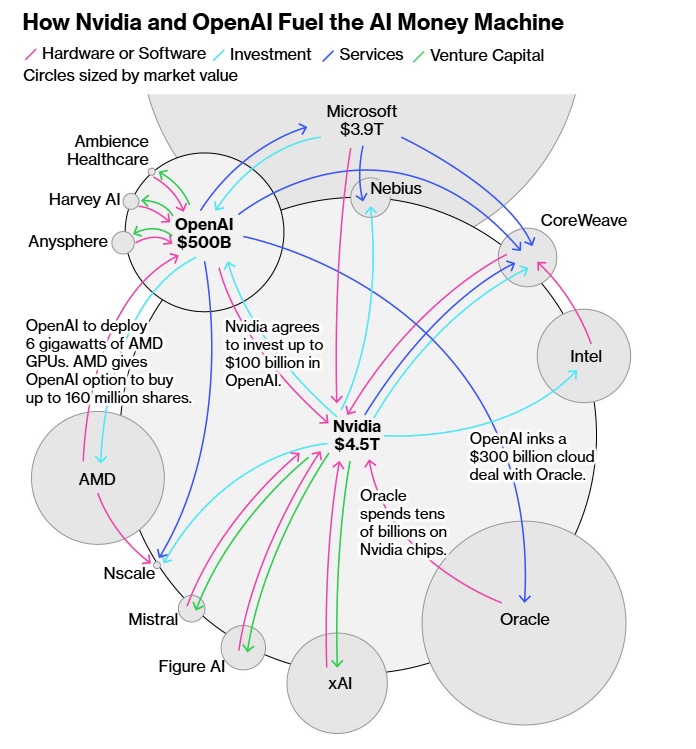
The largest technology companies are spending extraordinary sums on AI infrastructure. Chipmakers like NVIDIA finance customers who buy their chips. Reminiscent of circular “carriage deals” in the Dot Bomb era, technology companies invest in AI companies that become customers of their cloud services. Infrastructure companies borrow against anticipated demand from AI companies, while investors value many of the participants based partly upon the growth generated by the others.  See how that works?

The circularity is becoming difficult to miss. NVIDIA, for example, recently agreed to provide guarantees of up to $105 billion supporting an OpenAI data-center project in Ohio while also investing in OpenAI. Broadcom reportedly is exploring tens of billions of dollars of additional financing tied to AI infrastructure. AI is no longer simply another technology sector. It increasingly influences equity valuations, credit markets, underwriting decisions, infrastructure finance and the allocation of enormous pools of investment capital.

Wall Street consequently has a powerful incentive to believe that the AI buildout will continue.  Because the emperor has new clothes, but is the same old emperor.

Data Center Backlash on Main Street

Then there is Main Street.

Main Street’s experience with AI can look remarkably different.

Musicians and songwriters discover that recordings containing their performances and songs have been copied into training datasets without permission or legal basis. Songwriters discover that their compositions, especially lyrics, may have become inputs to systems capable of producing substitutes for their work. Performers discover that their names, voices and identifying characteristics may have become instructions capable of invoking their identities inside commercial products.  Their property is being taken—there’s that word again—in a massive theft that should involve prison time.  Because if this isn’t criminal copyright infringement, what is?

Drive a few hundred miles away from Nashville or Los Angeles and the property being taken changes, but the complaint sounds remarkably similar.

A farmer is told that a transmission corridor may cross land her family has owned for generations, backed by eminent domain that can force the family to surrender it. A rural community discovers that hundreds or thousands of acres have been assembled for a data center. Residents worry about aquifers, electricity prices, noise, gas generation and transmission lines. Governments offer tax incentives to enormously valuable technology companies while residents are told that the infrastructure is necessary because America must beat China in the AI race.  State and local elected officials make zoning decisions to permit these takings, with votes that only make sense if there’s a quid pro quo under the table.

The common denominator between musicians and farmers isn’t artificial intelligence.

It is consent and coercion.  It’s the callous taking.

But there is a deeper connection. The institutions demanding these resources did not suddenly become powerful with the invention of generative AI. Much of today’s platform economy accumulated extraordinary wealth and political influence during the preceding two decades through business models built around aggregation, scale, data collection and extraordinarily aggressive interpretations of legal safe harbors. Companies such as Meta and Google learned that once a platform becomes sufficiently large, the lives, work, attention, emails, chats, and baby pictures of its users can become inputs to be captured, scraped, optimized, aggregated and monetized.

The ongoing multidistrict litigation over social-media harms (MDL 3047) provides a sobering illustration of where that philosophy can lead. The allegations in the social media harms cases concern platforms accused of designing products to maximize engagement while exposing their own users—including children—to serious harms and exploiting those harms.  Cold blooded. Whatever the ultimate disposition of those cases in MDL 3047, they illustrate a recurring tension in the platform economy: the interests of the human beings using a platform and the protections they enjoy under the law and human rights are routinely trampled by the companies operating it—for the money.  And let’s not forget that when we say “companies” we actually mean the employees who went along with it and got rich doing so.

Generative AI extends that tension from users to inputs.

The same appetite for scale that drove platforms to accumulate and exploit behavioral data now creates an appetite for enormous quantities of creative work, human expression, electricity, water, land and transmission capacity. Scraping supplies one set of inputs. Political influence and infrastructure policy can supply another. And in the most extreme case, the sovereign power of eminent domain delegated to the MDL defendants can ultimately compel a property owner to surrender land for data centers serving the buildout.  If not stopped, this will give Silicon Valley a political control at the federal, state and local levels never seen before.

The mechanisms are legally different. The instinct is strikingly familiar.

Acquire the input first. Argue about permission, compensation and consequences later.  They’re happy to get a license when each artist and songwriter, or mom and child gets a final, non-appealable judgement if the AI companies don’t change the law as they tried and keep trying to do with federal preemption.

That is why the emerging alliance between musicians and landowners is less strange than it initially appears. Both increasingly confront institutions whose enormous financial resources can be converted into political and legal power, and whose growth depends upon obtaining resources belonging to other people.

For the musician, it may be a composition, performance, voice or identity. For the farmer, it may literally be the family farm. And increasingly, it is the perception that enormously powerful companies are building wealth and control over the economy by taking private property and humanity from people who possess considerably less economic and political power.

That is why dismissing the data-center backlash as NIMBYism—or dismissing musicians objecting to unauthorized training as Luddites—fundamentally misunderstands what is happening.

These constituencies are not necessarily anti-technology. They are objecting to a particular economic bargain.

Or, more accurately, the absence of one.

The Politics Are Arriving

This distinction matters because the data-center fight is rapidly escaping zoning commissions and utility proceedings and entering national politics.  This is called “jumping the shark” in some circles.

In Ohio, Sherrod Brown has already run television advertising attacking Senator Jon Husted as the “face of data centers in Ohio.” The National Republican Senatorial Committee reportedly warned AI companies privately that data-center opposition could cost Republicans the Ohio Senate seat and described the issue as a potential problem for the entire election cycle.

Texas Democrats are campaigning on data centers in rural Republican territory. Candidates elsewhere are attacking electricity costs, water consumption, tax subsidies and the conversion of agricultural land.

This is an unusual political coalition because it doesn’t fit comfortably on the traditional left-right axis.

The rancher who doesn’t want a transmission line across his property may be a lifelong Republican. The songwriter who doesn’t want her catalog ingested into a generative model may be a lifelong Democrat. The homeowners who don’t want a 500-megawatt industrial complex next door may have no particular view about AI whatsoever but want to protect their family.

They nevertheless understand the same sentence:

You shouldn’t be able to take something that belongs to me merely because you say your technology needs it.

That may prove considerably more powerful politically than “AI safety.”

What If Data Centers Become Obsolete Stranded Assets?

There is another reason the industry’s present approach seems unnecessarily confrontational and coercive.

Today’s enormous data-center buildout reflects today’s technological architecture. There is no reason to assume that every aspect of that architecture will remain necessary and may become unnecessary before the data center build is completed.

Indeed, NVIDIA—the company most closely associated with the hardware powering hyperscale AI—is simultaneously pushing substantial AI computation in the opposite direction. Its DGX Spark puts powerful model inference, fine-tuning, and autonomous-agent capabilities on a desktop, while its RTX platforms increasingly allow sophisticated AI models and agents to run locally. NVIDIA expressly markets these systems as “reducing the need for cloud-based token generation resources” and, in the case of its AI workstations, as a means to “offload data center compute resources.” This does not eliminate the need for hyperscale facilities, particularly for frontier-model training, but it demonstrates that an increasing share of AI computation can migrate from centralized data centers to local devices.

It’s a trend away from depending on data centers.  And if the answer was, you can’t build a gazillion data centers that inevitably will become stranded assets rather than  take whatever you want, do you think that trend might accelerate?  Constraints are choices.

That does not mean hyperscale data centers are disappearing. Training frontier models and serving enormous numbers of users will continue to require substantial centralized computing resources for a while.

But the direction of travel matters.

Models are becoming smaller and more efficient. Quantization reduces computational requirements. Specialized chips improve inference efficiency. More processing is moving to PCs, workstations, phones, vehicles and edge devices. Some workloads that required a data center yesterday can run locally today; workloads requiring a data center today may run locally tomorrow.

That makes the industry’s political strategy particularly shortsighted.

Why permanently alienate communities, seize land, subsidize massive infrastructure and create a nationwide political opposition movement around an architecture that technology itself is already beginning to decentralize?

True innovation would try to solve that problem if tech companies were constrained.

Take the Theft Out of AI

The same principle applies to music. The answer is not to stop artificial intelligence. The answer is to take the theft out of it.

And that requires acknowledging an uncomfortable fact about the technology as it exists today. Artificial intelligence can theoretically be useful and productive, but the major generative models did not emerge from a pristine laboratory. To one degree or another, the present generation of large models is shadowed by unresolved allegations and litigation concerning massive-scale copyright infringement, unauthorized scraping, collection of personal information and other privacy violations. Courts will ultimately decide many of those claims in their own inefficient way that Big Tech loves so much. But it is impossible to have an intellectually serious conversation about “responsible AI” while pretending that the provenance of today’s models is not itself contaminated.

That history matters because the question is not simply how AI should behave tomorrow. It is also what was taken to build the systems we have today, from whom, and without whose permission.

Just like I never believed that the law would permit “sharing” with 60 million of your closest friends in the Grokster case, I don’t believe that the AI cases will determine that the answer is because an enormously expensive technology has already been built, obtaining consent will be disregarded. (The subtext being, and if it is, we have much bigger problems.)

This isn’t that hard, people. Build models from licensed material. Ask musicians before converting their identities into commercial capabilities. Compensate creators whose work supplies valuable inputs. Give communities meaningful authority over infrastructure imposed upon them. Pay the actual cost of electricity and transmission rather than shifting it onto ratepayers. Don’t hoard power behind the meter while creating massive noise pollution and other negative externalities. Build smaller and more efficient systems.

And where existing models were built from material that should not have been taken in the first place, genuine innovators should be investing just as aggressively in provenance, licensed replacement datasets, machine unlearning and other technologies capable of removing unauthorized inputs as they invest in acquiring more compute.

That would be innovation directed at the problem rather than lobbying directed at avoiding it. Most importantly, stop treating consent as an obstacle to innovation.

The Human Artistry Campaign and Warner Music Group’s own public AI principles point toward the distinction. WMG says AI models should be licensed and that artists and songwriters should have an opt-in before their names, images, likenesses or voices are used in new AI-generated music. That is not anti-AI. It is an attempt to establish the terms under which AI can coexist with human creators. (That’s also not what happened with Suno, which is why Universal and Sony are still suing Suno.)

There is an enormous difference between saying “don’t build it” and saying “don’t build it with things you had no right to take.” Wall Street may not fully appreciate that distinction yet because markets presently reward companies for demonstrating exposure to AI growth—said another way, Wall Street rewards AI companies that take private property.

Main Street understands it instinctively.

A singer’s voice. A songwriter’s composition. A session player’s musical identity. A rancher’s land. A town’s water supply. A family’s electric bill.

They are very different things. But the political argument increasingly surrounding them is remarkably similar:

Innovation does not create an entitlement to somebody else’s property.

AI can be useful. But usefulness does not cleanse provenance, technological achievement does not retroactively supply consent, and scale does not convert unauthorized taking into a legitimate business model rather than a litigious model.

Local AI may eventually make some of today’s massive infrastructure unnecessary. Properly licensed models can create new markets for artists rather than simply competing against them. Assistive AI can make human creators more productive without replacing them.

The choice therefore isn’t between AI and no AI. It is between an AI economy built by consent and one built by extraction.

The companies that recognize that distinction first may ultimately be the genuine innovators. They will stop asking how much they can take before somebody stops them and start asking how to build technology people actually want to live with.

That is how AI earns a social contract. Take the theft out of AI, and a remarkable amount of the opposition may disappear with it.