The Data Center Completion Trap: When Insurance Risk Becomes Stranded Infrastructure

There may be another brake on the AI data-center boom that has received surprisingly little attention: insurance may become a binding constraint on financing and completion long before anyone runs out of enthusiasm for artificial intelligence.

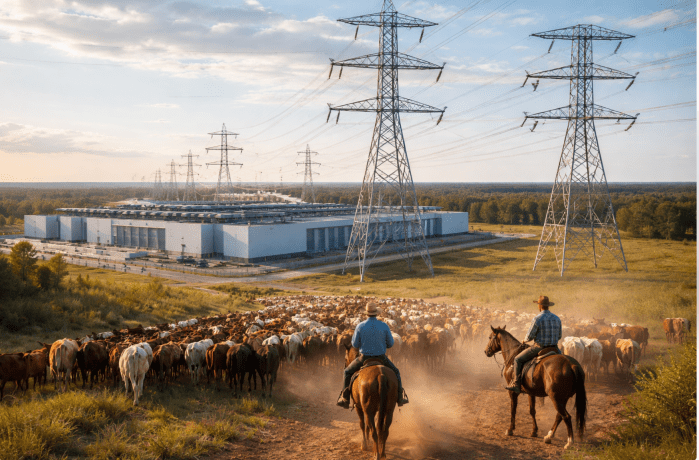
This is not simply a question of whether underwriters will insure a $10 billion building against fire. The deeper problem is that modern hyperscale data centers are becoming extraordinarily large, expensive and interdependent infrastructure projects that struggle to maintain a semblance of a capex construction budget. A single campus can combine data halls, substations, specialized transformers and switchgear, cooling systems, fiber, batteries, transmission infrastructure and, increasingly, dedicated power generation—each component of which is a complex system with a significant overbudget risk.

Once a developer adds on-site generation, what looks like a single data-center development can effectively become two major construction projects—a data center and a power plant. That creates something much more consequential than ordinary construction risk. It creates completion risk. The movie business knows all about completion bonds, but no movie ever cost as much as a data center.

Ninety-Eight Percent Finished Can Still Mean Zero Revenue

A data center is not economically complete merely because the building is standing. It must be electrified. The cooling systems have to work. Transformers and switchgear must be installed and commissioned. Fiber must be connected. The facility must satisfy its performance requirements. And, most importantly, there must actually be enough continuous electricity available to operate it. 24/7/365.

A hypothetical $8 billion facility that is 98% physically complete but cannot obtain its final power connection isn’t necessarily worth $7.84 billion. As an operating data center—which it isn’t—it may be worth very little until somebody solves the missing 2%. It might even be worth zero.

And that is where the insurance problem gets interesting. Traditional builder’s-risk insurance generally responds to physical loss or damage. Delay-in-start-up coverage can protect against certain resulting revenue losses, but ordinarily there must first be an insured event triggering the coverage. A project delayed because a transformer was destroyed in a fire presents a familiar insurance problem.

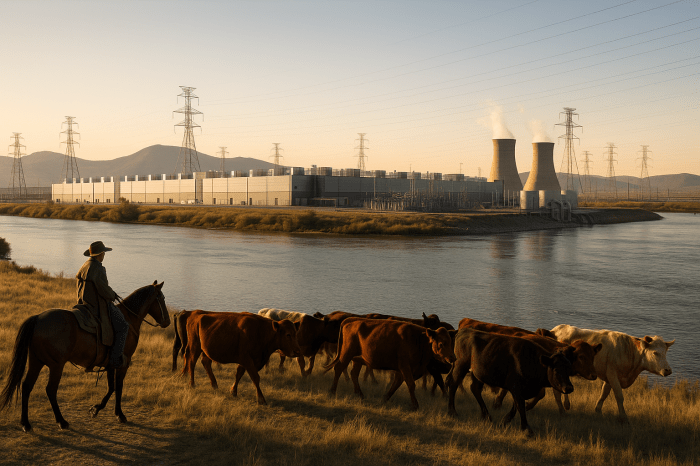
But a project delayed because its grid connection never materializes, a transmission line project is cancelled, a regulator changes course, a federal or state political moratorium intervenes, or sufficient electricity simply isn’t available presents a very different one. This includes a data center that is planned with behind the meter nuclear power, but the nuclear plant cannot get built.

Physical damage is easy to understand. Yet, there can be catastrophic economic loss without catastrophic physical damage. That distinction could become increasingly important as the industry attempts to build larger facilities in places where electricity infrastructure is already the project’s principal constraint.

Now Add the Banks

The problem becomes considerably more interesting when viewed through the capital structure. Large infrastructure projects increasingly rely on project-level financing in which lenders ultimately expect repayment from cash flows generated by the completed facility. During construction, however, lenders typically want considerably more protection against the possibility that the asset never reaches commercial operation. We joke that the music business is the only business in the world where an asset is worth more before it’s put in service than after. Not so funny applied to data centers.

That protection can include sponsor guarantees, cost-overrun commitments, completion guarantees, debt-service support and other forms of recourse. The project’s economics therefore change dramatically depending upon whether it successfully crosses the line from construction risk to operating risk. And that creates what might be called the data-center completion trap.

Imagine an $8 billion data center. Seven billion dollars has already been spent. The buildings are substantially complete. Equipment is installed. Customers may be waiting. Then the transmission solution fails.

Walking away means potentially crystallizing an enormous loss. So spending another $500 million to solve the power problem may appear perfectly rational. Then another problem emerges. Another $750 million may still look rational compared with abandoning the original $7.5 billion. The project has entered the classic sunk-cost problem—but with a particularly dangerous infrastructure twist:

The more capital that has already been sunk into the project, the greater the economic incentive to commit additional capital to rescue it, even as the assumptions that justified the original investment deteriorate. That is the completion trap.

Going Off Grid Doesn’t Necessarily Solve It

One increasingly popular response to grid constraints is behind-the-meter generation. Can’t get enough electricity from the grid? Build your own. That’s not really an answer if you’re actually doing it. It’s right up there with “because China” as the AI rationale. That may solve one problem while creating several others.

The developer now needs not merely a functioning data center but a functioning generating plant. That can introduce fuel-supply agreements, turbines, pipelines, environmental permits, additional construction contracts, emissions requirements and entirely new categories of operating and equipment risk.

The project’s dependency chain gets longer and longer. And every additional dependency creates another possible route by which a nearly completed project can fail to reach commercial operation. Reuters recently reported that grid bottlenecks are pushing businesses toward larger on-site power systems. That trend deserves to be understood not simply as an electricity story.

It is also a risk-transfer story. The grid constraint doesn’t disappear. Some of the risk associated with solving it simply migrates onto the developer’s balance sheet.

The Insurance Capacity Feedback Loop

Now consider what happens to insurers. Insurers don’t evaluate a $10 billion hyperscale campus solely by asking whether the building is likely to catch fire. They also manage aggregate exposure. How much capital is exposed at one location? To one natural catastrophe? To one electrical system? To one equipment manufacturer? To one utility? To one geographic concentration?

Aon has warned that the enormous concentration of value in hyperscale facilities creates the possibility that a single event can produce a portfolio-level loss for insurers and reinsurers. That creates a potentially important feedback loop:

Bigger projects → larger probable maximum losses → scarcer insurance capacity → higher premiums and deductibles → lower available limits → greater retained sponsor risk → tighter lender requirements → higher cost of capital → weaker project economics.

There is something important buried in that sequence. Insurance capacity is itself capital. And unlike GPUs, transformers or gas turbines, developers cannot simply manufacture more of it. An insurer or reinsurer must be willing to put its own balance sheet behind the risk. At sufficient concentrations, the rational answer may be higher prices, lower limits, exclusions, syndication across numerous carriers—or simply no. That can ultimately produce a constraint that receives far less attention than electricity or chips: bankability.

The Bankability Cliff

Consider the conversation among the three principal sources of risk capital. The lender asks: Is completion risk adequately transferred? The insurer answers: We don’t cover all of it.

The sponsor therefore has to retain the uncovered risk. The lender responds: Then we need more sponsor support.

The sponsor recalculates its expected return. At some point, the additional equity, guarantees, contingency reserves, insurance costs and financing expenses required to make the project bankable can push the project’s risk-adjusted return below the sponsor’s required return.

Understand how weirds this is. Nothing has physically prevented construction. There may still be enormous demand for AI. The developer may still believe its long-term demand forecast. And yet the project doesn’t finance.

That is the bankability cliff.

Now Connect It to Stranded Assets

This brings us back to the larger problem surrounding the data-center infrastructure boom. A data center cancelled before construction begins may be embarrassing, but the economic damage is comparatively containable. A project that fails after billions of dollars have been spent is something else entirely. And if this starts happening at a rate that anyone can call “frequently” cold feet will break out all over.

By then there may already be substations, transmission lines, gas pipelines, generating plants, water infrastructure and roads built specifically to accommodate the expected load. There may also be something much harder to reverse: eminent domain.

Property may have been condemned and permanent transmission easements imposed on landowners because planners concluded that enormous future electrical loads required new infrastructure. What happens if the private project that justified that infrastructure never reaches commercial operation? The developer takes a loss—although loss doesn’t quite cover it. The lender restructures the debt. Investors write down their equity.

But the landowner doesn’t get their family ranch back. And the transmission corridor doesn’t magically disappear.

Completion Risk Is Therefore a Public-Policy Question

This suggests that regulators may be asking the wrong question when evaluating enormous new data-center loads.

It isn’t enough to ask: Does the developer have financing? Nor is it enough to ask: Has somebody agreed to build the data center?

The better question is:

Has the developer demonstrated sufficient committed capital, insurance, power supply, equipment availability, completion guarantees and contingency resources to reach commercial operation if the original construction and power plan fails?

That is a much tougher test. And if data centers become poster children for bad investments…lenders will want out.

Before approving billions of dollars of transmission investment—or allowing eminent domain to be exercised on the assumption that a 1-gigawatt data center will exist—regulators might reasonably demand evidence that the project is not merely financeable enough to start. It needs to be financeable enough to finish.

The Risk Nobody Is Pricing Correctly

Much of the debate over stranded AI infrastructure assumes a particular sequence: AI boom → enormous data-center construction → AI bubble bursts → completed facilities become stranded assets.

There is another possibility. Some projects may never reach the third step. The constraint may arrive during construction, when increasingly enormous and interconnected projects encounter an insurance market unwilling to absorb all of their risk, lenders unwilling to accept what remains, and sponsors unwilling or unable to provide unlimited completion support.

The resulting stranded asset would not be an obsolete data center.

It could be a half-completed infrastructure ecosystem. And some portion of that abandoned ecosystem—transmission lines, substations, generating plants, pipelines and condemned rights-of-way—may already have been imposed on communities because somebody’s spreadsheet said the projected load was coming. Or because China.

That is why insurance belongs in the data-center backlash discussion. Insurance risk becomes completion risk. Completion risk becomes credit risk. Credit risk becomes stranded-asset risk. And when public infrastructure and eminent domain have already been committed to the project, private completion risk can become public risk.

The most dangerous data-center forecast may therefore not be the one predicting how much electricity artificial intelligence will consume in 2035. It may be the assumption hidden underneath it: that every project we are building the infrastructure for today will actually make it to the finish line.

That assumption must be phrased as a question: Will this project get finished on time and at least somewhat on budget.

Good luck with that.
A Tale of Two AIs: Wall Street, Main Street, and Taking the Theft Out of Artificial Intelligence

There are increasingly two conversations about artificial intelligence in America, and they are beginning to collide. These are familiar opponents: Wall Street and Main Street.

Pressure from Financial Markets

The first is taking place on Wall Street.

For publicly traded companies that aggregate, distribute, and monetize enormous quantities of creative content, being seen as an AI skeptic is increasingly difficult. Investors expect an AI strategy. Analysts ask about AI on earnings calls. Companies announce AI partnerships (which can get pompous like “global strategic partnerships” and are neither), a few AI licensing arrangements, claimed AI efficiencies, AI products and AI revenue opportunities. Emphasis on the opportunities in the search for elusive ROI.  Warner Music Group, for example, recently told its shareholders that it has taken an “early and aggressive approach” to AI partnerships and emphasized the variable economics of its deals with Suno and other AI companies. Universal Music Group likewise regularly highlights its growing portfolio of “responsible AI” partnerships in financial reporting.

That should hardly be surprising. AI has become deeply embedded in the capital markets themselves.

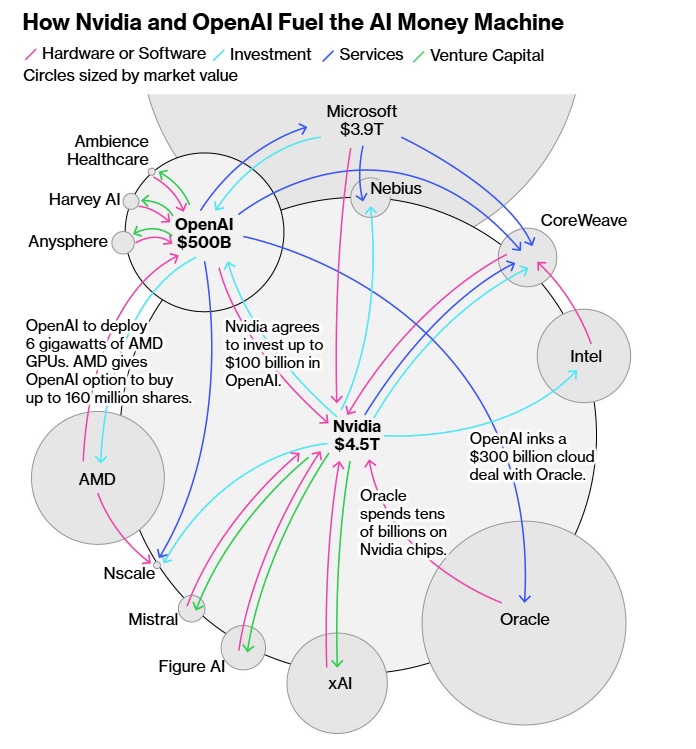
The largest technology companies are spending extraordinary sums on AI infrastructure. Chipmakers like NVIDIA finance customers who buy their chips. Reminiscent of circular “carriage deals” in the Dot Bomb era, technology companies invest in AI companies that become customers of their cloud services. Infrastructure companies borrow against anticipated demand from AI companies, while investors value many of the participants based partly upon the growth generated by the others.  See how that works?

The circularity is becoming difficult to miss. NVIDIA, for example, recently agreed to provide guarantees of up to $105 billion supporting an OpenAI data-center project in Ohio while also investing in OpenAI. Broadcom reportedly is exploring tens of billions of dollars of additional financing tied to AI infrastructure. AI is no longer simply another technology sector. It increasingly influences equity valuations, credit markets, underwriting decisions, infrastructure finance and the allocation of enormous pools of investment capital.

Wall Street consequently has a powerful incentive to believe that the AI buildout will continue.  Because the emperor has new clothes, but is the same old emperor.

Data Center Backlash on Main Street

Then there is Main Street.

Main Street’s experience with AI can look remarkably different.

Musicians and songwriters discover that recordings containing their performances and songs have been copied into training datasets without permission or legal basis. Songwriters discover that their compositions, especially lyrics, may have become inputs to systems capable of producing substitutes for their work. Performers discover that their names, voices and identifying characteristics may have become instructions capable of invoking their identities inside commercial products.  Their property is being taken—there’s that word again—in a massive theft that should involve prison time.  Because if this isn’t criminal copyright infringement, what is?

Drive a few hundred miles away from Nashville or Los Angeles and the property being taken changes, but the complaint sounds remarkably similar.

A farmer is told that a transmission corridor may cross land her family has owned for generations, backed by eminent domain that can force the family to surrender it. A rural community discovers that hundreds or thousands of acres have been assembled for a data center. Residents worry about aquifers, electricity prices, noise, gas generation and transmission lines. Governments offer tax incentives to enormously valuable technology companies while residents are told that the infrastructure is necessary because America must beat China in the AI race.  State and local elected officials make zoning decisions to permit these takings, with votes that only make sense if there’s a quid pro quo under the table.

The common denominator between musicians and farmers isn’t artificial intelligence.

It is consent and coercion.  It’s the callous taking.

But there is a deeper connection. The institutions demanding these resources did not suddenly become powerful with the invention of generative AI. Much of today’s platform economy accumulated extraordinary wealth and political influence during the preceding two decades through business models built around aggregation, scale, data collection and extraordinarily aggressive interpretations of legal safe harbors. Companies such as Meta and Google learned that once a platform becomes sufficiently large, the lives, work, attention, emails, chats, and baby pictures of its users can become inputs to be captured, scraped, optimized, aggregated and monetized.

The ongoing multidistrict litigation over social-media harms (MDL 3047) provides a sobering illustration of where that philosophy can lead. The allegations in the social media harms cases concern platforms accused of designing products to maximize engagement while exposing their own users—including children—to serious harms and exploiting those harms.  Cold blooded. Whatever the ultimate disposition of those cases in MDL 3047, they illustrate a recurring tension in the platform economy: the interests of the human beings using a platform and the protections they enjoy under the law and human rights are routinely trampled by the companies operating it—for the money.  And let’s not forget that when we say “companies” we actually mean the employees who went along with it and got rich doing so.

Generative AI extends that tension from users to inputs.

The same appetite for scale that drove platforms to accumulate and exploit behavioral data now creates an appetite for enormous quantities of creative work, human expression, electricity, water, land and transmission capacity. Scraping supplies one set of inputs. Political influence and infrastructure policy can supply another. And in the most extreme case, the sovereign power of eminent domain delegated to the MDL defendants can ultimately compel a property owner to surrender land for data centers serving the buildout.  If not stopped, this will give Silicon Valley a political control at the federal, state and local levels never seen before.

The mechanisms are legally different. The instinct is strikingly familiar.

Acquire the input first. Argue about permission, compensation and consequences later.  They’re happy to get a license when each artist and songwriter, or mom and child gets a final, non-appealable judgement if the AI companies don’t change the law as they tried and keep trying to do with federal preemption.

That is why the emerging alliance between musicians and landowners is less strange than it initially appears. Both increasingly confront institutions whose enormous financial resources can be converted into political and legal power, and whose growth depends upon obtaining resources belonging to other people.

For the musician, it may be a composition, performance, voice or identity. For the farmer, it may literally be the family farm. And increasingly, it is the perception that enormously powerful companies are building wealth and control over the economy by taking private property and humanity from people who possess considerably less economic and political power.

That is why dismissing the data-center backlash as NIMBYism—or dismissing musicians objecting to unauthorized training as Luddites—fundamentally misunderstands what is happening.

These constituencies are not necessarily anti-technology. They are objecting to a particular economic bargain.

Or, more accurately, the absence of one.

The Politics Are Arriving

This distinction matters because the data-center fight is rapidly escaping zoning commissions and utility proceedings and entering national politics.  This is called “jumping the shark” in some circles.

In Ohio, Sherrod Brown has already run television advertising attacking Senator Jon Husted as the “face of data centers in Ohio.” The National Republican Senatorial Committee reportedly warned AI companies privately that data-center opposition could cost Republicans the Ohio Senate seat and described the issue as a potential problem for the entire election cycle.

Texas Democrats are campaigning on data centers in rural Republican territory. Candidates elsewhere are attacking electricity costs, water consumption, tax subsidies and the conversion of agricultural land.

This is an unusual political coalition because it doesn’t fit comfortably on the traditional left-right axis.

The rancher who doesn’t want a transmission line across his property may be a lifelong Republican. The songwriter who doesn’t want her catalog ingested into a generative model may be a lifelong Democrat. The homeowners who don’t want a 500-megawatt industrial complex next door may have no particular view about AI whatsoever but want to protect their family.

They nevertheless understand the same sentence:

You shouldn’t be able to take something that belongs to me merely because you say your technology needs it.

That may prove considerably more powerful politically than “AI safety.”

What If Data Centers Become Obsolete Stranded Assets?

There is another reason the industry’s present approach seems unnecessarily confrontational and coercive.

Today’s enormous data-center buildout reflects today’s technological architecture. There is no reason to assume that every aspect of that architecture will remain necessary and may become unnecessary before the data center build is completed.

Indeed, NVIDIA—the company most closely associated with the hardware powering hyperscale AI—is simultaneously pushing substantial AI computation in the opposite direction. Its DGX Spark puts powerful model inference, fine-tuning, and autonomous-agent capabilities on a desktop, while its RTX platforms increasingly allow sophisticated AI models and agents to run locally. NVIDIA expressly markets these systems as “reducing the need for cloud-based token generation resources” and, in the case of its AI workstations, as a means to “offload data center compute resources.” This does not eliminate the need for hyperscale facilities, particularly for frontier-model training, but it demonstrates that an increasing share of AI computation can migrate from centralized data centers to local devices.

It’s a trend away from depending on data centers.  And if the answer was, you can’t build a gazillion data centers that inevitably will become stranded assets rather than  take whatever you want, do you think that trend might accelerate?  Constraints are choices.

That does not mean hyperscale data centers are disappearing. Training frontier models and serving enormous numbers of users will continue to require substantial centralized computing resources for a while.

But the direction of travel matters.

Models are becoming smaller and more efficient. Quantization reduces computational requirements. Specialized chips improve inference efficiency. More processing is moving to PCs, workstations, phones, vehicles and edge devices. Some workloads that required a data center yesterday can run locally today; workloads requiring a data center today may run locally tomorrow.

That makes the industry’s political strategy particularly shortsighted.

Why permanently alienate communities, seize land, subsidize massive infrastructure and create a nationwide political opposition movement around an architecture that technology itself is already beginning to decentralize?

True innovation would try to solve that problem if tech companies were constrained.

Take the Theft Out of AI

The same principle applies to music. The answer is not to stop artificial intelligence. The answer is to take the theft out of it.

And that requires acknowledging an uncomfortable fact about the technology as it exists today. Artificial intelligence can theoretically be useful and productive, but the major generative models did not emerge from a pristine laboratory. To one degree or another, the present generation of large models is shadowed by unresolved allegations and litigation concerning massive-scale copyright infringement, unauthorized scraping, collection of personal information and other privacy violations. Courts will ultimately decide many of those claims in their own inefficient way that Big Tech loves so much. But it is impossible to have an intellectually serious conversation about “responsible AI” while pretending that the provenance of today’s models is not itself contaminated.

That history matters because the question is not simply how AI should behave tomorrow. It is also what was taken to build the systems we have today, from whom, and without whose permission.

Just like I never believed that the law would permit “sharing” with 60 million of your closest friends in the Grokster case, I don’t believe that the AI cases will determine that the answer is because an enormously expensive technology has already been built, obtaining consent will be disregarded. (The subtext being, and if it is, we have much bigger problems.)

This isn’t that hard, people. Build models from licensed material. Ask musicians before converting their identities into commercial capabilities. Compensate creators whose work supplies valuable inputs. Give communities meaningful authority over infrastructure imposed upon them. Pay the actual cost of electricity and transmission rather than shifting it onto ratepayers. Don’t hoard power behind the meter while creating massive noise pollution and other negative externalities. Build smaller and more efficient systems.

And where existing models were built from material that should not have been taken in the first place, genuine innovators should be investing just as aggressively in provenance, licensed replacement datasets, machine unlearning and other technologies capable of removing unauthorized inputs as they invest in acquiring more compute.

That would be innovation directed at the problem rather than lobbying directed at avoiding it. Most importantly, stop treating consent as an obstacle to innovation.

The Human Artistry Campaign and Warner Music Group’s own public AI principles point toward the distinction. WMG says AI models should be licensed and that artists and songwriters should have an opt-in before their names, images, likenesses or voices are used in new AI-generated music. That is not anti-AI. It is an attempt to establish the terms under which AI can coexist with human creators. (That’s also not what happened with Suno, which is why Universal and Sony are still suing Suno.)

There is an enormous difference between saying “don’t build it” and saying “don’t build it with things you had no right to take.” Wall Street may not fully appreciate that distinction yet because markets presently reward companies for demonstrating exposure to AI growth—said another way, Wall Street rewards AI companies that take private property.

Main Street understands it instinctively.

A singer’s voice. A songwriter’s composition. A session player’s musical identity. A rancher’s land. A town’s water supply. A family’s electric bill.

They are very different things. But the political argument increasingly surrounding them is remarkably similar:

Innovation does not create an entitlement to somebody else’s property.

AI can be useful. But usefulness does not cleanse provenance, technological achievement does not retroactively supply consent, and scale does not convert unauthorized taking into a legitimate business model rather than a litigious model.

Local AI may eventually make some of today’s massive infrastructure unnecessary. Properly licensed models can create new markets for artists rather than simply competing against them. Assistive AI can make human creators more productive without replacing them.

The choice therefore isn’t between AI and no AI. It is between an AI economy built by consent and one built by extraction.

The companies that recognize that distinction first may ultimately be the genuine innovators. They will stop asking how much they can take before somebody stops them and start asking how to build technology people actually want to live with.

That is how AI earns a social contract. Take the theft out of AI, and a remarkable amount of the opposition may disappear with it.

The AI Capex Party May Be Nearing Last Call

For the past two years, Wall Street has treated artificial intelligence as a one-way trade. Hyperscalers, semiconductor companies, utilities, private-credit funds, and data-center developers have committed hundreds of billions of dollars to what may ultimately become nearly $1 trillion in AI-related infrastructure investment over roughly two years.

The underlying assumption has been remarkably consistent: demand for increasingly powerful AI models will continue growing fast enough to justify unprecedented spending on chips, data centers, transmission lines, substations, and electric generation.

But investment booms rarely end because one assumption proves wrong. They end when several assumptions begin to weaken at the same time.

That appears to be happening.

Ed Dowd’s recent Substack analysis argues that the economics supporting today’s AI buildout are becoming increasingly fragile. Financing is tightening. Enterprise customers are demanding clearer returns on investment. Open-weight models continue improving while driving prices lower. And perhaps most importantly, the physical infrastructure required to support AI is becoming a political issue.

Gary Marcus recently challenged David Sacks’ argument that regulation is the principal threat to American AI leadership (Sacks really needs some new sheet music). Marcus instead argued that the industry faces a far more fundamental economic problem:

“The real issue is that LLMs are commodities; lots of people know how to make them, and everybody is doing more or less the same thing, training on more or less the same data. That means nobody has a technical moat. Which means you get price wars and low margins and more and more competitors over time.”

If Marcus is right, Wall Street may eventually discover that AI resembles cloud computing more than pharmaceuticals. There may be tremendous demand—but not necessarily extraordinary profits. That observation dovetails with Goldman Sachs’ increasingly cautious assessment of the AI investment cycle. Goldman has repeatedly warned investors that the buildout depends on continued access to capital, sustained enterprise demand, adequate electric power, and enough economically valuable use cases to justify unprecedented capital expenditures.

AI does not exist in ‘the cloud.’ It exists on electric grids. Every new model depends on substations, transmission lines, transformers, cooling systems, water supplies, and local political consent.

For months, we’ve tracked what has become a genuine data center backlash. Communities across Texas, Georgia, Louisiana, Virginia, Oklahoma, Utah, Alabama, and elsewhere are increasingly questioning the costs of hosting massive AI infrastructure.

Politicians, meanwhile, are discovering that AI infrastructure is much easier to announce than it is to build. Many governors and local officials have promoted data centers by assuring taxpayers that the projects will ‘pay their own way.’ But that message begins to unravel the moment the infrastructure breaks ground or annexes farmland.

A homeowner facing a 765-kV transmission line across family property is unlikely to be persuaded that the project is privately financed. Likewise, a rancher confronting eminent domain does not care whether the transmission costs appear on a utility bill, a corporate balance sheet, or a tax-abatement agreement. The injury is the same: the family home, ranch, or farm is permanently altered to support infrastructure serving distant customers—who are often anonymous.

In the Texas Hill Country, landowners have mobilized against new transmission corridors intended to serve future electric demand, including AI-related growth. In Coweta County, Georgia, residents organized after learning that transmission infrastructure associated with large-scale data-center development could cut through long-held family properties. The debate quickly ceased being about economics and became about land, community, and the limits of eminent domain.

This is where many elected officials have found themselves trying to have it both ways. They assure taxpayers that private investment will shoulder the costs while simultaneously offering substantial tax abatements, infrastructure incentives, expedited permitting, and other forms of public support. Then, when opposition emerges, they discover that the political issue is no longer who pays for the infrastructure—it’s who lives with it.

For families whose property lies in the path of a transmission corridor, ‘the data centers will pay for themselves’ is not an answer. Their concern is not the financing model. Their concern is keeping the home that has been in the family for generations.

None of this means AI is a passing fad. Transformative technologies often survive speculative bubbles. The internet certainly did. But many companies that financed the dot-com boom did not survive intact, and many investors paid dearly for assuming that technological transformation automatically translated into sustainable profits.

Today’s AI investment cycle rests on multiple pillars: inexpensive capital, robust enterprise demand, premium pricing, abundant electricity, and political support for rapid infrastructure expansion. Gary Marcus questions the durability of the competitive moat. Goldman Sachs questions whether the economics can support the investment. Communities across America are questioning whether they should bear the physical burdens.

Those three conversations are converging. The story is no longer simply about faster models or larger training runs. It is about economics, infrastructure, and public acceptance. The market has spent the last two years pricing AI as though all three will remain aligned indefinitely. History suggests that is a very demanding assumption.

Data Center Backlash: Eminent Domain and Stranded Asset Forecast Risk

The most important data center story today wasn’t a zoning hearing, a transmission line fight, or a new hyperscaler valuation announcement.

The most important story is a poll.  And that poll may not only capture the sentiment of the public, it may also indicate which way elected officials and financiers are leaning, too.


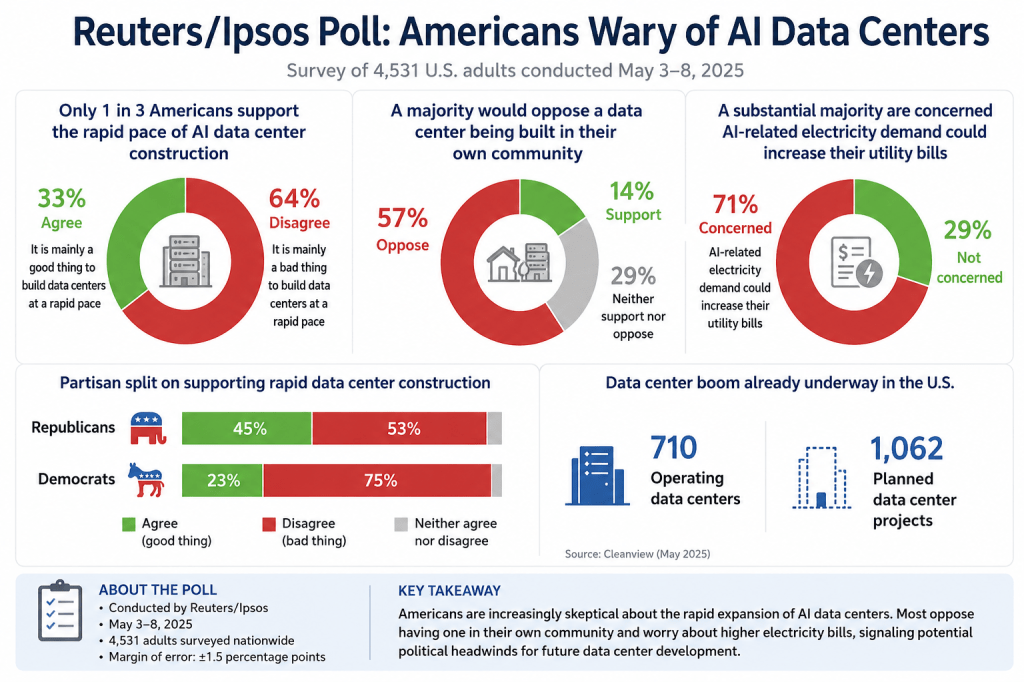
A new Reuters/Ipsos survey found that only one-third of Americans support the current pace of AI data center construction, while nearly two-thirds oppose it. More than half said they would oppose a data center in their own community, and a substantial majority expressed concern that AI-related electricity demand could increase their utility bills.

The six-day poll, which surveyed 4,531 people across the country and closed on Monday, showed just 33% of Americans agreed with a statement that it was mainly a good thing to build data centers at a rapid pace. Some 64% disagreed….Some 57% of people surveyed – including two-thirds of Democrats and half of ‌Republicans – also said they would oppose a data center ⁠being built in their community. Just 14% of survey takers said they were okay with a center being built near them, according to the Reuters/Ipsos poll.

The lopsided result should not be surprising.

For the past two years, the public conversation around data centers has focused on American AI leadership (“because China”), economic development, and technological competitiveness. But many communities are experiencing something very different: transmission line easements criss-crossing private property, industrial-scale facilities near homes, rising utility concerns, water consumption, noise, and tax incentives for some of the world’s largest companies.  It may be starting to dawn on the public why the White House AI Czar David Sacks was so obsessed with blocking any state laws that got in the way of AI.

In some cases, the issue goes even further. Landowners are being asked to surrender property rights through eminent domain—or the threat of eminent domain—so that transmission infrastructure can be built to serve facilities whose ultimate beneficiaries are among the wealthiest technology companies in the world.

Imagine you were the man who fell to earth and you knew nothing about AI workflow.  Would you look at all these data centers, substations, behind the meter nuclear reactors and transmission lines and say “oh, that makes total sense”?  Or would you ask what are these people thinking building a supply chain this kludgy with myriad points of failure?  Data centers in space?  Really?  What could possibly go wrong?

That is where the national security narrative begins to collide with local reality. “We have to do this because China” is a powerful slogan in Washington. For many landowners outside the Imperial City, however, it begins to ring hollow when the immediate consequence is a transmission easement across family property that will never happen in an urban setting.  

This is particularly true when the economic justification depends on AI demand forecasts that may not even be tested—much less achieved—for years. Viewed from a kitchen window looking out at a new transmission corridor in what used to be your vegetable garden or a pasture for livestock, the sacrifice is immediate and personal, while the promised strategic benefits remain abstract and distant.

We’ve already seen an econometric study from Professor Michael Hicks at Ball State University showing that all the hundreds of data centers in Texas have led to pretty much a wash in job creation, a major selling point that few ever believed.  A University of Texas study shows that data centers could potentially account for 3% to 9% of Texas’ water use by 2040, according to a new white paper. In other words, Big Data has largely been talking about the benefits of AI while residents have been living with the costs of that infrastructure.

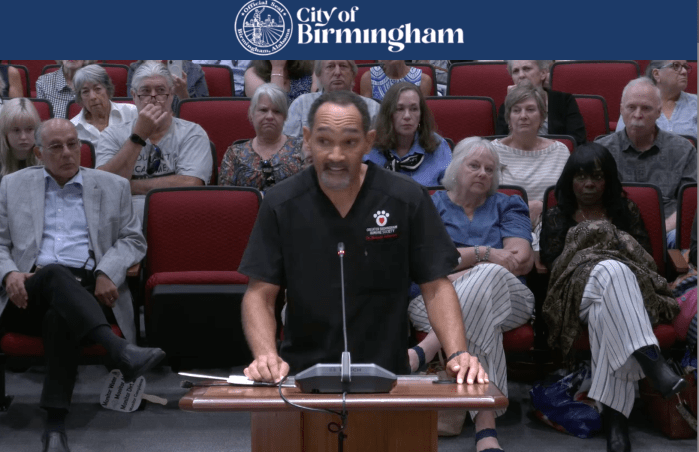
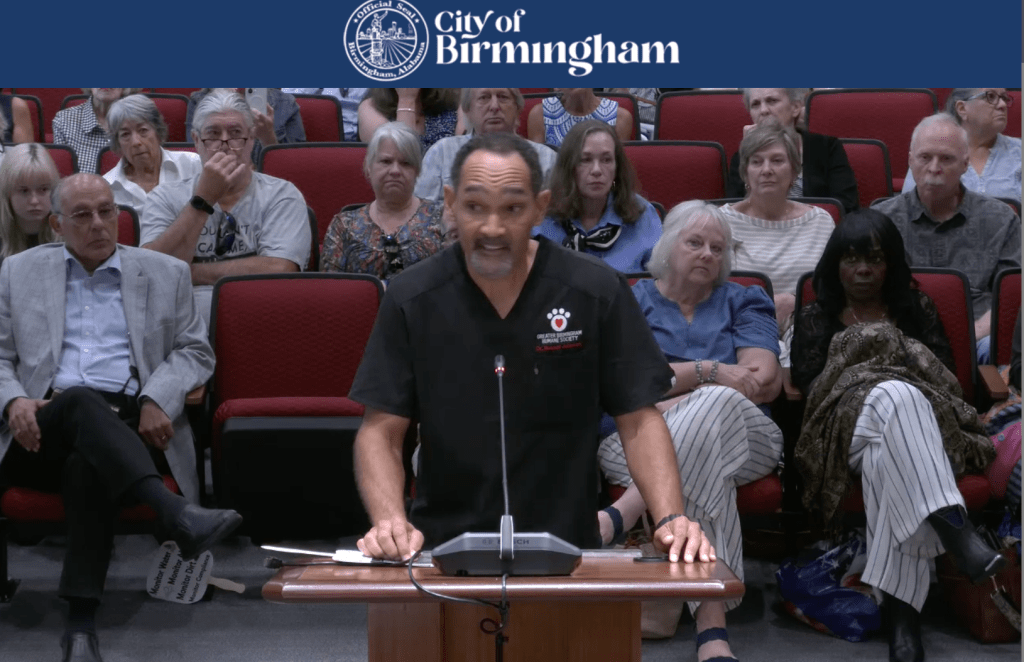
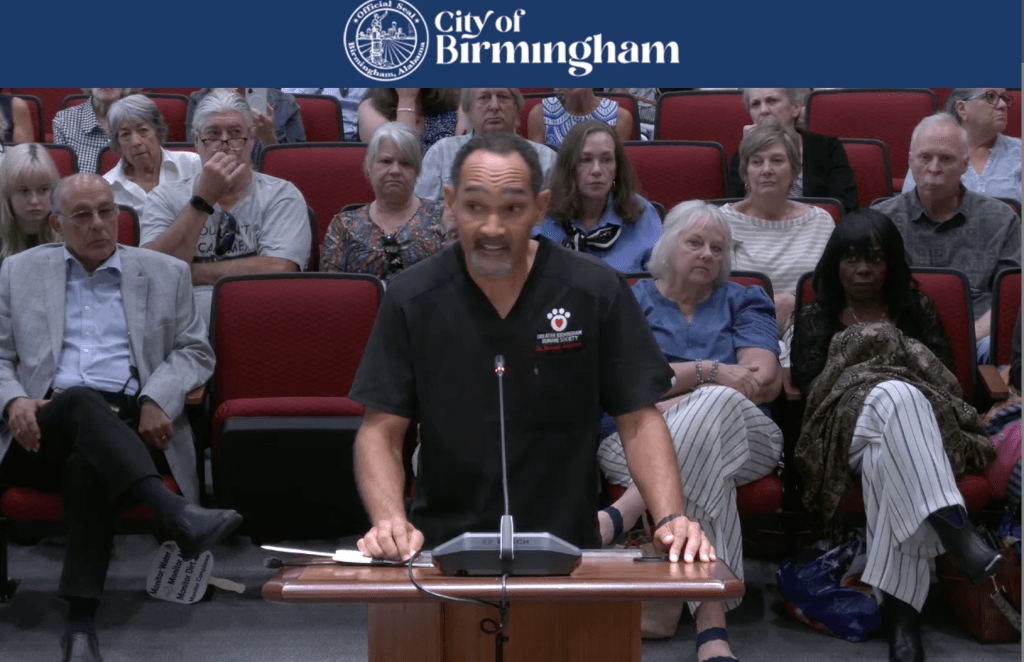
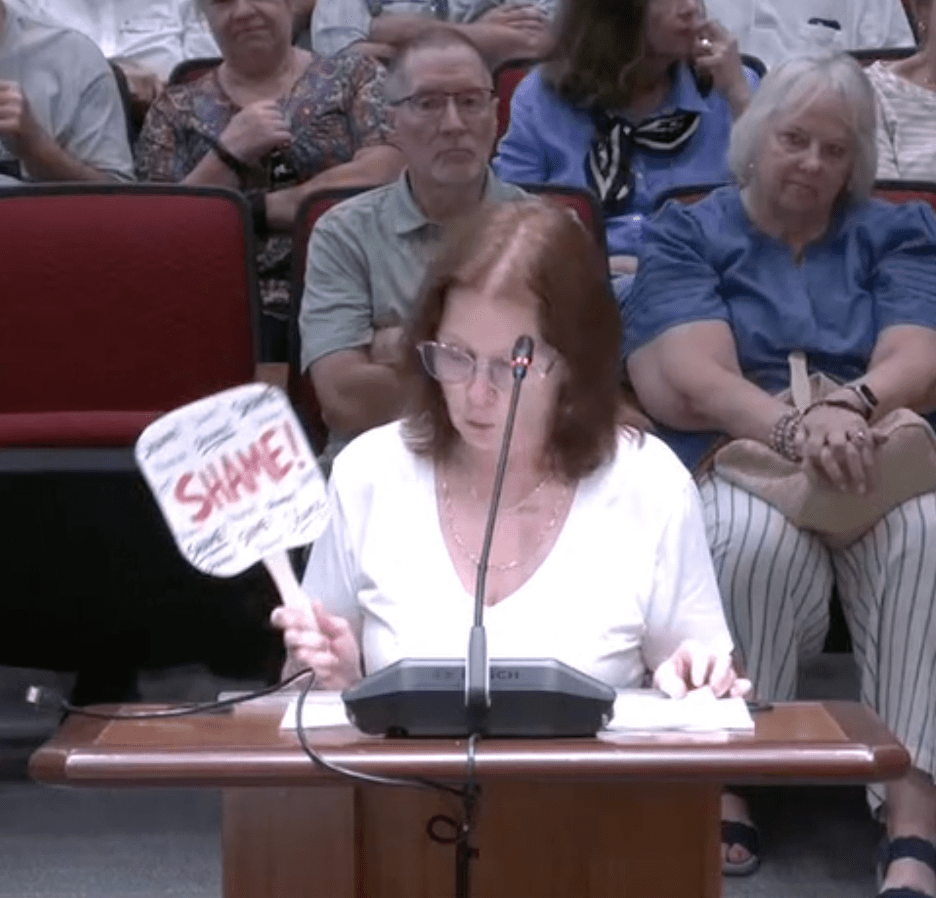
Chief Veterinary Officer for Greater Birmingham Humane Society Testifying against data center
Reverse Angle Showing City Council Left the building

The Reuters/Ipsos poll suggests the issue may be evolving from a collection of local land-use disputes into a national political movement. Historically, that is the point where elected officials begin to change their behavior. Local opposition can often be dismissed as isolated resistance. National polling is harder to ignore and could be the harbinger of somebody getting unelected.

The challenge for policymakers, utilities, and developers is that public concerns are becoming increasingly tangible while many projected benefits remain tied to forecasts extending years into the future with no current evidence. Voters tend to react more strongly to immediate and permanent impacts than to promised future gains that may never come to pass, particularly gains to other people who don’t have a transmission line in their garden or who were not forced to sell their family home to a power company.

That leads to a data center mobilization question that has received far less attention than corrupting farm land, water use, noise, or electricity rates: what happens if the forecasts are simply wrong?


Communities are being asked to accept transmission corridors, substations, power plants, and massive industrial facilities today based on projections of future AI demand that may extend a decade or more into the future. Yet the economics of AI remain highly uncertain as this week’s Google $85 billion equity round confirms.  When Google’s AI capital expenditures exceeded even Google’s free cash flow, the Leviathan of Mountain View turned to a Silicon Valley favorite:  Other people’s money. Revenue models are still evolving, competition is intense, and many of the assumptions underlying today’s infrastructure buildout have not yet been tested through a full business cycle.

Crucially, Investors are funding unprecedented AI capex on the assumption of durable competitive advantages, yet the underlying LLM asset increasingly exhibits commodity characteristics. Meaning the models are all very similar in the fundamental components. As hyperscalers converge on functionally similar models, infrastructure, and services at extraordinary cost, there is less and less that distinguishes one from the other.  When Google chooses to finance capex out of equity rather than continue financing from free cash flow and debt, that may also tell us something about the appetite of lenders getting a little skeptical.

It’s not just Google.  Consider the implications of the recent reports surrounding SoftBank’s OpenAI investment. SoftBank participated in OpenAI’s February 2026 funding round at a valuation of approximately $840 billion and emerged with roughly 13% ownership. On paper, SoftBank’s stake in OpenAI carried an implied value of approximately $109 billion. 

Yet when SoftBank reportedly sought to get a margin loan on those same shares a few weeks ago (three months after the $840 billion valuation was set) using that position as collateral, lenders appear to have viewed the value of the OpenAI shares very differently. The company initially sought a $10 billion loan secured by its OpenAI shares, later reducing the request to approximately $6 billion after lender interest reportedly proved limited. Even at the lower amount, loan negotiations have reportedly stalled.

The significance is not just  that SoftBank’s OpenAI position is worth only $6 billion (implied $46B valuation) or $10 billion as margin loan collateral, if that. Rather, it highlights the distinction between venture valuation, financing valuation, and realizable value. An $840 billion venture valuation reflects what investors were willing to pay in a private financing round under specific assumptions about future growth, profitability, and market structure.

A margin lender asks a different question: if the collateral must be liquidated under adverse circumstances like a bubble burst or the recent semiconductor crash, what is it actually worth? The resulting margin discount can be substantial, even taking into account the usual 50%-ish haircut on marginable securities. For AI investors, this episode may be one of the first visible indications that sophisticated credit markets are assigning materially different risk assessments to AI assets than those implied by headline-grabbing private-market valuations fueled by cheerleading from the financial press and, it must be said, the Oval Office.

Similar valuation disconnects have appeared before other major public offerings, including Spotify’s direct listing, WeWork’s failed IPO, and several high-profile technology listings where private-market expectations ultimately confronted public-market price discovery. For AI investors, the significance is less about OpenAI itself than what the episode may reveal about the difference between AI forecasts and the willingness of sophisticated creditors to finance those assumptions with actual cash.


If those forecasts prove overly optimistic, the result may not simply be disappointed investors. The result could be stranded assets: transmission lines cutting across ranches and farms, substations occupying valuable land, and industrial facilities looming over communities long after the expected economic justification has faded. That burden may ultimately become the defining political challenge of the AI infrastructure era. People are not merely being asked to tolerate temporary construction. They are being asked to accept permanent changes both to their homes, to their property ownership, and to their communities in support of forecasts that may or may not materialize. If a ranch is involuntarily divided, a neighborhood industrialized, or a home taken for infrastructure justified by projected future AI demand, the consequences are real regardless of whether the forecast is ultimately correct.

The Reuters/Ipsos poll suggests that the next phase of the debate may be less about artificial intelligence itself and more about who bears the risks, costs, and consequences of the infrastructure being built to support it—and who bears the consequences for an unpopular mobilization if those forecasts turn out to be wrong.

That conversation—and the inevitable litigation—is only beginning.

Data Center Backlash SITREP: Birmingham / Oxmoor Valley


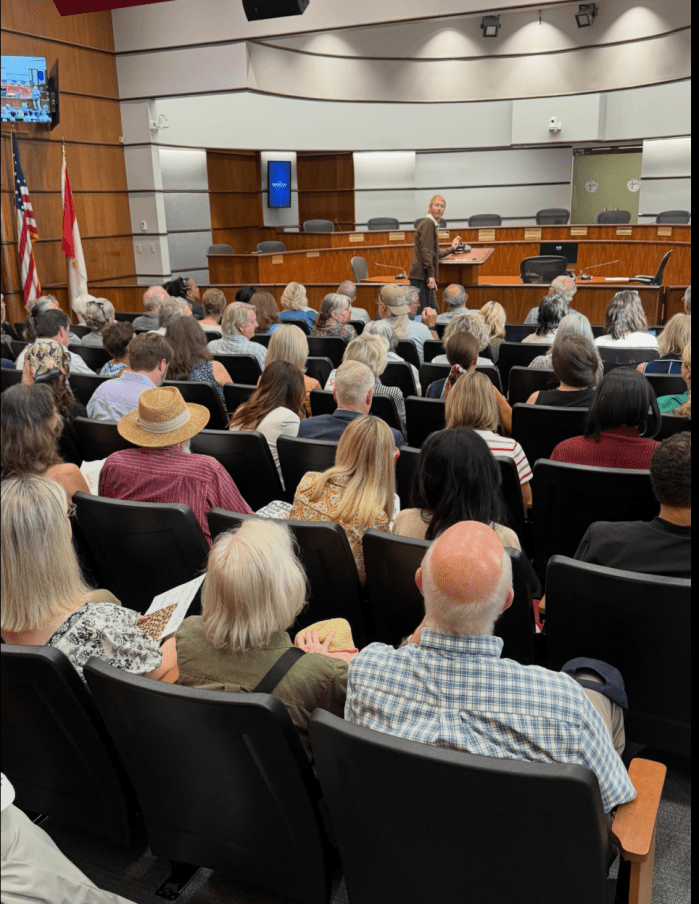
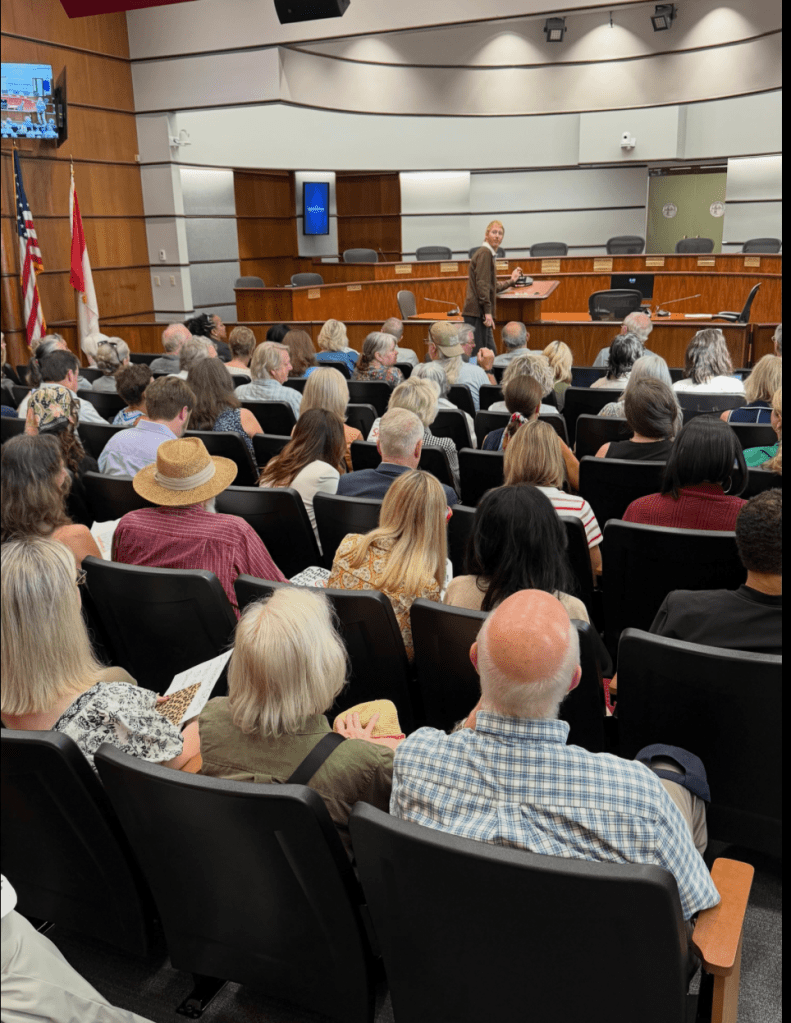
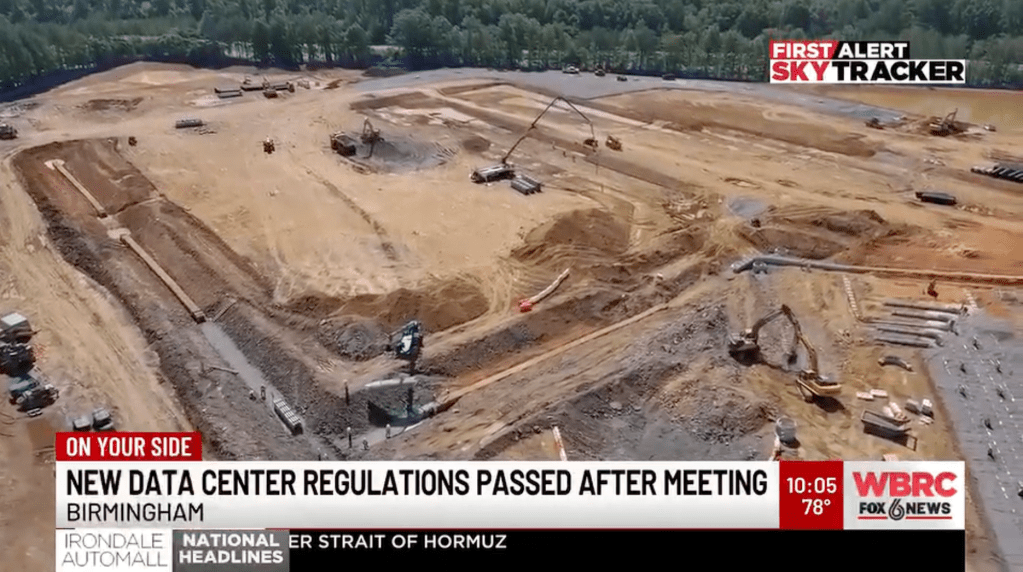
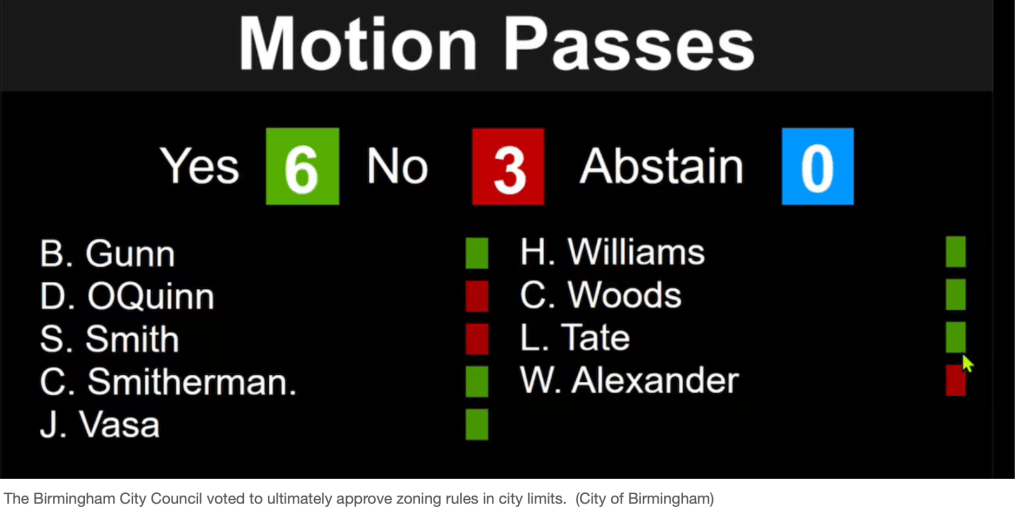
Birmingham’s data-center fight is now a full local legitimacy crisis. The City Council voted 6–3 to pass very unpopular hyperscale data-center regulations after a nearly five-hour meeting and nearly three hours of public hearing where every constituent spoke against the regulations. The ordinance creates 20 protective conditions, but also removes the special-exception requirement for hyperscale projects that meet those conditions.

Current Situation

The live Birmingham objections are not primarily about transmission lines. They are about data center buildout zoning, process, neighborhood impacts, animal welfare, and whether the planned Nebius hyperscale data center slipped through before the city caught up and caught on.

Residents have filed a class-action lawsuit seeking to stop construction. The lawsuit also disputes power-related infrastructure, including a proposed substation and switching station tied to the project.

Local reporters: Laura Harksen/WBRC News; Javacia Harris Brewster/Birmingham Times

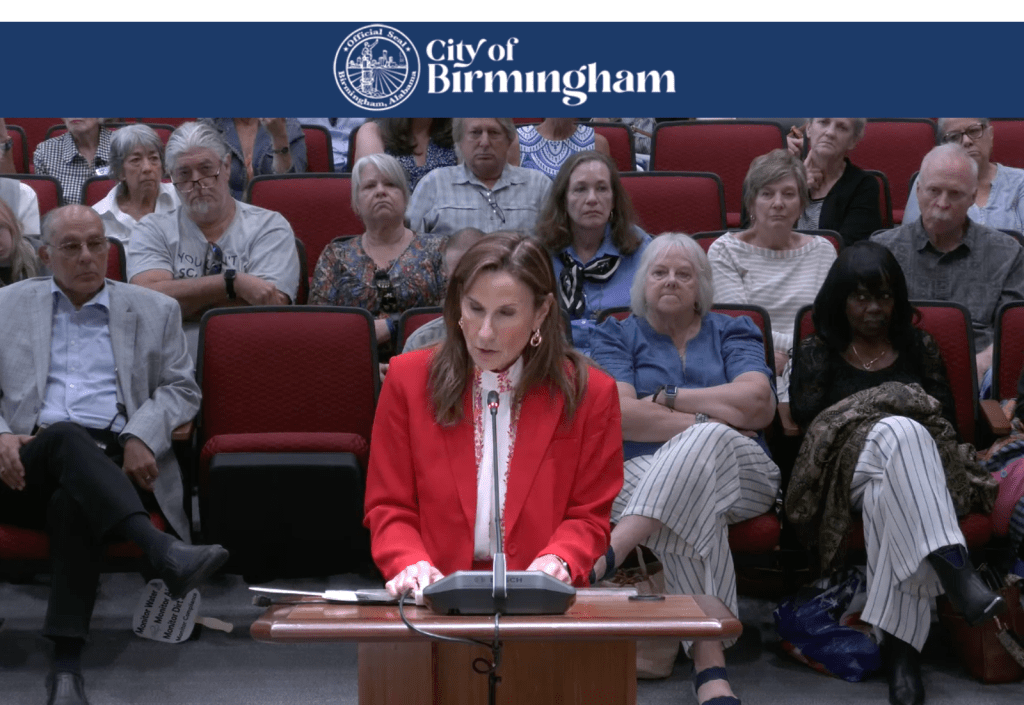
Local organizations: Allison Black Cornelius, CEO of Greater Birmingham Humane Society, Dr. Russell Johnson, DVM, Chief Veterinary Officer, Greater Birmingham Humane Society

Allison Black Cornelius
Dr. Russell Johnson, DVM

Severity: High+ / Approaching Severe

Backlash Index

Top complaints:

1. Loss of public process and consultation over permanent change to city.
2. Grandfathering and moratorium evasion.
3. Animal welfare and affects on planned Greater Birmingham Humane Society medical campus
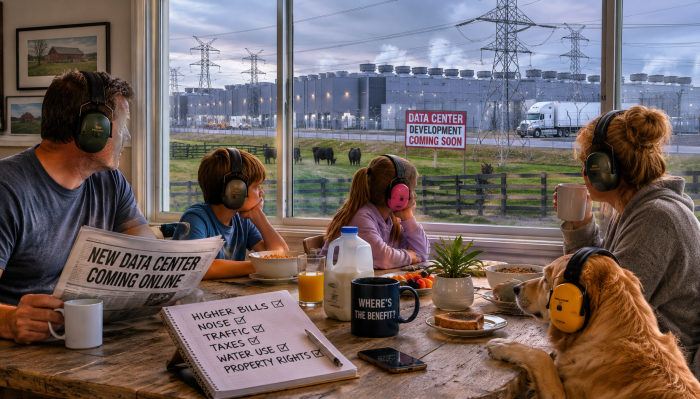
4. Noise, heat, water, traffic, and light pollution.
5. Public health, property values and quality-of-life concerns.

Public Opposition Meter

– Council vote: 6–3.
– Nearly three hours of public hearing.
– Litigation active.
– Organized opposition including Protect Oxmoor Coalition.
Greater Birmingham Humane Society petition and related community petition.
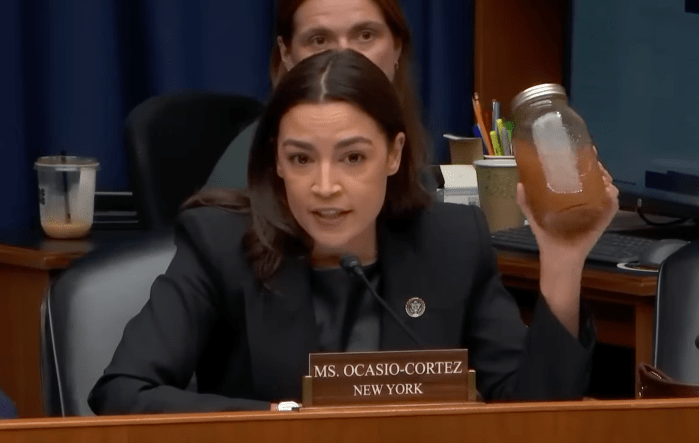
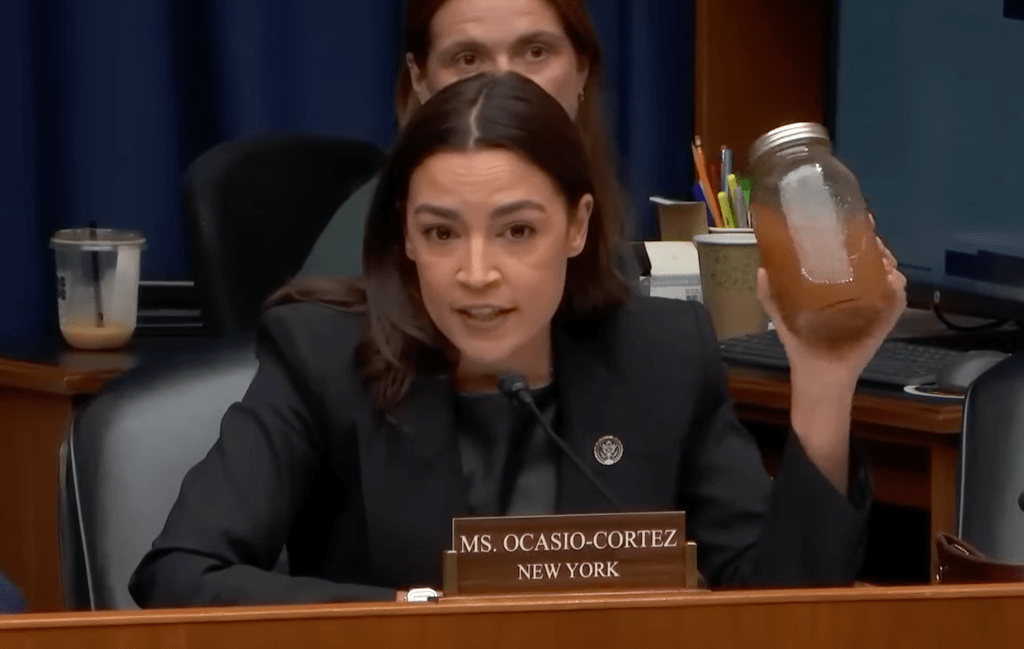
– Participation by community groups, environmental advocates, political candidates, and DSOC/DSA-type activists aligned with Sen. Sanders;Rep. AOC moratorium.

Government / Community Reaction

Moratorium → ordinance rewrite → packed hearing → split council vote → lawsuit → amended complaint → petition escalation.

Future Issues

1. Transmission and grid infrastructure.
2. Cost socialization and ratepayer exposure.
3. Stranded asset risk.
4. Public health and heat modeling.
5. Tax incentives and land-flip narratives.

Birmingham is not yet a transmission-line fight. It is a process, zoning, animal-welfare, neighborhood-impact, and legitimacy fight with power infrastructure beginning to surface through substations and switching stations.

Current status: zoning, process, GBHS, noise, heat, water, traffic, property values, litigation.

Future conflicts: substations, grid upgrades, cost socialization, ratepayer exposure, and stranded asset risk.

The Data Center Backlash Has Arrived

For years, the political conversation around AI data centers followed a familiar script that was straight out of the Chamber of Commerce. Governors competed to announce the next hyperscale campus. Counties rezoned farmland and conservation land into heavy industrial corridors. Legislatures approved enormous tax abatements with little debate. Utilities promised “economic development.” And local officials were told that if they moved too slowly, some other state would take the project instead. Kind of like because China.

Residents in Crowell, Texas are being forced to live with constant artificial daylight because of Google’s AI data center that is being built right next to them. Residents report severe 24/7 light pollution that creates artificial daylight at night (photo proof shown)

Why? Because even 10 years ago it was self-evidently true that there was no political opposition to Big Tech and nobody looked too hard at the reality of data centers in the places we had observable data like Oregon, for example. If they had, they would have known there was one thing that was absolutely true—data centers were not factories and they produced higher electric bills and fewer jobs. At least once the sugar high of construction had passed.

And speaking of jobs, in a November 2025 difference-in-differences study, economist Michael J. Hicks examined every data center opened in Texas and found zero statistically significant net employment effect — job gains in the data center sector were fully offset by losses in other industries, yielding an average treatment effect of roughly 46 workers per facility that the author concludes is “correctly interpreted as zero,” less than one-tenth the jobs generated by a single Walmart Supercenter. 

Good Jobs First has found that the three states that have measured their data center return on investment lose 52 to 91 cents on the dollar, and in Virginia alone, the sales and use tax exemption for data centers consumed 81.3% of the state’s entire economic development incentives budget in FY 2024.

But it’s not just light pollution. Even though it was patently obvious that the massive data centers that were getting built in Louisiana, Georgia, Utah and Nevada were vastly larger than the already operating data centers in Oregon and were guaranteed to chew up the environment way more, nobody bothered to put 2 and 2 together and check how deep the foundations were compared to local aquifers.

Just because she’s a socialist, doesn’t mean she’s wrong.

That script is now breaking down. I’m shocked, said no one.

As we told the UK Intellectual Property Office:

We call the IPO’s attention to the real-world example of the U.S. State of Oregon, a state that is roughly the geographical size of the UK.  Google built the first Oregon data centre in The Dalles, Oregon in 2006.  Oregon now has 125 of the very data centres that Big Tech will necessarily need to build in the UK to implement AI.  In other words, Oregon was sold much the same story that Big Tech is selling you today.

The rapid growth of Oregon data centres driven by the same tech giants like Amazon, Apple, Google, Oracle, and Meta, has significantly increased Oregon’s demand for electricity. This surge in demand has led to higher power costs, which are often passed on to local rate payers while data centre owners receive tax benefits.  This increase in price foreshadows the market effect of crowding out local rate payers in the rush for electricity to run AI—demand will only increase and increase substantially as we enter what the International Energy Agency has called “the age of electricity”.

Portland General Electric, a local power operator, has faced increasing criticism for raising rates to accommodate the encroaching electrical power needs of these data centers. Local residents argue that they unfairly bear the increased electrical costs while data centers benefit from tax incentives and other advantages granted by government. 

This is particularly galling in that the hydroelectric power in Oregon is largely produced by massive taxpayer-funded hydroelectric and other power projects built long ago. The relatively recent 125 Oregon data centres received significant tax incentives during their construction to be offset by a promise of future jobs.  While there were new temporary jobs created during the construction phase of the data centres, there are relatively few permanent jobs required to operate them long term as one would expect from digitized assets owned by AI platforms.

Of course, the UK has approximately 16 times the population of Oregon.  Given this disparity, it seems plausible that whatever problems that Oregon has with the concentration of data centers, the UK will have those same problems many times over due to the concentration of populations.

This message is getting through to elected officials around the world because citizens are freaking out.

Quietly at first, and then all at once, states and local governments across the country began pushing back. Some are freezing approvals entirely. Others are reconsidering billions in tax incentives. Some are demanding that data centers pay the real cost of the transmission infrastructure they require instead of socializing those costs onto ordinary ratepayers and anyone else who drinks water and breathes air.

This is no longer a niche zoning issue in Northern Virginia or some European bureaucratic nonsense. It is becoming a national political movement that has some real populist overtones worthy of a Brexiteer. According to the National Conference of State Legislatures (NCSL), at least 11 states have introduced statewide moratorium or ban legislation targeting data centers. Meanwhile, Good Jobs First reports more than 60 local moratorium efforts nationwidethat at least 14 states and scores of localities are failing to disclose tax abatement revenue losses they are suffering to data centers — even though they have been required to do so under Generally Accepted Accounting Principles (GAAP) since FY 2017.

The reasons vary by region as you’d suspect, but the themes are becoming remarkably consistent, many of which Artist Rights Institute raised in our comments on the US AI Action Plan and the UK IPO AI consultation:

• massive electricity demand;
• water consumption;
• transmission line expansion;
• opaque tax subsidies;
• industrialization of rural communities;
• secrecy surrounding the ultimate hyperscale users;
• and growing fear that ordinary households will subsidize AI infrastructure through higher utility bills.

What is striking is not merely the existence of resistance. It is the geographic breadth of it.

In Texas, lawmakers enacted new large-load interconnection rules while Hill County adopted a temporary construction pause and Agriculture Commissioner Sid Miller publicly called for broader scrutiny of data centers. In Virginia, long considered the unquestioned capital of the data center industry, legislators are openly debating whether to scale back tax exemptions that helped fuel “Data Center Alley.” In Illinois, Governor Pritzker proposed suspending new tax incentives entirely for two years.

Even places that aggressively courted data centers are beginning to hesitate.

In Reno, Nevada, officials adopted a pause on approving new data centers while they reevaluate land-use and infrastructure impacts. Duh. Ya think?

The Reno–Tahoe industrial corridor became a symbol of how quickly hyperscale development can transform an entire region once incentives and transmission infrastructure align. Nevada approved hundreds of millions in projected abatements over the last decade. Now local officials are asking whether the public actually understood the scale of what was being built. If you build it they will come, and they will take a huge dump in your backyard.

That same questions are emerging everywhere else: Who is the real end user? Who pays for the substations and 765-kV transmission lines? What happens if AI demand projections collapse halfway through construction? And why are local taxpayers subsidizing facilities that often employ surprisingly few permanent workers once operational? Well…not really surprisingly, but surprisingly if you believed the Chamber of Commerce hoorah.

The politics are changing because the physical footprint of AI is no longer abstract. The cloud is becoming visible. And you cannot bribe your way out of that one.

Pour some Sucre on them….

Residents now see the cooling towers. They see the transmission corridors. They hear the backup generators. In some communities they are learning about low-frequency industrial noise and infrasound issues that do not show up on ordinary decibel measurements. They see conservation land rezoned into industrial districts almost overnight. They see shell companies quietly assembling land while refusing to identify the ultimate hyperscale beneficiary.

Most importantly, they are beginning to understand that these projects are not temporary construction booms. They are permanent industrialization decisions. A 765-kV transmission corridor is not a pop-up startup. Neither is a hyperscale campus consuming as much electricity as a mid-sized city. And once the infrastructure is built, communities live with the consequences for generations.

The result is a new kind of political coalition that cuts across ideological lines. Environmental advocates, fiscal conservatives, rural landowners, grid-reliability hawks, and anti-subsidy activists are increasingly finding themselves on the same side of the debate. That does not mean the data center industry is stopping. Far from it. Billions are still flowing into AI infrastructure. Utilities continue planning enormous generation and transmission expansions. States remain eager for construction spending and property tax growth.

But the era of automatic approval is ending. The central political question is no longer whether AI infrastructure will expand. It is who bears the cost.

And there is another revealing development occurring at the federal level. What does it tell you that President Trump reportedly pulled back an executive-order framework that would have required certain AI labs to obtain government cybersecurity approval or clearance before launching advanced systems?

Whatever one thinks of the policy itself, the episode suggests intense behind-the-scenes conflict inside the administration and the AI industry over whether any meaningful federal guardrails should exist at all. Sources around Washington describe the push as a last-ditch effort by what critics derisively call the “Zombie AI Viceroy” David Sacks, the lobbyist who seemingly cannot be fired because the entire AI infrastructure race has become too politically and financially entangled. We will see whether federal safeguards reappear in another form. But at this moment, the practical reality is striking: the only governments actively imposing meaningful friction on AI infrastructure expansion are states, counties, and local municipalities.

State and Local Data Center Restriction / Tax Rollback Tracker (May 2026)

Alabama — Considering rules requiring data centers to bear infrastructure/grid costs

Arizona — Chandler pause; grid-cost proposals under consideration

California — Bills addressing ratepayer and environmental protections

Colorado — Denver moratorium; Larimer County pause; Logan County restrictions

Connecticut — Morris moratorium; Groton zoning restrictions

Florida — Enacted protections for local zoning authority and ratepayer safeguards

Georgia — HB 1059 introduced forbidding local permitting until December 2028; local pauses; estimated $2.5 billion per year in tax abatement revenue losses (highest in nation)

Illinois — Governor called for two-year pause of data center tax incentives

Indiana — Considering restructuring of tax incentive revenue sharing; fails to disclose data center costs despite ranking fifth-best in subsidy transparency nationally

Louisiana — New Orleans temporary moratorium

Maine — LD 307 moratorium on data centers over 20 MW (vetoed by Governor); local moratoria

Maryland — Proposed statewide approval restrictions (SB 931 / HB 1369)

Massachusetts — Lowell moratorium

Michigan — State moratorium proposals; Ypsilanti pause

Minnesota — Removed electricity sales tax exemption; created new annual energy-use fee; Minneapolis moratorium discussions

Nevada — Reno approval pause; growing tax-abatement controversy; Controller issues exemplary annual report of local revenue losses from state-awarded abatements

New Hampshire — HB 1265 one-year moratorium on data center construction (failed)

New Jersey — Millville ban/restrictions; prevailing wage requirement for data center construction (enacted February 2026)

New York — AB 10141 / SB 9144 statewide moratorium and Public Utility Commission rulemaking (introduced); Athens/Dryden/Mount Morris local restrictions

North Carolina — Chatham County moratorium; additional local reviews

North Dakota — Oliver County temporary moratorium activity

Ohio — Numerous local pauses; growing subsidy backlash

Oklahoma — SB 1488 moratorium until November 2029 (introduced); incentive rollback proposals

Oregon — Affordability/reliability proposals tied to large-load users

Pennsylvania — Moratorium discussions underway (HB 1370 introduced per NCSL)

South Carolina — SB 567 proposal to restrict approvals pending oversight framework (introduced)

South Dakota — SB 232 one-year statewide moratorium (introduced); local-control protections enacted

Texas — Large-load legislation; local moratoria and review fights; estimated $1 billion or more per year in tax abatement revenue losses; Hicks (2025) causal study found zero net job growth from data centers statewide

Vermont — S 205 proposed moratorium through 2030 with impact study requirement (introduced)

Virginia — HB 1515 prohibiting new approvals until interconnection requests fulfilled or July 2028 (continued); major debate over scaling back tax exemptions; estimated $1.94 billion per year in revenue losses; data center exemptions consumed 81.3% of state’s entire incentive budget in FY 2024

Washington — Restrictions tied to emissions-credit eligibility

Wisconsin — Moratorium proposal (status unverified; not listed in NCSL tracker)

The important point is not that every proposal will pass, which it may or may not. The important point is that resistance is no longer isolated. The backlash has become national. And resistance is not futile.

Federally Guaranteed Financial Preemption

The AI moratorium fight was never really about “innovation.” It was about preemption. More specifically, it was about what might be called federally guaranteed financial preemption.

That phrase matters because the walk-back campaign around the original proposal has become almost surreal. After backlash exploded over the broad federal effort to block state and local AI regulation, supporters suddenly insisted nobody was trying to force unwanted data centers, transmission lines, substations, gas plants, or hyperscale industrial infrastructure onto communities that did not want them.

Technically, that is true. Washington does not necessarily need to directly order a county commission to approve a data center. It can accomplish much the same thing by structuring the financial system around the assumption that the buildout will occur.

That is the trick.

David Sacks’ original moratorium language he stuck in the One Big Beautiful Bill Act reportedly reached not only states but “political subdivisions” as well. That means cities, counties, municipalities, and local authorities. The proposal was not merely about preventing fifty different state AI laws. It threatened to freeze local democratic responses before they could harden into enforceable policy. (And of course there was always a whiff of 5th Amendment taking about the whole doomed process.)

Then came the backlash. Suddenly the rhetoric softened into something more comforting: We just need one national framework. We are not trying to override local control. We are not trying to force data centers on anyone. But that framing ignores how infrastructure power actually works in the United States. You do not need formal federal commands if you can create overwhelming financial momentum.

Suppose the federal government provides taxpayer-backed loan guarantees for utility expansion tied to AI growth forecasts. Utilities then build new generation, transmission, substations, and grid upgrades designed around hyperscale demand projections. State utility commissions approve cost recovery. Transmission planners treat the load forecasts as inevitable. Investors price future growth into regional infrastructure decisions.

At that point, local communities are no longer arguing with a speculative proposal. They are arguing with a federally supported capital structure. That’s much harder to control.

The county commissioner is suddenly told: The transmission line is already planned. The utility already committed the generation. The state already approved portions of the recovery mechanism. The jobs are supposedly coming. The tax base is supposedly coming. The grid supposedly depends on it.

See, it’s magic. Nobody “forced” anything. Whatever were you thinking?

The machinery simply narrowed the realistic range of outcomes. That is federally guaranteed financial preemption.

And it matters because the economics of AI infrastructure are unusually fragile beneath the surface confidence. Data centers are not shopping centers. They are highly specialized industrial assets tied to assumptions about compute demand, electricity pricing, capital availability, chip supply, and continued investor faith in the AI growth curve.

Much of the current buildout depends on debt markets behaving rationally indefinitely.

That may not happen.

If AI demand softens, if monetization disappoints, if venture funding tightens, or if hyperscalers pull back from aggressive expansion schedules, communities may discover they absorbed the physical consequences of a speculative infrastructure cycle they never fully controlled in the first place.

And then comes the final insult in the “local choice” narrative.

Communities remain theoretically free to say no before the infrastructure becomes politically inevitable. They also remain theoretically free to clean up the wreckage after failure.

That means: condemnation fights, stranded industrial facilities, utility disputes, ratepayer battles, bondholder litigation, abandoned transmission corridors, water conflicts, and enormous demolition costs.

The same officials who insisted nobody forced anything can simply shrug and say: “Well, local communities always retained sovereignty.”

This is why local opposition has accelerated so dramatically across the country. Residents increasingly understand that hyperscale AI infrastructure is not an abstract software issue. It is physical industrial policy: land, water, electricity, noise, substations, transmission lines, tax incentives, utility rate structures, and debt.

The fight stopped being theoretical once people realized they were not debating apps. They were debating permanent industrial transformation of their communities.

That is also why the original AI moratorium language frightened so many people once they read it carefully. It was not merely a debate about chatbot regulation or algorithmic bias. It looked increasingly like a mechanism for suppressing state and local resistance before communities fully understood the infrastructure consequences of the AI buildout itself.

And that may explain why the rhetoric shifted so quickly after public scrutiny intensified.

Because once people understand the difference between legal preemption and financial preemption, the conversation changes entirely.

The federal government does not always need to formally eliminate local authority. Sometimes it only needs to guarantee enough money that resistance becomes structurally difficult.

That is a far more sophisticated form of power.

And a far more dangerous one,

The AI Subsidy Is Over. Or Maybe It’s Just Beginning.


The current narrative says the “AI subsidy era” is ending. Prices are rising. Rate limits are tightening. Ads are creeping in. Enterprise tiers are replacing all-you-can-eat plans. In short: users will finally start paying what AI actually costs.

Haydon Field writing in The Verge tells us:

Earlier this month, millions of OpenClaw users woke up to a sweeping mandate: The viral AI agent tool, which this year took the worldwide tech industry by storm, had been severely restricted by Anthropic.

Anthropic, like other leading AI labs, was under immense pressure to lessen the strain on its systems and start turning a profit. So if the users wanted its Claude AI to power their popular agents, they’d have to start paying handsomely for the privilege.

“Our subscriptions weren’t built for the usage patterns of these third-party tools,” wrote Boris Cherny, head of Claude Code, on X. “We want to be intentional in managing our growth to continue to serve our customers sustainably long-term. This change is a step toward that.”

The announcement was a sign of the times. Investors have poured hundreds of billions of dollars into companies like OpenAI and Anthropic to help them scale and build out their compute. Now, they’re expecting returns. After years of offering cheap or totally free access to advanced AI systems, the bill is starting to come due — and downstream, users are beginning to feel the pinch.

That’s true but it’s leaving out a lot.

Yes, the consumer subsidy—venture-backed underpricing of inference—may be winding down. But the broader subsidy system that made AI possible isn’t going away. It’s expanding. Just ask President Trump.

To understand why, you have to go back to the last great digital disruption.

From P2P to Streaming to AI

Start with Napster.

P2P didn’t just enable infringement. It rewired expectations. It taught users that all music should be available, instantly, for free. Why? Because there was gold in them long tails. Forget about supply and demand, we had infinite supply so demand would take care of itself.

It’s for sale

Every artist, songwriter, label and publisher in the history of recorded music were not compensated for this shift. They were its involuntary financiers. Their catalogs created the demand, the network effects, and the user adoption that built the early internet music economy.

Streaming—think Spotify—didn’t reverse that logic. It formalized it. (Remember, streaming saved us from piracy and we should all be so grateful.) It actually transferred that involuntary financing from the p2p balance sheet to Spotify’s, and took it public.


Streaming platforms accepted a new baseline: the entire world’s repertoire must be available at all times, regardless of demand. That is a costly and structurally inefficient mandate, but it became the price of competing in a market shaped by P2P expectations. Licensing systems like the Mechanical Licensing Collective (MLC) were built to support that scale, but the underlying premise remained: total availability first, compensation second.

AI changes the game again.

AI Doesn’t Just Distribute Works. It Consumes Them.

P2P distributed music. Streaming licensed it. AI models ingest it.

That’s the critical difference.

Generative AI systems are trained on massive corpora that include copyrighted works, performances, and what we might call personhood signals—voice, style, tone, phrasing, and creative identity. These inputs are not just indexed or streamed. They are transmogrified (see what I did there) into model weights that can generate new outputs that compete with, mimic, or substitute for the originals.

So the role of the artist evolves:
    •    In P2P: unpaid distributor subsidy
    •    In streaming: underpaid inventory supplier
    •    In AI: uncompensated production input
That is not a marginal shift. It is a structural one.

The Real Subsidy Stack

When people say the “AI subsidy era is over,” they are usually talking about one thing: cheap access to compute.
But AI has always depended on a multi-layered subsidy stack:

    Creators – supply training data, cultural value, and identity signals without compensation or consent
    Users – supply prompts, feedback, and behavioral data that improve the models
    Communities – absorb land use, water consumption, and environmental costs
    Ratepayers – fund grid upgrades, transmission, and reliability for data center demand
    Venture capital – underwrites early losses to drive adoption and scale

The shift we are seeing now is not the end of subsidies. It’s a reallocation. Or as a cynic might say, it’s rearranging the deck chairs to hide the lifeboats.

Users may start paying more. But creators still aren’t being paid for training. Communities are still being asked to host infrastructure. And the physical footprint of AI is accelerating. Just ask President Trump.

The World Turned Upside Down

What makes this moment different is the scale of the buildout.
We are not just talking about apps anymore. We are talking about an industrial transformation:
    •    New data centers the size of small cities
    •    High-voltage transmission lines
    •    Water-intensive cooling systems
    •    Semiconductor supply chains
    •    And even discussions of new nuclear capacity to support compute demand

This is infrastructure on the scale of a national project, or more like national mobilization. But it is being built on top of a premise that has not been resolved: the uncompensated use of human creative work as training input.

That is the inversion: We are building power plants for systems that depend on not paying the people whose work makes those systems possible.

A Better Frame

The cleanest way to understand this is as a continuum:

P2P turned infringement into consumer expectation.
Streaming turned that expectation into platform infrastructure.
AI turns uncompensated authorship into industrial feedstock.

Or more bluntly:
The AI free ride is not ending. It is being re-invoiced. Users may now see higher prices. But the deeper subsidies—creative, environmental, and civic—remain off the books.

What Comes Next

If the industry is serious about “pricing AI correctly,” it cannot stop at compute.

It has to address:
    •    Compensation frameworks for training data
    •    Attribution and provenance standards
    •    Licensing models for style and voice
    •    Infrastructure cost allocation (who pays for the grid?)
    •    Governance of large-scale compute deployment

Otherwise, we are not exiting the subsidy era. We are doing what Big Tech lives for.

We are scaling it.

And this time, instead of a few server racks in a dorm room, we are building an global energy system around it.

Update: Trump Floats “Ratepayer Protection” Pledges as Grassroots Revolt Over Data Centers Spreads

For the better part of a year, local opposition to AI hyperscaler data centers has been dismissed as NIMBYism—yet it is a movement that has gained real traction. Rural counties worried about water draw. Suburban communities objecting to diesel backup generators. Landowners frustrated over transmission corridors cutting through farmland and massive data centers removing large swaths of productive land in essentially irreversible dedication to AI.

Local politics around data-center construction often turn on land use, water, and power. Officials welcome tax base and jobs, but residents worry about noise, transmission lines, diesel backup generators, and groundwater consumption. Zoning boards and county commissioners become battlegrounds where developers promise infrastructure upgrades and community benefits while opponents push for setbacks, environmental review, and limits on incentives. Utilities and grid operators weigh reliability and cost shifting, especially where hyperscale demand requires new substations or high-voltage lines. Rural areas face pressure from land aggregation and fast-track permitting, while cities debate transparency, property-tax abatements, and whether long-term public costs outweigh near-term economic gains.

But the politics just escalated.

According to multiple reports, President Trump is preparing to highlight “ratepayer protection pledges” from major tech companies during his State of the Union address tonight — urging AI and cloud companies to publicly commit that residential electricity customers will not bear the cost of new data-center load.

That confirms concerns from Trump advisor Peter Navarro over the last couple months and is not a small signal.

For months, grassroots organizers have warned that hyperscale AI buildout could increase local electricity rates, force costly new transmission lines, accelerate natural gas plant approvals, and strain already fragile regional grids. And then there’s the nuclear issues as hyperscalers openly promote new nuclear plants. Until now, much of the policy conversation has centered on growth and competitiveness, you know, because China. The Trump pivot reframes the issue around consumer protection — closely tracking the concerns raised by grassroots opponents.

What the White House Is Signaling

The reported approach stops short of imposing a formal price cap on electricity or shifting costs to taxpayers. Instead, policymakers are signaling that large technology firms — particularly hyperscale operators — should voluntarily shoulder the marginal power costs created by their own demand growth.

In practice, this means encouraging companies such as Microsoft, Alphabet, Amazon, and OpenAI to fund grid upgrades, transmission extensions, standby generation, and other infrastructure required to serve new data-center loads, rather than socializing those costs across ordinary ratepayers. The political logic is straightforward: if hyperscale demand is driving billions in new utility investment, the beneficiaries should internalize the expense. The strategy relies on negotiated commitments, public-utility leverage, and reputational pressure rather than mandates, aiming to avoid rate shocks while still enabling continued digital-infrastructure expansion.

We’ll see.

In parallel, the administration has backed efforts to expand electricity supply in regions experiencing sharp data-center load growth, pairing political support with regulatory acceleration. In practice, this has meant encouraging grid operators to run emergency or supplemental capacity auctions—for example, in markets like PJM or ERCOT—to secure short-lead-time generation such as gas peaker plants, temporary turbines, and large-scale battery storage. Policymakers have also supported fast-track permitting and uprates at existing nuclear and natural-gas facilities, along with expedited approvals for new combined-cycle plants where reliability risks are rising. In some areas, utilities are advancing transmission expansions and demand-response programs to bridge near-term gaps. The goal is to bring firm capacity online quickly enough to keep pace with AI-driven electricity demand without triggering reliability shortfalls or price spikes.

Supposedly, Trump’s message is if data centers drive the demand spike, data centers should fund the solution. That makes sense, but count me as a skeptic as to whether this will actually happen, or whether hyperscalers will come to the taxpayer. You know, because China. But let’s sell China Nvidia chips.

Why This Matters for the Grassroots Fight

Grassroots opposition to large-scale data centers has crystallized around three increasingly defined pillars — each with its own constituency and political leverage.

1. Land Use and Community Character.
Residents object to the scale and industrial footprint of hyperscale campuses: multi-building complexes, 24/7 lighting, diesel backup generators, high-security fencing, and new high-voltage transmission corridors. In rural counties, projects can involve the quiet aggregation of farmland followed by rezoning from agricultural to industrial use. In suburban areas, neighbors focus on setbacks, noise from cooling systems, and visual impact. Planning and zoning hearings have become flashpoints where local control collides with state-level economic development priorities.

2. Environmental and Water Stress.
Data centers are energy- and water-intensive facilities. In water-constrained regions, evaporative cooling systems raise concerns about aquifer drawdown and drought resilience. Environmental advocates question lifecycle emissions from new gas-fired generation built to serve AI load, as well as the cumulative impact of substations, transmission lines, and backup generators. Even where companies pledge renewable procurement, critics argue that incremental demand can still drive fossil fuel buildout in constrained grids.

3. Electricity Costs and Grid Strain.
The most politically volatile pillar is ratepayer impact. Local activists argue that if hyperscale demand requires billions in new generation, transmission, and distribution investment, those costs could be socialized through higher retail rates. Concerns also extend to reliability — whether rapid load growth risks price spikes, capacity shortfalls, or emergency measures during extreme weather.

And then there’s the jobs myth. The “data center jobs” pitch often overstates long-term employment. Construction phases can generate hundreds of temporary union and trade jobs—electricians, concrete crews, steel, and site work—sometimes for 12–24 months. But once operational, hyperscale facilities are highly automated and run by surprisingly small permanent staffs relative to their footprint and power load. A multi-building campus consuming hundreds of megawatts may employ only a few dozen to low hundreds of full-time workers, focused on security, facilities management, and network operations. For rural counties weighing tax abatements and infrastructure upgrades, the gap between short-term construction labor and modest permanent payroll becomes a central economic-development question.

By elevating electricity price protection to a presidential talking point, the administration effectively validates this third pillar. What began as local testimony at zoning meetings is now part of national energy policy framing: the principle that ordinary households should not subsidize AI infrastructure through their power bills. That rhetorical shift transforms a local grievance into a broader political issue with statewide and federal implications.

This is no longer just a zoning fight. It is now a kitchen-table affordability issue. Which may be a good start.

The Uncomfortable Math

AI data centers run 24/7, require enormous continuous baseload power, often demand dedicated substations, and can trigger multi-billion-dollar transmission upgrades. In regulated utility regions, those upgrades may be socialized across ratepayers unless cost allocation rules are enforced.

That is the central fear: even if tech companies pay for direct interconnection, broader grid reinforcement costs may still reach residential customers. If “ratepayer protection” pledges gain traction, this would mark a major federal acknowledgement that the risk is politically real.

Why This Is Bigger Than Trump

Governors in data-center-heavy states have also expressed concern. Utilities want load growth but fear rate shock. Grid operators face pressure to accelerate capacity procurement without triggering bill spikes. Grassroots activists have argued the AI buildout is outpacing responsible grid planning — and that argument has now moved from local meetings to national politics.

Whether any president—including Trump—can truly compel hyperscale tech firms to absorb rising power and infrastructure costs remains uncertain. Without formal regulation, enforcement tools are limited to negotiation, procurement leverage, and public pressure, all of which depend on the companies’ strategic interests.

Voluntary pledges can signal cooperation but lack binding force especially if market conditions shift. The Trump announcement also raises a political question: does the “pledge” represent a balancing act inside the administration between economic populists and China hawks like Peter Navarro, often associated with industrial-policy cost discipline, and pro-AI growth lobbyists such as Silicon Valley’s AI Viceroy David Sacks? If so, the commitment may reflect an internal compromise as much as an external policy toward accelerationist hyperscalers.

Data-center growth is turning electricity affordability into a geopolitical issue, not just a local zoning fight. When hyperscalers drop a 100–500 MW load into a market, they can tighten reserve margins, push up wholesale prices, and force expensive transmission and distribution upgrades—costs that governments then have to allocate between the new entrant and everyone else. That same demand can crowd out electrification priorities (heat pumps, EVs, industrial decarbonization) or trigger emergency procurement of “firm” power—often gas—because reliability deadlines don’t wait for ideal renewable buildouts.

We are way past McDonald’s on the Champs-Élysées

This is where “net zero” starts to look like it’s in the rear-view mirror. Many jurisdictions still talk about decarbonization, but the near-term political imperative is keeping the lights on and bills stable. If the choice is between fast AI load growth and strict emissions trajectories, the operational reality in many grids is that fossil backup and accelerated thermal approvals re-enter the picture—sometimes explicitly, sometimes quietly. Meanwhile, countries with abundant cheap power (hydro, nuclear, subsidized gas) gain leverage as preferred data-center destinations, while constrained grids face moratoria, queue rationing, and public backlash.

Data-center expansion is rapidly turning electricity policy into a global political and economic tradeoff. When hyperscale facilities add hundreds of megawatts of demand, they can tighten capacity margins, raise wholesale prices, and force costly grid upgrades—decisions governments must make about who ultimately pays. In many markets, this new load competes directly with electrification goals such as EV adoption, heat pumps, and industrial decarbonization. Reliability timelines often drive utilities toward fast, firm capacity—frequently gas—because intermittent renewables and storage cannot always be deployed quickly enough.

In that sense, Trump’s choices increasingly resemble a classic “guns and butter” dilemma. Policymakers must balance the strategic push for AI infrastructure and digital competitiveness against long-term climate commitments. While net-zero targets remain official policy in many jurisdictions, near-term choices often prioritize keeping power reliable and affordable, even if that means slowing emissions progress. The tension does not necessarily mean decarbonization disappears, but it underscores the difficulty of advancing both rapid AI build-out and strict net-zero trajectories simultaneously under real-world grid constraints.

Rate Payers Get the Immediate Proof: Utility bills

If the White House advances voluntary ratepayer-protection pledges, several trajectories could unfold. Technology companies may publicly commit to absorbing incremental grid and infrastructure costs, framing the move as responsible corporate citizenship. Personally, I don’t think Trump actually believes it, and I fully expect that the teleprompter will say one thing, and then in a classic Trump aside, he will undercut the speech writers.

Utilities, facing rising capital requirements, could press for clearer cost-allocation rules to ensure large-load customers bear system expansion expenses. State public-utility commissions might reopen tariffs and special-contract pricing for hyperscale users, testing how far voluntary commitments translate into enforceable rate structures.

Meanwhile, grassroots groups are likely to demand transparent accounting to verify that ordinary customers are insulated from price impacts. Yet the full economic value of any pledge will emerge only over years of build-out and rate cases—long after the current administration, and Trump himself, are no longer in office.

For the moment, the debate has shifted. Grassroots opposition is no longer just about land or water. It is about who pays when AI reshapes the grid — and now the president is talking about it.

Let’s say I’m wrong and Trump is serious about reigning in AI. If Trump were able to make such a policy stick, it could mark a broader shift in how governments confront the external costs of rapid AI expansion. Requiring hyperscalers to internalize infrastructure and power burdens could slow the breakneck build-out that fuels large-scale model training and synthetic media proliferation.

For artists and performers, that deceleration could matter. The fight over voice, likeness, and identity—already highlighted by figures such as Brad Pitt and Tom Cruise ripped off by China’s Seedance 2.0 —centers on protecting human personhood from industrial-scale replication. A structural slowdown in AI growth would not end that conflict, but it could rebalance leverage, giving creators, unions, and policymakers more time to establish enforceable guardrails.

Grassroots Revolt Against Data Centers Goes National: Water Use Now the Flashpoint

Over the last two weeks, grassroots opposition to data centers has moved from sporadic local skirmishes to a recognizable national pattern. While earlier fights centered on land use, noise, and tax incentives, the current phase is more focused and more dangerous for developers: water.

Across multiple states, residents are demanding to see the “water math” behind proposed data centers—how much water will be consumed (not just withdrawn), where it will come from, whether utilities can actually supply it during drought conditions, and what enforceable reporting and mitigation requirements will apply. In arid regions, water scarcity is an obvious constraint. But what’s new is that even in traditionally water-secure states, opponents are now framing data centers as industrial-scale consumptive users whose needs collide directly with residential growth, agriculture, and climate volatility.

The result: moratoria, rezoning denials, delayed hearings, task forces, and early-stage organizing efforts aimed at blocking projects before entitlements are locked in.

Below is a snapshot of how that opposition has played out state by state over the last two weeks.

State-by-State Breakdown

Virginia  

Virginia remains ground zero for organized pushback.

Botetourt County: Residents confronted the Western Virginia Water Authority over a proposed Google data center, pressing officials about long-term water supply impacts and groundwater sustainability.  

Hanover County (Richmond region): The Planning Commission voted against recommending rezoning for a large multi-building data center project.  

State Legislature: Lawmakers are advancing reform proposals that would require water-use modeling and disclosure.

Georgia  

Metro Atlanta / Middle Georgia: Local governments’ recruitment of hyperscale facilities is colliding with resident concerns.  

DeKalb County: An extended moratorium reflects a pause-and-rewrite-the-rules strategy.  

Monroe County / Forsyth area: Data centers have become a local political issue.

Arizona  

The state has moved to curb groundwater use in rural basins via new regulatory designations requiring tracking and reporting.  

Local organizing frames AI data centers as unsuitable for arid regions.

Maryland  

Prince George’s County (Landover Mall site): Organized opposition centered on environmental justice and utility burdens.  

Authorities have responded with a pause/moratorium and a task force.

Indiana  

Indianapolis (Martindale-Brightwood): Packed rezoning hearings forced extended timelines.  

Greensburg: Overflow crowds framed the fight around water-user rankings.

Oklahoma  

Luther (OKC metro): Organized opposition before formal filings.

Michigan  

Broad local opposition with water and utility impacts cited.  

State-level skirmishes over incentives intersect with water-capacity debates.

North Carolina  

Apex (Wake County area): Residents object to strain on electricity and water.

Wisconsin & Pennsylvania 

Corporate messaging shifts in response to opposition; Microsoft acknowledged infrastructure and water burdens.

The Through-Line: “Show Us the Water Math”

Lawrence of Arabia: The Well Scene

Across these states, the grassroots playbook has converged:

Pack the hearing.  

Demand water-use modeling and disclosure.  

Attack rezoning and tax incentives.  

Force moratoria until enforceable rules exist.

Residents are demanding hard numbers: consumptive losses, aquifer drawdown rates, utility-system capacity, drought contingencies, and legally binding mitigation.

Why This Matters for AI Policy

This revolt exposes the physical contradiction at the heart of the AI infrastructure build-out: compute is abstract in policy rhetoric but experienced locally as land, water, power, and noise.

Communities are rejecting a development model that externalizes its physical costs onto local water systems and ratepayers.

Water is now the primary political weapon communities are using to block, delay, and reshape AI infrastructure projects.

Read the local news:

America’s AI Boom Is Running Into An Unplanned Water Problem (Ken Silverstein/Forbes)

Residents raise water concerns over proposed Google data center (Allyssa Beatty/WDBJ7 News)

How data centers are rattling a Georgia Senate special election (Greg Bluesetein/Atlanta Journal Constitution)

A perfect, wild storm’: widely loathed datacenters see little US political opposition (Tom Perkins/The Guardian) 

Hanover Planning Commission votes to deny rezoning request for data center development (Joi Fultz/WTVR)

Microsoft rolls out initiative to limit data-center power costs, water use impact (Reuters)