There are increasingly two conversations about artificial intelligence in America, and they are beginning to collide. These are familiar opponents: Wall Street and Main Street.
Pressure from Financial Markets
The first is taking place on Wall Street.
For publicly traded companies that aggregate, distribute, and monetize enormous quantities of creative content, being seen as an AI skeptic is increasingly difficult. Investors expect an AI strategy. Analysts ask about AI on earnings calls. Companies announce AI partnerships (which can get pompous like “global strategic partnerships” and are neither), a few AI licensing arrangements, claimed AI efficiencies, AI products and AI revenue opportunities. Emphasis on the opportunities in the search for elusive ROI. Warner Music Group, for example, recently told its shareholders that it has taken an “early and aggressive approach” to AI partnerships and emphasized the variable economics of its deals with Suno and other AI companies. Universal Music Group likewise regularly highlights its growing portfolio of “responsible AI” partnerships in financial reporting.
That should hardly be surprising. AI has become deeply embedded in the capital markets themselves.
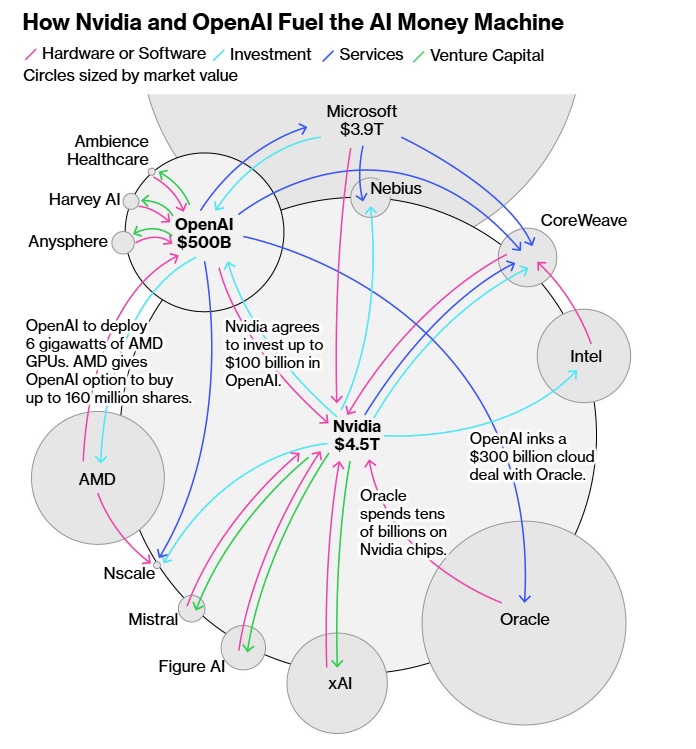
The largest technology companies are spending extraordinary sums on AI infrastructure. Chipmakers like NVIDIA finance customers who buy their chips. Reminiscent of circular “carriage deals” in the Dot Bomb era, technology companies invest in AI companies that become customers of their cloud services. Infrastructure companies borrow against anticipated demand from AI companies, while investors value many of the participants based partly upon the growth generated by the others. See how that works?
The circularity is becoming difficult to miss. NVIDIA, for example, recently agreed to provide guarantees of up to $105 billion supporting an OpenAI data-center project in Ohio while also investing in OpenAI. Broadcom reportedly is exploring tens of billions of dollars of additional financing tied to AI infrastructure. AI is no longer simply another technology sector. It increasingly influences equity valuations, credit markets, underwriting decisions, infrastructure finance and the allocation of enormous pools of investment capital.
Wall Street consequently has a powerful incentive to believe that the AI buildout will continue. Because the emperor has new clothes, but is the same old emperor.
Musicians and songwriters discover that recordings containing their performances and songs have been copied into training datasets without permission or legal basis. Songwriters discover that their compositions, especially lyrics, may have become inputs to systems capable of producing substitutes for their work. Performers discover that their names, voices and identifying characteristics may have become instructions capable of invoking their identities inside commercial products. Their property is being taken—there’s that word again—in a massive theft that should involve prison time. Because if this isn’t criminal copyright infringement, what is?
Drive a few hundred miles away from Nashville or Los Angeles and the property being taken changes, but the complaint sounds remarkably similar.
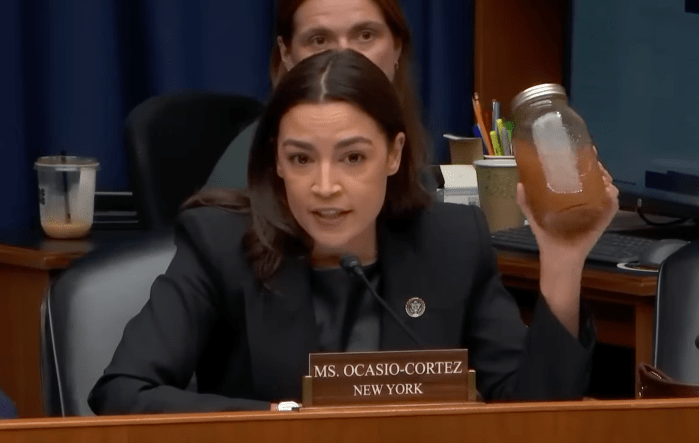
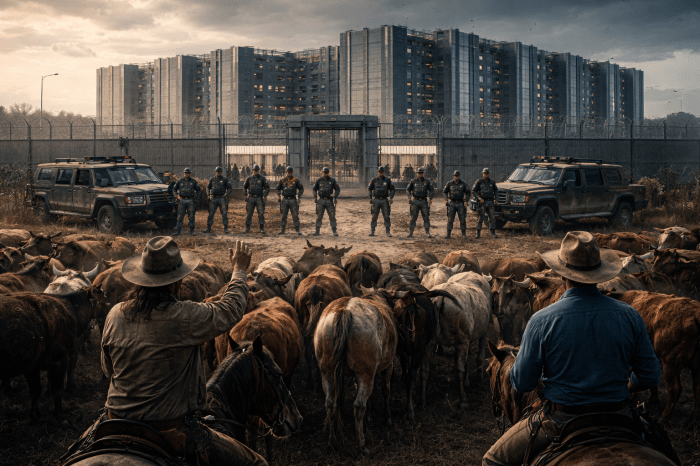
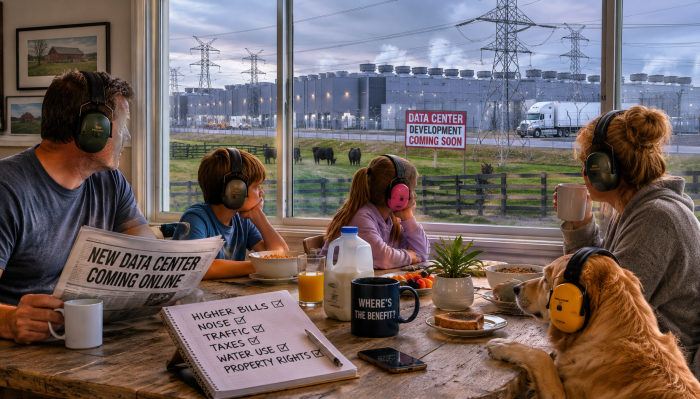
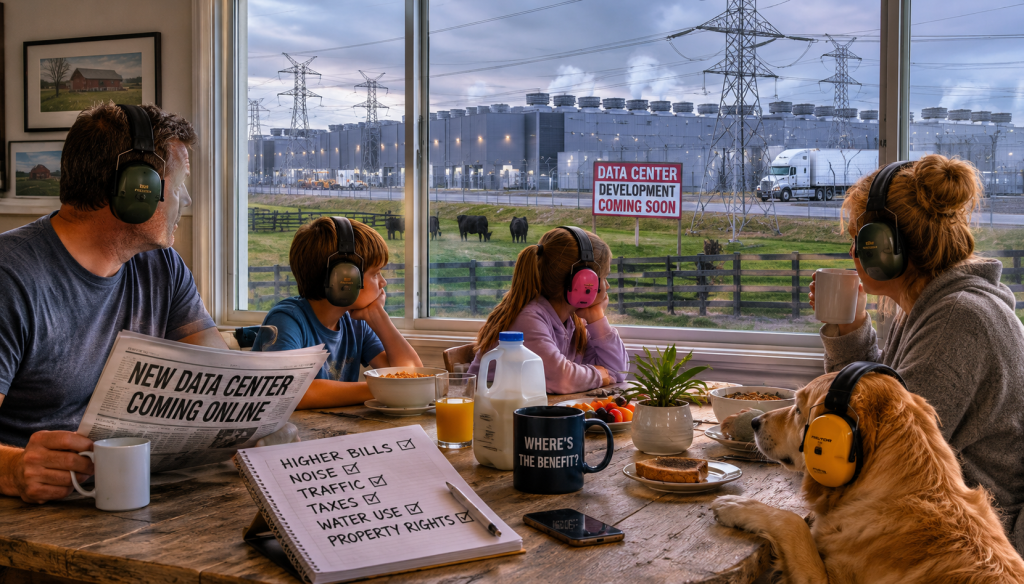
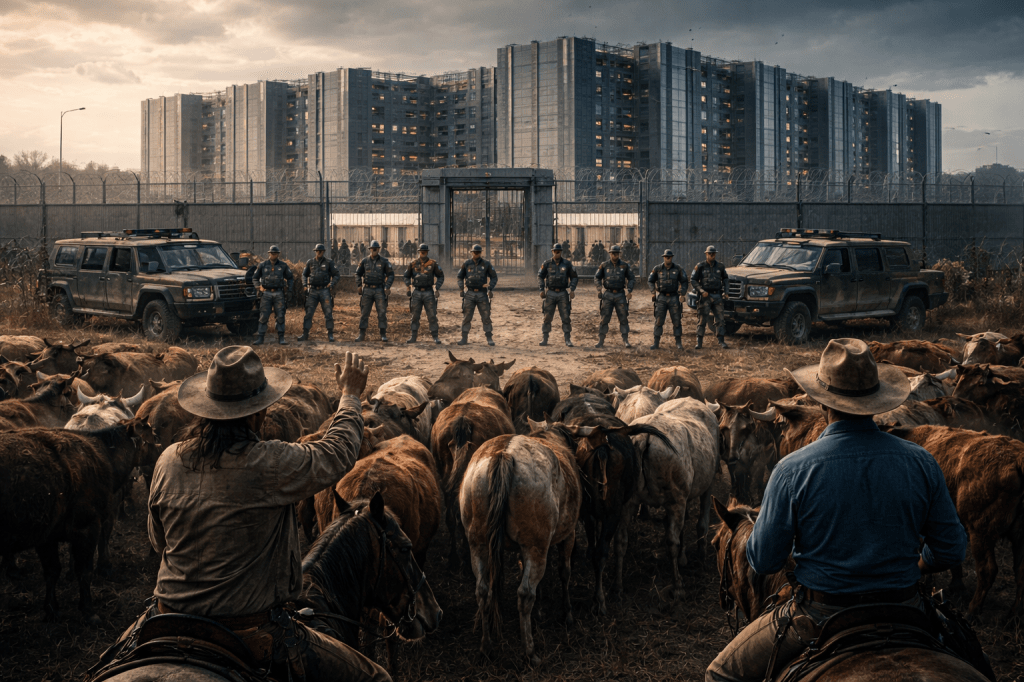
A farmer is told that a transmission corridor may cross land her family has owned for generations, backed by eminent domain that can force the family to surrender it. A rural community discovers that hundreds or thousands of acres have been assembled for a data center. Residents worry about aquifers, electricity prices, noise, gas generation and transmission lines. Governments offer tax incentives to enormously valuable technology companies while residents are told that the infrastructure is necessary because America must beat China in the AI race. State and local elected officials make zoning decisions to permit these takings, with votes that only make sense if there’s a quid pro quo under the table.
Today we began moving my moms birds! As many of you know my mom had to sell her home for transmission lines to power data centers in Coweta County. This is just a small part of this very long process. I’m hoping more people will enjoy a mix of content, going back to what made me… pic.twitter.com/LdLGjhuFFX
The common denominator between musicians and farmers isn’t artificial intelligence.
It is consent and coercion. It’s the callous taking.
But there is a deeper connection. The institutions demanding these resources did not suddenly become powerful with the invention of generative AI. Much of today’s platform economy accumulated extraordinary wealth and political influence during the preceding two decades through business models built around aggregation, scale, data collection and extraordinarily aggressive interpretations of legal safe harbors. Companies such as Meta and Google learned that once a platform becomes sufficiently large, the lives, work, attention, emails, chats, and baby pictures of its users can become inputs to be captured, scraped, optimized, aggregated and monetized.
The ongoing multidistrict litigation over social-media harms (MDL 3047) provides a sobering illustration of where that philosophy can lead. The allegations in the social media harms cases concern platforms accused of designing products to maximize engagement while exposing their own users—including children—to serious harms and exploiting those harms. Cold blooded. Whatever the ultimate disposition of those cases in MDL 3047, they illustrate a recurring tension in the platform economy: the interests of the human beings using a platform and the protections they enjoy under the law and human rights are routinely trampled by the companies operating it—for the money. And let’s not forget that when we say “companies” we actually mean the employees who went along with it and got rich doing so.
Generative AI extends that tension from users to inputs.
The same appetite for scale that drove platforms to accumulate and exploit behavioral data now creates an appetite for enormous quantities of creative work, human expression, electricity, water, land and transmission capacity. Scraping supplies one set of inputs. Political influence and infrastructure policy can supply another. And in the most extreme case, the sovereign power of eminent domain delegated to the MDL defendants can ultimately compel a property owner to surrender land for data centers serving the buildout. If not stopped, this will give Silicon Valley a political control at the federal, state and local levels never seen before.
The mechanisms are legally different. The instinct is strikingly familiar.
Acquire the input first. Argue about permission, compensation and consequences later. They’re happy to get a license when each artist and songwriter, or mom and child gets a final, non-appealable judgement if the AI companies don’t change the law as they tried and keep trying to do with federal preemption.
That is why the emerging alliance between musicians and landowners is less strange than it initially appears. Both increasingly confront institutions whose enormous financial resources can be converted into political and legal power, and whose growth depends upon obtaining resources belonging to other people.
For the musician, it may be a composition, performance, voice or identity. For the farmer, it may literally be the family farm. And increasingly, it is the perception that enormously powerful companies are building wealth and control over the economy by taking private property and humanity from people who possess considerably less economic and political power.
That is why dismissing the data-center backlash as NIMBYism—or dismissing musicians objecting to unauthorized training as Luddites—fundamentally misunderstands what is happening.
These constituencies are not necessarily anti-technology. They are objecting to a particular economic bargain.
Or, more accurately, the absence of one.
The Politics Are Arriving
This distinction matters because the data-center fight is rapidly escaping zoning commissions and utility proceedings and entering national politics. This is called “jumping the shark” in some circles.
Texas Democrats are campaigning on data centers in rural Republican territory. Candidates elsewhere are attacking electricity costs, water consumption, tax subsidies and the conversion of agricultural land.
This is an unusual political coalition because it doesn’t fit comfortably on the traditional left-right axis.
The rancher who doesn’t want a transmission line across his property may be a lifelong Republican. The songwriter who doesn’t want her catalog ingested into a generative model may be a lifelong Democrat. The homeowners who don’t want a 500-megawatt industrial complex next door may have no particular view about AI whatsoever but want to protect their family.
They nevertheless understand the same sentence:
You shouldn’t be able to take something that belongs to me merely because you say your technology needs it.
That may prove considerably more powerful politically than “AI safety.”
What If Data Centers Become Obsolete Stranded Assets?
There is another reason the industry’s present approach seems unnecessarily confrontational and coercive.
Today’s enormous data-center buildout reflects today’s technological architecture. There is no reason to assume that every aspect of that architecture will remain necessary and may become unnecessary before the data center build is completed.
Indeed, NVIDIA—the company most closely associated with the hardware powering hyperscale AI—is simultaneously pushing substantial AI computation in the opposite direction. Its DGX Spark puts powerful model inference, fine-tuning, and autonomous-agent capabilities on a desktop, while its RTX platforms increasingly allow sophisticated AI models and agents to run locally. NVIDIA expressly markets these systems as “reducing the need for cloud-based token generation resources” and, in the case of its AI workstations, as a means to “offload data center compute resources.” This does not eliminate the need for hyperscale facilities, particularly for frontier-model training, but it demonstrates that an increasing share of AI computation can migrate from centralized data centers to local devices.
It’s a trend away from depending on data centers. And if the answer was, you can’t build a gazillion data centers that inevitably will become stranded assets rather than take whatever you want, do you think that trend might accelerate? Constraints are choices.
That does not mean hyperscale data centers are disappearing. Training frontier models and serving enormous numbers of users will continue to require substantial centralized computing resources for a while.
But the direction of travel matters.
Models are becoming smaller and more efficient. Quantization reduces computational requirements. Specialized chips improve inference efficiency. More processing is moving to PCs, workstations, phones, vehicles and edge devices. Some workloads that required a data center yesterday can run locally today; workloads requiring a data center today may run locally tomorrow.
That makes the industry’s political strategy particularly shortsighted.
Why permanently alienate communities, seize land, subsidize massive infrastructure and create a nationwide political opposition movement around an architecture that technology itself is already beginning to decentralize?
True innovation would try to solve that problem if tech companies were constrained.
Take the Theft Out of AI
The same principle applies to music. The answer is not to stop artificial intelligence. The answer is to take the theft out of it.
And that requires acknowledging an uncomfortable fact about the technology as it exists today. Artificial intelligence can theoretically be useful and productive, but the major generative models did not emerge from a pristine laboratory. To one degree or another, the present generation of large models is shadowed by unresolved allegations and litigation concerning massive-scale copyright infringement, unauthorized scraping, collection of personal information and other privacy violations. Courts will ultimately decide many of those claims in their own inefficient way that Big Tech loves so much. But it is impossible to have an intellectually serious conversation about “responsible AI” while pretending that the provenance of today’s models is not itself contaminated.
That history matters because the question is not simply how AI should behave tomorrow. It is also what was taken to build the systems we have today, from whom, and without whose permission.
Just like I never believed that the law would permit “sharing” with 60 million of your closest friends in the Grokster case, I don’t believe that the AI cases will determine that the answer is because an enormously expensive technology has already been built, obtaining consent will be disregarded. (The subtext being, and if it is, we have much bigger problems.)
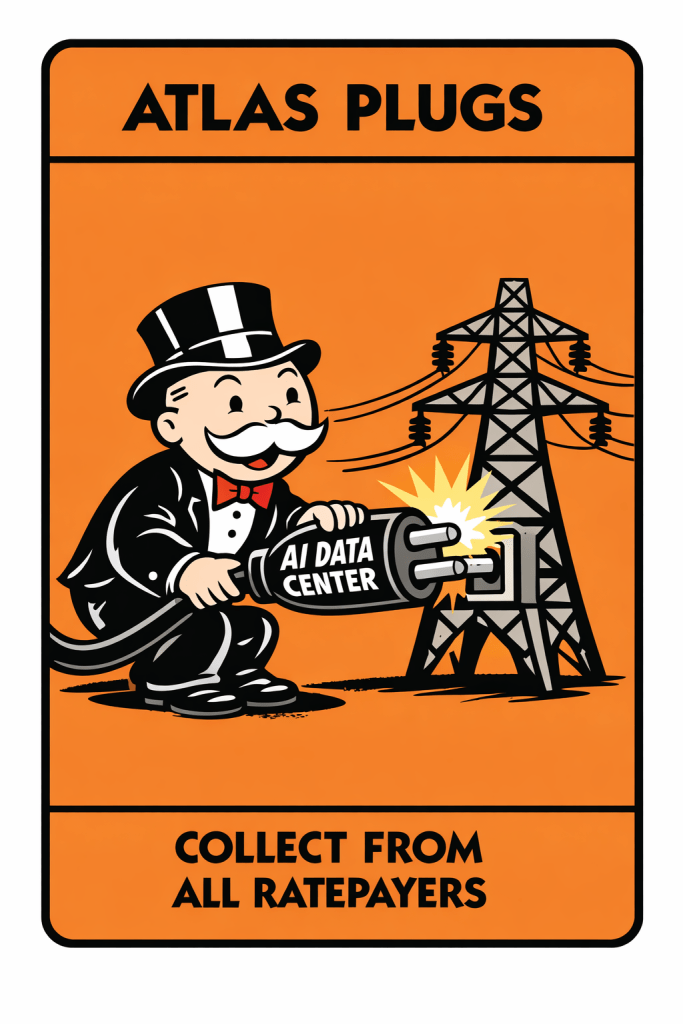
This isn’t that hard, people. Build models from licensed material. Ask musicians before converting their identities into commercial capabilities. Compensate creators whose work supplies valuable inputs. Give communities meaningful authority over infrastructure imposed upon them. Pay the actual cost of electricity and transmission rather than shifting it onto ratepayers. Don’t hoard power behind the meter while creating massive noise pollution and other negative externalities. Build smaller and more efficient systems.
And where existing models were built from material that should not have been taken in the first place, genuine innovators should be investing just as aggressively in provenance, licensed replacement datasets, machine unlearning and other technologies capable of removing unauthorized inputs as they invest in acquiring more compute.
That would be innovation directed at the problem rather than lobbying directed at avoiding it. Most importantly, stop treating consent as an obstacle to innovation.
The Human Artistry Campaign and Warner Music Group’s own public AI principles point toward the distinction. WMG says AI models should be licensed and that artists and songwriters should have an opt-in before their names, images, likenesses or voices are used in new AI-generated music. That is not anti-AI. It is an attempt to establish the terms under which AI can coexist with human creators. (That’s also not what happened with Suno, which is why Universal and Sony are still suing Suno.)
There is an enormous difference between saying “don’t build it” and saying “don’t build it with things you had no right to take.” Wall Street may not fully appreciate that distinction yet because markets presently reward companies for demonstrating exposure to AI growth—said another way, Wall Street rewards AI companies that take private property.
Main Street understands it instinctively.
A singer’s voice. A songwriter’s composition. A session player’s musical identity. A rancher’s land. A town’s water supply. A family’s electric bill.
They are very different things. But the political argument increasingly surrounding them is remarkably similar:
Innovation does not create an entitlement to somebody else’s property.
Today @mtgreenee stopped by to visit my childhood home that is being taken by Georgia Power under eminent domain laws to support data centers. I truely appreciate her taking the time to view our property, and understand the sick situation our county is dealing with. pic.twitter.com/vzqeenHD6N
AI can be useful. But usefulness does not cleanse provenance, technological achievement does not retroactively supply consent, and scale does not convert unauthorized taking into a legitimate business model rather than a litigious model.
Local AI may eventually make some of today’s massive infrastructure unnecessary. Properly licensed models can create new markets for artists rather than simply competing against them. Assistive AI can make human creators more productive without replacing them.
The choice therefore isn’t between AI and no AI. It is between an AI economy built by consent and one built by extraction.
The companies that recognize that distinction first may ultimately be the genuine innovators. They will stop asking how much they can take before somebody stops them and start asking how to build technology people actually want to live with.
That is how AI earns a social contract. Take the theft out of AI, and a remarkable amount of the opposition may disappear with it.
For the past two years, Wall Street has treated artificial intelligence as a one-way trade. Hyperscalers, semiconductor companies, utilities, private-credit funds, and data-center developers have committed hundreds of billions of dollars to what may ultimately become nearly $1 trillion in AI-related infrastructure investment over roughly two years.
The underlying assumption has been remarkably consistent: demand for increasingly powerful AI models will continue growing fast enough to justify unprecedented spending on chips, data centers, transmission lines, substations, and electric generation.
But investment booms rarely end because one assumption proves wrong. They end when several assumptions begin to weaken at the same time.
That appears to be happening.
Ed Dowd’s recent Substack analysis argues that the economics supporting today’s AI buildout are becoming increasingly fragile. Financing is tightening. Enterprise customers are demanding clearer returns on investment. Open-weight models continue improving while driving prices lower. And perhaps most importantly, the physical infrastructure required to support AI is becoming a political issue.
Gary Marcus recently challenged David Sacks’ argument that regulation is the principal threat to American AI leadership (Sacks really needs some new sheet music). Marcus instead argued that the industry faces a far more fundamental economic problem:
“The real issue is that LLMs are commodities; lots of people know how to make them, and everybody is doing more or less the same thing, training on more or less the same data. That means nobody has a technical moat. Which means you get price wars and low margins and more and more competitors over time.”
If Marcus is right, Wall Street may eventually discover that AI resembles cloud computing more than pharmaceuticals. There may be tremendous demand—but not necessarily extraordinary profits. That observation dovetails with Goldman Sachs’ increasingly cautious assessment of the AI investment cycle. Goldman has repeatedly warned investors that the buildout depends on continued access to capital, sustained enterprise demand, adequate electric power, and enough economically valuable use cases to justify unprecedented capital expenditures.
AI does not exist in ‘the cloud.’ It exists on electric grids. Every new model depends on substations, transmission lines, transformers, cooling systems, water supplies, and local political consent.
For months, we’ve tracked what has become a genuine data center backlash. Communities across Texas, Georgia, Louisiana, Virginia, Oklahoma, Utah, Alabama, and elsewhere are increasingly questioning the costs of hosting massive AI infrastructure.
Politicians, meanwhile, are discovering that AI infrastructure is much easier to announce than it is to build. Many governors and local officials have promoted data centers by assuring taxpayers that the projects will ‘pay their own way.’ But that message begins to unravel the moment the infrastructure breaks ground or annexes farmland.
A homeowner facing a 765-kV transmission line across family property is unlikely to be persuaded that the project is privately financed. Likewise, a rancher confronting eminent domain does not care whether the transmission costs appear on a utility bill, a corporate balance sheet, or a tax-abatement agreement. The injury is the same: the family home, ranch, or farm is permanently altered to support infrastructure serving distant customers—who are often anonymous.
In the Texas Hill Country, landowners have mobilized against new transmission corridors intended to serve future electric demand, including AI-related growth. In Coweta County, Georgia, residents organized after learning that transmission infrastructure associated with large-scale data-center development could cut through long-held family properties. The debate quickly ceased being about economics and became about land, community, and the limits of eminent domain.
This is where many elected officials have found themselves trying to have it both ways. They assure taxpayers that private investment will shoulder the costs while simultaneously offering substantial tax abatements, infrastructure incentives, expedited permitting, and other forms of public support. Then, when opposition emerges, they discover that the political issue is no longer who pays for the infrastructure—it’s who lives with it.
For families whose property lies in the path of a transmission corridor, ‘the data centers will pay for themselves’ is not an answer. Their concern is not the financing model. Their concern is keeping the home that has been in the family for generations.
None of this means AI is a passing fad. Transformative technologies often survive speculative bubbles. The internet certainly did. But many companies that financed the dot-com boom did not survive intact, and many investors paid dearly for assuming that technological transformation automatically translated into sustainable profits.
Today’s AI investment cycle rests on multiple pillars: inexpensive capital, robust enterprise demand, premium pricing, abundant electricity, and political support for rapid infrastructure expansion. Gary Marcus questions the durability of the competitive moat. Goldman Sachs questions whether the economics can support the investment. Communities across America are questioning whether they should bear the physical burdens.
Those three conversations are converging. The story is no longer simply about faster models or larger training runs. It is about economics, infrastructure, and public acceptance. The market has spent the last two years pricing AI as though all three will remain aligned indefinitely. History suggests that is a very demanding assumption.
The most important data center story today wasn’t a zoning hearing, a transmission line fight, or a new hyperscaler valuation announcement.
The most important story is a poll. And that poll may not only capture the sentiment of the public, it may also indicate which way elected officials and financiers are leaning, too.
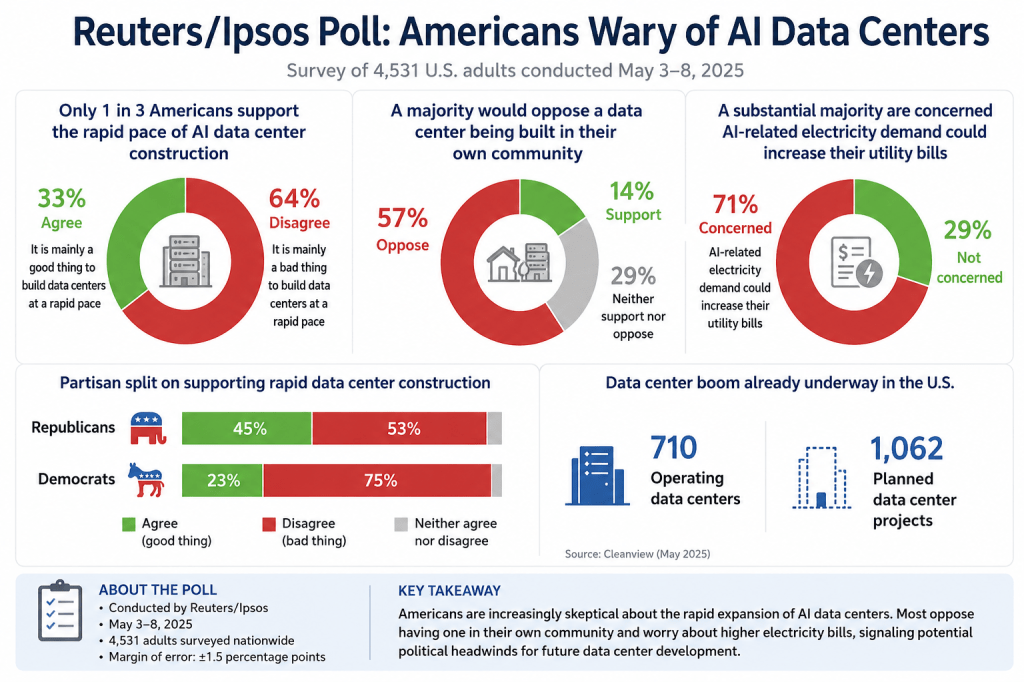
A new Reuters/Ipsos survey found that only one-third of Americans support the current pace of AI data center construction, while nearly two-thirds oppose it. More than half said they would oppose a data center in their own community, and a substantial majority expressed concern that AI-related electricity demand could increase their utility bills.
The six-day poll, which surveyed 4,531 people across the country and closed on Monday, showed just 33% of Americans agreed with a statement that it was mainly a good thing to build data centers at a rapid pace. Some 64% disagreed….Some 57% of people surveyed – including two-thirds of Democrats and half of Republicans – also said they would oppose a data center being built in their community. Just 14% of survey takers said they were okay with a center being built near them, according to the Reuters/Ipsos poll.
The lopsided result should not be surprising.
For the past two years, the public conversation around data centers has focused on American AI leadership (“because China”), economic development, and technological competitiveness. But many communities are experiencing something very different: transmission line easements criss-crossing private property, industrial-scale facilities near homes, rising utility concerns, water consumption, noise, and tax incentives for some of the world’s largest companies. It may be starting to dawn on the public why the White House AI Czar David Sacks was so obsessed with blocking any state laws that got in the way of AI.
In some cases, the issue goes even further. Landowners are being asked to surrender property rights through eminent domain—or the threat of eminent domain—so that transmission infrastructure can be built to serve facilities whose ultimate beneficiaries are among the wealthiest technology companies in the world.
Imagine you were the man who fell to earth and you knew nothing about AI workflow. Would you look at all these data centers, substations, behind the meter nuclear reactors and transmission lines and say “oh, that makes total sense”? Or would you ask what are these people thinking building a supply chain this kludgy with myriad points of failure? Data centers in space? Really? What could possibly go wrong?
That is where the national security narrative begins to collide with local reality. “We have to do this because China” is a powerful slogan in Washington. For many landowners outside the Imperial City, however, it begins to ring hollow when the immediate consequence is a transmission easement across family property that will never happen in an urban setting.
This is particularly true when the economic justification depends on AI demand forecasts that may not even be tested—much less achieved—for years. Viewed from a kitchen window looking out at a new transmission corridor in what used to be your vegetable garden or a pasture for livestock, the sacrifice is immediate and personal, while the promised strategic benefits remain abstract and distant.
We’ve already seen an econometric study from Professor Michael Hicks at Ball State University showing that all the hundreds of data centers in Texas have led to pretty much a wash in job creation, a major selling point that few ever believed. A University of Texas study shows that data centers could potentially account for 3% to 9% of Texas’ water use by 2040, according to a new white paper. In other words, Big Data has largely been talking about the benefits of AI while residents have been living with the costs of that infrastructure.
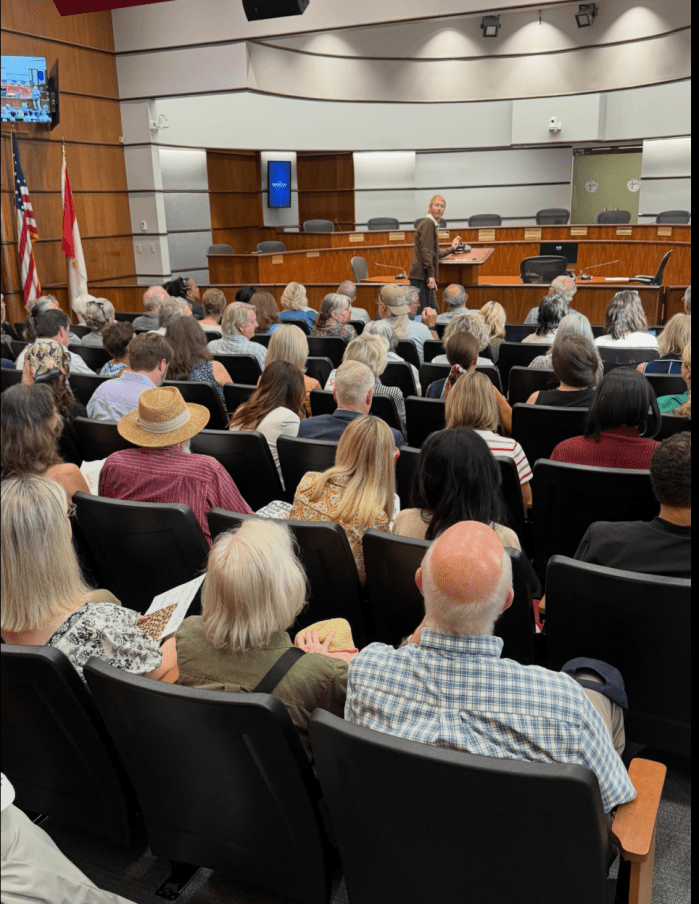
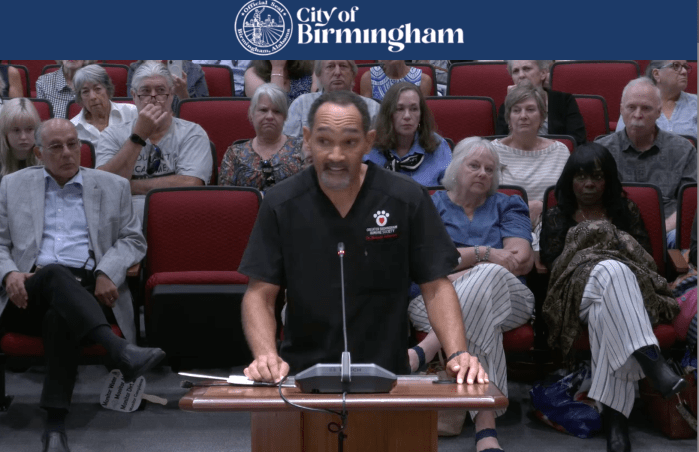
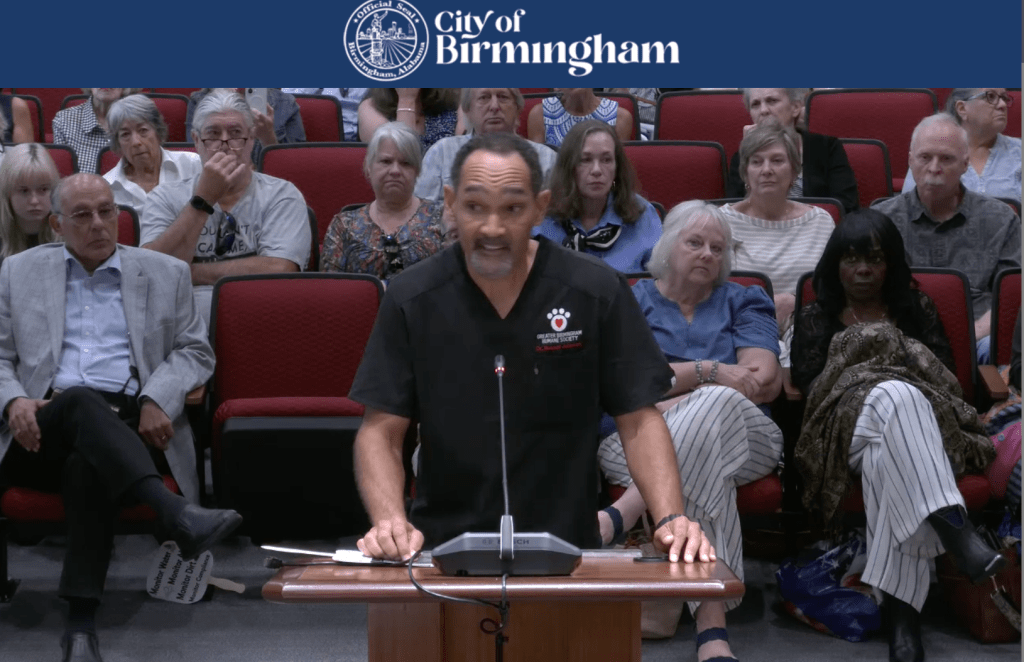
Chief Veterinary Officer for Greater Birmingham Humane Society Testifying against data center
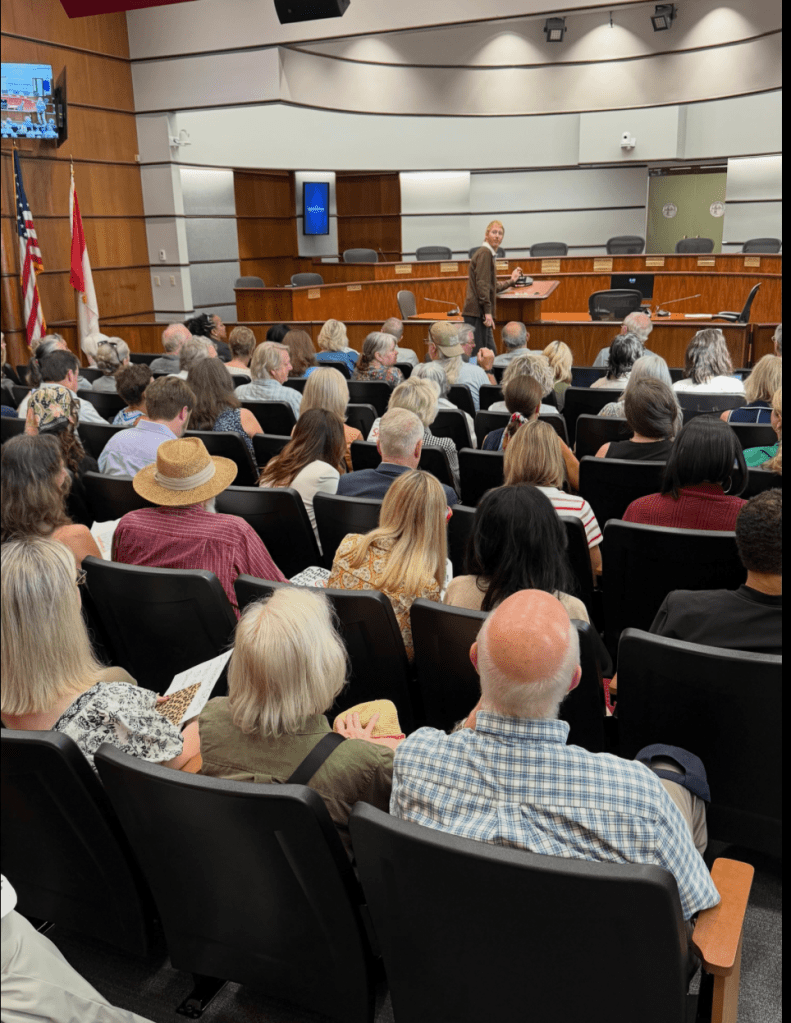
Reverse Angle Showing City Council Left the building
The Reuters/Ipsos poll suggests the issue may be evolving from a collection of local land-use disputes into a national political movement. Historically, that is the point where elected officials begin to change their behavior. Local opposition can often be dismissed as isolated resistance. National polling is harder to ignore and could be the harbinger of somebody getting unelected.
The challenge for policymakers, utilities, and developers is that public concerns are becoming increasingly tangible while many projected benefits remain tied to forecasts extending years into the future with no current evidence. Voters tend to react more strongly to immediate and permanent impacts than to promised future gains that may never come to pass, particularly gains to other people who don’t have a transmission line in their garden or who were not forced to sell their family home to a power company.
That leads to a data center mobilization question that has received far less attention than corrupting farm land, water use, noise, or electricity rates: what happens if the forecasts are simply wrong?
Communities are being asked to accept transmission corridors, substations, power plants, and massive industrial facilities today based on projections of future AI demand that may extend a decade or more into the future. Yet the economics of AI remain highly uncertain as this week’s Google $85 billion equity round confirms. When Google’s AI capital expenditures exceeded even Google’s free cash flow, the Leviathan of Mountain View turned to a Silicon Valley favorite: Other people’s money. Revenue models are still evolving, competition is intense, and many of the assumptions underlying today’s infrastructure buildout have not yet been tested through a full business cycle.
Crucially, Investors are funding unprecedented AI capex on the assumption of durable competitive advantages, yet the underlying LLM asset increasingly exhibits commodity characteristics. Meaning the models are all very similar in the fundamental components. As hyperscalers converge on functionally similar models, infrastructure, and services at extraordinary cost, there is less and less that distinguishes one from the other. When Google chooses to finance capex out of equity rather than continue financing from free cash flow and debt, that may also tell us something about the appetite of lenders getting a little skeptical.
It’s not just Google. Consider the implications of the recent reports surrounding SoftBank’s OpenAI investment. SoftBank participated in OpenAI’s February 2026 funding round at a valuation of approximately $840 billion and emerged with roughly 13% ownership. On paper, SoftBank’s stake in OpenAI carried an implied value of approximately $109 billion.
Yet when SoftBank reportedly sought to get a margin loan on those same shares a few weeks ago (three months after the $840 billion valuation was set) using that position as collateral, lenders appear to have viewed the value of the OpenAI shares very differently. The company initially sought a $10 billion loan secured by its OpenAI shares, later reducing the request to approximately $6 billion after lender interest reportedly proved limited. Even at the lower amount, loan negotiations have reportedly stalled.
The significance is not just that SoftBank’s OpenAI position is worth only $6 billion (implied $46B valuation) or $10 billion as margin loan collateral, if that. Rather, it highlights the distinction between venture valuation, financing valuation, and realizable value. An $840 billion venture valuation reflects what investors were willing to pay in a private financing round under specific assumptions about future growth, profitability, and market structure.
A margin lender asks a different question: if the collateral must be liquidated under adverse circumstances like a bubble burst or the recent semiconductor crash, what is it actually worth? The resulting margin discount can be substantial, even taking into account the usual 50%-ish haircut on marginable securities. For AI investors, this episode may be one of the first visible indications that sophisticated credit markets are assigning materially different risk assessments to AI assets than those implied by headline-grabbing private-market valuations fueled by cheerleading from the financial press and, it must be said, the Oval Office.
Similar valuation disconnects have appeared before other major public offerings, including Spotify’s direct listing, WeWork’s failed IPO, and several high-profile technology listings where private-market expectations ultimately confronted public-market price discovery. For AI investors, the significance is less about OpenAI itself than what the episode may reveal about the difference between AI forecasts and the willingness of sophisticated creditors to finance those assumptions with actual cash.
Homes will be sacrificed – said Holly Lovett, spokeswoman for @GeorgiaPower this article is our local newspaper from November of last year. https://t.co/VsVNDg8P05
If those forecasts prove overly optimistic, the result may not simply be disappointed investors. The result could be stranded assets: transmission lines cutting across ranches and farms, substations occupying valuable land, and industrial facilities looming over communities long after the expected economic justification has faded. That burden may ultimately become the defining political challenge of the AI infrastructure era. People are not merely being asked to tolerate temporary construction. They are being asked to accept permanent changes both to their homes, to their property ownership, and to their communities in support of forecasts that may or may not materialize. If a ranch is involuntarily divided, a neighborhood industrialized, or a home taken for infrastructure justified by projected future AI demand, the consequences are real regardless of whether the forecast is ultimately correct.
The Reuters/Ipsos poll suggests that the next phase of the debate may be less about artificial intelligence itself and more about who bears the risks, costs, and consequences of the infrastructure being built to support it—and who bears the consequences for an unpopular mobilization if those forecasts turn out to be wrong.
That conversation—and the inevitable litigation—is only beginning.
2 LOCAL ENGINEERS refute the @DCBLOXinc rep’s claims: “Waterless cooling does not mean more environmentally-friendly… they are going to continually burn fossil fuels and pollute our communities… not just the one @NashvilleZoo, the one at @Fisk1866 too.” pic.twitter.com/MpZuqYEQ4j