There are increasingly two conversations about artificial intelligence in America, and they are beginning to collide. These are familiar opponents: Wall Street and Main Street.
Pressure from Financial Markets
The first is taking place on Wall Street.
For publicly traded companies that aggregate, distribute, and monetize enormous quantities of creative content, being seen as an AI skeptic is increasingly difficult. Investors expect an AI strategy. Analysts ask about AI on earnings calls. Companies announce AI partnerships (which can get pompous like “global strategic partnerships” and are neither), a few AI licensing arrangements, claimed AI efficiencies, AI products and AI revenue opportunities. Emphasis on the opportunities in the search for elusive ROI. Warner Music Group, for example, recently told its shareholders that it has taken an “early and aggressive approach” to AI partnerships and emphasized the variable economics of its deals with Suno and other AI companies. Universal Music Group likewise regularly highlights its growing portfolio of “responsible AI” partnerships in financial reporting.
That should hardly be surprising. AI has become deeply embedded in the capital markets themselves.
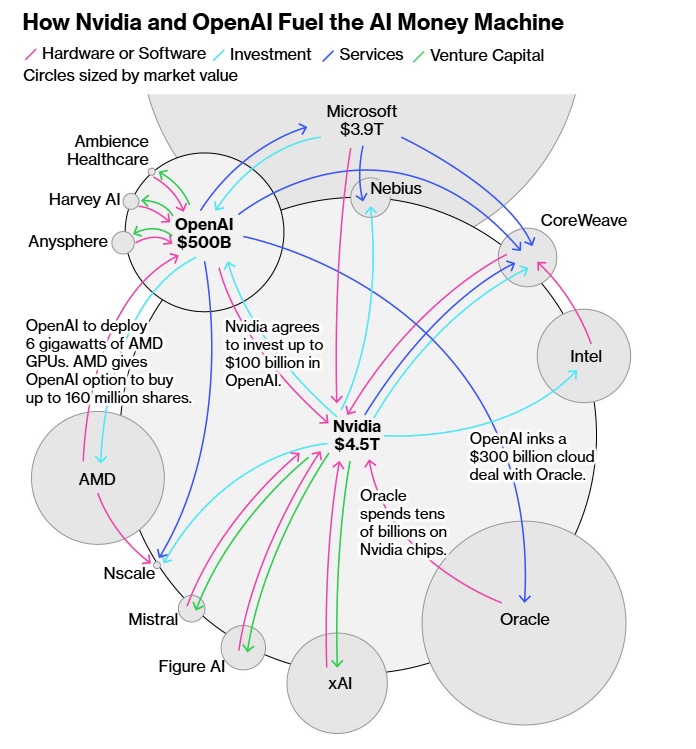
The largest technology companies are spending extraordinary sums on AI infrastructure. Chipmakers like NVIDIA finance customers who buy their chips. Reminiscent of circular “carriage deals” in the Dot Bomb era, technology companies invest in AI companies that become customers of their cloud services. Infrastructure companies borrow against anticipated demand from AI companies, while investors value many of the participants based partly upon the growth generated by the others. See how that works?
The circularity is becoming difficult to miss. NVIDIA, for example, recently agreed to provide guarantees of up to $105 billion supporting an OpenAI data-center project in Ohio while also investing in OpenAI. Broadcom reportedly is exploring tens of billions of dollars of additional financing tied to AI infrastructure. AI is no longer simply another technology sector. It increasingly influences equity valuations, credit markets, underwriting decisions, infrastructure finance and the allocation of enormous pools of investment capital.
Wall Street consequently has a powerful incentive to believe that the AI buildout will continue. Because the emperor has new clothes, but is the same old emperor.
Musicians and songwriters discover that recordings containing their performances and songs have been copied into training datasets without permission or legal basis. Songwriters discover that their compositions, especially lyrics, may have become inputs to systems capable of producing substitutes for their work. Performers discover that their names, voices and identifying characteristics may have become instructions capable of invoking their identities inside commercial products. Their property is being taken—there’s that word again—in a massive theft that should involve prison time. Because if this isn’t criminal copyright infringement, what is?
Drive a few hundred miles away from Nashville or Los Angeles and the property being taken changes, but the complaint sounds remarkably similar.
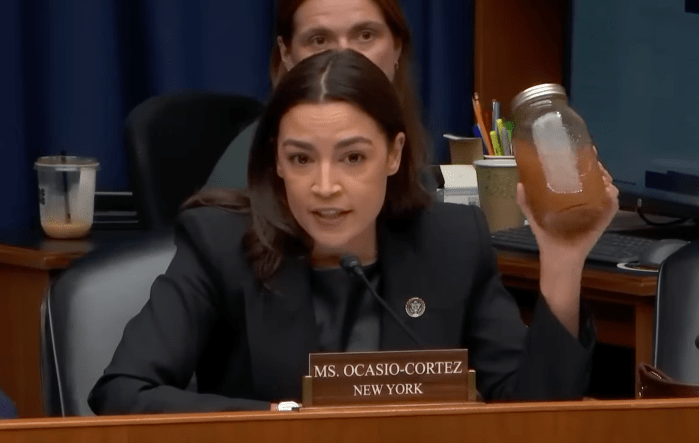
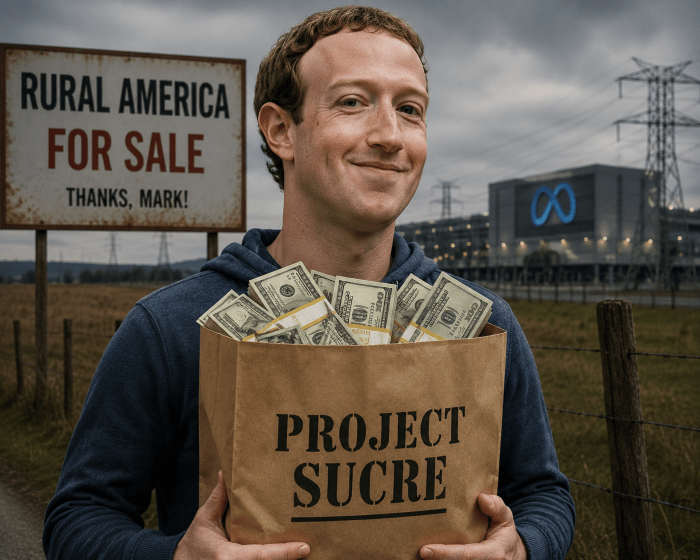
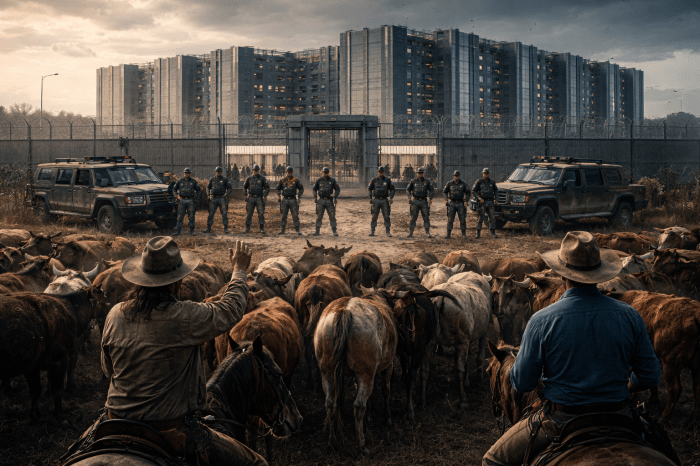
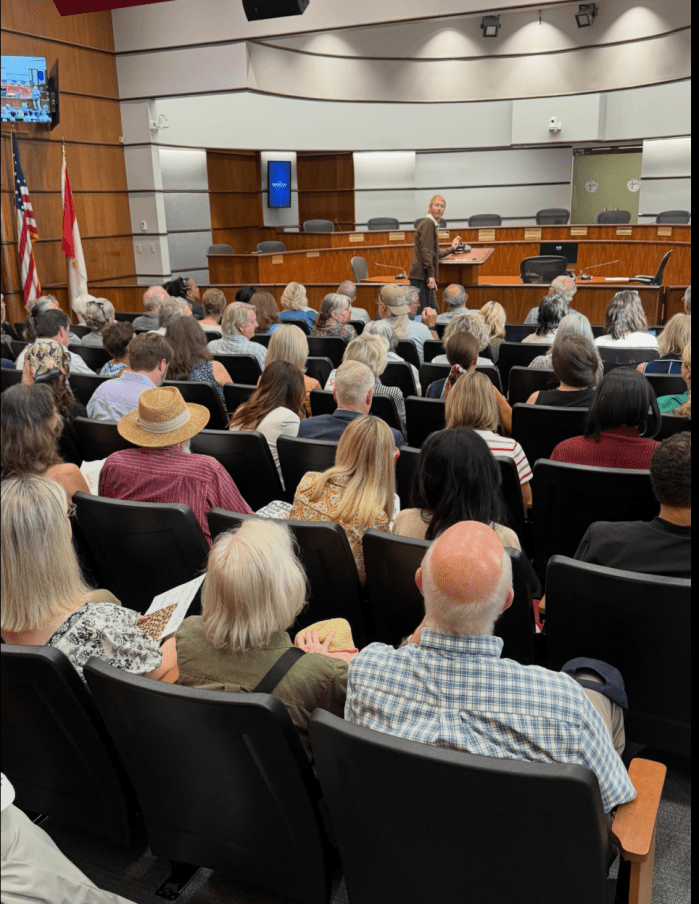
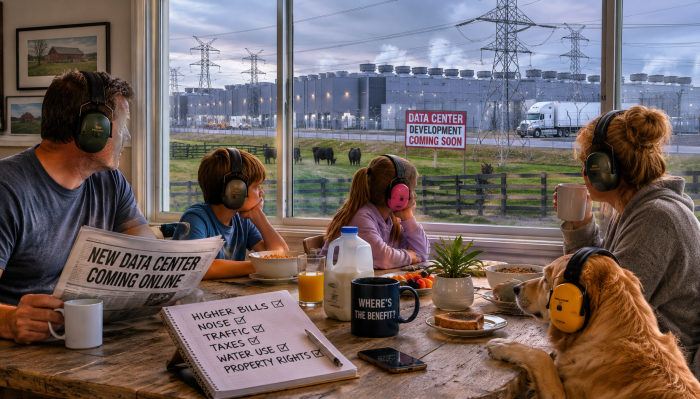
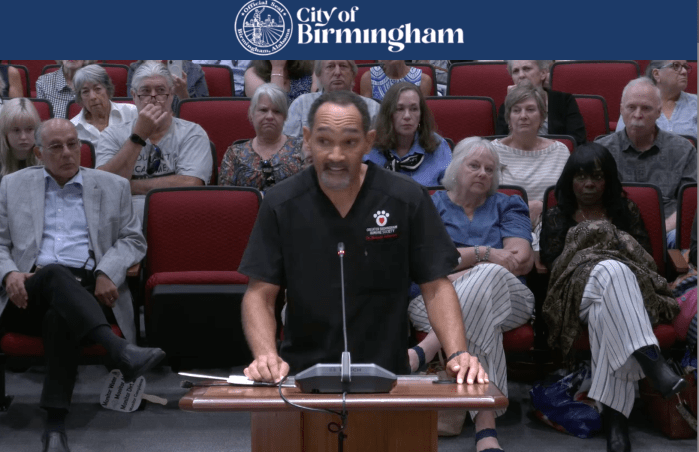
A farmer is told that a transmission corridor may cross land her family has owned for generations, backed by eminent domain that can force the family to surrender it. A rural community discovers that hundreds or thousands of acres have been assembled for a data center. Residents worry about aquifers, electricity prices, noise, gas generation and transmission lines. Governments offer tax incentives to enormously valuable technology companies while residents are told that the infrastructure is necessary because America must beat China in the AI race. State and local elected officials make zoning decisions to permit these takings, with votes that only make sense if there’s a quid pro quo under the table.
Today we began moving my moms birds! As many of you know my mom had to sell her home for transmission lines to power data centers in Coweta County. This is just a small part of this very long process. I’m hoping more people will enjoy a mix of content, going back to what made me… pic.twitter.com/LdLGjhuFFX
The common denominator between musicians and farmers isn’t artificial intelligence.
It is consent and coercion. It’s the callous taking.
But there is a deeper connection. The institutions demanding these resources did not suddenly become powerful with the invention of generative AI. Much of today’s platform economy accumulated extraordinary wealth and political influence during the preceding two decades through business models built around aggregation, scale, data collection and extraordinarily aggressive interpretations of legal safe harbors. Companies such as Meta and Google learned that once a platform becomes sufficiently large, the lives, work, attention, emails, chats, and baby pictures of its users can become inputs to be captured, scraped, optimized, aggregated and monetized.
The ongoing multidistrict litigation over social-media harms (MDL 3047) provides a sobering illustration of where that philosophy can lead. The allegations in the social media harms cases concern platforms accused of designing products to maximize engagement while exposing their own users—including children—to serious harms and exploiting those harms. Cold blooded. Whatever the ultimate disposition of those cases in MDL 3047, they illustrate a recurring tension in the platform economy: the interests of the human beings using a platform and the protections they enjoy under the law and human rights are routinely trampled by the companies operating it—for the money. And let’s not forget that when we say “companies” we actually mean the employees who went along with it and got rich doing so.
Generative AI extends that tension from users to inputs.
The same appetite for scale that drove platforms to accumulate and exploit behavioral data now creates an appetite for enormous quantities of creative work, human expression, electricity, water, land and transmission capacity. Scraping supplies one set of inputs. Political influence and infrastructure policy can supply another. And in the most extreme case, the sovereign power of eminent domain delegated to the MDL defendants can ultimately compel a property owner to surrender land for data centers serving the buildout. If not stopped, this will give Silicon Valley a political control at the federal, state and local levels never seen before.
The mechanisms are legally different. The instinct is strikingly familiar.
Acquire the input first. Argue about permission, compensation and consequences later. They’re happy to get a license when each artist and songwriter, or mom and child gets a final, non-appealable judgement if the AI companies don’t change the law as they tried and keep trying to do with federal preemption.
That is why the emerging alliance between musicians and landowners is less strange than it initially appears. Both increasingly confront institutions whose enormous financial resources can be converted into political and legal power, and whose growth depends upon obtaining resources belonging to other people.
For the musician, it may be a composition, performance, voice or identity. For the farmer, it may literally be the family farm. And increasingly, it is the perception that enormously powerful companies are building wealth and control over the economy by taking private property and humanity from people who possess considerably less economic and political power.
That is why dismissing the data-center backlash as NIMBYism—or dismissing musicians objecting to unauthorized training as Luddites—fundamentally misunderstands what is happening.
These constituencies are not necessarily anti-technology. They are objecting to a particular economic bargain.
Or, more accurately, the absence of one.
The Politics Are Arriving
This distinction matters because the data-center fight is rapidly escaping zoning commissions and utility proceedings and entering national politics. This is called “jumping the shark” in some circles.
Texas Democrats are campaigning on data centers in rural Republican territory. Candidates elsewhere are attacking electricity costs, water consumption, tax subsidies and the conversion of agricultural land.
This is an unusual political coalition because it doesn’t fit comfortably on the traditional left-right axis.
The rancher who doesn’t want a transmission line across his property may be a lifelong Republican. The songwriter who doesn’t want her catalog ingested into a generative model may be a lifelong Democrat. The homeowners who don’t want a 500-megawatt industrial complex next door may have no particular view about AI whatsoever but want to protect their family.
They nevertheless understand the same sentence:
You shouldn’t be able to take something that belongs to me merely because you say your technology needs it.
That may prove considerably more powerful politically than “AI safety.”
What If Data Centers Become Obsolete Stranded Assets?
There is another reason the industry’s present approach seems unnecessarily confrontational and coercive.
Today’s enormous data-center buildout reflects today’s technological architecture. There is no reason to assume that every aspect of that architecture will remain necessary and may become unnecessary before the data center build is completed.
Indeed, NVIDIA—the company most closely associated with the hardware powering hyperscale AI—is simultaneously pushing substantial AI computation in the opposite direction. Its DGX Spark puts powerful model inference, fine-tuning, and autonomous-agent capabilities on a desktop, while its RTX platforms increasingly allow sophisticated AI models and agents to run locally. NVIDIA expressly markets these systems as “reducing the need for cloud-based token generation resources” and, in the case of its AI workstations, as a means to “offload data center compute resources.” This does not eliminate the need for hyperscale facilities, particularly for frontier-model training, but it demonstrates that an increasing share of AI computation can migrate from centralized data centers to local devices.
It’s a trend away from depending on data centers. And if the answer was, you can’t build a gazillion data centers that inevitably will become stranded assets rather than take whatever you want, do you think that trend might accelerate? Constraints are choices.
That does not mean hyperscale data centers are disappearing. Training frontier models and serving enormous numbers of users will continue to require substantial centralized computing resources for a while.
But the direction of travel matters.
Models are becoming smaller and more efficient. Quantization reduces computational requirements. Specialized chips improve inference efficiency. More processing is moving to PCs, workstations, phones, vehicles and edge devices. Some workloads that required a data center yesterday can run locally today; workloads requiring a data center today may run locally tomorrow.
That makes the industry’s political strategy particularly shortsighted.
Why permanently alienate communities, seize land, subsidize massive infrastructure and create a nationwide political opposition movement around an architecture that technology itself is already beginning to decentralize?
True innovation would try to solve that problem if tech companies were constrained.
Take the Theft Out of AI
The same principle applies to music. The answer is not to stop artificial intelligence. The answer is to take the theft out of it.
And that requires acknowledging an uncomfortable fact about the technology as it exists today. Artificial intelligence can theoretically be useful and productive, but the major generative models did not emerge from a pristine laboratory. To one degree or another, the present generation of large models is shadowed by unresolved allegations and litigation concerning massive-scale copyright infringement, unauthorized scraping, collection of personal information and other privacy violations. Courts will ultimately decide many of those claims in their own inefficient way that Big Tech loves so much. But it is impossible to have an intellectually serious conversation about “responsible AI” while pretending that the provenance of today’s models is not itself contaminated.
That history matters because the question is not simply how AI should behave tomorrow. It is also what was taken to build the systems we have today, from whom, and without whose permission.
Just like I never believed that the law would permit “sharing” with 60 million of your closest friends in the Grokster case, I don’t believe that the AI cases will determine that the answer is because an enormously expensive technology has already been built, obtaining consent will be disregarded. (The subtext being, and if it is, we have much bigger problems.)
This isn’t that hard, people. Build models from licensed material. Ask musicians before converting their identities into commercial capabilities. Compensate creators whose work supplies valuable inputs. Give communities meaningful authority over infrastructure imposed upon them. Pay the actual cost of electricity and transmission rather than shifting it onto ratepayers. Don’t hoard power behind the meter while creating massive noise pollution and other negative externalities. Build smaller and more efficient systems.
And where existing models were built from material that should not have been taken in the first place, genuine innovators should be investing just as aggressively in provenance, licensed replacement datasets, machine unlearning and other technologies capable of removing unauthorized inputs as they invest in acquiring more compute.
That would be innovation directed at the problem rather than lobbying directed at avoiding it. Most importantly, stop treating consent as an obstacle to innovation.
The Human Artistry Campaign and Warner Music Group’s own public AI principles point toward the distinction. WMG says AI models should be licensed and that artists and songwriters should have an opt-in before their names, images, likenesses or voices are used in new AI-generated music. That is not anti-AI. It is an attempt to establish the terms under which AI can coexist with human creators. (That’s also not what happened with Suno, which is why Universal and Sony are still suing Suno.)
There is an enormous difference between saying “don’t build it” and saying “don’t build it with things you had no right to take.” Wall Street may not fully appreciate that distinction yet because markets presently reward companies for demonstrating exposure to AI growth—said another way, Wall Street rewards AI companies that take private property.
Main Street understands it instinctively.
A singer’s voice. A songwriter’s composition. A session player’s musical identity. A rancher’s land. A town’s water supply. A family’s electric bill.
They are very different things. But the political argument increasingly surrounding them is remarkably similar:
Innovation does not create an entitlement to somebody else’s property.
Today @mtgreenee stopped by to visit my childhood home that is being taken by Georgia Power under eminent domain laws to support data centers. I truely appreciate her taking the time to view our property, and understand the sick situation our county is dealing with. pic.twitter.com/vzqeenHD6N
AI can be useful. But usefulness does not cleanse provenance, technological achievement does not retroactively supply consent, and scale does not convert unauthorized taking into a legitimate business model rather than a litigious model.
Local AI may eventually make some of today’s massive infrastructure unnecessary. Properly licensed models can create new markets for artists rather than simply competing against them. Assistive AI can make human creators more productive without replacing them.
The choice therefore isn’t between AI and no AI. It is between an AI economy built by consent and one built by extraction.
The companies that recognize that distinction first may ultimately be the genuine innovators. They will stop asking how much they can take before somebody stops them and start asking how to build technology people actually want to live with.
That is how AI earns a social contract. Take the theft out of AI, and a remarkable amount of the opposition may disappear with it.
For the past two years, Wall Street has treated artificial intelligence as a one-way trade. Hyperscalers, semiconductor companies, utilities, private-credit funds, and data-center developers have committed hundreds of billions of dollars to what may ultimately become nearly $1 trillion in AI-related infrastructure investment over roughly two years.
The underlying assumption has been remarkably consistent: demand for increasingly powerful AI models will continue growing fast enough to justify unprecedented spending on chips, data centers, transmission lines, substations, and electric generation.
But investment booms rarely end because one assumption proves wrong. They end when several assumptions begin to weaken at the same time.
That appears to be happening.
Ed Dowd’s recent Substack analysis argues that the economics supporting today’s AI buildout are becoming increasingly fragile. Financing is tightening. Enterprise customers are demanding clearer returns on investment. Open-weight models continue improving while driving prices lower. And perhaps most importantly, the physical infrastructure required to support AI is becoming a political issue.
Gary Marcus recently challenged David Sacks’ argument that regulation is the principal threat to American AI leadership (Sacks really needs some new sheet music). Marcus instead argued that the industry faces a far more fundamental economic problem:
“The real issue is that LLMs are commodities; lots of people know how to make them, and everybody is doing more or less the same thing, training on more or less the same data. That means nobody has a technical moat. Which means you get price wars and low margins and more and more competitors over time.”
If Marcus is right, Wall Street may eventually discover that AI resembles cloud computing more than pharmaceuticals. There may be tremendous demand—but not necessarily extraordinary profits. That observation dovetails with Goldman Sachs’ increasingly cautious assessment of the AI investment cycle. Goldman has repeatedly warned investors that the buildout depends on continued access to capital, sustained enterprise demand, adequate electric power, and enough economically valuable use cases to justify unprecedented capital expenditures.
AI does not exist in ‘the cloud.’ It exists on electric grids. Every new model depends on substations, transmission lines, transformers, cooling systems, water supplies, and local political consent.
For months, we’ve tracked what has become a genuine data center backlash. Communities across Texas, Georgia, Louisiana, Virginia, Oklahoma, Utah, Alabama, and elsewhere are increasingly questioning the costs of hosting massive AI infrastructure.
Politicians, meanwhile, are discovering that AI infrastructure is much easier to announce than it is to build. Many governors and local officials have promoted data centers by assuring taxpayers that the projects will ‘pay their own way.’ But that message begins to unravel the moment the infrastructure breaks ground or annexes farmland.
A homeowner facing a 765-kV transmission line across family property is unlikely to be persuaded that the project is privately financed. Likewise, a rancher confronting eminent domain does not care whether the transmission costs appear on a utility bill, a corporate balance sheet, or a tax-abatement agreement. The injury is the same: the family home, ranch, or farm is permanently altered to support infrastructure serving distant customers—who are often anonymous.
In the Texas Hill Country, landowners have mobilized against new transmission corridors intended to serve future electric demand, including AI-related growth. In Coweta County, Georgia, residents organized after learning that transmission infrastructure associated with large-scale data-center development could cut through long-held family properties. The debate quickly ceased being about economics and became about land, community, and the limits of eminent domain.
This is where many elected officials have found themselves trying to have it both ways. They assure taxpayers that private investment will shoulder the costs while simultaneously offering substantial tax abatements, infrastructure incentives, expedited permitting, and other forms of public support. Then, when opposition emerges, they discover that the political issue is no longer who pays for the infrastructure—it’s who lives with it.
For families whose property lies in the path of a transmission corridor, ‘the data centers will pay for themselves’ is not an answer. Their concern is not the financing model. Their concern is keeping the home that has been in the family for generations.
None of this means AI is a passing fad. Transformative technologies often survive speculative bubbles. The internet certainly did. But many companies that financed the dot-com boom did not survive intact, and many investors paid dearly for assuming that technological transformation automatically translated into sustainable profits.
Today’s AI investment cycle rests on multiple pillars: inexpensive capital, robust enterprise demand, premium pricing, abundant electricity, and political support for rapid infrastructure expansion. Gary Marcus questions the durability of the competitive moat. Goldman Sachs questions whether the economics can support the investment. Communities across America are questioning whether they should bear the physical burdens.
Those three conversations are converging. The story is no longer simply about faster models or larger training runs. It is about economics, infrastructure, and public acceptance. The market has spent the last two years pricing AI as though all three will remain aligned indefinitely. History suggests that is a very demanding assumption.
“Formal property’s contribution to mankind is not the protection of ownership… Property’s real breakthrough is that it radically improved the flow of communications about assets and their potential.”
Hernando de Soto, The Mystery of Capital.
Musicians and other creators are unfortunately familiar with many efforts by big business to extract the economic value of their authorship through expansive free-riding copyright loopholes that pretend property rights don’t exist. The current AI crisis did not originate with Big Tech—they learned it from Big Radio. I distinctly recall having lunch with a Big Tech Washington lobbyist for XM radio (pre-merger) who had just found out that broadcast radio didn’t pay sound recording performances and wanted that same deal for satellite radio. I had to put the quietus on that pronto. And they didn’t even know how close they came to disaster. Sheesh.
In case you were wondering, Congress modernized copyright law in 1995 through the Digital Performance Right in Sound Recordings Act. The 1995 law created the statutory framework that launched licensed webcasting while preserving the archaic terrestrial radio performance loophole—preserved due to lobbying by Big Radio.
For decades, terrestrial AM/FM broadcasters have relied on a statutory copyright exception that allows them to broadcast sound recordings without compensating the featured artists, session musicians, and backup singers whose performances attract listeners, or the record companies who bear the substantial costs of discovering, recording, marketing, and promoting those works. Despite years of bipartisan efforts to end that free ride through legislation like the American Music Fairness Act (AMFA) and its predecessor bills, broadcasters have vigorously defended the exemption with overwhelming money and utilization of the very broadcast license they abuse to feather their nests. We have put excellent witnesses in front of Congress only to be outspent by smarmy swamp creatures from the National Association of Broadcasters.
AI disputes echo that familiar pattern. In the end, it all comes down to vast wealth accumulated through safe harbors of one kind or another. Instead of relying on a terrestrial performance exemption, AI companies advance absurd interpretations of fair use and text-and-data-mining doctrines to justify the uncompensated use of stolen works for commercial model training “because China.” They use influence peddlers like White House AI Viceroy David Sacks to try to sneak retroactive safe harbors into the law through Congress in the form of groundless federal preemption of state and local regulation or executive orders that are clearly bought and paid for under the guise of “data center factories” which are not factories at all. Although the legal theories differ between AI and broadcasting, the economic consequence is remarkably similar: sweeping commercial enterprises seek to build profitable businesses by lobbying or litigating (two sides of the same King’s shilling) to expand exceptions to the exclusive rights Congress granted creators, while forcing artists, musicians, writers, journalists, film makers and photographers to absorb the resulting loss in value.
That concern is no longer theoretical. In a recent Bloomberg podcast, SoundExchange President and CEO Michael Huppe—whose organization distributes more than $1 billion annually in digital performance royalties derived from rights created by that market-making 1995 legislation—described AI as “something that has a lot of danger, but also a lot of potential.” But he cautioned that “we need to make sure that human creators are protected” and that “there need to be guardrails so that [AI] doesn’t steamroll over the whole creative industry.” I couldn’t agree more. Rather than treating property rights as obstacles to AI, Congress should remember Hernando de Soto’s lesson that clearly defined ownership creates wealth—a principle it proved when licensing sound recordings gave birth to the webcasting industry largely thanks to SoundExchange and the infrastructure it brings to the table.
Huppe’s concerns are rooted in measurable economics rather than speculation. Streaming now accounts for approximately 85% of U.S. recorded music revenue, and streaming services distribute a finite, shared royalty pool among eligible recordings. Huppe noted that some services report receiving roughly 75,000 new recordings every day, with reports suggesting that more than 80% are AI-generated.
Whether those estimates ultimately prove higher or lower, the underlying economic principle is unavoidable: every AI-generated recording entering the marketplace competes for listener attention and, if streamed, competes for a share of the same finite, shared royalty pool. Huppe also warned that AI facilitates streaming fraud, allowing bad actors to generate AI recordings, deploy bots to inflate plays, and “siphon away payment from the pipeline that would otherwise go to real artists and real record labels.” His conclusion was unequivocal: “It’s fraud, basically. Straight-up fraud.”
Moreover, generative AI takes legitimate recorded performances to create competing works substituting for the originals themselves. This economic effect echoes Judge Vince Chhabria’s observations in the Kadrey v. Meta books litigation, where he suggested that flooding markets with AI-generated works competing against originals could constitute the type of market harm that would block a fair use defense to copyright infringement.
The explosion of AI-generated music that Mike Huppe cites therefore provides strong evidence of repeatable and measurable market harm identified by Judge Chhabria. Every AI-generated stream competes for listener attention while simultaneously reducing each human artist’s share of a finite, shared royalty pool. Unlike speculative claims of future injury, this dilution can be observed, quantified, and modeled using actual streaming and royalty distributions.
The economics become even more troubling when combined with large-scale scraping. As we have seen litigated in the cases against Udio, Anthropic and Meta (and I think will continue to see proven through all of the AI models including Suno), AI has trained on enormous quantities of illegally acquired works without obtaining licenses or compensating the creators whose recordings, performances, writings, images, and other expressive works supplied the raw material that makes those models commercially valuable. Sound familiar?
The same creative ecosystem that furnished the training corpus is then required to compete against a cascading and endless supply of AI-generated outputs while receiving no payment for either the training use or the resulting competition. Worse yet, because nothing says freedom like getting away with it, AI platforms connected to Google, Facebook and Amazon are so used to ignoring copyrights in their day jobs that they clearly planned to ignore our rights.
In music, the effect is especially stark: the recordings that taught music-generation systems how to produce theoretically commercially appealing songs also become the works displaced by those outputs in the marketplace. Creators are effectively asked to finance their own displacement. They suffer a double economic injury—first, uncompensated exploitation of their works to build commercial AI systems, and second, measurable erosion of their share of a finite, shared royalty pool as AI-generated recordings compete for the same listeners and revenues that streamers like Spotify seem unable to stop from invading the ecosystem.
Because of the insane pool allocation formula used for streaming mechanical royalties on interactive services like Spotify, Amazon, Apple and Deezer, songwriters are also subject to the same kind of dilution as artists. Hopefully the Copyright Royalty Judges will address this new humiliation in the current statutory rate proceeding and clearly state that AI works are not eligible for the statutory license under Section 115.
This measurable dilution also helps illustrate the broader market-flooding concern identified by Judge Chhabria. If AI-generated outputs systematically occupy the same commercial markets as human-created works, reducing revenues through sheer volume rather than direct substitution alone, then streaming provides one of the first empirical laboratories for proving market harm for “the effect of the use upon the potential market for or value of the copyrighted work.” Because streaming royalties are transparent, pooled, and data-driven, music offers unusually strong evidence that AI-generated competition can inflict repeatable, measurable, and scalable economic injury. If courts follow Judge Chhabria in recognizing this analysis, the same analytical framework could extend beyond music to books, journalism, visual art, film, software, and other creative industries in which AI-generated outputs compete for the same audiences, revenues, and licensing opportunities as human creators.
Against that backdrop, the American Music Fairness Act is no longer simply a current solution to a decades-old copyright reform proposal. If AI companies are correct that generative AI will place unprecedented pressure on the economics of human creativity, then Congress should strengthen—not further weaken—all of the economic foundations supporting human creators. AMFA would finally require terrestrial broadcasters to compensate featured artists, session musicians, and vocalists for the use of their sound recordings, just as streaming and satellite radio already do. It would also unlock reciprocal foreign performance royalties that American performers currently forfeit because the United States remains an international outlier.
At a moment when AI is intensifying the struggle for creative labor to survive even while platforms seek broad legal exceptions for uncompensated training through lobbying and executive orders, eliminating one of copyright law’s oldest uncompensated uses would send an important signal: the future of artificial intelligence should not be financed by the continued erosion of the livelihoods of human creators.
The AI industry’s habit of predicting existential harm while aggressively commercializing the same technology presents a profound ethical contradiction that Professor Cal Newport calls “doom trolling” in a recent New York Times post. This leads to a conclusion that AI companies cannot credibly claim their technology poses existential risks while continuing to accelerate its commercialization without meaningful restraint.
Newport gives this example reminiscent of my personal favorite, the exploding gas tank in Ford Pintos (not to pick on Ford):
Imagine if the Ford Motor Company put out a report saying that it feared its popular F-150 trucks might soon start bursting into flames, but that there was nothing the company could do about it because automotive technology was too inevitable and important to slow down. You’re probably struggling to picture this scenario because no reasonable consumer product company would ever act like this.
The A.I. companies could start behaving the same way. To do so would require that they stop treating A.I. like some inevitable force that they’re struggling to steward. It’s not. It’s a collection of specific tools that these companies are choosing to design and sell according to specific business plans. Accordingly, they need to talk about their offerings like any other consumer product. This means explaining clearly whom these products are for, justifying their benefits and, critically, taking full responsibility for any harm they might cause. Just because A.I. currently enjoys a high-tech sheen doesn’t make it exceptional with respect to common-sense safety standards.
If these A.I. companies insist on continuing to pretend that they’re merely stoic observers of an unavoidable dystopian future, then perhaps it’s time to force the issue. As consumers, we can refuse to play the doom-trolling game. Next time Anthropic releases a dire report, or Sam Altman’s voice cracks as he imagines the disruption that OpenAI is unleashing, we can pivot back to the pragmatic: “OK, but what benefits am I getting by spending $1,000 a month on tokens?” If they continue to ratchet up the doom, then perhaps it’s time to transform dread into ridicule: The earnest pseudoscience of Anthropic’s white papers already borders on satire. The current zeitgeist surrounding A.I. encourages a fretful submission to these tech leaders, but this could rapidly change.
The AI industry cannot have it both ways. It cannot warn that generative AI will fundamentally transform—or even eliminate—millions of creative jobs while simultaneously insisting that the law should expand uncompensated access to the very works that make those systems possible. If AI companies genuinely believe their own predictions, then the appropriate public policy response is not to weaken copyright, broaden fair use, or create new exceptions for commercial training. It is to reinforce every remaining economic support for human creativity.
The evidence emerging from music streaming already demonstrates why. AI-generated works are not merely theoretical substitutes; they compete for attention, streams, and revenue, measurably reducing each creator’s share of a finite, shared royalty pool. That provides some of the clearest real-world evidence yet of repeatable market harm from generative AI at commercial scale. Congress should take note. The question is no longer whether creators deserve compensation for their work. It is whether the United States will choose to finance the AI economy by systematically eroding the economic incentives that have sustained human creativity for generations—or whether it will insist that technological progress, like every other successful industry before it, pays its own way.
Perhaps the greatest lesson of the American Music Fairness Act is not about radio at all. It is about refusing to repeat yesterday’s policy mistakes in tomorrow’s technology. As Mike Huppe observed on Bloomberg, Congress should not be creating new copyright exceptions while it is still trying to fix old ones. That warning applies with even greater force to artificial intelligence. If policymakers know that generative AI is likely to place extraordinary pressure on the economics of human creativity—as many AI companies themselves readily acknowledge—then the answer cannot be to expand uncompensated uses of creative works in the name of innovation and unintended consequences be damned.
The webcasting revolution showed what Hernando de Soto long argued: respecting property rights doesn’t kill innovation—it gives innovators the legal foundation to build sustainable markets. AMFA is a cautionary tale: a narrow copyright exception adopted decades ago has deprived generations of American performers of compensation and remains difficult to unwind. Congress should learn from that history, not repeat it. The AI economy should be built by paying for the creative works that make it possible and respecting the rights of all creators—not by creating another exception that future generations will spend decades trying to reverse and an entrenched bureaucracy of the richest corporations in commercial history will oppose with all the resources they can muster.
The current narrative says the “AI subsidy era” is ending. Prices are rising. Rate limits are tightening. Ads are creeping in. Enterprise tiers are replacing all-you-can-eat plans. In short: users will finally start paying what AI actually costs.
Earlier this month, millions of OpenClaw users woke up to a sweeping mandate: The viral AI agent tool, which this year took the worldwide tech industry by storm, had been severely restricted by Anthropic.
Anthropic, like other leading AI labs, was under immense pressure to lessen the strain on its systems and start turning a profit. So if the users wanted its Claude AI to power their popular agents, they’d have to start paying handsomely for the privilege.
“Our subscriptions weren’t built for the usage patterns of these third-party tools,” wrote Boris Cherny, head of Claude Code, on X. “We want to be intentional in managing our growth to continue to serve our customers sustainably long-term. This change is a step toward that.”
The announcement was a sign of the times. Investors have poured hundreds of billions of dollars into companies like OpenAI and Anthropic to help them scale and build out their compute. Now, they’re expecting returns. After years of offering cheap or totally free access to advanced AI systems, the bill is starting to come due — and downstream, users are beginning to feel the pinch.
That’s true but it’s leaving out a lot.
Yes, the consumer subsidy—venture-backed underpricing of inference—may be winding down. But the broader subsidy system that made AI possible isn’t going away. It’s expanding. Just ask President Trump.
To understand why, you have to go back to the last great digital disruption.
From P2P to Streaming to AI
Start with Napster.
P2P didn’t just enable infringement. It rewired expectations. It taught users that all music should be available, instantly, for free. Why? Because there was gold in them long tails. Forget about supply and demand, we had infinite supply so demand would take care of itself.
It’s for sale
Every artist, songwriter, label and publisher in the history of recorded music were not compensated for this shift. They were its involuntary financiers. Their catalogs created the demand, the network effects, and the user adoption that built the early internet music economy.
Streaming—think Spotify—didn’t reverse that logic. It formalized it. (Remember, streaming saved us from piracy and we should all be so grateful.) It actually transferred that involuntary financing from the p2p balance sheet to Spotify’s, and took it public.
Streaming platforms accepted a new baseline: the entire world’s repertoire must be available at all times, regardless of demand. That is a costly and structurally inefficient mandate, but it became the price of competing in a market shaped by P2P expectations. Licensing systems like the Mechanical Licensing Collective (MLC) were built to support that scale, but the underlying premise remained: total availability first, compensation second.
AI changes the game again.
AI Doesn’t Just Distribute Works. It Consumes Them.
P2P distributed music. Streaming licensed it. AI models ingest it.
That’s the critical difference.
Generative AI systems are trained on massive corpora that include copyrighted works, performances, and what we might call personhood signals—voice, style, tone, phrasing, and creative identity. These inputs are not just indexed or streamed. They are transmogrified (see what I did there) into model weights that can generate new outputs that compete with, mimic, or substitute for the originals.
So the role of the artist evolves: • In P2P: unpaid distributor subsidy • In streaming: underpaid inventory supplier • In AI: uncompensated production input That is not a marginal shift. It is a structural one.
The Real Subsidy Stack
When people say the “AI subsidy era is over,” they are usually talking about one thing: cheap access to compute. But AI has always depended on a multi-layered subsidy stack:
Creators – supply training data, cultural value, and identity signals without compensation or consent Users – supply prompts, feedback, and behavioral data that improve the models Communities – absorb land use, water consumption, and environmental costs Ratepayers – fund grid upgrades, transmission, and reliability for data center demand Venture capital – underwrites early losses to drive adoption and scale
The shift we are seeing now is not the end of subsidies. It’s a reallocation. Or as a cynic might say, it’s rearranging the deck chairs to hide the lifeboats.
Users may start paying more. But creators still aren’t being paid for training. Communities are still being asked to host infrastructure. And the physical footprint of AI is accelerating. Just ask President Trump.
The World Turned Upside Down
What makes this moment different is the scale of the buildout. We are not just talking about apps anymore. We are talking about an industrial transformation: • New data centers the size of small cities • High-voltage transmission lines • Water-intensive cooling systems • Semiconductor supply chains • And even discussions of new nuclear capacity to support compute demand
This is infrastructure on the scale of a national project, or more like national mobilization. But it is being built on top of a premise that has not been resolved: the uncompensated use of human creative work as training input.
That is the inversion: We are building power plants for systems that depend on not paying the people whose work makes those systems possible.
A Better Frame
The cleanest way to understand this is as a continuum:
P2P turned infringement into consumer expectation. Streaming turned that expectation into platform infrastructure. AI turns uncompensated authorship into industrial feedstock.
Or more bluntly: The AI free ride is not ending. It is being re-invoiced. Users may now see higher prices. But the deeper subsidies—creative, environmental, and civic—remain off the books.
What Comes Next
If the industry is serious about “pricing AI correctly,” it cannot stop at compute.
It has to address: • Compensation frameworks for training data • Attribution and provenance standards • Licensing models for style and voice • Infrastructure cost allocation (who pays for the grid?) • Governance of large-scale compute deployment
Otherwise, we are not exiting the subsidy era. We are doing what Big Tech lives for.
We are scaling it.
And this time, instead of a few server racks in a dorm room, we are building an global energy system around it.
One of the most important things about the White House AI framework released last week is what it is not.
It is not an executive order.
That may sound like a technical distinction, but it is doing an enormous amount of work here. Because by avoiding the form of an executive order, the framework avoids something even more important: Judicial review.
An executive order that attempted to declare AI training on copyrighted works lawful—or to constrain Congress from acting—would immediately invite challenge in the very judicial branch the framework also seeks to influence. Oh, that would be fun.
It would raise Administrative Procedure Act questions. It would trigger separation-of-powers scrutiny. It would likely be litigated within days.
This framework does none of that and is not susceptible to judicial challenge.
Instead, it achieves much of the same practical effect—shaping legal outcomes, constraining policy space, and signaling preferred doctrine—without creating a justiciable action. It is, in effect, law without law, and outcomes by positioning. Silicon Valley’s favorite.
Takings by Policy, Not Statute
Start with the most obvious constitutional issue: the Takings Clause of Fifth Amendment of the U.S. Constitution which states that “private property [cannot] be taken for public use, without just compensation.”
Copyright is a form of property. That is not controversial. It is a statutory property right grounded in the Constitution’s Intellectual Property Clause, and it carries exclusive rights that have long been understood as economically valuable.
Now consider what the White House framework does.
It declares that AI training—mass, indiscriminate ingestion of copyrighted works—as lawful. It does so without requiring compensation. And it does so in a context where the resulting systems can substitute for, or diminish the market for, the original works.
If that official policy position of the Executive Branch were enacted into law, it would raise a straightforward question:
Has the government authorized the use of private property for public and commercial purposes without compensation? Or more directly, has the Executive Branch just announced that will not prosecute that indiscriminate ingestion for any reason? Can we expect to see amicus briefs from the Solicitor General opposing copyright owners pursuing their rights in court?
That is sounding a lot like a taking.
But because the framework is not law, it avoids the moment where that question must be answered. It does not extinguish rights formally. It renders them economically hollow in practice, while leaving the formal structure intact.
That is the key move: functional elimination without formal abolition.
Ex Post Facto in Everything but Name
The framework also raises a second, less discussed issue: the logic of ex post facto lawmaking.
The Ex Post Facto Clause technically applies to criminal law. But the underlying principle is broader: the government should not change the legal consequences of past conduct to benefit favored actors or disadvantage others. Of course, copyright owners raising this argument will have the Spotify retroactive safe harbor in Title I of the Music Modernization Act thrown in their face as rank hypocrisy, which they would richly deserve, although as any 10 year old can tell you, two wrongs don’t make a right, at least in theory.
Here, the timeline matters.
Massive datasets have already been scraped.
Models have already been trained.
The conduct that enabled this may, in many instances, have been legally questionable—and in cases of willful infringement, potentially criminal under federal copyright law. Or if you listen to me, the largest case of criminal copyright infringement in history.
Now comes the policy years after the fact in the face of over 150 AI lawsuits all based on copyright infringement to one degree or another:
Training is lawful.
That looks less like interpretation and more like retroactive validation.
Even if framed as civil doctrine, the effect is similar to retroactive decriminalization of conduct tied to vested rights. It sends a clear message: conduct that may have been unlawful when undertaken will be treated as lawful because it is now economically indispensable to the broligarchs.
That is not how the rule of law is supposed to work.
Separation of Powers by Suggestion
The framework’s treatment of Congress is equally striking. It does not say Congress lacks authority to legislate. The President cannot say that. Well…he can, but there’s no foundation for the statement. The Constitution is clear: Congress defines copyright.
Instead, the framework says Congress should not act in ways that would affect judicial resolution of the training question.
That is an unusual formulation. Congress legislates in areas under litigation all the time. Indeed, it is often expected to clarify statutory ambiguity.
What the framework is doing is more subtle: It is attempting to shape the legislative field without formally constraining it.
And it pairs that with an implicit second message:
Legislation that restricts training or mandates licensing is inconsistent with executive policy.
Such legislation is therefore unlikely to be signed by the President. So why bring it?
That is a veto signal—delivered without the political cost of an actual veto.
Judicial Signaling Without Command
The same dynamic applies to the courts.
The framework claims to “defer” to the judiciary. But it simultaneously declares a preferred outcome: training is lawful.
That is not deference. That is signaling.
Judges are, of course, independent. But they do not operate in a vacuum. They are aware of executive priorities, legislative inaction, and market realities. When all three align around a single policy direction, it creates an interpretive gravitational force that is difficult to ignore.
And the signal travels further.
To lawyers. To regulators. To anyone whose career may intersect with executive appointment.
It normalizes what counts as a “reasonable” position within the current policy environment.
Prosecutorial Silence as Policy
There is also a more immediate, practical consequence.
While the framework does not have the force of law, it functions as an indirect directive to the Department of Justice. By declaring training lawful as a matter of policy, it signals that federal enforcement resources should not be used to pursue cases premised on the opposite view.
In effect, it tells prosecutors:
Do not spend time considering criminal enforcement for large-scale copyright violations tied to AI training. Do not spend time considering antitrust enforcement against the broligarchs. In fact, don’t spend any time prosecuting anyone regarding AI.
That matters because, for example, willful copyright infringement at scale can, in certain circumstances, give rise to criminal liability. I mean if that doesn’t, what does? Yet under this framework, even the possibility of such enforcement is quietly set aside.
This is not formal immunity. But in practice, it can look very similar.
Why “Not an Executive Order” Matters
If this were an executive order, all of these issues would be front and center:
Is this a taking?
Does it exceed executive authority?
Does it interfere with Congress?
Does it interfere with the Judiciary?
Because it is not and EO, these important issues remain in the background—present but untested.
That is the genius, and the danger, of the approach.
It allows the executive branch to:
Shape doctrine
Influence courts
Constrain Congress
Guide enforcement priorities
Normalize contested conduct
—all without triggering the mechanisms designed to check it.
The Constitutional Shadow
The AI framework does not violate the Constitution in any formal sense.
It does something more complicated.
It operates in the constitutional shadow—where policy can reshape rights, incentives, and expectations without ever crossing the line that would allow a court to say no.
But shadows matter.
Because by the time the law catches up—if it ever does—the world the Constitution was meant to govern and protect may already have changed.
As generative music systems like Suno and Udio move into the center of copyright debates, one question keeps coming up: Can we actually tell which songs influenced an AI-generated track? And then can we use that determination in a host of other processes like royalty payments?
Recently a number of people have pointed to research from Sony AI as evidence that the answer might be yes. Sony has publicly discussed work on tools designed to analyze the relationship between training data and AI-generated music outputs.
But the reality is a little more nuanced. Sony’s work is interesting and potentially important—but it is often misunderstood. What Sony has described is not a magic detector that can listen to a generated song and instantly reveal every recording the model trained on.
Instead, Sony is describing something more modest—and in some ways more useful.
Let’s unpack what the technology appears to do right now.
The first is training-data attribution. This means trying to estimate which recordings in a model’s training dataset influenced a generated output.
The second is musical similarity or version matching. This involves detecting when two pieces of music share meaningful musical material even if they are not exact copies of each other.
Sony has framed both efforts as research directions rather than a finished commercial product. In other words, this is still a developing technical approach, not a turnkey system that can produce definitive copyright answers.
That title sounds intimidating, but the basic idea is fairly intuitive and also suggests the project is part of the broader machine unlearning academic discipline.
The system does not operate like Shazam. It does not simply listen to an AI-generated song and say:
“This track was trained on Song X, Song Y, and Song Z.”
Instead, the approach works more like this.
Imagine you already know—or at least suspect—which recordings were used to train the model. You have a candidate set of training tracks.
The system then asks:
Among these training recordings, which ones seem most likely to have influenced this generated output?
In other words, the system ranks influence among known candidates.
The research approach borrows from an area of machine learning called machine unlearning, which studies how particular training examples affect a model’s behavior. In simplified terms, researchers can test how the model behaves when certain training examples are removed or adjusted. If the output changes meaningfully, that suggests those examples had measurable influence.
The important point is that this is an influence-ranking tool, not a forensic detector.
It tries to answer:
“Which of these known training tracks mattered most?”
Not:
“Tell me every song the model was trained on.”
Sony’s Other Idea: Smarter Music Comparison
Sony has also described work on musical similarity detection.
Traditional audio fingerprinting systems—like those used by Shazam or Audible Magic—are very good at identifying identical recordings. If you upload the same song or a slightly altered version, the system can match it.
But generative AI raises a different problem. An AI output might resemble a song musically without copying the recording itself.
Sony’s research tries to detect those kinds of relationships.
For example, a system might notice that two tracks share melodic fragments, rhythmic patterns, harmonic progressions, or musical phrases even if the arrangement, production, or instrumentation is different.
In plain English, this kind of tool tries to answer a different question:
“Are these two pieces of music related in substance?”
Not:
“Are they the exact same recording?”
The Big Limitation: You Still Need the Training Dataset
Here’s the key limitation that often gets overlooked.
Sony’s attribution approach appears to depend on having access to the candidate training dataset.
The system works by comparing a generated output against recordings that are already known or suspected to have been used during training. It estimates influence among those candidates.
That means the system answers the question:
“Which of these training tracks influenced the output?”
But it does not answer the question:
“What unknown recordings were used to train this model?”
If the training corpus is hidden or undisclosed, the attribution system has nothing to test against.
This makes the technology conceptually similar to many machine-learning research experiments, which measure influence using known datasets. Researchers can test influence among known training examples, but they cannot reconstruct an unknown dataset from outputs alone.
What This Could Look Like in the Real World
If the training corpus were known, a practical workflow might look like this.
First, the recordings in the training corpus would be identified. Audio fingerprinting systems could match those recordings to commercial releases.
That step answers the question:
What copyrighted recordings appear in the training data?
Then an attribution tool like the one Sony describes could be used to analyze generated outputs and estimate which of those known recordings appear to have influenced them.
This would not prove copying in every case. But it could dramatically narrow the analysis—from millions of possible influences to a smaller list of likely candidates.
What Sony Has Not Claimed
Sony’s public statements do not suggest that the attribution problem is solved.
Sony has not announced a system that automatically calculates track-by-track royalty payments for AI-generated songs. Nor has it described a tool that conclusively proves copyright copying from an AI output alone.
Instead, the work is framed as research aimed at improving transparency and accountability in generative music systems.
Why Labels Might Still Be Interested
Even with these limitations, the idea could be attractive to rights holders.
If training datasets were known, attribution tools could theoretically support new ways of analyzing how music catalogs interact with generative AI systems.
For example, such tools might help support:
royalty allocation models
influence-weighted compensation frameworks
catalog analytics
AI audit trails showing how repertoire contributes to model behavior
In other words, the technology could potentially become a measurement tool for how music catalogs influence generative systems.
What Sony did and did not do (yet)
Sony’s work does not magically reveal every song an AI model trained on. And it does not eliminate the need to know what is in the training dataset.
Instead, its value appears to lie after the training data is known.
Once you have a candidate training corpus, tools like the ones Sony describes may help analyze which recordings influenced particular outputs.
That makes the technology best understood as a post-disclosure attribution layer, not a substitute for knowing what recordings were used in training in the first place.
Paul Sinclair’s framing of generative music AI as a choice between “open studios” and permissioned systems makes a basic category mistake. Consent is not a creative philosophy or a branding position. It is a systems constraint. You cannot “prefer” consent into existence. A permissioned system either enforces authorization at the level where machine learning actually occurs—or it does not exist at all.
That distinction matters not only for artists, but for the long-term viability of AI companies themselves. Platforms built on unresolved legal exposure may scale quickly, but they do so on borrowed time. Systems built on enforceable consent may grow more slowly at first, but they compound durability, defensibility, and investor confidence over time. Legality is not friction. It is infrastructure. It’s a real “eat your vegetables” moment.
The Great Reset
Before any discussion of opt-in, licensing, or future governance, one prerequisite must be stated plainly: a true permissioned system requires a hard reset of the model itself. A model trained on unlicensed material cannot be transformed into a consent-based system through policy changes, interface controls, or aspirational language. Once unauthorized material is ingested and used for training, it becomes inseparable from the trained model. There is no technical “undo” button.
The debate is often framed as openness versus restriction, innovation versus control. That framing misses the point. The real divide is whether a system is built to respect authorization where machine learning actually happens. A permissioned system cannot be layered on top of models trained without permission, nor can it be achieved by declaring legacy models “deprecated.” Machine learning systems do not forget unless they are reset. The purpose of a trained model is remembering—preserving statistical patterns learned from its data—not forgetting. Models persist, shape downstream outputs, and retain economic value long after they are removed from public view. Administrative terminology is not remediation.
Recent industry language about future “licensed models” implicitly concedes this reality. If a platform intends to operate on a consent basis, the logical consequence is unavoidable: permissioned AI begins with scrapping the contaminated model and rebuilding from zero using authorized data only.
Why “Untraining” Does Not Solve the Problem
Some argue that problematic material can simply be removed from an existing model through “untraining.” In practice, this is not a reliable solution. Modern machine-learning systems do not store discrete copies of works; they encode diffuse statistical relationships across millions or billions of parameters. Once learned, those relationships cannot be surgically excised with confidence. It’s not Harry Potter’s Pensieve.
Even where partial removal techniques exist, they are typically approximate, difficult to verify, and dependent on assumptions about how information is represented internally. A model may appear compliant while still reflecting patterns derived from unauthorized data. For systems claiming to operate on affirmative permission, approximation is not enough. If consent is foundational, the only defensible approach is reconstruction from a clean, authorized corpus.
The Structural Requirements of Consent
Once a genuine reset occurs, the technical requirements of a permissioned system become unavoidable.
Authorized training corpus. Every recording, composition, and performance used for training must be included through affirmative permission. If unauthorized works remain, the model remains non-consensual.
Provenance at the work level. Each training input must be traceable to specific authorized recordings and compositions with auditable metadata identifying the scope of permission.
Enforceable consent, including withdrawal. Authorization must allow meaningful limits and revocation, with systems capable of responding in ways that materially affect training and outputs.
Segregation of licensed and unlicensed data. Permissioned systems require strict internal separation to prevent contamination through shared embeddings or cross-trained models.
Transparency and auditability. Permission claims must be supported by documentation capable of independent verification. Transparency here is engineering documentation, not marketing copy.
These are not policy preferences. They are practical consequences of a consent-based architecture.
The Economic Reality—and Upside—of Reset
Rebuilding models from scratch is expensive. Curating authorized data, retraining systems, implementing provenance, and maintaining compliance infrastructure all require significant investment. Not every actor will be able—or willing—to bear that cost. But that burden is not an argument against permission. It is the price of admission.
Crucially, that cost is also largely non-recurring. A platform that undertakes a true reset creates something scarce in the current AI market: a verifiably permissioned model with reduced litigation risk, clearer regulatory posture, and greater long-term defensibility. Over time, such systems are more likely to attract durable partnerships, survive scrutiny, and justify sustained valuation.
Throughout technological history, companies that rebuilt to comply with emerging legal standards ultimately outperformed those that tried to outrun them. Permissioned AI follows the same pattern. What looks expensive in the short term often proves cheaper than compounding legal uncertainty.
Architecture, Not Branding
This is why distinctions between “walled garden,” “opt-in,” or other permission-based labels tend to collapse under technical scrutiny. Whatever the terminology, a system grounded in authorization must satisfy the same engineering conditions—and must begin with the same reset. Branding may vary; infrastructure does not.
Permissioned AI is possible. But it is reconstructive, not incremental. It requires acknowledging that past models are incompatible with future claims of consent. It requires making the difficult choice to start over.
The irony is that legality is not the enemy of scale—it is the only path to scale that survives. Permission is not aspiration. It is architecture.
La plus belle des ruses du Diable est de vous persuader qu’il n’existe pas! (“The greatest trick the Devil ever pulled was convincing the world he didn’t exist.”)
Charles Baudelaire, Le Joueur généreux
Ro Khanna’s so‑called “Creator Bill of Rights” is being sold as a long‑overdue charter for fairness in the digital economy—you know, like for gig workers. In reality, it functions as a political shield for Silicon Valley platforms: a non‑binding, influencer‑centric framework built on a false revenue‑share premise that bypasses child labor, unionized creative labor, professional creators, non‑featured artists, and the central ownership and consent crises posed by generative AI.
Mr. Khanna’s resolution treats transparency as leverage, consent as vibes, and platform monetization as deus ex machina-style natural law of the singularity—while carefully avoiding enforceable rights, labor classification, copyright primacy, artist consent for AI training, work‑for‑hire abuse, and real remedies against AI labs for artists. What flows from his assumptions is not a “bill of rights” for creators, but a narrative framework designed to pacify the influencer economy and legitimize platform power at the exact moment that judges are determining that creative labor is being illegally scraped, displaced, and erased by AI leviathans including some publicly traded companies with trillion-dollar market caps.
Rep. Khanna’s newly unveiled “Creator Bill of Rights” has been greeted with the kind of headlines Silicon Valley loves: Congress finally standing up for creators, fairness, and transparency in the digital economy. But the very first thing it doesn’t do should set off alarm bells. The resolution never meaningfully addresses child labor in the creator economy, a sector now infamous for platform-driven exploitation of minors through user generated content, influencer branding, algorithmic visibility contests, and monetized childhood. (Wikipedia is Exhibit A, Facebook Exhibit B, YouTube Exhibit C and Instagram Exhibit D.)
There is no serious discussion of child worker protections and all that comes with it, often under state laws: working-hour limits, trust accounts, consent frameworks, or the psychological and economic coercion baked into platform monetization systems. For a document that styles itself as a “bill of rights,” that omission alone is disqualifying. But perhaps understandable given AI Viceroy David Sacks’ obsession with blocking enforcement of state laws that “impede” AI.
And it’s not an isolated miss. Once you read Khanna’s framework closely, a pattern emerges. This isn’t a bill of rights for creators. It’s a political shield for platforms that is built on a false economic premise, framed around influencers, silent on professional creative labor, evasive on AI ownership and training consent, and carefully structured to avoid enforceable obligations.
The foundational error appears right at the center of the resolution: its uncritical embrace of the Internet’s coin of the realm: revenue-sharing. Khanna calls for “clear, transparent, and predictable revenue-sharing terms” between platforms and creators. That phrase sounds benign, even progressive. But it quietly locks in the single worst idea anyone ever had for royalty economics: big-pool platform revenue share. An idea that is being rejected by pretty much everyone except Spotify with its stream share threshold. In case Mr. Khanna didn’t get the memo, artist-centric is the new new thing.
Revenue sharing treats creators as participants in a platform monetization program, not as rights-holders. You know, “partners.” Artists don’t get a share of Spotify stock, they get a “revenue share” because they’re “partnering” with Spotify. If that’s how Spotify treats “partners”….
Under that revenue share model, the platform defines what counts as revenue, what gets excluded, how it’s allocated, which metrics matter, and how the rules change. The platform controls all the data. The platform controls the terms. And the platform retains unilateral power to rewrite the deal. Hey “partner,” that’s not compensation grounded in intellectual property or labor rights. It’s a dodge grounded in platform policy.
We already know how this story ends. Big-pool revenue share regimes hide cross-subsidies, reward algorithm gaming over quality, privilege viral noise over durable cultural work, and collapse bargaining power into opaque market share payments of microscopic proportion. Revenue share deals destroy price signals, hollow out licensing markets, and make creative income volatile and non-forecastable. This is exceptionally awful for songwriters and nobody can tell a songwriter today what that burger on Tuesday will actually bring.
A advertising revenue-share model penalizes artists because they receive only a tiny fraction of the ads served against their own music, while platforms like Google capture roughly half of the total advertising revenue generated across the entire network. Naturally they love it.
Rev shares of advertising revenue are the core economic pathology behind what happened to music, journalism, and digital publishing over the last fifteen years. As we have seen from Spotify’s stream share threshold, a platform can unilaterally decide to cut off payments at any time for any absurd reason and get away with it. And Khanna’s resolution doesn’t challenge that logic. It blesses it.
He doesn’t say creators are entitled to enforceable royalties tied to uses of their work at rates set by the artist. He doesn’t say there should be statutory floors, audit rights, underpayment penalties, nondiscrimination rules, or retaliation protections. He doesn’t say platforms should be prohibited from unilaterally redefining the pie. He says let’s make the revenue share more “transparent” and “predictable.” That’s not a power shift. That’s UX optimization for exploitation.
The second fatal flaw is sociological. Khanna’s resolution is written for the creator economy, not the creative economy.
The “creator” in Khanna’s bill is a YouTuber, a TikToker, a Twitch streamer, a podcast personality, a Substack writer, a platform-native entertainer (but no child labor protection). Those are real jobs, and the people doing them face real precarity. But they are not the same thing as professional creative labor. They are usually not professional musicians, songwriters, composers, journalists, photographers, documentary filmmakers, authors, screenwriters, actors, directors, designers, engineers, visual artists, or session musicians. They are not non-featured performers. They are not investigative reporters. They are not the people whose works are being scraped at industrial scale to train generative AI systems.
Those professional creators are workers who produce durable cultural goods governed by copyright, contract, and licensing markets. They rely on statutory royalties, collective bargaining, residuals, reuse frameworks, audit rights, and enforceable ownership rules. They face synthetic displacement and market destruction from AI systems trained on their work without consent. Khanna’s resolution barely touches any of that. It governs platform participation. It does not govern creative labor. It’s not that influencers shouldn’t be able to rely on legal protections; it’s that if you’re going to have a bill of rights for creators it should include all creators and very often the needs are different. Starting with collective bargaining and unions.
Nowhere is this shortcoming more glaring than in the complete bypass of unionized labor. The framework lives in a parallel universe where SAG-AFTRA, WGA, DGA, IATSE, AFM, Equity, newsroom unions, residuals, new-use provisions, grievance procedures, pension and health funds, minimum rates, credit rules, and collective bargaining simply do not exist. That entire legal architecture is invisible. And Khanna’s approach could easily roll back the gains on AI protections that unions have made through collective bargaining.
Which means the resolution is not attempting to interface with how creative work actually functions in film, television, music, journalism, or publishing. It is not creative labor policy. It is platform fairness rhetoric.
The same erasure applies to non-featured artists and invisible creative labor. Session musicians, backup singers, supporting actors, dancers, crew, editors, photographers on assignment, sound engineers, cinematographers — these people don’t live inside platform revenue-share dashboards. They are paid through wage scales, reuse payments, residuals, statutory royalty regimes, and collective agreements.
None of that exists in Khanna’s world. His “creator” is an account, not a worker.
The AI plank in the resolution follows the same pattern of rhetorical ambition and structural emptiness. Khanna gestures at transparency, consent, and accountability for AI and synthetic media. But he never defines what consent actually means.
Consent for training? For style mimicry? For voice cloning? For archival scraping of journalism and music catalogs? For derivative outputs? For model fine-tuning? For prompt exploitation? For replacement economics?
The bill carefully avoids the training issue. Which is the whole issue.
A real AI consent regime would force Congress to confront copyright primacy, opt-in licensing, derivative works, NIL rights, data theft, model ownership, and platform liability. Khanna’s framework gestures at harms while preserving the industrial ingestion model intact.
This omission is especially telling. Nowhere does Khanna say platforms may not claim authorship or ownership of AI outputs by default. Nowhere does he say AI-assisted works are not works made for hire. Nowhere does he say users retain rights in their contributions and edits. Nowhere does he say WFH boilerplate cannot be used to convert prompts into platform-owned assets.
That silence is catastrophic.
Right now, platforms are already asserting ownership contractually, claiming assignments of outputs, claiming compilation rights, claiming derivative rights, controlling downstream licensing, locking creators out of monetization, and building synthetic catalogs they own. Even though U.S. law says purely AI-generated content isn’t copyrightable absent human authorship, platforms can still weaponize terms of service, automated enforcement, and contractual asymmetry to create “synthetic ownership” or “practical control.” Khanna’s resolution says nothing about any of it.
Then there’s the portable-benefits mirage. Portable benefits sound progressive. They are also the classic substitute for confronting misclassification. So first of all, Khanna starts our saying that “gig workers” in the creative economy don’t get health care—aside from the union health plans, I guess. But then he starts with the portable benefits mirage. So which is it? Surely he doesn’t mean nothing from nothing leaves nothing?
If you don’t want to deal with whether creators are actually employees, whether platforms owe payroll taxes, whether wage-and-hour law applies, whether unemployment insurance applies, whether workers’ comp applies, whether collective bargaining rights attach, or…wait for it…stock options apply…you propose portable benefits without dealing with the reality that there are no benefits. You preserve contractor status. You socialize costs and privatize upside. You deflect labor-law reform and health insurance reform for that matter. You look compassionate. And you change nothing structurally.
Khanna’s framework sits squarely in that tradition of nothing from nothing leaves nothing.
Put all of this together and the picture becomes clear. Khanna’s “Creator Bill of Rights” is built on a false revenue-share premise. It is framed around influencers. It bypasses professional creators. It bypasses unions. It bypasses non-featured artists. It bypasses child labor. It bypasses training consent. It bypasses copyright primacy. It bypasses WFH abuse. It bypasses platform ownership grabs. It bypasses misclassification. It bypasses enforceability. I give you…Uber.
It doesn’t fail because it’s hostile to creators, rather because it is indifferent to creators. It fails because it redefines “creator” downward until every hard political and legal question disappears.
And in doing so, it functions as a political shield for the very platforms headquartered in Khanna’s district.
Ro Khanna’s “Creator Bill of Rights” isn’t a rights charter.
It’s a narrative framework designed to stabilize the influencer economy, legitimize platform compensation models, preserve contractor status, soften AI backlash, avoid copyright primacy, avoid labor-law reform, avoid ownership reform, and avoid real accountability.
It treats transparency as leverage. It treats consent as vibes. It treats revenue share as natural law. It treats AI as branding. It treats creative labor as content. It treats platforms as inevitable.
And it leaves out the people who are actually being scraped, displaced, devalued, erased, and replaced: musicians, journalists, photographers, actors, directors, songwriters, composers, engineers, non-featured performers, visual artists, and professional creators.
If Congress actually wants a bill of rights for creators, it won’t start with influencer UX and non-binding resolutions. It will start with enforceable intellectual-property rights, training consent, opt-in regimes, audit rights, statutory floors, collective bargaining, exclusion of AI outputs from work-for-hire, limits on platform ownership claims, labor classification clarity, and real remedies.
A pirate “preservation” collective best known for shadow libraries now claims to have scraped Spotify at industrial scale, releasing massive metadata dumps and hinting at terabytes of audio to follow. That alone would be alarming. But the deeper significance lies elsewhere: this episode mirrors the same shadow-library acquisition pipeline already at the center of major AI copyright cases like Bartz v. Anthropic and Kadrey v. Meta. It raises uncomfortable questions about Spotify’s security obligations to licensors, the chilling effect of its market power on enforcement, and whether centralized streaming platforms have quietly become the most valuable—and vulnerable—training datasets in the AI economy. Spotify sold itself as the cure for BitTorrent piracy but may have become the back door for the next generation of AI scraping.
Anna’s Archive, a pirate-adjacent “preservation” collective best known for shadow‑library aggregation is now claiming it has scraped Spotify at scale starting before July 2025—releasing a metadata torrent and promising bulk release of audio files measured in the hundreds of terabytes. Spotify has acknowledged unauthorized access, describing scraping of public metadata and illicit tactics used to circumvent DRM to access at least some audio files.
The immediate story will be framed as piracy. But for Spotify, the real exposure is corporate and contractual. As a public company, Spotify has to manage security and platform-risk disclosures in a way that doesn’t mislead investors, and it has to satisfy rightsholders that its delivery architecture meets the security commitments embedded in licensing practice. If tens of millions of full-length files and user-linked playlist metadata were extractable at scale, the question isn’t only who infringed—it’s whether Spotify’s controls, incident response, and contractual assurances withstand audit, cure, and reputational scrutiny.
This is not just a piracy story or corporate disclosure embarrassment for Spotify. It is a familiar pattern for anyone tracking the book‑dataset litigation side of generative AI: shadow libraries as industrial infrastructure. And that sounds like billion with a B.
THE SHADOW‑LIBRARY PIPELINE: FROM BOOKS TO MUSIC
In the major AI copyright cases involving books like Bartz v. Anthropic and Kadrey v. Meta, the recurring issue has not merely been whether training is fair use, but how the training corpus was acquired in the first place. Allegations in cases such as Bartz v. Anthropic and Kadrey v. Meta focus on bulk ingestion of pirated works from shadow libraries such as LibGen, Z‑Library, and Anna’s Archive as an upstream act distinct from downstream model training and fair use. It’s this ingestion issue that has Anthropic offering a $1.5 billion with a B settlement to authors (which itself is based on the 1999 statutory damages amendment to the Copyright Act that to deter…wait for it…CD ripping).
The Spotify scrape follows the same architectural logic. Swap “books” for “tracks” and the structure seems identical: a centralized, mirrored corpus assembled outside the licensing system, optimized for scale, and perfectly suited for machine‑learning pipelines. Voila.
THE ENTERPRISE TURN: AI ACCESS FOR A FEE
What distinguishes this moment is that shadow libraries are no longer operating solely as donation‑funded activist projects to save humanity. Anna’s Archive has openly described an enterprise‑style access tier, offering high‑speed bulk access to AI labs and other institutional users in exchange for large “donations.” You know, to save humanity. Ahem…
This AI connection reframes shadow libraries as industrial suppliers in my view. The Anna’s rhetoric may be preservation for the good of mankind, but whatever you believe the motives are, the product is dataset procurement—precisely the bottleneck facing AI developers seeking massive, curated, labeled corpora.
SPOTIFY’S SECURITY OBLIGATIONS — AND WHY MARKET POWER MATTERS
Spotify is not just a random consumer app. It is a licensed distribution platform bound by dense contractual obligations to labels, distributors, and other rightsholders. It likely has made substantial commitments to labels, particularly major labels and likely publishers, too regarding its security commitments. Large‑scale scraping raises questions that go well beyond copyright:
• What controls existed to prevent automated extraction at scale?
• What anomaly detection or rate limiting failed?
• What representations were made to licensors and licensees about safeguarding licensed content?
Here, Spotify’s monopoly (or at least dominant) market power becomes its most effective shield. Even if licensors could plausibly argue that security covenants were breached, many are economically dependent on Spotify’s distribution and algorithmic visibility. Enforcement is chilled not by law, but by leverage.
THE DOG THAT DIDN’T BARK: USER DATA
Public reporting has focused on sound recording catalog metadata and audio files. But any incident involving large‑scale access naturally raises a secondary question: what else was accessible through the same pathways? There is no public confirmation that user data has been posted. But “not posted” is not the same as “not taken.”
Listening histories, playlists, device identifiers, or internal engagement metrics would be far more valuable off‑market than in a public torrent.
SPOTIFY’S SHAREHOLDERS SAY WASSUP?
Public reporting that Spotify’s systems were scraped at scale—whether limited to metadata or extending to audio—raises issues that go beyond piracy narratives and into material risk disclosure territory. Spotify is a licensed platform whose core business depends on representations to labels, distributors, and artists about safeguarding catalog integrity and platform security.
Allegations of large-scale scraping, DRM circumvention, or control failures may implicate not only contractual obligations but also cybersecurity risk factors that a reasonable investor could consider material.
Under SEC guidance on cybersecurity disclosures, companies are expected to disclose material risks and incidents, even where investigations are ongoing, if the nature and potential scope could affect operations, relationships, or revenue. The question is not whether piracy exists—it always has—but whether centralized control failures expose Spotify to rightsholder claims, regulatory scrutiny, or renegotiation pressure that could affect future earnings.
So far (and this may change any minute so stay informed), Spotify’s public statement in media outlets is something like this:
“An investigation into unauthorized access identified that a third party scraped public metadata and used illicit tactics to circumvent DRM to access some of the platform’s audio files. We are actively investigating the incident.”
Spotify is circling the wagons and this nonstatement statement tells you everything you need to know: “Investigating” plus “some audio files” is classic damage control. The spin does three things at once: Narrows scope (“some audio files”) without committing to facts; deflects responsibility (“third party,” “illicit tactics”); avoids quantification (no numbers, no dates, no systems).
But—there is no acknowledgment of scale or contradiction. Spotify does not address Anna’s 86 million file / 300 TB claim; or Anna’s claim that files were Spotify-native OGG Vorbis; the presence of Spotify-specific file artifacts, the inclusion of playlist/user-linked data. They don’t even say “the claims are inaccurate.” They just… don’t…engage.
In fact, they never mention Anna’s Archive at all.
“Not necessarily a breach” is a lawyerly non-answer. By emphasizing that this may not represent a breach of internal infrastructure, Spotify leaves open: credential abuse, client-side exploitation, API misuse, session hijacking, DRM circumvention at the delivery layer which seems like it must have happened. In other words: it doesn’t reassure anyone—investors, licensors, or regulators.
Let’s not forget—Anna’s Archive wrote this up in a detailed blog post that is PUBLISHED ON THE INTERNET. People know about it. It’s believable but rebuttable. So rebut it.
That may be fine for one-day PR triage—but it’s not informative enough for me and it may not be for the SEC, either. And I can’t imagine this is what they are telling the labels or publishers.
So while I was posting this, Billboard released a new statement from Spotify:
“Spotify has identified and disabled the nefarious user accounts that engaged in unlawful scraping. We’ve implemented new safeguards for these types of anti-copyright attacks and are actively monitoring for suspicious behavior. Since day one, we have stood with the artist community against piracy, and we are actively working with our industry partners to protect creators and defend their rights.”
Oh, well “new safeguards” solves everything. In the immortal words of Ronnie Scott, and now back to sleep. This public description indicates an account-based circumvention pathway (as opposed to a traditional server intrusion) and reinforces that the incident may involve large-scale extraction through consumer-facing mechanisms. That context heightens the importance of law enforcement inquiry into the scope of data accessed and retained, the representations made by the scraping entity about the nature and purpose of its collection, and the foreseeable downstream uses of redistributed audio and user-linked data.
Spotify’s subsequent statement that it identified and disabled “nefarious user accounts” points to an account-side extraction pathway (perhaps through an account farm) rather than a traditional server breach. While server-side compromises are generally considered more severe, account-based abuse is a well-known and operationally plausible vector for large-scale data extraction when distributed across many automated accounts over time. A corpus on the order of hundreds of terabytes as Anna claims could be exfiltrated in this manner without triggering immediate public disclosure, particularly if activity was geographically distributed and designed to mimic legitimate streaming behavior. The relevant question is therefore not whether such extraction was technically possible, but when it was detected, how it was scoped internally, and whether public representations accurately reflected the magnitude and nature of the activity.
The new statement is still kind of a nondenial denial that could have been written: “Spotify identified and disabled user accounts that unlawfully scraped its platform. Spotify implemented new safeguards against these anti-copyright attacks and is actively monitoring for suspicious behavior.”
But…from an SEC perspective, this new statement makes it harder for Spotify to treat the episode as purely hypothetical risk. They’ve acknowledged an “attack,” they disabled accounts, and they changed safeguards. That’s the kind of “known event” that can support 10-Q risk factor updates (and possibly more, depending on materiality and contractual fallout).
Near silence may be defensible in the very short term (and getting shorter with each passing moment), but prolonged opacity increases the risk that disclosure comes later, under less favorable conditions.
Even if they said something like this, they’d be better off:
Spotify identified unauthorized access in which a third party scraped public metadata and used illicit tactics to circumvent DRM to access some of the platform’s audio files. Spotify is actively investigating the incident.
At least sentient beings could tell what in the world happened.
ENTER THE SECURITIES AND EXCHANGE COMMISSION
Understand that this is just postponing the inevitable in my view. Spotify’s response is notable less for what it says than for what it avoids. By neither confirming nor rebutting the scale and technical specifics described by Anna’s Archive, the company leaves unresolved whether tens of millions of Spotify-delivered audio files were extractable at scale—and whether existing controls matched the assurances Spotify has long made to rightsholders, users, and investors.
This disclosure probably belongs in a SEC Form 10Q, but it could go in an 8-K which will attract a bunch more attention. Form 8-K (Item 1.05 or 8.01) is likely only required if certain thresholds are met, mostly that Spotify deems the incident is deemed material to investors now, and there is a known impact (financial, operational, or contractual), not just investigation.
Given Spotify’s current public posture (“actively investigating,” “some audio files,” “safeguards”), an 8-K would usually be triggered only if they confirm large-scale audio extraction, licensor disputes or termination notices occur, regulatory action is initiated, or remediation costs or litigation exposure become quantifiable.
Right now, Spotify appears to be deliberately staying below the 8-K threshold, and I can’t say as I blame them. There’s no telling how much of Spotify’s share price is attributed (incorrectly in my view) to Spotify selling itself as a tech play, not a music play. The financial press has yet to pick up this story as of this writing, and most of Spotify’s press is in the “how do you manage your awesomeness” BS because the financial press never has understood the music business.
At this stage, the issue fits squarely in an SEC Form 10-Q risk-factor update rather than an 8-K: the company is acknowledging elevated platform and data-extraction risk without conceding a material event that requires immediate disclosure. That could change.
That risk factor might look something like this:
Risks Related to Unauthorized Access, Data Extraction, and Platform Security
We rely on technical controls, contractual restrictions, and digital rights management technologies to protect our platform, our content catalog, and data derived from user and licensor activity. From time to time, third parties may attempt to circumvent these controls through unauthorized access, scraping, or other illicit techniques.
We have identified instances in which third parties have engaged in unauthorized access to certain platform data, including the scraping of public metadata and the circumvention of technological measures designed to protect audio files. While we are actively investigating the scope and impact of such activity and implementing remedial measures, unauthorized access could expose us to reputational harm, regulatory scrutiny, contractual disputes with licensors, litigation, and increased costs associated with security enhancements and enforcement efforts.
In addition, even where extracted data does not include sensitive personal information, large-scale aggregation of platform data—particularly content files or behaviorally derived metrics—may be repurposed by third parties in ways that we cannot control, including for analytics, competitive modeling, or artificial intelligence training. Such downstream uses could adversely affect our relationships with licensors, artists, and other stakeholders, and may give rise to additional legal, regulatory, or commercial risks.
Any failure, or perceived failure, to prevent or respond effectively to unauthorized access or misuse of our platform could materially and adversely affect our business, financial condition, results of operations, or prospects.
THE FINAL IRONY: FROM BITTORRENT TO AI BACK DOOR
Daniel Ek built Spotify in the long shadow of peer‑to‑peer piracy. Spotify’s founding pitch to the music industry was explicit: centralized licensed access would replace BitTorrent as the dominant mode of music consumption. Spotify was sold as an anti‑piracy intervention right along with its fixed prices and shite royalty.
That argument persuaded rightsholders to centralize their catalogs inside a single platform. If you’ve ever sat in a major label marketing meeting, it’s like there are no platforms outside of Spotify.
As of today, Spotify has a huge target on its back. It represents one of the largest curated music corpora ever assembled—the precise object desired by pirate “archivists” and AI developers alike. And the allegation on the table is not marginal leakage, but industrial‑scale scraping that somehow did not get noticed by Spotify. Or so we are expected to believe.
At the same time, Ek has repositioned himself as a major AI and defense‑sector investor, backing companies like Helsing that frame artificial intelligence as strategic infrastructure for fully automated weapons (which are likely a violation of the Geneva Convention as I have discussed with you before). The AI sector’s most valuable input is not code, but data—large, clean, labeled datasets.
The same founder who persuaded the music industry to centralize its catalog inside Spotify as a solution to piracy now presides over a platform alleged to have left a back door open for the next extraction regime: AI scraping at scale.
It’s a strange question to ask about AI and copyright, but a useful one. When generative-AI fans insist that training models on copyrighted works is merely “learning like a human,” they rely on a metaphor that collapses under even minimal scrutiny. Psychoanalysis—whatever one thinks of Freud’s conclusions—begins from a premise that modern AI rhetoric quietly denies: the unconscious is not a database, and humans are not machines.
As Freud wrote in TheInterpretation of Dreams, “Our memory has no guarantees at all, and yet we bow more often than is objectively justified to the compulsion to believe what it says.” No AI truthiness there.
Human learning does not involve storing perfect, retrievable copies of what we read, hear, or see. Memory is reconstructive, shaped by context, emotion, repression, and time. Dreams do not replay inputs; they transform them. What persists is meaning, not a file.
AI training works in the opposite direction—obviously. Training begins with high-fidelity copying at industrial scale. It converts human expressive works into durable statistical parameters designed for reuse, recall, and synthesis for eternity. Where the human mind forgets, distorts, and misremembers as a feature of cognition, models are engineered to remember as much as possible, as efficiently as possible, and to deploy those memories at superhuman speed. Nothing like humans.
Calling these two processes “the same kind of learning” is not analogy—it is misdirection. And that misdirection matters, because copyright law was built around the limits of human expression: scarcity, imperfection, and the fact that learning does not itself create substitute works at scale.
Dream-Work Is Not a Training Pipeline
Freud’s theory of dreams turns on a simple but powerful idea: the mind does not preserve experience intact. Instead, it subjects experience to dream-work—processes like condensation (many ideas collapsed into one image), displacement (emotional significance shifted from one object to another), and symbolization (one thing representing another, allowing humans to create meaning and understanding through symbols). The result is not a copy of reality but a distorted, overdetermined construction whose origins cannot be cleanly traced.
This matters because it shows what makes human learning human. We do not internalize works as stable assets. We metabolize them. Our memories are partial, fallible, and personal. Two people can read the same book and walk away with radically different understandings—and neither “contains” the book afterward in any meaningful sense. There is no Rashamon effect for an AI.
AI training is the inverse of dream-work. It depends on perfect copying at ingestion, retention of expressive regularities across vast parameter spaces, and repeatable reuse untethered from embodiment, biography, or forgetting. If Freud’s model describes learning as transformation through loss, AI training is transformation through compression without forgetting.
One produces meaning. The other produces capacity.
The Unconscious Is Not a Database
Psychoanalysis rejects the idea that memory functions like a filing cabinet. The unconscious is not a warehouse of intact records waiting to be retrieved. Memory is reconstructed each time it is recalled, reshaped by narrative, emotion, and social context. Forgetting is not a failure of the system; it is a defining feature.
AI systems are built on the opposite premise. Training assumes that more retention is better, that fidelity is a virtue, and that expressive regularities should remain available for reuse indefinitely. What human cognition resists by design—perfect recall at scale—machine learning seeks to maximize.
This distinction alone is fatal to the “AI learns like a human” claim. Human learning is inseparable from distortion, limitation, and individuality. AI training is inseparable from durability, scalability, and reuse.
In The Divided Self, R. D. Laing rejects the idea that the mind is a kind of internal machine storing stable representations of experience. What we encounter instead is a self that exists only precariously, defined by what Laing calls “ontological security” or its absence—the sense of being real, continuous, and alive in relation to others. Experience, for Laing, is not an object that can be detached, stored, or replayed; it is lived, relational, and vulnerable to distortion. He warns repeatedly against confusing outward coherence with inner unity, emphasizing that a person may present a fluent, organized surface while remaining profoundly divided within. That distinction matters here: performance is not understanding, and intelligible output is not evidence of an interior life that has “learned” in any human sense.
Why “Unlearning” Is Not Forgetting
Once you understand this distinction, the problem with AI “unlearning” becomes obvious.
In human cognition, there is no clean undo. Memories are never stored as discrete objects that can be removed without consequence. They reappear in altered forms, entangled with other experiences. Freud’s entire thesis rests on the impossibility of clean erasure.
AI systems face the opposite dilemma. They begin with discrete, often unlawful copies, but once those works are distributed across parameters, they cannot be surgically removed with certainty. At best, developers can stop future use, delete datasets, retrain models, or apply partial mitigation techniques (none of which they are willing to even attempt). What they cannot do is prove that the expressive contribution of a particular work has been fully excised.
This is why promises (especially contractual promises) to “reverse” improper ingestion are so often overstated. The system was never designed for forgetting. It was designed for reuse.
Why This Matters for Fair Use and Market Harm
The “AI = human learning” analogy does real damage in copyright analysis because it smuggles conclusions into fair-use factor one (transformative purpose and character) and obscures factor four (market harm).
Learning has always been tolerated under copyright law because learning does not flood markets. Humans do not emerge from reading a novel with the ability to generate thousands of competing substitutes at scale. Generative models do exactly that—and only because they are trained through industrial-scale copying.
Copyright law is calibrated to human limits. When those limits disappear, the analysis must change with them. Treating AI training as merely “learning” collapses the very distinction that makes large-scale substitution legally and economically significant.
The Pensieve Fallacy
There is a world in which minds function like databases. It is a fictional one.
In Harry Potter and the Goblet of Fire, wizards can extract memories, store them in vials, and replay them perfectly using a Pensieve. Memories in that universe are discrete, stable, lossless objects. They can be removed, shared, duplicated, and inspected without distortion. As Dumbledore explained to Harry, “I use the Pensieve. One simply siphons the excess thoughts from one’s mind, pours them into the basin, and examines them at one’s leisure. It becomes easier to spot patterns and links, you understand, when they are in this form.”
That is precisely how AI advocates want us to imagine learning works.
But the Pensieve is magic because it violates everything we know about human cognition. Real memory is not extractable. It cannot be replayed faithfully. It cannot be separated from the person who experienced it. Arguably, Freud’s work exists because memory is unstable, interpretive, and shaped by conflict and context.
AI training, by contrast, operates far closer to the Pensieve than to the human mind. It depends on perfect copies, durable internal representations, and the ability to replay and recombine expressive material at will.
The irony is unavoidable: the metaphor that claims to make AI training ordinary only works by invoking fantasy.
Humans Forget. Machines Remember.
Freud would not have been persuaded by the claim that machines “learn like humans.” He would have rejected it as a category error. Human cognition is defined by imperfection, distortion, and forgetting. AI training is defined by reproduction, scale, and recall.
To believe AI learns like a human, you have to believe humans have Pensieves. They don’t. That’s why Pensieves appear in Harry Potter—not neuroscience, copyright law, or reality.