There are increasingly two conversations about artificial intelligence in America, and they are beginning to collide. These are familiar opponents: Wall Street and Main Street.
Pressure from Financial Markets
The first is taking place on Wall Street.
For publicly traded companies that aggregate, distribute, and monetize enormous quantities of creative content, being seen as an AI skeptic is increasingly difficult. Investors expect an AI strategy. Analysts ask about AI on earnings calls. Companies announce AI partnerships (which can get pompous like “global strategic partnerships” and are neither), a few AI licensing arrangements, claimed AI efficiencies, AI products and AI revenue opportunities. Emphasis on the opportunities in the search for elusive ROI. Warner Music Group, for example, recently told its shareholders that it has taken an “early and aggressive approach” to AI partnerships and emphasized the variable economics of its deals with Suno and other AI companies. Universal Music Group likewise regularly highlights its growing portfolio of “responsible AI” partnerships in financial reporting.
That should hardly be surprising. AI has become deeply embedded in the capital markets themselves.
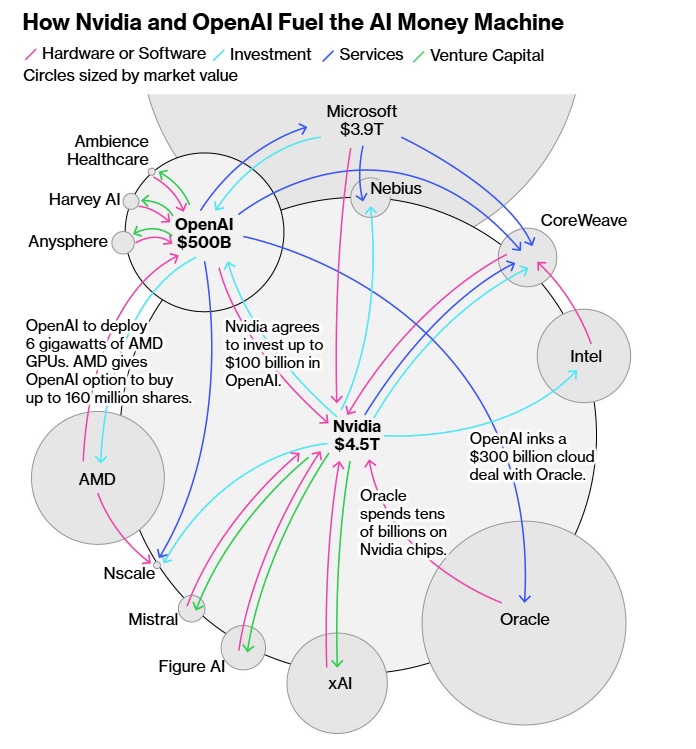
The largest technology companies are spending extraordinary sums on AI infrastructure. Chipmakers like NVIDIA finance customers who buy their chips. Reminiscent of circular “carriage deals” in the Dot Bomb era, technology companies invest in AI companies that become customers of their cloud services. Infrastructure companies borrow against anticipated demand from AI companies, while investors value many of the participants based partly upon the growth generated by the others. See how that works?
The circularity is becoming difficult to miss. NVIDIA, for example, recently agreed to provide guarantees of up to $105 billion supporting an OpenAI data-center project in Ohio while also investing in OpenAI. Broadcom reportedly is exploring tens of billions of dollars of additional financing tied to AI infrastructure. AI is no longer simply another technology sector. It increasingly influences equity valuations, credit markets, underwriting decisions, infrastructure finance and the allocation of enormous pools of investment capital.
Wall Street consequently has a powerful incentive to believe that the AI buildout will continue. Because the emperor has new clothes, but is the same old emperor.
Musicians and songwriters discover that recordings containing their performances and songs have been copied into training datasets without permission or legal basis. Songwriters discover that their compositions, especially lyrics, may have become inputs to systems capable of producing substitutes for their work. Performers discover that their names, voices and identifying characteristics may have become instructions capable of invoking their identities inside commercial products. Their property is being taken—there’s that word again—in a massive theft that should involve prison time. Because if this isn’t criminal copyright infringement, what is?
Drive a few hundred miles away from Nashville or Los Angeles and the property being taken changes, but the complaint sounds remarkably similar.
A farmer is told that a transmission corridor may cross land her family has owned for generations, backed by eminent domain that can force the family to surrender it. A rural community discovers that hundreds or thousands of acres have been assembled for a data center. Residents worry about aquifers, electricity prices, noise, gas generation and transmission lines. Governments offer tax incentives to enormously valuable technology companies while residents are told that the infrastructure is necessary because America must beat China in the AI race. State and local elected officials make zoning decisions to permit these takings, with votes that only make sense if there’s a quid pro quo under the table.
Today we began moving my moms birds! As many of you know my mom had to sell her home for transmission lines to power data centers in Coweta County. This is just a small part of this very long process. I’m hoping more people will enjoy a mix of content, going back to what made me… pic.twitter.com/LdLGjhuFFX
The common denominator between musicians and farmers isn’t artificial intelligence.
It is consent and coercion. It’s the callous taking.
But there is a deeper connection. The institutions demanding these resources did not suddenly become powerful with the invention of generative AI. Much of today’s platform economy accumulated extraordinary wealth and political influence during the preceding two decades through business models built around aggregation, scale, data collection and extraordinarily aggressive interpretations of legal safe harbors. Companies such as Meta and Google learned that once a platform becomes sufficiently large, the lives, work, attention, emails, chats, and baby pictures of its users can become inputs to be captured, scraped, optimized, aggregated and monetized.
The ongoing multidistrict litigation over social-media harms (MDL 3047) provides a sobering illustration of where that philosophy can lead. The allegations in the social media harms cases concern platforms accused of designing products to maximize engagement while exposing their own users—including children—to serious harms and exploiting those harms. Cold blooded. Whatever the ultimate disposition of those cases in MDL 3047, they illustrate a recurring tension in the platform economy: the interests of the human beings using a platform and the protections they enjoy under the law and human rights are routinely trampled by the companies operating it—for the money. And let’s not forget that when we say “companies” we actually mean the employees who went along with it and got rich doing so.
Generative AI extends that tension from users to inputs.
The same appetite for scale that drove platforms to accumulate and exploit behavioral data now creates an appetite for enormous quantities of creative work, human expression, electricity, water, land and transmission capacity. Scraping supplies one set of inputs. Political influence and infrastructure policy can supply another. And in the most extreme case, the sovereign power of eminent domain delegated to the MDL defendants can ultimately compel a property owner to surrender land for data centers serving the buildout. If not stopped, this will give Silicon Valley a political control at the federal, state and local levels never seen before.
The mechanisms are legally different. The instinct is strikingly familiar.
Acquire the input first. Argue about permission, compensation and consequences later. They’re happy to get a license when each artist and songwriter, or mom and child gets a final, non-appealable judgement if the AI companies don’t change the law as they tried and keep trying to do with federal preemption.
That is why the emerging alliance between musicians and landowners is less strange than it initially appears. Both increasingly confront institutions whose enormous financial resources can be converted into political and legal power, and whose growth depends upon obtaining resources belonging to other people.
For the musician, it may be a composition, performance, voice or identity. For the farmer, it may literally be the family farm. And increasingly, it is the perception that enormously powerful companies are building wealth and control over the economy by taking private property and humanity from people who possess considerably less economic and political power.
That is why dismissing the data-center backlash as NIMBYism—or dismissing musicians objecting to unauthorized training as Luddites—fundamentally misunderstands what is happening.
These constituencies are not necessarily anti-technology. They are objecting to a particular economic bargain.
Or, more accurately, the absence of one.
The Politics Are Arriving
This distinction matters because the data-center fight is rapidly escaping zoning commissions and utility proceedings and entering national politics. This is called “jumping the shark” in some circles.
Texas Democrats are campaigning on data centers in rural Republican territory. Candidates elsewhere are attacking electricity costs, water consumption, tax subsidies and the conversion of agricultural land.
This is an unusual political coalition because it doesn’t fit comfortably on the traditional left-right axis.
The rancher who doesn’t want a transmission line across his property may be a lifelong Republican. The songwriter who doesn’t want her catalog ingested into a generative model may be a lifelong Democrat. The homeowners who don’t want a 500-megawatt industrial complex next door may have no particular view about AI whatsoever but want to protect their family.
They nevertheless understand the same sentence:
You shouldn’t be able to take something that belongs to me merely because you say your technology needs it.
That may prove considerably more powerful politically than “AI safety.”
What If Data Centers Become Obsolete Stranded Assets?
There is another reason the industry’s present approach seems unnecessarily confrontational and coercive.
Today’s enormous data-center buildout reflects today’s technological architecture. There is no reason to assume that every aspect of that architecture will remain necessary and may become unnecessary before the data center build is completed.
Indeed, NVIDIA—the company most closely associated with the hardware powering hyperscale AI—is simultaneously pushing substantial AI computation in the opposite direction. Its DGX Spark puts powerful model inference, fine-tuning, and autonomous-agent capabilities on a desktop, while its RTX platforms increasingly allow sophisticated AI models and agents to run locally. NVIDIA expressly markets these systems as “reducing the need for cloud-based token generation resources” and, in the case of its AI workstations, as a means to “offload data center compute resources.” This does not eliminate the need for hyperscale facilities, particularly for frontier-model training, but it demonstrates that an increasing share of AI computation can migrate from centralized data centers to local devices.
It’s a trend away from depending on data centers. And if the answer was, you can’t build a gazillion data centers that inevitably will become stranded assets rather than take whatever you want, do you think that trend might accelerate? Constraints are choices.
That does not mean hyperscale data centers are disappearing. Training frontier models and serving enormous numbers of users will continue to require substantial centralized computing resources for a while.
But the direction of travel matters.
Models are becoming smaller and more efficient. Quantization reduces computational requirements. Specialized chips improve inference efficiency. More processing is moving to PCs, workstations, phones, vehicles and edge devices. Some workloads that required a data center yesterday can run locally today; workloads requiring a data center today may run locally tomorrow.
That makes the industry’s political strategy particularly shortsighted.
Why permanently alienate communities, seize land, subsidize massive infrastructure and create a nationwide political opposition movement around an architecture that technology itself is already beginning to decentralize?
True innovation would try to solve that problem if tech companies were constrained.
Take the Theft Out of AI
The same principle applies to music. The answer is not to stop artificial intelligence. The answer is to take the theft out of it.
And that requires acknowledging an uncomfortable fact about the technology as it exists today. Artificial intelligence can theoretically be useful and productive, but the major generative models did not emerge from a pristine laboratory. To one degree or another, the present generation of large models is shadowed by unresolved allegations and litigation concerning massive-scale copyright infringement, unauthorized scraping, collection of personal information and other privacy violations. Courts will ultimately decide many of those claims in their own inefficient way that Big Tech loves so much. But it is impossible to have an intellectually serious conversation about “responsible AI” while pretending that the provenance of today’s models is not itself contaminated.
That history matters because the question is not simply how AI should behave tomorrow. It is also what was taken to build the systems we have today, from whom, and without whose permission.
Just like I never believed that the law would permit “sharing” with 60 million of your closest friends in the Grokster case, I don’t believe that the AI cases will determine that the answer is because an enormously expensive technology has already been built, obtaining consent will be disregarded. (The subtext being, and if it is, we have much bigger problems.)
This isn’t that hard, people. Build models from licensed material. Ask musicians before converting their identities into commercial capabilities. Compensate creators whose work supplies valuable inputs. Give communities meaningful authority over infrastructure imposed upon them. Pay the actual cost of electricity and transmission rather than shifting it onto ratepayers. Don’t hoard power behind the meter while creating massive noise pollution and other negative externalities. Build smaller and more efficient systems.
And where existing models were built from material that should not have been taken in the first place, genuine innovators should be investing just as aggressively in provenance, licensed replacement datasets, machine unlearning and other technologies capable of removing unauthorized inputs as they invest in acquiring more compute.
That would be innovation directed at the problem rather than lobbying directed at avoiding it. Most importantly, stop treating consent as an obstacle to innovation.
The Human Artistry Campaign and Warner Music Group’s own public AI principles point toward the distinction. WMG says AI models should be licensed and that artists and songwriters should have an opt-in before their names, images, likenesses or voices are used in new AI-generated music. That is not anti-AI. It is an attempt to establish the terms under which AI can coexist with human creators. (That’s also not what happened with Suno, which is why Universal and Sony are still suing Suno.)
There is an enormous difference between saying “don’t build it” and saying “don’t build it with things you had no right to take.” Wall Street may not fully appreciate that distinction yet because markets presently reward companies for demonstrating exposure to AI growth—said another way, Wall Street rewards AI companies that take private property.
Main Street understands it instinctively.
A singer’s voice. A songwriter’s composition. A session player’s musical identity. A rancher’s land. A town’s water supply. A family’s electric bill.
They are very different things. But the political argument increasingly surrounding them is remarkably similar:
Innovation does not create an entitlement to somebody else’s property.
Today @mtgreenee stopped by to visit my childhood home that is being taken by Georgia Power under eminent domain laws to support data centers. I truely appreciate her taking the time to view our property, and understand the sick situation our county is dealing with. pic.twitter.com/vzqeenHD6N
AI can be useful. But usefulness does not cleanse provenance, technological achievement does not retroactively supply consent, and scale does not convert unauthorized taking into a legitimate business model rather than a litigious model.
Local AI may eventually make some of today’s massive infrastructure unnecessary. Properly licensed models can create new markets for artists rather than simply competing against them. Assistive AI can make human creators more productive without replacing them.
The choice therefore isn’t between AI and no AI. It is between an AI economy built by consent and one built by extraction.
The companies that recognize that distinction first may ultimately be the genuine innovators. They will stop asking how much they can take before somebody stops them and start asking how to build technology people actually want to live with.
That is how AI earns a social contract. Take the theft out of AI, and a remarkable amount of the opposition may disappear with it.
For the past two years, Wall Street has treated artificial intelligence as a one-way trade. Hyperscalers, semiconductor companies, utilities, private-credit funds, and data-center developers have committed hundreds of billions of dollars to what may ultimately become nearly $1 trillion in AI-related infrastructure investment over roughly two years.
The underlying assumption has been remarkably consistent: demand for increasingly powerful AI models will continue growing fast enough to justify unprecedented spending on chips, data centers, transmission lines, substations, and electric generation.
But investment booms rarely end because one assumption proves wrong. They end when several assumptions begin to weaken at the same time.
That appears to be happening.
Ed Dowd’s recent Substack analysis argues that the economics supporting today’s AI buildout are becoming increasingly fragile. Financing is tightening. Enterprise customers are demanding clearer returns on investment. Open-weight models continue improving while driving prices lower. And perhaps most importantly, the physical infrastructure required to support AI is becoming a political issue.
Gary Marcus recently challenged David Sacks’ argument that regulation is the principal threat to American AI leadership (Sacks really needs some new sheet music). Marcus instead argued that the industry faces a far more fundamental economic problem:
“The real issue is that LLMs are commodities; lots of people know how to make them, and everybody is doing more or less the same thing, training on more or less the same data. That means nobody has a technical moat. Which means you get price wars and low margins and more and more competitors over time.”
If Marcus is right, Wall Street may eventually discover that AI resembles cloud computing more than pharmaceuticals. There may be tremendous demand—but not necessarily extraordinary profits. That observation dovetails with Goldman Sachs’ increasingly cautious assessment of the AI investment cycle. Goldman has repeatedly warned investors that the buildout depends on continued access to capital, sustained enterprise demand, adequate electric power, and enough economically valuable use cases to justify unprecedented capital expenditures.
AI does not exist in ‘the cloud.’ It exists on electric grids. Every new model depends on substations, transmission lines, transformers, cooling systems, water supplies, and local political consent.
For months, we’ve tracked what has become a genuine data center backlash. Communities across Texas, Georgia, Louisiana, Virginia, Oklahoma, Utah, Alabama, and elsewhere are increasingly questioning the costs of hosting massive AI infrastructure.
Politicians, meanwhile, are discovering that AI infrastructure is much easier to announce than it is to build. Many governors and local officials have promoted data centers by assuring taxpayers that the projects will ‘pay their own way.’ But that message begins to unravel the moment the infrastructure breaks ground or annexes farmland.
A homeowner facing a 765-kV transmission line across family property is unlikely to be persuaded that the project is privately financed. Likewise, a rancher confronting eminent domain does not care whether the transmission costs appear on a utility bill, a corporate balance sheet, or a tax-abatement agreement. The injury is the same: the family home, ranch, or farm is permanently altered to support infrastructure serving distant customers—who are often anonymous.
In the Texas Hill Country, landowners have mobilized against new transmission corridors intended to serve future electric demand, including AI-related growth. In Coweta County, Georgia, residents organized after learning that transmission infrastructure associated with large-scale data-center development could cut through long-held family properties. The debate quickly ceased being about economics and became about land, community, and the limits of eminent domain.
This is where many elected officials have found themselves trying to have it both ways. They assure taxpayers that private investment will shoulder the costs while simultaneously offering substantial tax abatements, infrastructure incentives, expedited permitting, and other forms of public support. Then, when opposition emerges, they discover that the political issue is no longer who pays for the infrastructure—it’s who lives with it.
For families whose property lies in the path of a transmission corridor, ‘the data centers will pay for themselves’ is not an answer. Their concern is not the financing model. Their concern is keeping the home that has been in the family for generations.
None of this means AI is a passing fad. Transformative technologies often survive speculative bubbles. The internet certainly did. But many companies that financed the dot-com boom did not survive intact, and many investors paid dearly for assuming that technological transformation automatically translated into sustainable profits.
Today’s AI investment cycle rests on multiple pillars: inexpensive capital, robust enterprise demand, premium pricing, abundant electricity, and political support for rapid infrastructure expansion. Gary Marcus questions the durability of the competitive moat. Goldman Sachs questions whether the economics can support the investment. Communities across America are questioning whether they should bear the physical burdens.
Those three conversations are converging. The story is no longer simply about faster models or larger training runs. It is about economics, infrastructure, and public acceptance. The market has spent the last two years pricing AI as though all three will remain aligned indefinitely. History suggests that is a very demanding assumption.
If the tech industry has a signature fallacy for the 2020s aside from David Sacks, it belongs to Jensen Huang. The CEO of Nvidia has perfected a circular, self-consuming logic so brazen that it deserves a name: The Paradox of Huang’s Rope. It is the argument that China is too dangerous an AI adversary for the United States to regulate artificial intelligence at home or control export of his Nvidia chips abroad—while insisting in the very next breath that the U.S. must allow him to keep selling China the advanced Nvidia chips that make China’s advanced AI capabilities possible. The justification destroys its own premise, like handing an adversary the rope to hang you and then pointing to the length of that rope as evidence that you must keep selling more, perhaps to ensure a more “humane” hanging. I didn’t think it was possible to beat “sharing is caring” for utter fallacious bollocks.
The Paradox of Huang’s Rope works like this: First, hype China as an existential AI competitor. Second, declare that any regulatory guardrails—whether they concern training data, safety, export controls, or energy consumption—will cause America to “fall behind.” Third, invoke national security to insist that the U.S. government must not interfere with the breakneck deployment of AI systems across the economy. And finally, quietly lobby for carveouts that allow Nvidia to continue selling ever more powerful chips to the same Chinese entities supposedly creating the danger that justifies deregulation.
It is a master class in circularity: “China is dangerous because of AI → therefore we can’t regulate AI → therefore we must sell China more AI chips → therefore China is even more dangerous → therefore we must regulate even less and export even more to China.” At no point does the loop allow for the possibility that reducing the United States’ role as China’s primary AI hardware supplier might actually reduce the underlying threat. Instead, the logic insists that the only unacceptable risk is the prospect of Nvidia making slightly less money.
This is not hypothetical. While Washington debates export controls, Huang has publicly argued that restrictions on chip sales to China could “damage American technology leadership”—a claim that conflates Nvidia’s quarterly earnings with the national interest. Meanwhile, U.S. intelligence assessments warn that China is building fully autonomous weapons systems, and European analysts caution that Western-supplied chips are appearing in PLA research laboratories. Yet the policy prescription from Nvidia’s corner remains the same: no constraints on the technology, no accountability for the supply chain, and no acknowledgment that the market incentives involved have nothing to do with keeping Americans safe. And anyone who criticizes the authoritarian state run by the Chinese Communist Party is a “China Hawk” which Huang says is a “badge of shame” and “unpatriotic” because protecting America from China by cutting off chip exports “destroys the American Dream.” Say what?
The Paradox of Huang’s Rope mirrors other Cold War–style fallacies, in which companies invoke a foreign threat to justify deregulation while quietly accelerating that threat through their own commercial activity. But in the AI context, the stakes are higher. AI is not just another consumer technology; its deployment shapes military posture, labor markets, information ecosystems, and national infrastructure. A strategic environment in which U.S. corporations both enable and monetize an adversary’s technological capabilities is one that demands more regulation, not less.
Naming the fallacy matters because it exposes the intellectual sleight of hand. Once the circularity is visible, the argument collapses. The United States does not strengthen its position by feeding the very capabilities it claims to fear. And it certainly does not safeguard national security by allowing one company’s commercial ambitions to dictate the boundaries of public policy. The Paradox of Huang’s Rope should not guide American AI strategy. It should serve as a warning of how quickly national priorities can be twisted into a justification for private profit.
“Operation Gatekeeper has exposed a sophisticated smuggling network that threatens our Nation’s security by funneling cutting-edge AI technology to those who would use it against American interests,” said Ganjei. “These chips are the building blocks of AI superiority and are integral to modern military applications. The country that controls these chips will control AI technology; the country that controls AI technology will control the future. The Southern District of Texas will aggressively prosecute anyone who attempts to compromise America’s technological edge.”
That divergence from the prosecutors is not industrial policy. That is incoherence. But mostly it’s just bad advice, likely coming from White House AI Czar David Sacks, Mr. Trump’s South African AI policy advisor who may have a hard time getting a security clearance in the first place..
On one hand, DOJ is rightly bringing cases over the illegal diversion of restricted AI chips—recognizing that these processors are strategic technologies with direct national-security implications. On the other hand, the White House is signaling that access to those same chips is negotiable, subject to licensing workarounds, regulatory carve-outs, or political discretion.
You cannot treat a technology as contraband in federal court and as a commercial export in the West Wing.
Pick one.
AI Chips Are Not Consumer Electronics
The United States does not sell China F-35 fighter jets. We do not sell Patriot missile systems. We do not sell advanced avionics platforms and then act surprised when they show up embedded in military infrastructure. High-end AI accelerators are in the same category.
NVIDIA’s most advanced chips are not merely commercial products. They are general-purpose intelligence infrastructure or what China calls military-civil fusion. They train surveillance systems, military logistics platforms, cyber-offensive tools, and models capable of operating autonomous weapons and battlefield decision-making pipelines with no human in the loop.
If DOJ treats the smuggling of these chips into China as a serious federal crime—and it should—there is no coherent justification for authorizing their sale through executive discretion. Except, of course, money, or in Mr. Sacks case, more money.
Fully Autonomous Weapons—and Selling the Rope
China does not need U.S. chips to build consumer AI. It wants them for military acceleration.Advanced NVIDIA AI chips are not just about chatbots or recommendation engines. They are the backbone of fully autonomous weapons systems—autonomous targeting, swarm coordination, battlefield logistics, and decision-support models that compress the kill chain beyond meaningful human control.
There is an old warning attributed to Vladimir Lenin—that capitalists would sell the rope by which they would later be hanged. Apocryphal or not, it captures this moment with uncomfortable precision.
If NVIDIA chips are powerful enough to underpin autonomous weapons systems for allied militaries, they are powerful enough to underpin autonomous weapons systems for adversaries like China. Trump’s own National Security Strategy statement clearly says previous U.S. elites made “mistaken” assumptions about China such as the famous one that letting China into the WTO would integrate Beijing into the famous rules-based international order. Trump tells us that instead China “got rich and powerful” and used this against us, and goes on to describe the CCP’s well known predatory subsidies, unfair trade, IP theft, industrial espionage, supply-chain leverage, and fentanyl precursor exports as threats the U.S. must “end.” By selling them the most advanced AI chips?
Western governments and investors simultaneously back domestic autonomous-weapons firms—such as Europe-based Helsing, supported by Spotify CEO Daniel Ek—explicitly building AI-enabled munitions for allied defense. That makes exporting equivalent enabling infrastructure to a strategic competitor indefensible.
The AI Moratorium Makes This Worse, Not Better
This contradiction unfolds alongside a proposed federal AI moratorium executive order originating with Mr. Sacks and Adam Thierer of Google’s R Street Institute that would preempt state-level AI protections. States are told AI is too consequential for local regulation, yet the federal government is prepared to license exports of AI’s core infrastructure abroad.
If AI is too dangerous for states to regulate, it is too dangerous to export. Preemption at home combined with permissiveness abroad is not leadership. It is capture.
This Is What Policy Capture Looks Like
The common thread is not national security. It is Silicon Valley access. David Sacks and others in the AI–VC orbit argue that AI regulation threatens U.S. competitiveness while remaining silent on where the chips go and how they are used.
When DOJ prosecutes smugglers while the White House authorizes exports, the public is entitled to ask whose interests are actually being served. Advisory roles that blur public power and private investment cannot coexist with credible national-security policymaking particularly when the advisor may not even be able to get a US national security clearance unless the President blesses it.
A Line Has to Be Drawn
If a technology is so sensitive that its unauthorized transfer justifies prosecution, its authorized transfer should be prohibited absent extraordinary national interest. AI accelerators meet that test.
Until the administration can articulate a coherent justification for exporting these capabilities to China, the answer should be no. Not licensed. Not delayed. Not cosmetically restricted.
And if that position conflicts with Silicon Valley advisers who view this as a growth opportunity, they should return to where they belong. The fact that the US is getting 25% of the deal (which i bet never finds its way into America’s general account), means nothing except confirming Lenin’s joke about selling the rope to hang ourselves, you know, kind of like TikTok.
David Sacks should go back to Silicon Valley.
This is not venture capital. This is our national security and he’s selling it like rope.
“Hubris gives birth to the tyrant; hubris, when glutted on vain visions, plunges into an abyss of doom.” Agamemnon by Aeschylus
Masayoshi Son has always believed he could see farther into the technological future than everyone else. Sometimes he does. Sometimes he rides straight off a cliff. But the pattern is unmistakable: he is the market’s most fearless—and sometimes most reckless—Bubble Rider.
In the late 1990s, Masa became the patron saint of the early internet. SoftBank took stakes in dozens of dot-coms, anchored by its wildly successful bet on Yahoo! (yes, Yahoo! Ask your mom.). For a moment, Masa was briefly one of the world’s richest men on paper. Then the dot-bomb hit. Overnight, SoftBank lost nearly everything. Masa has said he personally watched $70 billion evaporate—the largest individual wealth wipeout ever recorded at the time. But his instinct wasn’t to retreat. It was to reload.
That same pattern returned with SoftBank’s Vision Fund. Masa raised unprecedented capital from sovereign wealth pools and bet big on the “AI + data” megatrend—then plowed it into companies like WeWork, Zume, Brandless, and other combustion-ready unicorns. When those valuations collapsed, SoftBank again absorbed catastrophic losses. And yet the thesis survived, just waiting for its next bubble.
We’re now in what I’ve called the AI Bubble—the largest capital-formation mania since the original dot-com wave, powered by foundation AI labs, GPU scarcity, and a global arms race to capture platform rents. And here comes Masa again, right on schedule.
SoftBank has now sold its entire Nvidia stake—the hottest AI infrastructure trade of the decade—freeing up nearly $6 billion. That money is being redirected straight into OpenAI’s secondary stock offering at an eyewatering marked-to-fantasy $500 billion valuation. In the same week, SoftBank confirmed it is preparing even larger AI investments. This is Bubble Riding at its purest: exiting one vertical where returns may be peaking, and piling into the center of speculative gravity before the froth crests.
What I suspect Masa sees is simple: if generative AI succeeds, the model owners will become the new global monopolies alongside the old global monopolies like Google and Microsoft. You know, democratizing the Internet. If it fails, the whole electric grid and water supply may crash along with it. He’s choosing a side—and choosing it at absolute top-of-market pricing.
The other difference between the dot-com bubble and the AI bubble is legal, not just financial. Pets.com and its peers (who I refer to generically as “Socks.com” the company that uses the Internet to find socks under the bed) were silly, but they weren’t being hauled into court en masse for building their core product on other people’s property.
Today’s AI darlings are major companies being run like pirate markets. Meta, Anthropic, OpenAI and others are already facing a wall of litigation from authors, news organizations, visual artists, coders, and music rightsholders who all say the same thing: your flagship models exist only because you ingested our work without permission, at industrial scale, and you’re still doing it.
That means this bubble isn’t just about overpaying for growth; it’s about overpaying for businesses whose main asset—trained model weights—may be encumbered by unpriced copyright and privacy claims. The dot-com era mispriced eyeballs. The AI era may be mispricing liability. And that’s serious stuff.
There’s another distortion the dot-com era never had: the degree to which the AI bubble is being propped up by taxpayers. Socks.com didn’t need a new substation, a federal loan guarantee, or a 765 kV transmission corridor to find your socks. Today’s Socks.ai does need all that to use AI to find socks under the bed. All the AI giants do. Their business models quietly assume public willingness to underwrite an insanely expensive buildout of power plants, high-voltage lines, and water-hungry cooling infrastructure—costs socialized onto ratepayers and communities so that a handful of platforms can chase trillion-dollar valuations. The dot-com bubble misallocated capital; the AI bubble is trying to reroute the grid.
In that sense, this isn’t just financial speculation on GPUs and model weights—it’s a stealth industrial policy, drafted in Silicon Valley and cashed at the public’s expense.
The problem, as always, is timing. Bubbles create enormous winners and equally enormous craters. Masa’s career is proof. But this time, the stakes are higher. The AI Bubble isn’t just a capital cycle; it’s a geopolitical and industrial reordering, pulling in cloud platforms, national security, energy systems, media industries, and governments with a bad case of FOMO scrambling to regulate a technology they barely understand.
And now, just as Masa reloads for his next moonshot, the market itself is starting to wobble. The past week’s selloff may not be random—it feels like a classic early-warning sign of a bubble straining under its own weight. In every speculative cycle, the leaders crack first: the most crowded trades, the highest-multiple stories, the narratives everyone already believes. This time, those leaders are the AI complex—GPU giants, hyperscale clouds, and anything with “model” or “inference” in the deck. When those names roll over together, it tells you something deeper than normal volatility is at work.
What the downturn may exposes is the growing narrative about an “earnings gap.“ Investors have paid extraordinary prices for companies whose long-term margins remain theoretical, whose energy demands are exploding, and whose regulatory and copyright liabilities are still unpriced. The AI story is enormous—but the business model remains unresolved. A selloff forces the market to remember the thing it forgets at every bubble peak: cash flow eventually matters.
Back in the late-cycle of the dot com era, I had lunch in December of 1999 with a friend who had worked 20 years in a division of a huge conglomerate, bought his division in a leveraged buyout, ran that company for 10 years then took that public, sold it to another company that then went public. He asked me to explain how these dot coms were able to go public, a process he equated with hard work and serious people. I said, well we like them to have four quarters of top line revenue. He stared at me. I said, I know it’s stupid, but that’s what they say. He said, it’s all going to crash. And boy did it ever.
And ironically, nothing captures this late-cycle psychology better than Masa’s own behavior. SoftBank selling Nvidia—the proven cash-printing side of AI—to buy OpenAI at a $500 billion valuation isn’t contrarian genius; it’s the definition of a crowded climax trade, the moment when everyone is leaning the same direction. When that move coincides with the tape turning red, the message is unmistakable: the AI supercycle may not be over, but the easy phase is.
Whether this is the start of a genuine deflation or just the first hard jolt before the final manic leg, the pattern is clear. The AI Bubble is no longer hypothetical—it is showing up on the trading screens, in the sentiment, and in the rotation of capital itself.
Masa may still believe the crest of the wave lies ahead. But the market has begun to ask the question every bubble eventually faces: What if this is the top of the ride?
Masa is betting that the crest of the curve lies ahead—that we’re in Act Two of an AI supercycle. Maybe he’s right. Or maybe he’s gearing up for his third historic wipeout.