There are increasingly two conversations about artificial intelligence in America, and they are beginning to collide. These are familiar opponents: Wall Street and Main Street.
Pressure from Financial Markets
The first is taking place on Wall Street.
For publicly traded companies that aggregate, distribute, and monetize enormous quantities of creative content, being seen as an AI skeptic is increasingly difficult. Investors expect an AI strategy. Analysts ask about AI on earnings calls. Companies announce AI partnerships (which can get pompous like “global strategic partnerships” and are neither), a few AI licensing arrangements, claimed AI efficiencies, AI products and AI revenue opportunities. Emphasis on the opportunities in the search for elusive ROI. Warner Music Group, for example, recently told its shareholders that it has taken an “early and aggressive approach” to AI partnerships and emphasized the variable economics of its deals with Suno and other AI companies. Universal Music Group likewise regularly highlights its growing portfolio of “responsible AI” partnerships in financial reporting.
That should hardly be surprising. AI has become deeply embedded in the capital markets themselves.
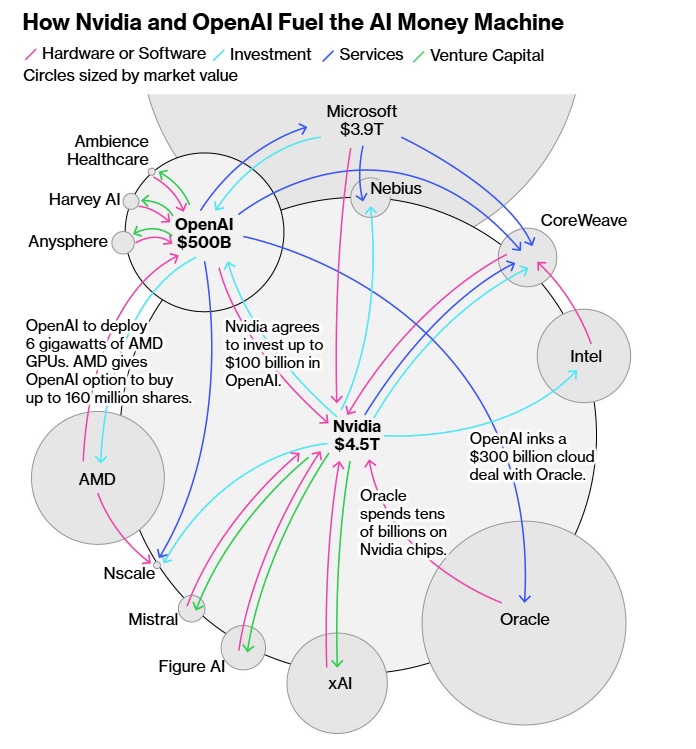
The largest technology companies are spending extraordinary sums on AI infrastructure. Chipmakers like NVIDIA finance customers who buy their chips. Reminiscent of circular “carriage deals” in the Dot Bomb era, technology companies invest in AI companies that become customers of their cloud services. Infrastructure companies borrow against anticipated demand from AI companies, while investors value many of the participants based partly upon the growth generated by the others. See how that works?
The circularity is becoming difficult to miss. NVIDIA, for example, recently agreed to provide guarantees of up to $105 billion supporting an OpenAI data-center project in Ohio while also investing in OpenAI. Broadcom reportedly is exploring tens of billions of dollars of additional financing tied to AI infrastructure. AI is no longer simply another technology sector. It increasingly influences equity valuations, credit markets, underwriting decisions, infrastructure finance and the allocation of enormous pools of investment capital.
Wall Street consequently has a powerful incentive to believe that the AI buildout will continue. Because the emperor has new clothes, but is the same old emperor.
Musicians and songwriters discover that recordings containing their performances and songs have been copied into training datasets without permission or legal basis. Songwriters discover that their compositions, especially lyrics, may have become inputs to systems capable of producing substitutes for their work. Performers discover that their names, voices and identifying characteristics may have become instructions capable of invoking their identities inside commercial products. Their property is being taken—there’s that word again—in a massive theft that should involve prison time. Because if this isn’t criminal copyright infringement, what is?
Drive a few hundred miles away from Nashville or Los Angeles and the property being taken changes, but the complaint sounds remarkably similar.
A farmer is told that a transmission corridor may cross land her family has owned for generations, backed by eminent domain that can force the family to surrender it. A rural community discovers that hundreds or thousands of acres have been assembled for a data center. Residents worry about aquifers, electricity prices, noise, gas generation and transmission lines. Governments offer tax incentives to enormously valuable technology companies while residents are told that the infrastructure is necessary because America must beat China in the AI race. State and local elected officials make zoning decisions to permit these takings, with votes that only make sense if there’s a quid pro quo under the table.
Today we began moving my moms birds! As many of you know my mom had to sell her home for transmission lines to power data centers in Coweta County. This is just a small part of this very long process. I’m hoping more people will enjoy a mix of content, going back to what made me… pic.twitter.com/LdLGjhuFFX
The common denominator between musicians and farmers isn’t artificial intelligence.
It is consent and coercion. It’s the callous taking.
But there is a deeper connection. The institutions demanding these resources did not suddenly become powerful with the invention of generative AI. Much of today’s platform economy accumulated extraordinary wealth and political influence during the preceding two decades through business models built around aggregation, scale, data collection and extraordinarily aggressive interpretations of legal safe harbors. Companies such as Meta and Google learned that once a platform becomes sufficiently large, the lives, work, attention, emails, chats, and baby pictures of its users can become inputs to be captured, scraped, optimized, aggregated and monetized.
The ongoing multidistrict litigation over social-media harms (MDL 3047) provides a sobering illustration of where that philosophy can lead. The allegations in the social media harms cases concern platforms accused of designing products to maximize engagement while exposing their own users—including children—to serious harms and exploiting those harms. Cold blooded. Whatever the ultimate disposition of those cases in MDL 3047, they illustrate a recurring tension in the platform economy: the interests of the human beings using a platform and the protections they enjoy under the law and human rights are routinely trampled by the companies operating it—for the money. And let’s not forget that when we say “companies” we actually mean the employees who went along with it and got rich doing so.
Generative AI extends that tension from users to inputs.
The same appetite for scale that drove platforms to accumulate and exploit behavioral data now creates an appetite for enormous quantities of creative work, human expression, electricity, water, land and transmission capacity. Scraping supplies one set of inputs. Political influence and infrastructure policy can supply another. And in the most extreme case, the sovereign power of eminent domain delegated to the MDL defendants can ultimately compel a property owner to surrender land for data centers serving the buildout. If not stopped, this will give Silicon Valley a political control at the federal, state and local levels never seen before.
The mechanisms are legally different. The instinct is strikingly familiar.
Acquire the input first. Argue about permission, compensation and consequences later. They’re happy to get a license when each artist and songwriter, or mom and child gets a final, non-appealable judgement if the AI companies don’t change the law as they tried and keep trying to do with federal preemption.
That is why the emerging alliance between musicians and landowners is less strange than it initially appears. Both increasingly confront institutions whose enormous financial resources can be converted into political and legal power, and whose growth depends upon obtaining resources belonging to other people.
For the musician, it may be a composition, performance, voice or identity. For the farmer, it may literally be the family farm. And increasingly, it is the perception that enormously powerful companies are building wealth and control over the economy by taking private property and humanity from people who possess considerably less economic and political power.
That is why dismissing the data-center backlash as NIMBYism—or dismissing musicians objecting to unauthorized training as Luddites—fundamentally misunderstands what is happening.
These constituencies are not necessarily anti-technology. They are objecting to a particular economic bargain.
Or, more accurately, the absence of one.
The Politics Are Arriving
This distinction matters because the data-center fight is rapidly escaping zoning commissions and utility proceedings and entering national politics. This is called “jumping the shark” in some circles.
Texas Democrats are campaigning on data centers in rural Republican territory. Candidates elsewhere are attacking electricity costs, water consumption, tax subsidies and the conversion of agricultural land.
This is an unusual political coalition because it doesn’t fit comfortably on the traditional left-right axis.
The rancher who doesn’t want a transmission line across his property may be a lifelong Republican. The songwriter who doesn’t want her catalog ingested into a generative model may be a lifelong Democrat. The homeowners who don’t want a 500-megawatt industrial complex next door may have no particular view about AI whatsoever but want to protect their family.
They nevertheless understand the same sentence:
You shouldn’t be able to take something that belongs to me merely because you say your technology needs it.
That may prove considerably more powerful politically than “AI safety.”
What If Data Centers Become Obsolete Stranded Assets?
There is another reason the industry’s present approach seems unnecessarily confrontational and coercive.
Today’s enormous data-center buildout reflects today’s technological architecture. There is no reason to assume that every aspect of that architecture will remain necessary and may become unnecessary before the data center build is completed.
Indeed, NVIDIA—the company most closely associated with the hardware powering hyperscale AI—is simultaneously pushing substantial AI computation in the opposite direction. Its DGX Spark puts powerful model inference, fine-tuning, and autonomous-agent capabilities on a desktop, while its RTX platforms increasingly allow sophisticated AI models and agents to run locally. NVIDIA expressly markets these systems as “reducing the need for cloud-based token generation resources” and, in the case of its AI workstations, as a means to “offload data center compute resources.” This does not eliminate the need for hyperscale facilities, particularly for frontier-model training, but it demonstrates that an increasing share of AI computation can migrate from centralized data centers to local devices.
It’s a trend away from depending on data centers. And if the answer was, you can’t build a gazillion data centers that inevitably will become stranded assets rather than take whatever you want, do you think that trend might accelerate? Constraints are choices.
That does not mean hyperscale data centers are disappearing. Training frontier models and serving enormous numbers of users will continue to require substantial centralized computing resources for a while.
But the direction of travel matters.
Models are becoming smaller and more efficient. Quantization reduces computational requirements. Specialized chips improve inference efficiency. More processing is moving to PCs, workstations, phones, vehicles and edge devices. Some workloads that required a data center yesterday can run locally today; workloads requiring a data center today may run locally tomorrow.
That makes the industry’s political strategy particularly shortsighted.
Why permanently alienate communities, seize land, subsidize massive infrastructure and create a nationwide political opposition movement around an architecture that technology itself is already beginning to decentralize?
True innovation would try to solve that problem if tech companies were constrained.
Take the Theft Out of AI
The same principle applies to music. The answer is not to stop artificial intelligence. The answer is to take the theft out of it.
And that requires acknowledging an uncomfortable fact about the technology as it exists today. Artificial intelligence can theoretically be useful and productive, but the major generative models did not emerge from a pristine laboratory. To one degree or another, the present generation of large models is shadowed by unresolved allegations and litigation concerning massive-scale copyright infringement, unauthorized scraping, collection of personal information and other privacy violations. Courts will ultimately decide many of those claims in their own inefficient way that Big Tech loves so much. But it is impossible to have an intellectually serious conversation about “responsible AI” while pretending that the provenance of today’s models is not itself contaminated.
That history matters because the question is not simply how AI should behave tomorrow. It is also what was taken to build the systems we have today, from whom, and without whose permission.
Just like I never believed that the law would permit “sharing” with 60 million of your closest friends in the Grokster case, I don’t believe that the AI cases will determine that the answer is because an enormously expensive technology has already been built, obtaining consent will be disregarded. (The subtext being, and if it is, we have much bigger problems.)
This isn’t that hard, people. Build models from licensed material. Ask musicians before converting their identities into commercial capabilities. Compensate creators whose work supplies valuable inputs. Give communities meaningful authority over infrastructure imposed upon them. Pay the actual cost of electricity and transmission rather than shifting it onto ratepayers. Don’t hoard power behind the meter while creating massive noise pollution and other negative externalities. Build smaller and more efficient systems.
And where existing models were built from material that should not have been taken in the first place, genuine innovators should be investing just as aggressively in provenance, licensed replacement datasets, machine unlearning and other technologies capable of removing unauthorized inputs as they invest in acquiring more compute.
That would be innovation directed at the problem rather than lobbying directed at avoiding it. Most importantly, stop treating consent as an obstacle to innovation.
The Human Artistry Campaign and Warner Music Group’s own public AI principles point toward the distinction. WMG says AI models should be licensed and that artists and songwriters should have an opt-in before their names, images, likenesses or voices are used in new AI-generated music. That is not anti-AI. It is an attempt to establish the terms under which AI can coexist with human creators. (That’s also not what happened with Suno, which is why Universal and Sony are still suing Suno.)
There is an enormous difference between saying “don’t build it” and saying “don’t build it with things you had no right to take.” Wall Street may not fully appreciate that distinction yet because markets presently reward companies for demonstrating exposure to AI growth—said another way, Wall Street rewards AI companies that take private property.
Main Street understands it instinctively.
A singer’s voice. A songwriter’s composition. A session player’s musical identity. A rancher’s land. A town’s water supply. A family’s electric bill.
They are very different things. But the political argument increasingly surrounding them is remarkably similar:
Innovation does not create an entitlement to somebody else’s property.
Today @mtgreenee stopped by to visit my childhood home that is being taken by Georgia Power under eminent domain laws to support data centers. I truely appreciate her taking the time to view our property, and understand the sick situation our county is dealing with. pic.twitter.com/vzqeenHD6N
AI can be useful. But usefulness does not cleanse provenance, technological achievement does not retroactively supply consent, and scale does not convert unauthorized taking into a legitimate business model rather than a litigious model.
Local AI may eventually make some of today’s massive infrastructure unnecessary. Properly licensed models can create new markets for artists rather than simply competing against them. Assistive AI can make human creators more productive without replacing them.
The choice therefore isn’t between AI and no AI. It is between an AI economy built by consent and one built by extraction.
The companies that recognize that distinction first may ultimately be the genuine innovators. They will stop asking how much they can take before somebody stops them and start asking how to build technology people actually want to live with.
That is how AI earns a social contract. Take the theft out of AI, and a remarkable amount of the opposition may disappear with it.
There was a time when the music business had a simple rule: “We will never let another MTV build a business on our backs”. That philosophy arose from watching the arbitrage as value created by artists was extracted by platforms that had nothing to do with creating it. That spectacle shaped the industry’s deep reluctance to license digital music in the early years of the internet. “Never” was supposed to mean never.
I took them at their word.
But of course, “never” turned out to be conditional. The industry made exception after exception until the rule dissolved entirely. First came the absurd statutory shortcut of the DMCA safe harbor era. Then YouTube. Then iTunes. Then Spotify. Then Twitter and Facebook, social media. Then TikTok. Each time, platforms were allowed to scale first and renegotiate later (and Twitter still hasn’t paid). Each time, the price of admission for the platform was astonishingly low compared to the value extracted from music and musicians. In many cases, astonishingly low compared to their current market value in businesses that are totally dependent on creatives. (You could probably put Amazon in that category.)
Some of those deals came wrapped in what looked, at the time, like meaningful compensation — headline-grabbing advances and what were described as “equity participation.” In reality, those advances were finite and the equity was often a thin sliver, while the long-term effect was to commoditize artist royalties and shift durable value toward the platforms. That is one reason so many artists came to resent and in many cases openly despise Spotify and the “big pool” model. All the while being told how transformative Spotify’s algorithm is without explaining how the wonderful algorithm misses 80% of the music on the platform.
And now we arrive at the latest collapse of “never”: Spotify’s announcement that it is developing its own music AI and derivative-generation tools.
If you disliked Spotify before, you may loathe what comes next.
This moment is different — but in many ways it is the same fundamental problem MTV created. Artists and labels provided the core asset — their recordings — for free or nearly free, and the platform built a powerful business by packaging that value and selling it back to them. Distribution monetized access to music; AI monetizes the music itself.
Spotify’s framing appears to offer something of a middle ground. [New CEO] Söderström is not arguing for open distribution of AI derivatives across the internet. Instead, he’s positioning Spotify as the platform where this interaction should happen – where the fans,the royalty pool, and the technology already exist.
Right, our fans and his pathetic “royalty pool.” And this is supposed to make us like you?
The Training Gap
Which brings us to the question Spotify has not answered — the question that matters more than any feature announcement or product demo:
What did they train on?
Was it Epidemic Sound? Was it licensed catalog? Public domain recordings? User uploads? Pirated material?
All are equally possible.
But far more likely to me: Did Spotify train on the recordings licensed for streaming and Spotify’s own platform user data derived from the fans we drove to their service — quietly accumulated, normalized, and ingested into AI over years?
Spotify has not said.
And that silence matters.
The Transparency Gap
Creators currently have no meaningful visibility into whether their work has already been absorbed into Spotify’s generative systems. No disclosure. No audit trail. No licensing registry. No opt-in structure. No compensation framework. The unknowns are not theoretical — they are structural:
Were your recordings used for training?
Do your performances now exist inside model weights?
Was consent ever obtained?
Was compensation ever contemplated?
Can outputs reproduce protected expression derived from your work?
If Spotify trained on catalog licensed to them for an entirely different purpose without explicit, informed permission from rights holders and performers, then AI derivatives are not merely a new feature. They are a massively infringing second layer of value extraction built on top of the firstexploitation — the original recordings that creators already struggled to monetize fairly.
This is not innovation. It is recursion.
Platform Data: The Quiet Asset
Spotify possesses one of the largest behavioral and audio datasets in the history of recorded music that was licensed to them for an entirely different purpose — not just recordings, but stems, usage patterns, listener interactions, metadata, and performance analytics. If that corpus was used — formally or informally — as training input for this Spotify AI tool that magically appeared, then Spotify’s AI is built not just on music, but on the accumulated creative labor of millions of artists.
Yet creators were never asked. No notice. No explanation. No disclosure.
It must also be said that there is a related governance question. Daniel Ek’s investment in the defense-AI company Helsing has been widely reported, and Helsing’s systems like all advanced AI depend on large-scale model training, data pipelines, and machine learning infrastructure. Spotify supposedly has separately developed its own AI capabilities.
This raises a narrow but legitimate transparency question: is there any technological, data, personnel, or infrastructure overlap — any “crosstalk” — between AI development connected to Helsing’s automated weapons and the models deployed within Spotify? No public evidence currently suggests such interaction, and the companies operate in different domains, but the absence of disclosure leaves creators and stakeholders unable to assess whether safeguards, firewalls, and governance boundaries exist. Where powerful AI systems coexist under shared leadership influence, transparency about separation is as important as transparency about training itself.
The core issue is not simply licensing. It is transparency. A platform cannot convert custodial access into training rights while declining to explain where its training data came from.
That’s why this quote from MBW belies the usual exceptionally short sighted and moronic pablum from the Spotify executive team:
Asked on the call whether AI music platforms like Suno, Udio and Stability could themselves become DSPs and take share from Spotify, Norström pushed back: “No rightsholder is against our vision. We pretty much have the whole industry behind us.”
Of course, the premise of the question is one I have been wondering about myself—I assume that Suno and Udio fully intend to get into the DSP game. But Spotify’s executive blew right past that thoughtful question and answered a question he wasn’t asked which is very relevant to us: “We have pretty much the whole industry behind us.”
Oh, well, you actually don’t. And it would be very informative to know exactly what makes you say that since you have not disclosed anything about what ever the “it” is that you think the whole industry is behind.
Spotify’s Shadow Library Problem
Across the AI sector, a now-familiar pattern has emerged: Train first. Explain later — if ever.
The music industry has already seen this logic elsewhere: massive ingestion followed by retroactive justification. The question now is whether Spotify — a licensed, mainstream platform for its music service — is replicating that same pattern inside a closed AI ecosystem for which it has no licenses that have been announced.
So the question must be asked clearly:
Is Spotify’s AI derivative engine built entirely on disclosed, authorized training sources? Or is this simply a platform-contained version of shadow-library training?
Because if models ingested:
Unlicensed recordings
User-uploaded infringing material
Catalog works without explicit training disclosure
Performances lacking performer awareness
then AI derivatives risk becoming a backdoor exploitation mechanism operating outside traditional consent structures. A derivative engine built on undisclosed training provenance is not a creator tool. It is a liability gap. You know, kind of like Anna’s Archive.
A Direct Response to Gustav Söderström : What Training Would Actually Be Required?
Launching a true music generation or derivative engine would require massive, structured training, including:
1. Large-Scale Audio Corpus Millions of full-length recordings across genres, eras, and production styles to teach models musical structure, timbre, arrangement, and performance nuance. Now where might those come from?
2. Stem-Level and Multitrack Data Separated vocals, instruments, and production layers to allow recombination, remixing, and stylistic transformation.
3. Performance and Voice Modeling Extensive vocal and instrumental recordings to capture phrasing, tone, articulation, and expressive characteristics — the very elements tied to performer identity.
4. Metadata and Behavioral Signals Tempo, key, genre, mood, playlist placement, skip rates, and listener engagement data to guide model outputs toward commercially viable patterns.
5. Style and Similarity Encoding Statistical mapping of musical characteristics enabling the system to generate “in the style of” outputs — the core mechanism behind derivative generation.
6. Iterative Retraining at Scale Continuous ingestion and refinement using newly available recordings and platform data to improve fidelity and relevance.
7.Funding for all of the above
No generative music system of consequence can be built without enormous training exposure to real recordings and performances, and the expense.
Which returns us to the unresolved question:
Where did Spotify obtain that training data?
Because the issue is not whether Spotify could license training material. The issue is that Spotify has not explained — at all — how its training corpus was assembled.
Opacity is the problem.
Personhood Signals: Training on Recordings Is Training on People
Spotify can describe AI derivatives as “music tools,” but training on recordings is not just training on songs. Recordings contain personhood signals — the distinctive human identifiers embedded in performance and production that let a system learn who someone is (or can sound like), not merely what the composition is.
Studio-musician signatures (the “nonfeatured” musicians who are often most identifiable to other musicians)
Songwriter styles harmonic signatures, prosodic alignment, and lyric identity markers
Production cues tied to an artist’s brand (adlibs, signature FX chains, cadence habits, recurring delivery patterns)
A modern generative system does not need to “copy Track X” to exploit these signals. It can abstract them — compress them into representations and weights — and then reconstruct outputs that trade on identity while claiming no particular recording was reproduced.
That’s why “licensing” isn’t the real threshold question here. The threshold questions are disclosure and permission:
Did Spotify extract personhood signals from performances on its platform?
Were those signals used to train systems that can output tokenized “sounds like” content?
Are there credible guardrails that prevent the model from generating identity-proximate vocals/instrumental performance?
And can creators verify any of this without having to sue first?
If Spotify’s training data provenance is opaque, then creators cannot know whether their identity-bearing performances were converted into model value which is the beginning of commoditization of music in AI. And when the platform monetizes “derivatives” (aka competing outputs) it risks building a new revenue layer (for Spotify) on top of the very human signals that performers were never asked to contribute.
The Asymmetry Problem
Spotify knows what it trained on. Creators do not. That asymmetry alone is a structural concern.
When a platform possesses complete knowledge of training inputs, model architecture, and monetization pathways — while creators lack even basic disclosure — the bargaining imbalance becomes absolute. Transparency is not optional in this context. It is the minimum condition for legitimacy.
Without it, creators cannot:
Assert rights
Evaluate consent
Measure market displacement
Understand whether their work shaped model behavior
Or even know whether their identity, voice, or performance has already been absorbed into machine systems
As every bully knows, opacity redistributes power.
Derivatives or Displacement?
Spotify frames AI derivatives as creative empowerment — fans remixing, artists expanding, new revenue streams emerging. But the core economic question remains unanswered:
Are these tools supplementing human creation or substituting for it?
If derivative systems can generate stylistically consistent outputs from trained material, then the value captured by the model originates in human recordings — recordings whose role in training remains undisclosed. In that scenario, AI derivatives are not simply tools. They are synthetic competitors built from the creative DNA of the original artists. Kind of like MTV.
The distinction between assistive and substitutional AI is economic, not rhetorical.
The Question That Will Not Go Away
Spotify may continue to speak about AI derivatives in the language of opportunity, scale, and creative democratization. But none of that resolves the underlying issue:
What did they train on?
Until Spotify provides clear, verifiable disclosure about the origin of its training data — not merely licensing claims, but actual transparency — every derivative output carries an unresolved provenance problem. And in the age of generative systems, undisclosed training is a real risk to the artists who feed the beast.
Framed this way, the harm is not merely reproduction of a copyrighted recording; it’s the extraction and commercialization of identity-linked signals from performances potentially impacting featured and nonfeatured performers alike. Spotify’s failure (or refusal) to disclose training provenance becomes part of the harm, because it prevents anyone from assessing consent, compensation, or displacement.
And it makes it impossible to understand what value Spotify wants to license, much less whether we want them to do it at all or train our replacements.
Because maybe, just maybe, we don’t what another Spotify to build a business on our backs.
Paul Sinclair’s framing of generative music AI as a choice between “open studios” and permissioned systems makes a basic category mistake. Consent is not a creative philosophy or a branding position. It is a systems constraint. You cannot “prefer” consent into existence. A permissioned system either enforces authorization at the level where machine learning actually occurs—or it does not exist at all.
That distinction matters not only for artists, but for the long-term viability of AI companies themselves. Platforms built on unresolved legal exposure may scale quickly, but they do so on borrowed time. Systems built on enforceable consent may grow more slowly at first, but they compound durability, defensibility, and investor confidence over time. Legality is not friction. It is infrastructure. It’s a real “eat your vegetables” moment.
The Great Reset
Before any discussion of opt-in, licensing, or future governance, one prerequisite must be stated plainly: a true permissioned system requires a hard reset of the model itself. A model trained on unlicensed material cannot be transformed into a consent-based system through policy changes, interface controls, or aspirational language. Once unauthorized material is ingested and used for training, it becomes inseparable from the trained model. There is no technical “undo” button.
The debate is often framed as openness versus restriction, innovation versus control. That framing misses the point. The real divide is whether a system is built to respect authorization where machine learning actually happens. A permissioned system cannot be layered on top of models trained without permission, nor can it be achieved by declaring legacy models “deprecated.” Machine learning systems do not forget unless they are reset. The purpose of a trained model is remembering—preserving statistical patterns learned from its data—not forgetting. Models persist, shape downstream outputs, and retain economic value long after they are removed from public view. Administrative terminology is not remediation.
Recent industry language about future “licensed models” implicitly concedes this reality. If a platform intends to operate on a consent basis, the logical consequence is unavoidable: permissioned AI begins with scrapping the contaminated model and rebuilding from zero using authorized data only.
Why “Untraining” Does Not Solve the Problem
Some argue that problematic material can simply be removed from an existing model through “untraining.” In practice, this is not a reliable solution. Modern machine-learning systems do not store discrete copies of works; they encode diffuse statistical relationships across millions or billions of parameters. Once learned, those relationships cannot be surgically excised with confidence. It’s not Harry Potter’s Pensieve.
Even where partial removal techniques exist, they are typically approximate, difficult to verify, and dependent on assumptions about how information is represented internally. A model may appear compliant while still reflecting patterns derived from unauthorized data. For systems claiming to operate on affirmative permission, approximation is not enough. If consent is foundational, the only defensible approach is reconstruction from a clean, authorized corpus.
The Structural Requirements of Consent
Once a genuine reset occurs, the technical requirements of a permissioned system become unavoidable.
Authorized training corpus. Every recording, composition, and performance used for training must be included through affirmative permission. If unauthorized works remain, the model remains non-consensual.
Provenance at the work level. Each training input must be traceable to specific authorized recordings and compositions with auditable metadata identifying the scope of permission.
Enforceable consent, including withdrawal. Authorization must allow meaningful limits and revocation, with systems capable of responding in ways that materially affect training and outputs.
Segregation of licensed and unlicensed data. Permissioned systems require strict internal separation to prevent contamination through shared embeddings or cross-trained models.
Transparency and auditability. Permission claims must be supported by documentation capable of independent verification. Transparency here is engineering documentation, not marketing copy.
These are not policy preferences. They are practical consequences of a consent-based architecture.
The Economic Reality—and Upside—of Reset
Rebuilding models from scratch is expensive. Curating authorized data, retraining systems, implementing provenance, and maintaining compliance infrastructure all require significant investment. Not every actor will be able—or willing—to bear that cost. But that burden is not an argument against permission. It is the price of admission.
Crucially, that cost is also largely non-recurring. A platform that undertakes a true reset creates something scarce in the current AI market: a verifiably permissioned model with reduced litigation risk, clearer regulatory posture, and greater long-term defensibility. Over time, such systems are more likely to attract durable partnerships, survive scrutiny, and justify sustained valuation.
Throughout technological history, companies that rebuilt to comply with emerging legal standards ultimately outperformed those that tried to outrun them. Permissioned AI follows the same pattern. What looks expensive in the short term often proves cheaper than compounding legal uncertainty.
Architecture, Not Branding
This is why distinctions between “walled garden,” “opt-in,” or other permission-based labels tend to collapse under technical scrutiny. Whatever the terminology, a system grounded in authorization must satisfy the same engineering conditions—and must begin with the same reset. Branding may vary; infrastructure does not.
Permissioned AI is possible. But it is reconstructive, not incremental. It requires acknowledging that past models are incompatible with future claims of consent. It requires making the difficult choice to start over.
The irony is that legality is not the enemy of scale—it is the only path to scale that survives. Permission is not aspiration. It is architecture.