Chronology: The Week in Review: Could Spotify Extend Stream Discrimination to Songs, the No AI Fraud Act, Chairman Issa Has Questions on MLC Investment Policy

Spotify has announced they are “Modernizing Our Royalty System.” Beware of geeks bearing “modernization”–that almost always means they get what they want to your disadvantage. Also sounds like yet another safe harbor. At a minimum, they are demonstrating the usual lack of understanding of the delicate balance of the music business they now control. But if they can convince you not to object, then they get away with it.

Don’t let them.

An Attack on Property Rights

There’s some serious questions about whether Spotify has the right to unilaterally change the way it counts royalty-bearing streams and to encroach on the private property rights of artists. 

Here’s their plan: Evidently the plan is to only pay on streams over 1,000 per song accruing during the previous 12 months. I seriously doubt that they can engage in this terribly modern “stream discrimination” in a way that doesn’t breach any negotiated direct license with a minimum guarantee (if not others). 

That doubt also leads me to think that Spotify’s unilateral change in “royalty policy” (whatever that is) is unlikely to affect everyone the same. Taking a page from 1984 newspeakers, Spotify calls this discrimination policy “Track Monetization Eligibility”. It’s not discrimination, you see, it’s “eligibility”, a whole new thing. Kind of like war is peace, right? Or bouillabaisse.

According to Spotify’s own announcement this proposed change is not an increase in the total royalty pool that Spotify pays out (God forbid the famous “pie” should actually grow): ”There is no change to the size of the music royalty pool being paid out to rights holders from Spotify; we will simply use the tens of millions of dollars annually [of your money] to increase the payments to all eligible tracks, rather than spreading it out into $0.03 payments [that we currently owe you].” 

Yep, you won’t even miss it, and you should sacrifice for all those deserving artists who are more eligible than you. They are not growing the pie, they are shifting money around–rearranging the deck chairs.

Spotify’s Need for Living Space

So why is Spotify doing this to you? The simple answer is the same reason monopolists always use: they need living space for Greater Spotify. Or more simply, because they can, or they can try. They’ll tell you it’s to address “streaming fraud” but there are a lot more direct ways to address streaming fraud such as establishing a simple “know your vendor” policy, or a simple pruning policy similar to that established by record companies to cut out low-sellers (excluding classical and instrumental jazz). But that would require Spotify to get real about their growth rates and be honest with their shareholders and partners. Based on the way Spotify treated the country of Uruguay, they are more interested in espoliating a country’s cultural resources than they are in fairly compensating musicians.

Of course, they won’t tell you that side of the story. They won’t even tell you if certain genres or languages will be more impacted than others (like the way labels protected classical and instrumental jazz from getting cut out measured by pop standards). Here’s their explanation:

It’s more impactful [says who?] for these tens of millions of dollars per year to increase payments to those most dependent on streaming revenue — rather than being spread out in tiny payments that typically don’t even reach an artist (as they do not surpass distributors’ minimum payout thresholds). 99.5% of all streams are of tracks that have at least 1,000 annual streams, and each of those tracks will earn more under this policy.

This reference to “minimum payout thresholds” is a very Spotifyesque twisting of a generalization wrapped in cross reference inside of spin. Because of the tiny sums Spotify pays artists due to the insane “big pool” or “market centric” royalty model that made Spotify rich, extremely low royalties make payment a challenge. 

Plus, if they want to make allegations about third party distributors, they should say which distributors they are speaking of and cite directly to specific terms and conditions of those services. We can’t ask these anonymous distributors about their policies if we don’t know who they are. 

What’s more likely is that tech platforms like PayPal stack up transaction fees to make the payment cost more than the royalty paid. Of course, you could probably say that about all streaming if you calculate the cost of accounting on a per stream basis, but that’s a different conversation.

So Spotify wants you to ignore the fact that they impose this “market centric” royalty rate that pays you bupkis in the first place. Since your distributor holds the tiny slivers of money anyway, Spotify just won’t pay you at all. It’s all the same to you, right? You weren’t getting paid anyway, so Spotify will just give your money to these other artists who didn’t ask for it and probably wouldn’t want it if you asked them.

There is a narrative going around that somehow the major labels are behind this. I seriously doubt it–if they ever got caught with their fingers in the cookie jar on this scam, would it be worth the pittance that they will end up getting in pocket after all mouths are fed? The scam is also 180 out from Lucian Grange’s call for artist centric royalty rates, so as a matter of policy it’s inconsistent with at least Universal’s stated goals. So I’d be careful about buying into that theory without some proof.

What About Mechanical Royalties?

What’s interesting about this scam is that switching to Spotify’s obligations on the song side, the accounting rules for mechanical royalties say (37 CFR § 210.6(g)(6) for those reading along at home) seem to contradict the very suckers deal that Spotify is cramming down on the recording side:

Royalties under 17 U.S.C. 115 shall not be considered payable, and no Monthly Statement of Account shall be required, until the compulsory licensee’s [i.e., Spotify’s] cumulative unpaid royalties for the copyright owner equal at least one cent. Moreover, in any case in which the cumulative unpaid royalties under 17 U.S.C. 115 that would otherwise be payable by the compulsory licensee to the copyright owner are less than $5, and the copyright owner has not notified the compulsory licensee in writing that it wishes to receive Monthly Statements of Account reflecting payments of less than $5, the compulsory licensee may choose to defer the payment date for such royalties and provide no Monthly Statements of Account until the earlier of the time for rendering the Monthly Statement of Account for the month in which the compulsory licensee’s cumulative unpaid royalties under section 17 U.S.C. 115 for the copyright owner exceed $5 or the time for rendering the Annual Statement of Account, at which time the compulsory licensee may provide one statement and payment covering the entire period for which royalty payments were deferred.

Much has been made of the fact that Spotify may think it can unilaterally change its obligations to pay sound recording royalties, but they still have to pay mechanicals because of the statute. And when they pay mechanicals, the accounting rules have some pretty low thresholds that require them to pay small amounts. This seems to be the very issue they are criticizing with their proposed change in “royalty policy.”

But remember that the only reason that Spotify has to pay mechanical royalties on the stream discrimination is because they haven’t managed to get that free ride inserted into the mechanical royalty rates alongside all the other safe harbors and goodies they seem to have bought for their payment of historical black box.

So I would expect that Spotify will show up at the Copyright Royalty Board for Phonorecords V and insist on a safe harbor to enshrine stream discrimination into the Rube Goldberg streaming mechanical royalty rates. After all, controlled compositions are only paid on royalty bearing sales, right? And since it seems like they get everything else they want, everyone will roll over and give this to them, too. Then the statutory mechanical will give them protection.

To Each According to Their Needs

Personally, I have an issue with any exception that results in any artist being forced to accept a royalty free deal. Plus, it seems like what should be happening here is that underperforming tracks get dropped, but that doesn’t support the narrative that all the world’s music is on offer. Just not paid for.

Is it a lot of money to any one person? Not really, but it’s obviously enough money to make the exercise worthwhile to Spotify. And notice that they haven’t really told you how much money is involved. It may be that Spotify isn’t holding back any small payments from distributors if all payments are aggregated. But either way it does seem like this new new thing should start with a clean slate–and all accrued royalties should be paid.

This idea that you should be forced to give up any income at all for the greater good of someone else is kind of an odd way of thinking. Or as they say back in the home country, from each according to their ability and to each according to their needs. And you don’t really need the money, do you?

By the way, can you break a $20?

The NO AI Fraud Act

Thanks to U.S. Representatives Salazar and Dean, there’s an effort underway to limit Big Tech’s AI rampage just in time for Davos. (Remember, the AI bubble got started at last year’s World Economic Forum Winter Games in Davos, Switzerland).

Chairman Issa Questions MLC’s Secretive Investment Policy for Hundreds of Millions in Black Box

As we’ve noted a few times, the MLC has a nontransparent–some might say “secretive”–investment policy that has the effect of a government rule. This has caught the attention of Chairman Darrell Issa and Rep. Ben Cline at a recent House oversight hearing. Chairman Issa asked for more information about the investment policy in follow-up “questions for the record” directed to MLC CEO Kris Ahrend. It’s worth getting smart about what the MLC is up to in advance of the upcoming “redesignation” proceeding at the Copyright Office. We all know the decision is cooked and scammed already as part of the Harry Fox Preservation Act (AKA Title I of the MMA), but it will be interesting to see if anyone actually cares and the investment policy is a perfect example. It will also be interesting to see which Copyright Office examiner goes to work for one of the DiMA companies after the redesignation as is their tradition.
Chronology: The week in review, Spotify layoffs, mechanical rate increase, FTC on copyright issues in AI

What Spotify needs is a good pandemic.  

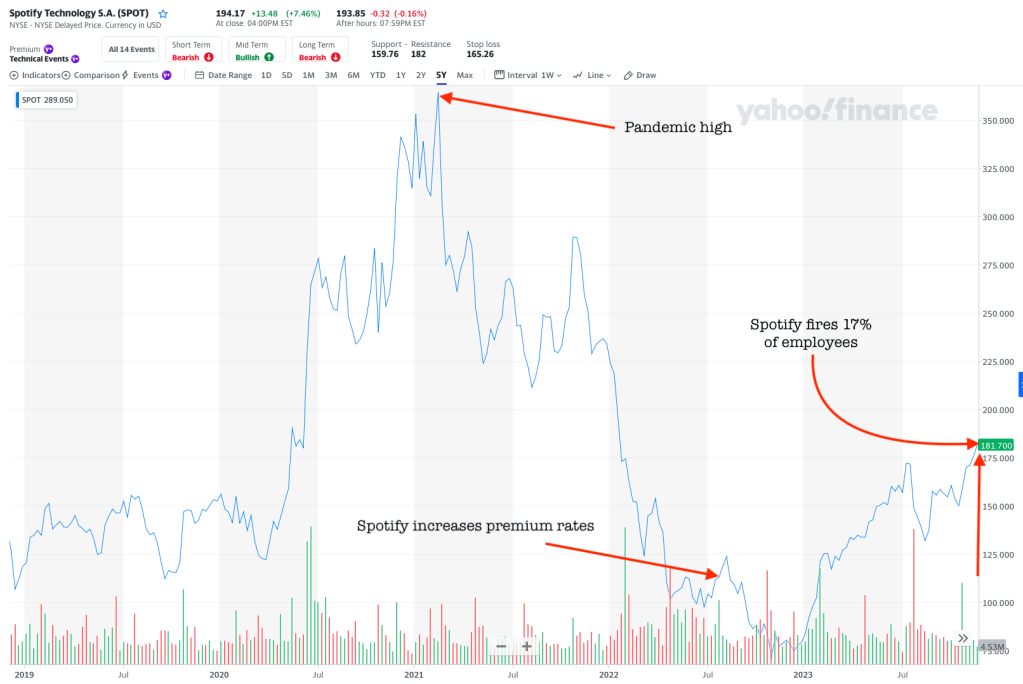
Harsh?  Not really, at least not from a share price point of view. Spotify’s all time highest share price was during the COVID pandemic.

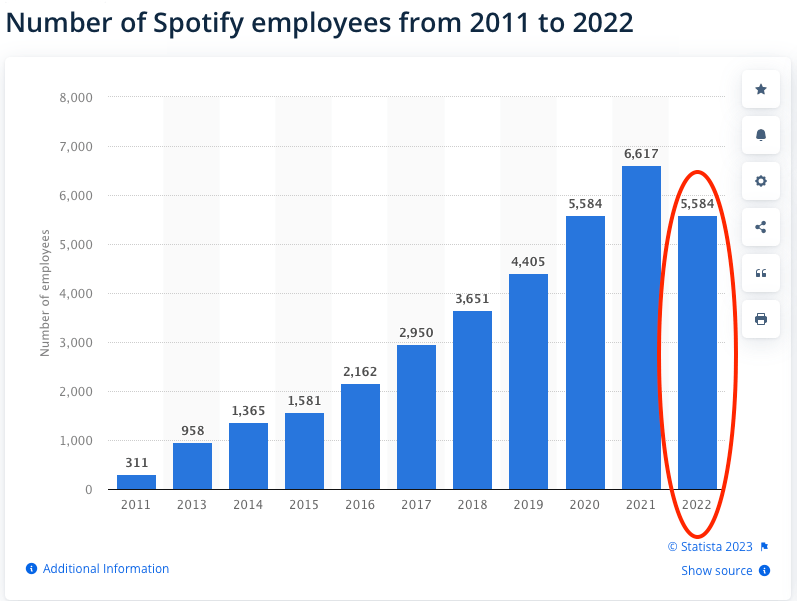
Spotify CEO Daniel Ek and the press tells us that Spotify is cutting 1,500 jobs which works out to about 17% of Spotify employees. Which works out to a pre-layoff workforce of 8,823.  So let’s start there—that workforce number seems very high and is completely out of line with some recent data from Statista which is usually reliable.

If Statista is correct, Spotify employed 5,584 as of last year. Yet somehow Spotify’s 2023 workforce grew to 9200 according to the Guardian, fully 2/3 over that 2022 level without a commensurate and offsetting growth in revenue. That’s a governance question in and of itself.

Why the layoffs? The Guardian reports that Spotify CEO Daniel Ek is concerned about costs. He says “Despite our efforts to reduce costs this past year, our cost structure for where we need to be is too big.” Maybe I missed it, but the only time I can recall Daniel Ek being vocally concerned about Spotify’s operating costs was when it came to paying royalties. Then it was full-blown poor mouthing while signing leases for very expensive office space in 4 World Trade Center as well as other pricy real estate, executive compensation and podcasters like Harry & Meghan.

Mr. Ek announced his new, new thing:

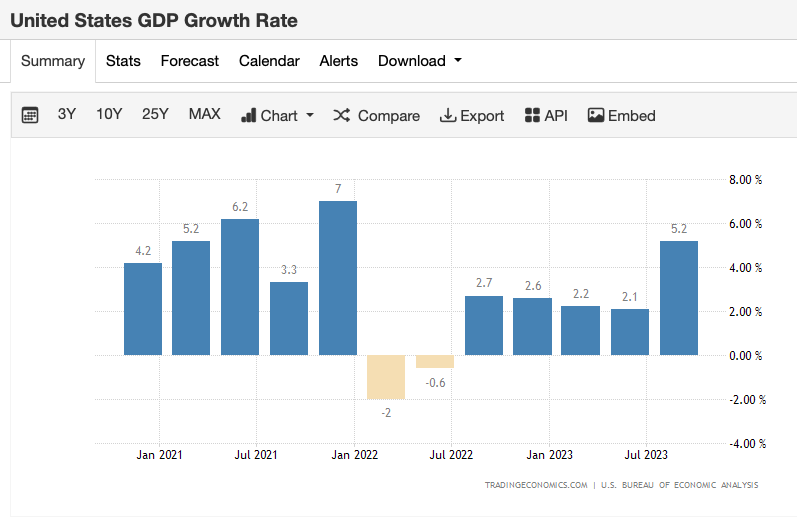
Over the last two years, we’ve put significant emphasis on building Spotify into a truly great and sustainable business – one designed to achieve our goal of being the world’s leading audio company and one that will consistently drive profitability and growth into the future. While we’ve made worthy strides, as I’ve shared many times, we still have work to do. Economic growth has slowed dramatically and capital has become more expensive. Spotify is not an exception to these realities.

Which “economic growth” is that?

But, he is definitely right about capital costs.

Still, Spotify’s job cuts are not necessarily that surprising considering the macro economy, most specifically rents and interest rates. As recently as 2018, Spotify was the second largest tenant at 4 WTC. Considering the sheer size of Spotify’s New York office space, it’s not surprising that Spotify is now subletting five floors of 4 WTC earlier this year. That’s right, the company had a spare five floors. Can that excess just be more people working at home given Mr. Ek’s decision to expand Spotify’s workforce? But why does Spotify need to be a major tenant in World Trade Center in the first place? Renting the big New York office space is the corporate equivalent of playing house. That’s an expensive game of pretend.

Remember that Spotify is one of the many companies that rose to dominance during the era of easy money in response to the financial crisis that was the hallmark of quantitative easing and the Federal Reserve’s Zero Interest Rate Policy beginning around 2008. Spotify’s bankers were able to fuel Daniel Ek’s desire to IPO and cash out in the public markets by enabling Spotify to run at a loss because money was cheap and the stock market had a higher tolerance for risky investments. When you get a negative interest rate for saving money, Spotify stock doesn’t seem like a totally insane investment by comparison. This may have contributed to two stock buy-back programs of $1 billion each, Spotify’s deal with Barcelona FC and other notorious excesses.

As a great man said, don’t confuse leverage for genius. It was only a matter of time until the harsh new world of quantitative tightening and sharply higher inflation came back to bite. For many years, Spotify told Wall Street a growth story which deflected attention away from the company’s loss making operations. A growth story pumps up the stock price until the chickens start coming home to roost. (Growth is also the reason to put off exercising pricing power over subscriptions.) Investors bought into the growth story in the absence of alternatives, not just for Spotify but for the market in general (compare Russell Growth and Value indexes from 2008-2023). Cutting costs and seeking profit is an example of what public company CEOs might do in anticipation of a rotational shift from growth to value investing that could hit their shares.

Never forget that due to Daniel Ek’s super-voting stock (itself an ESG fail), he is in control of Spotify. So there’s nowhere to hide when the iconography turns to blame. It’s not that easy or cheap to fire him, but if the board really wanted to give him the heave, they could do it.

I expect that Ek’s newly found parsimony will be even more front and center in renegotiations of Spotify’s royalty deals since he’s always blamed the labels for why Spotify can’t turn a profit. Not that WTC lease, surely. This would be a lot more tolerable from someone you thought was actually making an effort to cut all costs not just your revenue. Maybe that will happen, but even if Spotify became a lean mean machine, it will take years to recover from the 1999 levels of stupid that preceded it.

Hellooo Apple. One big thinker in music business issues calls it “Spotify drunk” which describes the tendency of record company marketers to focus entirely on Spotify and essentially ignore Apple Music as a distribution partner. If you’re in that group drinking the Spotify Kool Aid, you may want to give Apple another look. One thing that is almost certain is that that Apple will still be around in five years.

Just sayin.

Mechanicals on Physical and Downloads Get COLA Increase; Nothing for Streaming

Recall that the “Phonorecords IV” minimum mechanical royalties paid by record companies on physical and downloads increased from 9.1¢ to 12¢ with an annual cost of living adjustment each year of the PR IV rate period. The first increase was calculated by the Copyright Royalty Judges and was announced this week. That increase was from 12¢ to 12.40¢ and is automatic effective January 1, 2024.

Note that there is no COLA increase for streaming for reasons I personally do not understand. There really is no justification for not applying a COLA to a government mandated rate that blocks renegotiation to cover inflation expectations. After all, it works for Edmund Phelps.

The Federal Trade Commission on Copyright and AI

The FTC’s comment in the Copyright Office AI inquiry shows an interesting insight to the Commission’s thinking on some of the same copyright issues that bother us about AI, especially AI training. Despite Elon Musk’s refreshing candor of the obvious truth about AI training on copyrights, the usual suspects in the Copyleft (Pam Samuelson, Sy Damle, etc.) seem to have a hard time acknowledging the unfair competition aspects of AI and AI training (at p. 5):

Conduct that may violate the copyright laws––such as training an AI tool on protected expression without the creator’s consent or selling output generated from such an AI tool, including by mimicking the creator’s writing style, vocal or instrumental performance, or likeness—may also constitute an unfair method of competition or an unfair or deceptive practice, especially when the copyright violation deceives consumers, exploits a creator’s reputation or diminishes the value of her existing or future works, reveals private information, or otherwise causes substantial injury to consumers. In addition, conduct that may be consistent with the copyright laws nevertheless may violate Section 5.

We’ve seen unfair competition claims pleaded in the AI cases–maybe we should be thinking about trying to engage the FTC in prosecutions.

Chronology: The Week in Review, Eric Schmidt Spills on his “Bait” to UK PM, Musk on AI Training and other news

Elon Musk Calls Out AI Training

We’ve all heard the drivel coming from Silicon Valley that AI training is fair use. During his interview with Andrew Ross Sorkin at the DealBook conference, Elon Musk (who ought to know given his involvement with AI) said straight up that anyone who says AI doesn’t train on copyrights is lying.

The UK Government “Took the Bait”: Eric Schmidt Says the Quiet Part Out Loud on Biden AI Executive Order and Global Governance

There are a lot of moves being made in the US, UK and Europe right now that will affect copyright policy for at least a generation. Google’s past chair Eric Schmidt has been working behind the scenes for the last two years at least to establish US artificial intelligence policy. Those efforts produced the “Executive Order on the Safe, Secure, and Trustworthy Development and Use of Artificial Intelligence“, the longest executive order in history. That EO was signed into effect by President Biden on October 30, so it’s done. (It is very unlikely that that EO was drafted entirely at Executive Branch agencies.)

You may ask, how exactly did this sweeping Executive Order come to pass? Who was behind it, because someone always is. As you will see in his own words, Eric Schmidt, Google and unnamed senior engineers from the existing AI platforms are quickly making the rule and essentially drafted the Executive Order that President Biden signed into law on October 30. And which was presented as what Mr. Schmidt calls “bait” to the UK government–which convened a global AI safety conference convened by His Excellency Rishi Sunak (the UK’s tech bro Prime Minister) that just happened to start on November 1, the day after President Biden signed the EO, at Bletchley Park in the UK (see Alan Turing). (See “Excited schoolboy Sunak gushes as mentor Musk warns of humanoid robot catastrophe.”)

Remember, an executive order is an administrative directive from the President of the United States that addresses the operations of the federal government, particularly the vast Executive Branch. In that sense, Executive Orders are anti-majoritarian and are as close to at least a royal decree or Executive Branch legislation as we get in the United States (see Separation of Powers, Federalist 47 and Montesquieu). Executive orders are not legislation; they require no approval from Congress, and Congress cannot simply overturn them.

So you can see if the special interests wanted to slide something by the people that was difficult to undo or difficult to pass in the People’s House…and based on Eric Schmidt’s recent interview with Mike Allen at the Axios AI+ (available here), this appears to be exactly what happened with the sweeping and vastly concerning AI Executive Order. I strongly recommend that you watch Mike Allen’s “interview” with Mr. Schmidt which fortunately is the first conversation in the rather long video of the entire event. I put “interview” in scare quotes because whatever it is, it isn’t the kind of interview that prompts probing questions that might put Mr. Schmidt on the spot. That’s understandable because Axios is selling a conference and you simply won’t get senior corporate executives to attend if you put them on the spot. Not a criticism, but understand that you have to find value for your time. Mr. Schmidt’s ego provides plenty of value; it just doesn’t come from the journalists.

Crucially, Congress is not involved in issuing an executive order. Congress may refuse to fund the subject of the EO which could make it difficult to give it effect as a practical matter but Congress cannot overturn an EO. Only a sitting U.S. President may overturn an existing executive order. In Mr. Schmidt’s interview at AI+, he tells us how all this regulatory activity happened:

The tech people along with myself have been meeting for about a year. The narrative goes something like this: We are moving well past regulatory or government understanding of what is possible, we accept that. [Remember the antecedent of “we” means Schmidt and “the tech people,” or more broadly the special interests, not you, me or the American people.].

Strangely…this is the first time that the senior leaders who are engineers have basically said that they want regulation, but we want it in the following ways…which as you know never works in Washington [unless you can write an Executive Order and get the President to sign it because you are the biggest corporation in commercial history].

There is a complete agreement that there are systems and scenarios that are dangerous. [Agreement by or with whom? No one asks.]. And in all of the big [AI platforms with which] you are familiar like GPT…all of them have groups that look at the guard rails [presumably internal groups of managers] and they put constraints on [their AI platform in their silo]. They say “thou shalt not talk about death, thou shall not talk about killing”. [Anthropic, which received a $300 million investment from Google] actually trained the model with its own constitution [see “Claude’s Constitution“] which they did not just write themselves, they hired a bunch of people [actually Claude’s Constitution was crowd sourced] to design a “constitution” for an AI, so it’s an interesting idea.

The problem is none of us believe this is strong enough….Our opinion at the moment is that the best path is to build some IPCC-like environment globally that allows accurate information of what is going on to the policy makers. [This is a step toward global governance for AI (and probably the Internet) through the United Nations. IPCC is the Intergovernmental Panel on Climate Change.]

So far we are on a win, the taste of winning is there.  If you look at the UK event which I was part of, the UK government took the bait, took the ideas, decided to lead, they’re very good at this,  and they came out with very sensible guidelines.  Because the US and UK have worked really well together—there’s a group within the National Security Council here that is particularly good at this, and they got it right, and that produced this EO which is I think is the longest EO in history, that says all aspects of our government are to be organized around this.

While Mr. Schmidt may say, aw shucks dictating the rules to the government never works in Washington, but of course that’s simply not true if you’re Google. In which case it’s always true and that’s how Mr. Schmidt got his EO and will now export it to other countries.

It’s not Just Google: Microsoft Is Getting into the Act on AI and Copyright

Be sure to read Joe Bambridge (Politico’s UK editor) on Microsoft’s moves in the UK. You have to love the “don’t make life too difficult for us” line–as in respecting copyright.

Google and New Mountain Capital Buy BMI: Now what?

Careful observers of the BMI sale were not led astray by BMI’s Thanksgiving week press release that was dutifully written up as news by most of the usual suspects except for the fabulous Music Business Worldwide and…ahem…us. You may think we’re making too much out of the Google investment through it’s CapitalG side fund, but judging by how much BMI tried to hide the investment, I’d say that Google’s post-sale involvement probably varies inversely to the buried lede. Not to mention the culture clash over ageism so common at Google–if you’re a BMI employee who is over 30 and didn’t go to Carnegie Mellon, good luck.

And songwriters? Get ready to jump if you need to.

Spotify Brings the Streaming Monopoly to Uruguay

After Uruguay was the first Latin American country to pass streaming remuneration laws to protect artists, Spotify threw its toys out of the pram and threatened to go home. Can we get that in writing? A Spotify exit would probably be the best thing that ever happened to increase local competition in a Spanish language country. Also, this legislation has been characterized as “equitable remuneration” which it really isn’t. It’s its own thing, see the paper I wrote for WIPO with economist Claudio Feijoo. Complete Music Update’s Chris Cook suggested that a likely result of Spotify paying the royalty would be that they would simply do a cram down with the labels on the next round of license negotiations. If that’s not prohibited in the statute, it should be, and it’s really not “paying twice for the same music” anyway. The streaming remuneration is compensation for the streamers use of and profit from the artists’ brand (both featured and nonfeatured), e.g., as stated in the International Covenant on Economic, Social and Cultural Rights and many other human rights documents:

The Covenant recognizes everyone’s right — as a human right–to the protection and the benefits from the protection of the moral and material interests derived from any scientific, literary or artistic production of which he or she is the author. This human right itself derives from the inherent dignity and worth of all persons. 

@LinaKhanFTC Launches Investigation into AI-Enabled Voice Cloning

Streaming Remuneration:  An answer to global cultural dominance by European/US Streaming Services

Streamers Lack of Local Cultural Contribution

Look at Spotify’s “Global Top 50” playlist on any day and the world’s biggest music service will show all or nearly all English language songs. With few exceptions these songs are performed by Anglo-American artists released by major record companies.  

These “enterprise” playlists largely take the place of broadcast radio for many users where Spotify operates and Spotify competes with local radio for advertising revenue on the free version of Spotify.

Spotify’s now former general counsel told the recent inquiry into the music streaming economy conducted by the UK Parliament’s Digital, Culture, Media and Sport Committee, “Our job is sucking users away from radio”[2] and Spotify uses its market power to do just that.  

However, Spotify has not been subject to any local content protections that would be in place for local radio broadcasters.  Enterprise playlists that exclude local music contributes to the destruction of music economies, including performers.  Local performers struggle even more to compete with Anglo-American repertoire, even in their own countries.  

Due to this phenomenon, local artists are forced to compete for “shelf space” with everyone in their local language and then the Anglo-American artists and their record companies.  This also means that local artists compete for a diminishing share of the payable royalties.  The “big pool” revenue share method of royalty compensation is designed to overcompensate the English-language big names and reduce payments to artists performing in other languages in their own country.

Local Content Rules 

Many countries implement local content broadcast rules that require broadcasters to play a certain number of recordings performed by local artists or indigenous people, songs written by local songwriters in local languages, or recordings that are released by locally-owned record companies.

Because streaming playlists, especially Spotify enterprise playlists or algorithmically selected recordings, are an equivalent to broadcast radio, there is a question as to whether national governments should regulate streaming services operating in their countries to require local content rules.  Implementing such rules could benefit local performers and songwriters in an otherwise unsustainable enviornment.

The Fallacy of Infinite Shelf Space

Because Spotify adds recordings at a rate of 60,000 tracks daily (now reports of 100,000 tracks daily) and never deletes recordings, there is a marked competitive difference between a record store and Spotify.  In the record store model, artists had to compete with recordings that were in current release; in the Spotify model, artists have to compete will all recordings ever released.  

Adding the dominant influence of Anglo-American recordings on Spotify, the “infinite shelf space” simply compounds the competitive problems for non-English recordings.

Streaming Remuneration Helps Solve the Sustainability Crisis

The streaming remuneration model requires streaming services—not record companies—to pay additional compensation to nonfeatured and featured performers.  Streaming remuneration would be created under national law and is compensatory in nature, not monies in exchange for a license.  Existing licenses (statutory or contractual) would not be affected and remuneration payments could not be offset by streamers against label payments or by labels against artist payments.

Each country would determine the amount to be paid to performers by streaming services and the payment periods.  Payments would be made to local CMOs or the equivalent depending on the infrastructure in the particular country.

European Corporate Dominance 

It must also be said that the two founders of Spotify hold a 10:1 voting control over the company through special stock issued only to them.  This means that these two Caucasian Europeans control 100% of the dominant music streaming company in the world.  For comparison, Google and Facebook have a similar model, while Apple has a 1 share 1 vote structure as does Amazon (although Jeff Bezos owns a controlling interest in Amazon).  

The net effect is that the entire global streaming music industry is controlled by six Caucasian males of European descent.  This demography also argues for local content rules to protect local performers from these influences that have produced an English-only Global Top 50 playlist.

Local governments could consider whether companies with the 10:1 voting stock (so-called “dual class” or “supervoting” shares) should be allowed to operate locally.

Countries Can Respond to Streaming’s Homogenized Algorithmic Playlist Culture

Many national cultural protection laws have a history of sustaining local culture and musicians in the face of the Anglo-American Top 40 juggernaut. There is no reason to think that these agencies are not up for the task of protecting their citizens in the face of algorithms and neuromarketing.

Does the Metaverse Have Rights? Permissionless Innovation Bias and Artificial Intelligence

As Susan Crawford told us in 2010:

I was brought up and trained in the Internet Age by people who really believed that nation states were on the verge of crumbling…and we could geek around it.  We could avoid it.  These people [and their nation states] were irrelevant.

Ms. Crawford had a key tech role in the Obama Administration and is now a law professor. She crystalized the wistful disappointment of technocrats when the Internet is confronted with generational expectations of non-technocrats (i.e., you and me). The disappointment that ownership means something, privacy means something and that permission defines a self-identity boundary that is not something to “geek around” in a quest for “permissionless innovation.”

Seeking permission recognizes humanity. Failing to do so takes these rights away from the humans and gives them to the people who own the machines–at least until the arrival of general artificial intelligence which may find us working for the machines.

These core concepts of civil society are not “irrelevant”. They define humanity. What assurance do we have that empowered AI machines won’t capture these rights?

All these concepts are at issue in the “metaverse” plan announced by Mark Zuckerberg, who has a supermajority of Facebook voting shares and has decided to devote an initial investment of $10 billion (that we know of) to expanding the metaverse. Given the addictive properties of social media and the scoring potential of social credit it is increasingly important that we acknowledge that the AI behind the metaverse (and soon almost everything else) is itself a hyper efficient implementation of the biases of those who program that AI.

AI bias and the ethics of AI are all the rage. Harvard Business Review tells us that “AI can help identify and reduce the impact of human biases, but it can also make the problem worse by baking in and deploying biases at scale in sensitive application areas.” Cathy O’Neill’s 2016 book Weapons of Math Destruction is a deep dive into how databases discriminate and exhibit the biases of those who create them.

We can all agree that insurance redlining, gender stereotyping and comparable social biases need to be dealt with. But concerns about bias don’t end there. An even deeper dive needs to be done into the more abstract biases required to geek around the nation state and fundamental human rights corrupted by the “permissionless innovation” bias that is built into major platforms like Facebook and from which its employees and kingpin enjoy unparalleled riches.

That bias will be incorporated into the Zuckerberg version of the metaverse and the AI that will power it.

Here’s an example. We know that Facebook’s architecture never contemplated a music or movie licensing process. Zuckerberg built it that way on purpose–the architecture reflected his bias against respecting copyright, user data and really any private property rights not his own. Not only does Zuckerberg take copyright and data for his own purposes, he has convinced billions of people to create free content for him and then to pay him to advertise that content to Facebook users and elsewhere. He takes great care to be sure that there is extraordinarily complex programming to maximize his profit from selling other people’s property, but he refuses to do the same when it comes to paying the people who create the content, and by extension the data he then repackages and sells.

He does this for a reason–he was allowed to get away with it. The music and movie industries failed to stop him and let him get away with it year after year until he finally agreed to make a token payment to a handful of large companies. That cash arrives with no really accurate reporting because reporting would require reversing the bias against licensing and reporting that was built into the Facebook systems to begin with.

A bias that is almost certainly going to be extended into the Facebook metaverse.

The metaverse is likely going to be a place where everything is for sale and product placements abound. The level of data collection on individuals will likely increase exponentially. Consider this Techcrunch description of “Project Cambria” the Metaverse replacement for the standard VR headset:

Cambria will include capabilities that currently aren’t possible on other VR headsets. New sensors in the device will allow your virtual avatar to maintain eye contact and reflect your facial expressions. The company says that’s something that will allow people you’re interacting with virtually to get a better sense of how you’re feeling. Another focus of the headset will be mixed-reality experiences. With the help of new sensors and reconstruction algorithms, Facebook claims Cambria will have the capability to represent objects in the physical world with a sense of depth and perspective.

If past is prologue, the Metaverse will exhibit an even greater disregard for human rights and the laws that protect us than Facebook. That anti-human bias will be baked into the architecture and the AI that supports it. The machines don’t look kindly on those pesky humans and all their petty little rights that stand in the way of the AI getting what it wants.

If you don’t think that’s true, try reading the terms of service for these platforms. Or considering why the technocrats are so interested in safe harbors where their machines can run free of liability for collateral damage. The terms of service should make clear that AI has greater rights than you. We are way beyond pronouns now.

If the only concern of AI ethics is protection against stereotypes or insurance redlining (a version of the social credit score), we will be missing huge fundamental parts of the bias problem. Should we be content if AI is allowing its owner (for so long as it has an owner) to otherwise rob you blind by taking your property or selling your data while using the right pronoun as it geeks around the nation state?