@ArtistRights Symposium 5 Panel: Beware the AI Opt-In: Hidden Right of Publicity Waivers

Registration is open for Artist Rights Symposium 5 at Eventbrite!

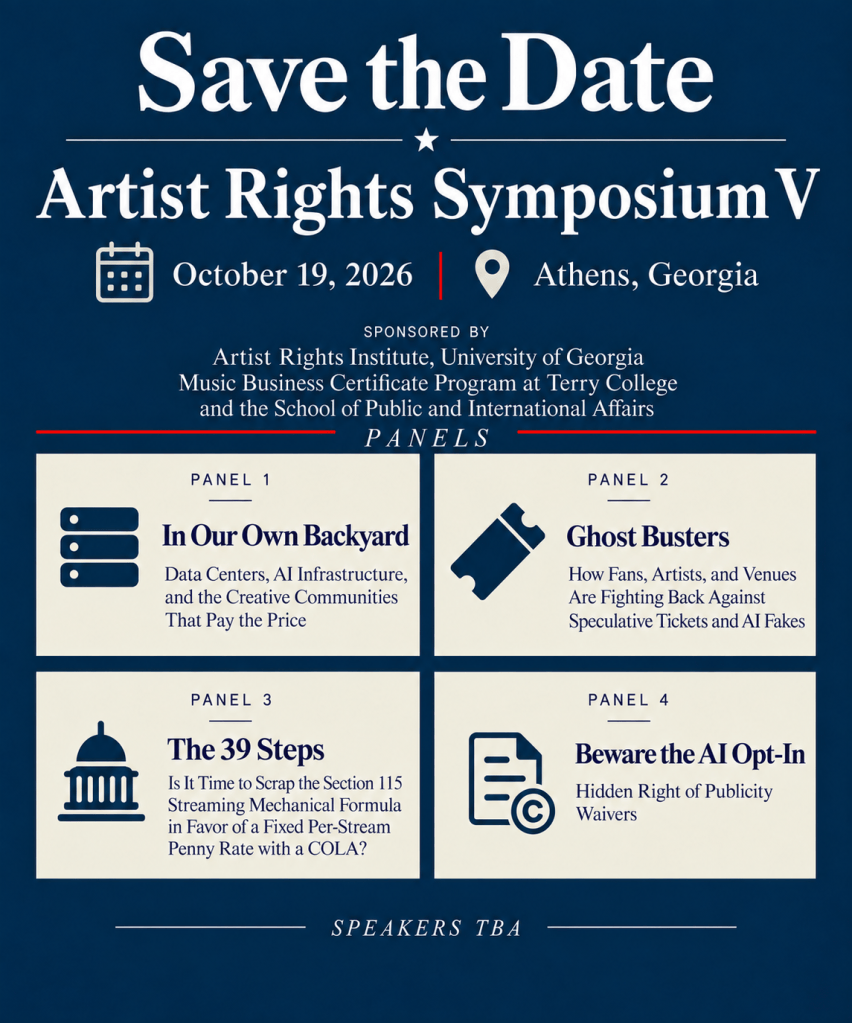
The Artist Rights Symposium 5 is coming on October 19 at Tweed Recording in Athens, GA hosted by the University of Georgia Terry College of Business Music Certificate Program and the School of Policy and International Affairs, and the Artist Rights Institute. More about the Symposium here and register on Eventbrite here.

As AI companies like Suno and Udio settle copyright lawsuits with record companies and music publishers, they introduce new licensing arrangements. Artists and songwriters may be offered the “opportunity” to “opt in” to the settlements and “new revenue streams”. But not all revenue streams are equal, remember streaming? Remember “Let’s help that plucky startup Spotify”? We have seen this movie before and we know how it ends.

Why a Suno Copyright Settlement Is Different from Spotify, LimeWire—or Even Bartz

The music industry has settled copyright infringement disputes before. Spotify’s mechanical royalty settlements in David Lowery’s class action resolved claims over unpaid or improperly licensed compositions. LimeWire’s settlement addressed unauthorized reproduction and distribution of copyrighted recordings. In both cases, the essential bargain concerned compensation for past copyright infringement, not permission to reproduce the identity of the human beings who created the music. Identity theft never came up.

Suno presents a fundamentally different problem. Its generative AI technology can potentially reproduce not merely copyrighted expression but recognizable characteristics of an artist’s voice, performance and identity—what Chris has called  personhood signals. A settlement that licenses recordings for future training may therefore implicate rights that neither the record company nor publisher controls. That’s why they need the “opt in” agreement to waive these rights because the AI platform doesn’t want to pay for the artist’s identify if the artist would even consider that deal. Many artists and songwriters, if not most, will not.

The Bartz v. Anthropic settlement illustrates the limitation of treating AI disputes exclusively as copyright cases. Bartzcompensates copyright owners for specified historical conduct involving pirated books. It settles the claims brought in litigation, so does not expressly resolve the separate problem of extracting and commercializing human identity. That is what a conventional copyright settlement misses.

Settling infringement of the work does not settle exploitation of the person. And no copyright settlement should quietly become consent to commercialize someone’s voice, identity or personhood.

So artists, their managers and lawyers are asking, what exactly are we being asked to agree to this time? Before you even get to the “new revenue stream,” an opt-in for an apparent copyright settlement may also include permission for future AI training, broad releases, perpetual covenants not to sue, or waivers of an artist’s rights in their name, voice and identity. These are fundamentally different transactions, with potentially permanent consequences. Before signing, creators need to understand not only what they will be paid, but what rights they are surrendering, how those rights may be exploited, and whether they can ever get them back.

Meet the Panelists

Chris Castle will lead the closing panel at Artist Rights Symposium 5, that warns “Beware the AI Opt-In: Hidden Right of Publicity Waivers.” The panel brings together four speakers with complementary perspectives on artist advocacy, litigation and music-industry licensing.

Jen Jacobsen, Artist Rights Alliance.  Friend of the show Jen Jacobsen is a long time artist rights advocate who brings the artist-advocacy perspective, focusing on meaningful consent, transparency and protecting musicians from agreements that may surrender irreversible grants of rights with hidden waivers.

George Zelcs of Korein Tillery.  George Zelcs is the lead counsel on the Jason Isbell/David Lowery personhood class action against Suno to help us understand the implications of “opt in” agreements with waivers on rights of publicity and the practical question of what remedies artists should retain.

Gwendolyn Seale — Gwen Seale PLLC.  Gwen brings experience representing songwriters and music copyright owners, with particular relevance to licensing authority, co-writer and co-owner interests, compensation and contractual protections.

Tim Kappel — Wells Kappel.  Tim is a copyright expert and artist rights advocate who successfully argued in federal trial court and the Fifth Circuit Court of Appeals that his client Cyril Vetter should retain foreign rights as part of a statutory copyright termination— a case now before the U.S. Supreme Court. 

The panel is scheduled for 3:00–4:00 p.m. on October 19. 

Three Deals Disguised as One?

An AI opt-in may combine three distinct transactions as part of the copyright settlement and go-forward license: compensation for past unauthorized uses (probably not shared by the label, but check), licensing for future model training, and revenue sharing from products built on those models (but don’t hold your breath). But accepting settlement compensation for yesterday’s conduct should not automatically mean consenting to tomorrow’s exploitation. 

There may also be a fourth transaction: authorization to use an artist’s name, voice, likeness or other personhood rights which could not have been brought by a record company or music publisher because they do not control those rights.

A copyright license is not permission to commercialize personhood.

The panel will examine how these rights can become entangled, particularly when record companies, publishers or other representatives may not control all the rights an AI company seeks.

What Happens After You Sign?

The panel will address the questions that can be overlooked when attention focuses on the size of a settlement or the promise of future royalties.

What exactly is inside the AI company’s “walled garden”? How are revenues attributed to particular recordings or compositions? Can users generate synthetic voices or prompt an artist’s name? Can artists examine the product before consenting? 

And what happens when an artist wants out later when the term expires (if there is a term)? Deleting a source recording does not necessarily remove its influence from an already-trained model. Termination, machine unlearning, continuing model exploitation and rights that survive expiration may determine whether an opt-in becomes a one-way door in an AI Hotel California.

Register for Artist Rights Symposium V on Eventbrite

Related reading: The AI “License” That Isn’t: A Musician’s Checklist for Spotting a Covenant Not to Sue Censorship Trap in Disguise.

UGA School of Public and International Affairs Joins Artist Rights Symposium 5

We’re pleased to announce that the University of Georgia’s School of Public and International Affairs has joined the Artist Rights Institute and UGA’s Music Business Certificate Program at Terry College as a sponsor of the fifth annual Artist Rights Symposium, October 19, 2026, in Athens, Georgia.

The addition of SPIA is especially timely. This year’s Symposium reaches beyond traditional music-industry issues to examine the broader public-policy consequences of artificial intelligence—from the massive data centers, energy infrastructure, and local communities supporting AI development to the legal and policy questions surrounding artist consent, identity, compensation, and the use of creative work.

Bringing together music business, law, public policy, artists, advocates, and policymakers is exactly what this moment requires.

Artist Rights Symposium V
October 19, 2026 — Athens, Georgia
Speakers and additional program details coming soon.

Y’all Street Rising: Why the Future of Music Finance Won’t Be Made in Manhattan

There’s a new gravity well in American finance, and it’s not New York. It’s not even Silicon Valley. It’s Dallas. It’s Austin. It’s Y’all Street.

And anyone paying attention could have seen it coming. The Texas Stock Exchange (TXSE) is preparing for launch in 2026.  TXSW is not some bulletin board; it’s backed by billions from institutions that have grown weary of the compliance culture and cost of New York. Goldman Sachs’s Dallas campus is now operational. BlackRock and Charles Schwab have shifted major divisions to the Lone Star State. Tesla and Samsung are expanding giga-scale manufacturing and chip fabrication plants.

A strong center of gravity for capital formation is moving south, and with it, a new cultural economy is taking shape. And AI may not save it:  Scion Asset Management, “Big Short” investor Michael Burry’s hedge fund, disclosed to the SEC that it had a short bet worth $1.1 billion against Nvidia and Palantir.   He’s also investing in waterthat AI burns.  So not everyone is jumping off a cliff.

A New Realignment

Texas startups have raised roughly $9.8 billion in venture capital through Q3 2025, pushing the state to a consistent #4 ranking nationally. Austin remains the creative and software hub, while Dallas–Fort Worth and Houston lead in AI infrastructure, energy tech, and finance.

The TXSE will formalize what investors already know: capital markets no longer need Manhattan to function.

And that raises an uncomfortable question for the music industry:

If capital, infrastructure, and innovation no longer orbit Wall Street, why should music?

Apple Learned It the Hard Way

Despite New York’s rich musical legacy—Tin Pan Alley, Brill Building, CBGB, and the era of the major-label tower when Sony occupied that horrible AT&T building and flew sushi in from Japan for the executive dining room—the city has become an increasingly difficult place to sustain large-scale creative infrastructure. Real estate costs, over-regulation, and financial concentration have hollowed out the middle layer of production.  As I’ve taught for years, the key element to building the proverbial “creative class” is cheap rent, preferably with a detached garage.

Even Apple Inc. learned long ago that creativity can’t thrive where every square foot carries a compliance surcharge. That’s why Apple’s global supply chain, data centers, and now content operations span Texas, Tennessee, and North Carolina instead of Midtown Manhattan.  And then there’s the dirty power, sump pumps and subways—Electric Lady would probably never get built today.

The lesson for the music business is clear: creative capital follows economic oxygen. And right now, that oxygen is in Texas.

The Texas Music Office: A Model for How to Get It Done

If you want to understand how Texas built a durable, bipartisan music infrastructure, start with the Texas Music Office (TMO). Founded in 1990 under Governor Bill Clements, the TMO was one of the first state agencies in America to recognize the music industry not just as culture, but as economic development.

Over the decades—through governors of both parties—the TMO has become a master class in how to institutionalize support for creative enterprise without strangling it in bureaucracy. From George W. Bush’s early focus on export promotion, to Rick Perry’s integration of music into economic development, to Greg Abbott’s expansion of the Music Friendly Communities network, each administration built upon rather than dismantled what came before.

Today, the TMO supports more than 70 certified Music Friendly Communities, funds music-education grants, tracks economic data, and connects local musicians with investors and international partners. It’s a template for how a state can cultivate creative industries while maintaining fiscal discipline and accountability.

It’s also proof that cultural policy doesn’t have to be partisan—it just has to be practical.

When people ask why Texas has succeeded where others stalled, the answer is simple: the TMO stayed focused on results, not rhetoric. That’s a lesson a lot of states—and more than a few record labels—could stand to relearn.

Artist Rights Institute: Doing Our Part for Texas and Beyond

The Artist Rights Institute (ARI) has done its part to make sure that Texas and other local music and creators aren’t an afterthought in rooms that are usually dominated by platform interests and coastal trade groups.

When questions of AI training, copyright allocation, black-box royalties, and streaming transparency landed in front of the U.S. Copyright Office, Congress, and U.K. policymakers, ARI showed up with the Texas view: creators first, no speculative ticketing, no compulsory “data donation,” and no silent expropriation of recordings and songs for AI. ARI has filed comments, contributed research, and supported amicus work to make sure Texas artists, songwriters, and indie publishers are in the record — not just the usual New York, Nashville, and Los Angeles voices.

Just as important, ARI has pushed financial education for artists. Because Y’all Street doesn’t help creators if they don’t know what a discount rate is, how catalog valuations work, how to read a mechanical statement, or why AI licenses need to be expressly excluded from legacy record and publishing deals. ARI programs in Texas and Georgia have focused on:
– explaining how federal policy actually hits musicians,
– showing how to negotiate or at least spot AI/derivative-use clauses,
– and connecting artists to local music industry infrastructure.

In other words, ARI joined other Texas and Georgia organizations to be a translator between Texas’s very real music economy and the fast-moving policy debates in Washington and the U.K. If Texas is going to be the place where music is financed, ARI wants to make sure local artists are also the ones who capture the value.

Music’s Texas Moment

Texas is no newcomer to the business of music. Its industry already generates over $13.4 billion in annual economic activity, supporting more than 91,000 jobs across its certified cities. Austin retains the crown of “Live Music Capital of the World,” but Denton, Fort Worth, and San Antonio have joined the state-certified network of “Music Friendly Communities”.

Meanwhile, universities from UT-Austin to Texas A&M study rights management, AI provenance, and royalties in the age of generative audio.

The result: a state that treats music not as nostalgia, but as an evolving economic engine.  Plus we’ve got Antone’s.

Wall Street’s ‘Great Sucking Sound,’ Replayed

Ross Perot once warned of “that giant sucking sound” as jobs moved south. Thirty years later, the sound you hear isn’t manufacturing—it’s money, data, and influence flowing to Y’all Street.

If the major labels and publishers don’t track that migration, they risk becoming cultural tenants in cities they no longer own. The next catalog securitization, the next AI-royalty clearinghouse, the next Bell Labs-for-Music could just as easily be financed out of Dallas as from Midtown.

Because while New York made the hits of the last century, Texas may well finance the next one.  We’ve always had the musicians, producers, authors, actors and film makers, but soon we’ll also have the money.

Y’all Ready?

The world no longer needs a Midtown address to mint creative wealth. As the TXSE prepares its debut and Texas cements its position as the nation’s innovation corridor, the music industry faces a choice:

Follow the capital—or become another cautionary tale of what happens when you mistake heritage for destiny.

Because as Apple learned long ago, even the richest history can’t compete with the freedom to build something new.  

Speaker Updates for September 18 Artist Rights Roundtable in DC

We’re pleased to welcome Josh Hurvitz, Partner, NVG and Head of Advocacy for A2IM and Kevin Amer, Chief Legal Officer, The Authors Guild to the Roundtable on September 18 at American University in DC!

Artist Rights Roundtable on AI and Copyright: 
Coffee with Humans and the Machines     

Join the Artist Rights Institute (ARI) and Kogod’s Entertainment Business Program for a timely morning roundtable on AI and copyright from the artist’s perspective. We’ll explore how emerging artificial intelligence technologies challenge authorship, licensing, and the creative economy — and what courts, lawmakers, and creators are doing in response.

🗓️ Date: September 18, 2025
🕗 Time: 8:00 a.m. – 12:00 noon
📍 Location: Butler Board Room, Bender Arena, American University, 4400 Massachusetts Ave NW, Washington D.C. 20016

🎟️ Admission:
Free and open to the public. Registration required at Eventbrite. Seating is limited.

🅿️ Parking map is available here. Pay-As-You-Go parking is available in hourly or daily increments ($2/hour, or $16/day) using the pay stations in the elevator lobbies of Katzen Arts Center, East Campus Surface Lot, the Spring Valley Building, Washington College of Law, and the School of International Service

Hosted by the Artist Rights Institute & American University’s Kogod School of Business, Entertainment Business Program

🔹 Overview:

☕ Coffee served starting at 8:00 a.m.
🧠 Program begins at 8:50 a.m.
🕛 Concludes by 12:00 noon — you’ll be free to have lunch with your clone.

🗂️ Program:

8:00–8:50 a.m. – Registration and Coffee

8:50–9:00 a.m. – Introductory Remarks by KOGOD Dean David Marchick and ARI Director Chris Castle

9:00–10:00 a.m. – Topic 1: AI Provenance Is the Cornerstone of Legitimate AI Licensing:

Speakers:

  • Dr. Moiya McTier Human Artistry Campaign
  • Ryan Lehnning, Assistant General Counsel, International at SoundExchange
  • The Chatbot

Moderator: Chris Castle, Artist Rights Institute

10:10–10:30 a.m. – Briefing: Current AI Litigation

  • Speaker: Kevin Madigan, Senior Vice President, Policy and Government Affairs, Copyright Alliance

10:30–11:30 a.m. – Topic 2: Ask the AI: Can Integrity and Innovation Survive Without Artist Consent?

Speakers:

  • Erin McAnally, Executive Director, Songwriters of North America
  • Jen Jacobsen, Executive Director, Artist Rights Alliance
  • Josh Hurvitz, Partner, NVG and Head of Advocacy for A2IM
  • Kevin Amer, Chief Legal Officer, The Authors Guild

Moderator: Linda Bloss-Baum, Director, Business and Entertainment Program, KOGOD School of Business

11:40–12:00 p.m. – Briefing: US and International AI Legislation

  • Speaker: George York, SVP, International Policy Recording Industry Association of America

🔗 Stay Updated:

Watch this space and visit Eventbrite for updates and speaker announcements.

Creators Rally Behind Cyril Vetter’s Termination Rights Case in the Fifth Circuit

Songwriter and publisher Cyril Vetter is at the center of a high-stakes copyright case over his song “Double Shot of My Baby’s Love” with massive implications for authors’ termination rights under U.S. law. His challenge to Resnik Music Group has reached the Fifth Circuit Court of Appeals, and creators across the country are showing up in force—with a wave of amicus briefs filed in support including Artist Rights Institute.  Let’s consider the case on appeal.

At the heart of Vetter’s case is a crucial question: When a U.S. author signs a U.S. contract governed by U.S. law and then later the author (or the author’s heirs) invokes their 35-year termination right under Sections 203 and 304 of the U.S. Copyright Act, does that termination recover only U.S. rights (the conventional wisdom)—or the entire copyright, including worldwide rights?  Vetter argued for the worldwide rights at trial.  And the trial judge agreed over strenuous objections by the music publisher opposing Cyril.

Judge Shelly Dick of the U.S. District Court for the Middle District of Louisiana agreed. Her ruling made clear that a grant of worldwide rights under a U.S. contract is subject to U.S. termination. To hold otherwise would defeat the statute’s purpose which seems obvious.

I’ve known Vetter’s counsel Tim Kappel since he was a law student and have followed this case closely. Tim built a strong record in the District Court and secured a win against tough odds. MTP readers may recall our interviews with him about the case, which attracted considerable attention. Tim’s work with Cyril has energized a creator community long skeptical of the industry’s ‘U.S. rights only’ narrative—a narrative more tradition than law, an artifact of smoke filled rooms and backroom lawyers.

The Artist Rights Institute (David Lowery, Nikki Rowling, and Chris Castle), along with allies including Abby North (daughter-in-law of the late film composer Alex North), Blake Morgan (#IRespectMusic), and Angela Rose White (daughter of the late television composer and music director David Rose), filed a brief supporting Vetter. The message is simple: Congress did not grant a second bite at half the apple. Termination rights are meant to restore the full copyright—not just fragments.

As we explained in our brief, Vetter’s original grant of rights was typical: worldwide and perpetual, sometimes described as ‘throughout the universe.’ The idea that termination lets an author reclaim only U.S. rights—leaving the rest with the publisher—is both absurd and dangerous.

This case is a wake-up call. Artists shouldn’t belong to the  ‘torturable class’—doomed to accept one-sided deals as normal. Termination was Congress’s way of correcting those imbalances. Terminations are designed by Congress to give a second bite at the whole apple, not the half.

Stay tuned—we’ll spotlight more briefs soon. Until then, here’s ours for your review.